The short answer
Rhodesian Ridgebacks are smart but independent. They were bred to hunt on their own, so they do not have the wait-for-instructions wiring of a herding or retrieving breed, and they carry real prey drive. That makes recall the single hardest thing to train, and it is why many experienced owners keep a Ridgeback on a long line in open spaces like Nose Hill and only trust off-leash in fully fenced areas. Train early, keep it positive, use high-value rewards, proof against distraction slowly, and stay honest about what a chase instinct can override. Always follow the City of Calgary off-leash rules.
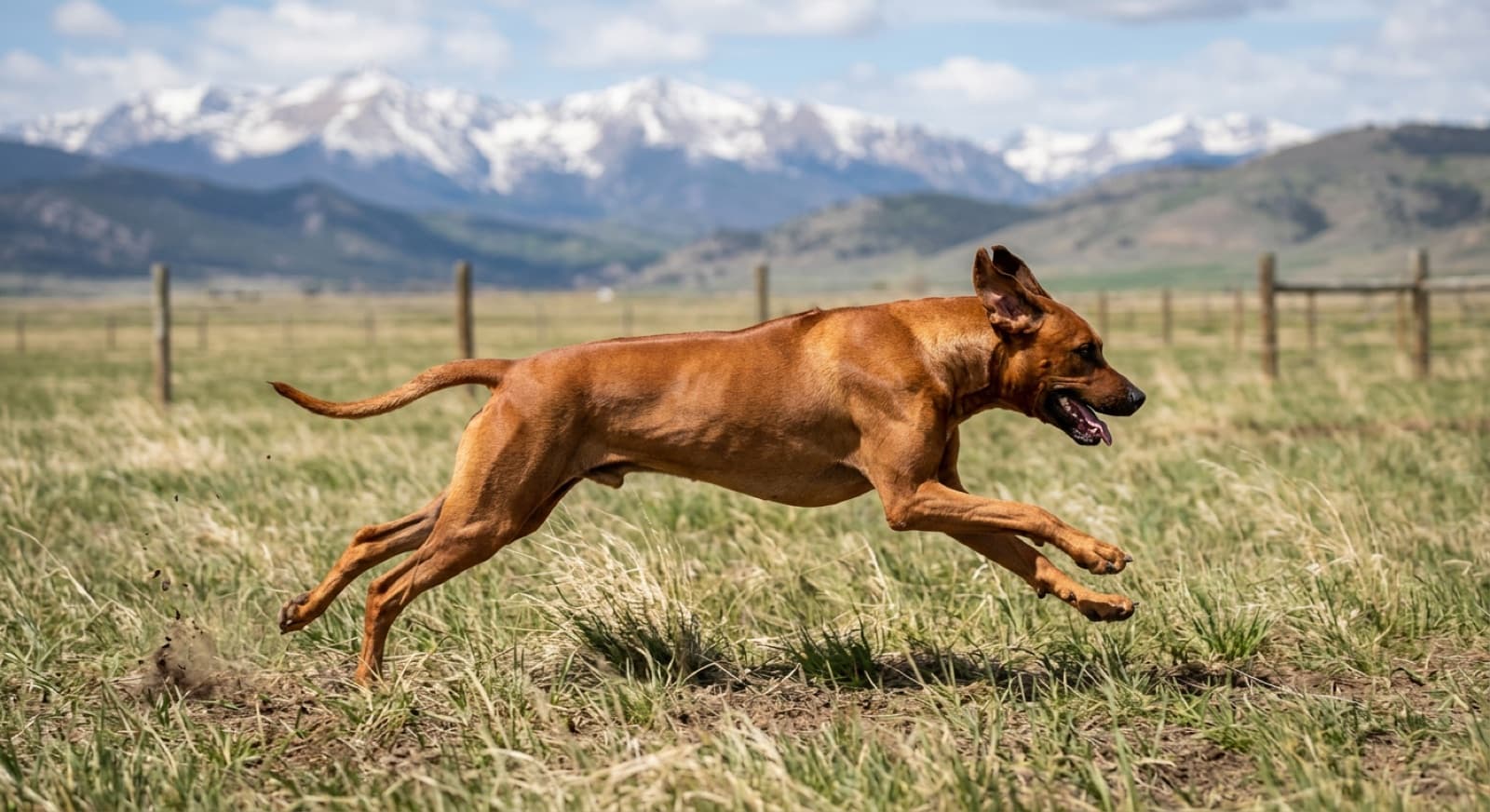
Every breed has one thing that defines ownership. For the Rhodesian Ridgeback it is not grooming or drool or barking. It is the tension between an athletic dog that loves to run and a hunting brain that was never built to check in with a person first. Understand that, and you understand almost everything about training this breed and about the honest limits of off-leash freedom in Calgary.
Bred to hunt without you: why recall is hard
The Ridgeback's job in southern Africa was to track and bay big game, working ahead of the hunter and making its own decisions in the field. According to the American Kennel Club, this is a strong-willed, independent breed whose owners need experience. That independence is not a flaw to be trained out; it is the whole design. A dog bred to pursue on its own initiative is, by definition, a dog that does not naturally wait for permission.
Add real prey drive and you get the core recall problem. When a hare breaks cover on Nose Hill or a squirrel bolts in Fish Creek, a Ridgeback in full chase is not being defiant. It genuinely cannot hear you, because instinct has taken the wheel. No amount of shouting competes with a hunting brain that is doing exactly what centuries of breeding shaped it to do. The training question is never how to remove the drive. It is how to build a recall strong enough, and enough judgement in yourself, to work with it.
Training the strong-willed adolescent
Ridgebacks are sensitive and dignified, which means heavy-handed methods tend to shut them down or sour the relationship. Positive reinforcement, being clear and consistent, and making the right choice the rewarding one, works far better. Start early: a puppy who learns that coming back is the best thing that ever happens builds a foundation that holds when the strong-willed adolescent phase arrives, somewhere between six and eighteen months. That is the stage where a previously biddable pup suddenly “forgets” everything and tests every boundary.
Keep sessions short, motivating, and frequent rather than long and repetitive; a bored Ridgeback checks out fast. Many Calgary owners of independent breeds do best with help from a force-free trainer experienced with hounds and sighthound-type dogs, whether through a group class or private sessions. If you have adopted an adult, the same principles apply: build trust first, then a fresh recall, and expect a solid adult Ridgeback to learn well once the relationship is there.
The honest off-leash reality in Calgary
Here is the part other breed pages soften. A Ridgeback with prey drive in an unfenced space is a real risk, both to the dog and to wildlife, and Calgary's open parks are full of the exact triggers that light up a hunting brain: hares, squirrels, ground birds, and coyotes along the river paths. A fully fenced off-leash area is a different situation, and a well-trained Ridgeback can do beautifully there. In open spaces, many experienced owners keep a long line on until recall is genuinely proven, and some never fully trust it. Neither choice is failure; both are honest.
Wherever you go, follow the rules. The City of Calgary off-leash areas page lists where dogs may be off-leash, and the Responsible Pet Ownership Bylaw requires that a dog off-leash be under control, which for this breed is a meaningful bar. If your Ridgeback's recall is not reliable around distraction, a designated fenced area or a long line is not a limitation, it is responsible ownership. For where to start, see our guide to the best off-leash dog parks in Calgary.
Building a recall that actually holds
The general shape of reliable-recall training applies to Ridgebacks with extra patience built in:
- Make the reward worth it. Dry kibble does not compete with a chase. Use genuinely high-value food or a favourite toy, and pay generously every time your dog comes back, especially early on.
- Start where it is easy. Practise in the house and yard first, then quiet areas, and only add real distraction once the behaviour is solid. Skipping this is why so many recalls fall apart outdoors.
- Use a long line. A fifteen-metre line lets your dog feel free while making sure it can never practise ignoring you. Every successful blow-off makes the next one more likely; the line prevents that rehearsal.
- Never punish a return. If coming back means the fun ends or you are angry, your dog learns not to come. Coming to you should always be safe and rewarding, even when it took a while.
- Read the environment. Learn to see the hare before your dog does. Managing the setting is half of recall with a prey-driven breed.
This is general training guidance, not a guarantee. If you are stuck, a qualified Calgary trainer can watch you and your dog work and fix the specific gap faster than any article can. For the fuller picture of living with this breed, our Rhodesian Ridgeback adoption guide covers temperament, energy, and who the breed suits.
Ready for an athletic, independent companion?
Adopting an adult Ridgeback through a rescue means you can match energy and temperament to your own life, and start recall training with a known personality. See who is available across Calgary rescues.
See Calgary Rhodesian Ridgebacks →Frequently Asked Questions
Are Rhodesian Ridgebacks hard to train?↓
Can you let a Rhodesian Ridgeback off-leash in Calgary?↓
Why does my Rhodesian Ridgeback ignore me when I call?↓
How much exercise does a Rhodesian Ridgeback need?↓
When should I start training a Ridgeback puppy or rescue?↓
Continue reading
Rescues, costs, energy, and who the breed suits.
Dermoid sinus, bloat, hips, and preventive care.
Live listings across Calgary rescues.
Fenced areas and open spaces, and which suits a prey-driven dog.
New dog? Start with these care guides
Everything a new adopter needs to set up a safe, happy home.