The short answer
Samoyeds are vocal because the Samoyedic peoples of Siberia bred them to alert herders to predators and to communicate across distance. They struggle alone because they were bred to live inside the family chum with people. A Calgary household that leaves a Samoyed alone for a full workday every day is fighting the breed. The fix is structure: a force-free desensitisation protocol for separation anxiety, capture-the-quiet training for demand barking, a daycare or midday walker for working homes, and a veterinary behaviourist for severe panic cases. Aversive tools like bark or shock collars make it worse.
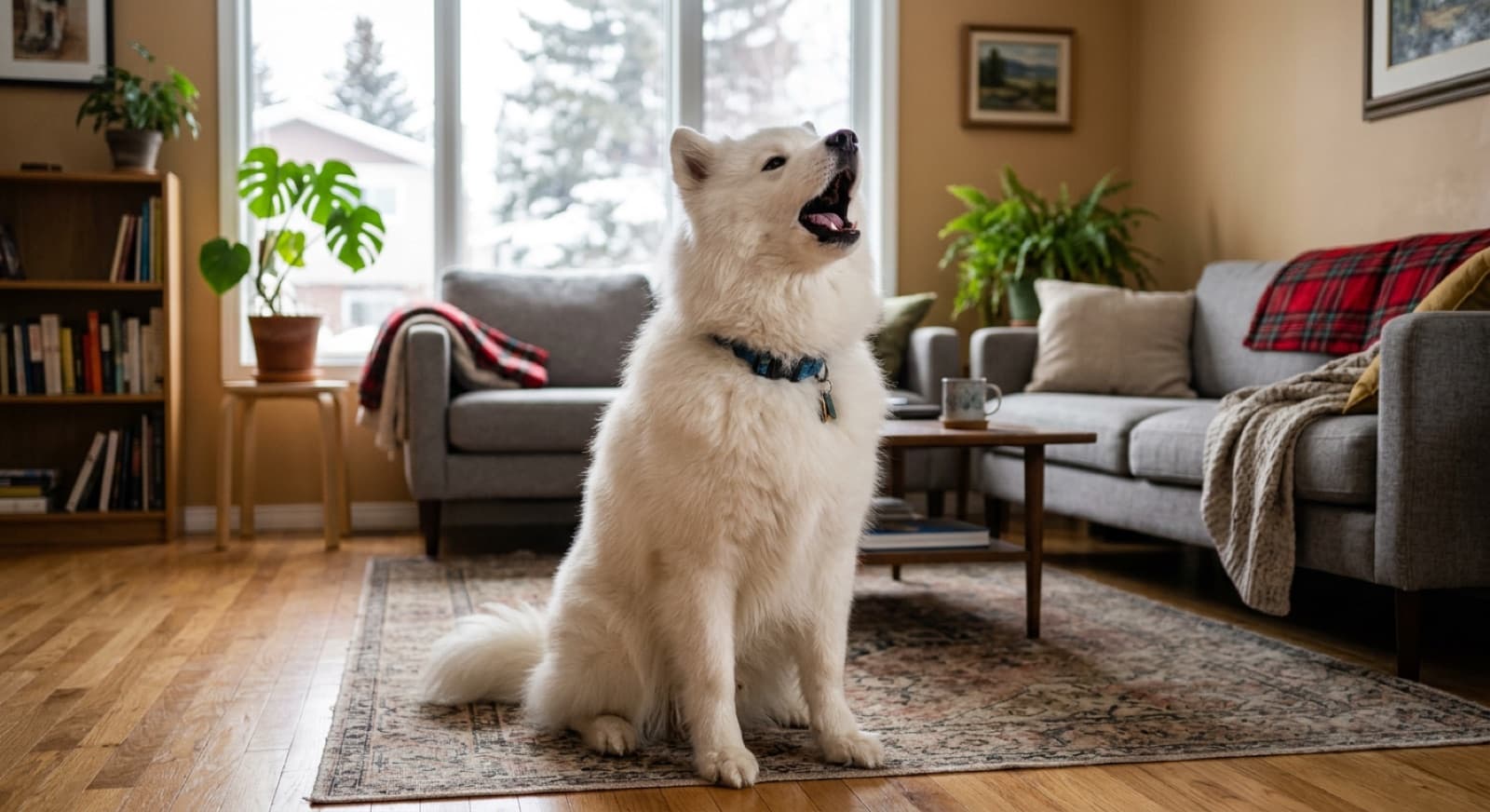
Why Samoyeds are genuinely vocal
The Samoyed is one of the 14 oldest dog breeds on record. The Samoyedic peoples of northwestern Siberia developed the breed over centuries to herd reindeer, pull sleds, hunt, and live inside the family chum (a portable tent) for warmth in subzero conditions.
Two parts of that history shape the modern Samoyed's vocal personality. First: the dog was bred to alert herders to wolves, bears, and other predators approaching the reindeer herd, sometimes across hundreds of metres of open tundra. A quiet dog is a useless herd guardian. Second: the dog was bred to sleep inside the chum with the children for shared warmth in temperatures that would kill most breeds. The Samoyed is not built to be a yard dog or a basement dog. It is built to live inside with the family, and to communicate vocally as part of that bond.
Modern Calgary Samoyeds carry the same wiring. The dog who alert-barks when the Amazon driver pulls up to a Bridgeland townhouse is not malfunctioning; that is the herd-guardian job description. The dog who talks and grumbles when you come home from work is greeting you the way the breed greets. The dog who sings along with a passing siren in Inglewood is doing what spitz breeds do.
This matters because the most common owner mistake is treating breed-typical vocalising as a behaviour problem to suppress. The Calgary force-free trainers we work with see this pattern weekly. The owner buys a bark collar, the dog suppresses the alert bark, the underlying vigilance and frustration do not go away, and within months the dog has developed displacement behaviours that are harder to live with than the original barking. The job is not to silence a Samoyed. The job is to distinguish what is breed-typical and acceptable, what is reinforced demand barking the owner is feeding accidentally, and what is anxiety-driven panic that needs a different response.
The four forms of Samoyed vocalising
Not all Samoyed barking means the same thing. Distinguishing the four types is the first step in deciding whether to manage, train, or treat.
- Alert barks. Short, sharp, triggered by a specific stimulus: a person at the door, a delivery truck, a squirrel on the fence, a neighbour's cat. The dog typically settles within a minute once the trigger passes. This is breed-typical herd-guardian behaviour. Manageable, not eliminable. The goal is a clean stop on cue, not zero alert barks.
- Talking and grumbling. Low-volume vocal play sounds the dog produces during greetings, play, anticipation of food or a walk, or general excitement. Often called “woo-wooing” in the Samoyed community. This is enthusiastic communication, not anxiety. Leave it alone unless it is happening at 2am.
- Singing and howling. Sustained, melodic vocalising triggered by sirens, other dogs howling, music with high registers, or just the dog feeling expressive. A spitz trait shared with Huskies and Malamutes. Most owners enjoy this once they understand it. Not an anxiety signal on its own.
- Demand barks. Repeated, insistent barking directed AT a human, usually for attention, food, a toy, or to be let out. The dog is barking because the bark has worked before. This is the form most worth addressing because it is reinforced behaviour the owner can untrain. See the demand-barking section below.
A separate category sits outside these four: panic vocalising during alone time. Sustained, escalating, often paired with destruction or self-injury, beginning within minutes of the owner leaving. That is separation anxiety, covered in its own section. The response is different from the other four.
Separation anxiety in a breed built for company
The Samoyed was bred to live inside the family tent. Not in a yard, not in a kennel, not in a basement. Inside, with humans, sharing space and warmth. A Calgary household that leaves a Samoyed alone 9 hours a day, every weekday, is fighting the breed's entire developmental history.
This shows up in rescue intake patterns. A meaningful share of Samoyed surrenders in Alberta come from working couples who underestimated how much company the dog needs. The story is consistent: owner adopts an 8-week-old Sam puppy, takes a week off work to settle the puppy in, returns to a 9-hour workday with the puppy crated alone. By month three the puppy is howling for hours, destroying the crate, soiling indoors despite being mostly housetrained, and the neighbour upstairs has filed a noise complaint. The rescue sees the dog at month six.
The same household with a Labrador often gets away with this routine. The Lab is more tolerant of solo time. The Samoyed is not. The breed is not less intelligent, less trainable, or more anxious; it is correctly identifying that the situation it has been put in is not the situation it was bred for, and it is responding accordingly.
The practical implication for Calgary adopters: if your household has nobody home for a full workday five days a week, the responsible plan before you bring home a Samoyed is one of the following:
- A force-free Calgary daycare two or three days a week (most working Samoyed households we know run this setup)
- A midday dog walker doing 45 to 60 minutes of off-leash play or a long structured walk
- A work-from-home or hybrid schedule for at least one adult in the household
- A partner or adult child whose schedule offsets yours so the dog is rarely alone for more than 4 to 5 hours
- A multi-dog home where another well-matched dog provides company
If none of these are realistic, the honest move is to choose a different breed or postpone the adoption. A Sam who develops severe separation anxiety in the first 6 months of an unprepared placement is much harder to rehabilitate than to prevent.
Telling separation anxiety from normal alone-time discomfort
Record video. This is the single most useful diagnostic step, and most Calgary owners skip it. Set up a phone on the counter, leave the house on your normal departure routine, and watch the first 60 minutes back.
Normal alone-time discomfort
- Brief vocalising at departure, fades within 5 to 15 minutes
- Settles into a bed, sofa, or window spot
- Eats the food puzzle or chew you left
- Sleeps for stretches
- May pace briefly, then resettle
- Greets you calmly on return, recovers fast
True separation anxiety
- Sustained vocalising past 30 minutes
- Pacing without settling for the entire absence
- Drooling, heavy panting in a cool room
- Destruction focused on exit points (doors, windows, crate bars)
- Refuses food and water when alone
- Self-injury: broken teeth, raw paws, lacerations
- Indoor soiling despite being housetrained
- Frantic greeting on return, slow to recover
The panic pattern is the diagnostic key. Normal alone-time discomfort fades. Separation anxiety escalates or sustains. A dog who is uncomfortable for 10 minutes and then settles into a chew is in a different category from a dog who is still pacing and drooling at the 60-minute mark.
The American Veterinary Society of Animal Behavior (AVSAB) position statements on humane training and anxiety treatment are the canonical references for distinguishing manageable discomfort from clinical separation anxiety, and both formally recommend force-free, reward-based approaches over aversive tools for either.
If your video shows the right-side pattern, do not start a protocol alone with a YouTube tutorial. Book a force-free Calgary trainer experienced with separation anxiety, and if the dog is showing severe panic or self-injury, escalate to a board-certified veterinary behaviourist (DACVB) from the start. Calgary referrals are in the trainer section below.
The force-free desensitisation protocol
This protocol is the standard of care for separation anxiety across the force-free training and veterinary behaviour fields. It works by keeping the dog under threshold (the duration at which panic does not start) and slowly increasing tolerance. It is a months-long process. There is no shortcut, and aversive tools (bark collars, “cry it out,” punishment for vocalising) actively worsen the underlying anxiety.
Step 1: Identify the dog's current threshold. The threshold is the longest duration the dog can be alone without panic starting. Use video to find it. For mild cases this might be 5 to 10 minutes. For severe cases it can be 1 to 3 seconds (the time it takes to close the door behind you). Whatever the number is, that is where the work starts. Honest assessment matters more than fast progress.
Step 2: Build a sub-threshold routine. The dog gets a high-value food puzzle, frozen Kong, or long-lasting chew right before the practice departure. The puzzle is reserved for alone-time practice only; it loses its power if used at other times. Departure cue (picking up keys, putting on shoes) happens calmly and predictably.
Step 3: Practice absences just under threshold. If threshold is 3 seconds, leave for 1 to 2 seconds. Walk out, close the door, immediately walk back in. The dog must not panic during the absence. Return calmly, ignore the dog for 30 seconds, then go about your business. Repeat 5 to 10 times per session.
Step 4: Increase duration in small increments. Only after the dog has stayed calm at the current duration for 3 to 5 consecutive sessions. A workable progression for a moderate case: 5 seconds, 15 seconds, 30 seconds, 1 minute, 2 minutes, 5 minutes, 10 minutes, 20 minutes, 45 minutes, 90 minutes, 3 hours. Each step verified on video before moving up. Two practice sessions a day, ideally morning and afternoon.
Step 5: Vary the routine. Once the dog tolerates 10 minutes calmly, start randomising. Sometimes you grab keys and leave for 3 seconds, sometimes for 8 minutes. The dog learns that the departure cue does not predict a long absence. This stage prevents the dog from memorising a fixed pattern and panicking at the wrong cue.
The critical rule: never push past threshold during training. A single panic episode mid-protocol sets the work back days or weeks because the dog re-learns that being alone equals panic. If the household needs to leave the dog for longer than current threshold during the protocol, that is what daycare, dog walkers, or a friend's house is for. Daily life and training are run in parallel: training builds tolerance, daycare covers what tolerance does not yet reach.
A force-free trainer or DACVB will tailor this protocol to the individual dog. For severe cases (1 to 3 second threshold, self-injury, refusing food and water), do not run the protocol alone. The risk of accidentally pushing past threshold and worsening the case is too high without professional support.
Crate, pen, or open room?
The default advice to “crate train your puppy” does not always apply to Samoyeds. Some Sams settle in a crate. Many do not. Forcing a panicking dog into a crate is one of the fastest ways to manufacture severe separation anxiety, self-injury, and broken teeth from bar chewing.
The dogs who crate well are typically Sams who were introduced to a crate positively as young puppies, who reliably choose to sleep there even when the door is open, and who show no escalation when the door closes. If you have that dog, the crate is a useful tool for transport, vet visits, and short calm absences.
The dogs who do not crate well are typically adult Sams adopted with no crate history, dogs who have been crated as punishment, dogs whose owners closed the door before positive crate training was done, or dogs with any existing claustrophobic or panic tendencies. For these dogs the crate becomes the trigger, and forcing the dog in makes the underlying anxiety worse, not better.
The safer default for an unknown-history adopted Samoyed: a baby-gated kitchen, laundry room, or hallway. The dog gets a comfortable bed, fresh water, the food puzzle for alone-time practice, and ideally a window view. If the dog is calm in that setup on video, expand the space gradually. If not, that is the data: the setup is wrong and needs more management or more behaviour work, not more confinement.
Open-room access (giving the dog the run of the house) works for some Sams but not others. The risk is destruction during panic or counter-surfing if food is left out. The reward is the dog has the most freedom to self-regulate, find their preferred resting spots, and not associate alone time with confinement. Video tells you which side your dog is on.
Counter-conditioning the alert and demand barks
Alert barking and demand barking respond well to a different approach than separation anxiety: capture-the-quiet plus positive interrupters. The goal is not silence; it is a clean stop on cue and an end to barks that have been accidentally reinforced.
For alert barking. When the doorbell rings or the delivery truck pulls up, the dog gets a couple of alert barks (that is the job). Then say a chosen cue word (“thank you” works well, “enough” works well) and immediately scatter five small treats on the floor. The treat scatter does three things at once: it interrupts the bark, it gives the dog an alternative behaviour (find the treats), and it pairs the cue word with stopping. Over 2 to 4 weeks the cue alone produces the stop, and the trigger produces fewer baseline barks because the dog has learned that you handle the threat once they have alerted you.
For demand barking. Demand barks are reinforced by attention, including eye contact and verbal corrections. Two parallel steps:
- Capture quiet. Any time the dog is calmly quiet for 2 seconds, mark it (a clear “yes” or clicker) and reward with a small treat. Build duration gradually: 2 seconds, 5 seconds, 10 seconds, 30 seconds. The dog learns that quiet pays.
- Extinguish the demand bark. When the dog demand-barks AT you, give zero response: no eye contact, no “quiet,” no movement. Wait for a 2-second pause, then immediately reward the pause. The bark stops paying. Within 2 to 4 weeks the behaviour fades.
Expect an “extinction burst” in the first week of working on demand barks: the dog barks harder for a few days because what used to work is no longer working, so they escalate. This is the moment most owners cave and reinforce the louder bark, which permanently teaches the dog that louder works. Hold the line through the extinction burst. After 5 to 10 days the behaviour collapses.
Never use bark collars (shock, vibration, citronella, ultrasonic) on a Samoyed or any dog. AVSAB and IAABC both formally recommend against them. They suppress the symptom without addressing the underlying frustration or anxiety, and they damage the dog's trust in their handler. The International Association of Animal Behaviour Consultants maintains a directory of credentialed force-free consultants if you want a second opinion before any aversive tool is considered.
Calgary daycare and dog walker options
For working households, daycare or a midday walker is often the missing piece. The breed is built for company, and partial coverage of the workday turns an unworkable setup into a sustainable one.
What to look for in a Calgary daycare for a Samoyed:
- Force-free philosophy. Ask directly: “Do you use prong, e-collar, choke, or spray correction tools?” The correct answer is no. If the daycare uses aversive corrections, find another one.
- Group size and structure. Smaller, supervised groups beat large free-for-all play floors for Sams who can over-arouse. Many Calgary daycares cap groups at 15 to 20 with active human supervision.
- Heat management. Critical for the breed. The daycare floor needs to be climate-controlled and have shaded, cool rest areas. (Our Samoyed summer heat safety article covers temperature thresholds in detail.)
- Trial day. Most reputable Calgary daycares require an assessment day for new dogs. The assessment also tells you how your Sam handles the environment before you commit to weekly attendance.
- Pickup energy. A well-run daycare returns your dog tired and settled, not over-aroused. A daycare that returns your Sam more wound up than they arrived is too much stimulation, not too little.
Midday dog walkers are the lower-cost alternative for households who need only one break in the middle of the workday. A 45- to 60-minute force-free walk or off-leash session (in a fenced area: see the off-leash recall article for why Sams need fenced spaces) can reset the day. Ask the walker the same force-free question. A walker who shows up with a prong collar gets the same answer as a daycare that uses one.
For multi-day-a-week coverage, daycare is generally more economical than a daily walker. Most Calgary working Sam households we know run two to three daycare days a week plus a midday walker on the in-between days.
Calgary trainers and veterinary behaviourists
For mild to moderate cases a force-free Calgary trainer is the right starting point. For severe panic, self-injury, or cases that are not improving with a structured protocol, escalate to a board-certified veterinary behaviourist (DACVB).
Force-free Calgary trainers we recommend across this breed cluster:
- Raising Canine. Force-free, experienced with spitz and working breeds, runs separation-anxiety protocols.
- Pup City Pup Academy. Force-free, group classes and private behaviour work, comfortable with vocal breeds.
Three vetting questions to ask any Calgary trainer before booking a Samoyed behaviour session: (1) Do you ever use prong, e-collar, choke, or spray bark collars? The correct answer is no. (2) What is your approach if a dog vocalises or panics during a session? The correct answer involves adding distance and reassessing, not correcting the behaviour. (3) Are you familiar with the standard force-free desensitisation protocol for separation anxiety? The correct answer references threshold work and sub-threshold absences.
When to escalate to a veterinary behaviourist. A board-certified veterinary behaviourist (DACVB) is a licensed veterinarian with post-graduate specialty training in behaviour medicine. Escalate when:
- The dog is self-injuring during alone time (broken teeth, raw paws, lacerations)
- The dog refuses food and water for the entire absence
- The desensitisation protocol has not progressed after 6 to 8 weeks of consistent work
- The threshold is 5 seconds or less and the household cannot reliably stay under it
- The dog is showing generalised anxiety (not just separation-specific) including noise sensitivity, panic on car rides, or panic at vet visits
- Two or more force-free trainers have flagged the case as out of their scope
A DACVB can rule out and treat medical contributors, prescribe behaviour-supporting medication where appropriate as part of an integrated multi-modal plan, and co-manage the case with your force-free trainer. We do not recommend any specific medication in this article: that decision belongs with the clinician who has examined the dog. Western Veterinary Specialist Centre handles many Calgary-area behaviour and complex-case referrals; your regular vet can refer.
Neighbour communication and the Calgary bylaw reality
In a Calgary condo, townhouse, or apartment a vocal Samoyed will be noticed. The City of Calgary Responsible Pet Ownership Bylaw governs barking complaints, and it applies to any dog of any breed. The protective move is proactive neighbour communication, not reactive defence after a complaint is filed.
What triggers a complaint. Sustained barking for extended periods, barking at consistent times that disturb sleep (early morning, late evening), and barking that the neighbour interprets as distress. A few alert barks at the door rarely generate complaints. Hours of howling while the owner is at work generate them quickly.
Proactive neighbour communication. Before you have a problem, introduce yourself and the dog to immediate neighbours (the unit beside you, the unit above and below if you are in a stack). A short honest message goes a long way: “We just adopted a Samoyed, the breed is vocal, we are actively working on alone-time training. Please tell me directly if it is becoming a problem and I will adjust. Here is my number.” Most noise complaints in condo buildings come from neighbours who feel ignored, not from neighbours who feel respected.
Written communication is better than verbal for any sensitive exchange. A short note in the mailbox, a building-app message, or a text gives both parties time to respond calmly and creates a record. Avoid hallway confrontations.
If a complaint is filed. The bylaw process typically starts with a warning letter from 311 or bylaw services. Escalation involves fines and, in severe cases, removal orders. The fix is the behaviour work this article describes plus daycare or a walker to cover the alone time that is driving the complaints. Arguing the complaint without changing the underlying cause does not work.
Condo bylaws and rental agreements. Beyond the city bylaw, your building may have its own pet rules. Confirm before adopting that the building permits the breed and check whether there are noise clauses that go beyond city rules. If you rent, get landlord written approval in advance; verbal approval falls apart the first time a neighbour complains.
Setting up the home for a vocal Samoyed
The physical environment a Samoyed comes home to either reinforces calm or feeds barking and anxiety. Small setup decisions compound.
Window management. A Samoyed at a window with a view of the street and sidewalk is a Samoyed who will alert-bark all day at every walker, dog, squirrel, and delivery truck. The cure is window film, frosted contact paper on the bottom half of the window, or simply moving the dog's preferred resting spot away from the street-facing window. The dog is not being defiant; you have built a stimulus-rich environment and the dog is responding the way the breed responds.
White noise during alone time. A fan, white-noise machine, or quiet music masks outdoor triggers (sirens, neighbour's dog barking, the building's elevator) that would otherwise set off alert barking the dog has to manage alone. Many Calgary owners run a small fan in the dog's alone-time space year-round.
Predictable routine. Samoyeds settle better when departures and returns follow a consistent pattern. Random departures at random times feel unpredictable; a regular morning routine (food, short walk, food puzzle, depart) becomes a calming sequence the dog can anticipate.
Food puzzles reserved for alone time. Frozen Kongs, snuffle mats, lick mats, and puzzle feeders are given ONLY when the owner leaves. They become a positive cue for the start of alone time and give the dog a 20- to 45-minute productive activity right when the anxiety would otherwise peak.
Some of the product links in this section are Amazon affiliate links — we may earn a small commission at no extra cost to you. It never changes which products we recommend.
A safe space the dog chose. Watch where your Sam naturally rests when relaxed. That is the place to put the bed and the food puzzle. Forcing the dog to settle in a spot you chose, against where they prefer, fights you. Working with the dog's preference is free and effective.
Exercise BEFORE alone time, not after. A tired, satisfied dog settles better. Twenty to forty minutes of structured exercise (off-leash play in a fenced area, a brisk walk, mental work like nose games) before the owner leaves does more to reduce alone-time vocalising than any post-departure intervention. Save high-energy activity for the morning routine.
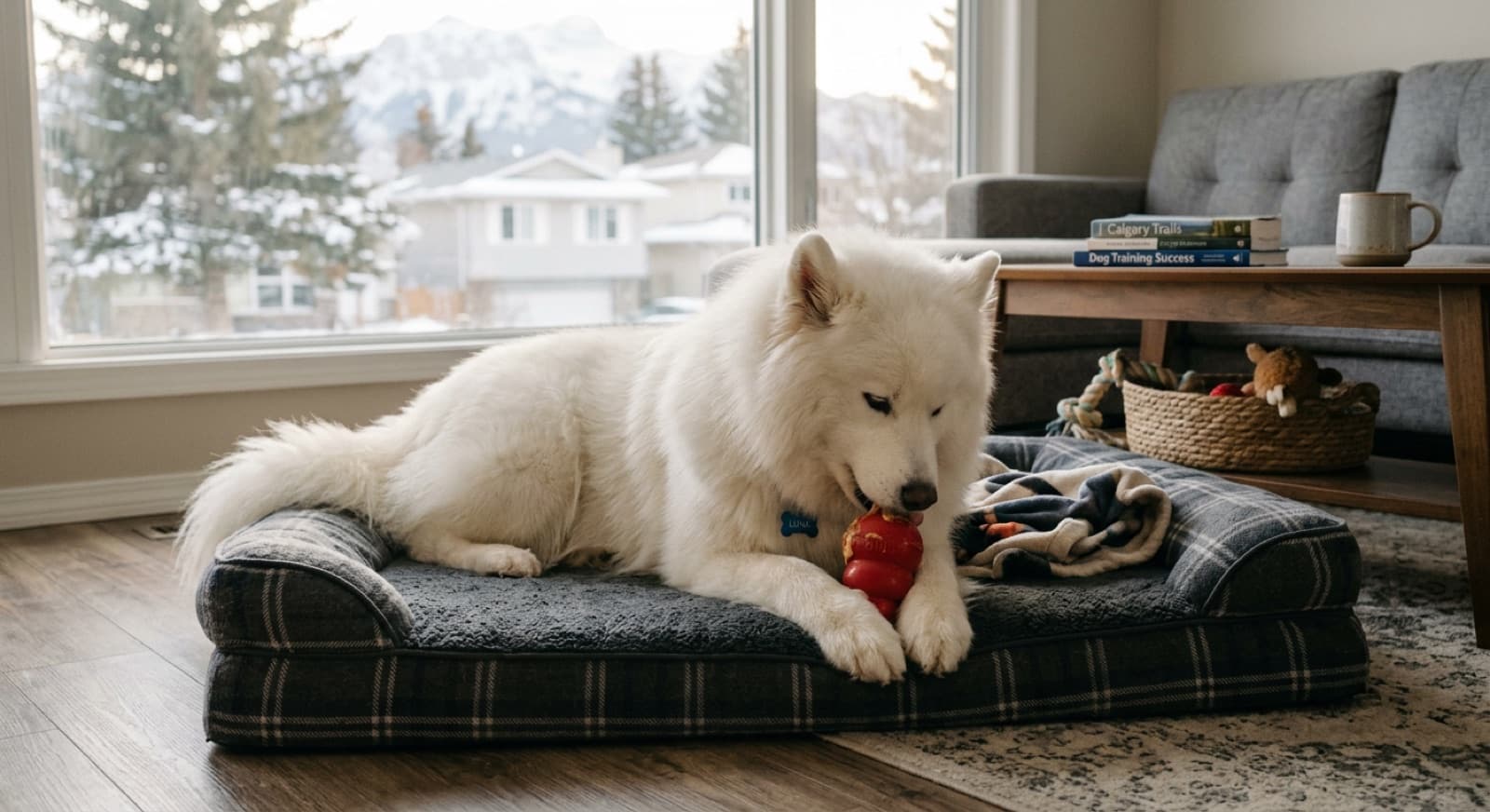
Browse adoptable Samoyeds in Calgary
Foster temperament evaluation tells you whether a particular Samoyed has a history of separation anxiety or vocal issues before you bring them home. Rescue placements give you that information up front.
See Available Samoyeds →Sources and further reading
- American Veterinary Society of Animal Behavior (AVSAB) — position statements on humane training and behaviour treatment
- International Association of Animal Behaviour Consultants (IAABC) — force-free consultant directory and separation anxiety resources
- Fear Free Pets — veterinary and training certification for low-stress handling
- City of Calgary Responsible Pet Ownership Bylaw — barking complaint process
This article is informational. It is not behavioural or veterinary advice for an individual dog. For specific separation anxiety, panic, or self-injury concerns, work with your Calgary veterinarian, a force-free trainer experienced with separation anxiety, and where appropriate a board-certified veterinary behaviourist.
Frequently Asked Questions
Why does my Samoyed bark so much?
Samoyeds were bred by the Samoyedic peoples of Siberia to alert herders to predators and to live inside the family chum communicating with people. Vocal behaviour is breed-typical, not a training failure. Alert barks, talking and grumbling, singing or howling, and demand barks are all normal. What is concerning is sustained vocalising for hours when alone, panic-driven destruction, or a sudden change in a previously quiet adult dog. Those patterns suggest separation anxiety or pain and need a different response.
Can a Samoyed be left alone during a Calgary workday?
A full 8 to 10 hour workday alone every day is a known mismatch for the breed. The dog was bred to live inside with people. Plans that work: a force-free Calgary daycare two to three days a week, a midday dog walker, a hybrid or work-from-home schedule, or a partner with an offset schedule. Yard alone, basement alone, or 9 hours crated does not work and produces a meaningful share of Samoyed surrenders in Alberta.
How do I know if my Samoyed has separation anxiety?
Record video. Leave on your normal routine and watch the first 60 minutes. Normal alone-time discomfort fades within 10 to 20 minutes; the dog settles, eats the food puzzle, and rests. Separation anxiety escalates: sustained vocalising past 30 minutes, pacing without settling, drooling, destruction at exit points, refusing food, self-injury, indoor soiling. The panic pattern is the diagnostic difference. If video shows the panic pattern, work with a force-free trainer and consider a veterinary behaviourist for severe cases.
What is the force-free desensitisation protocol?
Identify the threshold (longest duration the dog stays calm). Start with absences just under that. Pair departure with a high-value food puzzle reserved for alone-time practice. Return calmly before panic starts. Repeat 5 to 10 times per session, two sessions a day. Increase duration in small increments only after the current duration is consistently calm on video. Vary the routine once tolerance reaches 10 minutes. Never push past threshold; a single panic episode sets the work back days. For severe cases work with a force-free trainer or DACVB from the start.
Should I crate my Samoyed for alone time?
It depends on the dog. Some Sams settle in a crate if it was introduced positively from puppyhood. Many Sams, particularly adopted adults with no crate history, do worse in a crate than in an open room or gated area. Forcing a panicking dog into a crate manufactures severe separation anxiety, self-injury, and broken teeth. The safer default for an unknown-history adult Sam is a baby-gated kitchen or laundry room. If the dog stays calm on video, expand. If not, the setup needs adjustment.
How do I stop my Samoyed from demand barking?
Capture quiet: any time the dog is calmly quiet for 2 seconds, mark and reward. Build duration gradually. When the dog demand-barks, give zero response (no eye contact, no verbal correction). Wait for a 2-second pause, then immediately reward the pause. Expect an extinction burst (louder barking) in the first week as the old behaviour stops working. Hold the line. Within 2 to 4 weeks the demand bark loses its function. Never punish with bark collars; they suppress without solving.
When should I involve a veterinary behaviourist?
Escalate to a board-certified veterinary behaviourist (DACVB) if the dog is self-injuring during alone time, refuses food and water for the entire absence, has shown no progress with a structured protocol after 6 to 8 weeks, has a threshold of 5 seconds or less, or shows generalised anxiety beyond separation. A DACVB is a licensed vet with post-graduate specialty training in behaviour medicine. They can rule out medical contributors and prescribe behaviour-supporting medication as part of an integrated plan. Your regular Calgary vet can refer.
Will my neighbour complain about my Samoyed barking?
Possibly. Sustained barking generates complaints under the City of Calgary Responsible Pet Ownership Bylaw, regardless of breed. The protective move is proactive: tell your neighbours about the breed and your training plan before there is a problem. Leave your phone number. Most complaints come from neighbours who feel ignored. If a complaint is filed, the process starts with a warning and escalates to fines. The fix is the behaviour work in this article plus daycare or a walker to cover alone time.
Can I leave my Samoyed in the backyard while I am at work?
No. Yarded Samoyeds bark at everything beyond the fence, generate sustained bylaw complaints, and the breed was built to live inside with people. Calgary summers also push into temperature ranges that are dangerous for a double-coated arctic breed: our Samoyed summer heat safety article covers the specific thresholds. Supervised yard time in cool weather is fine. Yard as the alone-time solution is one of the worst outcomes for the breed.
Are bark collars safe for Samoyeds?
No. AVSAB and IAABC both formally recommend force-free methods over aversive tools, including bark collars (shock, vibration, citronella, ultrasonic). For separation anxiety they are actively harmful: they punish the symptom of panic without addressing the underlying anxiety, can drive worse compensatory behaviours, and damage the dog’s trust in their handler. If a Calgary trainer recommends a bark collar, find a different trainer. Force-free desensitisation and a veterinary behaviourist where needed are the legitimate paths.
Samoyed Adoption Calgary
Where to find Samoyeds in Calgary, rescue vs breeder costs, surrender patterns, and the screening that protects both dog and adopter.
Is a Samoyed Right for You?
Honest self-assessment for Calgary households: workday coverage, vocal tolerance, grooming, exercise, and the breed's real cost.
Samoyed Grooming and Shedding
The undercoat reality, Calgary grooming costs, the never-shave rule, and how to manage seasonal coat blow in a chinook climate.
Samoyeds for Adoption in Calgary
Current Samoyed and Sam-mix listings from Calgary Humane, AARCS, and the partner rescue network. Updated regularly.
New dog? Start with these care guides
Everything a new adopter needs to set up a safe, happy home.