The short answer
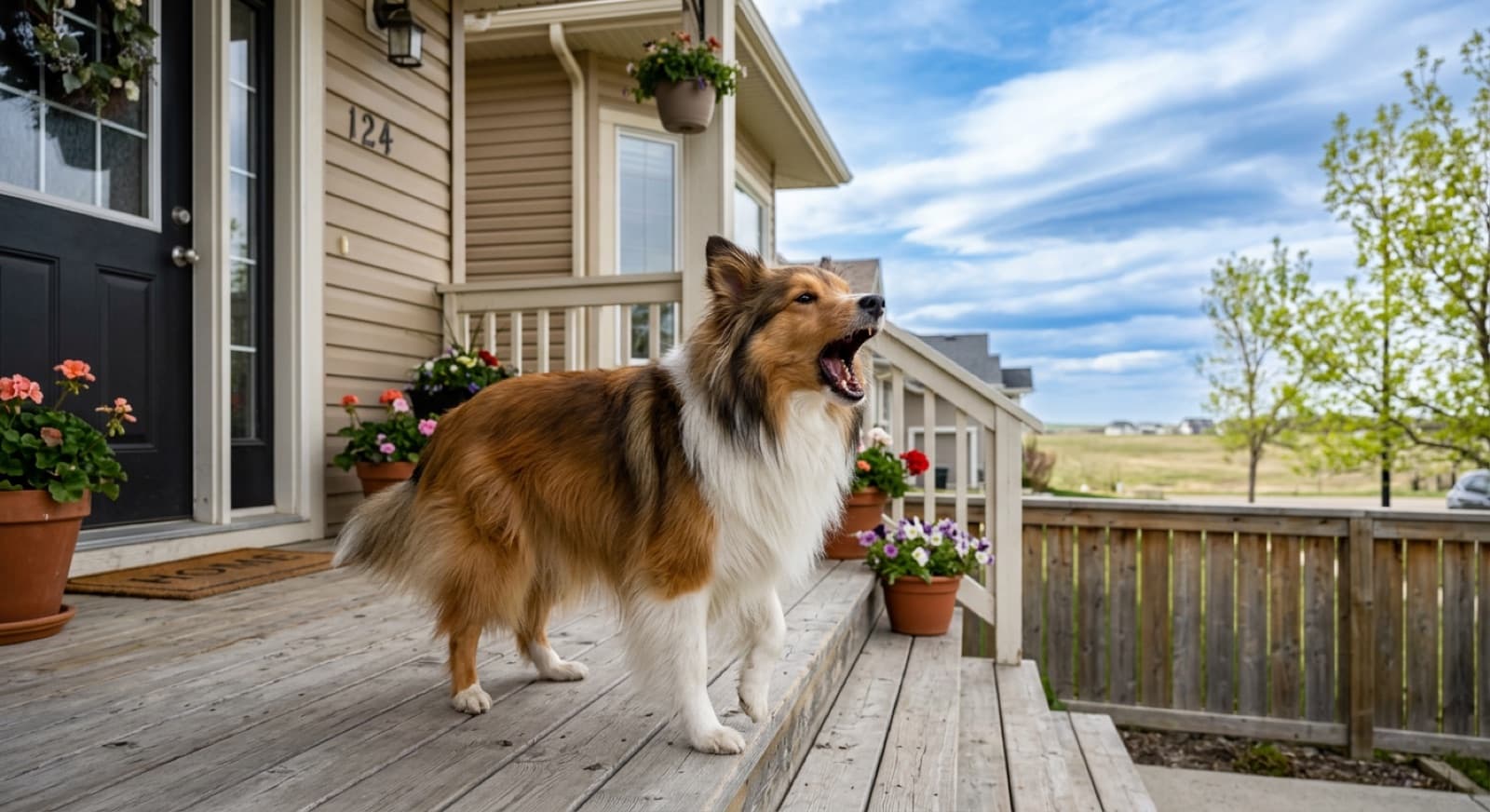
Shelties bark because Shetland Island shepherds bred them over centuries to alert across distance. The vocal drive is wired in. A realistic Calgary management protocol reduces the volume and the frequency to a level the household and the neighbours can live with, but rarely eliminates it. The path is force-free: capture-the-quiet, counter-condition the doorbell, ignore demand barks, block visual triggers at windows, and run a desensitisation protocol if the barking happens during alone time. Aversive tools like bark collars backfire on Shelties because the breed is sensitive and shuts down under correction without resolving the underlying drive.
Why Shelties are genuinely vocal
The Shetland Sheepdog was developed on the Shetland Islands off the north coast of Scotland to herd small sheep and Shetland ponies. The terrain is open, windswept, and treeless. Visibility for the shepherd was limited and a working dog had to communicate at distance using its voice.
That is the breed's job description. The dog was rewarded over generations for alerting on stock movement, predator approach, and any change in the environment that affected the herd. A quiet Sheltie was a useless Sheltie. The vocal drive was selected for and reinforced for centuries. The American Shetland Sheepdog Association describes the breed as “intensely loyal, alert, and intelligent,” and the alert piece carries a vocal component the casual breed-page reader often skips past.
Modern Calgary Shelties carry the same wiring. The dog who alert-barks when the food delivery rider rolls past a Beltline condo window is doing the breed job. The dog who runs the fence line in a Hillhurst backyard, barking at every dog walking past on the sidewalk, is herding the boundary. The dog who lets you know the elevator is opening on your floor three seconds before you hear it has worked exactly as the Shetland shepherds wanted.
This matters because the most common owner mistake is treating breed-typical vocalising as a behaviour problem to suppress. The owner buys a bark collar, the dog suppresses the alert bark, the underlying vigilance does not go away, and within months the dog has developed displacement behaviours that are harder to live with than the original barking. The job is not to silence a Sheltie. The job is to distinguish what is breed-typical, what is reinforced demand barking the owner is feeding accidentally, and what is anxiety-driven panic that needs a different response.
A second part of the breed history matters for training. Shelties were bred to work with the shepherd, not against the shepherd. They are intensely biddable, intensely attuned to the handler, and intensely sensitive to correction. That biddability is why a force-free protocol works so well on the breed. The same sensitivity is why aversive correction backfires so badly. A Sheltie who is yelled at, jerked on a prong collar, or shocked with a bark collar does not just suppress the behaviour; the dog withdraws emotionally and the relationship with the handler erodes.
The eight forms of Sheltie vocalisation
Not all Sheltie barking means the same thing. Distinguishing the eight forms is the first step in choosing the right intervention. The wrong intervention applied to the right behaviour makes the problem worse.
- Alert bark. Short, sharp, focused on a specific trigger (knock at the door, person on the front walk, unfamiliar dog passing the window). The dog typically settles within a minute once the trigger passes or the handler acknowledges it. Breed-typical, manageable, not eliminable. Goal: clean stop on cue.
- Herding bark. Rhythmic, directed at moving targets the dog perceives as needing to be herded (children running in the yard, a partner walking past, cyclists on a path, balls and frisbees). The dog may circle, nip at heels, and bark in sequence. This is breed working drive needing a structured outlet.
- Demand bark. Repeated, insistent, directed AT a human, usually for attention, food, a toy, to be let out, or to be picked up. The dog is barking because the bark has worked before. The most worth addressing because it is owner-reinforced behaviour that can be untrained.
- Fence-line bark. Sustained patrol barking along a fence, at a window, or on a balcony, triggered by the appearance and disappearance of passersby. Highly self-rewarding (the trigger always “leaves” because they were walking by anyway, so the dog thinks the barking worked). Without environmental management this one cements fast.
- Doorbell trigger. A specific subtype of alert bark where the doorbell or knock has become a strong arousal cue. The bark is sustained, the dog struggles to settle when guests enter, and the trigger has been rehearsed daily for years in most cases. Counter-conditioning works but takes weeks.
- Prey-drive yip. Sharp, high-pitched, triggered by squirrels, rabbits, cars, bikes, or skateboards moving fast. The dog tracks the target visually and vocalises with body tension. Common in Calgary off-leash parks, on the Bow River pathways, and in backyards backing onto green space.
- Anxiety vocalisation. Sustained whining, howling, or barking during alone time, often paired with pacing, drooling, destruction at exit points, refusing food, or self-injury. This is separation anxiety or a panic state. It needs a behaviour protocol, not bark training.
- Attention-seeking yodel. The conversational vocal Shelties produce when they want interaction, when they are excited about a coming walk, or when greeting family. Low-volume, communicative, breed-typical. Most owners enjoy it once they understand what it is. Leave it alone unless it is happening at 2am.
Identifying which form you are dealing with is the first step. Video record the dog during episodes, note the time of day, the trigger, the duration, and what the dog does when the episode ends. Different forms need different interventions, and several can run simultaneously in the same dog.
The realistic goal
The goal of Sheltie vocal management is reduction and threshold control. Not silence. Owners who set the goal as “my Sheltie will stop barking” either fail at the goal or harm the dog trying to achieve it.
Realistic outcomes with consistent force-free work over three to six months for a typical Calgary Sheltie:
- Alert bark reduced from 30 seconds of sustained barking to two or three barks followed by a clean stop on cue.
- Doorbell trigger reduced from full-arousal sustained barking to a couple of alerts plus a settle within a minute.
- Demand barks extinguished entirely (most owner-reinforced behaviour resolves within four weeks of consistent extinction).
- Fence-line bark reduced through environmental management plus recall training.
- Anxiety vocalisation resolved through a desensitisation protocol if it was below the panic threshold; clinical separation anxiety requires longer work and often a veterinary behaviourist.
- Attention-seeking yodel preserved (it is the dog), with a quiet-on-cue layered on for late evening and early morning.
What that adds up to in lived experience: a dog who alerts when alerting is useful, settles when the trigger passes, and goes through a normal Calgary day without generating bylaw complaints. Some quiet hours, some vocal moments, and a sustainable household equilibrium.
What the goal is not: a silent Sheltie. The breed does not produce silent dogs at population scale. Shelties live 12 to 14 years, so the management is lifelong. Owners who accept the breed reality at year one are happier and have better-adjusted dogs at year five than owners who spend the first year fighting the genetics.
If you are still in the decision stage and the vocal profile feels unworkable for your household, the Sheltie right-for-you sibling article walks through the full self-assessment. If you have already adopted, the rest of this article is the management playbook.
Diagnose first: which form is it?
The right protocol depends on which form of vocalisation you are dealing with. The diagnostic step is video plus a written log. Most Calgary owners skip it. The owners who run it solve the problem faster.
Video record episodes. Set up a phone or tablet at the dog's eye level. Capture both alone-time absences (leave the house on your normal departure routine for 30 to 60 minutes) and at-home episodes (the doorbell trigger, the fence-line patrol, the demand bark over dinner). Watch the footage back. The dog's body language tells you what category you are in.
Keep a written trigger log for one week. A simple notebook entry per episode: time of day, trigger if known, duration, intensity (rate out of 10), what stopped it. After seven days the patterns are obvious. Most Calgary Shelties produce 70 percent of their barking from two or three predictable triggers. Identifying those triggers focuses the training.
Watch for time-of-day patterns. Many Sheltie owners discover their dog barks predictably at the school bus pickup window, the delivery rush hour (3 to 6 pm in most Calgary neighbourhoods), or at the cycling commuter window (7 to 9 am on routes near pathways). Environmental management for those windows is a high-yield intervention.
Check for medical contributors. A previously quiet adult Sheltie who suddenly starts barking warrants a vet visit. Cognitive dysfunction in senior dogs, hearing loss, pain (dental, orthopaedic, gastrointestinal), and thyroid changes can all drive new vocal behaviour. Behaviour change in older dogs is medical until proven otherwise.
Distinguish breed-typical from clinical anxiety on video. A breed-typical vocal Sheltie can be redirected, takes treats, settles between episodes, and goes about a normal day. A Sheltie with clinical separation anxiety shows sustained panic during the absence: pacing without settling, drooling, panting in a cool room, destruction focused on exit points (doors, windows, crates), self-injury, refusing food and water, indoor soiling despite being housetrained. If the video shows the panic pattern, skip the bark-training protocols and go straight to the separation anxiety protocol below or a force-free trainer.
Force-free protocols by bark type
Each form of vocalisation has a different right answer. Applied to the wrong form, even a correct protocol can backfire. Match the intervention to the diagnosis.
1. Alert bark: capture-the-quiet plus a clean stop cue
Allow one or two alerts (the breed job). Then say a chosen cue word (“thank you,” “enough,” or “all done” work well) and immediately scatter five small treats on the floor. The treat scatter does three things: interrupts the bark, gives the dog an alternative behaviour (find the treats), and pairs the cue word with stopping. Repeat at every legitimate alert opportunity for two to four weeks. The cue alone eventually produces the stop, and the trigger generates fewer baseline barks because the dog has learned you handle the threat once they have alerted you. Never punish the alert itself; you are training the response, not silencing the breed.
2. Herding bark: redirect into a structured outlet
Herding barks at children, the partner, or moving cyclists are the breed's working drive looking for a job. Suppressing the behaviour leaves the drive unaddressed; the dog will find a worse outlet. The fix is a structured outlet that satisfies the herding instinct in a way the household approves of: fetch with rules (sit before the throw, wait before the release), structured tug, scent work, herding ball (a large rubber ball the dog can chase and push), or a herding instinct class. Calgary has several force-free trainers who run group classes; the Sheltie Adoption hub in the cluster covers options. Daily structured outlet plus consistent redirection from the bark trigger collapses most herding-bark issues within a month.
3. Demand bark: ignore plus capture-the-quiet
This is the hardest because intermittent reinforcement creates the behaviour. The dog learned somewhere along the way that barking AT you produces attention, food, or movement. Two parallel steps:
- Capture quiet. Any time the dog is calmly quiet for two seconds, mark it (a verbal “yes” or clicker) and reward with a small treat. Build duration: two seconds, five seconds, ten seconds, thirty seconds. The dog learns that quiet pays.
- Extinguish the demand bark. When the dog demand-barks AT you, give zero response. No eye contact, no “quiet,” no movement, no walking away (walking away can be reinforcing too). Wait for a two-second pause, then immediately reward the pause.
Expect an extinction burst in the first week: the dog barks harder for several days because what used to work is no longer working, so they escalate. This is the moment most owners cave and reinforce the louder bark, permanently teaching the dog that louder works. Hold the line through the extinction burst. After five to ten days the behaviour collapses.
4. Fence-line and window bark: management first, training second
Self-rewarding behaviours are nearly impossible to extinguish through training alone if the dog keeps getting the reward. Every passerby the Sheltie barks at “leaves” (because they were walking by anyway), and the dog interprets this as the bark working. Step one is environmental management: frosted contact paper or window film on the bottom half of street-facing windows, blinds closed during peak walker hours, fence-line access limited to supervised yard time. Step two is recall training so the dog can be called off the fence into the house for a treat. Step three is layering in a settle cue so the dog has an alternative behaviour when the trigger appears. Management without training does not generalise; training without management cannot compete with the self-reward. Both together work.
5. Doorbell trigger: counter-conditioning protocol
The doorbell has become a strong arousal cue over years of rehearsal. The fix is to change what the bell predicts.
- Practice sessions with a helper. The dog is on leash or behind a baby gate. The helper rings the bell. As soon as the bell rings, before the dog escalates, scatter five small treats on the floor. The dog finds the treats. Repeat 10 to 20 times per session.
- Repeat daily for one to two weeks. The bell starts predicting a treat scatter instead of a threat. The arousal drops.
- Layer in the cue word. Once the dog hears the bell and looks for treats instead of escalating, add “thank you” just before the scatter. Within another week the cue alone produces the calm response.
- Generalise. Have different people ring the bell at different times of day. Mix the routine so the dog learns the response, not a memorised pattern.
A typical Calgary doorbell-trained Sheltie reaches a couple of alerts plus a settle within four to six weeks. Faster if the rehearsal history is short; slower for dogs who have rehearsed the arousal for years.
6. Prey-drive yip: management plus impulse control
Prey-drive vocalisation at squirrels, bikes, and cars is wired in. Management means leashed walks in high-stimulus areas, gates and visual barriers between the dog and the trigger, and a long-line for off-leash work in fenced spaces. Impulse control training (Look at That, structured engage-disengage games, default settle on a mat) builds the dog's ability to notice the trigger without escalating. The Bow River pathways and Calgary off-leash areas like Nose Hill Park and Sue Higgins are full of prey-drive triggers; expecting a Sheltie to not vocalise in those environments without training is unrealistic.
7. Anxiety vocalisation: desensitisation protocol
If the video shows sustained panic during alone time (pacing, drooling, destruction, refusing food, self-injury), the dog is in a separation anxiety state. Bark training does not apply; the dog is not making a choice you can shape. The protocol works by staying below the panic threshold and slowly building tolerance:
- Identify the threshold (longest duration alone before panic starts). For mild cases ten minutes; for severe cases under three seconds.
- Practice absences just under threshold, paired with a high-value food puzzle reserved for alone-time practice.
- Return calmly before panic, repeat five to ten times per session, two sessions a day.
- Increase duration in small increments only after the current duration is consistently calm on video.
- Never push past threshold; a single panic episode sets the work back days or weeks.
For severe cases (threshold of seconds, self-injury, refusing food), do not run this alone. Work with a force-free trainer or a board-certified veterinary behaviourist from the start. The risk of accidentally pushing past threshold and worsening the case is too high without professional support.
8. Attention-seeking yodel: leave it alone (mostly)
The conversational vocal is the breed. Most owners enjoy it once they understand it is not anxiety or demand. The one carve-out is teaching a quiet cue for late evening and early morning so the dog can yodel during the day and settle at sensitive hours. Capture quiet on a verbal cue during low-arousal moments, build duration, and layer it in around bedtime and pre-dawn. The dog learns to communicate when it is OK to communicate.
Why aversive tools backfire on Shelties
Bark collars, prong collars, e-collars, and other aversive correction tools are not recommended for Shelties. The breed's sensitivity makes the cost of aversive correction higher than the benefit, and the underlying drive is not addressed by suppression.
The American Veterinary Society of Animal Behavior formally recommends force-free, reward-based methods over aversive tools for all dogs, citing the elevated risk of fear, anxiety, and aggression when punishment-based training is used. The International Association of Animal Behaviour Consultants maintains the same position. Fear Free Pets, the credentialing body for low-stress veterinary and training practice, also rejects aversive correction across the board.
The cost is even higher in Shelties specifically. Three reasons.
First: Shelties are bred for sensitivity to the handler. A working sheepdog had to respond to subtle handler cues across distance. The breed reads correction harder than most. A jerk on a leash, a yelled correction, or a citronella spray to the face does not just stop the behaviour in the moment; it tells the dog that the handler is unpredictable and punishing. The relationship erodes, the dog becomes more reactive elsewhere, and the trust required for force-free training in the future is damaged.
Second: aversive correction suppresses without resolving. A bark collar can stop the alert bark at the doorbell. It does not stop the dog from being aroused by the doorbell. The arousal goes somewhere: displacement chewing, pacing, fence running, generalised anxiety. The owner who solved barking with a shock collar often shows up six months later with a different behaviour problem and a more inhibited dog.
Third: Shelties are prone to fear-based behaviour patterns that aversive tools worsen. Noise sensitivity, novel-object fear, and stranger reactivity show up at meaningful rates in the breed. Adding aversive correction to a dog with any of these patterns compounds the underlying anxiety. The dog can spiral into learned helplessness or panic-driven reactivity that is much harder to address than the original barking.
If a Calgary trainer recommends a bark collar, a prong, an e-collar, or any “balanced” method for your Sheltie, the right answer is to find a different trainer. The force-free trainers listed in the next section are the appropriate referrals.
Calgary Responsible Pet Ownership Bylaw 3M2006
The City of Calgary Responsible Pet Ownership Bylaw 3M2006 governs barking complaints across the city, regardless of breed or housing type. The fix for a noise complaint is the behaviour work in this article, not arguing the complaint.
What triggers a complaint. Sustained barking for extended periods, barking at consistent times that disturb sleep (early morning, late evening), barking that the neighbour interprets as distress, and barking that interferes with the reasonable enjoyment of a neighbour's property. A few alert barks at the door rarely generate complaints. Hours of howling while the owner is at work generate them quickly. The threshold is not defined in minutes per day; it is contextual and complaint-driven.
What the city can do. The process typically starts with a 311 complaint and a warning letter from bylaw services. If the barking continues unaddressed, fines escalate. In severe and repeated cases the city can pursue further enforcement under the bylaw. A complaint history attached to a dog also affects condo board relationships and rental agreements.
What owners can do proactively. Talk to the neighbours before there is a problem. A short honest message goes a long way: “We just adopted a Sheltie, the breed is vocal, we are working on alone-time training. Please tell me directly if it is becoming a problem and I will adjust. Here is my phone number.” Most complaints come from neighbours who feel ignored, not from neighbours who feel respected. Leave the number. Follow up after a week. The conversation buys an enormous amount of patience.
If a complaint has already been filed. Acknowledge it directly with the neighbour and with bylaw services. Engaging a force-free Calgary trainer creates a paper trail showing you are addressing the issue. Adding a daycare day or a midday walker reduces the alone-time vocalisation that is usually driving the complaints. Most complaints resolve when the neighbour sees genuine action; complaints that escalate to fines are typically the ones where the owner stayed silent or defensive.
Written communication is better than verbal for any sensitive exchange. A short note in the mailbox, a building-app message, or a text gives both parties time to respond calmly and creates a record. Avoid hallway confrontations in condos.
The Calgary condo and townhouse reality
Shelties are physically small enough for a Calgary condo. The vocal profile is what makes shared-wall housing genuinely difficult for the breed. Sound carries through condo and townhouse walls in ways single-family neighbours rarely encounter, and the breed's vocal range cuts through normal building soundproofing.
If you are still in the planning stage and considering a Sheltie for a Beltline, Mission, Bridgeland, or Kensington condo, think carefully. The hard cases the Calgary rescue network sees are not first-floor townhouses with one shared wall. They are stacked condos with neighbours above, below, and beside, where one vocal dog reaches eight neighbours and complaints stack fast. Owners who do well with Shelties in condos almost always have stand-alone units, ground-floor end units, or buildings with strong soundproofing.
If you are already in a condo with a Sheltie, the playbook tightens but is workable:
- Proactive neighbour communication on day one. Introduce yourself and the dog to the immediate neighbours (the unit beside you, the unit above and below). The honest message above goes a long way. Leave numbers, follow up.
- White noise during alone time. A fan, white-noise machine, or quiet music masks outdoor triggers (sirens, hallway voices, the elevator) that would otherwise set off alert barking the dog has to manage alone. Many Calgary condo Sheltie households run a fan year-round.
- Soundproofing options. Heavy curtains over windows, rugs over hardwood, acoustic panels on shared walls (available at hardware stores), and weatherstripping on doors all reduce sound transmission in both directions. Inexpensive and meaningful.
- Daycare to break up alone-time. Two or three force-free daycare days a week keep the dog from spending 40-plus hours a week vocalising in an empty condo. Many Calgary working condo households consider daycare a non-negotiable line item for vocal breeds.
- Window film on balcony-facing windows. Balcony hallways and shared corridors are constant trigger generators. Frosted contact paper on the bottom half of the window blocks the visual without losing the daylight.
- Condo board awareness. Confirm the building permits the breed and check for noise clauses beyond city rules. If you rent, get landlord written approval in advance; verbal approval falls apart the first time a neighbour complains.
The honest framing: a Sheltie in a Calgary condo is workable with effort and good neighbour communication. A Sheltie in a Calgary condo with an absentee owner who leaves for nine-hour workdays is not workable. The mismatch shows up in bylaw complaints within months.
Calgary trainers and behaviourists
For mild to moderate cases a force-free Calgary trainer is the right starting point. For severe panic, self-injury, or cases that are not improving with a structured protocol, escalate to a board-certified veterinary behaviourist.
Force-free Calgary trainers we recommend across this breed cluster:
- Raising Canine. Force-free, experienced with herding breeds, runs separation anxiety and reactivity protocols.
- Pup City Pup Academy. Force-free, group classes and private behaviour work, comfortable with vocal breeds.
Three vetting questions to ask any Calgary trainer before booking a Sheltie behaviour session: (1) Do you ever use prong, e-collar, choke, or spray bark collars? The correct answer is no. (2) What is your approach if a dog vocalises or escalates during a session? The correct answer involves adding distance and reassessing, not correcting the behaviour. (3) Are you familiar with counter-conditioning and the standard force-free desensitisation protocol for separation anxiety? The correct answer references threshold work and reward-based protocols.
When to escalate to a veterinary behaviourist. A board-certified veterinary behaviourist (DACVB) is a licensed veterinarian with post-graduate specialty training in behaviour medicine. Escalate when:
- The dog is showing true panic on video (pacing, drooling, self-injury, destruction at exit points).
- Vocal behaviour has not improved after six to eight weeks of consistent force-free work.
- The dog is showing generalised anxiety beyond the bark trigger (noise sensitivity, car panic, vet visit panic, novel-object fear).
- The threshold for alone-time tolerance is seconds rather than minutes.
- Two or more force-free trainers have flagged the case as out of their scope.
- The dog is self-injuring, refusing food and water, or soiling indoors despite being housetrained.
A DACVB can rule out and treat medical contributors, co-manage with a force-free trainer, and where appropriate prescribe behaviour-supporting medication as part of an integrated multi-modal plan. We do not recommend any specific medication in this article; that decision belongs with the prescribing clinician who has examined the dog. Western Veterinary Specialist Centre handles many Calgary-area behaviour and complex-case referrals; your regular vet can refer.
The lifelong reality
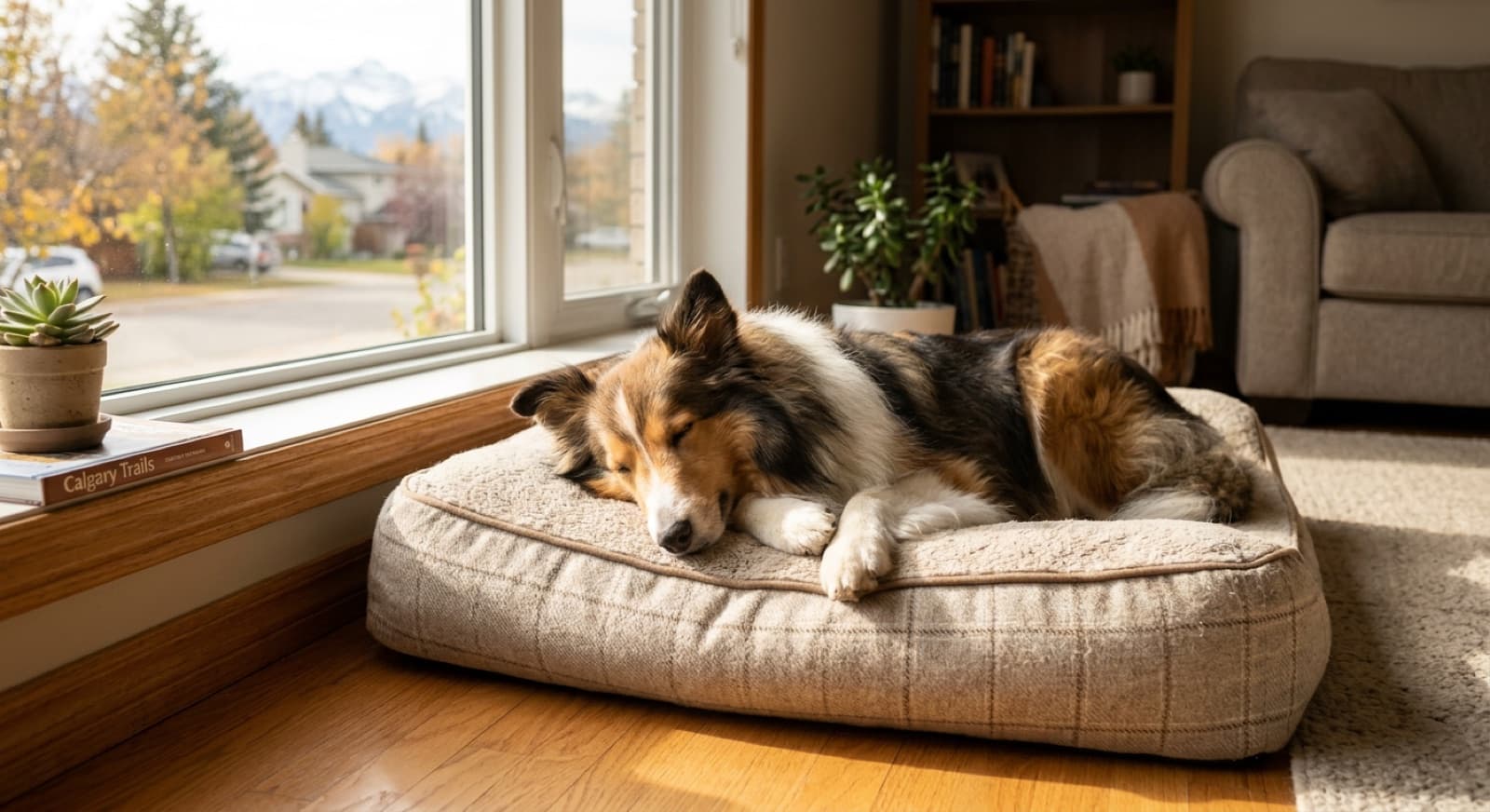
Shelties stay vocal. The owners who do well long-term are the ones who reach a sustainable level of barking they can live with rather than chasing elimination. Most reach that equilibrium within the first six months and then maintain it for the dog's lifetime.
The breed lifespan is 12 to 14 years. Vocal management is not a six-month project; it is a relationship the household builds with the dog over a decade. The good news is that consistency compounds. A Sheltie who has learned at year one that the doorbell predicts a treat scatter still responds calmly to the doorbell at year ten. A dog who has learned that demand barks produce nothing keeps that pattern lifelong. The training does not need to be redone; it needs to be maintained.
What does change over the dog's lifetime:
- Adolescence (8 to 18 months). Expect setbacks. Adolescent Shelties test established patterns and rehearse new ones. Hold the line through the adolescent year; the work pays off after.
- Adult stability (2 to 7 years). The plateau years. The training holds, the household equilibrium settles, and the dog is the dog you wanted.
- Senior years (8 to 14). New vocal behaviours can emerge with cognitive dysfunction, hearing loss, or pain. Any new pattern in a senior Sheltie warrants a vet visit before assuming it is behavioural. The vet rules out medical first, then the behaviour work resumes if needed.
If you are considering whether a Sheltie is the right breed for your household, the Sheltie right-for-you guide walks through the full self-assessment. If you are weighing the breed against the Rough Collie or the Australian Shepherd, the Sheltie vs Collie vs Aussie comparison covers the differences. For the full rescue pathway and where to find Shelties in Calgary, the Sheltie adoption hub is the starting point.
Browse adoptable Shelties in Calgary
Foster temperament evaluation tells you whether a particular Sheltie has a history of severe vocal issues, separation anxiety, or successful management before you bring them home. Rescue placements give you that information up front.
See Available Shelties →Sources and further reading
- American Veterinary Society of Animal Behavior (AVSAB) — position statements on humane training and behaviour treatment
- International Association of Animal Behaviour Consultants (IAABC) — force-free consultant directory and behaviour resources
- Fear Free Pets — veterinary and training certification for low-stress handling
- American Shetland Sheepdog Association — breed standard and temperament profile
- City of Calgary Responsible Pet Ownership Bylaw 3M2006 — barking complaint process
This article is informational. It is not behavioural or veterinary advice for an individual dog. For specific vocal, panic, or self-injury concerns, work with your Calgary veterinarian, a force-free trainer experienced with vocal management, and where appropriate a board-certified veterinary behaviourist.
Frequently Asked Questions
Will my Sheltie ever stop barking?
Probably not entirely, and that is not the goal. Shelties were bred over generations on the Shetland Islands to alert herders to threats across distance. Vocal behaviour is the breed working as designed, not a training failure. A realistic outcome with consistent force-free training is reduction and threshold control: an alert bark that stops on cue instead of running 30 seconds, doorbell barks that settle within a minute, demand barks extinguished, and panic vocalisation resolved with a behaviour protocol. Most Calgary Sheltie owners reach a sustainable level they can live with by month six of consistent work. Shelties typically live 12 to 14 years, so vocal management is a lifelong skill, not a one-time fix.
Are bark collars OK for Shelties?
No. Shock, citronella, vibration, and ultrasonic bark collars are not recommended for Shelties or any dog. Shelties are a sensitive temperament breed and tend to shut down hard under aversive correction. The American Veterinary Society of Animal Behavior (AVSAB) and the International Association of Animal Behaviour Consultants (IAABC) both formally recommend force-free, reward-based methods over aversive tools. Bark collars suppress the symptom without resolving the underlying drive, so the behaviour either pops up in another form or the dog becomes generally anxious and inhibited. If a Calgary trainer recommends a bark collar for a Sheltie, find a different trainer.
How do I stop my Sheltie from barking at the doorbell?
Counter-condition the doorbell so it predicts a calm activity instead of an arousal trigger. Step one: with the dog on a leash or behind a baby gate, have a helper ring the bell. As soon as the bell rings, before the dog escalates, scatter five small treats on the floor. Repeat 10 to 20 times per session over several days. The bell stops being a threat alert and starts being a treat cue. Step two: layer in a cue word like “thank you” after one or two alert barks, paired with the treat scatter. Within two to four weeks most Shelties shift from sustained barking to a couple of alerts plus a calm settle. Never punish the bark itself; you are training the response, not suppressing the alert.
My neighbours are complaining about my Sheltie. What do I do?
Act fast and proactively. The City of Calgary Responsible Pet Ownership Bylaw governs barking complaints, and sustained vocalisation can escalate to fines if not addressed. First, talk to the neighbour directly with a short honest message: you are aware of the issue, you are working on it, here is your phone number, please tell you directly if it continues. Most complaints come from neighbours who feel ignored. Second, identify what is triggering the barking (alone-time, window views, doorbell, fence-line) and apply the matching protocol in this article. Third, if the barking is happening during alone time, add a midday walker or daycare day to break up the absence. Fourth, if a complaint has already been filed, engaging a force-free trainer creates a paper trail showing you are addressing it.
Why is my Sheltie barking at nothing?
It is rarely nothing. Shelties have sharper hearing and stronger predator vigilance than most breeds, and a working herding dog was rewarded for alerting on stimuli humans cannot perceive. The neighbour two doors down opening their garage, a coyote on a green space three blocks away, a delivery truck idling on the next street, a furnace cycling on, a child crying in the apartment above all register for a Sheltie that you may not consciously notice. Video record the dog during a barking episode and watch for what the ears, eyes, and nose are tracking. The trigger is almost always there once you look for it.
How do I tell normal alert barking from anxiety vocalisation?
Alert barking is short, focused, triggered by a specific stimulus, and stops when the trigger passes or you intervene. The dog can be redirected, takes treats, and settles within a minute or two. Anxiety vocalisation is sustained, often paired with pacing, drooling, panting in a cool room, destruction at exit points, refusing food, or self-injury. It does not respond to redirection and escalates rather than fades. The diagnostic test is video: leave the house on your normal routine for 30 to 60 minutes and watch the footage. If the dog settles within 15 to 20 minutes, that is normal alone-time discomfort. If the dog stays at panic intensity for the full hour, that is separation anxiety and needs a different response than alert-bark training.
Are Shelties OK in a Calgary condo?
They can be, with caveats. Shelties are small, exercise needs are moderate, and shedding aside they are physically a reasonable condo dog. The hard part is the vocal profile in a shared-wall building. Sustained barking carries through condo and townhouse walls in ways that single-family neighbours rarely deal with, and the Responsible Pet Ownership Bylaw applies the same regardless of housing type. If you are already in a condo with a Sheltie, the path is proactive neighbour communication, white noise during alone time, window film to block visual triggers from the hallway or balcony, and a force-free desensitisation protocol if the barking happens when you leave. If you are still in the planning stage, consider whether a shared-wall building is genuinely the right housing for a herding-alert breed.
Will more exercise stop my Sheltie from barking?
Exercise helps the underlying arousal but does not on its own resolve vocal behaviour. A tired Sheltie still barks at the doorbell, still alerts at the window, and still demand-barks if demand barks have worked before. What exercise does well is take the edge off the morning so the dog enters alone-time below their arousal ceiling, and reduce the displacement barking that happens when an under-exercised herding dog has nothing to do. Aim for 30 to 45 minutes of structured exercise plus 10 to 20 minutes of mental work (nose games, training sessions, puzzle feeders) before any extended alone time. The exercise is necessary but not sufficient; the behaviour protocols still need to run.
Should I let my Sheltie bark out the window?
No. A Sheltie at a window with a view of the street is going to alert-bark at every walker, dog, squirrel, delivery truck, and leaf that moves all day. Each rehearsal of the behaviour strengthens it. The cure is environmental management: frosted contact paper or window film on the bottom half of the window, moving the dog's preferred resting spot away from street-facing windows, or closing blinds during alone time. You are not punishing the dog or suppressing the breed; you are removing a stimulus your dog cannot ignore so the training protocols have a chance to work.
When should I see a veterinary behaviourist for vocal issues?
Escalate from a force-free trainer to a board-certified veterinary behaviourist (DACVB) when the vocalisation is paired with panic (sustained pacing, drooling, self-injury, destruction at exit points), is not improving after six to eight weeks of consistent force-free work, includes generalised anxiety beyond the bark trigger (noise sensitivity, car panic, vet visit panic), or when two or more force-free trainers have flagged the case as out of scope. A DACVB is a licensed veterinarian with post-graduate specialty training in behaviour medicine. They can rule out medical contributors, co-manage with a force-free trainer, and where appropriate prescribe behaviour-supporting medication as part of an integrated plan. We do not recommend any specific medication in this article; that decision belongs with the prescribing clinician.
Sheltie Adoption Calgary
Where to find Shelties in Calgary, rescue vs breeder costs, surrender patterns, and the screening that protects both dog and adopter.
Is a Sheltie Right for You?
Honest self-assessment for Calgary households: vocal tolerance, exercise, grooming, condo realities, and the breed's real fit.
Sheltie vs Collie vs Aussie
Three herding breeds, three different households. Side-by-side comparison of size, energy, vocal profile, and Calgary fit.
Shelties for Adoption in Calgary
Current Sheltie and Sheltie-mix listings from Calgary Humane, AARCS, and the partner rescue network. Updated regularly.
New dog? Start with these care guides
Everything a new adopter needs to set up a safe, happy home.