The short answer
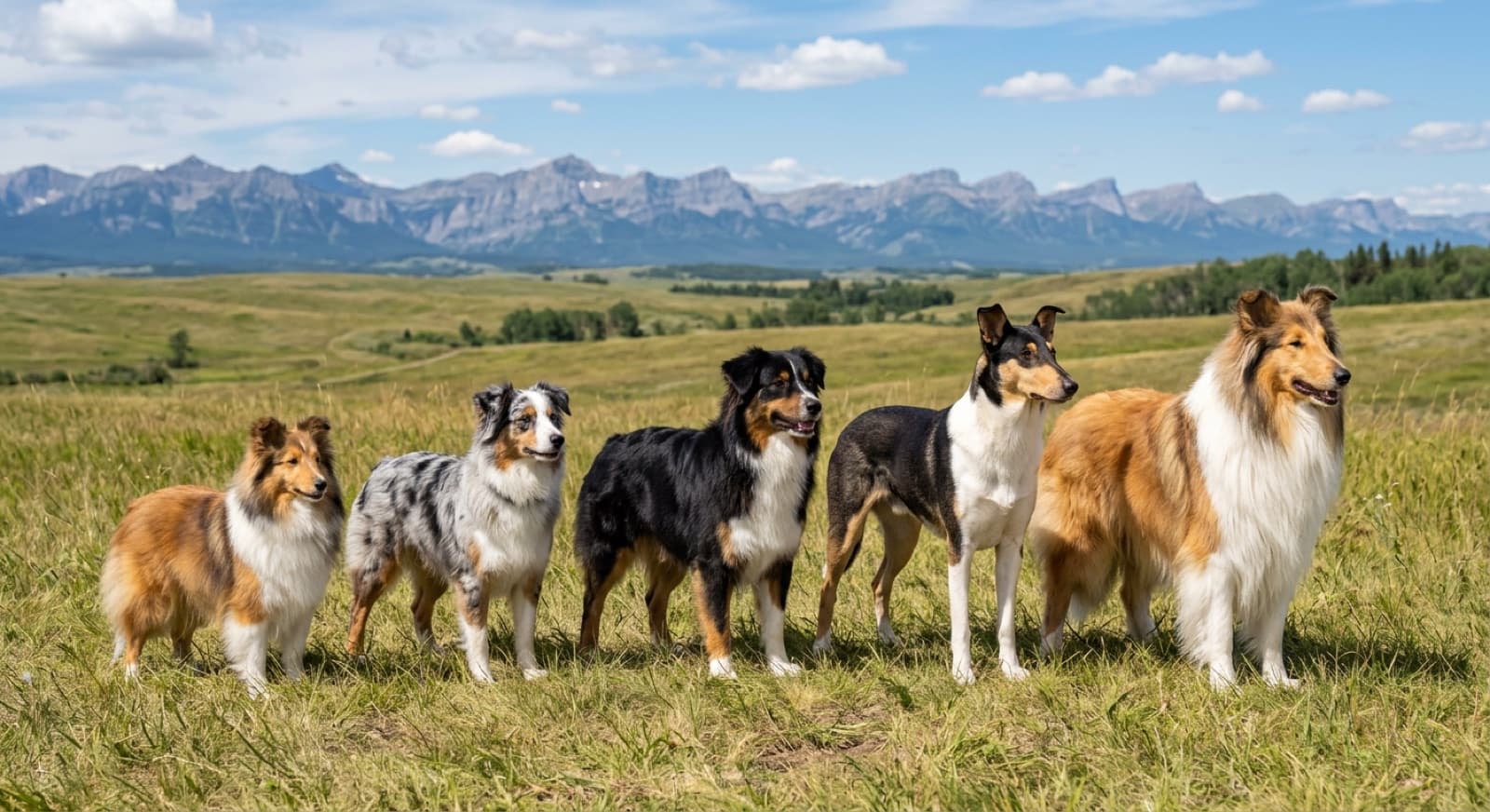
The five breeds Calgary adopters confuse are the Shetland Sheepdog (Sheltie), Rough Collie (the Lassie type), Smooth Collie, Miniature American Shepherd, and Australian Shepherd. Size tells them apart fastest. Sheltie at 15 to 25 lbs, Mini American Shepherd at 25 to 40 lbs, Aussie at 40 to 65 lbs, both Collie varieties at 50 to 75 lbs. They share the long-muzzle, almond-eye Collie family face plus a Scottish or American herding heritage, but each breed was developed independently. “Mini Collie” is not a recognised breed.
At-a-glance comparison
Five Collie-family breeds, size-ordered smallest to largest.
| Breed | Weight | Height | Lifespan | Energy | Coat | Origin | Best for |
|---|---|---|---|---|---|---|---|
| Shetland Sheepdog | 15 to 25 lbs | 13 to 16 in | 12 to 14 yr | High | Long double | Shetland Is. 1800s | Apartment-OK vocal small herder |
| Mini American Shepherd | 25 to 40 lbs | 13 to 18 in | 12 to 13 yr | High | Medium double | California 1960s | Athletic mid-size herder |
| Australian Shepherd | 40 to 65 lbs | 18 to 23 in | 12 to 15 yr | High | Medium double | American West 1800s | High-drive working dog |
| Smooth Collie | 50 to 75 lbs | 22 to 26 in | 12 to 14 yr | Medium-high | Short double | Scotland 1700s | Lowest-maintenance family dog |
| Rough Collie (Lassie) | 50 to 75 lbs | 22 to 26 in | 12 to 14 yr | Medium-high | Long double | Scotland 1700s | Classic family dog, needs space |
Why these five breeds get confused
All five share the same recognisable Collie-family face. Long pointed muzzle, almond-shaped eyes, prick or semi-prick ears, double coat in tri-colour, sable, blue merle, or black-and-white. From a distance and at a glance, a black-and-white Sheltie and a black-and-white Aussie look like the same dog at different sizes. A Smooth Collie and an Australian Shepherd in the same colour have similar facial structure.
They also share Scottish or American herding heritage. The Rough and Smooth Collie were developed in mainland Scotland in the 1700s for large-scale livestock work. The Sheltie was developed in the Shetland Islands in the 1800s, partly from Collie ancestors plus smaller Spitz-type dogs, to work smaller livestock on harsh terrain. The Australian Shepherd was developed in the American West in the 1800s and 1900s, named “Australian” because shepherds who arrived from Australia were associated with the type. The Miniature American Shepherd was developed in 1960s California by selectively breeding smaller Aussies together. AKC formally recognised it as a separate breed in 2015.
So you have five breeds with overlapping faces, overlapping coat patterns, overlapping origins, overlapping herding instincts, and overlapping intelligence rankings. The differences are real but easy to miss without side-by-side comparison.
Shetland Sheepdog (Sheltie)
Size: 15 to 25 lbs, 13 to 16 inches at the shoulder.
Origin: Shetland Islands of Scotland in the 1800s. Bred to herd sheep, ponies, and chickens on rocky, harsh terrain.
Temperament: Highly intelligent (top 10 by Stanley Coren), trainable, sensitive, often reserved with strangers, devoted to family. Loud and frequent vocalisation is the defining trait. A Sheltie barks to alert, to communicate, and sometimes to express any change in routine. Apartment Sheltie owners need a barking management plan from day one.
Coat: Long double coat. Heavy shedding year-round plus dramatic spring and fall coat blow (2 to 4 weeks each). Twice or three times weekly brushing during non-blow seasons, daily during coat blow. Mat-magnet zones behind ears, in britches, around neck ruff.
Energy: High, but compressed into a small body. 60 minutes daily exercise plus mental enrichment satisfies most Shelties. Sport potential is high (agility, rally, obedience, scent work, treibball).
Calgary fit: the most apartment-feasible of the five. Vocalisation is the biggest constraint, not size or energy. See our dedicated Sheltie vocal management guide and the cluster hub at our Sheltie adoption guide.
Breed parent club: American Shetland Sheepdog Association.
Rough Collie (the Lassie type)
Size: 50 to 75 lbs, 22 to 26 inches at the shoulder.
Origin: Mainland Scotland in the 1700s, developed for large-scale sheep and cattle herding. Queen Victoria's patronage in the 1800s made the breed internationally famous. The 1943 film “Lassie Come Home” and the 1954 to 1973 television series cemented the breed in popular culture.
Temperament: Gentle, devoted, intelligent, sensitive, generally good with kids. Lower herding drive than Aussies or Shelties after decades of show and companion selection. Often labelled the “family dog” of the herding group. Vocalisation is moderate.
Coat: Long, dense double coat with the distinctive mane around the neck. Heavy shedding year-round plus dramatic seasonal coat blow. Daily brushing during coat blow, two to three times weekly otherwise. Professional grooming every 8 to 12 weeks in Calgary runs $80 to $130.
Energy: Medium-high. 60 to 75 minutes daily exercise plus moderate mental enrichment. Less sport-driven than the Aussie or the Mini American Shepherd, but capable in obedience, rally, scent work, and modified agility.
Calgary fit: a detached home with a yard suits the Rough Collie well. Apartment fit is poor (size plus coat-blow vacuum demand). A senior or adult adoption from the Collie Club of Canada rescue network is often the easiest entry point.
Breed parent club: Collie Club of America.
Smooth Collie
Size: 50 to 75 lbs, 22 to 26 inches at the shoulder. Identical to the Rough Collie in size and structure.
Origin: Mainland Scotland in the 1700s, developed alongside the Rough Collie. The AKC and the Collie Club of America treat the two as varieties of one breed (you can interbreed and the offspring register as their parent variety). The Canadian Kennel Club takes the same approach.
Temperament: Identical to the Rough Collie. Gentle, devoted, lower herding drive than other Collie-family breeds, generally good with kids, moderate vocalisation. The differences between Smooth and Rough are coat only.
Coat: Short double coat. Year-round shedding plus the same dramatic spring and fall coat blow as the Rough Collie. Once-weekly brushing handles non-blow seasons. No professional grooming required. The lowest day-to-day grooming demand of the five breeds.
Energy: Medium-high. Same exercise needs as the Rough Collie (60 to 75 minutes daily).
Calgary fit: for adopters who want the Collie temperament without the long-coat maintenance, the Smooth Collie is the best of the five for first-time herding-breed owners. Detached home preferred, but the smaller grooming load makes apartment life more feasible than for the Rough Collie. The breed is rarer than the Rough, so Calgary rescue availability is occasional rather than common.
Miniature American Shepherd
Size: 25 to 40 lbs, 13 to 18 inches at the shoulder.
Origin: Developed in California in the 1960s by breeding smaller Australian Shepherds together. AKC formally recognised the breed in 2015 under the name “Miniature American Shepherd” to clarify that it is a separate breed, not a smaller variety of the Aussie. ASCA still calls it “Mini Australian Shepherd” in some contexts, so both names persist.
Temperament: High-drive working dog at miniature size. Velcro attachment to handler, sport-driven, intense focus. Often confused with the Sheltie at puppy stage based on size, but the energy profile is closer to the standard Aussie. Vocalisation is moderate to high.
Coat: Medium double coat. Heavy shedding year-round plus seasonal coat blow. Mat-magnet zones behind ears, in britches, around neck ruff. Brushing two to three times weekly non-blow, daily during coat blow.
Energy: High to very high. 60 to 90+ minutes daily exercise plus significant mental enrichment. Sport potential is excellent (agility, treibball, herding trials, rally, dock diving).
Calgary fit: a suburban house with yard or an active outdoor family suits the Mini American Shepherd well. Apartment fit is challenging. See our dedicated Mini American Shepherd guide for the full breakdown.
Breed parent club: MASCUSA (Miniature American Shepherd Club of the USA).
Australian Shepherd
Size: 40 to 65 lbs, 18 to 23 inches at the shoulder.
Origin: American West, late 1800s and early 1900s. The breed name is misleading. Aussies were developed by American ranchers, not in Australia. The name comes from the association with Basque shepherds who arrived in the US via Australia in the 1800s. The breed was used to herd sheep and cattle on western ranches and is still actively worked today in some areas.
Temperament: The highest working drive of the five breeds. Velcro attachment, intense focus, sport-driven, often vocal alert behaviour. Aussies are not casual companion dogs. They are working dogs that have been adapted to family life with significant exercise and training investment.
Coat: Medium double coat. Heavy shedding year-round plus dramatic seasonal coat blow. Same grooming routine as the Mini American Shepherd.
Energy: Very high. 60 to 90+ minutes daily exercise plus significant mental enrichment is the minimum. Sport potential is among the highest of any breed (agility, herding trials, dock diving, flyball, treibball, rally, obedience).
Calgary fit: a suburban house with yard or an acreage with active outdoor lifestyle suits the Aussie. Apartment fit is poor. Sedentary owner fit is poor. See our cluster hub at our Australian Shepherd adoption guide and the right-for-you guide at is an Australian Shepherd right for you.
Breed parent club: Australian Shepherd Club of America (ASCA).
The “Mini Collie” problem
“Mini Collie” is not a recognised breed. AKC, CKC, and the Collie Club of America do not register it.
People searching for a “Mini Collie” in Calgary usually mean one of two things.
Most often, they mean a Shetland Sheepdog. The Sheltie is the closest the Collie family has to a small Collie-style dog. The long-coat, tri-colour or sable variety in particular looks like a miniature Rough Collie. If the Lassie look at apartment size is what you want, the Sheltie is the answer.
Less often, they mean a Miniature American Shepherd. The size is similar but the body type, coat, and herding heritage are different. Mini American Shepherds came from Aussie stock, not Collie stock.
Sometimes “Mini Collie” or “Toy Collie” is a backyard breeder marketing label for runts of Rough Collie litters or for unethically bred small dogs. Dwarfism plus miniaturization stacks health risks (IVDD-style back issues, dental crowding, heart defects). Avoid this category entirely.
The honest advice: if you want the Collie look at a smaller size, adopt or buy a properly registered Sheltie. If you want the Aussie look at a smaller size, choose the Miniature American Shepherd. Both options are legitimate, parent-club-recognised, and available through ethical Calgary breeders or the rescue network.
Herding instinct compared
All five breeds are herding breeds. Working drive intensity varies significantly.
Australian Shepherd: highest working drive. Still actively used on western ranches. Many Calgary Aussies show strong eye-stalk-chase patterns at livestock, kids, joggers, bikes, or cats. Without an outlet, herding behaviour often turns into anxious pacing or fence-running.
Miniature American Shepherd: high working drive at smaller size. Same eye-stalk-chase patterns as the standard Aussie, just less physically intimidating.
Shetland Sheepdog: moderate working drive. Circling, chasing running kids, occasional nipping at heels. The smaller size makes the behaviour less dangerous, but it still needs management. Treibball and scent work redirect herding drive productively.
Rough Collie and Smooth Collie: lowest working drive of the five. Decades of show and companion selection have softened the working instinct. Many Calgary Collies never show strong herding behaviour. Some still do, especially from working-line backgrounds.
The Calgary takeaway: all five can nip at running kids or chase bikes without training. Force-free redirection plus proper outlets (treibball, agility, scent work, structured exercise) handles it in all five. The Aussie and Mini American Shepherd need more outlet hours per week than the Collie or Sheltie.
Vocalisation: the Sheltie wins by a mile
Vocalisation is the single biggest differentiator within the five breeds. Ordered most to least vocal.
- Shetland Sheepdog: the most vocal by a wide margin. Barking is part of the breed identity. Alert, demand, excitement, communication. Calgary apartment Shelties need a barking plan from day one. See managing Sheltie barking.
- Miniature American Shepherd: vocal alert dogs. Less constant than Shelties but more than the Aussie.
- Australian Shepherd: moderately vocal. Barking with purpose (alert, demand, herding excitement) more than background noise.
- Rough Collie: moderate. Alert barker but generally settles quietly.
- Smooth Collie: the least vocal. Same temperament as the Rough Collie, just with the easier coat.
For a Calgary condo or townhouse with a noise bylaw, the Smooth Collie (if you can handle the size) or the Rough Collie is the best fit. For a detached home with tolerant neighbours, any of the five works with training. A Sheltie in a noise-sensitive building is a recipe for complaints and possible eviction.
Coat and grooming
All five are heavy shedders. None are hypoallergenic. Maintenance demand varies by coat length.
Long-coat breeds: Sheltie, Rough Collie, Mini American Shepherd, Australian Shepherd. Twice or three times weekly brushing during non-blow seasons. Daily brushing during the spring and fall coat blow (2 to 4 weeks each). Mat-magnet zones behind ears, in britches, under armpits, around neck ruff. Professional grooming every 8 to 12 weeks in Calgary runs $60 to $130 depending on size and matting.
Short-coat breed: Smooth Collie. Once-weekly brushing handles non-blow seasons. Daily during coat blow. No professional grooming required. The lowest day-to-day grooming demand of the five.
Coat-blow management: the Calgary chinook cycle plus the Aberta seasonal swing produces particularly dramatic coat blow in all five breeds. Plan for vacuum cleaner upgrades, lint rollers, and tolerance for tumbleweeds of fur for a few weeks twice a year. A high-velocity dryer (HV dryer) speeds up the coat-blow process dramatically.
Never shave any of the five. Double coats protect against both heat and cold. Shaving can damage the coat permanently and increases sunburn risk in summer.
Allergy alternative: none of the five are hypoallergenic. Allergy-sensitive families need a low-shedding breed. The Sheltidoodle and Aussiedoodle exist but are not parent-club recognised, and Poodle ancestry moderates herding intensity less than people expect.
MDR1 drug sensitivity
MDR1 is present in all five breeds. Every dog should be DNA-tested regardless of breed.
MDR1 (Multi-Drug Resistance mutation, also called ABCB1) is a genetic mutation that makes certain drugs toxic by allowing them to cross the blood-brain barrier and accumulate. The mutation originated in a common ancestor of the Collie family and is now found in all herding breeds descended from it.
Approximate breed prevalence per the Washington State University Veterinary Clinical Pharmacology Lab:
- Rough Collie and Smooth Collie: approximately 70%
- Australian Shepherd: approximately 50%
- Miniature American Shepherd: approximately 50%
- Shetland Sheepdog: approximately 15%
The two Collie varieties have the highest prevalence of the five. The Sheltie has the lowest. None of the five are MDR1-free as a breed.
The DNA test is $45 to $80 through Embark, or free through WSU CTRAW (Canine Test Request for At-risk Animals). Test once, result is permanent.
If a dog tests positive:
- Avoid ivermectin (heartworm preventive), loperamide (Imodium), vincristine (chemotherapy), and the full WSU problem drug list
- Anesthesia protocols need adjustment for any surgical procedure
- Tell every vet, groomer, and boarding kennel the MDR1 status
- Use the WSU list as a reference any time a new medication is prescribed
Calgary emergency cost of a contraindicated drug reaction can run $5K to $15K at Western Veterinary Specialist Centre or VCA Canada West.
Calgary lifestyle fit
Which breed fits which Calgary household. Read the household type, then the recommended breed.
Apartment or condo, working full-time: Smooth Collie (if you can handle the size) is the realistic top pick. Lower vocalisation, lower exercise demand than the Aussie, manageable coat. Sheltie possible only if you commit to a vocalisation management plan and neighbours are tolerant. Aussie and Mini American Shepherd are poor fits.
Apartment or condo, home-based or hybrid work: Sheltie is feasible. Daily exercise plus mental enrichment plus barking management. Smooth Collie also good. Mini American Shepherd is borderline. Aussie is challenging.
Townhouse or duplex, working full-time: Smooth Collie or Rough Collie. Sheltie with vocalisation plan. Aussie and Mini American Shepherd need daycare 2 to 4 times per week.
Detached home with yard, working full-time: any of the five. The yard helps but does not replace exercise. Mini American Shepherd or Aussie still needs daily structured exercise.
Detached home with yard, home-based: Aussie or Mini American Shepherd shines here. Velcro temperament fits home-based work. Sport-driven dogs need the engagement.
Active outdoor family (hiking, skiing, biking): Aussie is the top pick. Mini American Shepherd close second. The two Collies and Sheltie work but underutilise their potential.
Family with young kids: Smooth Collie or Rough Collie. Lower herding drive, gentle temperament, less likely to nip at running kids. Sheltie possible. Aussie and Mini American Shepherd need careful introduction and consistent force-free training to manage herding-nip behaviour around kids.
Senior adopter or first-time herding-breed owner: Smooth Collie is the top recommendation. Sheltie second. Aussie last.
Best pick for first-time owners
The Smooth Collie is the most underrated breed in the Collie family. Lower vocalisation than the Sheltie. Lower exercise demand than the Aussie. Lower grooming demand than the Rough Collie. Manageable energy at 60 to 75 minutes daily. Calgary rescue availability is occasional rather than common, but worth the wait.
The Sheltie is the second-best first-time herding-breed choice for owners willing to commit to a barking plan. Smaller size makes physical handling easier. Very trainable. Adult adoptions from Calgary rescues simplify the picture.
The Rough Collie is similar to the Smooth but with the higher-maintenance coat. Good first-time choice if grooming time is not a constraint.
The Australian Shepherd and Miniature American Shepherd are usually too high-drive for first-time herding-breed owners. We see Aussie surrenders from first-time owners more often than any of the other four breeds. The story is consistent. Cute Aussie puppy, owner not prepared for velcro intensity plus sport-level exercise needs, behavioural issues develop, surrender at adolescence (8 to 18 months). A foster-tested adult Aussie (3+ years) from AARCS or BARCS is a more realistic first-time option than an Aussie puppy from any source.
For all five breeds, work with a Calgary force-free trainer like Raising Canine or Pup City Pup Academy from week one. Aversive training elevates aggression risk in herding breeds.
Browse adoptable Shelties in Calgary
The Sheltie is the most apartment-feasible of the five Collie-family breeds. Browse current Calgary rescue listings on the breed page.
See Available Shelties →Frequently Asked Questions
Is a Sheltie just a small Collie?
No. A Sheltie (Shetland Sheepdog) is a separate breed, not a miniature Collie. The two share the Collie-family face and Scottish herding heritage but were developed independently. The Sheltie comes from the Shetland Islands and tops out at 15 to 25 lbs and 13 to 16 inches. The Rough and Smooth Collie were developed on mainland Scotland for larger-scale herding and run 50 to 75 lbs and 22 to 26 inches. AKC and CKC register them as distinct breeds with separate parent clubs.
What is the difference between a Mini Aussie and a Miniature American Shepherd?
They are the same dogs under two names. AKC recognised the breed in 2015 as Miniature American Shepherd. ASCA still uses “Mini Australian Shepherd” in some contexts. Both names persist. Adult size runs 25 to 40 lbs. They are not a teacup or toy version of the Aussie. A “Toy Aussie” label is a backyard breeder red flag. MASCUSA is the AKC parent club.
Which is the smallest of these breeds?
The Shetland Sheepdog is smallest at 15 to 25 lbs and 13 to 16 inches. Miniature American Shepherd next at 25 to 40 lbs. Australian Shepherd at 40 to 65 lbs. Rough Collie and Smooth Collie at 50 to 75 lbs. For Calgary apartments, the Sheltie is the most realistic of the five. The Mini American Shepherd is borderline. The two Collies and the standard Aussie are not apartment breeds.
Which has the least herding drive?
The Rough Collie and Smooth Collie have the lowest working herding drive of the five. Decades of show and companion selection have softened the original cattle and sheep working instinct. The Sheltie comes next. The Australian Shepherd has the strongest working drive. The Miniature American Shepherd sits between the Sheltie and the Aussie. None of the five is herding-free. All can nip at running kids or chase bikes without training and management.
Do all five breeds carry MDR1?
Yes, at different prevalence rates. Collie (Rough and Smooth) around 70%, Australian Shepherd around 50%, Miniature American Shepherd around 50%, Shetland Sheepdog around 15%. Every dog should be DNA-tested regardless of breed ($45 to $80 Embark or free through WSU CTRAW). Once positive, avoid the WSU problem drug list and tell every vet, groomer, and boarding kennel.
Is a “Mini Collie” a real breed?
No. AKC, CKC, and the Collie Club of America do not recognise it. Anyone searching for one usually means a Shetland Sheepdog (the closest small Collie-style breed) or a Miniature American Shepherd. Some unethical breeders use “Mini Collie” as a marketing label for runts or unethically bred small dogs. Dwarfism plus miniaturization stacks health risks. Adopt or buy a properly registered Sheltie or Mini American Shepherd instead.
Which is the most vocal?
The Sheltie is the most vocal by a wide margin. Mini American Shepherd next. Australian Shepherd moderately vocal. Rough Collie moderate. Smooth Collie the least vocal. For a Calgary condo or townhouse with a noise bylaw, the Smooth Collie or Rough Collie is the best fit. A Sheltie in a noise-sensitive building needs a barking management plan from day one.
Which has the easiest coat to maintain?
The Smooth Collie. Short double coat. Once-weekly brushing non-blow seasons. No professional grooming required. The other four have long double coats requiring two to three times weekly brushing plus daily during coat blow, mat-magnet zone attention, and $60 to $130 professional grooming every 8 to 12 weeks in Calgary. None of the five are hypoallergenic.
Which fits a Calgary working professional best?
The Sheltie and Smooth Collie. A Sheltie at 15 to 25 lbs is apartment-feasible with daily exercise plus mental enrichment. The Smooth Collie is bigger but settles well and has low vocalisation. Both respond well to force-free methods. The Aussie is the toughest fit for a working professional. Velcro temperament plus high exercise needs plus separation-anxiety tendency makes solo full-time work difficult. Adult adoptions simplify the picture.
Which is the best first-time owner choice?
The Smooth Collie. Lower vocalisation, lower herding drive, manageable energy, easy coat. Sheltie second. Rough Collie third. Aussie and Mini American Shepherd are usually too high-drive for first-time herding-breed owners. We see Aussie surrenders from first-time owners more often than the other four breeds. A foster-tested adult Aussie from AARCS or BARCS is a more realistic first-time option than a puppy.
Sheltie Adoption Calgary
Rescue sources, real costs, MDR1, vocalisation, and the breeder-vs-rescue reframe.
Is a Sheltie Right for You?
Honest lifestyle fit guide. Vocalisation, energy, apartment compatibility, family fit.
Australian Shepherd Adoption Calgary
Mini Aussie clarification, ARPH rescue verification, costs, working vs show lines.
Mini American Shepherd Calgary
The full Mini Aussie breakdown. Size, energy, MDR1, sport potential, costs.
Adoptable Shelties in Calgary
Live listings of Shetland Sheepdogs from the Calgary rescue network, updated regularly.
Adoptable Australian Shepherds
Live listings of Aussies and Mini Aussies from the Calgary rescue network.
New dog? Start with these care guides
Everything a new adopter needs to set up a safe, happy home.