The short answer
Staffordshire Bull Terriers typically weigh 24 to 38 lbs and live 12 to 14 years with proactive care. The breed has several distinct elevated risks. From the top of the list: L-2-hydroxyglutaric aciduria (L2HGA) is a metabolic disorder essentially unique to the Staffy, DNA testable, and ethical breeders screen for it. Hereditary cataracts (HC) are DNA testable and ethical breeders screen for them. Persistent hyperplastic primary vitreous (PHPV) is a congenital eye condition ethical breeders identify on ophthalmic exam. Hip dysplasia is documented, and OFA or PennHIP screening matters. Patellar luxation follows the small-to-medium breed pattern. Mast-cell tumours are the most common skin cancer in the breed and the dominant senior cancer risk. Atopic dermatitis and demodectic mange are documented skin conditions in some lines. Brachycephalic-light anaesthesia caution applies; the muzzle is shorter than a Lab's but less compromised than a Bulldog's. Obesity risk is real because the breed is food-motivated and joint-prone.
This article is informational only and is not veterinary advice. Always consult your Calgary veterinarian for individualised health guidance for your specific dog.
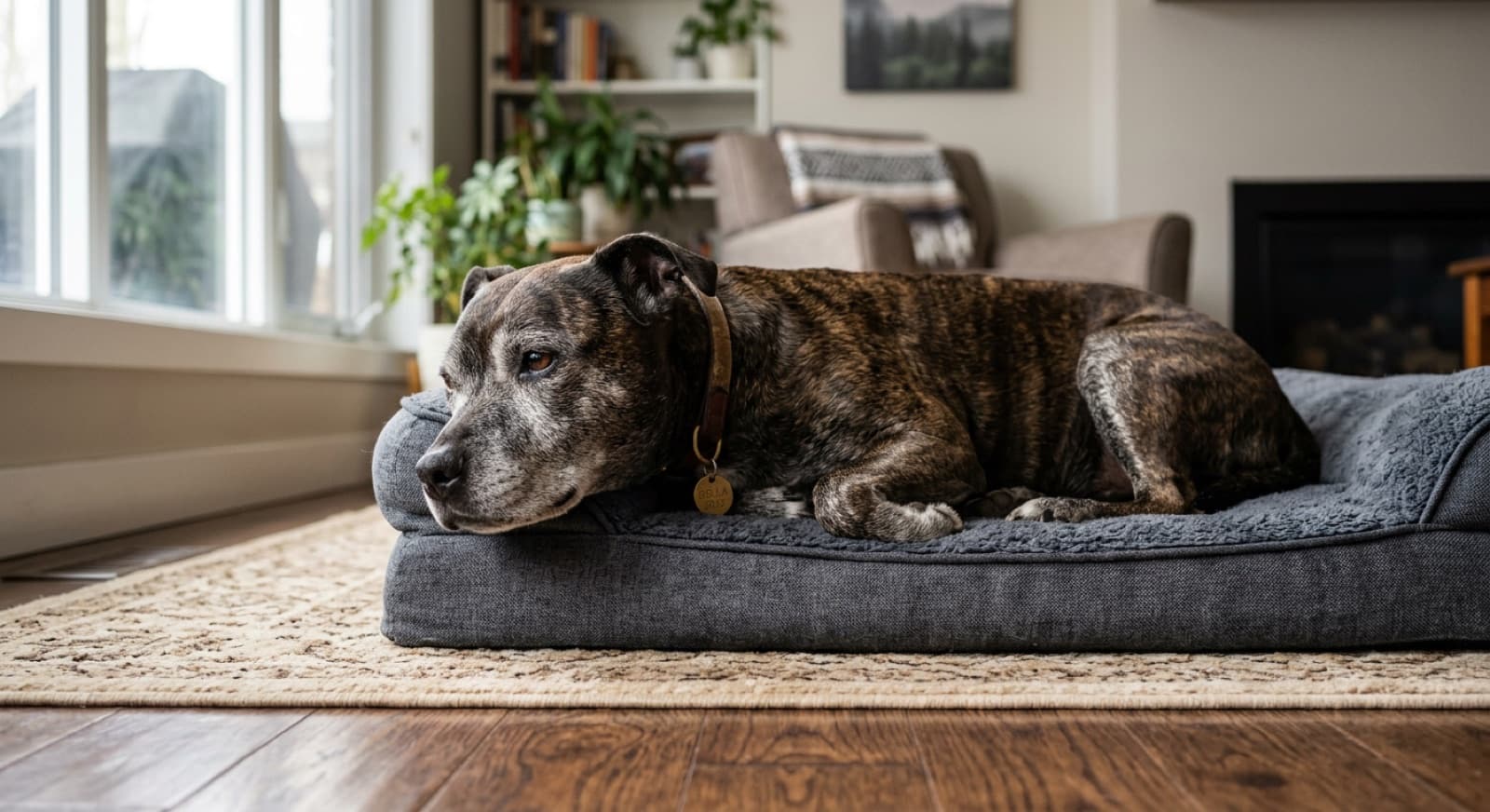
The Staffordshire Bull Terrier is a compact muscular terrier developed in 19th-century England from old bull-and-terrier crosses and standardised by the Kennel Club in 1935. The modern Staffy is family-oriented, sturdy, and remarkably gentle despite the breed's historical working background. The 1935 standardisation drew from a relatively small founding population, which concentrated several recessive disorders into the breed (L2HGA, hereditary cataracts, PHPV). Ethical breeders now screen with DNA tests widely available through commercial labs. This article walks Calgary owners through the conditions to discuss with your vet at adoption and at every annual exam after that, what to watch for at home, and what belongs in the hands of a veterinarian rather than the internet. Sources include the American Kennel Club, the Orthopedic Foundation for Animals (OFA), the AKC Canine Health Foundation, the Cornell University College of Veterinary Medicine, the American Animal Hospital Association, the Canadian Kennel Club, and the UK Kennel Club hereditary health resources.
Why Staffies have a distinct health profile
Three facts shape almost everything on this page. First, the breed traces to a relatively narrow founding population at the 1935 Kennel Club standardisation, which concentrated a small number of recessive disorders into the modern Staffy population (L2HGA, hereditary cataracts, PHPV). Ethical breeders now screen with DNA tests widely available through commercial labs. Second, the Staffy's compact muscular build sits in the small-to-medium body band where patellar luxation and joint disease are documented patterns. Third, the breed sits in a moderately elevated-risk group for mast-cell tumours, which makes monthly home skin checks one of the highest-value owner habits.
For a rescue Staffy without breeder records (which is most rescue Staffies), the practical implication is simple: manage proactively. Build a Calgary vet schedule, plan a week-1 baseline workup, and establish a monthly skin-check habit before you bring the dog home. The rest of this article walks through what to ask the vet about and when.
L-2-hydroxyglutaric aciduria (L2HGA, DNA testable)
L2HGA is a metabolic disorder essentially unique to the Staffordshire Bull Terrier breed. It is autosomal recessive (two affected copies needed for clinical disease) and DNA testable through commercial veterinary genetics labs. Ethical breeders screen both parents. Affected dogs show neurological signs starting in early adulthood. Any suspected L2HGA episode is a Calgary vet visit, ideally with a neurology referral.
L-2-hydroxyglutaric aciduria is a rare metabolic disorder in which a key enzyme in mitochondrial energy metabolism is missing or defective. The result is accumulation of L-2-hydroxyglutaric acid in the central nervous system, which causes progressive neurological dysfunction. The condition was first characterised in the Staffordshire Bull Terrier and is essentially confined to the breed. The DNA test has been widely available since the mid-2000s, and ethical breeders have used it to dramatically reduce the prevalence of affected puppies.
Signs to discuss with your Calgary vet (typically appearing 6 months to 6 years):
- Progressive ataxia (unsteady wobbly gait)
- Behaviour changes including dementia-like episodes, anxiety, or unusual reactivity
- Tremors, particularly head tremors or whole-body tremors during exertion
- Seizure-like episodes
- Reduced exercise tolerance
- Loss of learned behaviours or training
- Stiffness or muscle cramping after exercise
Diagnosis is by DNA testing through a commercial veterinary genetics lab combined with neurological evaluation by your vet or a referral neurologist. Urine organic acid testing can also detect elevated L-2-hydroxyglutaric acid. Management is supportive only; there is no cure, and the condition is progressive. Quality-of-life conversations are part of the care plan. Specific management decisions belong entirely with your Calgary veterinary team, often in consultation with a neurologist at Western Veterinary Specialist Centre or VCA Canada West. For a Staffy from breeder paperwork, the L2HGA DNA result for both parents should be in writing before purchase. Carriers (one copy) are clinically normal and can be bred only to clear partners.
Hereditary cataracts (HC, DNA testable)
Hereditary cataracts in Staffordshire Bull Terriers are an inherited eye condition distinct from age-related cataracts. The Staffy form is DNA testable through commercial veterinary genetics labs. Ethical breeders screen both parents. For a rescue Staffy with visible lens cloudiness, your Calgary vet can confirm by ophthalmic exam and order DNA testing.
Hereditary cataracts in Staffies are autosomal recessive and typically appear bilaterally between 6 months and 3 years of age. The cataracts progress over months to years and can cause significant vision impairment or complete blindness. This is a different condition from age-related (senile) cataracts that may appear in any senior dog. The HC DNA test has been widely available for over a decade and ethical breeders use it to avoid producing affected puppies.
Signs to discuss with your Calgary vet:
- Visible cloudiness in the lens, often appearing as a bluish-grey or white opacity behind the pupil
- Reluctance to navigate in dim light or in unfamiliar environments
- Hesitation on stairs or curbs
- Bumping into furniture in familiar rooms
- Changes that appear in both eyes within months of each other
Diagnosis is by veterinary ophthalmology examination and DNA testing through commercial labs. Treatment for advanced cataracts causing vision loss may include surgical lens replacement (phacoemulsification) at a veterinary ophthalmology specialty centre; this is a major procedure and the decision belongs entirely with your vet team and the ophthalmologist. Many Staffies with hereditary cataracts adapt well to gradual vision loss in a stable home environment when furniture stays put and routines stay consistent.
Persistent hyperplastic primary vitreous (PHPV)
Persistent hyperplastic primary vitreous is a congenital eye condition documented in Staffordshire Bull Terriers, in which the embryonic blood-vessel network that normally regresses before birth persists in the eye after birth. The condition ranges from minor remnants (no visual impact) through significant remnants (variable visual impact) to severe forms with cataracts and retinal detachment. Affected dogs are born with the condition; it is not progressive in the way hereditary cataracts are. PHPV is identifiable on ophthalmic exam, and the UK Kennel Club has historically supported screening for the condition in the breed.
Signs to discuss with your Calgary vet:
- Visual hesitation in a young Staffy, especially in dim light or unfamiliar environments
- An eye that appears different from the other on close inspection
- Visible remnants or opacities behind the lens on careful examination
- Bumping into objects on one side (suggesting unilateral impairment)
Diagnosis is by veterinary ophthalmology examination, often as part of a CERF or OFA eye certification visit. There is no cure for PHPV, but the focal forms are often clinically silent and require no treatment. Severe forms with cataract or detachment may need surgical evaluation by a veterinary ophthalmologist. Decisions belong with your vet and an ophthalmology referral when needed.
Hip dysplasia
Hip dysplasia is documented in Staffordshire Bull Terriers and is included in OFA hip dysplasia breed statistics. Ethical breeders evaluate both parents with OFA or PennHIP scoring before breeding.
Hip dysplasia is a developmental malformation of the hip joint where the ball and socket do not fit together correctly. Over time, the joint develops painful arthritis. The condition is influenced by genetics, growth rate, body weight, and exercise pattern during growth. Staffies are not in the highest-risk breed band, but the condition is present at a meaningful rate in the breed.
Symptoms to discuss with your Calgary vet:
- Bunny-hopping gait when running, where both rear legs push off together rather than alternating
- Reluctance to climb stairs, jump into the car, or get up onto the couch
- Hindlimb stiffness after rest that improves with movement
- Visible muscle wasting in the hindquarters
- A drop in willingness to run hard on Calgary off-leash trails such as Nose Hill Park, Fish Creek Provincial Park, or Bowmont Park
Diagnosis is by X-ray imaging scored against OFA or PennHIP standards, read by your Calgary vet or a referral radiologist. Management ranges from conservative care (weight control, joint support recommended by your vet, physiotherapy, and pain control your vet selects) through to surgical options for severe cases. Surgical decisions and rehabilitation plans belong with a Calgary specialty centre. Calgary surgical correction is available through specialty orthopaedic surgeons when needed; your regular vet refers.
Body weight is the most important owner-controllable factor. An overweight Staffy puts more load through hips and elbows than a lean one of the same height. Body condition scoring on the 1 to 9 scale at every Calgary vet visit is more useful than the bathroom scale alone. Staffies are food-motivated and weight-prone, and lean body condition through the lifespan pays dividends in every joint.
Patellar luxation
Patellar luxation is a condition in which the kneecap slips out of its normal groove in the femur. It is more common in small-to-medium breeds and follows that pattern in the Staffy. Affected dogs may show intermittent hindlimb lameness, a characteristic skipping or hopping gait for a few steps, or holding the leg up briefly before returning to normal. The condition is graded I through IV by severity, and grading belongs with your Calgary vet on physical exam.
Signs to discuss with your Calgary vet:
- A skipping or hopping gait for a few steps, then returning to normal
- Briefly holding a hindleg up while running, then putting it back down
- Intermittent hindlimb lameness, often unilateral but sometimes bilateral
- Stiffness after exercise that resolves with rest
Diagnosis is by physical exam (palpation of the knee) and sometimes X-ray imaging. Management ranges from conservative care for low-grade cases through to surgical correction (trochleoplasty) for high-grade cases causing lameness. Surgical decisions belong with a Calgary specialty centre.
Mast-cell tumours (the dominant senior cancer risk)
Mast-cell tumours are the most common skin cancer in Staffordshire Bull Terriers, and the breed sits in a moderately elevated-risk group. Monthly home skin checks and prompt vet visits for any new lump are the highest-value owner habits. A fine-needle aspirate is a quick in-clinic diagnostic.
Mast-cell tumours are skin and subcutaneous tumours arising from mast cells, immune cells normally involved in allergic responses. They can range from low-grade and curable with surgical excision to aggressive and metastatic with a more challenging prognosis. The Staffy is one of several breeds documented in the moderately elevated-risk category.
What to watch for at home:
- Any new lump on or just under the skin, including ones that feel different from existing fatty lumps
- Lumps that change size from day to day (waxing and waning is a classic mast-cell tumour pattern)
- Lumps that become red, itchy, swollen, or ulcerated
- Lumps on the trunk, limbs, around the muzzle, in the groin, or near the genitals
- Lumps that appear suddenly and grow visibly
- Any new lump in a senior Staffy, even a small subtle one
Home routine: a monthly skin check is the single most useful habit. Run your hands slowly over the dog from nose to tail, feeling for any new lump or change in an existing one. Document size, location, and date noted for every new finding in a notebook or phone note. Bring the documentation to every Calgary vet visit. Any new lump warrants a vet conversation, not a wait-and-see.
Diagnosis is typically a fine-needle aspirate done in clinic, with cells examined under the microscope. Confirmed mast-cell tumours are usually staged with bloodwork, lymph-node aspiration, and sometimes abdominal ultrasound. Treatment is typically surgical excision with wide margins, sometimes with adjuvant chemotherapy for higher-grade tumours. Specialty oncology and veterinary dermatology referral may be part of the plan. The full treatment plan belongs entirely with your Calgary veterinary team. Mast-cell tumour treatment in Calgary commonly runs $2,000 to $8,000 or more depending on grade, staging needs, and treatment plan, which is the reason early pet insurance matters for this breed.
Brachycephalic-light features and heat sensitivity
Some Staffy lines carry a slightly shortened muzzle compared with longer-nosed breeds, which places the breed in the brachycephalic-light category. The breathing risks are far less severe than English Bulldogs, French Bulldogs, or Pugs, but the muzzle shape still matters for anaesthesia planning and heat tolerance. A standard Staffy is far less compromised than a Bulldog, but pre-anaesthetic conversations with your Calgary vet still benefit from the breed context.
Practical implications for Calgary owners:
- Summer heat sensitivity. Calgary July and August afternoons routinely hit 25 to 30+ degrees Celsius, and Staffies cool less efficiently than longer-nosed breeds. Move walks to early morning or evening. Provide constant water access. Never leave a Staffy in a parked car. Watch for excessive panting, gum colour changes, or lethargy as early heat-stress signs.
- Exercise pacing on hot days. A 30-minute walk that is fine in May becomes risky in late July. Adjust intensity to the conditions.
- Anaesthesia planning. Pre-operative conversations with your vet about airway evaluation and monitoring intensity are worthwhile.
- Snoring and breathing sounds. Some baseline snoring is breed-typical; new or worsening noisy breathing warrants a vet conversation.
Skin conditions (atopic dermatitis and demodectic mange)
Staffordshire Bull Terriers are at moderately elevated risk for several skin conditions, and skin disease is one of the most common reasons owners see the vet repeatedly. The two main concerns in the breed are atopic dermatitis (environmental allergy) and demodectic mange in some lines, particularly in younger dogs and those under stress.
Atopic dermatitis is an inherited tendency to react to environmental allergens such as pollens, dust mites, and moulds. Classic Staffy signs are recurrent paw licking and chewing, face rubbing, itching around the armpits, groin, and belly, and recurrent ear or skin infections that come back after every course of antibiotics. Onset is typically between ages 1 and 3. The condition is lifelong rather than curable. Diagnosis is by ruling out other causes and observing the seasonal or year-round pattern; allergy testing can identify specific triggers. Management is individualised and includes lifestyle modifications, vet-prescribed itch control, and sometimes immunotherapy. The plan belongs with your Calgary vet or a veterinary dermatologist.
Demodectic mange is caused by Demodex mites that normally live in low numbers on dog skin. In dogs with immature or compromised immune systems, the mites can multiply and cause patchy hair loss, redness, and sometimes secondary skin infections. Localised demodex (a few small patches) often resolves on its own in young Staffies. Generalised demodex (widespread involvement) needs veterinary treatment and may warrant a dermatology referral. Diagnosis is by skin scraping done by your vet. Treatment selection belongs entirely with your veterinary team.
What not to do. Do not treat ongoing Staffy skin disease with over-the-counter human products, internet remedies, or anti-itch medications you have heard about from another owner. Many of the products discussed casually online are inappropriate or unsafe for dogs, and several of the prescription options that work well in skin disease have specific dose and monitoring requirements that belong with your vet.
Obesity risk and weight management
Staffordshire Bull Terriers are notoriously food-motivated, and the breed's muscular compact build can hide weight gain. An overweight Staffy puts more load through hips, elbows, and knees, accelerates joint disease, and increases anaesthesia risk for any procedure. Obesity is one of the most preventable health problems in the breed, and it sits firmly in the owner-controllable category.
Practical weight management for a Calgary Staffy:
- Body condition scoring on the 1 to 9 scale at every Calgary vet visit. The target is 4 or 5 (you should be able to feel ribs easily without seeing them prominently, and the dog should have a visible waist from above).
- Measured meals, not free-feeding. Use a kitchen-scale-accurate cup or weighed portions.
- Treat budget capped at 10 percent of daily calories. Use treats as training currency, not random snacks.
- Daily exercise: 45 to 60 minutes of moderate activity in moderate weather, adjusted down for Calgary summer heat and Calgary winter cold extremes.
- Senior diet conversation with your vet around age 7; caloric needs typically drop in seniors.
- A weight chart kept on the fridge or in a phone note, updated at every vet visit.
Weight loss plans for an already-overweight Staffy belong with your Calgary vet. Restrictive feeding done poorly can mask other conditions and cause new ones; structured weight-loss diets and the timeline belong in the hands of a veterinarian.
Calgary Staffy health checklist by life stage
The breed-specific conditions above each have a typical onset window, which gives a reasonable framework for what to ask your Calgary vet about and when. The specific tests, the timing, and any modifications based on your individual dog's history are decisions for your veterinarian.
Puppy (under 12 months):
- Standard vaccination series, parasite prevention, spay or neuter conversation
- Confirm L2HGA, hereditary cataracts, and PHPV status from breeder paperwork (or testing through your vet)
- Baseline eye exam
- Body condition scoring established as a baseline; food intake planning
- Patellar exam at every wellness visit
- Skin and coat baseline (note any flare patterns or demodex patches)
Young adult (1 to 4 years):
- Annual wellness exam with full physical and dental check
- Annual skin exam (mast-cell tumour vigilance habit established)
- Baseline bloodwork
- Annual eye exam, CERF or OFA Eye Certification where available
- Hip radiograph conversation if any gait irregularity appears
- Skin and allergy conversation; atopic dermatitis often starts in this window
- Monthly home skin-check habit established
Middle-aged (5 to 7 years):
- Annual wellness exam, escalating toward twice-yearly
- Annual full bloodwork
- Annual eye exam (age-related cataracts may begin to appear)
- Annual skin exam (mast-cell tumour vigilance)
- Lump and bump documentation begins in earnest
Senior (8+ years):
- Twice-yearly wellness exams
- Full senior bloodwork twice yearly
- Rigorous lump-and-bump documentation; new lumps get a fine-needle aspirate, not a wait-and-see
- Annual eye exam
- Cancer screening conversations; mast-cell tumours are the dominant senior cancer risk
- Joint support and mobility aids: orthopaedic bed, traction rugs on hardwood, ramps for stairs and the car
- Body condition scoring at every visit (lean is gentler on hips, elbows, knees, and the heart)
- Quality-of-life conversations started long before they feel needed
Calgary veterinary access for a Staffy
The single most useful thing a new Staffy owner can do in the first week is build a Calgary veterinary plan before the dog has a problem. That means a regular vet you trust, a 24-hour emergency clinic identified and saved in your phone, and a short list of specialty referral options for the breed-specific conditions that may come up. Staffies in particular tend to get to know their veterinary oncologist or dermatologist over the years, so picking a practice that is comfortable referring early is worth doing on purpose.
Calgary planning checklist:
- Regular vet: Choose a Calgary clinic with experience in terriers and short-coated medium breeds. Ask whether the practice routinely manages mast-cell tumour aspirates and atopic skin disease, because these are the bread-and-butter of Staffy ownership. Use the Canadian Veterinary Medical Association directory if you need a starting point.
- 24-hour emergency clinic: Calgary has several distributed across NW, NE, SW, and SE. Identify the closest one to your home, save the address in your phone, and drive the route once in daylight so the path is in your head.
- Specialty referral options: Western Veterinary Specialist Centre and VCA Canada West Veterinary Specialists handle internal medicine, cardiology, ophthalmology, dermatology, neurology, oncology, and orthopaedic surgery. Your regular vet refers when needed.
- Low-cost spay and neuter access: Calgary Pet Wellness and Spay/Neuter Clinic offers lower-cost spay and neuter for adopters on a budget. Confirm services and pricing with the clinic.
- Pet insurance: Enrol while the Staffy is young and symptom-free, particularly before any skin diagnosis or lump appears in the chart. Compare Canadian providers on deductible, reimbursement, per-condition limits, and whether hereditary conditions and cancer treatment are covered.
- Microchip and licence: Calgary requires dog licensing under the Responsible Pet Ownership Bylaw, and microchipping is a standard recommendation.
- Calgary-specific seasonal preparation: Winter paw protection for ice melt, summer heat planning (Staffies cool less efficiently than longer-nosed breeds), and a sweater or coat for the deep cold snaps a short-coated Staffy cannot tolerate well.
Pet insurance ROI for a Staffy
Pet insurance is a strong consideration for Staffordshire Bull Terriers because the senior mast-cell tumour risk is real, atopic skin disease can generate steady monthly vet costs across the breed's lifespan, and orthopaedic correction for severe hip dysplasia or patellar luxation can run into five figures. Mast-cell tumour treatment in Calgary commonly runs $2,000 to $8,000 or more depending on grade, staging needs, and whether surgery alone or surgery plus chemotherapy is involved. A serious atopic dermatitis workup at a veterinary dermatologist can run into the thousands across an initial workup plus ongoing management.
The lever that matters most is enrolling early. Every Canadian provider excludes pre-existing conditions. A Staffy enrolled at 8 weeks old with no symptoms qualifies for the broadest coverage; one enrolled at age 4 after a diagnosis of atopic dermatitis or after a documented skin lump will have those issues excluded from coverage indefinitely. Skin conditions and lumps are exactly the kind of diagnoses that, once on the chart, are very hard to insure around. Calgary premiums vary by provider, age, and breed, so request real quotes from several Canadian insurers and compare deductible, reimbursement (typically 70 to 90 percent), and per-condition versus annual limits side by side.
Questions to ask any insurer before enrolling a Staffy:
- Are hereditary and congenital conditions covered, or excluded?
- Are bilateral conditions (both hips for dysplasia, both knees for patellar luxation, both eyes for cataracts) treated as one claim or two?
- Is there a per-condition lifetime cap or only an annual cap?
- How are pre-existing conditions defined, and what counts as evidence of pre-existence? (This matters most for skin and lump history.)
- Are diagnostics (bloodwork, urinalysis, imaging, dermatology cytology, fine-needle aspirate, DNA testing) covered, or only treatments?
- Is dermatologist and oncologist referral covered?
- Is cancer treatment (surgery, chemotherapy, radiation) covered without sub-limit caps?
Considering a Staffordshire Bull Terrier in Calgary?
Health-aware adoption is the single biggest thing you can do for a Staffy. Monthly skin checks, an early Calgary vet plan, lean body condition, and pet insurance enrolled before any skin diagnosis or lump turn a 12 to 14 year compact companion into the dog the breed is supposed to be. Browse adoptable Staffies in Calgary and read the matching breed-fit guides before you bring the dog home.
See Calgary Staffies available now →Adopting a rescue Staffy with unknown history
Most rescue Staffies in Calgary come with limited paperwork. That is normal. The practical implication is that the week-1 vet visit is more important than it would be for a dog with breeder documentation, and the questions you ask the rescue before adopting matter.
What to ask the rescue:
- What is the dog's known history? Any prior owners, any returns, any reason for surrender?
- Any prior skin conditions, recurrent itching, hot spots, or treated demodex episodes?
- Any tremors, ataxia, behaviour changes, or seizure-like episodes (which may suggest L2HGA)?
- Any limping, stiffness, kneecap slipping, or reluctance to exercise?
- Any prior vet records, transferred X-rays, or eye exam results?
- Any current or historical lumps on the skin?
- Has the dog been spayed or neutered?
- What food has the dog been eating, and at what schedule?
- Any heat-tolerance issues noted during foster?
Plan a week-1 Calgary vet workup that covers:
- Thorough physical exam including skin check and patellar exam
- Baseline bloodwork: complete blood count, chemistry panel, electrolytes
- Conversation about hip and eye screening at the appropriate age
- Conversation about DNA panel for L2HGA and hereditary cataracts if there is any clinical suspicion
- Lump and bump baseline documentation
- Pet insurance enrolment before any new diagnoses appear in the chart
Budget framing. Plan for a week-1 vet workup of several hundred dollars. Plan to enrol pet insurance immediately, before any new diagnosis. Plan for a steady ongoing budget for skin care across the dog's lifespan, with occasional dermatology referral fees when an underlying allergy needs a workup. The conditions that matter most in a Staffy's lifespan are largely manageable when caught early; the budget for catching them early is the actual lever.
Senior Staffy care (8 years and up)
Staffies are a working terrier at heart, and seniors do best when their owners adjust the routine rather than dropping it. The dog who played hard at age 4 still wants to be out and engaged at age 11; the question is how to keep that going safely.
Mobility and orthopaedics:
- Orthopaedic bed with good support; rotate position for dogs with reduced mobility
- Traction rugs on hardwood and tile to prevent slipping
- Ramps for getting into the car and up onto the couch
- Body condition scoring at every visit; lean is gentler on every joint
- Daily moderate exercise rather than weekend-warrior intensity
- Pain management decisions belong with your vet
Cancer monitoring (the dominant senior priority for a Staffy):
- Twice-yearly wellness exams with thorough skin check
- Full senior bloodwork twice yearly
- Document every new lump (size, location, date noted)
- Any new lump in a senior Staffy gets a fine-needle aspirate, not a wait-and-see
- Sudden weakness, pale gums, or visible distress is a same-day Calgary 24-hour emergency event
Skin and dental:
- Monthly home skin check continues through the senior years
- Skin lumps documented and brought to every vet visit
- Annual or semi-annual dental check; professional cleaning when your vet recommends
- Oral masses are a common finding in seniors; any new growth in the mouth is a vet visit
Dietary refinement and cognitive support:
- Senior diet conversation with your vet; caloric needs typically drop in seniors
- Cognitive dysfunction signs (disorientation, altered sleep, house-soiling, reduced engagement) are vet conversations
End-of-life framing:
Quality-of-life conversations should start years before they feel needed. Your Calgary vet team has the experience to help you read the trajectory and to discuss palliative options, in-home euthanasia, and aftercare when the time comes. Planning ahead is a kindness to the dog and to yourself.
Anaesthesia considerations
Staffies generally tolerate standard anaesthesia protocols well, but the breed's brachycephalic-light muzzle shape and the senior mast-cell tumour risk profile mean a few specific pre-operative conversations are worth having with your Calgary veterinary team.
- Airway evaluation. A pre-anaesthetic conversation about the dog's individual airway anatomy is worthwhile. Most Staffies are far less compromised than Bulldogs or Pugs, but the muzzle shape still affects intubation and recovery monitoring.
- Recovery monitoring intensity. Brachycephalic-light dogs benefit from closer post-anaesthetic monitoring during recovery, particularly for any sign of airway distress.
- Temperature regulation. Staffies cool less efficiently than longer-nosed breeds. Maintaining a stable body temperature through recovery matters, particularly in Calgary summer.
- Skin condition baseline at the pre-operative exam helps your vet plan post-operative wound monitoring, since atopic Staffies may lick or chew incisions more.
- Analgesia for orthopaedic procedures. Pain control planning around hip or knee surgery in seniors is a specialty conversation; orthopaedic surgical centres in Calgary handle this routinely.
Anaesthesia planning, drug selection, monitoring intensity, and any modifications to standard protocols belong entirely with your Calgary veterinary team and any specialty consultants they involve.
The ethical Staffy breeder screening checklist
If you are considering a Staffordshire Bull Terrier from a breeder, the documentation below should be available in writing for both parents. The Staffordshire Bull Terrier Club of Canada and the Canadian Kennel Club publish parent-club versions of this guidance. Without these documents, walk away.
Required documentation for both parents:
- L2HGA DNA test result. Clear, Carrier, or Affected. Pair Clear-to-Clear or Clear-to-Carrier (never Carrier-to-Carrier or Affected breeding).
- Hereditary cataracts (HC) DNA test result. Clear, Carrier, or Affected. Same pairing rules.
- PHPV eye examination. By a board-certified veterinary ophthalmologist.
- OFA or PennHIP hip evaluation. OFA scores of Fair, Good, or Excellent are acceptable starting points.
- OFA elbow evaluation. Normal is the target.
- Patellar luxation evaluation. Grading by a vet.
- CERF or OFA annual eye certification.
- Cardiac evaluation. Auscultation at minimum; echocardiogram for older breeding dogs.
- Discussion of skin disease, demodex, and cancer history in the breeding lines.
Beyond paperwork. An ethical Staffy breeder will want to meet you, ask about your home, ask about your previous dogs and your family situation, and answer your questions in detail. They will offer a written contract that requires the dog to come back to them if it ever cannot stay with you. They will offer ongoing support. Puppies will have been socialised to many sights, sounds, surfaces, and handling experiences before they leave.
The walk-away test. If a Staffy breeder cannot or will not produce written L2HGA and hereditary cataracts DNA results plus OFA hip evaluations for both parents, walk away. These are the bare minimum. A Staffy from a backyard breeder with untested parents carries the full untested breed-risk profile.
Emergency signs that warrant immediate vet attention
These signs are same-day Calgary emergency vet visits. Do not wait, do not Google, do not ask a Facebook group. Drive to your nearest 24-hour clinic and call ahead so they are ready.
Suspected mast-cell tumour reaction (degranulation):
- A known or suspected mast-cell tumour that becomes suddenly red, swollen, and itchy
- Vomiting, lethargy, or collapse in a dog with a documented mast-cell tumour
- A lump that ruptures and bleeds
Suspected heat stress (Calgary summer):
- Heavy panting that does not resolve with rest in shade
- Bright red or pale gums
- Stumbling, weakness, or collapse on a warm day
- Vomiting or diarrhoea after exertion in heat
Sudden neurological signs (possible L2HGA episode in a young adult):
- Tremors that do not resolve quickly
- Sudden ataxia (severely unsteady gait)
- Seizure-like episodes
- Sudden dramatic behaviour change
Eye emergencies:
- Sudden cloudiness, blue-grey corneal change, or a film over the eye
- Persistent squinting, especially with redness or swelling
- A visibly enlarged or painful eye
- Sudden vision loss in an apparently healthy dog
Sudden collapse or distress:
- Apparent fainting or collapse, especially in a senior Staffy
- Pale gums, distended abdomen, or profound weakness
- Difficulty breathing or noisy breathing that is new or worsening
Frequently Asked Questions
What is the typical lifespan of a Staffordshire Bull Terrier?↓
Is L2HGA in Staffordshire Bull Terriers DNA testable?↓
What are the early warning signs of a mast-cell tumour in a Staffy?↓
Does hip screening really matter for a Staffordshire Bull Terrier?↓
What should I ask a Staffy rescue about a dog's health history?↓
When should I enrol a Staffordshire Bull Terrier in pet insurance?↓
Are Staffies brachycephalic, and does it affect anaesthesia?↓
How often should a Staffy have an eye exam?↓
How often should an adult Staffy see the vet?↓
When should I escalate to a Calgary specialty vet?↓
How does ethical breeder DNA screening work for Staffies?↓
Are Staffies more brachycephalic than Pit Bulls?↓
Continue reading
Staffordshire Bull Terriers in Calgary
Browse adoptable Staffies in Calgary right now, with live rescue listings and breed-fit context for each dog.
Staffordshire Bull Terrier adoption Calgary
The full Calgary Staffy adoption guide: rescue sources, real costs, surrender patterns, and the breed-vs-buy conversation.
Staffy vs Pit Bull Calgary
How the Staffordshire Bull Terrier and the American Pit Bull Terrier differ in build, drive, temperament, and health profile.
Pit Bull Health Issues: Skin, Knees, Lumps
Pit Bull-type dog health issues to plan for: itchy skin and allergies, torn knee ligaments, mast cell tumours, hips, weight and what to ask your vet.
New dog? Start with these care guides
Everything a new adopter needs to set up a safe, happy home.