The short answer
Two distinct breeds since 1999 in FCI countries; one breed with two types in AKC/CKC. The Japanese Akita Inu (55 to 75 lbs, foxier face, strict colour palette of red/white/brindle/sesame) preserves the traditional Japanese hunting-dog form. The American Akita (80 to 130+ lbs, bear-like head, all colours) developed into a larger, more openly protective guardian. Both share Akita-foundation temperament: aloof with strangers, devoted to family, high prey drive, dog-selective (especially same-sex aggression), guardian-instinctive. Both require experienced owners, force-free training, 6 ft fenced yard, single-dog or opposite-sex pair (no cats or small animals in most cases). Most Edmonton rescue Akitas are American type or mixed-line; foster home observation matters more than breed-line label. Bylaw 21244 dangerous-dog provisions apply equally to both. Neither type suits first-time dog owners or households wanting a friendly-with-everyone breed.
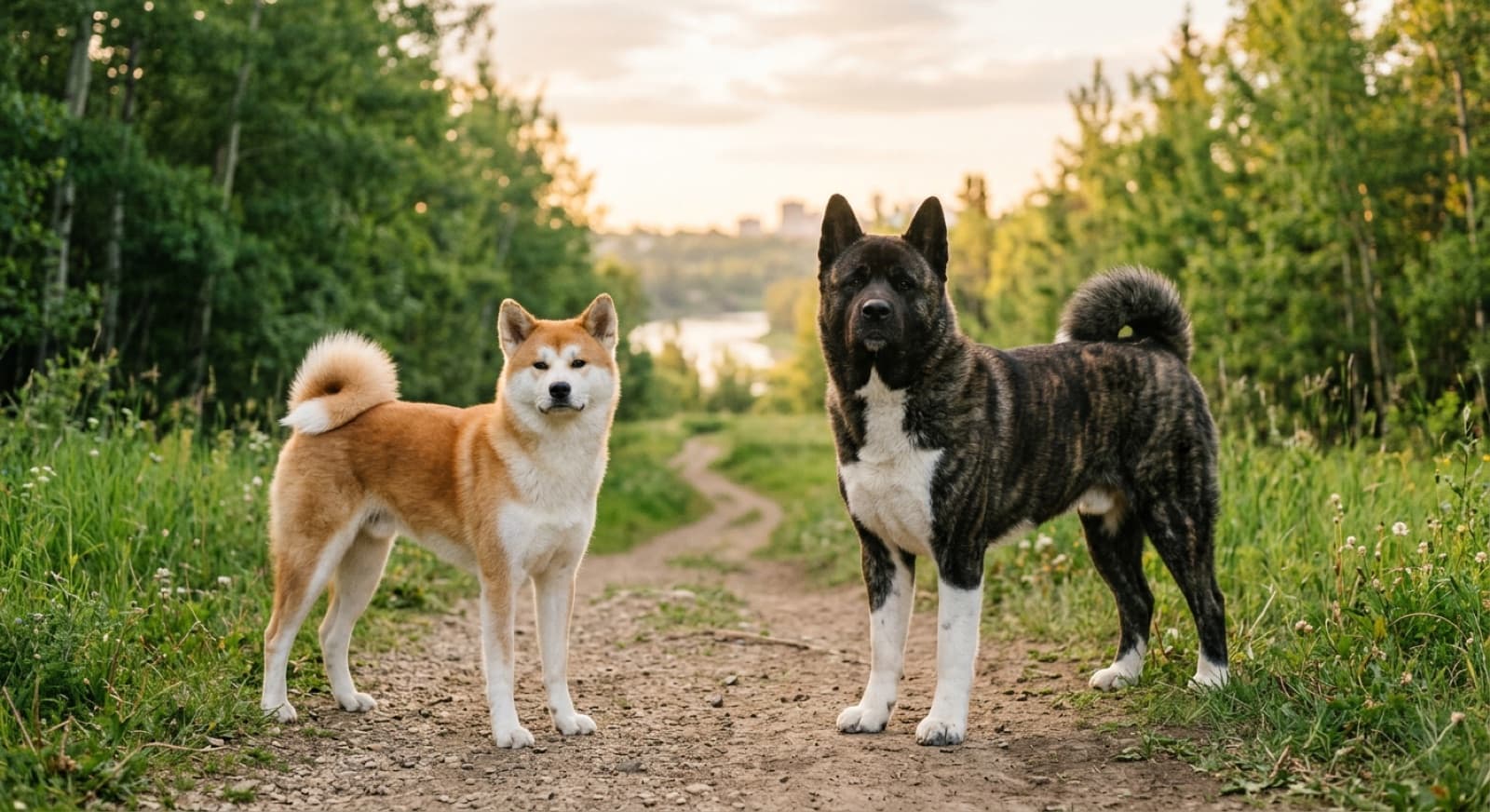
The post-WWII breed split
The Akita Inu originated in the mountainous Akita prefecture of northern Japan, where the breed was developed by the Matagi (traditional hunting peoples) for bear, boar, and deer hunting. By the early 20th century, the breed was associated with Japanese national heritage and was declared a natural monument in 1931. The breed nearly went extinct during the Second World War due to government orders, but a small population survived.
After the war, two distinct breeding directions emerged. The Japanese breeding community focused on restoring the traditional Akita Inu form: smaller, foxier-faced, strict colour palette. American servicemen including Helen Keller and others brought dogs back to the United States in the late 1940s and 1950s. American breeders developed the dogs in a different direction: larger, more substantial, broader colour acceptance, more guardian-style temperament.
By the 1970s and 1980s, the two lines had diverged substantially. The Federation Cynologique Internationale (FCI), which governs most kennel clubs outside North America, formally split the two breeds in 1999, recognising the Japanese Akita Inu and the American Akita as separate registered breeds.
The American Kennel Club and the Canadian Kennel Club consider the two types a single breed (registered simply as “Akita”) with two acceptable types within the standard. The Japanese Kennel Club only recognises the Japanese Akita Inu.
The practical implication for Edmonton adopters: the dogs labelled “Akita” in Edmonton rescue can be either type, and the differences matter for size, exercise requirements, household fit, and temperament expectations.
Side-by-side comparison
| Feature | Japanese Akita Inu | American Akita |
|---|---|---|
| Adult weight | 55 to 75 lbs | 80 to 130+ lbs |
| Shoulder height | 22 to 27 inches | 24 to 28 inches |
| Head shape | Foxier, triangular muzzle, refined | Bear-like, broader, more massive |
| Eyes | Small, almond-shaped | Deep-set, dark |
| Coat colours | Strict: red+white (urajiro), white, brindle, sesame | All colours including pinto, black masks |
| Temperament emphasis | More reserved, one-person bond intense | More openly protective of family/territory |
| Lifespan | 10 to 14 years | 10 to 13 years |
| FCI status | Separate breed (1999) | Separate breed (1999) |
| AKC/CKC status | Single breed (Akita) with two types | Single breed (Akita) with two types |
Individual variation within each type is substantial. Foster home observation and breeder evaluation matter more than breed-line averages for any specific dog.
Shared Akita-foundation temperament
Both types share the foundational Akita temperament: aloof with strangers, devoted to family, intelligent but independent, high prey drive, strong guarding instinct, often dog-selective particularly with same-sex dogs.
Shared traits:
- Aloof with strangers. Not aggressive without cause, but reserved and watchful. The Akita is not a “friendly to everyone” breed.
- Devoted to family. Deeply bonded with household members; protective of the family unit.
- Intelligent but independent. Quick learners but they will think about whether to comply. Not for owners who want immediate compliance.
- High prey drive. The breed evolved for hunting large game. Cats, small dogs, rabbits, squirrels are at risk in most cases.
- Strong guarding instinct. Both types alert and act on perceived threats to family or territory.
- Dog-selective, especially same-sex. Multi-Akita households of the same sex are commonly inadvisable for both lines.
Differences within these shared traits:
- Japanese Akita Inu: slightly more reserved demeanour. Stronger “one-person dog” tendency. Historically lived in close family hunting partnerships; bonds are intense and sometimes singular.
- American Akita: more openly protective stance toward family and territory. Slightly more outward expression of guarding behaviour. Same-sex aggression particularly notable in this line.
Both types require: experienced ownership, force-free training (aversive training is dangerous in both lines and elevates bite risk), structured socialisation in the first 18 months without overwhelming the dog, lifelong management including muzzle training as baseline life skill. Edmonton Bylaw 21244 dangerous-dog provisions apply equally to both types.
Browse adoptable Akitas in Edmonton
Most Edmonton rescue Akitas are American type or mixed-line. Foster home observation of temperament and household-fit matters more than breed-line label.
See Available Akitas →Which type for which household?
Japanese Akita Inu fits better in households that:
- Want a slightly smaller dog (55 to 75 lbs vs 80 to 130+)
- Prioritise the breed's traditional Japanese aesthetic
- Can handle the intense one-person bond that can complicate multi-person households
- Have a quieter home environment suiting the breed's reserved nature
- Can manage the high prey drive (cat-safe households or households without other small animals)
American Akita fits better in households that:
- Want a larger, more substantial dog (110+ lb dogs need proportionally more space, transport, vet care costs)
- Want a more openly protective family dog
- Accept higher dog-dog selectivity (especially same-sex aggression); plan for single-dog or carefully-paired multi-dog scenarios
- Can handle the more substantial physical management requirements during adolescence (peak rebellious phase 18 to 30 months)
Both types require: experienced large-breed owners, secure 6-ft fenced yard, force-free training relationship by month 6 to 8 (CCPDT, KPA, IAABC, or Fear Free certified Edmonton trainer), realistic expectations about aloofness with strangers, structured socialisation in the first 18 months without overwhelming the dog.
Neither type suits: first-time dog owners, households that want a traditionally “friendly with everyone” family dog, households with cats or small animals (the prey drive is breed-defining), households with toddlers without serious management plan.
Edmonton rescue context
Both types appear in Edmonton rescue but American Akitas (or American-Japanese mixes) are more common. The American Kennel Club and Canadian Kennel Club register both lines as “Akita” so rescue paperwork often does not distinguish. The breed assessment usually comes from foster home observation and visual identification.
Distinguishing features visible in foster photos and notes:
- Size (American Akitas are noticeably larger)
- Head shape (Japanese has foxier face, American has bear head)
- Colour and markings (Japanese has strict red/white/brindle/sesame palette; American has wider range)
- Overall substance (American is more substantial)
Many Edmonton rescue Akitas are mixed-line dogs where both types contributed to the lineage. The practical implications for size, exercise, and temperament are similar enough that the distinction matters less for management than for matching adopter expectations.
Edmonton rescue pathways: SCARS, Edmonton Humane Society, Zoe's Animal Rescue, AHHRB, and AARCS Edmonton fosters all see Akitas occasionally; breed-specific Akita rescue networks operate nationally and sometimes place dogs in Edmonton.
Frequently Asked Questions
Are the Japanese Akita and the American Akita really different breeds?
Yes, formally so since the late 20th century. After the Second World War, two distinct breeding lines emerged. The Japanese line preserved the traditional Akita Inu form (smaller, foxier face, strict colour palette of red, white, brindle, sesame) while the American line, descended from dogs brought back by US servicemen including Helen Keller and others, developed into a larger, more substantial dog with a bear-like head and a broader colour range. The Federation Cynologique Internationale (FCI), which governs most kennel clubs outside North America, formally split the two breeds in 1999, recognising the Japanese Akita Inu and the American Akita as separate registered breeds. The American Kennel Club (AKC) and Canadian Kennel Club (CKC) consider them a single breed (registered simply as "Akita") with two acceptable types within the standard. The Japanese Kennel Club only recognises the Japanese Akita Inu. The practical implication for Edmonton adopters: the dogs labelled "Akita" in Edmonton rescue can be either type, and the differences matter for size, exercise requirements, household fit, and temperament expectations.
What does a Japanese Akita Inu look like?
Smaller and more refined than the American Akita. Adult Japanese Akita Inu typically weigh 55 to 75 lbs (females smaller) and stand 22 to 27 inches at the shoulder. The face is foxier with a triangular muzzle, smaller ears set forward, and a more delicate skull structure than the American Akita's bear-like head. The eyes are small and almond-shaped. The tail is plumed and curled tight over the back. Coat colours follow strict Japanese breed standards: red with white markings ("urajiro"), white, brindle, and sesame (red with black tipping). Solid white Japanese Akitas have no mask. The double coat is dense and stands off from the body. The overall impression is athletic spitz-type dog with refined Japanese aesthetic. The Japanese Akita Inu retains more of the original Matagi (Japanese hunting dog) build that hunted bears, boar, and deer in the mountainous regions of Akita prefecture in northern Japan. The breed is considered a natural monument in Japan and has strict preservation breeding standards.
What does an American Akita look like?
Substantially larger and more substantial than the Japanese Akita Inu. Adult American Akitas typically weigh 80 to 130+ lbs (females smaller but still 70 to 110 lbs) and stand 24 to 28 inches at the shoulder. The head is broader and more bear-like with a deeper muzzle, larger ears, and a more massive skull structure. The eyes are deep-set and dark. The tail is similar in curl to the Japanese type but proportionally larger. Coat colours include all combinations: red, brindle, fawn, sable, solid white, pinto, plus the wider acceptance of black masks on red dogs. Markings can be more dramatic. The double coat is thick and dense. The overall impression is large powerful guardian-type dog with a more imposing presence than the Japanese line. American breeding lines emphasised size and substantiality during the 20th-century development period; the breed evolved into a different working framework than the Japanese hunting dog origin.
What are the temperament differences between the two types?
Both share the foundational Akita temperament: aloof with strangers, devoted to family, intelligent but independent, high prey drive, strong guarding instinct, often dog-selective particularly with same-sex dogs. Differences within these shared traits: Japanese Akita Inu owners often report a slightly more reserved demeanor and stronger "one-person dog" tendency; the breed historically lived in close family hunting partnerships and the bonds are intense and sometimes singular. American Akita owners often report a more openly protective stance toward family and territory, with slightly more outward expression of guarding behaviour. Same-sex dog aggression is well-documented in both types but particularly notable in American Akitas; multi-Akita households of the same sex are commonly inadvisable for both lines but especially the American type. Both types are aloof with strangers but the American Akita more often actively wards off strangers; the Japanese Akita Inu more often simply ignores. Both have very high prey drive and are unsafe with cats and small dogs in most cases. Both require experienced ownership and structured force-free training; aversive training is dangerous in both lines and elevates bite risk. Individual variation within each type is substantial; foster home observation matters more than breed-line averages.
Which type is typically in Edmonton rescue?
Both types appear but American Akitas (or American-Japanese mixes) are more common in Edmonton rescue. The American Kennel Club and Canadian Kennel Club register both lines as "Akita" so rescue paperwork often does not distinguish. The breed assessment usually comes from foster home observation and visual identification. Distinguishing features visible in foster photos and notes: size (American Akitas are noticeably larger), head shape (Japanese has foxier face, American has bear head), colour and markings (Japanese has strict red/white/brindle/sesame palette; American has wider range), overall substance (American is more substantial). Many Edmonton rescue Akitas are mixed-line dogs where both types contributed to the lineage; the practical implications for size, exercise, and temperament are similar enough that the distinction matters less for management than for matching adopter expectations. SCARS, Edmonton Humane Society, Zoe's Animal Rescue, AHHRB, and AARCS Edmonton fosters all see Akitas (mostly American type) occasionally; breed-specific Akita rescue networks operate nationally and sometimes place dogs in Edmonton.
Which type is right for what kind of household?
Japanese Akita Inu fit better in households that: want a slightly smaller dog (55 to 75 lbs vs 80 to 130+), prioritise the breed's traditional Japanese aesthetic, can handle the intense one-person bond that can complicate multi-person households, have a quieter home environment that suits the breed's more reserved nature, can manage the high prey drive (cat-safe households or households without other small animals). American Akitas fit better in households that: want a larger, more substantial dog (consider that 110+ lb dogs need proportionally more space, transport, vet care costs), want a more openly protective family dog, accept the higher dog-dog selectivity (especially same-sex aggression) and willing to plan for single-dog or carefully-paired multi-dog scenarios, can handle the more substantial physical management requirements during adolescence (peak rebellious phase 18 to 30 months). Both types require: experienced large-breed owners, secure 6-ft fenced yard, force-free training relationship by month 6 to 8 (CCPDT, KPA, IAABC, Fear Free certified Edmonton trainer), realistic expectations about aloofness with strangers, structured socialisation in the first 18 months without overwhelming the dog. Neither type suits first-time dog owners or households that want a traditionally "friendly with everyone" family dog.
What about size differences in practical Edmonton terms?
The size difference matters for daily logistics. A 70 lb Japanese Akita Inu fits in a mid-size SUV crate; a 110+ lb American Akita needs a full-size SUV or van with appropriate crate. A 70 lb dog can be lifted in emergency situations by one adult; a 110+ lb dog cannot. Food costs roughly 50 to 70% higher for American Akitas. Annual heartworm and flea/tick medication costs higher for larger dogs (cost scales with weight). Pet insurance premiums similar across both lines but climb with size. Boarding and daycare daily rates often higher for American Akitas (more space requirements). Vet costs proportional to body weight: anaesthesia for surgery higher for larger dogs, medication dosing higher, hospitalisation costs scale. Lifetime difference between the two types in care cost: roughly $5,000 to $15,000+ over a 10 to 14 year lifespan. Edmonton-specific: -25C wind chill winter is comfortably tolerated by both types (the breed is built for similar Northern Japanese mountain weather), but the larger American Akita carries more body mass for heat dissipation in summer which slightly elevates heat-stress risk at 28C+.
Are exercise needs different between the two types?
Similar in baseline needs, slightly different in execution. Both types need 60 to 90 minutes of daily structured exercise: walking, hiking, structured play in fenced yard, swimming where safe. Both are NOT marathon training partners; the breed is built for short bursts of intense effort (originally hunting), not sustained endurance running. Both need mental enrichment (food puzzles, scent work, training sessions, supervised explore time). Japanese Akita Inu: slightly more agile and can handle more vigorous play; some excel at low-key dog sports if temperament suits (rally, basic agility, scent work). American Akita: slightly more substantial body limits some athletic activities; longer recovery from intense exercise. Both: leashed-only outside fenced areas (prey drive overrides recall reliably), 6 ft dig-proofed fence for yard time (both can escape over or under standard fencing), no off-leash zones for both (dog-dog aggression and prey drive make off-leash unsafe at most public dog parks). Edmonton winter: both types thrive in -25C and below; the breed is genuinely happier in deep winter than summer; river-valley walks at -20C are comfortable for healthy adult Akitas. Edmonton summer: both types need careful heat management above 25C; American Akita slightly more so due to body mass.
What about health differences between the two types?
Both lines share the breed's elevated health risk profile. Hip and elbow dysplasia (common in both, slightly more documented in American line due to larger body size). Hypothyroidism (common in both lines). Sebaceous adenitis (autoimmune skin condition; both lines but more documented in Japanese Akita Inu). Bloat/GDV (both lines, elevated risk in any deep-chested large breed; gastropexy discussion warranted at spay/neuter for both, particularly American Akita due to size). Progressive Retinal Atrophy (both lines). Autoimmune disorders (both lines; the breed has elevated autoimmune risk overall). VKH-like syndrome (uveodermatologic syndrome; documented in both lines). Lifespan: 10 to 14 years for Japanese Akita Inu; 10 to 13 years for American Akita (slightly shorter due to size). Health-screening: OFA hip/elbow, eye certification (CERF/ACVO), thyroid panel are standard for ethical breeders in both lines. Edmonton specialty veterinary access (orthopedics, dermatology, internal medicine) handles both types; complex cases refer to WCVM Saskatoon. The detailed Akita health-issue framework lives in our sibling Edmonton Akita health-issues guide.
Is the Akita right for me, regardless of which type?
A serious question. The breed (both types) is not for most households. RIGHT IF: experienced large-breed and/or guardian-breed owner, comfortable with aloof-to-strangers temperament (the Akita is not a "friendly to everyone" breed), commitment to force-free training relationship by month 6 to 8 (CCPDT, KPA, IAABC, Fear Free certified Edmonton trainer), Edmonton suburb or large-acreage home with 6 ft dig-proofed fence, accept dog-dog selectivity especially same-sex aggression (plan for single-dog or opposite-sex pair only), accept cat/small-animal incompatibility (no cats, no rabbits, no small dogs in most cases), realistic about size-related care costs ($1,500 to $3,500+ annual care for adult), Bylaw 21244 dangerous-dog provisions awareness (force-free training builds your defence if there is ever an incident), willing to commit to lifelong management including muzzle training. WRONG IF: first-time dog owner, want a friendly-with-everyone breed, condo or apartment without serious management plan, frequent visitors and parties, household with small animals, expectation of off-leash freedom, unable to absorb $4,000+ emergency surgical events (bloat, joint surgery, autoimmune crisis), expectation of adolescent ease (the 18 to 30 month phase is intense for both types). Senior Akita adoption (6+ years) from Edmonton rescue (SCARS, EHS, Zoe's, AHHRB, AARCS Edmonton fosters or breed-specific Akita rescue networks) skips much of the high-intensity adolescent phase.
Can the two types interbreed?
Yes biologically, but it is uncommon among ethical breeders. In FCI countries (most of the world outside North America), the two are formally separate breeds and crossing them in registered breeding is not allowed. In AKC/CKC countries (Canada and US), both types are registered as "Akita" and crossing is technically permitted, but most breed clubs and ethical breeders preserve the lines separately. Many Edmonton rescue Akitas are mixed-line or unknown-line dogs from backyard breeding situations where Japanese and American influence is not documented. Behavioural and physical traits in mixed-line dogs are variable: a mixed dog might inherit Japanese facial structure with American body size, or vice versa. The practical implication: for an Edmonton rescue Akita with unknown lineage, treat as the larger end of the size spectrum until the dog is fully grown (most mixed-line Akitas land between the two pure-line averages). For an ethical-breeder Akita, expect the line characteristics to follow the parent breeding standards.
Bottom line for Edmonton Akita adopters?
Both types share the foundational Akita temperament: aloof, devoted, independent, prey-driven, dog-selective, guardian-instinctive. The differences (size, coat colour, head shape, intensity of one-person bond vs broader protectiveness) matter for matching the dog to the household but not for whether the breed itself suits you. Right for Akita ownership generally (both types): experienced owner, force-free training commitment, 6 ft fenced yard, single-dog or opposite-sex pair, no cats or small animals, willing to commit to lifelong management, Bylaw 21244 awareness, realistic about the breed's aloofness. Pick Japanese Akita Inu if: smaller size preference, traditional Japanese aesthetic, quieter home suits one-person-bond intensity. Pick American Akita if: substantial size preference, more openly protective family dog, household that can handle 110+ lb dog logistics. Pick either or unknown-line: most Edmonton rescue Akitas are between the two types or unknown lineage; the breed-typical needs apply regardless. Adult or senior Akita adoption (4+ years) from Edmonton rescue often arrives with documented temperament and household-fit observations; ask the rescue during foster phone screen.
Adoptable Akitas in Edmonton
Live listings from SCARS, Edmonton Humane Society, Zoe's, AHHRB, and AARCS Edmonton fosters.
Akita Adoption Edmonton
Rescue pipelines, costs, decision framework, family-fit reality.
Akita Temperament + Training Edmonton
Aloof temperament reality, force-free training, socialisation through 18 months, muzzle training.
Akita Coat + Grooming Edmonton
Double-coat shedding, brushing rotation, professional grooming, never-shave rule.
New dog? Start with these care guides
Everything a new adopter needs to set up a safe, happy home.