The short answer
Akitas are dignified primitive guardians with selection-bred same-sex aggression and high prey drive. Solo-dog households are the ideal. Multi-dog homes need opposite-sex pairings with careful matching. Force-free and reward-based training is mandatory because aversive tools backfire heavily with this breed (Akitas often fight back rather than submit). Plan for slow 2 to 3 year maturation, reserved-with-strangers behaviour, and resource guarding that needs trade-up protocols. For medical rule-outs that mimic behaviour change (pain, hypothyroidism), see our Akita health issues guide.
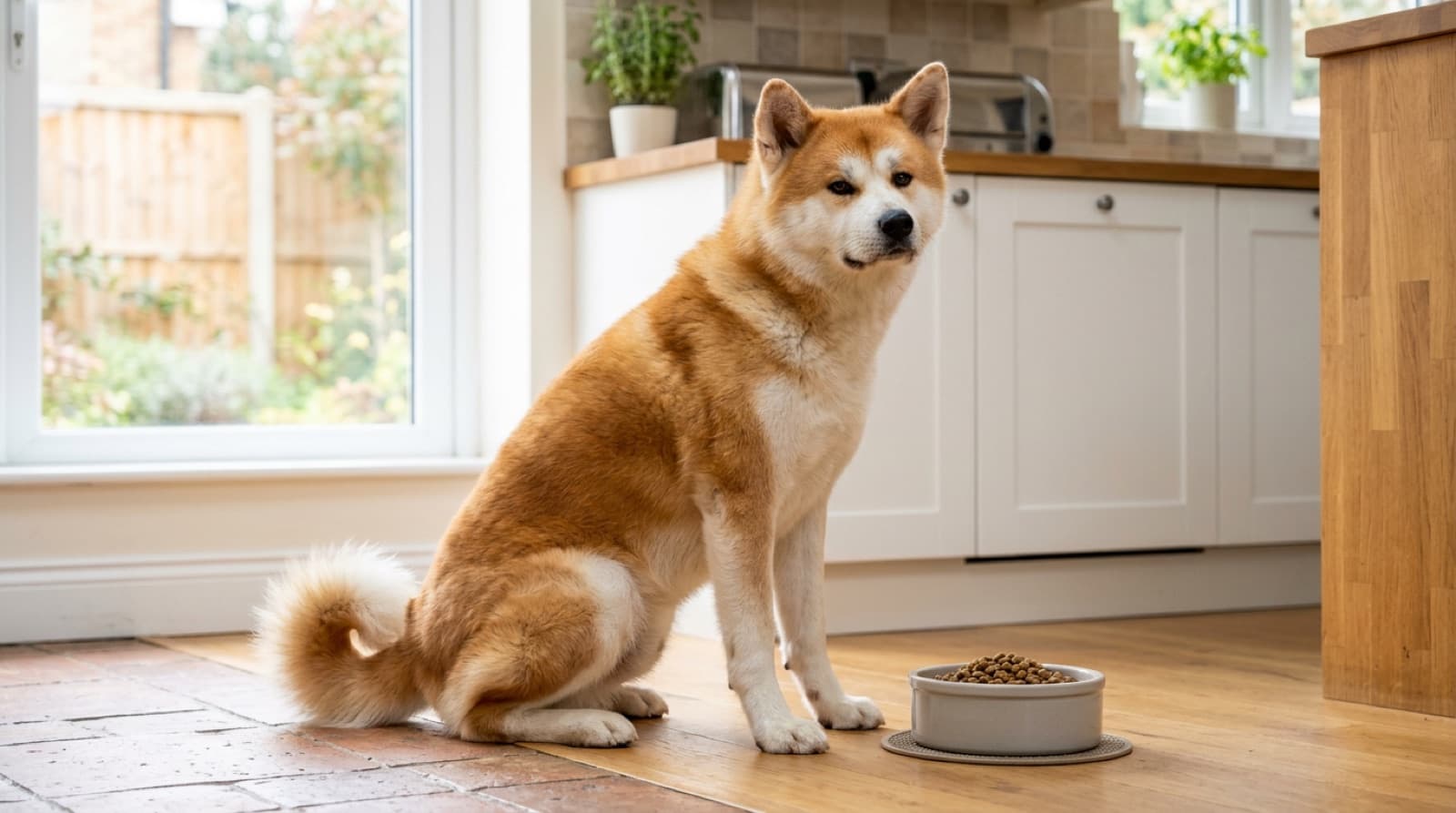
The Akita temperament profile
The Akita is a primitive Japanese guardian breed, developed in the mountainous Akita Prefecture for big-game hunting (boar, deer, even Yezo bear) and for household guarding. Centuries of selection produced a coherent temperament package that any new Akita owner notices in the first weeks at home. The breed split into two recognised types in the twentieth century: the Japanese Akita Inu (smaller, foxier head, more refined) and the American Akita (larger, more bear-like head, more substantial bone), and the Canadian Kennel Club recognises both as separate breeds. Most Edmonton rescue Akitas are American Akitas or American-Akita mixes.
The temperament package includes six core traits, each rooted in the breed's working history.
- Aloof with strangers. The Akita does not greet unfamiliar people the way a Lab does. The default posture is reserved, watchful, and dignified rather than enthusiastic. Strangers are evaluated, not welcomed.
- Deeply loyal to family. The Akita bonds strongly to the household, often with a particular attachment to one or two primary people. The loyalty is famously deep and persistent.
- Quiet (not yappy). Akitas vocalise infrequently. They do not bark for fun or for attention. When an Akita barks, it usually means something: a perimeter event, an unfamiliar arrival, a warning. The quiet baseline makes the bark meaningful.
- Confident and independent. The breed makes decisions without consulting the handler. This is selection-driven (a working Akita on a Japanese mountain pasture needed to act without instruction) and shows up in companion homes as a dog that processes cues rather than reflex-responding to them.
- Dignified. Akitas carry themselves deliberately. They are not playful clowns. The breed is closer to cat-like in self-possession than to retriever-like in exuberance.
- Resource-aware. Akitas guard valued items (food, chews, favourite resting spots, sometimes the primary person) more than most breeds. Resource guarding is a default behaviour pattern to manage, not an exception.
Owners who understand the package and choose a home that accommodates it have steady, deeply rewarding companions. Owners who expect Akita temperament to look like Lab or Golden Retriever temperament end up disappointed. The mismatch is the single biggest predictor of Akita surrender to Edmonton rescues.
Not a fetch-and-frolic breed
One of the most common expectation mismatches between new Akita owners and the breed is the play style. Akitas are not retrievers. Most do not fetch with sustained enthusiasm. Most are not interested in chasing balls or sticks for extended sessions. Many will play briefly and then disengage when the activity feels repetitive. The cat-like comparison is closer to accurate than the Lab comparison.
The play style that suits the breed is shorter, more purposeful, and more intellectually structured: scent games, puzzle feeders, short structured obedience drills with very high-value reinforcement, and supervised play with the right size and temperament of canine partner (if any). Dog-park frolic is rarely a good fit for adult Akitas. Long walks where the dog gets to investigate the environment usually are.
Owners who set expectations against the breed's actual play profile are less frustrated and more consistent. The Akita that disengages from a tennis ball after two throws is not bored or stubborn; the dog is being an Akita. Substitute a scent game or a frozen puzzle feeder and the same dog will engage for thirty minutes.
Same-sex aggression: the well-documented Akita trait
Same-sex aggression is one of the most extensively documented traits in the Akita. The Akita Club of Canada and parent-breed clubs in the US and Japan all describe it. Most reputable Akita rescues describe it in their adoption application. The pattern is consistent enough that the safest planning assumption for any Edmonton adopter is solo-dog household, with multi-dog homes built only with careful matching.
The trait does not always show in puppyhood. Two Akita puppies from the same litter, or an Akita puppy and another resident dog, can coexist fine through the first 12 to 18 months. Conflict often emerges as social maturity arrives between 18 and 36 months. The first incident may be small (stiff posture over a chew, a brief snap at a doorway, a controlled fight that ends without injury), and the trajectory from there depends on management and on the individual dogs.
What does not work is hoping the conflict resolves on its own. Akita-Akita same-sex aggression tends to escalate as the dogs build a conflict history, not de-escalate. Owners who address the first incident with a force-free behaviour consultant and a structured management plan have the best outcomes. Owners who shrug off the first incident often face a more serious second incident within months.
The risk ranking for multi-dog Akita homes
- Highest risk: two adult intact same-sex Akitas. Particularly two adult intact females. Most breed-rescue volunteers will refuse to place a second adult same-sex Akita into a home that already has one.
- High risk: two adult same-sex Akitas, both spayed or neutered. Hormones lower the baseline but do not eliminate the trait.
- Moderate risk: opposite-sex adult Akita pair, both fixed. Works more often than same-sex pairs but still needs careful matching.
- Lower risk: Akita with an opposite-sex non-Akita dog of different size and temperament. A male Akita with a calm older female Lab, for example, is a more workable combination.
- Lowest risk: solo Akita. The most reliably stable configuration. Most Edmonton rescue volunteers consider this the default recommendation.
For households committed to multi-dog life with an Akita, the path that works best is to adopt the Akita as the second dog into a home with a calm, established, opposite-sex resident, and to do a slow, fostering-first introduction with the rescue facilitating. Adopting a second Akita into a home with an existing adult Akita is the configuration that produces the most surrenders.
Prey drive on small pets
Akitas were used in northern Japan for hunting deer, wild boar, and Yezo bear. Centuries of selection produced a breed with strong prey response to fast-moving small animals. The trait is genetic, not trainable away, and is the second-most-common reason rescues refuse a placement (after same-sex aggression).
The practical implications for Edmonton households:
- Cats. Akitas raised from puppyhood with a resident cat often do well with that specific cat. Adult Akitas adopted into homes with cats are a higher-risk introduction; some succeed with a slow protocol, some never settle. Outdoor cats and unfamiliar cats are usually unsafe regardless. Most reputable rescues test prey response in the foster home and report it honestly on the application.
- Small dogs (under 25 lbs). Small fast-moving dogs trigger prey response in some adult Akitas. The risk is highest when the small dog runs, yips, or moves in a way that mimics prey behaviour. Even a stable adult Akita who lives peacefully with the family Lab may not be safe around a small unfamiliar dog at the off-leash park.
- Rabbits, ferrets, pet birds, pocket pets. Generally not safe. The breed's prey response to small mammals is strong and predictable, and the close-quarters reality of household life means an incident can happen in seconds. Most rescues will not place Akitas in homes with these animals.
- Wildlife on walks. Squirrels, rabbits, urban deer, and small wildlife along Edmonton river-valley trails trigger lunging and pulling in many Akitas. A solid loose-leash foundation and management through a front-clip harness reduce but do not eliminate the response.
The honest screening question from rescues: does the household have small pets, and is the household willing to accept that this specific Akita may never be safe with them? An adopter who says “we'll just train it out” is the adopter most likely to surrender the dog within 90 days. The rescues that ask the question directly are trying to set up a placement that lasts.
Children and Akitas
Akitas can be excellent with their own family children, with two consistent caveats. First, the breed bonds deeply to family and includes household children in the protective sphere, which is generally a positive but means the Akita may react to rough play between siblings or perceived threats to children with intensity. Second, strange children (visitors at the door, neighbour children in the yard, children running past in a park) are evaluated as outside the family unit and often trigger more guarding behaviour than they would with most breeds.
The realistic age framework for Akita homes:
- Older children (8 and up) who can read dog body language. The strongest fit. Children who understand that a stiff posture or whale-eye is a request for space, who respect the dog's resting spots, and who do not approach the food bowl, do well with Akitas and the dogs do well with them.
- School-age children (5 to 7). Workable with strong adult supervision and explicit training of child-dog interaction rules. The risk is the rough hug or the surprise approach to a sleeping dog.
- Toddlers (under 5). Most rescues are cautious about placing adult Akitas in households with toddlers. Resource guarding around food, the size disparity, and the unpredictability of toddler movement create too many failure points. Households with toddlers are often steered toward a different breed or toward an older calm Akita with documented child history through a foster home.
- Households with frequent visiting children. A significant management challenge. The Akita who is calm with household children may be reactive to visiting children. Daycare-style home environments are usually not the right fit for the breed.
The supervision rule for Akitas with children of any age is straightforward: never leave them alone unsupervised. Not because the Akita is dangerous, but because the breed's defaults (resource awareness, reserved with unfamiliar approach, protective of family) are the wrong defaults for an unsupervised dog-child interaction. The rule is the rule with any large dog and any young child, and it applies with extra weight here.
Stranger reactivity: ignores vs greets
The default Akita response to strangers is to ignore, not to greet. A well-socialised adult Akita on a leash walk often looks past an approaching stranger as if the person is not there, or holds a brief eye contact and then disengages. This is not unfriendliness; it is the breed's baseline. Owners who try to push the dog into Lab-style greeting (hello to every stranger, sit for petting) are working against the breed.
What does work is structured neutral exposure during the puppy socialisation window (3 to 14 weeks) and consistent low-pressure exposure through adolescence. A puppy Akita who meets dozens of calm strangers without being pushed into close contact builds a stable adult pattern of ignoring or briefly acknowledging strangers without reactivity. A puppy Akita who is forced into close contact with strangers (especially strangers who reach over the head or hug) often grows into an adult who is more reactive than the breed default.
For Edmonton owners, the practical pattern is to walk the dog through busy public spaces (downtown sidewalks, farmers' markets, outdoor patios at off-peak times) and let the dog observe people from a comfortable distance without expectations. Most adult Akitas reach a calm watchful adult pattern with strangers by age 3 if the socialisation foundation was done well in puppyhood.
Slow maturation (2 to 3 year window)
Akitas mature later than most breeds. Most dogs reach adult temperament by 18 to 24 months. Akitas often take to 2 or 3 years, with full temperament settling sometimes pushing to age 3. The extended adolescence shows up across several domains:
- Same-sex aggression emergence. Often appears between 18 and 36 months rather than in puppyhood.
- Longer reactive phases. Adolescent reactivity that resolves in a Lab at 18 months may continue in an Akita through 24 to 30 months.
- Extended resource testing. The dog tests guarding boundaries, hierarchy boundaries, and household rules periodically through the second year and into the third.
- Slower settling into the adult routine. The famously dignified, watchful adult Akita often arrives at year 3.
- Foster note translation. When an Edmonton rescue describes a 22-month-old Akita as “still adolescent,” the note is accurate to the breed, not coded language for problem dog.
The implication for adopters: expect the work to take longer than with most breeds, resist the conclusion at 18 months that the dog has a permanent problem, and stay consistent with force-free management through the third year. The adolescent Akita at 16 months is not the adult Akita at 3 years.
Rule out medical first
Before building a behaviour plan for an Akita with new or escalating reactivity, rule out medical contributors. Two are particularly worth checking in this breed.
Pain. Orthopaedic pain, dental pain, and chronic ear pain all present as behaviour change. A 4-year-old Akita who has been stable and suddenly becomes reactive to handling around the head may have a developing ear infection or a dental problem. A senior Akita who becomes reactive on walks may be experiencing hip or stifle pain. Veterinary exam first, training plan second.
Hypothyroidism. Akitas show hypothyroidism at moderately elevated rates, and the symptom picture includes reactivity, lethargy, weight gain, and coat changes. The appropriate diagnostic is a full thyroid panel including free T4 by equilibrium dialysis and TSH; a basic T4 alone is not sufficient. Treatment is once or twice daily levothyroxine, and behaviour often improves significantly once thyroid levels normalise.
The medical rule-out protocol, including the full breed-frequent health list for Akitas (autoimmune disease, hip dysplasia, gastric dilatation-volvulus, progressive retinal atrophy, sebaceous adenitis), lives in the cluster sibling on Akita health issues in Edmonton. This article defers there for medical detail so the two pages do not contradict each other.
Browse adoptable Edmonton Akitas
Current Edmonton-area Akita and Akita-mix listings from SCARS, the Edmonton Humane Society, AHHRB, and Zoe's Animal Rescue. Foster temperament notes describe the actual same-sex tolerance, prey drive, and household fit of the individual dog.
See Edmonton Adoptable Dogs →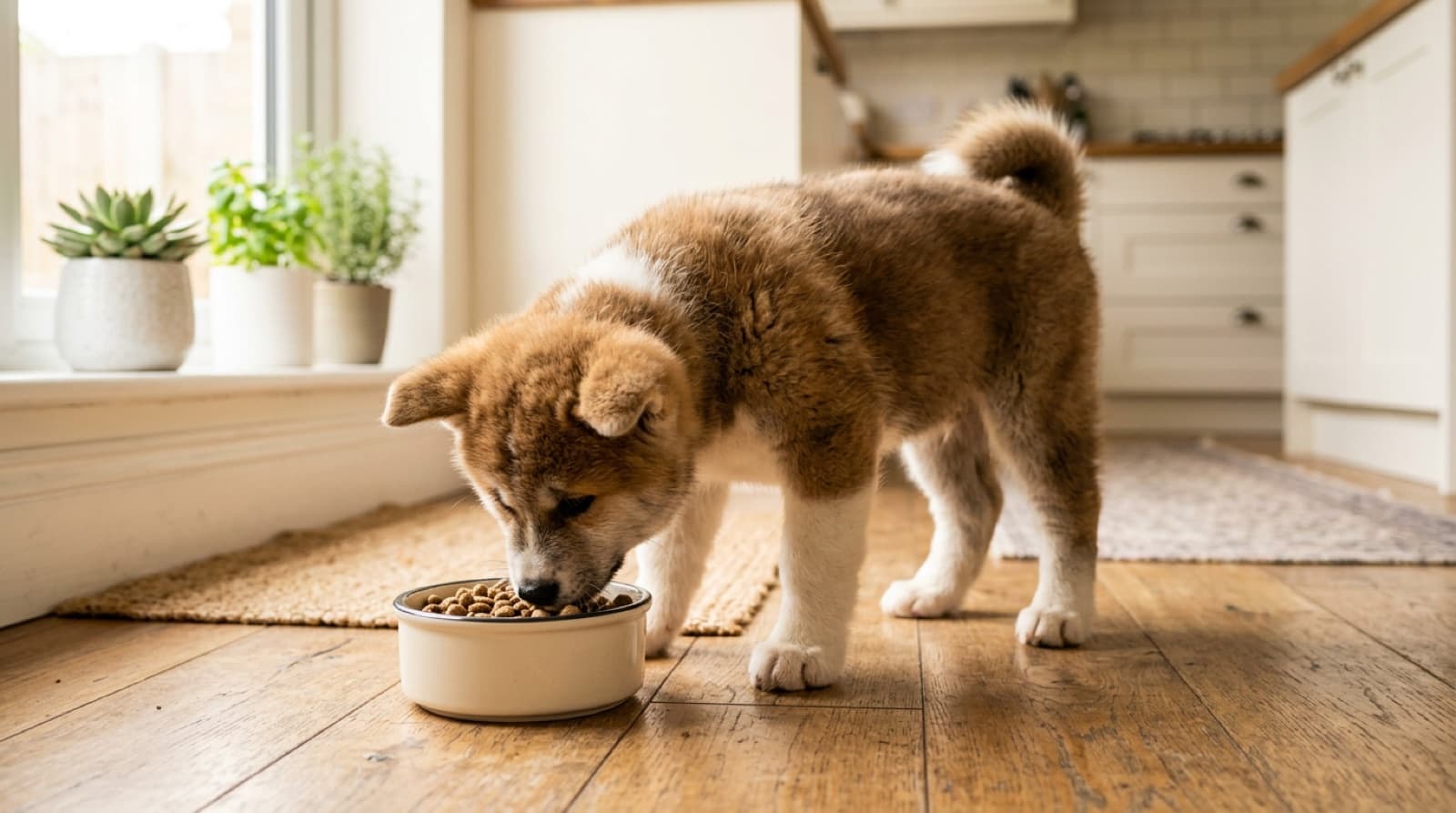
Force-free training methodology
Force-free, reward-based training is the methodology supported by current behaviour science across all breeds, and it is the only methodology that fits the Akita. Aversive tools (prong collars, choke chains, e-collars, alpha rolls) are contraindicated for any breed on the American Veterinary Society of Animal Behavior (AVSAB) position statement on humane training, which describes increased fear, anxiety, and aggression as the documented outcome of aversive use. For Akitas specifically, the harm signal is amplified for reasons covered in the next section.
The training plan that works for the breed has four pillars.
Foundation skills, not a long trick list
Layer six to eight reliable skills rather than 40 mediocre ones. Name response, loose-leash walking, settle on a mat, recall on a long-line, trade-up for resource items, leave-it, and a default check-in cover most household needs. Trick training is fine after the foundations are solid; it is not the priority during the first 18 months.
High-value, variable reinforcement
An independent breed needs richer reinforcement than a biddable one. Cooked chicken, cheese, freeze-dried liver. A variable schedule (sometimes high-value, sometimes lower, occasionally a jackpot) keeps motivation steady. Predictable kibble-only reinforcement runs out of value fast with this breed.
Realistic timelines
A Lab might have a usable recall at 6 months and a reliable one at 18 months. An Akita often takes through age 2 to reach the same point, and even then the recall is processed rather than instant. Owners who set expectations against the Akita timeline rather than the sporting-breed timeline are less frustrated and more consistent.
Trainer credentials that matter
Dog training is unregulated in Alberta. The credentials that mean something are independent: CCPDT (Certification Council for Professional Dog Trainers) for trainers and IAABC (International Association of Animal Behaviour Consultants) for behaviour consultants. Ask any prospective trainer whether they have worked with primitive guardian breeds specifically, what they would adjust for an Akita, and what their position is on aversive tools. The answers matter.
Why aversive tools are especially dangerous with Akitas
Aversive corrections are harmful for any breed on the AVSAB position. For Akitas specifically, the risk is amplified by two breed-specific factors.
Akitas are not submissive dogs. The breed was selected for confident, independent decision-making and resistance to physical pressure (the working Akita needed to stand its ground against large game and predators). An Akita corrected with a prong, e-collar, or physical alpha roll is more likely to fight back than to submit. The bite that follows an aversive correction can be serious because the breed has both the physical capacity and the temperament to defend itself. Multiple bite-history Akitas in Edmonton rescue intake share a common backstory: an inexperienced owner used aversive tools, and the dog responded.
Akitas are deliberate signallers. The breed communicates intent through clear body-language signals: lip-lift, stiffening, whale eye, hard stare, weight shift. These signals are visible to anyone watching the dog. Punishing the signals teaches the dog to skip the warning, because the warning predicts punishment. The dog who has learned to skip the warning bites without preamble, which is the most dangerous bite pattern in any breed and the exact wrong direction for a guardian breed.
For an Edmonton Akita owner, force-free is also the practical legal methodology because the bylaw environment is behaviour-based. The City of Edmonton Animal Care and Control Bylaw 21244 dangerous-dog provisions classify dogs on individual behaviour rather than breed. A dog with a bite history is at real legal risk regardless of breed. Aversive tools that increase the probability of a bite (which they do, on the AVSAB evidence) create legal exposure alongside welfare harm.
Puppy socialisation window (3 to 14 weeks)
The puppy socialisation window between roughly 3 and 14 weeks is the most important developmental period for any dog, and it is particularly critical for guardian breeds. Akitas socialised well during this window grow into confident, watchful adults who handle the world with composure. Akitas who miss the window (because they were kept in isolation, because they came from a puppy mill or backyard breeder, because they had a difficult early-life history) often grow into reactive, fear-driven adults whose temperament cannot be fully repaired later.
For owners of an Akita puppy in Edmonton, the socialisation checklist for the window includes:
- Calm exposure to many people of different appearances. Children, adults, seniors, people in hats, people with beards, people in uniforms, people of different ethnicities. Always at a comfortable distance, never forced.
- Calm exposure to other dogs. Force-free puppy class run by a CCPDT trainer, structured play with known calm adult dogs, supervised greetings on leash. Avoid chaotic dog-park free-for-alls.
- Calm exposure to environments. Sidewalks, parks, parking lots, store entrances, vet clinic waiting rooms, downtown sidewalks with mild traffic noise.
- Handling acclimation. Daily handling of paws, ears, mouth, tail, with reward. Critical for vet visits and grooming through adulthood.
- Resource exchange practice. Trade-up games where the puppy learns that giving up an item produces a better item. Foundation for resource-guarding prevention.
The window cannot be recreated later. An adult Akita who missed socialisation can be helped with structured behaviour work, but the calm adult who emerged from a well-socialised puppyhood is a different dog from the reactive adult who emerged from an isolated puppyhood.
Reading Akita body language
Akitas communicate intent through clear, deliberate body-language signals. Owners who learn to read the signals prevent escalation. Owners who miss the signals get blindsided by bites that the dog actually telegraphed for several seconds.
The signal ladder, from earliest warning to bite:
- Stiffening. The dog goes still. Muscles tighten. Movement stops. This is the earliest signal and the cheapest to respond to. Back off, redirect, increase distance.
- Whale eye. The dog turns the head away while the eyes track the trigger, showing the whites of the eyes. A request for space.
- Hard stare. Direct fixed eye contact with the trigger, body weight shifting forward. The dog is preparing to act.
- Lip-lift. The lip raises to expose the front teeth, often with a closed mouth. A deliberate warning. Akitas use the lip-lift more clearly than many breeds.
- Growl. A vocal warning that the previous signals were ignored. Punishing the growl is contraindicated; the growl is information.
- Snap. An air bite or a controlled bite that does not connect with full force. The dog is communicating that the next step is real.
- Bite. The dog acts.
For Edmonton families with children and an Akita, teaching the children to recognise the early signals (stiffening, whale eye, hard stare) is one of the highest-value training investments. A child who sees stiffening and steps away has prevented an escalation. A child who misses the signal and reaches for the dog has not. Resources like the “Family Paws” programme and the “Doggone Safe” programme teach children to read these signals in age-appropriate ways.
Leash reactivity protocol
Akita leash reactivity is most often dog-directed (other dogs on the sidewalk) or arousal-driven (small fast-moving animals, sometimes unfamiliar humans approaching too quickly). The force-free protocol is the same as for any breed, with adjustments for the Akita's independent processing style.
- Distance management. Work below threshold. If the dog reacts at 10 metres, work at 15 metres until the dog is calm at that distance, then close in.
- Counter-conditioning. Pair the appearance of the trigger with very high-value reinforcement. The order matters: trigger appears, food appears, trigger disappears, food disappears. Done over weeks, the trigger predicts food rather than threat.
- Front-clip harness. Reduces lunging mechanical leverage. Not a head halter (which Akitas often resist) and not a flat collar that allows full neck-pulling power.
- Loose-leash foundation. The behaviour change builds on a stable loose-leash baseline. Without that foundation, reactivity work plateaus.
- Slow progress acceptance. Akita reactivity work takes longer than retriever reactivity work. Six to twelve months of consistent application is realistic. Owners who expect faster results often abandon the protocol before it shows.
A force-free behaviour consultant credentialed through IAABC is the right partner for entrenched leash reactivity. Group obedience class is not the right setting for an actively reactive dog; private work first, then graduated re-introduction to controlled social settings.
Edmonton off-leash park calculus
Edmonton off-leash dog parks are not automatically unsafe for an Akita, but the calculus differs from most breeds. The combination of same-sex aggression risk, prey response to small fast-moving dogs, and the breed's tendency to read high-arousal play as threatening makes crowded off-leash zones a poor fit for most adult Akitas.
The risk profile by park type
Edmonton's main river-valley off-leash zones (Hawrelak, Mill Creek, Whitemud, Terwillegar, Capilano) are unfenced and high-traffic. For adult Akitas, the risk profile is elevated. Smaller fenced neighbourhood off-leash zones are sometimes a better fit for an individual Akita with strong social history, but only at off-peak hours.
The realistic alternative
For most Edmonton Akita owners, the right pattern is long-line walks on quieter river-valley trail segments, occasional short visits to less crowded off-leash zones during off-peak times with the individual dog's known canine companions, and (when budget allows) hourly fenced-rental sessions at private facilities. The dog gets real exercise without the social pressure of an open park. The Edmonton off-leash parks guide covers which zones suit which dog stages.
What to watch for at the park
Early-warning signs that the park is the wrong setting today: stiffening when other dogs approach, hard stares at specific dogs, the Akita placing itself between you and another dog, ignoring recall cues. If any of these appear, leash up and leave. The escalation curve is shorter in Akitas than in most breeds, and the bite that follows is more serious.
Multi-dog household matching
For households committed to a multi-dog setup with an Akita, the matching criteria that produce the best outcomes:
- Opposite sex. The most important variable. Mixed-sex pairs have substantially lower conflict risk than same-sex pairs.
- Both spayed and neutered. Hormones lower the baseline arousal and reduce conflict probability.
- Different size. A 90-pound Akita with a 50-pound mid-size dog often works better than two Akita-size dogs in the same household. The size differential reduces resource competition.
- Different temperament. A high-arousal Akita matches better with a low-arousal companion than with another high-arousal dog. A calm older Lab is a workable companion. A young high-drive Border Collie usually is not.
- Slow introduction with rescue support. Most reputable Edmonton rescues facilitate a structured meet-and-greet between the resident dog and the prospective adoptee before placement, and many will support a foster-to-adopt trial period.
The combination most often refused by Akita rescues is the second-adult-Akita placement into a home with an existing adult Akita, particularly same-sex. The combination most often supported is the Akita-with-opposite-sex-non-Akita placement with documented foster history.
Condo and apartment trigger density
Akitas can live successfully in Edmonton condos and apartments, more often than the Pyrenees or other heavy-bark breeds, because the Akita is quiet by default. The challenge is not noise. The challenge is trigger density: shared hallways with unfamiliar dogs and humans, shared elevators, shared entrances. For a guardian breed that is reserved with strangers and aware of perimeter, every elevator ride is a stranger encounter.
The management plan that works in condo or apartment settings:
- Off-peak elevator timing. Early morning, late evening. Avoid the rush windows when the elevator is full.
- Loose-leash hallway practice. The dog learns to walk past unit doors and through common areas calmly, with high-value reinforcement.
- Front-clip harness for hallway and elevator. Reduces lunging leverage in tight space.
- Stranger acknowledgement training. The dog learns to register the stranger and disengage rather than escalate.
- Solo elevator if possible. A trained Akita can comfortably wait for the next elevator if the current one already has people.
Most building condo boards in Edmonton do not breed-restrict Akitas under current bylaw frameworks, but some buildings have weight limits or breed-specific insurance exclusions worth checking before signing. The pit-bull-housing-insurance article in the rotation covers the bylaw-vs-strata-rules logic that applies similarly to large guardian breeds.
City of Edmonton Bylaw 21244
Alberta has no breed-specific legislation, and the City of Edmonton Animal Care and Control Bylaw 21244 treats Akitas the same as every other breed. The dangerous-dog provisions are behaviour-based: a dog can be declared dangerous after biting, attacking, or threatening a person or animal, regardless of breed. The classification carries serious consequences including mandatory leashing, muzzle in public, secure containment requirements, and significant fines.
For Akita owners, the practical implications:
- License the dog under Bylaw 21244. Required for all dogs in Edmonton. The licence connects the dog to the owner of record in case of loss or escape.
- Microchip and keep registration current. Lost-dog recovery is faster with current microchip data.
- Leash everywhere outside fenced yards. Bylaw requires leash in public spaces. For an Akita with same-sex aggression or prey drive, the bylaw position is also the safe position.
- Manage triggers to prevent the first incident. A dog without a bite history is not at risk of dangerous-dog declaration. A dog with a single serious bite is. The training plan is, in part, a bite-prevention plan with legal stakes.
- Carry liability coverage. Most homeowner insurance policies cover dog-bite liability, but some exclude specific breeds or apply limits. Confirm coverage with the carrier; an Akita with no bite history is usually covered, but a documented incident can trigger non-renewal.
The bylaw environment is one more reason force-free training is the practical methodology: aversive tools increase bite probability, and increased bite probability increases legal exposure. The math is straightforward.
When to escalate to a veterinary behaviourist
A force-free trainer handles foundation skills and most normal Akita behaviour management. An IAABC behaviour consultant handles entrenched reactivity, resource guarding, or aggression that has not responded to standard protocols. A veterinary behaviourist credentialed through the American College of Veterinary Behaviorists (DACVB) handles cases that need diagnosis of a behavioural disorder and often medication alongside training.
Escalate to a DACVB for any of these triggers:
- Any actual bite to a human that breaks skin or holds.
- Resource guarding that escalates over weeks rather than settling under a trade-up protocol.
- Same-sex Akita-Akita conflict in the household that has produced an incident.
- Sustained generalised anxiety that prevents the dog from settling anywhere.
- Severe noise phobia producing self-injury or full panic.
- Predatory drift on cats or small dogs that includes bite-and-shake.
- Sudden behaviour change in an adult dog after thyroid and pain have been ruled out.
The closest DACVB-staffed program for Edmonton is the Western College of Veterinary Medicine at the University of Saskatchewan in Saskatoon. Consultations run by referral from your primary vet, sometimes by telehealth, and expect $400 to $800 for an initial workup plus medication and follow-up costs. For genuinely dangerous behaviour or for cases where training is plateauing, this is the right tier.
Day-to-day Akita routine
The structured day for an Edmonton Akita blends typical companion-dog routines with adjustments for the guardian profile. The structure below works across suburban detached homes and condo settings with minor modifications.
- Morning yard check or short patrol. A brief outdoor session before breakfast. The dog gets a legitimate environment scan to start the day.
- Breakfast as enrichment. Slow feeder, scattered in a snuffle mat, or in a frozen puzzle. Not free-fed from a bowl. Channels resource-aware behaviour into a controlled activity.
- Morning leashed walk, 30 to 45 minutes. Loose-leash work, name response drills, neighbourhood exposure. The most consistent training slot of the day.
- Mid-morning training session, 5 to 10 minutes. Foundation skills, high reinforcement rate, end before the dog disengages.
- Daytime indoor settle. The Akita rests for several hours through the daytime. A designated bed or place near family activity.
- Midday potty break. Brief, structured.
- Afternoon yard time or supervised activity. Fenced yard time, supervised play with known canine companion if applicable, scent work, or a short hike.
- Late afternoon leashed walk, 30 to 45 minutes. Often the highest-engagement slot of the day for shared activity.
- Dinner as enrichment. Same pattern as breakfast.
- Evening indoor settle with chew or puzzle. The dog channels evening alertness into a contained activity near family.
- Last potty break, 10 to 11 PM. Short and structured.
- Overnight indoor sleep. The dog sleeps near family or in a designated indoor space. Outdoor overnight sleep produces alarm response and is not recommended.
Total handler-engaged time runs about 90 to 120 minutes, which overlaps with normal household routine. Owners who hold this structure through the first 18 to 24 months find the routine becomes automatic, and the dog settles into the calm dignified adult pattern as the 2 to 3 year maturity window closes.
Red flags: when to call for help today
Most Akita behaviour is normal guardian-breed behaviour managed with structure and force-free training. A smaller subset is genuine crisis behaviour that warrants a same-week call to a force-free trainer, an IAABC behaviour consultant, or a veterinary behaviourist.
- Any actual bite to a human that breaks skin or holds, regardless of context.
- Same-sex household conflict that has produced a fight, regardless of injury level.
- Resource guarding that escalates over weeks rather than settling under a trade-up protocol.
- Predatory bite-and-shake on a cat, small dog, or wildlife.
- Sleep-startle aggression where the dog snaps or bites when woken or approached while resting.
- Generalised inability to settle for more than a few minutes at a time in a quiet home.
- Sudden behaviour change in an adult dog with no environmental cause, after thyroid and pain have been ruled out.
Calling early is always cheaper than calling late, and reputable Edmonton rescues are usually willing to consult informally with adopters in the first months. The conversation that ends with a referral to a credentialed behaviour consultant at week six is a much better outcome than the conversation at month eight where the family is exhausted and the dog has built up an incident history. For medical contributors that mimic behaviour change, the cluster sibling on Akita health issues in Edmonton covers the rule-out protocol.
Frequently asked questions
How do I train an Akita in Edmonton?
Train an Akita with a force-free, reward-based methodology and a trainer who has worked with primitive guardian breeds. The Akita was selection bred in northern Japan for big-game hunting and household guarding, which produced a dog that is dignified, independent, and deliberate. Aversive tools (prong collars, choke chains, e-collars, alpha rolls) are contraindicated for any breed on the AVSAB position, and the harm signal is amplified in Akitas, who often fight back rather than submit. The practical plan is six to eight solid foundation skills (name response, loose-leash walking, settle on a mat, recall on a long-line, trade-up, leave-it, default check-in), very high-value reinforcement (cooked meat, cheese, freeze-dried liver), realistic timelines (an Akita does not fully mature until age 2 to 3), and a credentialed trainer through CCPDT or IAABC. Aversive corrections degrade the partnership in ways that are particularly hard to recover from with this breed.
Do Akitas have same-sex aggression?
Yes, same-sex aggression is one of the most well-documented Akita traits. Most adult Akitas cannot reliably live with another same-sex adult dog. The pattern often does not emerge in puppyhood; littermates and young dogs can coexist fine, then conflicts appear at social maturity around 18 to 36 months. Opposite-sex pairs (both spayed and neutered) work more often than same-sex pairs, but even mixed-sex pairs require careful matching and supervision. The honest position from most rescues is that the safest home for an Akita is solo-dog. If a multi-dog home is the goal, the second dog should be opposite sex, smaller, calmer in temperament, and ideally introduced to the Akita as a puppy. Same-sex Akita-Akita pairs are the highest-risk combination.
Can an Akita live with cats or small dogs?
Sometimes, with the right individual Akita and careful introduction, but high prey drive is a real consideration. Akitas were used for big-game hunting and many adult dogs retain strong prey response to fast, small, scurrying animals. Akitas raised with cats from puppyhood often do well with their resident cat while still being unsafe with unfamiliar outdoor cats. Adult Akitas adopted into homes with cats are a higher-risk introduction and need a slow decompression protocol with the rescue. Small dogs (under 25 lbs) present similar risk, particularly small dogs that run, yip, or move in a way that triggers prey response. Reputable Edmonton rescues screen for prey drive in foster homes and will tell adopters directly when a specific Akita is not safe with small pets. Take that note seriously.
Are Akitas good with children?
Akitas can be excellent with their own family children when properly socialised and supervised, but they are typically not good with strange children. The breed bonds deeply to the family and includes household children as flock; the protective instinct extends to them. Unfamiliar children at the door, in the yard, or running past in a park are a different category and often trigger guarding behaviour. The honest position from most rescues is that Akitas suit households with older children (8 and up) who can read dog body language and respect the dog's space, rather than households with toddlers who may startle the dog or households that host frequent visiting children. Resource guarding around food, toys, and resting spots is also more common in Akitas than in retriever breeds, which raises the supervision bar with kids of any age.
When does an Akita fully mature?
Roughly 2 to 3 years, longer than most breeds. The adolescent Akita at 14 months is not the adult Akita at 30 months. Same-sex aggression often emerges during this window rather than in puppyhood. Reactive phases that resolve in a Lab at 18 months may continue in an Akita through 24 to 30 months. Resource testing, perimeter testing, and reserved-with-strangers behaviour all show up across the extended adolescence. The owners who push through the second and third year with consistent force-free training see the dignified, confident, deeply loyal adult the breed was selected to become. The owners who expect adult Akita temperament at 12 months are usually frustrated.
Why are aversive training tools especially bad for Akitas?
Two reasons specific to the breed. First, Akitas are not submissive dogs. The breed was selected for confident, independent decision-making, and an Akita corrected with a prong, e-collar, or alpha roll is more likely to fight back than to submit. The AVSAB position on humane training notes that aversive tools increase fear and aggression across all breeds; Akitas show this effect at the high end of the curve, and the bite that follows an aversive correction can be serious. Second, the Akita is a deliberate signaller. Body language signs (lip-lift, stiffening, whale eye) are clearly visible to anyone watching the dog. Punishing those signals teaches the dog to skip the warning and bite without preamble, which is exactly the wrong direction for any guardian breed and is a setup for a bylaw 21244 dangerous-dog declaration after the first incident.
Can an Akita be off-leash in an Edmonton dog park?
For most Akitas, the realistic answer is no, particularly for adults in busy off-leash zones. The same-sex aggression risk, the prey drive on small fast-moving dogs, and the breed's tendency to read high-arousal play as threatening combine to make crowded off-leash parks a poor fit. Puppy Akitas under 12 months who are well-socialised can do well at quiet off-peak sessions, but the calculus changes as social maturity arrives. The safer pattern for adult Akitas is long-line work on quieter river-valley trail segments, occasional visits to less crowded zones at off-peak times, and (when budget allows) hourly fenced-rental sessions at private facilities where the dog gets real off-leash exercise without crowd pressure. The Edmonton off-leash parks guide covers which zones suit which dog stages.
Will an Akita protect my family?
Yes, by selection, but protective behaviour is not the same as protection training and a family Akita should not be trained to bite. The Akita is naturally reserved with strangers, watchful of perimeter, and protective of household and territory. That instinct is genetic and shows up without training. What rescues steer adopters away from is any attempt to sharpen the protective response through bite-work or schutzhund-style training; that direction increases legal exposure under City of Edmonton Bylaw 21244 and produces a dog that is less safe in normal life, not more. The honest position is to let the natural watchfulness be the natural watchfulness, train solid foundation manners, and trust that the breed handles the guardian role on its own without artificial sharpening.
When should I escalate to a veterinary behaviourist for my Akita?
Most Akita behaviour is normal guardian-breed behaviour managed with structure, force-free training, and patience. A smaller subset warrants escalation to a DACVB credentialed veterinary behaviourist through the American College of Veterinary Behaviorists. The triggers are the same as for any breed: an actual bite to a human that breaks skin, resource guarding that escalates over weeks rather than settling under a trade-up protocol, sustained generalised anxiety, severe noise phobia producing self-injury, predatory bite-and-shake on a cat or small dog, or sudden behaviour change in an adult dog after thyroid and pain have been ruled out. The closest DACVB-staffed program for Edmonton is the Western College of Veterinary Medicine in Saskatoon, accessed by referral from your primary vet. Force-free trainers and IAABC behaviour consultants handle most cases; the DACVB tier is for diagnosis and prescribing when training alone is not enough.
What if my Akita is showing aggression toward another dog in the home?
Call the rescue and a credentialed behaviour consultant the same week. Akita same-sex aggression that emerges at social maturity does not resolve on its own; it tends to escalate as the dogs build a conflict history. The honest first conversation is whether the household can be permanently structured as a rotation (one dog out, one dog in, never together unsupervised) or whether one of the dogs needs to be rehomed to a single-dog setting. Crate-and-rotate setups can work long-term for some households, but they require commitment and the dogs are still living without full freedom. Force-free management around resource triggers (separate feeding, separate sleeping, no high-value chews with both dogs present) reduces incidents while the longer plan is decided. The cluster sibling on Akita adoption covers the rescue-side surrender pipeline for owners who reach that decision.
What if I think my Akita has a medical reason for the behaviour change?
Rule it out first. A sudden behaviour change in an adult Akita, particularly increased reactivity or aggression after a period of stable behaviour, often has a medical contributor. Pain is the most common: orthopaedic pain in a giant-frame breed, dental pain, or chronic ear pain can all present as behaviour change. Hypothyroidism produces reactivity, lethargy, and coat changes and is well-documented in Akitas as a breed-frequent endocrine issue; a full thyroid panel including free T4 by equilibrium dialysis is the appropriate diagnostic. The medical rule-out protocol lives in the cluster sibling article on Akita health issues, and a force-free trainer or behaviour consultant working a behaviour case will almost always ask for current bloodwork and a recent veterinary exam before building the training plan. Behaviour without a medical workup is incomplete behaviour work.
Related Edmonton Akita guides
Edmonton Adoptable Dogs
Current Edmonton-area Akita and Akita-mix listings from SCARS, EHS, AHHRB, Zoe's, and other Edmonton rescues. Foster notes describe real same-sex tolerance and household fit.
Akita Adoption Edmonton
The rescue-first Akita adoption guide: local intake patterns, surrender pipeline, Japanese Akita vs American Akita disambiguation, real fees, and adopter readiness check.
Akita Health Issues Edmonton
Autoimmune disease, hip dysplasia, bloat, progressive retinal atrophy, sebaceous adenitis, hypothyroidism, and the medical rule-out protocol when behaviour change has a medical contributor.
Akita Coat & Grooming Edmonton
Double-coat management, twice-a-year coat blow, undercoat rake technique, Edmonton winter coat care, and the realistic grooming budget for an Akita-size double-coated dog.
Find your Edmonton rescue Akita
Browse current Edmonton-area Akita and Akita-mix listings. Foster temperament notes describe real same-sex tolerance, prey drive, and the household match each dog will need.
Browse All Edmonton Dogs →New dog? Start with these care guides
Everything a new adopter needs to set up a safe, happy home.