The short answer
Aussies were bred to chase moving things and nip at heels to direct cattle. The drive is genetic, not bad behaviour. Suburban Edmonton triggers fire constantly: kids on bikes, joggers, cyclists, cars, scooters, other dogs, LRT cars. Redirect the drive into appropriate outlets or it goes into fence-running, shadow-chasing, kid-nipping, and door destruction. Edmonton sport access: herding lessons (rural-adjacent communities offer beginner clinics), agility, flyball, scent work, skijoring, treibball, flirt poles at home. Daily structured exercise 90 to 120 minutes plus 30 to 60 minutes mental enrichment. Force-free Edmonton trainer relationship by month 8 to 10 regardless of behaviour. Winter is the highest-risk season: indoor sport substitution mandatory November through March. Kid-Aussie management: never run from the dog, baby gates during high-energy times, force-free training only.
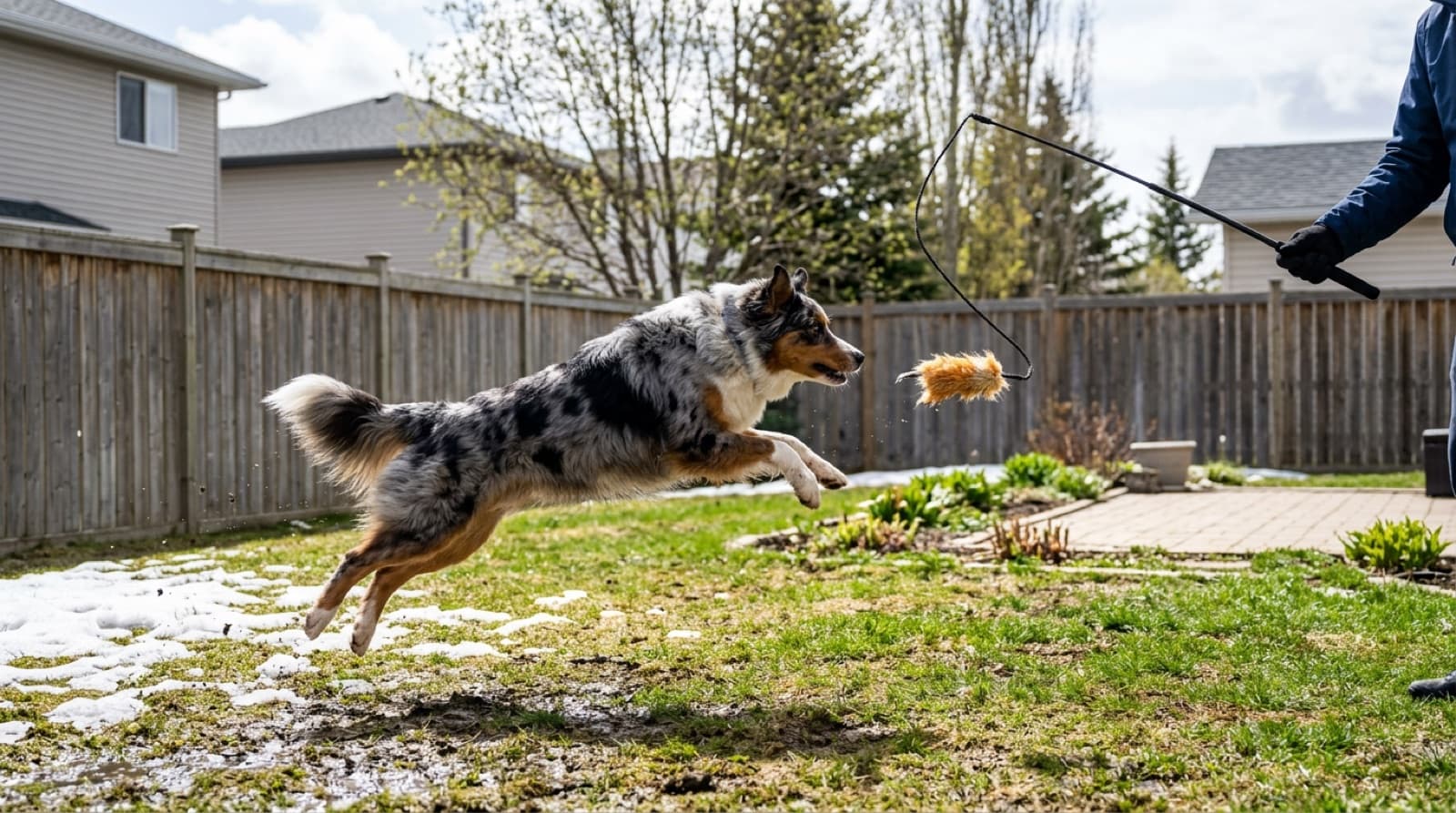
The herding drive is genetic, not bad behaviour
Australian Shepherds were developed on American ranches in the 1800s and 1900s for cattle herding. The breed was selected over generations for:
- A strong chase instinct triggered by movement (especially fast or erratic movement)
- A natural inclination to round up moving groups
- Heel-nipping behaviour to direct stubborn cattle
- A high-intensity stare (the “eye”) to influence target movement
- Endurance to work all day
These instincts do not turn off in suburban Edmonton. The AKC Australian Shepherd breed profile describes the breed as “smart, exuberant, work-oriented” without foregrounding that working orientation requires real work or substitute outlets.
Critical distinction: herding drive is not aggression. It is misdirected work behaviour. But misdirected herding can cause real harm. Heel-nips become real bites if a child kicks or runs. Aussies chasing moving cars get hit or cause accidents. Other dogs at off-leash zones react defensively when an Aussie tries to herd them. When prevented from chasing, Aussies redirect the drive into fences, doors, walls, shadows, and lights.
Symptoms of pent-up herding drive
When a working breed lives in a non-working environment without substitute outlets, the drive redirects in problematic ways. These are symptoms, not personality defects.
- Fence-running and barrier frustration. Running back and forth along the fence line, often with intense barking and lunging at every passing dog or person.
- Shadow and light chasing. Compulsively chasing shadows on walls, light reflections, laser pointers. If you have ever used a laser pointer with an Aussie and the dog now chases reflections constantly, that is the problem.
- Tail chasing. Compulsive spinning, sometimes self-injurious.
- Circling family members. Physically rounding up the family group on walks, often with eye contact and body pressure.
- Redirecting onto other dogs at the off-leash zone. Trying to herd dogs that do not want to be herded creates fights.
- Destructive behaviour when alone. Digging, wall chewing, door destruction.
- Reactive lunging at bikes, runners, vehicles on Edmonton river-valley walks.
- LRT or bus obsession. Edmonton-specific warning sign. An Aussie that obsessively watches passing LRT cars or buses is showing redirected herding drive on moving vehicles.
None of these are personality defects. All of them are the symptom of a working breed in a non-working environment without appropriate substitute outlets. The fix is providing outlets, not suppressing the drive.
Sport and activity outlets for Edmonton Aussies
The most effective outlets channel the herding drive into structured activity:
- Herding lessons. Edmonton-area herding instruction is available through ranches and farms in rural-adjacent communities (Sherwood Park, Spruce Grove, St Albert area, broader Edmonton-region acreage operations offer beginner herding clinics). Most Aussies show clear “this is what I was made for” energy in their first session. Cost: $50 to $150 per session.
- Flyball. High-speed retrieve relay sport. Edmonton flyball clubs welcome Aussies.
- Agility. The classic Aussie sport. Multiple Edmonton-area agility clubs offer training and competition. $200 to $400 per 8-week course.
- Disc dog. Frisbee retrieval and trick competition. Aussies excel at chase + retrieve + cue.
- Treibball. “Push ball” sport where the dog herds large fitness balls into a goal. Designed for herding breeds without livestock access.
- Scent work. Edmonton scent-work clubs and AKC scent work events accept Aussies.
- Canicross or skijoring. The dog pulls the owner on running gear or cross-country skis. Edmonton skijor clubs welcome high-energy breeds.
- Flirt pole at home. Pole with a rope and fluffy lure. Handler swings the lure in herding patterns; the dog chases, stalks, pounces, catches. 10 minutes burns more energy than 30 minutes of fetch. $25 to $40 commercial or DIY for $15.
Aussies that receive 2 to 3 sport outlets weekly typically show dramatically reduced redirected-herding behaviour at home.
Important: never use laser pointers as a herding outlet. They create compulsive light-chasing behaviour that does not resolve and worsens redirected drive.
Browse adoptable Australian Shepherds in Edmonton
Senior Aussies (8+ years) from Edmonton rescue skip the high-intensity 8 to 24 month adolescent window and provide mostly-settled adult temperament.
See Available Australian Shepherds →Edmonton river-valley pathway management
The Edmonton river-valley pathways (Hawrelak, Mill Creek Ravine, Whitemud, North Saskatchewan River pathway) are high-trigger environments for adolescent and untrained Aussies. Cyclists and joggers pass every few minutes in good weather. The pathway is narrow in many sections, which puts triggers within reactivity distance and limits handler options.
Management approach:
- Long-line (10 to 15 metres of biothane, $30 to $50, NOT a retractable leash). Gives you control without restricting movement on a wide open trail.
- Distance management. Step well off the pathway when you see a cyclist or jogger approaching (5+ metres to keep your Aussie under threshold). Reward calm watching. Never punish a barked alert.
- High-value treats (cooked chicken, freeze-dried liver, salmon skin) for sub-threshold trigger exposures. LAT (Look At That) protocol: mark the trigger with “yes” or a clicker and treat for calm watching. Over weeks the trigger becomes the cue to check in with you rather than chase.
- Avoid peak hours initially. Early morning (before 7 AM) and late evening (after 8 PM) have lowest trigger density on Edmonton river-valley trails.
- Edmonton force-free trainer for reactive or herding-driven Aussies if the pattern is severe. The detailed reactivity protocol lives in our sibling Edmonton Border Collie reactivity guide; the principles transfer directly.
- Consider quiet alternative trails (suburban neighbourhood streets, industrial-zone Sunday mornings, Sniffspot rentals) until your Aussie can handle river-valley trigger density.
Edmonton winter substitution plan
Edmonton winter (November through March) is the highest-risk season for Aussie surrender. Outdoor sport access drops (snow, ice, wind chill below -25C make agility and treibball impractical; herding lessons typically pause until spring). The drive has nowhere structured to go for 4 to 5 months unless you plan for it.
Common Aussie-surrender driver in Edmonton: families that managed well from May to October hit January with pent-up drive and no outlet.
Winter management protocol:
- Indoor enrichment volume goes UP, not down. Puzzle feeders, snuffle mats, trick training sessions, scent work games, indoor stair runs, hallway fetch. Target 60 to 90 minutes of structured indoor mental work daily.
- Indoor sport access. Edmonton has indoor agility facilities, indoor scent-work clubs, and indoor flyball training that operate year-round. Drive across town for sessions if needed.
- Daycare 3+ days per week through January and February. Edmonton sport-style daycares often have indoor play structure that satisfies herding-driven dogs.
- Skijoring or canicross for cold-tolerant Aussies. Edmonton cold (down to -25C in calm conditions) is workable for healthy adult Aussies in skijoring. Edmonton skijor clubs welcome new participants.
- Avoid the temptation to “just take winter off” from structured activity. Most surrender-triggering destruction in Edmonton Aussies happens January through March in households that paused all sport for the season.
Frequently Asked Questions
Why do Aussies chase kids on bikes, cars, skateboards, and joggers?
Because they were bred to do exactly this: chase moving things and direct them with eye contact, body positioning, and occasional nipping. Australian Shepherds were developed on American ranches in the 1800s and 1900s for cattle herding. The breed was selected over generations for a strong chase instinct triggered by movement (especially fast or erratic movement), a natural inclination to round up moving groups, heel-nipping behaviour to direct stubborn cattle, a high-intensity stare (called "eye") to influence target movement, and endurance to work all day. These instincts do not turn off in suburban Edmonton. A 14-month-old Aussie sees a kid on a bike speeding past and every genetic instinct screams chase, redirect, control. The dog is not being bad. The dog is doing exactly what it was bred to do, in an environment where the behaviour is dangerous and inappropriate. Critical distinction: this is not aggression. It is misdirected herding drive. But misdirected herding drive can cause real harm. Heel-nips become real bites if a child kicks or runs. Aussies chasing moving cars get hit or cause accidents. Other dogs at off-leash zones react defensively when an Aussie tries to herd them. Responsible Aussie ownership requires acknowledging this drive exists and providing appropriate outlets.
Will my Aussie nip my kids and is that dangerous?
Yes, many Aussies will nip kids at some point, and yes, it can be dangerous if not addressed. Herding nips target the back of the heels or calves of moving people, typically delivered as quick lateral grabs without sustained bite pressure. Adult Aussies (40 to 65 lbs) have adult jaw strength even when the bite is "just a herding nip." A child running, kicking, or falling can turn a controlled herding nip into a torn skin wound, especially on bare legs in summer. Edmonton family Aussie owners report nips most commonly during: backyard play (kids running across the yard, the Aussie circling and nipping at heels), bike-riding (kids on bikes, the Aussie chasing and nipping at ankles), wrestling games (the Aussie joining and herding by nipping), and tantrums (the Aussie redirecting the chaotic energy through herding). Management: never allow kids to run from the dog (movement triggers chase); teach kids to "be a tree" when they want the dog to stop (no movement = no chase trigger); use baby gates to separate during high-energy kid play; train an emergency recall and "leave it" cue; redirect the herding drive into appropriate outlets (flirt poles, sports, herding lessons). Most herding-nip patterns moderate with structured management by 18 to 24 months as the Aussie matures and learns alternative behaviours. Some Aussies require lifelong management around kids.
What are the symptoms of pent-up herding drive in an Aussie?
When a herding-driven Aussie does not get appropriate outlets, the drive redirects in problematic ways. Common symptoms of pent-up herding drive: fence-running and barrier frustration (running back and forth along the fence line, often with intense barking and lunging at every passing dog or person), shadow and light chasing (compulsively chasing shadows on walls, light reflections, laser pointers; if you have ever used a laser pointer with an Aussie and the dog now chases reflections constantly, that is the problem), tail chasing (compulsive spinning, sometimes self-injurious), circling family members on walks (the dog physically rounding up the family group, often with eye contact and body pressure), redirecting onto other dogs at the dog park (trying to herd dogs that do not want to be herded creates fights), destructive behaviour when alone (digging, wall chewing, door destruction), reactive lunging at bikes, runners, vehicles on walks. Edmonton-specific warning sign: an Aussie that obsessively watches the LRT cars or buses passing the house is showing redirected herding drive on moving vehicles. None of these are personality defects. All of them are the symptom of a working breed in a non-working environment without appropriate substitute outlets. The fix is providing outlets, not suppressing the drive.
What sport and activity outlets work for herding-driven Edmonton Aussies?
The most effective outlets channel the herding drive into structured activity. (1) Herding lessons. Edmonton-area herding instruction is available through ranches and farms in rural-adjacent communities (Sherwood Park, Spruce Grove, St Albert area, broader Edmonton-region acreage operations offer beginner herding clinics). Most Aussies show clear "this is what I was made for" energy in their first session. Cost: $50 to $150 per session, monthly clinics for ongoing access. (2) Flyball. High-speed retrieve relay sport. Edmonton Flyball clubs welcome Aussies, who frequently excel. (3) Agility. The classic Aussie sport. Multiple Edmonton-area agility clubs offer training and competition. Cost: $200 to $400/8-week course. (4) Disc dog. Frisbee retrieval and trick competition. Aussies excel at the combination of chase + retrieve + cue. (5) Treibball. "Push ball" sport where the dog herds large fitness balls into a goal. Designed specifically for herding breeds without livestock access. Edmonton facilities offer treibball training. (6) Scent work. Edmonton scent-work clubs and AKC scent work events accept Aussies. Builds mental engagement and self-control. (7) Canicross or skijoring. The dog pulls the owner on cross-country skis or running gear. Edmonton skijor clubs welcome high-energy breeds. (8) Flirt pole. DIY at-home tool. A pole with a rope and a fluffy lure on the end. Mimics herding motion. 10-minute sessions burn intense energy. ($30 setup.) Aussies that receive 2 to 3 sport outlets weekly typically show dramatically reduced redirected-herding behaviour at home.
How do I stop my Aussie from chasing cyclists and joggers on Edmonton river-valley walks?
The river-valley pathways (Hawrelak, Mill Creek Ravine, Whitemud, North Saskatchewan River pathway) are high-trigger environments for adolescent and untrained Aussies. Cyclists and joggers pass every few minutes in good weather. The pathway is narrow in many sections, which puts triggers within reactivity distance and limits handler options. The management approach: (1) Long-line (10 to 15 metres of biothane, $30 to $50, NOT a retractable leash). Gives you control without restricting movement on a wide open trail. (2) Distance management. Step well off the pathway when you see a cyclist or jogger approaching (often 5 metres or more to keep your Aussie under threshold). Reward calm watching. Never punish a barked alert. (3) High-value treats (cooked chicken, freeze-dried liver, salmon skin) for sub-threshold trigger exposures. LAT (Look At That) protocol: mark the trigger with a "yes" or click and treat for calm watching. Over weeks the trigger becomes the cue to check in with you rather than to chase. (4) Avoid peak hours initially. Early morning (before 7 AM) and late evening (after 8 PM) have lowest trigger density on Edmonton river-valley trails. Build calm-exposure foundation first; then move to mid-day trails. (5) Edmonton force-free trainer for reactive/herding-driven Aussies if the pattern is severe. The detailed reactivity protocol lives in our sibling Border Collie reactivity guide; the principles transfer directly. (6) Consider quiet alternative trails (suburban neighbourhood streets, industrial-zone Sunday mornings, Sniffspot rentals) until your Aussie can handle river-valley trigger density.
Will my Aussie outgrow the herding instinct?
No, but it moderates. The herding drive is permanently part of the breed. Adult Aussies are not less driven; they are more controlled. The 8 to 24 month adolescent window is the most intense expression of herding drive, when the dog is physically capable of the behaviour but has not yet developed adult impulse control. Many family-Aussie problem behaviours peak in this window. As the dog matures past 24 months, structured training plus environmental management plus regular sport outlets typically produce an adult Aussie that: still notices triggers but does not act on them, can be cued to redirect attention to handler, has a reliable "leave it" and emergency recall, channels herding drive into sport rather than fence-running, can be off-leash in appropriate environments. What does NOT outgrow on its own without intervention: kid-nipping (must be actively addressed), car-chasing (active management plus structured training), reactive lunging at runners and cyclists on river-valley walks, fence-running with adjacent dogs. These patterns lock in during adolescence and require active rehabilitation if not addressed early. Force-free Edmonton trainer relationship by month 8 to 10 is the standard recommendation for herding-driven Aussies.
Can a herding-driven Aussie live in an Edmonton condo or apartment?
Challenging but possible with significant lifestyle commitment. The breed is not impossible for apartment living, but it requires sport-volume substitute for the absent yard. The honest framework: an Edmonton condo Aussie needs 90 to 120 minutes of structured daily exercise (river-valley walks, sport practice, agility class, flyball, scent work), plus 30 to 60 minutes of indoor mental enrichment (puzzle feeders, snuffle mats, training sessions, trick rehearsal), plus daycare 2 to 3 days per week through high-energy adolescence ($30 to $55/day in Edmonton, ideally Aussie-friendly sport-style daycare with active play). Edmonton condo Aussie risks: noise complaints (the breed is vocal; Bylaw 21244 noise provisions apply; condo board enforcement is common), boredom destruction (under-stimulated Aussies destroy furniture and door frames), fence-running substitute (without a yard, the redirected herding goes into window-watching obsession, LRT-tracking, or compulsive shadow/light chasing). Honest Edmonton recommendation: condo Aussie ownership works for committed owners with sport-club access and budget for $400 to $700/month in daycare + activities. For most Edmonton households, a suburban home with yard works better. Many Edmonton rescue Aussies are surrendered specifically because of condo-environment mismatch.
What about flirt poles, herding balls, and home herding toys?
Flirt poles are the highest-value home-herding outlet for an Aussie. The flirt pole is a long pole (4 to 6 feet) with a length of rope attached to a fluffy lure (synthetic fur, large soft toy, sometimes purpose-built lures). The handler swings the lure in herding patterns: circling motions, sudden direction changes, sudden stops, and short bursts. The Aussie chases, stalks, pounces, and "catches" the lure. The lure is then released as a reward. 10-minute sessions deliver more focused herding satisfaction than 30 minutes of fetch. Cost: $25 to $40 commercial flirt pole, or DIY for under $15 (PVC pipe + rope + soft toy). Edmonton owners use flirt poles in fenced backyards, indoor garages during winter, or large basement spaces in deep cold. Treibball (large fitness-ball herding) is another high-value home outlet. The dog herds an inflated yoga or pilates ball with body pressure and nose pushes. Suits a backyard with a target zone. Edmonton sport-club access offers structured treibball training. Herding wands and tug toys also satisfy aspects of the drive but at lower intensity than flirt poles or treibball. Important: never use laser pointers as a herding outlet. They create compulsive light-chasing behaviour that does not resolve and worsens redirected drive.
Does Edmonton winter change the herding-instinct management plan?
Significantly. Outdoor sport access drops in deep winter (snow, ice, wind chill below -25C make agility and treibball impractical, herding lessons typically pause until spring), which means the herding drive has nowhere structured to go for 4 to 5 months. This is a common Aussie-surrender driver in Edmonton: families that managed well from May to October hit January with pent-up drive and no outlet. Winter management protocol: (1) Indoor enrichment volume goes UP, not down. Puzzle feeders, snuffle mats, trick training sessions, scent work games, indoor stair runs, hallway fetch. Target 60 to 90 minutes of structured indoor mental work daily. (2) Indoor sport access. Edmonton has indoor agility facilities, indoor scent-work clubs, and indoor flyball training that operate year-round. Drive across town for sessions if needed. (3) Daycare 3+ days per week through January and February. Edmonton sport-style daycares often have indoor play structure that satisfies herding-driven dogs. (4) Skijoring or canicross for cold-tolerant Aussies. Edmonton cold (down to -25C with wind chill in calm conditions) is workable for healthy adult Aussies in skijoring sport. Edmonton skijor clubs welcome new participants. (5) Avoid the temptation to "just take winter off" from structured activity. Most surrender-triggering destruction in Edmonton Aussies happens January through March in households that paused all sport for the season.
When should I escalate to a force-free trainer or vet behaviourist?
Earlier than most owners do. Force-free Edmonton trainer relationship by month 8 to 10 is the standard recommendation regardless of behaviour. Initial assessment ($150 to $250) sets a baseline and gives you a trainer relationship before problems emerge. Escalate immediately if: kid nips break skin or cause real injury, the Aussie is chasing cars on actual streets (not just from inside a yard), reactivity is escalating despite consistent training, fence-running is reaching obsessive intensity (hours per day), tail-chasing or shadow-chasing has reached compulsive intensity, redirected aggression onto family members occurs. Veterinary behaviourist consultation if: training is not improving within 8 to 12 weeks of consistent professional work, suspected pain or medical issues affecting behaviour (Aussies have elevated frequency of MDR1 gene mutation that affects medication metabolism; behavioural medication choices need MDR1 awareness; consult a board-certified vet behaviourist via DACVB telemedicine or refer to Western College of Veterinary Medicine in Saskatoon). MDR1-aware behavioural medication selection is the case for specialty veterinary behaviourist consultation rather than general-practice prescribing. The detailed MDR1 framework lives in our sibling Border Collie reactivity guide. Cost: $300 to $600 DACVB telemedicine initial, $400 to $800 in-person consult. Worth it for serious cases.
Is a herding-driven Aussie right for my Edmonton family?
Right for you if: experienced dog owner with structured-training relationship, willing to commit to 90 to 120 minutes daily structured exercise plus sport outlets, Edmonton suburb with yard OR genuine condo-sport-club commitment, kids age 7+ (toddler-Aussie pairings are high-management; kids 0-4 plus adolescent Aussie is the worst combination for nip risk), willing to invest $400 to $1,500 in trainer relationship over the first 18 months, willing to channel the herding drive rather than suppress it. Challenging but possible if: first-time large-breed owner with experienced support network, Edmonton condo with sport-club access and budget, families with kids 5 to 7 with active management plan. Wrong for you if: first-time dog owner with no support, expecting "easy family dog" because the breed looks calm in photos, condo with limited sport-club access or budget, families with toddlers and no plan for kid-Aussie separation during high-energy times, unable to absorb herding sports cost ($200 to $400/8-week course plus $50 to $150 monthly herding lessons), expecting suburban yard to absorb the drive without sport supplementation. Senior Aussie adoption (8+ years) from Edmonton rescue (SCARS, Edmonton Humane Society, Zoe's Animal Rescue, AHHRB, AARCS Edmonton fosters) skips the high-intensity 8 to 24 month adolescent window and provides mostly-settled adult temperament. Senior Aussie + retired or work-from-home owners is the highest-success Edmonton match.
Bottom line for Edmonton Aussie owners with herding drive?
The herding drive is not a problem to fix. It is the breed. The work is providing appropriate outlets and managing the environment around the drive. Owners who succeed accept this from adoption forward. Force-free Edmonton trainer relationship by month 8 to 10 regardless of behaviour. Sport access (herding lessons, agility, flyball, scent work, skijoring, treibball, flirt pole at home) 2 to 3 sessions weekly minimum. Daily structured exercise 90 to 120 minutes with mental enrichment supplements. Edmonton winter sport substitution plan (indoor agility, scent work, daycare, skijoring) so the drive has somewhere to go from November through March. Realistic expectations about kid management (no running from dog, separation during high-energy times, force-free training). Calm acceptance that the breed will chase cyclists on the river-valley trail unless trained otherwise, will herd family members on group walks, will redirect onto fence-running if exercise drops. The reward is a working dog that channels intense intelligence and devotion into work. Aussies that get appropriate outlets become extraordinary partners. Aussies that do not become surrendered Aussies. Edmonton rescue intake includes many of the second category. Be the first category.
Adoptable Australian Shepherds in Edmonton
Live listings from SCARS, Edmonton Humane Society, Zoe's, AHHRB, and AARCS Edmonton fosters.
Australian Shepherd Adoption Edmonton
Rescue pipelines, costs, working-line vs show-line, family-fit framework, MDR1 and merle considerations.
Aussie MDR1 Drug Safety
MDR1 gene mutation, drugs to avoid, behavioural medication selection, WSU testing.
BC Reactivity Training Edmonton
Threshold work, BAT and LAT, force-free trainer selection. Principles transfer to Aussie reactivity.
New dog? Start with these care guides
Everything a new adopter needs to set up a safe, happy home.