The short answer
MDR1 is a genetic pharmacogenetic mutation in the ABCB1 gene that affects about half of all Australian Shepherds. Affected dogs cannot properly clear certain common drugs across the blood-brain barrier, and exposure causes severe or fatal toxicity. The protocol is straightforward: get the $80 to $150 DNA test at adoption to confirm genotype, keep a visible avoidance list (high-dose ivermectin, loperamide/Imodium, acepromazine, certain chemotherapy drugs), disclose to every vet, groomer, and boarder, and know the nearest Edmonton 24-hour ER for accidental ingestion. For deeper breed-specific medical context, see our Australian Shepherd health issues guide.
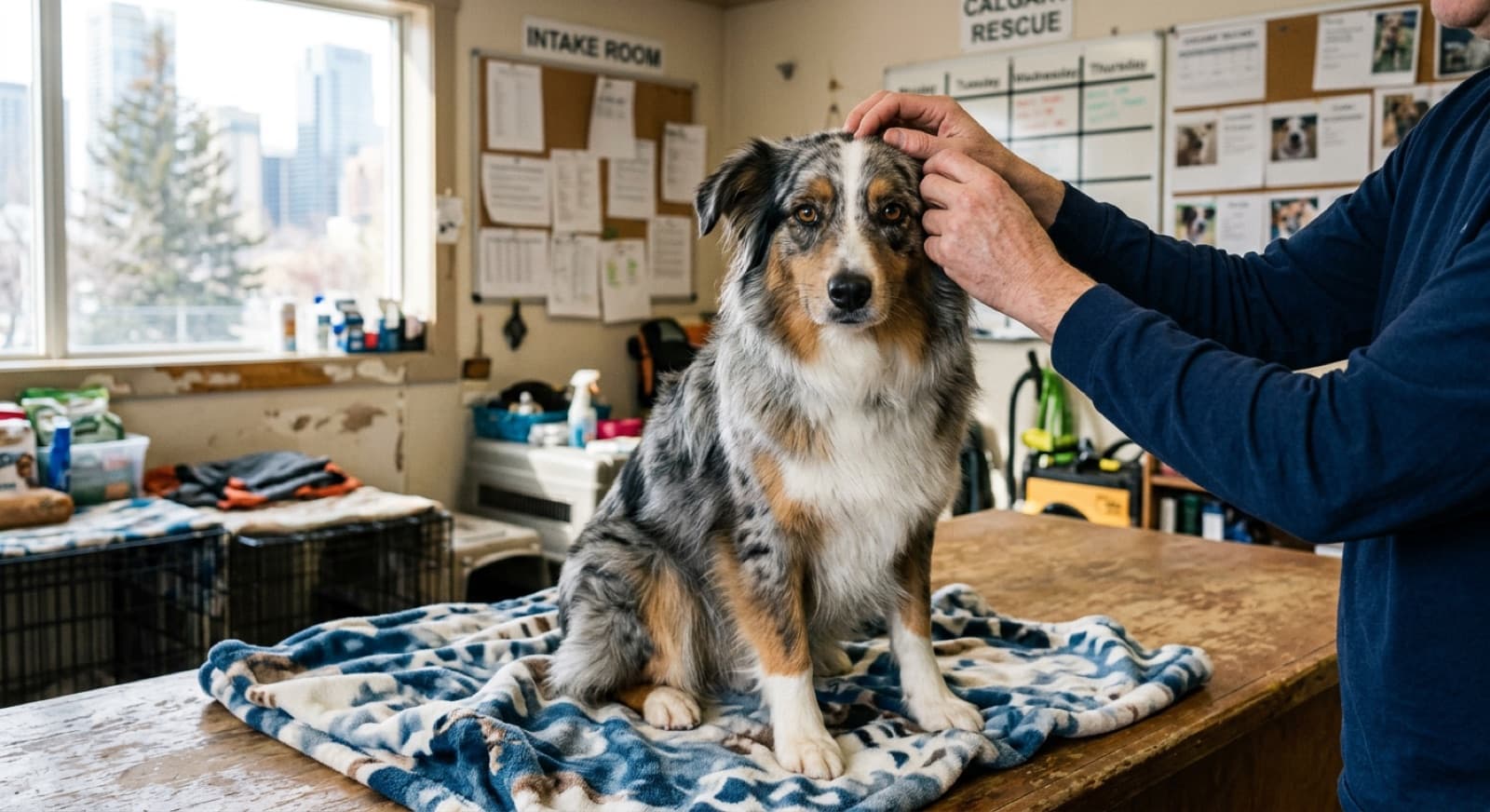
What MDR1 actually is, and why it matters
MDR1 stands for Multi-Drug Resistance 1. The technical name for the gene is ABCB1. The gene codes for a protein called P-glycoprotein, which sits in the cell membrane of the blood-brain barrier and acts like a pump. Its job is to actively push certain drugs back out of the brain before they can cause neurologic effects. In a normal dog, P-glycoprotein works correctly, drugs that should not cross into the central nervous system are kept out, and a wide range of medications are tolerated at standard doses.
In a dog with the MDR1 mutation, the P-glycoprotein pump is defective. The drugs that P-glycoprotein normally blocks accumulate in the brain and reach concentrations that cause severe neurologic toxicity. Same dose, same drug, completely different outcome. A standard preventive dose that is safe for a Labrador can put an affected Aussie into a coma. This is not an allergy or a sensitivity in the casual sense. It is a hard pharmacogenetic limit defined by the gene.
The mutation was first identified in Collies in the 1980s and traced genetically through the herding breeds that share a common Collie ancestor. The Washington State University Veterinary Clinical Pharmacology Lab maintains the most authoritative reference on the mutation, the affected breeds, and the drug avoidance list. The WSU VCPL MDR1 reference is the source every Aussie owner should bookmark and every vet should pattern protocols after.
The clinical implication: any Aussie should be assumed MDR1-affected until proven otherwise. The test is cheap, the result is permanent, and the avoidance list is short. Skipping the test means flying blind through every future medical event.
The three genotypes and what each means clinically
The MDR1 test returns one of three genotype results. Each result has different clinical implications, and the protocol for the dog depends on which category the test lands in.
Mutant/Mutant (homozygous affected)
Two copies of the mutant allele. The dog produces essentially no functional P-glycoprotein. This is the most severe genotype and the dog has the highest risk of life-threatening reactions to the drugs on the avoidance list. Roughly 5 to 15 percent of the Aussie population is mutant/mutant depending on the line. These dogs need the strictest avoidance protocol, the most visible identification, and the most cautious vet team. Even small accidental ingestions of loperamide or high-dose ivermectin can be fatal.
Mutant/Normal (heterozygous affected)
One copy of the mutant allele, one copy of the normal allele. The dog produces some functional P-glycoprotein but not full capacity. Roughly 35 to 50 percent of the Aussie population falls in this category. Clinical reactions are real but generally less severe than mutant/mutant. The same avoidance list applies. A heterozygous dog can still experience severe toxicity from a high enough dose of an avoidance-list drug, just usually at a higher threshold than a homozygous dog. The safe assumption is that heterozygous dogs need the same protocol as homozygous dogs at the household level.
Normal/Normal (unaffected)
Two copies of the normal allele. The dog produces full P-glycoprotein function and has no clinically significant MDR1 sensitivity. About 40 to 55 percent of the Aussie population tests normal/normal. These dogs can be dosed with standard protocols across the full pharmacopoeia. The result still belongs on the medical record because a future owner or vet team has the right to know.
Without testing, you do not know which category your Aussie sits in. The default assumption should be affected until proven otherwise. Many Aussies live happy lives without ever being tested because they never encounter an avoidance-list drug in clinically dangerous form, but the day they need anaesthesia or accidentally eat the Imodium bottle is the day the missing test becomes a crisis.
The DNA test: cost, lab, and how to order
The MDR1 DNA test is a simple buccal swab (inside of the cheek). No blood draw, no fasting, no sedation. Two practical options for Edmonton owners:
Direct order from WSU VCPL
The Washington State University Veterinary Clinical Pharmacology Lab is the original lab that identified the mutation and remains the gold-standard reference. You order a kit online, receive a buccal swab kit in the mail, swab your dog at home, mail it back, and receive the genotype result by email in 2 to 3 weeks. Cost is around $60 to $80 USD plus shipping, which lands around $90 to $110 CAD total. This is the cheapest authoritative option.
Through your Edmonton vet
Your vet can do the cheek swab in the exam room and send it through a referral diagnostic lab. Cost is typically $120 to $180 in Edmonton including the consultation fee. The advantage is the result goes directly to the medical record without owner intermediation. The disadvantage is the higher cost.
Multi-panel DNA tests
Direct-to-consumer DNA test kits from companies like Embark and Wisdom Panel include MDR1 in their standard panels and run $130 to $200. These are convenient if you want breed identification plus a broader health-screening panel in one purchase. The MDR1 component of these tests uses the same underlying genotyping methodology as WSU and is considered reliable. Confirm with your vet that the result is acceptable for the medical record before relying on it for an anaesthesia protocol decision.
Whichever option you choose, get the genotype on the medical record flag at your Edmonton vet within the first 30 days of adoption. The American Animal Hospital Association recommends pharmacogenetic screening for at-risk breeds as part of routine wellness care, and the cost is trivial compared to one preventable toxicity event. See the AAHA guidelines for the broader veterinary preventive-care framework.
The problem drugs: the full avoidance list by category
The comprehensive avoidance list, grouped by drug class. This is the list to print or screenshot and keep with the dog medical file.
Antiparasitics (high doses)
- Ivermectin at high doses: the classic offender. Used to treat mange, demodex, and parasitic infections at doses 30 to 100 times higher than heartworm prevention. Low-dose Heartgard is safe.
- Milbemycin oxide at treatment doses: safe at heartworm preventive doses (Sentinel, Interceptor), risky at the higher treatment doses.
- Moxidectin at treatment doses: the injectable ProHeart at preventive doses is generally safe; high-dose treatment formulations are not.
- Selamectin (Revolution): at the standard topical preventive dose, generally considered safe; cautious-use at higher doses.
Anti-diarrhoea (the most common household risk)
- Loperamide (Imodium): the most common accidental ingestion. Sitting in nearly every household medicine cabinet. Severe neurologic toxicity in affected Aussies. Replace with probiotics, prescription metronidazole under vet guidance, or a bland diet for routine cases.
Sedatives and anaesthetic pre-meds
- Acepromazine: common pre-anaesthesia sedative and travel sedative. Avoid as the default for MDR1 affected Aussies. Substitute dexmedetomidine or use lower doses with closer monitoring.
Opioids and antiemetics
- Butorphanol: reduce dose for MDR1 affected dogs or substitute buprenorphine.
- Morphine: reduce dose, monitor closely.
- Ondansetron (Zofran): standard antiemetic for post-op nausea. Reduce dose for affected dogs.
Chemotherapy drugs
- Vincristine: standard lymphoma protocol drug. Contraindicated for MDR1 affected Aussies at standard doses.
- Vinblastine: similar mechanism, similar restriction.
- Doxorubicin: bone marrow toxicity at standard doses for affected dogs.
Other categories
- Antifungals: ketoconazole, itraconazole at higher doses interact with P-glycoprotein.
- Cardiac: digoxin reaches higher tissue concentrations in affected dogs.
- Some antibiotics: erythromycin and a few others on the cautious-use list.
The list is not static. New drugs get evaluated as they enter the market, and the WSU VCPL updates the reference as evidence accumulates. Check the current published list at any vet appointment where a new medication is being prescribed. The American College of Veterinary Internal Medicine publishes consensus statements on pharmacogenetic management worth reading.
Safe alternatives: what your Aussie can have
The avoidance list reads like a long restriction, but in practical terms most common dog medications are still available. The substitutions:
Heartworm prevention
Heartgard (low-dose ivermectin), Sentinel (low-dose milbemycin), Interceptor Plus, and ProHeart 6 or 12 injectable at preventive doses are all generally considered safe for MDR1 affected Aussies. The standard year-round heartworm prevention protocol works without modification. Edmonton heartworm risk is lower than southern climates, but the recommendation to stay on prevention is still standard for any dog that travels or boards.
Flea and tick
The isoxazoline-class products (Bravecto, NexGard, Simparica, Credelio) work through a different mechanism than the macrocyclic lactones and are generally considered safe for MDR1 dogs. These are the default choice for affected Aussies in Edmonton.
Anti-diarrhoea
Skip the loperamide entirely. For routine soft stool, use a bland diet (boiled chicken and rice, or a vet-prescribed gastrointestinal diet) plus probiotics. For more severe diarrhoea, your vet can prescribe metronidazole (Flagyl) at standard doses, which is safe for MDR1 dogs. Probiotics like FortiFlora are widely available at Edmonton vet clinics.
Pain management
NSAIDs at standard doses are safe: carprofen (Rimadyl), meloxicam (Metacam), galliprant. These are the default for arthritis pain, post-surgical pain, and inflammatory conditions in affected Aussies. Gabapentin is also safe.
Sedation for grooming or transport
Trazodone at standard doses is safe and is the most common substitute for acepromazine in MDR1 affected dogs that need pre-grooming or pre-travel sedation. Gabapentin can be added for anxiety. Confirm doses with your vet.
The takeaway: an affected Aussie has access to a full functional medication pharmacopoeia with substitutions, not a curtailed life. The constraint is around a specific subset of drugs that need to be flagged, avoided, or dose-adjusted. Confirm every new prescription with the vet before filling it.
Browse adoptable Australian Shepherds in Edmonton
Aussies in rescue often arrive with unknown MDR1 status. A foster home that has already done the WSU test makes the first 30 days much easier, and adoption fees from $400 to $700 typically include initial vet workups.
See Edmonton Adoptable Dogs →
The accidental ingestion emergency: what to do at the 24-hour ER
The two highest-risk household scenarios are loperamide (Imodium) left in reach on a counter or nightstand, and high-dose ivermectin paste eaten at a horse farm. Both are time-critical and both require immediate 24-hour ER vet care. The protocol:
Step 1: confirm the exposure
Find the container. Confirm how much was in it before and how much is left. Estimate the dose your dog ingested. Note the time of ingestion. Take a photo of the label for the ER vet.
Step 2: call the ER on the way in
Edmonton has multiple 24-hour ER vet facilities. Call ahead with the breed, the MDR1 status (if known), the drug name, the dose, and your ETA. This gives the team time to prepare. If your dog has not yet shown symptoms, the window for inducing vomiting at the clinic is roughly 1 to 2 hours post-ingestion. After that, the drug is past the stomach and the treatment shifts to supportive care.
Step 3: treatment at the ER
For early presentation, the team may induce vomiting (apomorphine) and give activated charcoal. For symptomatic dogs, the treatment is supportive: IV fluids, monitoring, anti-seizure medication if needed, and intravenous lipid emulsion (ILE) therapy for severe ivermectin or loperamide toxicity. ILE works by binding lipophilic drugs in the bloodstream and accelerating clearance. It is now standard of care for severe MDR1 toxicity. Recovery typically takes 24 to 72 hours of hospitalisation for moderate cases, longer for severe.
Step 4: cost expectations
Edmonton 24-hour ER vet treatment for moderate MDR1 toxicity runs $1,500 to $4,000. Severe cases requiring ventilator support or prolonged hospitalisation run $5,000 to $12,000. Pet insurance generally covers accidental drug ingestion under the standard accident category, which is one of the strongest arguments for enrolling an Aussie during the puppy year before any pre-existing condition accrues.
The American Veterinary Medical Association publishes general emergency care guidance worth reviewing. See the AVMA pet emergency resources for the broader framework. For Aussie-specific protocol consultation in complex cases, Edmonton ER vets routinely refer to the Western College of Veterinary Medicine at the University of Saskatchewan.
The disclosure protocol: vet, groomer, boarder, dog walker
The drugs on the avoidance list show up in places most owners do not anticipate. Groomers and boarders use sedatives for difficult dogs. Dog walkers may give over-the-counter pain or anti-diarrhoea medication if the dog seems off. The vet office that does not have a flag on the chart may default to acepromazine for pre-anaesthesia. The fix is the same protocol every time:
Medical record flag at every vet
Confirm at your first vet visit that the MDR1 genotype is on the patient file as a drug-sensitivity alert. Most Edmonton clinics have a flag system that triggers an alert when any medication is prescribed. Ask to see the flag during the visit. If your dog ever visits a different clinic or ER, the genotype needs to be communicated verbally and confirmed on their chart as well.
Visible collar tag
A medical alert tag on the collar reading “MDR1 affected, no ivermectin, no Imodium, no acepromazine” handles disclosure when the owner is not in the room. The tag works at the groomer, the boarder, the dog walker, and the field-level ER vet if the dog is brought in by a friend or neighbour. Tags run $10 to $25 at most pet stores or online. The investment is trivial.
Microchip note
Most microchip registries allow a medical note field. Add the MDR1 status there. If the dog is lost and scanned by an Edmonton facility, the chip lookup will return the alert.
Boarder and groomer briefing
At the first visit to any new boarder, groomer, or daycare, hand over a one-page MDR1 brief: genotype, drug avoidance list, your vet emergency contact, and the nearest 24-hour ER. Many Edmonton boarders and groomers have a medical notes field in their intake form. Use it.
The disclosure system fails when one link breaks. The vet knows but the groomer does not. The boarder knows but the field ER does not. Build redundancy in: medical record flag, collar tag, microchip note, and a one-page printed brief that travels with the dog to every appointment.
Anaesthesia, surgery, and dental work: planning ahead
Any scheduled anaesthesia event is a planned opportunity to build the protocol in advance. Send the MDR1 genotype to the vet team a week before the appointment. The pre-op plan needs to address pre-medication sedation, induction, maintenance, post-op pain control, and post-op nausea.
The substitutions:
- Pre-med sedation: dexmedetomidine in place of acepromazine. Trazodone the night before for anxiety.
- Induction: propofol and ketamine are generally safe.
- Maintenance: isoflurane or sevoflurane inhalant. Both are safe.
- Pain control: NSAIDs (carprofen, meloxicam, galliprant) at standard doses. Buprenorphine instead of butorphanol at reduced doses.
- Post-op nausea: reduced-dose ondansetron or maropitant.
- Recovery monitoring: extended observation because some metabolites clear differently.
Dental cleanings, spay or neuter, soft-tissue surgery, and orthopaedic surgery all follow this framework. The principle is the same: substitute, dose-reduce, and monitor.
For complex surgical procedures, Edmonton has board-certified soft-tissue and orthopaedic specialty practices, with WCVM Saskatoon available for referral on the rare protocol challenge. The cost premium for specialty anaesthesia consultation is typically $300 to $600 above the standard procedure cost and is worth it for any non-routine event.
Chemotherapy: when an MDR1 Aussie gets cancer
Aussies have moderate cancer risk in line with other working breeds. The most common diagnoses are lymphoma, hemangiosarcoma, and mast cell tumours. The standard first-line lymphoma protocol uses vincristine and doxorubicin as core drugs, both of which are contraindicated at standard doses for MDR1 affected dogs.
The board-certified veterinary oncologist will adjust the protocol in three ways: substitute alternative chemotherapy drugs that do not depend on P-glycoprotein efflux (lomustine, cyclophosphamide, prednisone-based protocols), dose-reduce the vincristine and doxorubicin if they remain in the plan, and add closer haematology monitoring through treatment.
Edmonton oncology access runs through specialty practices in Edmonton plus WCVM Saskatoon for complex cases. Initial consultation runs $400 to $700. A full lymphoma chemotherapy protocol runs $6,000 to $12,000 over 6 months for a medium dog. Pet insurance covers oncology if the policy was in force before the cancer diagnosis, which is the strongest argument for enrolling early.
The five-year-old Aussie that gets diagnosed with lymphoma and has known MDR1 status entering the oncology consult gets a faster, safer treatment plan than the same dog with unknown MDR1 status. The test paid back a hundred times over.
Heartworm and parasite prevention for MDR1 Aussies
Edmonton heartworm transmission risk is lower than southern climates because the mosquito season is shorter and the parasite load is lower, but the standard year-round prevention recommendation still applies for any dog that travels, boards, or summers at a lake. The MDR1-safe prevention options:
- Heartgard (ivermectin): low-dose monthly chewable. Safe at preventive dose. Tested and labelled for MDR1 dogs.
- Sentinel (milbemycin + lufenuron): monthly chewable combining heartworm and flea-egg prevention. Safe at preventive dose.
- Interceptor Plus (milbemycin + praziquantel): heartworm and intestinal worm coverage. Safe at preventive dose.
- ProHeart 6 or 12 (moxidectin): injectable lasting 6 or 12 months. Safe at preventive dose. Reduces compliance risk for forgetful owners.
For intestinal parasites, fenbendazole (Panacur) is safe and is the default for routine deworming. Praziquantel is safe.
What to avoid: any high-dose ivermectin formulation, large-animal antiparasitics (horse ivermectin paste, cattle injectable ivermectin), and any older off-label prescription that uses ivermectin at treatment doses for mange or demodex. For mange treatment in an affected Aussie, the safer alternatives are the isoxazoline-class products (fluralaner, sarolaner) which are now standard of care for demodex anyway. Talk to your vet about the substitution.
Flea and tick: the isoxazoline default
The isoxazoline class is the default flea and tick prevention for MDR1 affected Aussies. The four major products on the Canadian market:
- Bravecto: oral chewable, lasts 12 weeks. Convenience and compliance benefit.
- NexGard: oral monthly chewable. Same active class, monthly cadence.
- Simparica Trio: combines flea, tick, and heartworm in one monthly chewable. Good single-product choice.
- Credelio: oral monthly chewable. Same class.
All four are generally considered safe for MDR1 dogs at labelled doses. Side effects are rare but include occasional GI upset and very rarely neurologic events. The risk profile is acceptable, and the isoxazolines have largely replaced the older topical and macrocyclic-lactone options for flea and tick control.
Edmonton tick season runs May through October at the river valley and trail systems. The American Wood Tick and Black-Legged Tick both occur in the region. Year-round prevention is standard for any Aussie that hikes, runs trails, or stays at lake properties in the summer. Confirm the product and dosing with your vet at the first wellness visit.
Senior MDR1 Aussies and cumulative drug exposure
By the senior years (age 9 onward) most Aussies have accumulated some health load: arthritis, dental disease, vision changes, possibly cardiac or renal concerns. The medication list grows with age, and the MDR1 protocol becomes more relevant, not less.
The senior Aussie protocol additions:
- Annual wellness with full medication review. Every drug the dog is on gets cross-checked against the avoidance list. Some senior dogs end up on 4 to 6 daily medications and the interaction risk grows.
- Anaesthesia for dental cleanings. Most senior Aussies need dental work, and each event needs the MDR1 anaesthesia protocol reviewed in advance.
- Pain management. NSAIDs are safe but kidney function should be monitored with twice-yearly bloodwork in seniors on chronic NSAIDs.
- Cognitive dysfunction medications. Selegiline (Anipryl) for canine cognitive dysfunction is generally considered safe.
- Senior wellness panel. Annual senior bloodwork at the Edmonton clinic catches the renal and hepatic changes that affect drug clearance even for non-MDR1 drugs. Cost runs $300 to $500 annually.
The senior Aussie is the dog most likely to need anaesthesia for the most procedures and most likely to be prescribed the largest number of medications. The MDR1 protocol pays back the most in the senior years.
Multi-dog households: storing meds safely
A common Edmonton scenario is the Aussie household with a second non-Aussie dog. The non-Aussie may be on a medication that is dangerous for the Aussie. The fix is straightforward but easy to forget: store all medications out of dog reach, label them clearly, and feed pill-dosed medications in separate sessions where the Aussie cannot intercept the wrong dose.
The two highest-risk scenarios:
- The non-Aussie eats the Aussie heartworm chewable, and the Aussie eats the non-Aussie one. Most modern heartworm chewables are safe at preventive doses regardless of MDR1 status, but the dose calibrated for a 90 lb Lab is wrong for a 50 lb Aussie. Feed in separate rooms.
- The non-Aussie spits out an Imodium tablet and the Aussie eats it. Loperamide is the classic risk. If the non-Aussie is on loperamide for a chronic condition (rare but possible), the Aussie household needs strict separation during feeding plus a check that no tablets land on the floor.
The simplest defence is the locked medication cabinet plus the supervised pill-dosing routine. Most accidental ingestion events in MDR1 affected dogs happen with the owner home, distracted, in the kitchen. Treat medications like baby-locks worth.
Edmonton specialty access for complex MDR1 cases
Edmonton has solid emergency vet coverage with multiple 24-hour facilities. Specialty pharmacology consultation for complex protocol challenges is harder to access locally. The standard escalation path:
- Primary vet: first line for routine medications, vaccines, wellness. Confirms MDR1 protocol on the chart.
- Edmonton ER vets: for accidental ingestion or acute toxicity. Stabilise, treat with supportive care plus ILE.
- Edmonton specialty practices: for board-certified internal medicine, surgery, oncology. Most complex anaesthesia and chemotherapy protocols.
- WCVM Saskatoon: the regional referral hub at the University of Saskatchewan. Reachable by road (5 hours) or air ambulance for critical cases. Consult-call available for protocol guidance.
For routine MDR1 management, the primary vet handles the full protocol. Specialty consultation only comes in for non-routine surgery, chemotherapy, or severe toxicity events.
Pet insurance for an Aussie in Edmonton runs $35 to $80 monthly depending on age and coverage tier. The accident category covers MDR1-related toxicity events at most major plans, and the illness category covers oncology. Enroll during the puppy or first-month-after-adoption window before any pre-existing condition accrues. Premiums for Aussies are not elevated for MDR1 status itself, only for the statistical reality of more emergency claims over a lifetime.
Frequently asked questions
What drugs are dangerous for an Australian Shepherd with MDR1?
The core list every Aussie owner should know covers high-dose antiparasitics (ivermectin at the higher doses used to treat mange or demodex, milbemycin oxime at treatment doses, moxidectin at treatment doses), the anti-diarrhoea drug loperamide (sold over the counter as Imodium), the sedative acepromazine, some opioids at standard doses (butorphanol, morphine), the antiemetic ondansetron at standard doses, the antifungals ketoconazole and itraconazole, the cardiac drug digoxin, and the cancer chemotherapy drugs vincristine, vinblastine, and doxorubicin. At standard low doses, the heartworm preventive form of ivermectin (Heartgard) is safe even for affected Aussies. The risk scales with both dose and genotype. Mutant homozygous dogs (two copies of the mutation) react most severely. Mutant heterozygous (one copy) dogs show moderate sensitivity. The Washington State University Veterinary Clinical Pharmacology Lab keeps the current evidence-based avoidance list, and every Aussie owner should print or screenshot it for the vet file.
How much does an MDR1 test cost in Edmonton?
The test runs $80 to $150 depending on whether you order direct from the Washington State University VCPL (the gold-standard lab) or have your Edmonton vet send a buccal swab through a referral diagnostic lab. WSU is the cheapest direct option and the most authoritative result. Your vet can do the cheek swab in the exam room or you can collect it at home with the WSU mail-in kit. Turnaround is typically 2 to 3 weeks. The result is a genotype: mutant/mutant (most severe), mutant/normal (moderate), or normal/normal (no clinically significant sensitivity). Knowing the genotype is the single highest-value investment an Aussie owner can make for the dog drug-safety file.
Is Heartgard safe for MDR1 Aussies?
Yes. Heartgard contains ivermectin at the low dose used for monthly heartworm prevention (6 micrograms per kg), which is well below the threshold that causes MDR1 toxicity. The drug-warning label on Heartgard explicitly states the product is safe for Collies and other MDR1-susceptible breeds at the recommended preventive dose. The dangerous use of ivermectin in Aussies is high-dose ivermectin for treating mange, demodex, or accidental exposure to large-animal ivermectin formulations (horse paste, cattle injectable). At preventive doses, Heartgard, Sentinel (milbemycin), and the ProHeart injectable (moxidectin) are all considered safe for MDR1 dogs. Always confirm the dose and product with your Edmonton vet, and never substitute a horse or cattle ivermectin product for the dog formulation.
My Aussie ate Imodium. What do I do?
Treat it as a 24-hour emergency vet visit. Loperamide (Imodium) is one of the most dangerous accidental ingestions for an MDR1 Aussie because it is sitting in many household medicine cabinets and most owners do not know it is on the avoidance list. The toxicity presents as profound neurologic signs: severe sedation, ataxia, tremors, seizures, coma, respiratory depression. Onset is within hours. Go to the nearest 24-hour ER vet immediately. Bring the pill bottle so the clinic knows the dose. Treatment is supportive: IV fluids, lipid emulsion therapy for severe cases, monitoring, and time. Recovery typically takes 24 to 72 hours of hospitalisation. Do not wait to see if symptoms develop. The toxicity is dose-dependent and fast.
What should I tell my vet, groomer, and boarder about MDR1?
Disclose at every appointment with everyone who handles your dog. Your primary vet needs the MDR1 genotype on the medical record flag (most Edmonton clinics have a field for drug-sensitivity alerts in the patient file). Your emergency vet needs to know if you call for any urgent care. Your groomer and boarder need to know because they may use sedatives, anti-anxiety meds, or tranquillisers for difficult dogs, and some of those are on the avoidance list. A clear collar tag reading "MDR1 affected, no ivermectin, no Imodium, no acepromazine" handles the field-level disclosure. The American College of Veterinary Internal Medicine recommends visible identification plus medical-record flags for any pharmacogenetic mutation a dog carries.
Are flea and tick products safe for MDR1 Aussies?
Most of the modern isoxazoline-class flea and tick products are generally considered safe for MDR1 dogs at labelled doses. That includes Bravecto, NexGard, Simparica, and Credelio. The isoxazolines act through a different mechanism than the macrocyclic lactones (ivermectin family) and are not affected by P-glycoprotein dysfunction. The exception worth flagging is selamectin (Revolution), which is a macrocyclic lactone like ivermectin and is on the cautious-use list for MDR1 dogs at higher doses, though the standard topical preventive dose is generally considered safe. Always confirm the specific product and dose with your Edmonton vet before starting any new parasite preventive, and choose isoxazoline-class products as the default for MDR1 affected Aussies.
What anaesthesia protocol does an MDR1 Aussie need for surgery?
Pre-op planning is critical. The standard small-animal anaesthesia protocol leans on acepromazine as a pre-med sedative and may include butorphanol and other opioids at routine doses. For an MDR1 Aussie, the vet team should substitute acepromazine with dexmedetomidine or a different sedative class, use butorphanol at reduced doses or substitute buprenorphine, and avoid ondansetron at standard doses for post-op nausea. Ketamine and propofol induction are generally safe. Inhalant maintenance (isoflurane, sevoflurane) is safe. Recovery monitoring should be extended because some metabolites of the alternative drugs clear differently. Send the MDR1 genotype result to the vet team a week before any scheduled procedure so the protocol is built in advance, not improvised on the day.
Can my Aussie have chemotherapy if they get cancer?
Yes, but the protocol changes. The most common dog chemotherapy drugs that are contraindicated for MDR1 dogs are vincristine, vinblastine, and doxorubicin at standard doses. These cause severe bone marrow suppression and gastrointestinal toxicity in affected dogs. A board-certified veterinary oncologist will substitute alternative chemotherapy protocols (different drug classes, dose-reduced versions, or non-pharmacological options like radiation where appropriate). Edmonton oncology access runs through specialty practices in Edmonton and referral to the WCVM at the University of Saskatchewan in Saskatoon for complex cases. The MDR1 status changes both the drug choice and the dosing, so a confirmed diagnosis is mandatory before any chemotherapy starts. The American College of Veterinary Internal Medicine has the current oncology protocols for MDR1 dogs.
My Aussie ate horse ivermectin paste on a farm. What do I do?
Go to the nearest 24-hour ER vet immediately. Horse paste ivermectin is concentrated 50 to 100 times higher than the dose used in dog heartworm prevention, and a single small lick is potentially fatal for an MDR1 affected dog. Toxicity presents within 4 to 12 hours as severe neurologic signs: depression, dilated pupils, ataxia, tremors, blindness, seizures, coma. Bring the tube or empty syringe so the clinic knows the concentration and estimated dose. Treatment is supportive (IV fluids, intralipid emulsion therapy, ventilator support in severe cases) and recovery can take 1 to 7 days of hospitalisation. Many affected dogs recover with prompt aggressive care but the cost runs $3,000 to $10,000 for severe cases. If you have an Aussie on or near a horse property, this is the single highest-risk accidental exposure, and the farm owner should store ivermectin paste in a locked cabinet out of dog reach.
Does pet insurance cover MDR1-related drug toxicity?
Generally yes, with one caveat. Most major pet insurance plans cover emergency treatment for accidental drug ingestion, including loperamide and ivermectin toxicity, under the standard accident coverage. The caveat is the pre-existing condition exclusion. If you enroll your Aussie after a known MDR1 toxicity event, that specific event will be flagged as pre-existing and the policy may exclude future claims related to it. Enroll during the puppy year before any incident accrues. Premiums for Aussies in Edmonton run $35 to $80 monthly depending on age and coverage level. The MDR1 genotype itself does not raise premiums, but the eventual emergency event (which is statistically more likely for affected dogs) is what makes the insurance pay off.
How is Edmonton MDR1 management different from other cities?
Edmonton has solid emergency vet coverage with multiple 24-hour facilities, which matters because MDR1 toxicity is a time-critical event. Specialty pharmacology consultation is harder to access locally. Most complex cases get referred to the Western College of Veterinary Medicine at the University of Saskatchewan in Saskatoon, about 5 hours by road or transferable by air ambulance for severe cases. Day-of-event you stabilise at an Edmonton ER and consult-call WCVM for protocol guidance. The other Edmonton factor is the farm-and-acreage adjacent population: Aussies often go home with horse-owning families, and accidental ivermectin paste ingestion at the barn is the highest-incidence MDR1 emergency we see. Owners with horse-property friends or barn boarders should know the risk and the storage protocol.
Related Edmonton Australian Shepherd guides
Adoptable Dogs in Edmonton
Browse current Aussies and Aussie crosses listed with Edmonton-area rescues. Updated regularly.
Australian Shepherd Adoption Edmonton
Edmonton Aussie rescue sources, adoption costs, surrender patterns, and the working-dog adopter reality.
Australian Shepherd Health Issues: MDR1, Eyes
Australian Shepherd health issues to plan for: MDR1 drug sensitivity, epilepsy, Collie eye anomaly and other eye disease, hip dysplasia, EPI and deafness in merle-to-merle puppies.
Australian Shepherd Merle Coat Genetics Edmonton
Merle inheritance, double merle health risks, and what blue merle, red merle, and black tri mean.
Find your Edmonton Australian Shepherd
Browse adoptable Aussies and Aussie crosses from Edmonton-area rescues. Filter by age and energy to find a match.
Browse All Edmonton Dogs →New dog? Start with these care guides
Everything a new adopter needs to set up a safe, happy home.