The short answer
Beagles are breed-defined by two intertwined challenges. Housetraining takes 4 to 12 months, not 8 to 12 weeks, because 220 million olfactory receptors keep detecting old spots even after standard cleaning. Alone-time ceiling is 3 to 4 hours, pack-dog instinct. Edmonton apartment Beagles hit Bylaw 21244 noise complaints fast: baying carries through walls and 311 complaints accumulate. Force-free protocol throughout (aversive corrections worsen SA). Enzymatic cleaners only (Nature's Miracle, Rocco and Roxie). Crate training in week-by-week increments with high-value rewards. Edmonton winter at -25C compounds housetraining timeline by 2 to 4 months; indoor pee pads as winter accommodation are reasonable Nov-Mar. WFH-to-office return crisis hit Beagles too: 2024-2026 surrenders trace to pandemic adoptions hitting sudden isolation. Daycare 1 to 3 days/week plus midday walker plus indoor enrichment is the working-owner playbook ($400 to $800/month).
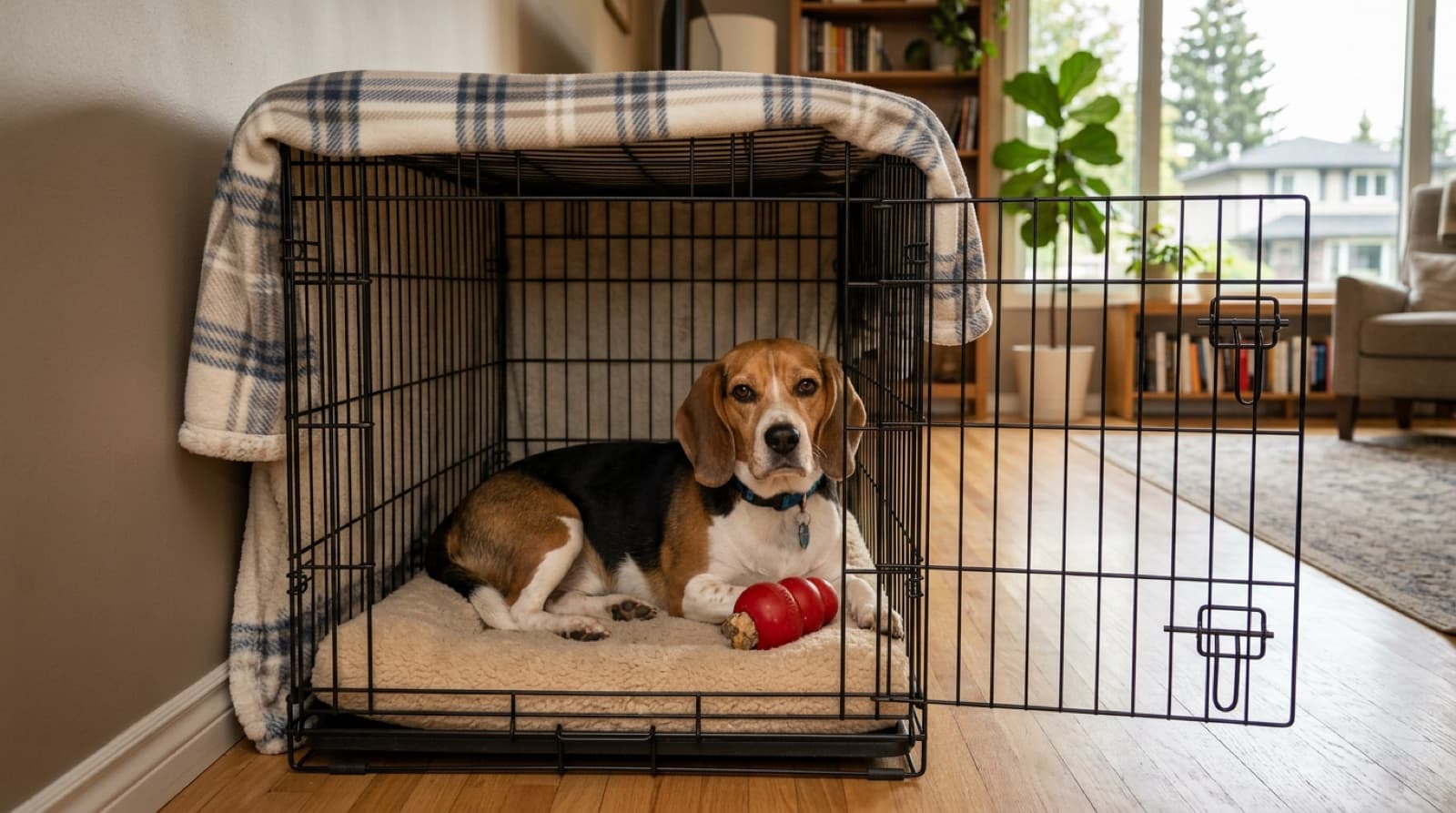
The 220-million-olfactory-receptor problem
Beagles have roughly 220 million olfactory receptors. Humans have about 5 million. The breed was developed for scent tracking, and that genetic substrate explains most of what makes Beagles distinctively challenging.
For housetraining specifically:
- Old accident spots remain detectable to the dog even after cleaning that satisfies humans. The dog returns to them.
- Outdoor scent distraction is overwhelming. The Beagle goes outside to potty and gets absorbed in scent investigation, then forgets to eliminate.
- The dog comes back inside and eliminates when comfortable.
- Standard 4-week housetraining timelines do not apply.
The breed-club consensus: Beagles housetrain in 4 to 12 months typically. Lab-rescue Beagles (Envigo dogs and similar releases) often need 6 to 18 months. The AKC Beagle breed profile describes the breed as “friendly, curious, merry” without foregrounding the housetraining timeline. The breed-club community is more direct: every Beagle owner needs patience and a long timeline.
Edmonton winter compounds this. Wind chill at -25C makes outdoor potty trips genuinely painful for the dog. Many Beagles refuse to potty in deep cold, which leads to indoor accidents. The 4 to 12 month timeline often extends to 6 to 14 months in Edmonton for dogs adopted in late fall.
The 3 to 4 hour alone-time ceiling
Beagles were bred as pack dogs. They have not evolved to be alone for 9 to 11 hour Edmonton workdays. The pack-instinct gap is real and not fixable through training alone.
Alone-time tolerances by life stage:
- Puppies under 8 months: 1 to 3 hours
- Adolescents 8 months to 3 years: 3 to 4 hours maximum
- Adult Beagles 3+ years: 3 to 4 hours typical, sometimes 4 to 6 with strong training
- Senior Beagles 8+ years: often slightly longer, but cardiac and medical considerations
- Rescue Beagles first 30 to 60 days: 30 minutes to 2 hours, build slowly
- Lab-rescue Beagles: 6 to 12 months to build basic alone-time skills
Edmonton downtown commute reality. A 30 to 45 minute commute each way plus 9-hour office equals 9 to 11 hour daily alone time. Most Beagles cannot handle this.
The WFH-to-office return crisis that hit Doberman and Cavalier owners after 2024 also hit Beagle owners hard. Many Edmonton Beagles surrendered to rescue in 2024 to 2026 trace back to pandemic-adopted dogs hitting sudden return-to-office isolation. The sibling Edmonton Doberman velcro and separation anxiety guide covers the WFH-return pattern in detail; the principles apply directly to Beagles.
The working-owner playbook: daycare 1 to 3 days/week ($30 to $55/day in Edmonton), midday walker on non-daycare days ($20 to $35/visit), hybrid work schedule if possible, second-Beagle companion sometimes. Budget $400 to $800/month for the daycare and walker network. Without it, Beagles surrender within 6 to 18 months.
Edmonton Bylaw 21244 and apartment Beagles
Beagle baying carries far and neighbours hear it through standard apartment construction. The Edmonton Animal Care and Control Bylaw 21244 noise provisions are enforced through Edmonton 311 complaints.
Pattern: neighbour reports excessive barking through 311, bylaw officer investigates, warning issued, fines for repeated complaints, escalating amounts. Condo board complaints separately can result in violation notices and in rare cases eviction.
Prevention:
- Adequate exercise and mental stimulation (60 to 90 minutes daily including scent work)
- Soundproofing (sound-absorbing curtains, white noise machines, area rugs)
- Crate placement away from shared walls
- Daycare 2 to 3 days/week to reduce accumulated alone-time arousal
- Force-free training (aversive bark collars worsen SA in pack-anxious breeds)
- Sometimes medication for severe separation anxiety (vet-prescribed)
- Proactive conversation with neighbours before complaints escalate
Some of the product links in this section are Amazon affiliate links — we may earn a small commission at no extra cost to you. It never changes which products we recommend.
If a complaint is filed: do not ignore. Work with the neighbour and property manager actively. Address the barking immediately. Document training efforts (trainer receipts, behaviourist consultation, medication paperwork).
The honest conversation: for an Edmonton condo dweller with full-time office work and no daycare or walker investment, a Beagle is genuinely the wrong fit. Many Edmonton suburban Beagle placements happen because a condo Beagle's noise issues forced rehoming.
Daily housetraining protocol
Beagles thrive on predictability. The protocol that works:
- Feed at exact times daily. Predictable feeding equals predictable elimination.
- Potty trips at key times: first thing in the morning, 15 to 30 minutes after meals, 10 to 15 minutes after naps, 10 to 15 minutes after play, before bed, every 2 to 4 hours during the day for adults (every 1 to 2 hours for puppies).
- Same outdoor spot each time. Scent association reinforces the behaviour.
- Consistent cue word (“go potty”).
- Reward immediately with a high-value treat within 1 to 3 seconds of elimination, not when you go back inside.
- Stay with the dog. Do not rush; sometimes 10 to 15 minutes outdoors is needed even in cold.
- Limit indoor freedom. Supervised, crated, penned, or tethered to you.
- Never punish accidents. Clean with an enzymatic cleaner and adjust the schedule.
Typical Edmonton timeline: 4 to 12 months reliable, with occasional accidents during stress, cold snaps, or schedule changes. Indoor pee pads as winter accommodation (November through March) are reasonable Edmonton Beagle strategy.
Enzymatic cleaners (because Beagles smell what humans cannot): Nature's Miracle Advanced Stain and Odor Remover ($15 to $30), Rocco and Roxie Professional ($20 to $40), Simple Solution Extreme ($25 to $45), Animal Chemistry Urine Off ($30 to $50). Saturate to subfloor, sit 10 to 30 minutes, air-dry, repeat over 2 to 3 days for set-in spots. Avoid ammonia-based cleaners (smell like urine to dogs, encourage repeat). Black light ($15 to $30) reveals invisible old spots.
Browse adoptable Beagles in Edmonton
Senior Beagles (8+ years) often have established housetraining, calmer baseline, and known temperament. The high-intensity vocal-adolescent phase is past.
See Available Beagles →True separation anxiety vs boredom barking
| Signal | Boredom barking | Clinical SA |
|---|---|---|
| Vocalisation pattern | Intermittent, with breaks | Continuous 30+ minutes |
| Destruction | Random, not concentrated | Focused on exits (doors, windows) |
| Self-injury | None | Broken nails, raw paws, sometimes teeth |
| Indoor soiling (housetrained dog) | No | Yes, despite training |
| Pre-departure behaviour | Normal | Trembling, hiding when you grab keys/coat |
| Greeting on return | Calm or normal | Hyperventilating |
| Trajectory over time | Settles after activity | Escalates |
| Fix | More exercise + mental work | Force-free trainer + sometimes vet behaviourist + medication |
The puppy-cam test (Wyze, Ring, Furbo) reveals the truth in 30 minutes. For clinical SA cases, work with a force-free Edmonton trainer or veterinary behaviourist. Virtual DACVB consultations run $300 to $600 initial; in-person consults $400 to $800. Medication options (prescribed and dosed by your vet) include fluoxetine ($30 to $70/month), clomipramine ($40 to $80/month), and situational trazodone, always paired with behaviour modification. The detailed medication framework lives in the sibling Edmonton Doberman velcro and SA guide.
Lab-rescue Beagle specifics
Lab Beagles (Envigo and similar research-facility releases) have never lived in homes. They are a different adoption category than standard surrender Beagles.
What lab Beagles arrive with:
- No indoor versus outdoor distinction
- No leash training
- Overwhelming response to the outdoor world (initial fear or freezing on grass, sidewalk, or snow is common)
- Pack-dependent elimination (often will not eliminate without a companion present)
- Often undiagnosed UTIs, dental disease, or parasites
The lab-Beagle protocol:
- Three weeks of decompression with minimal expectations.
- A calm housetrained companion dog modelling outdoor elimination accelerates learning dramatically.
- Leash-train separately from housetraining (start indoors with treats).
- Build outdoor exposure gradually.
- Edmonton $300 to $600 full vet workup essential before housetraining begins in earnest.
- Expect 6 to 18 month timeline.
- Indoor pee pads as long-term backup are reasonable, not failure.
The trade-off is real: lab Beagles are profoundly grateful for home life. Edmonton-area placement of lab Beagles happens through partnerships between national lab-rescue organisations and local Edmonton rescue networks; the specific intake pipeline varies year-to-year.
Frequently Asked Questions
Why are Beagles harder to housetrain than other breeds?
Several factors combine. Beagles have roughly 220 million olfactory receptors (humans have about 5 million), so they keep detecting old accident spots even after cleaning, and they return to them. They were bred to live in pack kennels where eliminating in shared spaces was normal, so the concept of "outdoor only" is less natural than for breeds bred as solo companions. They are independent decision-makers who do not care about owner approval the way Golden Retrievers do. They are easily distracted by scents outdoors and forget to potty, then go indoors when comfortable. Most breeds housetrain reliably in 8 to 12 weeks. Beagles typically need 4 to 12 months or more. Lab-rescue Beagles (Envigo dogs and similar research facility releases) often need 6 to 12 months of adjustment because they have never lived in a home. Do not panic at month 3 with incomplete training. Keep the routine, the management, and the patience going. Edmonton winter compounds the timeline: -25C wind chill makes outdoor potty trips genuinely painful, which slows learning by 2 to 4 months for many dogs.
Adult rescue Beagle still has accidents. Medical or behavioural?
Start with the vet, not the trainer. A urinary tract infection is common in Beagles, especially females, and presents as increased frequency, smaller volumes, sometimes blood in the urine. Bladder stones, diabetes, kidney disease, and estrogen-responsive incontinence in spayed females are all possibilities. Sudden incontinence combined with back pain points to IVDD-like conditions, which warrants emergency vet attention. An Edmonton $200 to $400 vet workup with urinalysis and sometimes bloodwork rules these out. If everything is clear medically, then look at behavioural causes: submissive or excitement urination, marking, stress, incomplete housetraining, or separation anxiety. Many adoptable Beagles labelled "not housetrained" actually have undiagnosed UTI or hormonal incontinence that is easy to treat once identified. SCARS, Edmonton Humane Society, Zoe's Animal Rescue, and AHHRB all include baseline vet workup in adoption fees, but a 14-day post-adoption recheck is worth the $200 to $400 for any Beagle with persistent accidents.
Best enzymatic cleaner for Beagle-level scent?
This matters because Beagles return to spots they can still smell, and standard cleaners do not eliminate dog-perceptible scent. Enzymatic cleaners break down the urea and uric acid components dogs detect. Edmonton pet stores stock Nature's Miracle Advanced Stain and Odor Remover ($15 to $30), Rocco and Roxie Professional ($20 to $40), Simple Solution Extreme ($25 to $45), and Animal Chemistry Urine Off ($30 to $50). Apply enough to saturate down to the subfloor or padding, let sit 10 to 30 minutes, air-dry, and repeat over 2 to 3 days for set-in spots. A $15 to $30 black light reveals invisible old spots. Avoid ammonia-based cleaners (they smell like urine to dogs and encourage repeat). Vinegar and bleach are not sufficient on their own. For carpet and upholstery, sometimes professional steam cleaning is needed in addition to enzymatic treatment.
Crate training a Beagle who howls in the crate?
Foundation week one: crate present and open in the main living area, treats inside at random, no confinement. Then feed meals in the crate with the door open. Then close the door for 30 seconds, then a minute, building up while the dog is eating calmly. If the dog vocalises but is settling, wait for 30 seconds of silence before releasing (releasing during a howl reinforces howling). Beagles bay as pack communication, not always panic. Some baying is tolerable if the dog calms after 5 to 10 minutes. Edmonton apartment owners need to consider Bylaw 21244 noise risk: place the crate away from shared walls, use a white noise machine, and consider sound-absorbing curtains. Trazodone prescribed by your vet can help in severe cases. Some Beagles never tolerate a crate. Alternatives that work: an exercise pen with a safe-room setup, single-room confinement with a baby gate, or free-roam in a dog-proofed home.
How long can a Beagle be left alone? The 3 to 4 hour ceiling.
Most adult Beagles top out at 3 to 4 hours of comfortable alone-time daily. Adolescent Beagles (8 months to 3 years) max out at 3 to 4 hours. Puppies under 8 months: 1 to 3 hours. Rescue Beagles in their first 30 to 60 days: start at 30 minutes to 2 hours and build slowly. Lab-rescue Beagles (Envigo and similar) have much less alone-time tolerance and may take 6 to 12 months to build basic alone-time skills. An Edmonton downtown commute plus a 9-hour office day equals roughly 9 to 11 hours of alone-time, which most Beagles cannot handle. Edmonton working Beagle owners typically use 1 to 3 days of daycare a week, a midday walker, work-from-home days, or a second Beagle as a companion. Budget $400 to $800 a month for the daycare and walker network. The WFH-to-office return crisis that hit Doberman and Cavalier owners after 2024 also hit Beagle owners hard; many Edmonton Beagles surrendered to rescue in 2024 to 2026 trace back to pandemic-adopted dogs hitting sudden return-to-office isolation.
Edmonton apartment + Bylaw 21244 noise complaint risk?
Beagle baying carries far and neighbours hear it through standard apartment construction. The Edmonton Animal Care and Control Bylaw 21244 noise provisions are enforced through 311 complaints. Repeated complaints can lead to bylaw fines, escalating for repeats, plus condo board violations and in rare cases eviction. Prevention is straightforward: adequate exercise and mental stimulation, soundproofing (sound-absorbing curtains, white noise machines), crate placement away from shared walls, daycare days to reduce alone-time barking, force-free training, sometimes medication for severe separation anxiety, and proactive conversation with neighbours before complaints escalate. If a complaint is filed: work with the neighbour and property manager actively, document training efforts (trainer receipts, behaviourist consultation, medication), and consider Edmonton Animal Care and Control mediation services. For an Edmonton condo dweller with full-time office work and no daycare or walker investment, a Beagle is genuinely the wrong fit. Many Edmonton suburban Beagle placements happen because a condo Beagle's noise issues forced rehoming.
Edmonton winter at -25C limits pre-departure exercise. What now?
Standard advice ("tire your Beagle out before leaving") assumes outdoor walks are possible. At -25C wind chill they are not, and Edmonton hits -25C wind chill multiple times every winter, with -35 to -40C wind chill events most years. Indoor exercise can fully replace outdoor walks during extreme Edmonton cold. Aim for 60 to 90 minutes of indoor activity daily: indoor fetch in a long hallway or basement, stair work for adults (avoid for puppies under 12 months and seniors), tug-of-war (10 to 20 minutes vigorous tug equals 30 to 45 minutes of walking), flirt pole, food puzzles and snuffle mats ($20 to $60), scent-work games hiding treats around the home (Beagles excel at this), 15 to 20 minute trick training sessions, and Edmonton indoor dog daycare at $30 to $55 a day. Edmonton scent work classes through indoor facilities operate year-round and suit the breed perfectly. Brief outdoor enthusiastic play in protective gear (5 to 10 minutes) still helps. Edmonton Beagle winter gear: insulated jacket from Hurtta, Voyagers K9 Apparel, or Chilly Dogs ($80 to $200), Muttluks or Ruffwear boots ($40 to $120), and Musher's Secret paw wax ($15 to $25).
Signs of true separation anxiety vs boredom barking?
Boredom looks like intermittent vocalisation with breaks, some destruction (not concentrated at exit points), settling between activity bursts, no self-injury, and a calm greeting on return. The fix is more exercise and mental work. Clinical separation anxiety looks different: continuous vocalisation for 30 minutes or more, destruction focused on exit doors and windows, self-injury (broken nails, raw paws, sometimes broken teeth from biting bars), soiling indoors despite being housetrained, refusing food or water while alone, trembling and hiding when you pick up keys or a coat, hyperventilating on greeting, and escape attempts. A puppy cam (Wyze, Ring, Furbo) reveals the truth. Boredom settles after a while; clinical SA escalates. For severe cases, work with a force-free Edmonton trainer or a veterinary behaviourist. Virtual DACVB consultations run $300 to $600 initial. Medication options (prescribed and dosed by your vet) include fluoxetine ($30 to $70 a month), clomipramine ($40 to $80 a month), and situational trazodone, always paired with behaviour modification.
Does a second Beagle help with separation anxiety?
Sometimes. A second Beagle helps when: the primary Beagle enjoys other dogs (confirmed through actual socialisation), the first Beagle has worked through alone-time training, and the household can absorb the additional $3,000 to $6,000 a year in food, vet care, insurance, and daycare. A second Beagle worsens things when: the first Beagle resource-guards or is dog-reactive, the household is unstable, the first Beagle's SA is handler-focused rather than dog-focused, or the first Beagle is not yet housetrained. Opposite-sex pairs typically harmonise better. Two Beagles vocalising together are significantly louder, which amplifies Bylaw 21244 noise risk. Get a force-free trainer or behaviourist assessment ($90 to $150) before committing. Edmonton rescues sometimes offer foster-to-adopt trial periods so you can test compatibility before locking in. Bonded pair Beagles are occasionally available through rescue and skip the introduction problem entirely.
Daily housetraining protocol for Edmonton Beagle owners?
Beagles thrive on predictability. Feed at exact times daily (predictable feeding equals predictable elimination). Potty trips at key times: first thing in the morning, 15 to 30 minutes after meals, 10 to 15 minutes after naps, 10 to 15 minutes after play, before bed, and every 2 to 4 hours during the day for adults (every 1 to 2 hours for puppies). Use the same outdoor spot each time. Use a consistent cue word ("go potty"). Reward immediately with a high-value treat within 1 to 3 seconds of elimination, not when you go back inside. Stay with the dog. Do not rush; sometimes 10 to 15 minutes outdoors is needed even in cold weather. Limit indoor freedom (supervised, crated, penned, or tethered to you). Never punish accidents. Clean with an enzymatic cleaner and adjust the schedule. Typical Edmonton timeline: 4 to 12 months reliable, with occasional accidents during stress, cold snaps, or schedule changes. Indoor pee pads as winter accommodation are reasonable for Edmonton Beagles November through March.
Lab-rescue Beagle (Envigo and similar) specifics?
Lab Beagles have never lived in homes. Indoor versus outdoor distinctions do not register. They have not been leash-trained. The outdoor world is overwhelming on day one (initial fear or freezing on grass, sidewalk, or snow is common). They are pack-dependent and often will not eliminate without a companion present. They often arrive with undiagnosed UTIs, dental disease, or parasites. Start with three weeks of decompression and minimal expectations. A calm housetrained companion dog modelling outdoor elimination accelerates learning dramatically. Leash-train separately from housetraining (start indoors with treats). Build outdoor exposure gradually. An Edmonton $300 to $600 full vet workup is essential before housetraining begins in earnest. Expect a 6 to 18 month timeline. Indoor pee pads as long-term backup are reasonable, not failure. The trade-off is real: lab Beagles are profoundly grateful for home life. Edmonton-area placement of lab Beagles happens through partnerships between national lab-rescue organisations and local rescue networks; the specific intake pipeline varies year-to-year.
Is a Beagle the right breed for an Edmonton downtown professional?
For most full-time downtown professionals without daycare and walker investment, no. The 3 to 4 hour alone-time ceiling does not fit a 9 to 11 hour workday. With $400 to $800 a month for daycare 1 to 3 days a week and a midday walker, plus a commitment to indoor enrichment through Edmonton winter, it can work. Apartment dwellers add Bylaw 21244 noise complaint risk on top. The Beagles surrendered to Edmonton rescues largely come from households that did not anticipate the housetraining timeline and the alone-time difficulty. Adopt with realistic expectations and a support infrastructure already lined up. Senior Beagle adoption (8+ years) from SCARS, Edmonton Humane Society, Zoe's Animal Rescue, AHHRB, or AARCS Edmonton fosters skips much of the high-intensity vocal-adolescent phase and provides established household manners.
Adoptable Beagles in Edmonton
Live listings from SCARS, Edmonton Humane Society, Zoe's, AHHRB, and AARCS Edmonton fosters.
Beagle Adoption Edmonton
Rescue pipelines, costs, breed-mix patterns, lab-rescue context, family-fit reality.
Beagle Food Obsession + Counter-Surfing
POMC food drive, counter-surfing prevention, weight management, toxic food awareness.
Beagle Scent Drive + Escape
Why recall is unreliable, fence escape prevention, GPS tracking, off-leash safety reality.
New dog? Start with these care guides
Everything a new adopter needs to set up a safe, happy home.