The short answer
Beagles and Labradors are paired in this guide because their adoption profile overlaps. Both come through Edmonton Humane Society, SCARS, AHHRB, and the Edmonton foster-based rescues. Both need rock-solid recall training, weight management, and indoor enrichment for Edmonton winters. Labs handle Alberta cold better; Beagles need winter gear earlier. Both are family-friendly and beginner-tolerant if you commit to daily exercise and force-free training. Choose based on size, home setup, and how much off-leash work you can commit to.
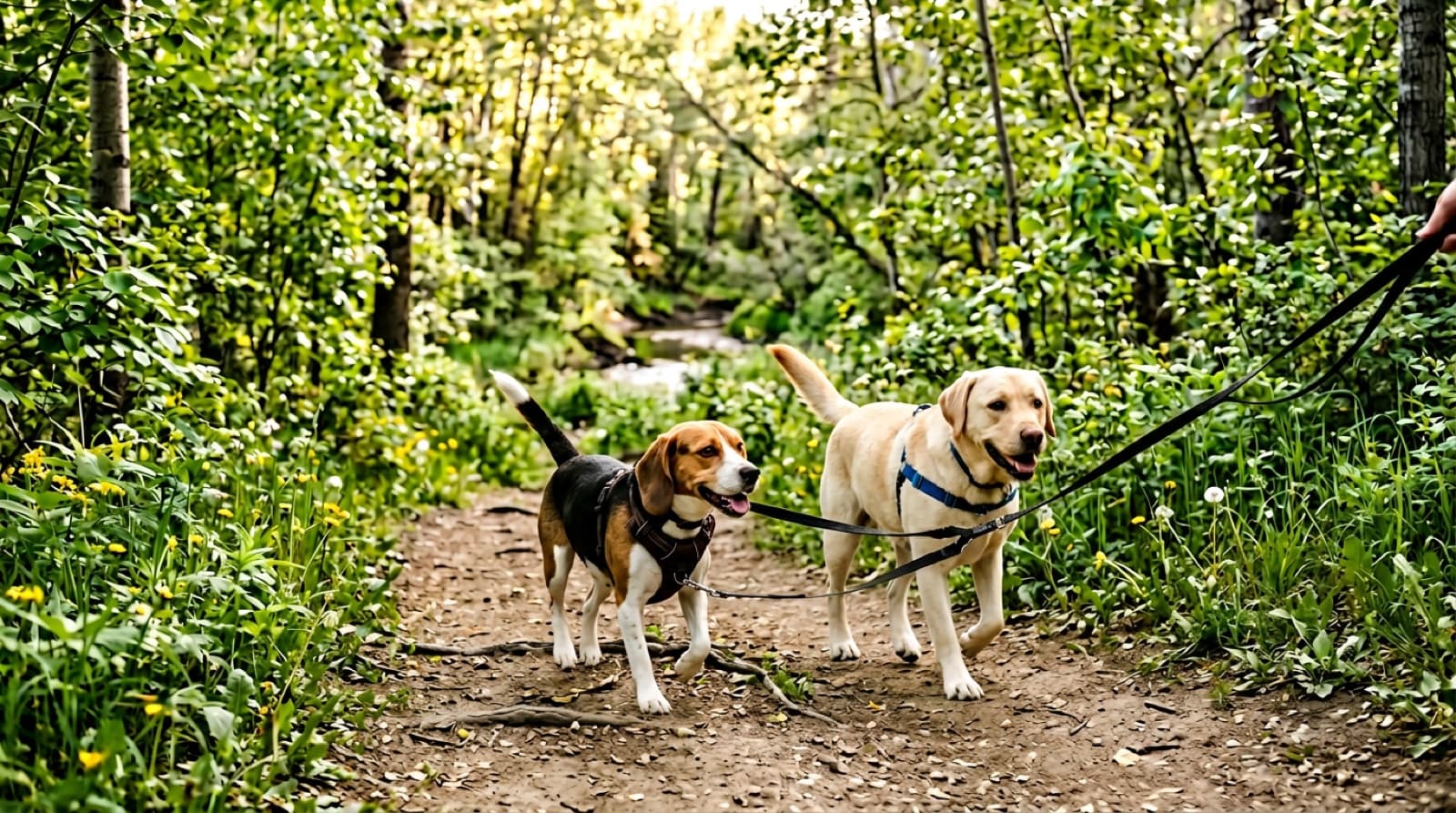
Why these two breeds go together
The surface-level differences are real (Beagles are 20 to 30 pounds; Labs are 55 to 80 pounds), but the adoption-relevant profile overlaps in important ways:
- Both are scent-driven: Beagles by breed history, Labs by retrieve-and-search drive.
- Both are food-motivated to a degree that drives both training success and obesity risk.
- Both are family-friendly and tolerant of household chaos.
- Both lose recall reliability around new scents.
- Both are surrendered to Edmonton rescues for many of the same reasons: poor recall, unmet exercise, weight gain, adolescent behaviour the family did not anticipate.
- Both respond extremely well to positive-reinforcement training and shut down under aversive methods.
The training fundamentals are the same for both. The breed-specific differences in coat, size, and Edmonton winter fit are covered in the comparison below.
Edmonton rescue sources
Labradors and Lab-mixes:
- Edmonton Humane Society regularly has Labs and Lab mixes. Labs are one of the most-surrendered breeds nationwide and EHS reflects that.
- SCARS pulls Lab-mix dogs from northern Alberta partnerships fairly often.
- AHHRB sees Labs through bylaw-agency intake across Sherwood Park, Strathcona County, Fort Saskatchewan, Leduc, Camrose, Tofield, and Edmonton.
- Hope Lives Here Animal Rescue, Zoe's Animal Rescue, GEARS place Labs through their foster networks.
Beagles and Beagle-mixes:
- Edmonton Humane Society has Beagles less often than Labs but they appear regularly.
- AHHRB sees Beagle and Beagle-mix dogs through bylaw intake.
- SCARS Beagles are less common; Beagle-mixes show up more often.
- Foster-based rescues occasionally have Beagles; the wait is sometimes longer than for Labs.
For either breed, foster-based rescues are usually a better fit when you want detailed temperament evaluation; EHS is faster if you can adopt quickly and the right dog is on-site. Mixed-breed Beagle and Lab crosses are common in Edmonton rescue and can combine the traits unpredictably; ask the foster about observed behaviour rather than predicting from the mix label.
Comparison table
| Trait | Beagle | Labrador Retriever |
|---|---|---|
| Adult size | 13 to 15 in, 20 to 30 lb | 21 to 24 in, 55 to 80 lb |
| Coat | Short, single coat | Double coat, oily outer layer |
| Edmonton winter fit | Coat needed below -10C, boots below -20C | Comfortable to -20C, watch paws below -30C |
| Daily exercise | 60 to 90 min (walk + sniff + enrichment) | 60 to 90 min vigorous (walk + fetch + swim) |
| Recall reliability | Multi-year project; long-line for life | Multi-year project; consistent off-leash work |
| Food motivation | Extreme; obesity risk high | Extreme; obesity risk high |
| Vocalisation | Loud baying; check building tolerance | Moderate barking; usually building-tolerable |
| Kid friendliness | Good; supervise around food | Excellent; AKC family-friendly breed |
| Cat compatibility | Variable; can have prey drive | Variable; some have prey drive |
| Apartment fit | Reasonable if baying tolerated | Reasonable with stair access + commitment |
| Common health | Ear infections, IVDD, epilepsy, hypothyroidism | Hip/elbow dysplasia, ear infections, allergies |
| Lifespan | 12 to 15 years | 10 to 12 years |
Shared training fundamentals
Both breeds need the same foundation work, and both respond extremely well to positive reinforcement. Aversive methods (shock collars, prong collars, yank corrections) shut down both breeds and damage the bond.
The starting protocol:
- High-value food rewards (cheese, freeze-dried liver, hot dog bits work for both)
- Short frequent sessions (3 to 5 minutes, multiple times daily)
- Reward-based force-free methods throughout
- A 30-foot long-line for outdoor training before off-leash recall is proven
- Counter-conditioning if leash reactivity surfaces
- An Edmonton group obedience class or private force-free trainer for the foundation
Look for trainers with credentials from CCPDT (CPDT-KA), the IAABC, the Karen Pryor Academy, or Fear Free Pets. Group obedience runs $150 to $300 for a 6-week course in Edmonton; private sessions run $80 to $150. Budget $300 to $800 for foundation training in the first year.
Recall is the hardest cue
Beagles were bred for centuries to follow scent independently of the handler, sometimes for hours, sometimes through rough country. Their default response to an interesting scent is to track it. Labradors were bred to retrieve, which means they are extremely focused on the handler in retrieve mode, but their food-motivation and curiosity often pull them off-task in non-retrieve contexts.
Off-leash reliability for either breed in a high-distraction environment is a 1 to 2 year training project, not a 1 month one. Use a 30-foot long-line in any unfenced area until recall reliability is proven. Edmonton off-leash parks like Hawrelak, Terwillegar, Capilano, and Buena Vista vary in fencing; check the specific zone before relying on it.
Recall building protocol: use a recall cue the dog has never heard before (not the name, not “come” if it has been overused). Reward generously on every recall, even when the dog was already coming. Never call the dog for something unpleasant (nail trim, end of play). Practice in increasing-distraction environments only after the dog is reliable at the previous level. Treat a long-line as a lifestyle tool for the first 1 to 2 years.
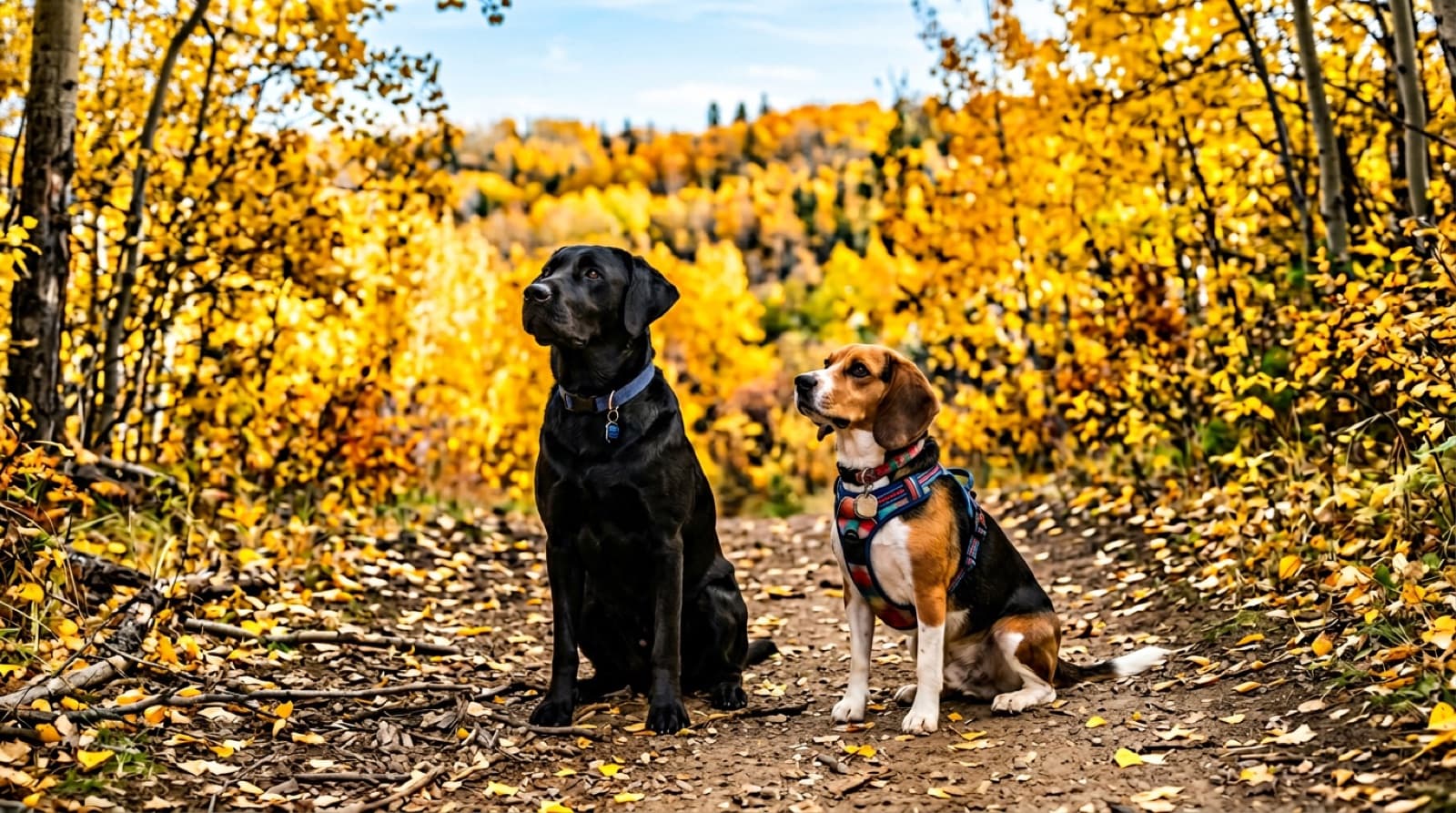
Weight management is the lifetime project
Both breeds are at high obesity risk because their food motivation is essentially infinite. Overweight Beagles develop IVDD risk on their long backs; overweight Labs develop hip and elbow dysplasia complications.
What works:
- Measure every meal with a measuring cup, not eyeballed
- Account for treats as a percentage of daily calories (no more than 10 percent)
- Use part of the daily kibble allowance for training rewards rather than additional treats
- Replace high-calorie human food sharing with low-calorie alternatives (carrot, green bean, ice cube)
- Weigh the dog monthly and adjust portions based on body condition score, not the bag's recommended amount
- For counter-surfing, manage the environment first (close pantry doors, never leave food on counters)
- Cut portions by 10 to 15 percent during the December to March Edmonton window when outdoor exercise drops
The American Kennel Club and the Canadian Kennel Club both document Labrador obesity as one of the breed's biggest welfare issues. The same applies to Beagles.
Nose work as winter enrichment
Both breeds excel at nose work and it is one of the best enrichment activities for either, especially in Edmonton winter when outdoor exercise is short.
Starting setup: hide a high-value treat in increasingly difficult locations (under a cup, in a closed box, in another room), let the dog find it, reward the find. Formal nose-work classes are offered by some Edmonton force-free trainers. For an Edmonton winter day when -25C limits outdoor time, 20 minutes of nose work often produces more behavioural settling than an hour of physical exercise would.
For Beagles specifically, nose work taps into hard-wired breed behaviour and burns mental energy fast. For Labs, the breed is widely used in detection work and the indoor and outdoor scent games suit them. Either way, this is the highest-ROI indoor enrichment for both breeds.
Pet insurance ROI
Labradors: elevated rates of hip dysplasia, elbow dysplasia, ear infections (often allergy-related), atopic dermatitis, and obesity-related complications. The Orthopedic Foundation for Animals statistics show ongoing orthopaedic risk in the breed. Surgical interventions for hip or elbow run $5,000 to $15,000 per occurrence.
Beagles: elevated rates of ear infections, IVDD (particularly on overweight dogs), epilepsy, hypothyroidism, and cherry eye. IVDD decompression surgery runs $5,000 to $10,000. Epilepsy management is lifelong medication and monitoring.
Insurance: enroll before any condition is documented. Once a Labrador shows hip dysplasia or a Beagle shows IVDD, insurance carriers usually exclude the condition as pre-existing. Premium for either breed runs $40 to $90 per month for an adult. Neither breed has a brachycephalic concern; both can be safely anesthetised for routine procedures. Budget for one to two ear-related vet visits per year as a normal cost for either breed.
Bottom line: choosing between them
Choose a Beagle if: smaller home or condo (with building tolerance for baying), want a smaller dog (20 to 30 pounds), can commit to a long-line in any unfenced area for the dog's entire life, willing to manage strong food drive and weight, want high enrichment potential through nose work.
Choose a Labrador if: larger home or active outdoor lifestyle, comfortable with a 55 to 80 pound dog, want strong tolerance for kids and family chaos, can commit to daily real exercise including off-leash work in Edmonton off-leash parks, want a breed that handles Edmonton winters with minimal extra gear.
Foster-to-adopt is a particularly strong path for either breed; it lets you confirm the match with the dog in your specific home before the contract is final. Most Edmonton rescues will help you think through fit; a foster who has lived with the dog for weeks is the best source of honest match advice.
References used in this guide: American Kennel Club: Beagle; American Kennel Club: Labrador Retriever; Canadian Kennel Club; Certification Council for Professional Dog Trainers; Cornell Riney Canine Health Center.
Browse adoptable Beagles and Labradors in Edmonton
Beagles, Labradors, and Beagle-Lab mixes from Edmonton Humane Society, SCARS, AHHRB, Hope Lives Here, Zoe's Animal Rescue, and GEARS. Foster-to-adopt + force-free trainer + weight management routine + long-line commitment is the highest-success path for either breed. Listings update regularly.
See Available Dogs →Frequently Asked Questions
Why is this guide about Beagles AND Labradors together?
Beagles and Labrador Retrievers share more than most adopters expect. Both are scent-driven, deeply food-motivated, family-friendly, and surrendered to Edmonton rescues for many of the same reasons: poor recall when distracted, unmet exercise needs, weight management failure, and adolescent behaviour the family did not anticipate. The training fundamentals overlap enough that a single adopter guide is more useful than two separate ones. The breed-specific differences (size, coat, separation tolerance) matter too, and the comparison table below covers them. Edmonton rescues regularly have one or both breeds in foster.
Where do Edmonton rescue Beagles and Labs come from?
Edmonton Humane Society regularly has Labradors and Lab mixes; Labs are one of the most-surrendered breeds nationwide and EHS reflects that. AHHRB (Alberta Homeward Hound Rescue Bureau) sees both breeds through bylaw-agency intake across Sherwood Park, Strathcona County, Fort Saskatchewan, Leduc, Camrose, Tofield, and Edmonton. SCARS (Second Chance Animal Rescue Society) pulls Lab-mix dogs from northern Alberta partnerships fairly often; pure Beagles are less common but Beagle-mixes show up. Hope Lives Here Animal Rescue, Zoe's Animal Rescue, and GEARS (Greater Edmonton Animal Rescue Society) place both breeds through their foster networks. For a pure Beagle, the wait is sometimes longer; for a Lab or Lab-mix, the inventory is usually current.
Are Beagles and Labradors good with kids and other pets?
Both breeds are usually good with kids, with the standard caveats: supervise interactions, teach the kids to read body language, never disturb the dog while eating or sleeping. Labs tolerate the chaos of family life well; they are one of the breeds the AKC consistently lists as family-friendly. Beagles are also generally kid-tolerant but can be vocal (the breed-typical bay is loud) and may show food guarding around small children. With other dogs, both breeds are usually social. With cats, Labs vary by individual; some are fine, some have prey drive. Beagles can have a higher prey drive toward small animals because of their scent-hound heritage. Ask the foster about specific tested-with history rather than relying on breed generalisations.
What is the difference in size, energy, and exercise needs?
Beagles are 13 to 15 inches at the shoulder, 20 to 30 pounds, and need roughly 60 to 90 minutes of daily exercise (a brisk walk plus a sniff walk plus enrichment). Labradors are 21 to 24 inches, 55 to 80 pounds, and need 60 to 90 minutes of more vigorous exercise (longer walks, fetch, swim where available). Both are food-motivated to a degree that drives a lot of training success and a lot of obesity risk if exercise drops. Beagle apartment fit is reasonable if the building tolerates baying; Lab apartment fit is reasonable if the building has stair access and the owner commits to off-leash exercise. Neither breed thrives without daily real exercise; Edmonton winters complicate that and the mitigation is the same for both breeds.
What are the shared training fundamentals?
Both breeds need rock-solid recall and loose-leash walking work, and both are notorious for losing reliability when a scent or food source distracts. The training fundamentals: high-value food rewards (cheese, freeze-dried liver, hot dog bits work for both breeds), short frequent sessions (3 to 5 minutes, multiple times daily, rather than one long session), reward-based force-free methods throughout, a long-line for outdoor training before reliable off-leash recall, and counter-conditioning protocols if leash reactivity surfaces. Both breeds respond extremely well to positive reinforcement; aversive methods (shock collars, prong collars) shut down both breeds and damage the bond. Enroll in an Edmonton group obedience class or hire a private force-free trainer for the foundation in the first three months.
Why is recall so hard for both breeds?
Beagles were bred for centuries to follow scent independently of the handler, sometimes for hours, sometimes through rough country. Their default response to an interesting scent is to track it. This is breed-typical hunting behaviour, not disobedience. Labradors were bred to retrieve, which means they are extremely focused on the handler in retrieve mode, but their food-motivation and curiosity often pull them off-task in non-retrieve contexts. Off-leash reliability for either breed in a high-distraction environment (a Mill Creek Ravine trail in spring with new scents everywhere, or a Whitemud Creek off-leash zone with other dogs to greet) is a 1 to 2 year training project, not a 1 month one. Use a 30-foot long-line in any unfenced area until recall reliability is proven. Edmonton off-leash parks like Hawrelak, Terwillegar, Capilano, and Buena Vista are fully fenced or partially fenced; check the specific zone before relying on it.
How do you manage weight in a Beagle or a Lab?
Both breeds are at high obesity risk because their food motivation is essentially infinite. Strategies that work: measure every meal with a measuring cup, not eyeballed; account for treats as a percentage of daily calories (no more than 10 percent); use part of the daily kibble allowance for training rewards rather than additional treats; replace high-calorie human food sharing with low-calorie alternatives (carrot, green bean, ice cube); weigh the dog monthly and adjust portions based on body condition score, not the bag's recommended amount; for table-counter-surfing, manage the environment first (close pantry doors, never leave food on counters) rather than relying on training. Overweight Beagles develop IVDD risk on their long backs; overweight Labs develop hip and elbow dysplasia complications. Both breeds gain weight fast in Edmonton winter when outdoor exercise drops. Cut the portion by 10 to 15 percent during the December to March window if exercise has decreased.
How does Edmonton winter affect each breed?
Labradors are one of the breeds best suited to Edmonton winters. Their dense double coat with the oily water-resistant outer layer handles cold well; most healthy adult Labs are comfortable outside for moderate exercise to -20C, and many tolerate -30C for short trips. Watch the paws on salt and ice; consider Musher's Secret or boots for sustained cold. Beagles are short-coated, lower-bodied, and lose heat faster than Labs. Most Beagles need a winter coat below -10C and boots below -20C; deep cold snaps (-30C and below) usually mean indoor enrichment plus brief potty trips only. Both breeds need indoor mental work to compensate for lost outdoor exercise: food puzzles, scent games (especially good for Beagles), basement training sessions, and indoor fetch.
Are Beagles and Labs prone to ear infections?
Yes, both breeds are. Beagles have long pendulous ears that trap moisture and limit airflow. Labradors' ears flop down and have a similar moisture-trap pattern; the breed is also prone to atopic dermatitis (a hereditary skin condition that often shows up as recurrent ear infections plus skin issues). Weekly ear checks plus dry-with-cotton after swimming or bathing reduce infection risk for both. If you see head shaking, head tilt, ear scratching, redness inside the ear, or a yeasty smell, see your Edmonton vet; ear infections are treatable but tend to recur if the underlying cause (allergies in Labs, moisture in Beagles) is not managed. Budget for one to two ear-related vet visits per year as a normal cost for either breed.
Should I do nose work or scent training with these breeds?
Both breeds excel at nose work and it is one of the best enrichment activities for either. Beagles are literally bred for scent; nose work taps into the hard-wired behaviour and burns mental energy fast. Labradors are also strong scent dogs (the breed is widely used in detection work) and the indoor and outdoor scent games suit them. The basic setup: hide a high-value treat in increasingly difficult locations (under a cup, in a closed box, in another room), let the dog find it, reward the find. Formal nose-work classes are offered by some Edmonton force-free trainers. For an Edmonton winter when outdoor exercise is short, nose work is one of the best indoor activities for both breeds. Twenty minutes of nose work often produces more behavioural settling than an hour of physical exercise.
What does pet insurance ROI look like for each breed?
Labradors have well-documented elevated rates of hip dysplasia, elbow dysplasia, ear infections (often allergy-related), and obesity-related complications. The OFA Labrador statistics show ongoing orthopaedic risk. Beagles have elevated rates of ear infections, IVDD (intervertebral disc disease, particularly on overweight dogs), epilepsy, and hypothyroidism. Cherry eye is also common in Beagles. Both breeds benefit from pet insurance enrolled before any condition is documented; once a Labrador shows hip dysplasia or a Beagle shows IVDD, insurance carriers usually exclude the condition as pre-existing. Premium for either breed runs $40 to $90 per month for an adult. The lifetime payoff is usually substantial on either breed because the documented conditions are surgical (hip replacement, IVDD decompression) and run $5,000 to $15,000 per occurrence. Neither breed has a brachycephalic concern; both can be safely anesthetised for routine procedures.
How do I choose between a Beagle and a Labrador for my Edmonton home?
Choose a Beagle if you live in a smaller home or condo (with building tolerance for baying), want a smaller dog (20 to 30 pounds), can commit to a long-line in any unfenced area for the dog's entire life, are willing to manage strong food drive and weight, and want a dog with high enrichment potential through nose work. Choose a Labrador if you have a larger home or active outdoor lifestyle, are comfortable with a 55 to 80 pound dog, want strong tolerance for kids and family chaos, can commit to daily real exercise including off-leash work in Edmonton off-leash parks, and want a breed that handles Edmonton winters with minimal extra gear. Mixed-breed Beagle and Lab crosses combine the traits unpredictably; ask the foster about observed behaviour rather than predicting from the mix. Most Edmonton rescues will help you think through the fit; a foster who has lived with the dog for weeks is the best source of honest match advice.
Beagle Adoption Edmonton
The full Beagle-specific Edmonton adoption overview: rescues, costs, lifestyle fit.
Labrador Retriever Adoption Edmonton
The full Lab-specific Edmonton adoption overview: rescues, costs, lifestyle fit.
Best Dog Rescues Edmonton
All Edmonton rescues compared by adopter persona.
All Edmonton Adoptable Dogs
Live listings of rescue dogs from Edmonton-area shelters and foster networks.
New dog? Start with these care guides
Everything a new adopter needs to set up a safe, happy home.