The short answer
A Bernedoodle inherits from both parent breeds, so plan for: hip and elbow dysplasia (both lines), eye disease (PRA and cataracts from the Poodle), bloat (a deep-chested-dog emergency, learn the signs), the Bernese cancer question (elevated in the breed, variable in a cross), Addison's disease and sebaceous adenitis (Poodle line), plus allergies and ear infections. The big myth to drop: a cross is not a guarantee of health. Hybrid vigour helps only when both parents were health-tested, which you cannot know for a rescue dog, so assume the breed-typical risks apply. Keep the dog lean, learn the bloat warning signs, and enrol in pet insurance week one, since every Canadian provider excludes pre-existing conditions. Pair this with the parent-breed picture in the Bernese Mountain Dog health guide.
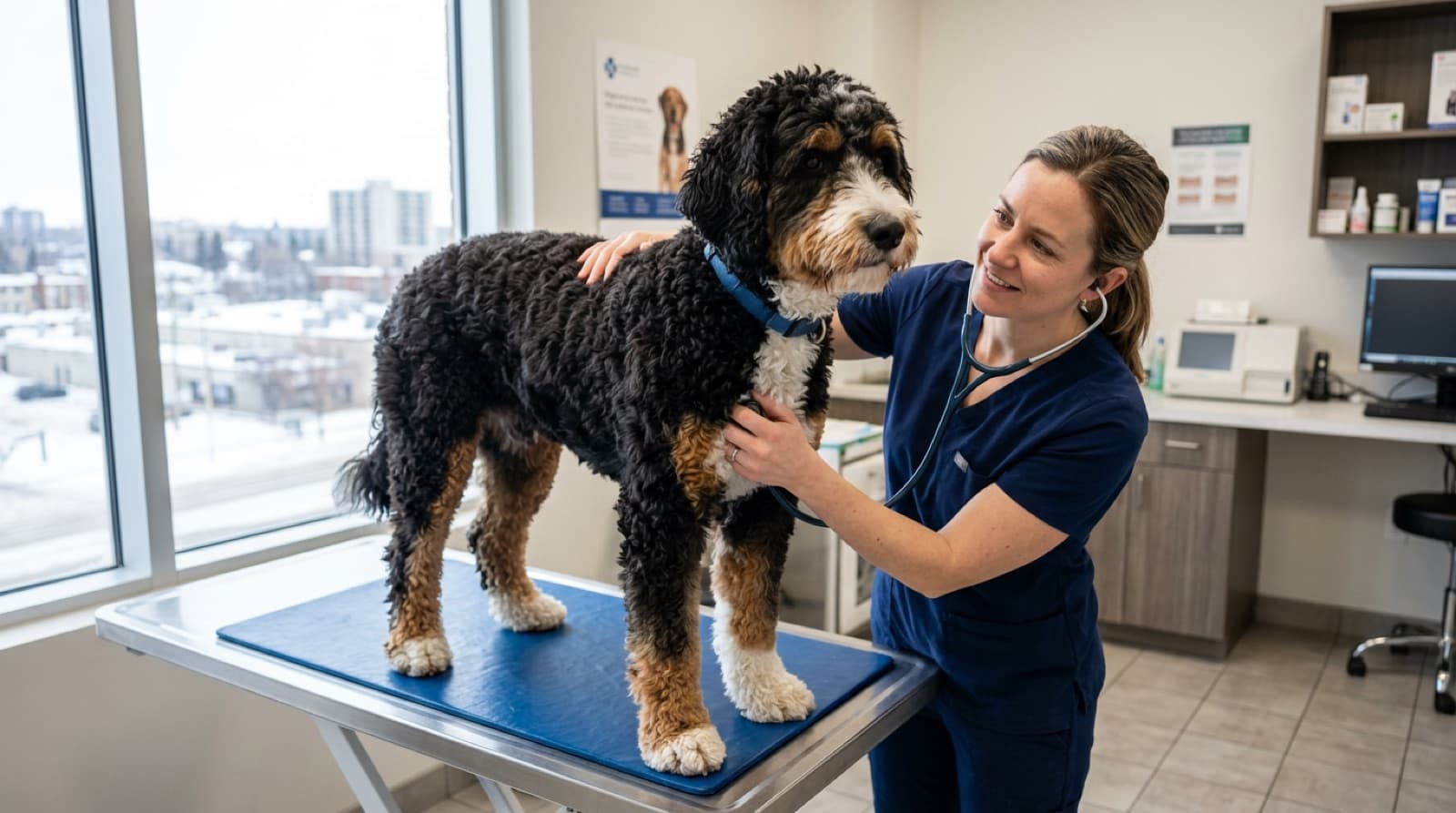
The hybrid reality: a cross is not a guarantee
The Bernedoodle is a deliberate cross of a Bernese Mountain Dog and a Poodle, bred for an affectionate temperament and a lower-shedding coat. Generations vary (an F1 is a first cross; an F1b is bred back to a Poodle, and so on), and so does size, from miniature through standard, depending on the Poodle used. The single most important health concept to understand is that a Bernedoodle can inherit concerns from either parent line, and being a cross is not, by itself, a guarantee of good health.
Crossbreeding can produce hybrid vigour, where a wider gene pool reduces the odds of inheriting the same recessive disease from both parents. A well-bred Bernedoodle from health-tested parents may genuinely avoid some purebred problems. But the protection comes from the parents being screened (hips, elbows, eyes, and relevant DNA tests), not from the word doodle. A cross can also inherit the worst of both lines, and hybrid vigour does nothing when both parents share a condition or were never tested.
For a rescue Bernedoodle of unknown background, you will not know the parents' health testing, so the sensible posture is to assume the breed-typical risks below apply, watch for them, and carry insurance. This is not pessimism; it is planning. A Bernedoodle is a wonderful dog, and going in informed is how you give it the best, longest life.
Hip and elbow dysplasia
Hip and elbow dysplasia are among the most relevant Bernedoodle concerns because both parent breeds are prone to them. They are malformations of those joints that lead to arthritis, stiffness, and pain over time, and they matter more in a larger dog carrying more weight through the joints. Signs include limping, stiffness (often worse after rest or on cold Edmonton mornings), reluctance to jump or take stairs, and a bunny-hopping gait in the rear.
Management ranges from weight control, appropriate exercise, and joint support in milder cases to surgical options in severe ones, all guided by your vet. The Orthopedic Foundation for Animals maintains the hip and elbow grading schemes. Two everyday levers matter most: keep the dog lean, since excess weight accelerates joint disease, and for a large-breed puppy, support appropriate growth and avoid over-exercising immature joints. Any persistent limping or stiffness deserves a vet exam rather than waiting it out.
Bloat (GDV): the deep-chest emergency
For a larger, deep-chested Bernedoodle, gastric dilatation-volvulus, or bloat, is the emergency every owner must be able to recognise. The stomach fills with gas and can twist on itself, cutting off blood supply, and it can kill quickly without emergency surgery. This is not a wait-and-see condition. The warning signs:
- A swollen, distended, or hard belly
- Unproductive retching (trying to vomit with little or nothing coming up)
- Restlessness, pacing, and obvious discomfort
- Excessive drooling
- Signs of pain, weakness, or collapse
If you see these, go to an emergency vet immediately; minutes matter. Risk-reducing measures your vet can discuss include feeding smaller meals rather than one large one, avoiding heavy exercise right around mealtimes, and, for higher-risk dogs, a preventive gastropexy, a surgery that tacks the stomach so it cannot twist, often done at the same time as spay or neuter. Standard-sized Bernedoodles carry more risk than miniatures, but every owner should know the signs and keep the nearest Edmonton emergency clinic's details handy.
Browse adoptable Edmonton Bernedoodles
Current Edmonton Bernedoodle and doodle-mix listings from SCARS, Zoe's, EHS, GEARS, Hope Lives Here, AHHRB, and AARCS Edmonton fosters. Foster notes flag any documented joint, skin, or growth history. Plan a first-month vet workup that baselines the joints and sets a lean-weight and bloat-awareness plan.
See Available Bernedoodles →The Bernese cancer question
This deserves honest treatment because it is the most-asked Bernedoodle health question. Bernese Mountain Dogs have one of the higher cancer rates of any breed, including aggressive cancers such as histiocytic sarcoma, and that genetic risk can carry into a Bernedoodle. Crossing with a Poodle widens the gene pool and may dilute the risk compared with a purebred Bernese, which is part of the appeal of the cross, but it does not erase it, and how much any individual dog inherits varies.
The right response is awareness, not alarm. Keep up regular vet exams, learn your dog's normal so you notice changes early, and get any new lump, persistent lameness, unexplained weight loss, or unusual lethargy checked promptly rather than watching and waiting. Carry pet insurance enrolled before anything is documented. Early detection is by far the biggest lever you have, and many cancers are far more treatable when caught early. Veterinary oncologists at Edmonton specialty practices and the WCVM in Saskatoon guide families through options if cancer is ever diagnosed.
Addison's disease, skin, eyes, and the rest
Addison's disease
Addison's disease (hypoadrenocorticism), seen in Poodles, is where the adrenal glands underproduce essential hormones. It is known as the great pretender because its signs are vague and intermittent: lethargy, poor appetite, vomiting or diarrhea, and weakness, sometimes worsening with stress. Untreated it can progress to a life-threatening crisis. The reassuring part is that once diagnosed (through bloodwork and a confirmatory test), it is very manageable with lifelong medication, and most dogs do well. Mention any vague, waxing-and-waning illness to your vet so Addison's stays on the radar.
Skin, ears, and eyes
Sebaceous adenitis, a Poodle-line skin disease in which the oil glands become inflamed, can cause a dull, thinning coat, scaling, and hair loss, and is managed long-term with your vet. Allergies (atopic dermatitis) are common and show as itchy skin and recurrent ear infections. The floppy, hairy doodle ears trap moisture and are prone to infection, so routine ear checks and grooming matter. On the eyes, progressive retinal atrophy (a DNA test exists for the common Poodle form) and cataracts are the inherited concerns; any cloudiness or vision change warrants an eye exam.
Other concerns
Degenerative myelopathy (a progressive spinal-cord disease, with a DNA test available), hypothyroidism (easy to diagnose and treat), and von Willebrand disease (a Poodle-line bleeding disorder worth knowing before surgery) round out the picture. Size-appropriate anaesthesia is routine for a healthy dog; sharing any known history helps your vet plan. For a rescue Bernedoodle, a thorough first-month exam establishes the baseline the rest of the dog's care builds on.
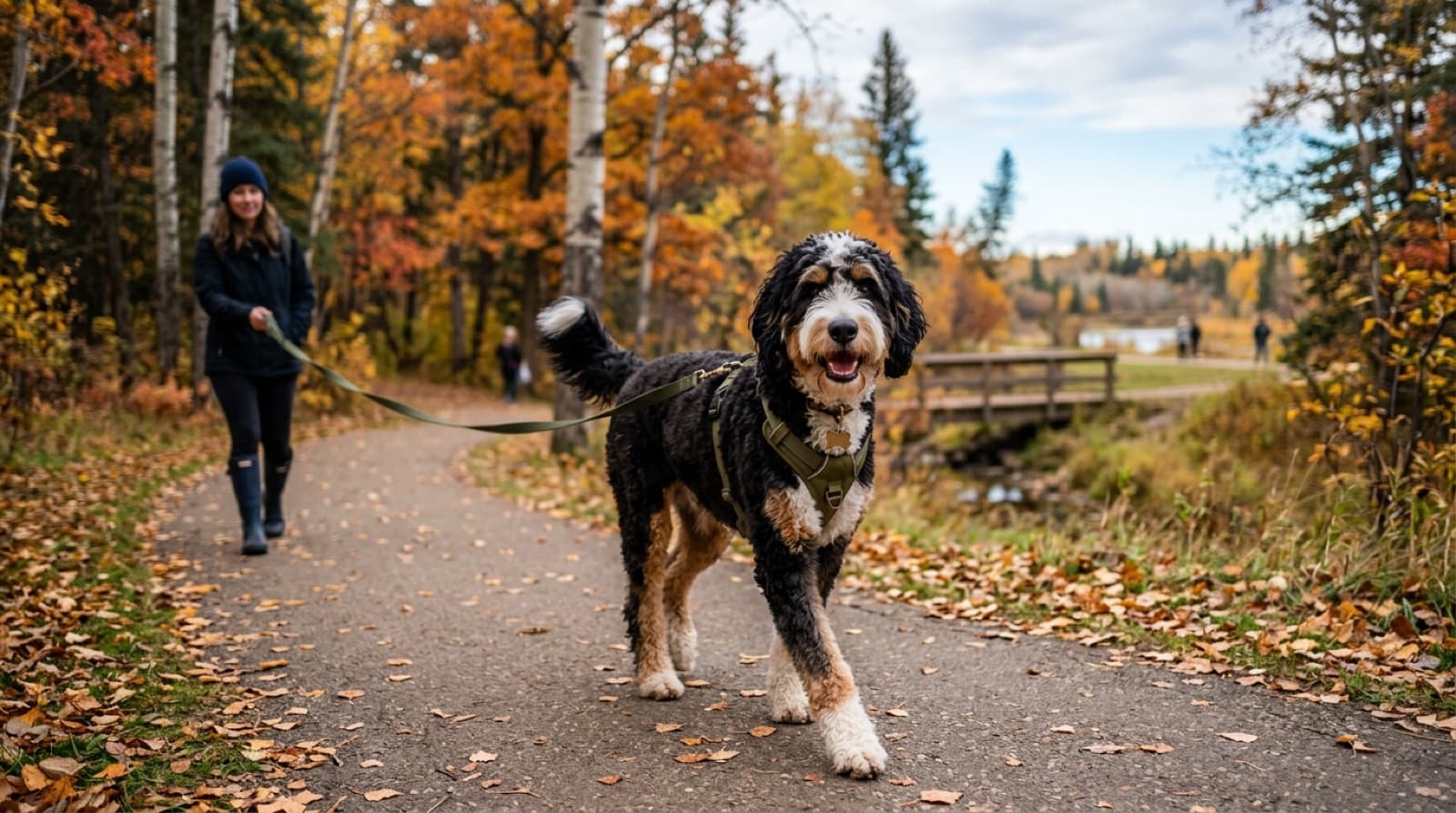
The first-month Edmonton vet workup
A rescue adoption fee typically covers the basics: spay or neuter, core vaccines, deworming, a microchip, and treatment of any acute issue found at intake. What it usually does not cover is the breed-specific baseline that makes the years ahead easier to manage.
Plan a first-month visit with your chosen Edmonton vet that establishes the Bernedoodle baseline:
- An orthopaedic exam of hips and elbows, with a body-condition assessment and lean-weight target
- A conversation about bloat: the warning signs, feeding practices, and whether a preventive gastropexy makes sense (often paired with spay or neuter)
- Baseline bloodwork, including thyroid, and a note to keep Addison's on the radar for any vague recurring illness
- A skin and ear exam, watching for allergy or sebaceous adenitis signs, plus an ear-care routine for the hairy doodle ears
- An eye exam, with referral to an ophthalmologist if anything looks off
- A frank talk about pet insurance and enrolling now, before anything is documented
- The nearest after-hours emergency clinic noted for bloat
For a senior Bernedoodle, add full senior bloodwork and urinalysis, closer joint and lump monitoring, and more frequent exams. Budget $500 to $1,200 for a senior intake workup at an Edmonton clinic, and bring any vet notes the rescue can share.
Frequently asked questions
Where can I find specialty care for a Bernedoodle near me in Edmonton?
Start with your general-practice Edmonton vet, who handles most needs and refers to specialists when required: an internal medicine specialist for Addison's disease or complex cases, a surgeon for orthopaedic work or a bloat emergency, an ophthalmologist for eye disease, and oncology for any cancer workup. Edmonton has a smaller specialty network than Calgary, so some owners travel to Calgary specialty centres or the Western College of Veterinary Medicine (WCVM) in Saskatoon for advanced diagnostics and surgery. The American College of Veterinary Internal Medicine credentials the relevant boards. Because a Bernedoodle can be a large, deep-chested dog, know your nearest after-hours emergency clinic before you need it, since bloat is a true time-critical emergency.
What are the main Bernedoodle health issues to know before adopting?
A Bernedoodle is a Bernese Mountain Dog crossed with a Poodle, so it can inherit concerns from either parent line, and the mix is not a guarantee of health. In rough order of practical importance: hip and elbow dysplasia (both parent breeds are prone); eye disease including progressive retinal atrophy and cataracts (from the Poodle side); gastric dilatation-volvulus, or bloat (a deep-chested-dog emergency); the Bernese cancer question (Bernese have notably elevated cancer rates, and how much a given Bernedoodle inherits varies); Addison's disease (hypoadrenocorticism, seen in Poodles); sebaceous adenitis (a Poodle-line skin disease); allergies and ear infections (the floppy, hairy ears trap moisture); degenerative myelopathy; hypothyroidism; and von Willebrand disease (a Poodle-line bleeding disorder). Most are manageable, size-appropriate anaesthesia and bloat awareness matter, and week-one pet insurance is well worth it for a potentially large dog with this range of concerns.
Are Bernedoodles healthier than purebreds because they are a cross?
Sometimes, but it is not guaranteed, and this is the most important myth to set aside. Crossbreeding can produce hybrid vigour, where a wider gene pool reduces the chance of inheriting the same recessive disease from both parents, and a well-bred Bernedoodle from health-tested parents may indeed avoid some purebred problems. But a cross can also inherit the worst of both lines, and hybrid vigour does nothing if both parents carry the same conditions or were not health-tested at all. The protection comes from the parents being screened (hips, elbows, eyes, and relevant DNA tests), not from the label doodle. For a rescue Bernedoodle of unknown background, you simply will not know the parents' health testing, so the sensible approach is to assume the breed-typical risks apply, watch for them, and carry pet insurance. The cross is not a free pass on health.
Do Bernedoodles get hip and elbow dysplasia?
Yes, it is one of the most relevant concerns because both parent breeds are prone to it. Hip and elbow dysplasia are malformations of those joints that lead to arthritis, stiffness, and pain over time, and they matter more in a larger dog carrying more weight through the joints. Signs include limping, stiffness (especially after rest or in cold Edmonton mornings), reluctance to jump or climb stairs, and a bunny-hopping gait. Management ranges from weight control, appropriate exercise, and joint support in milder cases to surgery in severe ones. The Orthopedic Foundation for Animals maintains the hip and elbow grading schemes vets use. Keeping a Bernedoodle lean is the single most protective everyday measure, and for a large-breed puppy, appropriate growth and not over-exercising young joints matters too. Any persistent limping deserves a vet exam.
How serious is bloat in a Bernedoodle?
Potentially life-threatening, and every owner of a larger, deep-chested Bernedoodle must know the signs. Gastric dilatation-volvulus (bloat) is when the stomach fills with gas and can twist, cutting off blood supply; it kills quickly without emergency surgery. Warning signs include a swollen or distended belly, unproductive retching (trying to vomit with nothing coming up), restlessness and pacing, drooling, and signs of pain or distress. This is a drop-everything, go-to-the-emergency-vet-now situation where minutes matter, not a wait-and-see. Risk-reducing measures your vet can discuss include feeding smaller meals, avoiding heavy exercise right around meals, and, for high-risk dogs, a preventive gastropexy (a surgery that tacks the stomach so it cannot twist), sometimes done at the same time as spay or neuter. Standard-sized Bernedoodles are more at risk than miniature ones, but know the signs regardless.
Do Bernedoodles get cancer like Bernese Mountain Dogs?
It is a real question without a tidy answer, and worth understanding honestly. Bernese Mountain Dogs have one of the higher cancer rates of any breed, including aggressive cancers like histiocytic sarcoma, and that genetic risk can carry into a Bernedoodle. Crossing with a Poodle widens the gene pool and may dilute that risk compared with a purebred Bernese, which is part of the appeal of the cross, but it does not eliminate it, and how much any individual inherits varies. The practical takeaway is not alarm but awareness: keep up regular vet exams, learn your dog's normal so you notice changes early, get any new lump, persistent lameness, unexplained weight loss, or lethargy checked promptly, and carry pet insurance enrolled before anything is documented. Early detection is the biggest lever you have, and many cancers are far more treatable caught early.
Should I get pet insurance for an Edmonton rescue Bernedoodle?
Yes, and enrol in week one. The Bernedoodle case is strong because the potential costs are both varied and large: orthopaedic surgery for hips or elbows, a bloat emergency (surgery commonly runs into the thousands), cancer treatment if the Bernese risk materialises, lifelong management of Addison's disease or skin disease, and the eye and dental needs of a long life. Any one is manageable; the range of possibilities across a big dog's life is what makes insurance sensible. Every Canadian provider excludes pre-existing conditions, and the clock starts the day you adopt, so a limp, a lump, a skin condition, or abnormal bloodwork documented before enrolment becomes a permanent exclusion. Premiums for a larger dog run higher than for a toy breed, but a single bloat surgery or cancer course can exceed years of premiums. Look for explicit hereditary and congenital coverage, a high annual cap, and explicit oncology coverage.
Do Bernedoodles handle Edmonton weather?
Winter is generally fine; summer needs more care. With Bernese heritage, many Bernedoodles have a thick coat and good cold tolerance, and a lot of them genuinely enjoy Edmonton winter and snow. The grooming caveat is that a long doodle coat picks up snow, ice balls, and road salt and mats if not maintained, so winter coat care and paw cleaning matter. Summer is the bigger concern: that same heavy coat plus a potentially large body means real heat sensitivity, so exercise in the cool of the day, provide shade and water, and watch for overheating on hot days. Do not shave a double coat down to the skin for summer without your groomer's guidance, as it can affect the coat's ability to insulate and protect; ask a professional about appropriate summer trimming. With seasonal coat care and heat sense, a Bernedoodle is well suited to Edmonton.
Related Edmonton Bernedoodle guides
Edmonton Adoptable Dogs
Current Edmonton-area Bernedoodle and doodle-mix listings from SCARS, Zoe's, EHS, GEARS, Hope Lives Here, AHHRB, and AARCS Edmonton fosters.
Bernedoodle Adoption Edmonton
Rescue sources, real adoption costs, the doodle reality, generations and sizes, and what to expect adopting a Bernedoodle.
Bernese Mountain Dog Health Edmonton
The Bernese side of the cross, including the breed's cancer profile and the giant-breed concerns a Bernedoodle can inherit.
Goldendoodle Health Edmonton
Another popular Poodle cross, with overlapping doodle health themes and the same hybrid-vigour caveats.
Find your Edmonton rescue Bernedoodle
Browse current Edmonton-area Bernedoodle and doodle-mix listings. Foster temperament notes help you flag any documented joint, skin, or growth history before you apply, and your first-month vet workup baselines the joints and sets the lean-weight and bloat-awareness plan that protect a big dog.
Browse All Edmonton Dogs →New dog? Start with these care guides
Everything a new adopter needs to set up a safe, happy home.