The short answer
Adopt from Edmonton rescue ($500 to $900). Bernedoodles appear occasionally through SCARS, Edmonton Humane Society, Zoe's Animal Rescue, AHHRB, and AARCS Edmonton fosters. Less common in rescue than Goldendoodle or Labradoodle (newer breed, smaller total population). Three sizes: Tiny (10-25 lbs, Toy Poodle cross), Mini (25-50 lbs, Miniature Poodle cross), Standard (70-90 lbs, Standard Poodle cross). Bernese cancer caveat: the breed was developed specifically to dilute Bernese cancer genetics with Poodle longevity; F1 dogs carry more risk than F1B (25% Bernese). Pet insurance enrolled at adoption is essential. Excellent Edmonton winter dog; the Bernese alpine heritage shows. Grooming commitment is substantial: $600 to $1,500/year depending on size. 12 to 15 year lifespan, substantially longer than purebred Bernese (7-8 years).
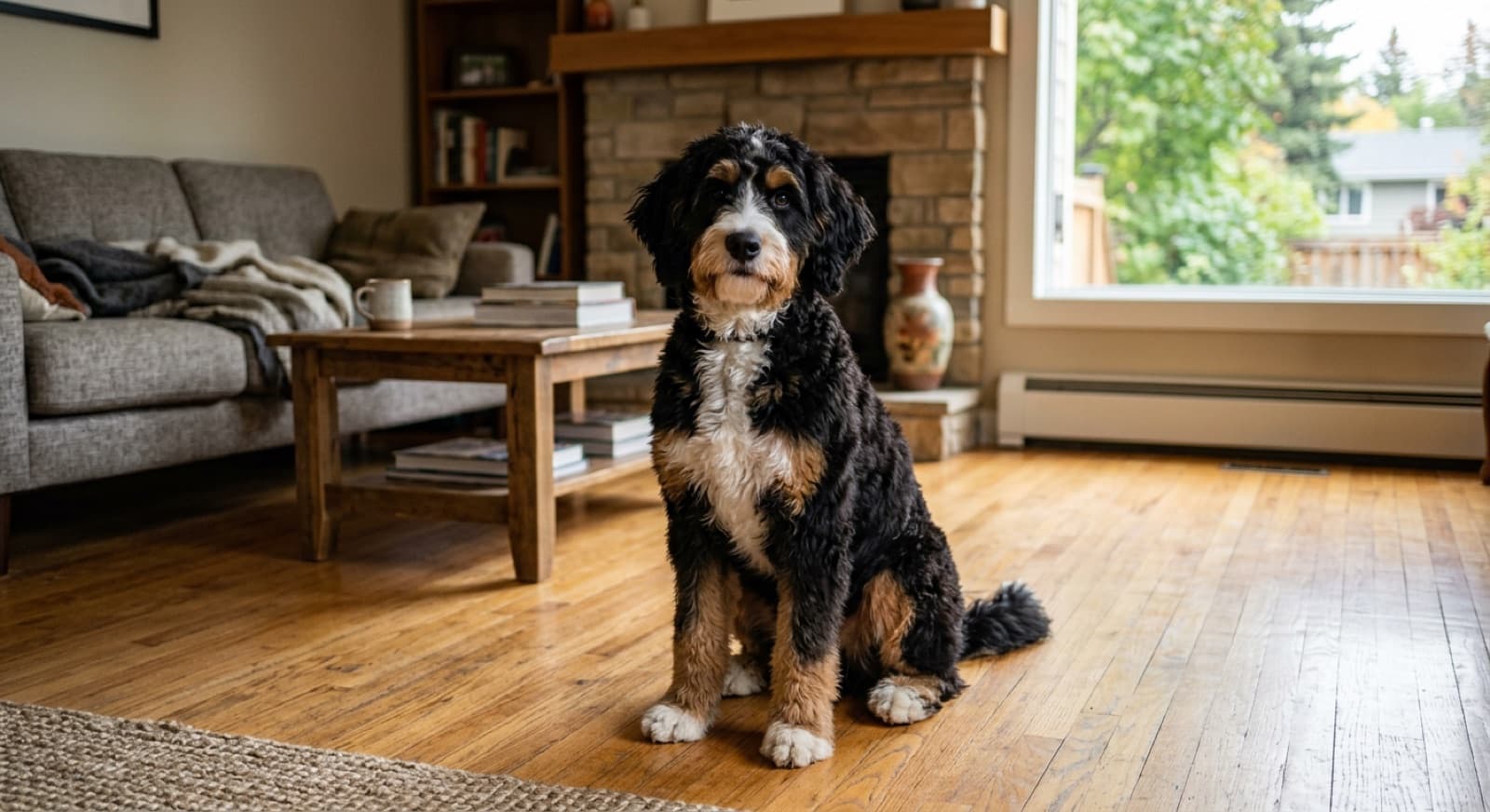
Browse adoptable doodles in Edmonton
Bernedoodles are less common than other doodle crosses. Flexibility on size (Tiny/Mini/Standard) and on Bernedoodle mixes substantially shortens the wait.
See Available Dogs →Three sizes at a glance
| Size | Adult weight | Poodle parent | Best fit |
|---|---|---|---|
| Tiny Bernedoodle | 10 to 25 lbs | Toy Poodle | Apartment, small space, lap-companion |
| Mini Bernedoodle | 25 to 50 lbs | Miniature Poodle | Most families, manageable size |
| Standard Bernedoodle | 70 to 90 lbs | Standard Poodle | Houses with yards, experienced large-dog handlers |
The Bernese temperament influence is similar across all three sizes; the Poodle parent size determines adult Bernedoodle size. For Edmonton rescue puppies, foster home size projection matters; adult Bernedoodles have established size.
The Bernese cancer caveat
Bernese Mountain Dogs have one of the highest lifetime cancer mortality rates of any breed. The Bernedoodle cross was developed specifically to dilute the Bernese cancer genetics with Poodle health and longevity. Pet insurance enrolled at adoption is essential.
Purebred Bernese Mountain Dog lifespan averages 7 to 8 years, driven largely by elevated cancer rates (histiocytic sarcoma is particularly common in the breed, plus hemangiosarcoma and other cancers). The Bernedoodle cross was developed by Sherry Rupke in 2003 Ontario specifically to dilute these genetics with Poodle longevity.
Generation-by-generation cancer risk:
- F1 Bernedoodle (50% Bernese): carries more Bernese cancer genetic risk
- F1B Bernedoodle (25% Bernese, 75% Poodle): lower cancer risk profile
- F2 and multi-generational: cancer risk dilutes slower than coat-type genetics because cancer involves multiple genes
Pet insurance enrolled at adoption is essential for Bernedoodles because cancer treatment is one of the higher-cost veterinary scenarios. Edmonton specialty oncology referrals are available; WCVM Saskatoon (Western College of Veterinary Medicine) handles complex protocols. Ask the rescue about any documented cancer history in the parent breeds during the phone screen.
The good news: Bernedoodle lifespan averages 12 to 15 years across many lines, substantially longer than purebred Bernese 7 to 8 years. The Poodle influence is meaningful.
Frequently Asked Questions
Where can I adopt a Bernedoodle in Edmonton?
Bernedoodles appear in Edmonton rescue occasionally and place quickly when listed. SCARS (Second Chance Animal Rescue Society), Edmonton Humane Society, Zoe's Animal Rescue, AHHRB (Alberta Homeward Hound Rescue Bureau), and AARCS Edmonton fosters all see Bernedoodles and doodle crosses through the year. National doodle rescue networks coordinate placement across Canada when foster homes are available. Bernedoodles are less common in rescue than Goldendoodles or Labradoodles because the breed is newer (intentional breeding dates to roughly 2003) and total population is smaller. Bernedoodle mixes (Bernedoodle-Lab, Bernedoodle-Goldendoodle, Saint Berdoodle which is Saint Bernard + Poodle) appear with similar frequency.
What is the Bernedoodle origin?
The Bernedoodle was first intentionally bred in 2003 by Sherry Rupke in Ontario, Canada, as a cross between Bernese Mountain Dog and Standard Poodle. The intent was a low-shedding family dog with the Bernese gentle temperament and longer lifespan than the purebred Bernese (which has a notoriously short lifespan of 7 to 8 years due to elevated cancer rates). Bernedoodles inherited the Poodle's longer lifespan genetics in many lines, with typical Bernedoodle lifespan of 12 to 15 years depending on size and individual genetics. The breed grew in popularity through the 2010s and is now produced widely by breeders of varying ethics. The Bernedoodle is not a CKC or AKC-recognised breed because the genetics remain variable across lines.
What are the three Bernedoodle sizes?
Bernedoodles come in three size categories based on which Poodle is used in the cross. Tiny Bernedoodle: 10 to 25 lbs adult weight, Toy Poodle cross. Smaller than the breed average and may inherit Toy Poodle health risks (luxating patella, hypoglycemia in puppies). Mini Bernedoodle: 25 to 50 lbs adult weight, Miniature Poodle cross. Often the sweet spot for families wanting a manageable size with Bernese temperament. Standard Bernedoodle: 70 to 90 lbs adult weight, Standard Poodle cross. Closest to original purebred Bernese size; substantial dog requiring proportionally more food, exercise, and medical investment. The Bernese influence is similar across all three sizes but the Poodle parent size determines the adult Bernedoodle size. Foster home observation of size projection matters for puppies; adult Bernedoodles from rescue have established size.
How much does it cost to adopt a Bernedoodle in Edmonton?
Edmonton rescue adoption fees for Bernedoodles typically run $500 to $900 covering spay/neuter, current vaccinations, microchip, and a baseline vet workup. The fee is well below ethical breeder pricing ($3,000 to $6,000+ for a properly health-tested Bernedoodle puppy from a breeder with OFA hip and elbow tested parents, eye certification, and Bernese cancer screening protocols where available). Initial setup costs vary by size: Tiny ($200 to $400 for crate, bed, supplies), Mini ($300 to $600), Standard ($400 to $800 plus larger crate and bed). Annual ownership cost: Tiny $1,800 to $2,800, Mini $2,200 to $3,500, Standard $2,800 to $4,500. Costs include quality food (scales with size), routine veterinary care ($500 to $900), pet insurance ($400 to $900 depending on size), grooming every 6 to 8 weeks at Edmonton groomer prices of $80 to $180 per visit depending on size ($600 to $1,500/year).
What is the Bernese Mountain Dog cancer caveat?
Honest framing: Bernese Mountain Dogs have one of the highest lifetime cancer mortality rates of any breed, with average lifespan of 7 to 8 years driven largely by cancer (histiocytic sarcoma is particularly common, plus hemangiosarcoma and other cancers). The Bernedoodle cross was specifically developed to dilute the Bernese cancer genetics with Poodle health and lifespan. Bernedoodle lifespan averages 12 to 15 years in many lines, substantially longer than purebred Bernese, but the Bernese cancer genetics persist to varying degrees across Bernedoodle lines. F1 Bernedoodles (50% Bernese) carry more Bernese cancer risk than F1B Bernedoodles (25% Bernese, 75% Poodle). Pet insurance enrolled at adoption is essential for Bernedoodles because cancer treatment is one of the higher-cost veterinary scenarios. Edmonton specialty oncology referrals available; WCVM Saskatoon handles complex protocols. Ask the rescue about any documented cancer history in the parent breeds during the phone screen.
Are Bernedoodles good first dogs for Edmonton families?
Yes for many households, with size-appropriate planning. Bernedoodles are generally affectionate, gentle, family-oriented, friendly with most children when properly introduced (the breed inherited the Bernese gentle temperament), sociable with other dogs, intelligent and trainable, often described as “mellow” compared with other doodle crosses. The breed-specific demands vary by size: Tiny and Mini Bernedoodles fit apartment and condo living; Standard Bernedoodles need proportionally more space and exercise. All sizes require grooming every 6 to 8 weeks ($600 to $1,500/year depending on size), exercise 45 to 90 minutes daily (more for Standard size, less for Tiny), force-free training to channel the gentle Bernese temperament. Adult Bernedoodles from Edmonton rescue (3+ years) often skip the most intense adolescent phase. Standard Bernedoodles are best suited to households with experience managing 70+ lb dogs.
How do Bernedoodles handle Edmonton winters?
Excellently. The Bernese Mountain Dog parent was developed in Swiss alpine conditions; the Bernedoodle inherits substantial cold tolerance and dense double or curly coat. Healthy adult Bernedoodles of all sizes tolerate Edmonton cold well; Standard Bernedoodles particularly thrive in -25C and below. Booties help on heavily salted Edmonton sidewalks (salt accumulates in curly coats). The breed enjoys snow and most Bernedoodles are enthusiastic about winter walks. Edmonton dry winter (15-25% indoor humidity from furnace heat) can dry coat and skin; a humidifier helps both dog and humans. Watch for ice-ball buildup between paw pads and in the leg feathering after walks. Summer heat above 25C is more challenging than winter cold because of the dense coat; modify exercise to early morning or evening during Edmonton heat waves.
What are common Bernedoodle health issues to plan for?
The breed lifespan is 12 to 15 years (substantially longer than purebred Bernese 7 to 8 years; the Poodle influence is meaningful). Breed-specific health concerns inherited from both parents: cancer (Bernese cancer risk is the breed-defining concern; F1 dogs carry more risk than F1B; pet insurance is essential), hip and elbow dysplasia (Bernese risk; OFA-tested parents are responsible breeding), bloat/GDV (deep-chested giant-breed risk in Standard Bernedoodles; slow-feeder bowl, two meals daily, no elevated bowl, no vigorous exercise within 30 to 60 minutes of feeding), eye conditions including progressive retinal atrophy (Poodle line), Addison's disease (Poodle line), epilepsy in some lines, von Willebrand disease in some lines, allergies common. Tiny Bernedoodles inherit Toy Poodle risks: patellar luxation, hypoglycemia in puppies. Pet insurance enrolled at adoption is critical.
How does Bernedoodle grooming work in Edmonton?
Substantial commitment varying by coat type and size. Bernedoodles can have curly (more Poodle), wavy fleece (intermediate), or straight (more Bernese) coats. Curly coats require daily brushing to prevent matting; wavy coats need weekly brushing; straight coats need 2 to 3 times weekly brushing because the Bernese-influence coat can mat in areas the curly coat does not. Professional grooming every 6 to 8 weeks at Edmonton groomer prices: Tiny $60 to $100, Mini $80 to $130, Standard $120 to $180 per visit. Many owners maintain a shorter "puppy cut" trim that simplifies daily care. Ear care matters (drop ears with curl-trapped moisture); weekly check and clean. Never shave a Bernedoodle with significant Bernese influence (the double coat regulates temperature); curly-coated dogs can be trimmed but not shaved to skin. Bath every 6 to 8 weeks. Nail trim every 3 to 4 weeks.
What about the F1, F1B, F2 generation framework for Bernedoodles?
Same framework as other doodle crosses. F1 (first generation): 50% Bernese + 50% Poodle. Coat type unpredictable; carries more Bernese cancer risk. F1B (first generation backcross): F1 Bernedoodle + Standard Poodle, resulting in 25% Bernese + 75% Poodle. More reliably low-shedding coat and lower Bernese cancer risk. F2 (second generation): F1 + F1. Variable coat and health profile. Multi-generational (later generations bred Bernedoodle-to-Bernedoodle): more consistent traits but the Bernese cancer genetics dilute slower than coat type genetics. For Edmonton rescue Bernedoodles, the generation label matters less than foster-home observation of temperament, coat, and any health history. Ask explicitly during the phone screen.
What are common Bernedoodle mixes in Edmonton rescue?
Bernedoodle-Lab cross (50 to 80 lbs, friendlier outgoing temperament than purebred Bernedoodle, common in Edmonton rescue), Bernedoodle-Goldendoodle cross (50 to 90 lbs, two-doodle mix, often dramatic coat colours), Bernedoodle-Mastiff cross (90 to 130 lbs, larger build), Saint Berdoodle (Saint Bernard + Poodle, technically a separate cross but visually similar to large Bernedoodle), Bernedoodle-Australian Shepherd cross (50 to 80 lbs, more herding influence). All these mixes appear in Edmonton rescue at the same $500 to $900 fee range. Mixed-breed Bernedoodles sometimes have less concentrated Bernese cancer risk because of the diluting influence; the cross can be a good first-Bernedoodle match. Foster home should disclose any documented cancer history in known parent breeds during the phone screen.
Bottom line for Edmonton Bernedoodle adoption?
Bernedoodles are wonderful Edmonton companions for households committed to the grooming and health planning. Affectionate, gentle, family-oriented, often described as mellow compared with other doodle crosses, well-adapted to Edmonton winter, 12 to 15 year lifespan. The breed-specific demands that determine fit: substantial grooming commitment ($600 to $1,500/year depending on size), Bernese cancer risk (pet insurance enrolled at adoption is essential), size-appropriate exercise and space (Tiny for apartments, Standard for houses with yards), force-free training to channel the gentle temperament, summer heat management above 25C. Adopt from SCARS, Edmonton Humane Society, Zoe's, AHHRB, AARCS Edmonton fosters; $500 to $900 fee covers spay/neuter, vaccines, microchip, baseline workup. Bernedoodle mixes (Bernedoodle-Lab, Bernedoodle-Goldendoodle, Saint Berdoodle) are equally well-suited candidates. Adult adoption (3+ years) skips the adolescent phase and arrives with documented temperament, coat type, and any health observations. The Bernedoodle is a relatively new breed (intentional breeding from 2003) so older dogs are rarer in rescue.
Adoptable Dogs in Edmonton
Live listings from SCARS, EHS, Zoe's, AHHRB, and AARCS Edmonton fosters.
Bernese Mountain Dog Adoption Edmonton
Purebred Bernese parent breed; cancer reality and shorter lifespan that the Bernedoodle cross was developed to address.
Bernese Cancer + Lifespan Edmonton
Detailed Bernese cancer framework; relevant to Bernedoodle health planning for F1 dogs in particular.
Goldendoodle Adoption Edmonton
Related doodle cross; similar generation framework and grooming reality, lower cancer risk profile.
New dog? Start with these care guides
Everything a new adopter needs to set up a safe, happy home.