The short answer
Bernese Mountain Dogs average 7 to 10 years lifespan, significantly shorter than the 10 to 13 year large-breed average. Cancer is the leading cause of death. Histiocytic sarcoma is the breed-defining concern (fast-progressing, often diagnosed late). Other elevated cancers: lymphoma, mast cell tumours, osteosarcoma, hemangiosarcoma. Build a monthly home-screening routine (lumps, lymph nodes, gum colour, behaviour). Get pet insurance within 14 days of adoption before any pre-existing exclusion kicks in. Edmonton specialty veterinary oncology handles most cases locally; complex cases refer to WCVM Saskatoon. Lifetime cost: $10,000 to $25,000 insurance premiums + $5,000 to $25,000+ potential cancer treatment if needed. Adult Bernese rescue adoption (5+ years from SCARS, EHS, Zoe's, AHHRB) gives defined timeline and lower upfront cost. The breed is worth the trade-off for many; for others, a different choice is responsible.
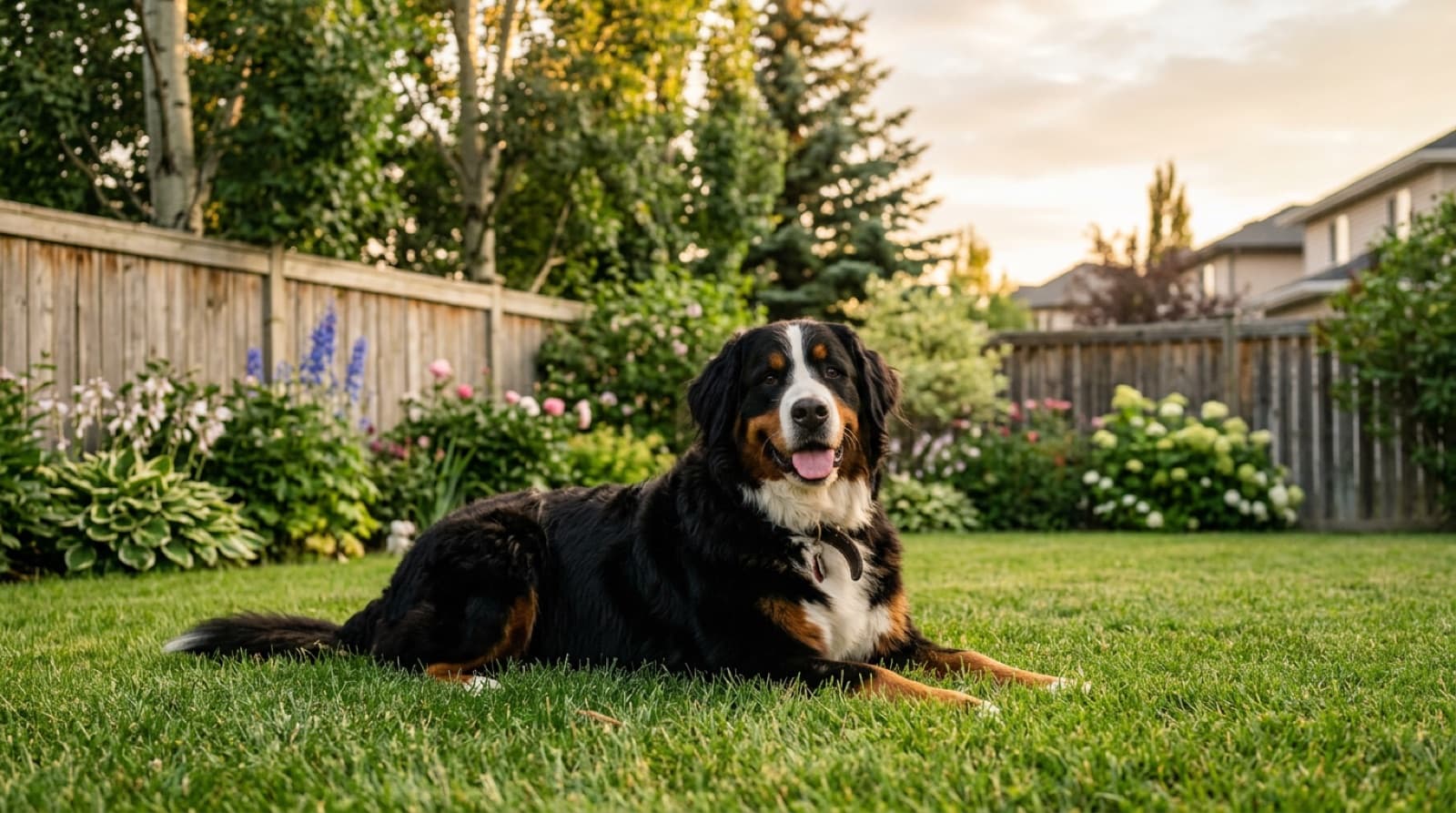
The lifespan math
7 to 10 years on average, with most Berners landing in the 7 to 9 year range. This is significantly shorter than the typical large-breed lifespan (10 to 13 years) and dramatically shorter than many medium-sized breeds (12 to 15 years).
Peer-reviewed Swiss Bernese health surveys (the breed of origin), American Bernese Mountain Dog Club longevity registries, and Royal Veterinary College epidemiological studies all consistently report 7 to 10 years as the breed average. The AKC Bernese Mountain Dog breed profile acknowledges the short lifespan as a defining breed characteristic.
This is not a defect in your individual dog. It is a breed-genetic reality that prospective Edmonton adopters need to understand before committing. Most Berner owners face the emotional reality of saying goodbye to their dog much sooner than other large-breed owners.
The breed is worth the trade-off for many owners. The compassionate years are real. So is the early ending. Honest framing matters more than optimistic framing.
The cancers to watch
Histiocytic sarcoma is the breed-defining cancer. Fast-progressing, often diagnosed at advanced stage because early symptoms are subtle, and frequently fatal within months of diagnosis even with aggressive treatment.
Histiocytic sarcoma accounts for a substantial portion of Berner cancer deaths and is documented in peer-reviewed veterinary oncology literature as elevated in the breed compared to all other breeds. The Bernese Mountain Dog Club of America Berner-Garde health database tracks breed-cancer incidence and remains the largest breed-specific oncology registry in North America.
Other elevated cancers in the breed:
- Lymphoma (cancer of lymphatic tissue; common across many breeds but elevated in Berners)
- Mast cell tumours (skin cancer; can appear as innocuous lumps)
- Osteosarcoma (bone cancer; common in large breeds, particularly Berners)
- Hemangiosarcoma (blood-vessel cancer; often sudden internal bleeding presentation)
Early signs to watch for:
- Persistent lameness or limping (especially shifting between legs, not associated with injury)
- Unexplained weight loss
- Lethargy or behaviour changes (energy drop, reduced enthusiasm for normal activities)
- Palpable lumps under the skin (any new lump in a Berner is a same-week vet visit)
- Enlarged lymph nodes (under the jaw, behind the knee, in the armpit; learn to feel for these monthly)
- Pale gums (sign of internal bleeding or anaemia)
- Distended abdomen
- Breathing difficulty
Any persistent symptom warrants vet evaluation. This is the breed where early detection matters most.
The monthly home-screening routine
Edmonton Berner owners should establish a monthly home-screening routine plus annual specialty screenings as the dog ages.
Monthly home routine (15 minutes):
- Palpate the entire body systematically for new lumps, swellings, or asymmetries.
- Pay attention to lymph node sites (under the jaw, behind the knee, in the armpit, around the shoulder).
- Check gum colour (healthy pink, not pale or blue).
- Watch for behaviour changes (energy level, appetite, gait, water consumption).
- Note anything new in a dedicated journal (date, location of lump, size in mm, texture).
Annual vet visits (or twice-yearly after age 5):
- Complete physical exam
- Basic bloodwork (CBC, chemistry panel, urinalysis)
- Discuss any owner-noticed concerns
- Edmonton vet annual senior wellness package: $200 to $500
After age 6: discuss chest x-rays and abdominal ultrasound with your vet as baseline screening tools. Edmonton imaging cost: $300 to $700 for x-rays, $500 to $900 for ultrasound.
After age 7: consider quarterly check-ins rather than semi-annual. Berner lifespan numbers make early detection critical, and many Berner cancers are subtle until late stage.
The cost of screening is much less than the cost of late-stage treatment plus the emotional cost of feeling like you missed signs.
Edmonton oncology referral pathway
Edmonton specialty oncology access has developed over the past several years. For initial cancer diagnosis and many treatment protocols, Edmonton specialty veterinary practices can handle most cases locally.
Available in Edmonton:
- Routine surgical oncology
- Basic chemotherapy protocols
- Ultrasound and imaging
- Biopsy services
- Initial diagnosis and staging
Refer to Western College of Veterinary Medicine in Saskatoon (5.5 hours from Edmonton):
- Rare cancer types requiring academic expertise
- Advanced surgical reconstruction
- Complex radiation oncology (Edmonton has limited local access)
- Clinical trial enrolment
Your GP vet initiates the referral; you do not self-refer to a veterinary teaching hospital. For Edmonton owners, the practical pathway is GP vet does initial workup and diagnosis, specialty veterinary practice handles surgical resection or first-line chemotherapy, WCVM handles complex protocols.
Edmonton cancer treatment costs
| Treatment phase | Edmonton cost range |
|---|---|
| Diagnostic workup (biopsy, imaging, staging) | $1,500 to $4,000 |
| Surgical removal of lump or mass | $2,000 to $6,000 |
| Chemotherapy protocol (typical 6-month lymphoma) | $5,000 to $12,000 |
| Radiation therapy (specialty referral) | $6,000 to $15,000+ |
| Palliative care (months) | $2,000 to $5,000 |
| End-of-life care plus euthanasia | $400 to $1,500 (plus cremation $200 to $800) |
Pet insurance is the financial buffer. Get coverage within 14 days of adoption, before the first wellness visit if possible. Pre-existing exclusions apply if cancer was already diagnosed or strongly suspected before coverage began. Edmonton-active carriers (Trupanion, Pets Plus Us, OVMA, Fetch) all cover Bernese cancer treatment IF diagnosis occurs after policy start. Premiums for an adult Bernese: $70 to $150/month for young adults, climbing to $150 to $300/month by age 5 to 7. Lifetime premium total: $10,000 to $25,000.
Browse adoptable Bernese Mountain Dogs in Edmonton
Adult Bernese (5+ years) and Bernese mixes from Edmonton rescue often arrive with documented health history. Defined timeline can be emotionally easier for some families than open-ended young-adult adoption.
See Available Bernese Mountain Dogs →The emotional reality
Many Bernese Mountain Dog owners describe the breed as “the dog who breaks your heart twice: once when you love them, once when you lose them.” That framing is honest.
The compassionate framework Edmonton owners have shared:
- Live in the present years rather than dreading the future ending. The 7 to 10 years you have are real. The early ending is also real. Both are true at the same time.
- Quality of life over length. Many Berner cancer diagnoses force the conversation about treatment vs comfort sooner than other breeds. Some families choose aggressive treatment; some choose palliative care; some choose mid-range. There is no wrong answer.
- Engage with the broader Bernese owner community. The Bernese Mountain Dog Club of Canada, Berner-Garde health database, and Reddit r/berners are spaces where the emotional reality is acknowledged and shared. You are not alone in this.
- Discuss end-of-life preferences with your vet before they are urgent. Many Edmonton families decide on home-based euthanasia with mobile vet services. The conversation is easier when it is hypothetical.
- Consider senior Bernese adoption (5+ years from rescue) if the lifespan trade-off is right for you. Senior Bernese adoption is a meaningful path that gives an older dog a final loving home and gives you a defined timeline.
The Bernese is not for everyone, and that is a fair conversation to have with yourself.
Frequently Asked Questions
What is the average lifespan of a Bernese Mountain Dog?
7 to 10 years on average, with most Berners landing in the 7 to 9 year range. This is significantly shorter than the typical large-breed lifespan of 10 to 13 years, and dramatically shorter than the 12 to 15 year lifespan of many medium-sized breeds. Peer-reviewed Swiss Bernese health surveys (the breed of origin), American Bernese Mountain Dog Club longevity registries, and Royal Veterinary College epidemiological studies all consistently report 7 to 10 years as the breed average. Cancer is the leading cause of death, accounting for the majority of Berner mortality. This is not a defect in your individual dog. It is a breed-genetic reality that prospective Edmonton adopters need to understand before committing. Most Berner owners face the emotional reality of saying goodbye to their dog much sooner than other large-breed owners. The breed is worth the trade-off for many owners. The compassionate years are real. So is the early ending.
What cancers are Bernese Mountain Dogs most prone to?
Histiocytic sarcoma is the breed-defining cancer and accounts for a substantial portion of Berner cancer deaths. Other elevated cancers in the breed include lymphoma, mast cell tumours, osteosarcoma (bone cancer), and hemangiosarcoma. Histiocytic sarcoma is particularly aggressive in Berners: fast-progressing, often diagnosed at advanced stage because early symptoms are subtle, and frequently fatal within months of diagnosis even with aggressive treatment. The breed's elevated risk is documented in peer-reviewed veterinary oncology literature and the Bernese Mountain Dog Club of America Berner-Garde health database. Early signs to watch for: persistent lameness or limping (especially shifting between legs, not associated with injury), unexplained weight loss, lethargy or behaviour changes, palpable lumps under the skin (any new lump in a Berner is a same-week vet visit), enlarged lymph nodes (under the jaw, behind the knee, in the armpit; learn to feel for these monthly), pale gums, distended abdomen, or breathing difficulty. Any persistent symptom warrants vet evaluation. This is the breed where early detection matters most.
How do I screen my Bernese Mountain Dog for cancer?
Edmonton Berner owners should establish a monthly home-screening routine plus annual specialty screenings as the dog ages. Monthly home routine (15 minutes): palpate the entire body systematically for new lumps, swellings, or asymmetries. Pay attention to lymph node sites (under the jaw, behind the knee, in the armpit, around the shoulder). Check gum colour (healthy pink, not pale or blue). Watch for behaviour changes (energy level, appetite, gait, water consumption). Annual vet visits (or twice-yearly after age 5): complete physical exam, basic bloodwork (CBC, chemistry panel, urinalysis), discuss any owner-noticed concerns. Edmonton vet annual senior wellness package: $200 to $500. After age 6: discuss chest x-rays and abdominal ultrasound with your vet as baseline screening tools. Edmonton imaging cost: $300 to $700 for x-rays, $500 to $900 for ultrasound. After age 7: consider quarterly check-ins rather than semi-annual. Berner lifespan numbers make early detection critical, and many Berner cancers are subtle until late stage. The cost of screening is much less than the cost of late-stage treatment plus the emotional cost of feeling like you missed signs.
What does Bernese cancer treatment cost in Edmonton?
Wide range depending on cancer type, stage at diagnosis, and treatment chosen. Diagnostic workup (biopsy, imaging, staging): $1,500 to $4,000. Surgical removal of a lump or mass: $2,000 to $6,000 depending on location and complexity. Chemotherapy protocol (typical lymphoma protocol, 6 months of treatment): $5,000 to $12,000. Radiation therapy (for specific tumour types): $6,000 to $15,000+ (requires referral to a specialty centre; Edmonton has limited radiation oncology access, complex cases often refer to the Western College of Veterinary Medicine in Saskatoon or specialty centres further afield). Palliative care (no curative intent, comfort-focused): $2,000 to $5,000 over several months. End-of-life care plus euthanasia: $400 to $1,500 depending on home-based or in-clinic, plus optional cremation services $200 to $800. Pet insurance is the financial buffer. Trupanion, Pets Plus Us, OVMA Pet Health Insurance, and Fetch all cover Bernese cancer treatment IF the diagnosis occurs after policy start. Pre-existing exclusions apply if cancer was already diagnosed or strongly suspected before coverage began. Get insurance within 14 days of adoption, before the first wellness visit if possible. Premiums for an adult Bernese run $70 to $150/month in Edmonton, climbing to $150 to $300/month by age 5 to 7.
Where do Edmonton Berner owners go for cancer treatment?
Edmonton specialty oncology access has developed over the past several years. For initial cancer diagnosis and many treatment protocols, Edmonton specialty veterinary practices can handle most cases locally. Routine surgical oncology, basic chemotherapy protocols, ultrasound and imaging, and biopsy services are available within Edmonton. For complex cases that require academic-medical expertise (rare cancer types, advanced surgical reconstruction, complex radiation oncology, clinical trial enrollment), referral routes to the Western College of Veterinary Medicine in Saskatoon (about 5.5 hours drive from Edmonton, the closest full veterinary teaching hospital in western Canada). Veterinary radiation oncology in particular often requires WCVM referral or further-afield specialty centres. Your GP vet initiates the referral; you do not self-refer to a veterinary teaching hospital. For Edmonton owners, the practical pathway is: GP vet does initial workup and diagnosis, specialty veterinary practice handles surgical resection or first-line chemotherapy, WCVM or other major centres for complex protocols. Veterinary behaviourists are also available for the end-of-life comfort care conversation if your dog's case progresses to palliative.
Should I get pet insurance for a Bernese Mountain Dog?
Yes. This is the breed where insurance timing matters most. The lifetime cancer probability combined with the variety of other Bernese health issues (hip and elbow dysplasia, bloat, eye conditions, autoimmune disorders) makes the insurance math overwhelmingly favourable IF coverage starts before any condition is diagnosed. The critical rule: buy insurance within 14 days of adoption, ideally before the first wellness visit. Any condition noted in vet records becomes pre-existing for that condition. Edmonton-active carriers: Trupanion (90% coverage after deductible, no per-condition caps, popular for chronic conditions), Pets Plus Us (80% reimbursement, multiple plan tiers), OVMA Pet Health Insurance (through Ontario Veterinary Medical Association, available to Alberta dogs), Fetch (formerly Petplan Canada, 90% reimbursement available). Premiums for an adult Bernese: $70 to $150/month for young adults, climbing to $150 to $300/month by age 5 to 7. Lifetime premium total: $10,000 to $25,000. A single cancer treatment protocol ($5,000 to $15,000+) recovers a significant portion of the premium investment. Coverage philosophies around hereditary conditions and breed-elevated cancers vary significantly. Read the policy specifically for breed exclusions and cancer-treatment coverage caps before signing.
How do I emotionally prepare for the short Bernese lifespan?
You can prepare, but you cannot eliminate the grief. Many Bernese Mountain Dog owners describe the breed as "the dog who breaks your heart twice: once when you love them, once when you lose them." That framing is honest. The compassionate framework Edmonton owners have shared: (1) Live in the present years rather than dreading the future ending. The 7 to 10 years you have are real. The early ending is also real. Both are true at the same time. (2) Quality of life over length. Many Berner cancer diagnoses force the conversation about treatment vs comfort sooner than other breeds. Some families choose aggressive treatment; some choose palliative care; some choose mid-range. There is no wrong answer. (3) Engage with the broader Bernese owner community. The Bernese Mountain Dog Club of Canada, Berner-Garde health database, and Reddit r/berners are spaces where the emotional reality is acknowledged and shared. You are not alone in this. (4) Discuss end-of-life preferences with your vet before they are urgent. Many Edmonton families decide on home-based euthanasia with mobile vet services. The conversation is easier when it is hypothetical. (5) Consider adopting a senior Bernese (5+ years from rescue) if the lifespan trade-off is right for you. Senior Bernese adoption is a meaningful path that gives an older dog a final loving home and gives you a defined timeline. Bernese rescues exist within the Edmonton network and through national breed-specific rescue.
Is the Bernese Mountain Dog right for me given the short lifespan?
A personal question with no universal answer. RIGHT IF: you can emotionally handle a 7 to 10 year companionship (vs 12 to 15 with many other breeds); you have the financial bandwidth for $10,000 to $25,000 in lifetime pet insurance plus potential cancer treatment costs of $5,000 to $25,000+ if needed; you have realistic expectations and will not blame your individual dog or yourself when breed-typical health issues emerge; you have Edmonton specialty veterinary access (urban location helps, rural Alberta is more challenging); you want a calm large-breed family companion and can accept the cost of that companionship in lifespan terms. WRONG IF: you cannot handle the emotional weight of saying goodbye early; you do not have the financial bandwidth for chronic medical care; you expect breeder genetics or rescue luck to eliminate the breed-typical health pattern (they will not); you live somewhere with limited specialty veterinary access; you want a long-lifespan dog for child companionship through teen years (medium and small breeds typically outlast Berners). For some Edmonton households, the Bernese is the right dog despite the math. For others, a Bernese mix (the cross often retains the temperament with somewhat better lifespan) or a different breed entirely is a better fit. The Bernese is not for everyone, and that is a fair conversation to have with yourself.
Does Edmonton climate change the Bernese cancer or health picture?
Not in any documented way related to cancer specifically. Bernese genetics are the primary driver of cancer prevalence; environmental factors play a much smaller role. However, Edmonton climate does affect general Bernese health management. Cold tolerance is excellent (the breed was developed in the Swiss Alps for cold-mountain work; Edmonton winter is well within breed comfort range). Heat tolerance is poor: the double coat that protects in winter overheats easily above 22C, and Berners are at elevated heat-stroke risk during Edmonton summer events above 25C. Practical Edmonton heat management: walks before 9 AM or after 7 PM in summer, AC indoor exercise during heat waves, never leave a Berner in a vehicle (the heavy coat traps heat fast), constant fresh water, cooling mats and kiddie pools. Edmonton winter is actually friendlier to the breed than summer heat. The 5 to 6 month indoor heating season can dry skin and coat; humidifier (35 to 45% RH) helps. River-valley walks at -20C are fine for healthy Berners; below -25C wind chill add paw protection and shorten sessions.
Should I adopt an adult Bernese given the lifespan question?
Strongly worth considering. Edmonton Bernese rescue intake includes senior Bernese (5+ years) who are often calmer, established household personalities, and provide a defined timeline that some families find emotionally easier than the open-ended young-adult adoption. The trade-offs: shorter remaining time (sometimes 2 to 5 years vs 7 to 10 for a puppy or young adult), often pre-existing medical conditions that pet insurance excludes (rescue paperwork helps document baseline), but lower upfront cost ($300 to $700 rescue fee vs $2,500 to $5,000+ breeder puppy), known temperament from foster home observation, and the satisfaction of giving a senior dog a final loving home. Edmonton rescues that occasionally have Bernese: Edmonton Humane Society, SCARS (rare), Zoe's Animal Rescue, AHHRB, AARCS Edmonton fosters. National breed-specific rescue (BMDCA-affiliated networks) sometimes ships Bernese to Edmonton placements. The Bernese Mountain Dog Club of Canada maintains breed-rescue contacts. The senior adoption path is the responsible adoption-vs-buy framework for many Edmonton households considering the breed.
What about Bernese mixes for longer lifespan?
Bernese mixes (Bernedoodle, Bernese-Lab, Bernese-Pyrenees, accidental mixes from open rescue intake) often retain much of the temperament while gaining some lifespan and reduced cancer risk through hybrid genetic diversity. The trade-off is less predictability: a Bernedoodle puppy could grow up looking and behaving more like a Bernese or more like a Poodle; a Bernese-Lab mix could lean either parent direction. Edmonton rescue Bernese mixes appear at SCARS, EHS, Zoe's, AHHRB, and AARCS Edmonton fosters. Often available at $400 to $700 vs $3,000 to $6,000+ for a breeder Bernedoodle puppy. The mix often gives families the calm-large-family-dog they want with some of the lifespan and health-risk concerns reduced. Foster home observation reveals the temperament and likely health trajectory in ways a breeder puppy cannot. Adult mixed-breed adoption is the highest-value adopt-vs-buy decision in the Bernese space for Edmonton families. Discuss with the rescue what specific mix and what foster home observations suggest about temperament and any known health concerns.
Bottom line for Edmonton Bernese owners?
The Bernese Mountain Dog is one of the most rewarding and most heartbreaking breeds to own. RIGHT IF: realistic about 7 to 10 year lifespan, financial bandwidth for $70 to $300/month insurance + potential $5,000 to $25,000 cancer treatment, comfort with making quality-of-life decisions earlier than other breeds, Edmonton suburb home with structured exercise routine, willing to commit to monthly home cancer screening and annual specialty vet visits, prepared for the emotional reality. CHALLENGING IF: first large-breed owner, limited budget for chronic medical care, rural Edmonton-area with reduced specialty veterinary access, families with young children counting on the dog through teen years, owners unable to handle the emotional weight of breed-typical early loss. WRONG IF: expectation that good breeding eliminates breed-typical cancer (it reduces but does not eliminate), reliance on rescue luck for low health-burden dog (most rescue Berners arrive with established medical concerns), wanting a long-lifespan family dog. Adult Bernese adoption (5+ years from Edmonton rescue or breed-specific network) is a meaningful alternative for many families. Bernese mixes through Edmonton rescue offer similar temperament with potentially better lifespan and health-risk profile. The Bernese is worth the trade-off for many owners; for others, a different breed is the responsible choice. Honest self-assessment matters more than wishful thinking.
Adoptable Bernese in Edmonton
Live listings from SCARS, Edmonton Humane Society, Zoe's, AHHRB, and AARCS Edmonton fosters.
Bernese Adoption Edmonton
Rescue pipelines, breed-specific rescue networks, costs, family-fit reality.
Bernese Mountain Dog Health Issues: Cancer, Joints
Bernese Mountain Dog health issues to plan for: histiocytic sarcoma and other cancers, hip and elbow dysplasia, degenerative myelopathy, bloat and epilepsy.
Bernese Grooming Edmonton
Heavy double-coat shedding management, never-shave rule, professional grooming costs.
New dog? Start with these care guides
Everything a new adopter needs to set up a safe, happy home.