The short answer
Chihuahua reactivity is overwhelmingly fear-based, not personality. “Small dog syndrome” is owner-reinforced, not breed-defined. The playbook is force-free training credentialed through CCPDT or IAABC, a pain rule-out at the vet as step zero (dental, patellar luxation, IVDD), threshold-based counter-conditioning in the place of corrections, and a structured Edmonton routine that survives condo trigger density and five months of winter exposure gaps. Aversive tools like prong and e-collars are contraindicated for small fearful dogs by current AVSAB behaviour science. Escalate to an IAABC behaviour consultant or DACVB veterinary behaviourist for bites, escalating resource guarding, or generalised anxiety.
The “small dog syndrome” myth
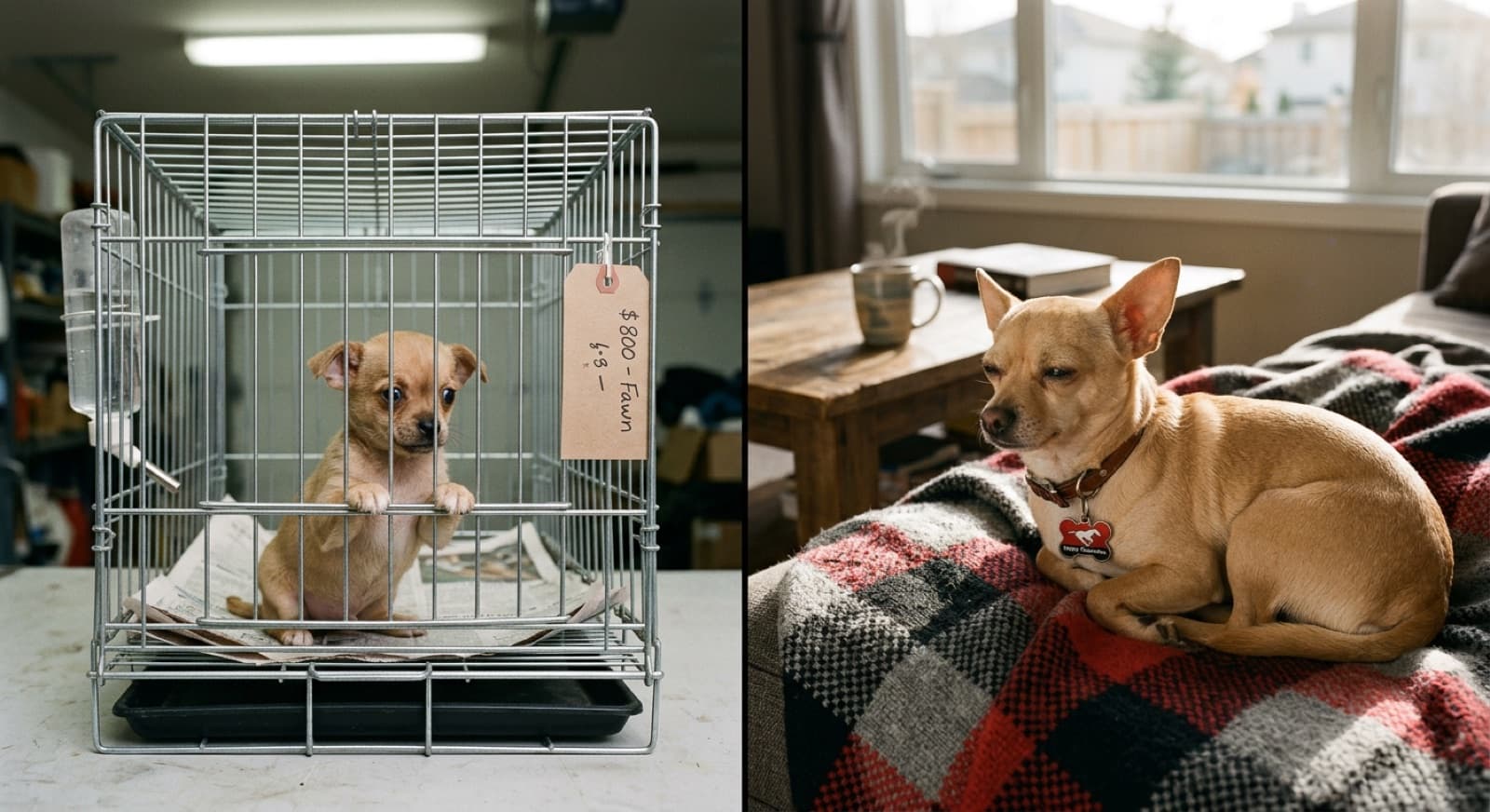
“Small dog syndrome” gets used as if it is a breed trait. It is not. The behaviour pattern is real (reactive barking at strangers and large dogs, lunging on leash, snapping when picked up by unfamiliar hands) but the cause sits squarely with how small dogs get handled, not with what small dogs are. A confident, well-socialized Chihuahua under force-free training behaves like any other well-handled small dog: alert, social, calm in normal public spaces.
The reinforcement loop that produces the pattern is straightforward. A small dog barks at a passing large dog. The owner picks them up, soothes them, says “it is okay,” and walks away from the trigger. From the dog's perspective: barking produced distance, owner attention, and physical safety. The behaviour gets repeated next time, faster. Within months the dog defaults to barking at any approaching dog before assessing the situation. A larger dog would never get this much accommodation; the same accommodation is invisible to most small-dog owners because it feels caring.
The fix is not to stop being kind to the dog. The fix is to stop reinforcing the reactive state. Threshold management does the work: the dog stays at a distance where they can notice the trigger without barking, the owner pays well for calm observation, and over weeks the dog's emotional response to the trigger shifts. This is the same protocol used for reactive large dogs. The Chihuahua version is identical in structure; the distances are usually shorter because Chihuahua triggers (eye-level adults, fast-moving children, large dogs in elevators) sit closer in normal life.
Why Chihuahuas are genetically prone to anxiety
The Chihuahua was bred as a companion and alarm-bark dog. The selection pressure favoured small size, intense bonding to one or two humans, and quick alert response to environmental change. These traits are useful in a Mexican household with a chained yard and known neighbours. They produce a hair-trigger anxious dog in an Edmonton condo with thirty unknown neighbours, elevator strangers, hallway sounds, and delivery doorbells.
The breed's physical size compounds the genetic anxiety baseline. A 5 lb dog is structurally vulnerable. A normal adult human reaching down to pet feels different to a 5 lb dog than the same hand feels to a 50 lb Lab. A passing 70 lb off-leash dog at the off-leash park is a real predator-class threat. The dog's anxiety is a rational response to a world built for animals five to ten times their size. Calling it neurotic misses the point.
The training implication is that the protocol cannot fight the biology. Chihuahuas will always be alert, will always notice their environment, and will always have stronger feelings about strangers approaching than a Golden Retriever does. The goal is not a Chihuahua that ignores triggers. The goal is a Chihuahua that notices, looks to their handler, takes information, and stays under threshold. That is achievable in most dogs with consistent work.
Fear-based reactivity vs aggression
Most Chihuahua “aggression” is distance-increasing fear behaviour. The bark-and-lunge presentation, the snap when a stranger reaches in, the growl at a child approaching the couch: these are communication, not predation. The dog wants the trigger to go away, and the available tools are bark, lunge, and snap. True aggression (intent to do harm with no fear component) is rare in Chihuahuas. Predatory drift toward smaller animals exists but reads differently: silent, focused, low body, no fear posture.
Telling the difference matters because the protocols are opposites. Fear-based reactivity gets worse with corrections and better with counter-conditioning. True aggression needs different handling. For 95 percent of Edmonton Chihuahua presentations, the right diagnosis is fear-based reactivity, and the right protocol is threshold-based desensitization plus counter-conditioning.
The body-language tell is fear posture. Ears pinned back. Tail tucked or low. Weight shifted backward. Tense lips. Whale-eye (white visible around the iris). Trembling. A dog showing fear posture while barking and lunging is communicating distress, not dominance. A dog showing forward posture (weight forward, hard stare, stiff tail) without fear signals warrants a behaviourist consult, not a routine training plan.
Common Chihuahua triggers
The triggers that produce most Chihuahua reactivity are predictable. Knowing them lets the training plan target the actual stressors rather than working in the abstract.
- Larger dogs at close range. The single most common trigger. Off-leash dogs approaching are worse than leashed dogs at distance.
- Strangers reaching down. A hand descending from above looks like predation to a small prey-perception animal. Eye-level greetings work better than top-down reaches.
- Fast movement. Runners, cyclists, scooters, children sprinting. Speed activates prey-response circuits in the watching dog.
- Elevators and small enclosed spaces. The Chihuahua cannot move away from a perceived threat. Edmonton condo elevators are a daily trigger.
- Doorways and entries. A doorbell predicts unknown entrants. Many Chihuahuas develop intense doorway reactivity.
- Eye-level adult humans walking past. When a Chihuahua is carried at chest height, every passing adult is at eye level, which is an animal-world threat posture.
- Children, especially under 8. Unpredictable movement, fast hands, high voices. The mismatch is rarely the child's fault; the prey-perception dog reads the energy as alarming.
- Being picked up by unfamiliar people. Loss of ground contact plus restraint plus stranger proximity is a maximum-stress combination.
Building the trigger inventory for your specific Chihuahua is the first week of training. Owners often discover the dog has three or four primary triggers, not the general “everything” that the daily walks suggested. Targeted protocol beats generic exposure work every time.
Step zero: rule out pain
Pain is the most under-diagnosed driver of small-dog reactivity. A Chihuahua that suddenly snaps when picked up, growls during handling, or escalates leash reactivity over weeks may be telling you something hurts. The vet workup should happen before any behaviour modification plan.
Three pain categories matter most for the Chihuahua:
- Dental disease. Chihuahuas are extremely prone to advanced dental disease, often by age 3 to 5. A painful mouth changes behaviour. Annual professional dental exams are non-negotiable for this breed.
- Patellar luxation. Grade I and II patellar luxation is common in Chihuahuas and produces intermittent knee pain that owners often miss. A reactive episode triggered by a stumble or a touch on the leg may have a patellar root.
- Intervertebral disc disease (IVDD). Less common than in Dachshunds but present in toy breeds. A Chihuahua that resists being picked up or stiffens when the back is touched warrants imaging.
The sibling article on Chihuahua health issues in Edmonton covers the full breed-specific medical picture. Every credentialed behaviour consultant will ask whether pain has been ruled out before starting work. Skipping this step means potentially running a 12-week training program for a dental abscess.
Force-free methodology is the standard of care
The American Veterinary Society of Animal Behavior (AVSAB) position statement on humane dog training is unambiguous: aversive tools like prong collars, choke chains, shock collars, and alpha rolls are associated with increased fear, anxiety, and aggression in dogs. For small fearful breeds, the risk profile is worse, not better. The same correction intensity is proportionally larger to a 5 lb dog than a 70 lb dog, and the existing anxiety baseline is already elevated.
The mechanism is direct. A reactive Chihuahua barking at a passing large dog is signalling distress. A leash correction at that moment pairs the distress with pain. The dog learns that the appearance of a large dog predicts pain, which intensifies the reactivity at the next exposure rather than reducing it. Force-free protocols invert this: the appearance of a large dog predicts something good (food, distance, the handler's engagement), and the dog's emotional response to the trigger gradually shifts.
For the Edmonton Chihuahua owner, force-free is also the practical methodology because the bylaw environment is behaviour-based, not breed-based. City of Edmonton Bylaw 21244 covers dangerous-dog provisions on individual behaviour. A 5 lb Chihuahua that bites a child can be classified the same way as a 70 lb Pit Bull that bites a child. The breed does not lower the legal exposure. Aversive tools that increase the probability of a bite (which they do, on the AVSAB evidence) create the same legal exposure as well as welfare harm.
Credentials that mean something
Dog training is unregulated in Alberta. Anyone can call themselves a trainer. The credentials that mean something are independent third-party certifications: CCPDT (Certification Council for Professional Dog Trainers), which administers the CPDT-KA and CPDT-KSA exams, and IAABC (International Association of Animal Behaviour Consultants), which credentials CDBC-level behaviour consultants on assessment portfolios and continuing education. A trainer who cannot name their certifying body, or who relies on celebrity-trainer methodology rather than credentials, is not the right partner for a reactive Chihuahua.
Browse adoptable Edmonton Chihuahuas
Current Chihuahua and Chihuahua-mix listings from Edmonton Humane Society, AARCS Edmonton fosters, Zoe's, AHHRB, GEARS, Hope Lives Here, and SCARS. Foster temperament notes describe real reactivity patterns and the training support each dog will need.
See Edmonton Adoptable Dogs →Counter-conditioning and threshold work
The protocol that works for most cases of Chihuahua reactivity is threshold-based desensitization plus counter-conditioning, sometimes referenced as LAT (Look At That) or BAT (Behaviour Adjustment Training) in the force-free literature. The three levers are distance, duration, and intensity.
Distance
The dog cannot learn at over-threshold. If the trigger is close enough that your Chihuahua is barking, lunging, or unable to take food, the distance is wrong. Find the distance where the dog notices the trigger but can still take food and respond to a cue. That distance becomes your starting point. Many Edmonton Chihuahua owners discover their actual starting threshold is 30 to 50 feet from a passing dog, not 10. The condo elevator threshold is the door of your unit, not the elevator.
Duration
Short exposures, repeated. A two-minute encounter at threshold distance is more useful than a 20-minute walk full of over-threshold encounters. As the dog stays under threshold, duration extends naturally. For a reactive Chihuahua, three short 10-minute training walks per day produce more change than one 30-minute walk that includes three over-threshold encounters.
Intensity
Calmer triggers first, harder triggers later. A still dog at distance is easier than a moving dog. A medium dog is usually easier than a giant breed. A leashed dog is easier than an off-leash one. A solo stranger walking is easier than a stranger with a child on a scooter. Build the hierarchy from easy to hard, and only progress when the previous level is genuinely fluent.
This is methodology, not a step-by-step protocol for an individual dog. A reactive Chihuahua benefits from a force-free trainer running the actual plan, because the threshold work has to be calibrated to the specific dog. Owners who try to apply generic protocols from a YouTube video are usually surprised at how much closer their actual threshold is than they assumed.
The lap-dog position amplifies triggers
One of the most under-recognised contributors to Chihuahua reactivity is carry position. A Chihuahua carried at chest height, or perched on a shoulder, sits at eye level with every passing adult. From the dog's perspective, this is direct face-to-face confrontation with unknown animals continuously. The same dog on the ground sees the same humans from below, which reads completely differently in animal body language.
The fix is not to never pick the dog up. The fix is to do most exposure work from the ground. Walks on a step-in harness with a four-foot leash. Training sessions at floor level with the owner kneeling. Greetings with strangers happening at the dog's pace, with the dog approaching forward at ground level, not the stranger reaching down. The reactivity that owners describe as “he hates everyone” often resolves substantially once the dog is no longer at eye level with every passing trigger.
Edmonton condo lobbies and elevators are the hardest environments for this. The instinct to pick the dog up in a busy lobby is strong. The protocol-correct response is a sit on the ground at a managed distance, with food reinforcement, until the elevator opens. Owners who switch from carrying to ground-walking report a meaningful drop in reactivity within weeks.
Adolescent emergence: 6 to 18 months
Chihuahua adolescence runs roughly 6 to 18 months. The dog is past the puppy socialization window, fully aware of their environment, and developing opinions. Reactivity that was absent at four months may emerge at nine months. Resource guarding that did not exist at six months may surface at twelve. Recall regresses. Barking patterns intensify. None of this is the dog being difficult on purpose; it is normal developmental neurobiology in a small alert breed.
The adopted adolescent Chihuahua often arrives at the rescue precisely because the original family hit this stage and concluded they had a problem dog. They usually had an adolescent dog. The protocol is the same as for any adolescent: consistent foundation training, threshold-managed exposure, no aversive tools, structured daily routine. Most pet-line Chihuahuas settle into a stable adult temperament by 18 to 24 months when handled this way.
Resource guarding emergence at 8 to 14 months is common and responds well to trade-up protocols. Trade-up means approaching with something better than what the dog has, dropping it, walking away. The dog learns that human approach near a resource predicts gain, not loss. Practise daily with low-value items first; build to higher-value items as the dog stays comfortable. Resource guarding that responds to trade-up over 4 to 8 weeks is a normal adolescent pattern; resource guarding that escalates or generalises warrants a behaviourist referral.
Separation anxiety in over-bonded Chihuahuas
Toy breeds show elevated separation distress rates, and the Chihuahua sits at the high end. The mechanism is partly genetic (companion breed selection over centuries) and partly environmental: small dogs spend more time being carried, sleeping in beds, and following owners room to room. The dependency baseline runs higher than for a Lab raised the same way.
The distinction worth drawing is between common over-attachment (the dog prefers your company, gets clingy, mopes when you leave) and true separation anxiety (panic, destructive behaviour, sustained barking for hours, soiling in the absence of any house-training issue, self-injury). Common over-attachment responds to gradual independence work. True separation anxiety is a behavioural disorder that often needs DACVB consultation and medication alongside training.
Gradual independence protocol
Start with absences the dog handles without distress. For some Chihuahuas that is 30 minutes. For others it is 30 seconds. The duration is the dog's, not the owner's. Build duration in small increments, never reaching the point of panic. Provide a high-value chew or food puzzle at departure. Make arrivals low-key, not greeting parties. Practise short absences multiple times daily during weekends so the dog gets repetitions without high stakes.
Never punish a Chihuahua for distress behaviour in your absence. Soiling, chewing, or barking during separation are panic responses, not defiance. Punishment on return intensifies the anticipatory anxiety that produces the panic in the first place. If protocol does not produce visible improvement over 8 to 12 weeks, the case is likely true separation anxiety and warrants a DACVB referral. The American College of Veterinary Behaviorists is the diagnostic and prescribing tier.
Group classes vs private training
The right format depends on the dog and the stage.
Group classes work for
- Puppy socialization (8 to 16 weeks). Foundation skills plus controlled exposure to other puppies.
- Young adolescent foundation (4 to 8 months) when the dog is not actively reactive in group settings.
- Post-reactivity skill-building once threshold work has produced a calm baseline.
- Small-dog-specific classes, where the trainer separates size groups and the trigger density is manageable.
Private training works for
- Active leash reactivity. The reactive dog cannot learn in a room full of triggers, and the rest of the class cannot work around your dog.
- Resource guarding. The protocol needs careful supervision and individual pacing.
- Severe stranger fear. Exposure work has to be controlled.
- Condo-specific training (elevator desensitization, hallway protocols, doorway management) that does not exist in a group class setting.
Group class costs run $200 to $400 for six to eight weeks. Private sessions run $100 to $200 per hour. A typical Chihuahua reactivity case might use 4 to 8 private sessions over three to six months, so budget $400 to $1,600 for the path. This is part of the real cost of adopting an under-socialized rescue Chihuahua in Edmonton and should be in the budget before adoption.
Edmonton-specific training environments
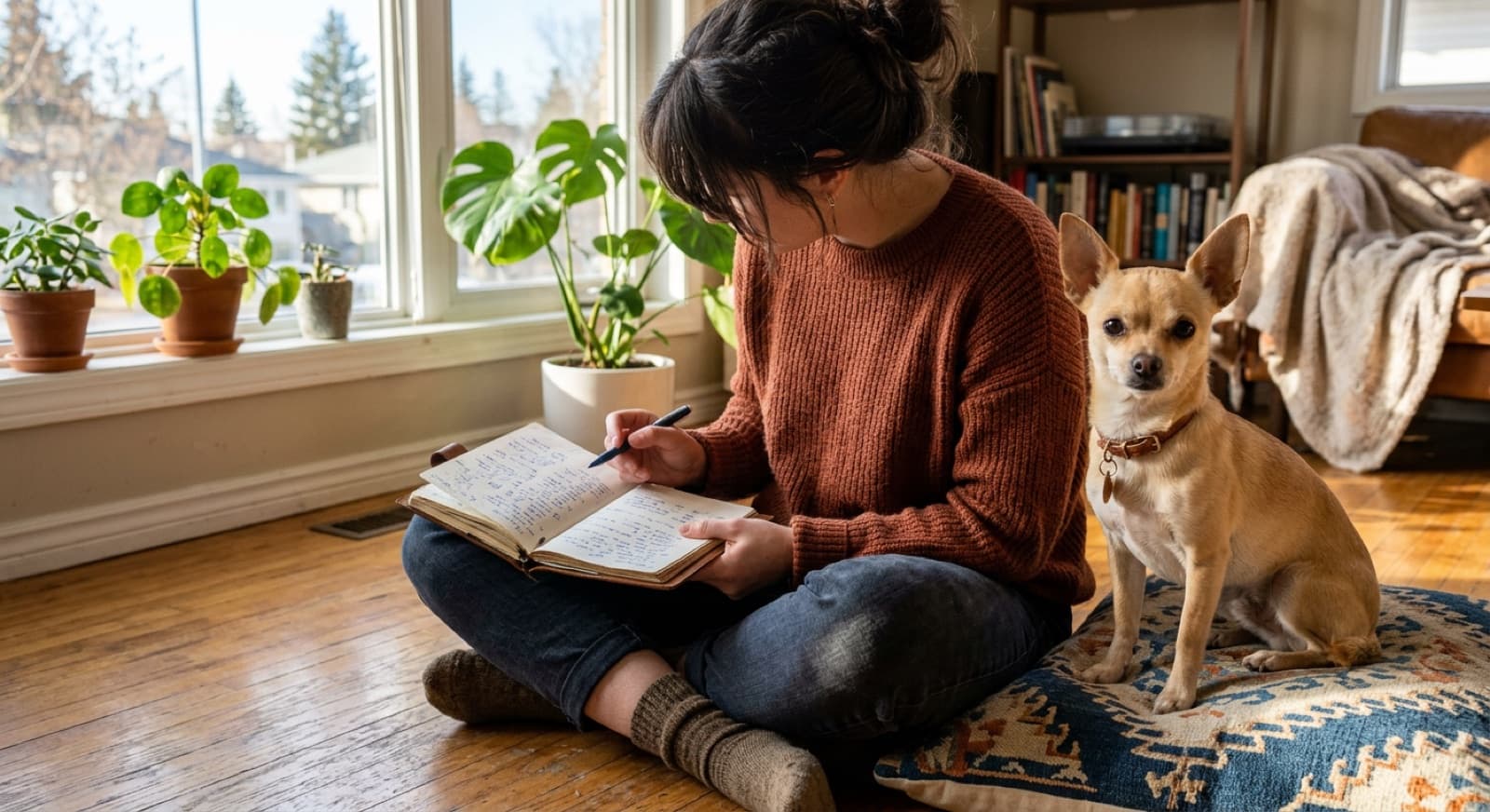
Edmonton geography, climate, and density shape the training year in ways generic small-dog guides do not capture.
Condo and apartment trigger density
Most Edmonton Chihuahuas live in condos or apartments. The trigger density is real: elevators with unknown dogs and humans, hallway encounters at close range, neighbours visible through the door peephole, delivery sounds at unpredictable intervals. The training plan has to account for the building. Defer elevator socialization until after foundation work. Use stairwells when possible during the first weeks. Reinforce calm entries and exits. Owners in dog-friendly buildings who can request hallway courtesy from neighbours during foundation work have an easier path than owners who try to power through.
Winter exposure gaps
From late November through early April, outdoor public exposure shrinks significantly. The Chihuahua tolerates real cold poorly even with a coat; outdoor time on -25 to -35 degrees Celsius days becomes brief potty trips, not training opportunities. The reactive dog loses five months of structured outdoor exposure work each year. Plan winter to be heavy on indoor training (puzzle feeders, scent games, name response drills, place training, settle on a mat) and light on the outdoor reactivity work that defines the spring-through-fall season.
Spring re-socialization
March and April are re-socialization months for every Edmonton Chihuahua owner. After five months of reduced exposure, the dog re-emerges with rusty thresholds. Triggers that were manageable in October now produce reactions. The right response is to treat March and April as a structured rebuild: shorter walks, quieter routes, more reinforcement, more distance from triggers. The dog catches up to last fall's baseline by May or June. Skipping this rebuild and assuming the dog will pick up where October left off is one of the most common Edmonton Chihuahua training mistakes.
Off-leash parks are not a Chihuahua environment
Edmonton off-leash parks (Mill Creek Ravine, Terwillegar, Buena Vista, Capilano) are dominated by medium and large dogs. The combination of size mismatch, owners not watching closely, and the social pressure that prevents you from leaving quickly is high-risk for a 5 to 8 lb dog. One curious Lab with poor manners can injure a Chihuahua without intent to do harm. Predatory drift on small dogs from larger reactive dogs is also a real risk. Most experienced Chihuahua owners skip off-leash parks entirely. Better substitutes: long-line work on quiet river-valley trails, fenced rental sessions at private facilities, small-dog meetups when offered.
The Edmonton apartment-living article
The sibling article on Chihuahua apartment living in Edmonton covers the housing, building selection, neighbour management, and indoor exercise programming that runs alongside the reactivity work.
Bylaw 21244: behaviour, not breed
Alberta has no breed-specific legislation, and City of Edmonton Animal Care and Control Bylaw 21244 treats Chihuahuas the same as every other breed. The dangerous-dog provisions are behaviour-based: a dog can be declared dangerous after biting, attacking, or threatening a person or animal, regardless of breed or size. A biting 5 lb Chihuahua can be classified the same as a biting 70 lb Pit Bull. The classification carries serious consequences including mandatory leashing, muzzle in public, secure containment requirements, and fines that can run into thousands of dollars.
For the Chihuahua owner, this is the practical case for force-free training. The small-dog bite that gets dismissed as “just a nip” in the owner's head still counts under bylaw if it breaks skin and the victim files a complaint. The behaviour-modification record matters if there is ever an incident. A dog whose owner can demonstrate ongoing work with a credentialed CCPDT trainer or IAABC consultant is in a different position than a dog whose owner cannot. Liability is real even when the dog is small.
The structured Chihuahua day
The structured day for a reactive Chihuahua looks something like this. Details vary by household, but the components matter.
- Morning short walk, 15 to 20 minutes. Loose-leash work, name-response drills, threshold practice if triggers appear. Quieter routes early.
- Breakfast as enrichment. Puzzle feeder or snuffle mat. Not free-fed from a bowl.
- Mid-morning training session, 5 minutes. Two or three skills, high reinforcement rate, end before the dog disengages.
- Midday potty break, 10 minutes. Short and structured. Calm hallway exits.
- Settle on a mat during work hours. Designated bed or crate. Builds the off-switch.
- Late afternoon walk, 20 to 30 minutes. Often the highest-trigger slot of the day. Quieter routes if reactivity is active.
- Dinner as enrichment. Same pattern as breakfast.
- Evening training session, 5 minutes. Skill layering, no new triggers.
- Settle on a mat during human evening time. Reinforced daily.
- Last potty break, 9 to 10 PM. Short and structured.
- Predictable bedtime routine. Chihuahuas settle into structure quickly when it is consistent.
- One structured outing per week. A longer river-valley trail walk on a long line, a fenced-rental session, a low-density public space exposure. Building real-world generalisation.
Total time: about 60 to 80 minutes of structured handler input daily. Some of this overlaps with normal household routine. The off-switch is the underrated piece; many Chihuahua reactivity cases are partly chronic over-arousal, and a dog that settles well at home reactes less on walks.
When to escalate to a veterinary behaviourist
A force-free trainer handles foundation skills and most normal Chihuahua reactivity. An IAABC behaviour consultant handles entrenched reactivity, generalised behaviour modification, and resource guarding that has not responded to trade-up protocols. A veterinary behaviourist (DACVB) handles the cases that need diagnosis of a behavioural disorder and often medication alongside training.
Escalate to a DACVB for any of these:
- Any actual bite that breaks skin. Behaviourist territory, not trainer territory, regardless of context.
- Sleep-startle snapping that does not resolve with awake-state desensitization.
- Resource guarding that escalates over weeks rather than settling under a trade-up protocol, generalises across many items, or progresses to bite attempts.
- Generalised anxiety that prevents the dog from settling anywhere, including at home with no triggers present.
- Severe noise phobia producing trembling, hiding, or self-injury during normal household sounds.
- Severe separation distress with sustained barking, destruction, soiling, or self-injury in the owner's absence.
- Sudden behaviour change with no obvious environmental cause, after pain and dental have been ruled out.
The closest DACVB-staffed program for Edmonton is the Western College of Veterinary Medicine at the University of Saskatchewan in Saskatoon. Consultations may run through referral from your primary vet, or by telehealth. Expect $400 to $800 for an initial workup and a structured follow-up plan, with medication costs additional. For genuine behavioural disorders, this is the right tier and worth the cost.
Red flags: when to call for help this week
Most Chihuahua reactivity is normal and responds to consistent work. A smaller subset is genuine crisis behaviour. The triggers below should produce a same-week call to either an IAABC behaviour consultant or a veterinary behaviourist, not a wait-and-see approach.
- Any bite to a human that breaks skin, regardless of context.
- Growling that escalates over weeks rather than reducing with management.
- Sleep-startle snapping that does not resolve with awake-state desensitization.
- Predatory bite-and-shake on small animals or wildlife.
- Generalised inability to settle for more than a few minutes at a time in a quiet home.
- Severe noise phobia producing self-injury or full panic.
- Reactivity that intensifies over a 12 week period of consistent training, rather than reducing.
- Sudden behaviour change in an adult dog with no environmental cause, after pain and dental have been ruled out.
Calling early is always cheaper than calling late. A behaviour consultant who sees the case at the growl stage is solving a different problem than the one who sees it at the bite stage.
Frequently asked questions
How do I train a reactive Chihuahua in Edmonton?
Start with three things. First, rule out pain at the vet (dental, patellar luxation, IVDD/back) because pain is one of the most common drivers of sudden Chihuahua reactivity and gets missed in small dogs more than large ones. Second, find a force-free trainer credentialed through CCPDT or IAABC; aversive tools like prong and e-collars are contraindicated for small fearful dogs by current AVSAB behaviour science. Third, build threshold-based distance management into every walk: most Edmonton Chihuahua owners discover their actual starting threshold is 30 to 50 feet from a trigger, not 10. Condo hallways and elevators count as triggers and need their own protocol.
Is "small dog syndrome" real?
Not as a breed trait. The term describes a behaviour pattern (reactive barking, lunging, snapping at large dogs and strangers) that emerges when owners inadvertently reinforce small-dog anxiety. Picking up a reactive Chihuahua mid-bark, soothing them while they react, or never asking them to walk through normal triggers all reward the reactive state. The dog learns that barking produces distance plus owner attention. Real Chihuahuas under force-free training and structured exposure are confident, calm, and indistinguishable from any other well-handled small dog. The label is convenient shorthand for owner-mediated reinforcement, not a Chihuahua personality.
Why is my Chihuahua barking at every dog on walks?
Almost always fear, not aggression. The bark-and-lunge presentation reads as “mean little dog” but the underlying emotion is distress: the dog wants the larger dog to go away, and barking has worked before. A 5 lb Chihuahua at eye level with an off-leash 70 lb dog has a legitimate threat assessment. The protocol is counter-conditioning at threshold distance, not correction. The dog learns that the appearance of another dog predicts food and handler engagement, not pain. Most leash reactivity in adult Chihuahuas responds to consistent threshold work over 8 to 16 weeks.
Should I use a prong collar or e-collar on my Chihuahua?
No. The American Veterinary Society of Animal Behavior (AVSAB) position statement on humane training is explicit: aversive tools like prong collars, choke chains, and shock collars are associated with increased fear, anxiety, and aggression in dogs. For a small fearful breed, the harm signal is amplified because the same correction intensity is proportionally larger to a 5 lb dog than a 70 lb dog, and the existing fear baseline is higher. Trainers who recommend prong or e-collars for a reactive Chihuahua are working outside current behaviour science. Force-free methodology with CCPDT or IAABC credentialing is the only defensible approach.
Can my Chihuahua go to off-leash parks in Edmonton?
Almost never safely. Edmonton off-leash parks (Mill Creek, Terwillegar, Buena Vista, Capilano) are dominated by medium and large dogs, often with weak recall and owners not watching closely. A 5 to 8 lb Chihuahua in that environment has real injury risk from one curious Labrador with poor manners, let alone predatory drift. Most experienced Chihuahua owners skip off-leash parks entirely. Better substitutes: long-line work on quiet river-valley trails, fenced rental sessions at private facilities, small-dog-only meetups when offered, and structured backyard play with known dog friends.
My rescue Chihuahua hides constantly. Is something wrong?
Probably not, in the first weeks. Rescue Chihuahuas often arrive shut down from kennel stress, transport, and an unknown new home. The 3-3-3 settling pattern (3 days decompression, 3 weeks routine learning, 3 months full settling) applies. Provide a covered crate or quiet corner as a safe space, do not force interaction, let the dog approach you. Persistent hiding past 8 to 12 weeks, especially with reduced eating, no interest in low-arousal play, or trembling at normal household sounds, warrants a vet visit and a force-free trainer consult. Generalised anxiety that does not resolve with environmental adjustment is a behaviourist case, not a training case.
When should I escalate from a trainer to a veterinary behaviourist?
Any actual bite that breaks skin. Sleep-startle snapping that does not resolve with awake-state work. Resource guarding that escalates over weeks despite a trade-up protocol. Generalised anxiety that prevents settling anywhere, including a quiet home. Severe noise phobia producing trembling, hiding, or self-injury. Separation distress with sustained barking or destructive behaviour. Veterinary behaviourists are board-certified through the American College of Veterinary Behaviorists (DACVB). The Western College of Veterinary Medicine in Saskatoon is the closest DACVB program to Edmonton; consultations may run by referral or telehealth and often include medication alongside training.
Do Chihuahuas get separation anxiety more than other breeds?
Yes, statistically. Toy breeds in general show elevated separation distress rates compared to medium and large breeds, and the Chihuahua is among the most over-bonded. The mechanism is partly genetic (companion breed selection) and partly environmental: small dogs spend more time being carried, sleeping in beds, and following owners room to room, which builds a dependency baseline that handles separation poorly. The protocol is gradual independence work, not flooding. Start with brief absences the dog handles without distress and build duration slowly. Real separation anxiety (panic, destruction, soiling, self-injury) needs DACVB consultation and often medication; common over-attachment responds to consistent independence training.
How does Edmonton winter affect Chihuahua anxiety?
It compounds it. The Chihuahua tolerates real cold poorly; outdoor exposure shrinks to short potty trips for almost five months. The reactive dog loses the structured trigger-exposure work that defines the warm season. In March and April, the dog re-emerges to public spaces with rusty thresholds and often shows worse reactivity than the previous October. The Edmonton Chihuahua training year has to budget for winter indoor work (puzzle feeders, scent games, name response, place training) plus a deliberate spring re-socialization phase. Skipping the rebuild and assuming the dog picks up where October left off is the most common Edmonton mistake.
My Chihuahua growled at me near a chew. What now?
Do not punish the growl. The growl is information: the dog is communicating that they feel threatened over a resource. Punishing it teaches the dog to skip the warning and bite without notice. The right response is a trade-up protocol: approach with something better than what the dog has, drop it, walk away. Repeat with low-value items first, build to higher-value items as the dog stays comfortable. Run the protocol under the supervision of a CCPDT trainer or IAABC behaviour consultant for the first weeks. Resource guarding that responds to trade-up over 4 to 8 weeks is a normal pattern; resource guarding that escalates or generalises across many items warrants a DACVB referral.
Can a reactive Chihuahua actually become a calm adult dog?
In most cases, yes. Chihuahua reactivity that is fear-based (which is most of it) responds well to consistent force-free training and threshold management. The timeline is usually 12 to 24 weeks of structured work for visible change, and 6 to 12 months for the new baseline to feel automatic. The exceptions are dogs with bite history, severe generalised anxiety, untreated medical contributors, or owners who continue to reinforce the reactivity through avoidance and soothing. The best predictor of outcome is what the owner does between adoption and the 6 month mark. Many adopters of shy, reactive rescue Chihuahuas describe a different dog at the 1 year mark than the one they brought home.
Related Edmonton Chihuahua guides
Edmonton Adoptable Dogs
Current Edmonton-area Chihuahua and Chihuahua-mix listings from EHS, AARCS Edmonton fosters, Zoe's, AHHRB, GEARS, Hope Lives Here, and SCARS.
Chihuahua Adoption Edmonton
The rescue-first Chihuahua adoption guide: local intake patterns, common mixes, fees, surrender reasons, and the bonded-pair calculus.
Chihuahua Health Issues Edmonton
Dental disease, patellar luxation, IVDD, hypoglycemia, tracheal collapse, and the pain rule-out that drives most behaviour change.
Chihuahua Apartment Living Edmonton
Condo and building selection, neighbour management, indoor exercise programming, pee-pad and winter strategies for Edmonton small-dog owners.
New dog? Start with these care guides
Everything a new adopter needs to set up a safe, happy home.