The short answer
The 1-3 year-old surrender wave is the canonical Edmonton GSD story. Most rescue Shepherds are not damaged dogs; they are normal adolescents whose first home was the wrong fit. Adolescence runs from six months to about 30 months, with the hardest window from 12 to 24 months. With structure, 60 to 90 minutes of daily exercise, and a force-free training class, the typical adolescent settles into an outstanding adult within three to six months. The first 90 days are everything: decompression first 30, structure next 30, basic obedience next 30. Best starting points: SCARS, Edmonton Humane Society, Zoe's Animal Rescue.
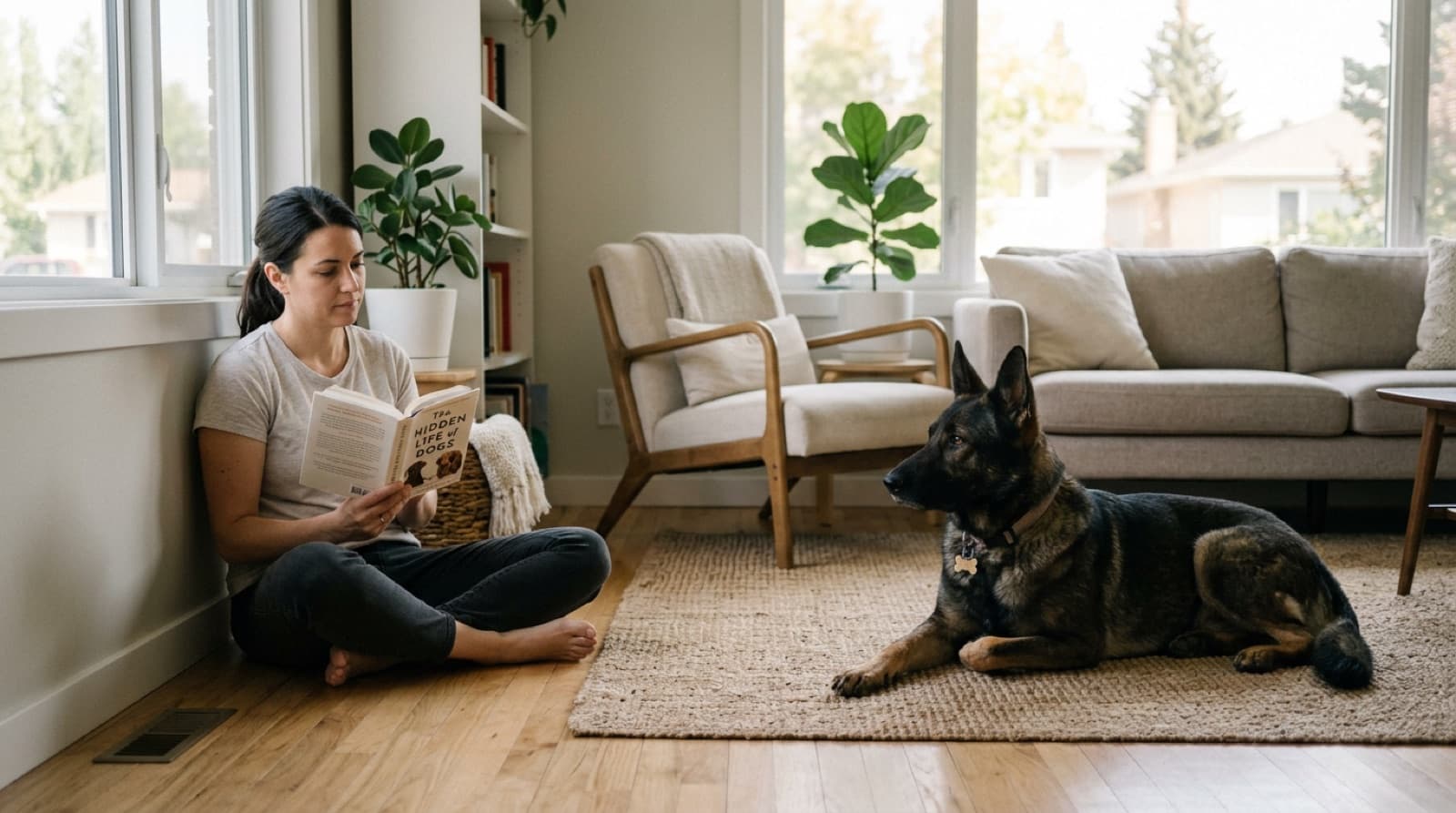
The German Shepherd adolescent timeline
Shepherds do not mature in a clean curve. The breed delivers a series of distinct developmental stages, each of which can blindside an owner who was happily raising the previous stage. Knowing which stage you are in tells you what is normal and what needs intervention.
0 to 6 months: the manageable puppy
A Shepherd puppy is small, sleeps most of the day, and chews soft household items. Crate training establishes quickly, house-training usually clicks by 14 to 16 weeks, and basic socialisation works because the puppy is naturally curious and not yet suspicious of new things. This is the easy stage, and it is also when owners decide the breed is “just like any other dog.” They are about to be corrected.
6 to 12 months: adolescence starts
The dog hits 40 to 60 lbs and develops opinions. Recall regresses. The puppy who came when called at five months now hesitates, sniffs longer, and sometimes refuses outright. Adolescent reactivity emerges: barking at the doorbell, suspicion of strangers, alert-barking at squirrels. Counter-surfing becomes a possibility for the first time because the dog can now reach. Chewing intensity sometimes returns as adult teeth fully set. This is when many owners first think, “Wait, what happened to my dog?”
12 to 18 months: peak surrender risk
The dog is 60 to 80 lbs, physically a full-sized Shepherd, neurologically still adolescent. Reactivity peaks here. The dog tests every rule that worked at six months. The yard fence that contained the puppy is now jumped or dug under. Vocalisation gets louder. Resource guarding can surface, even in dogs who showed no sign at six months. Off-leash recall is at its least reliable. Most Edmonton rescue intake for Shepherds happens in this window because owners decide the dog has “changed.” The dog has not changed; the dog is adolescent.
18 to 24 months: still hard, starting to bend
The structural maturity is finishing. Drive is still high. Reactivity is still active but starts to respond better to consistent training. Owners who pushed through 12 to 18 months start seeing returns on the work they put in. Rescue dogs adopted at this age often settle faster than rescue dogs adopted at 14 months because the worst of the adolescent peak is past.
24 to 36 months: the adult emerges
This is when the dog the breed is famous for arrives. Steady. Biddable. Reliable obedience. Reactivity manageable with consistent handling. Working-line dogs may take to 36 months to finish settling; pet-line dogs are usually there by 30. The adolescent who was destroying baseboards at 16 months is now the dog who lies under the desk while you work.
The whole arc is six months to about 30 months. The hardest window is 12 to 24. Owners who surrender at 18 months pull the plug just before the dog starts to settle, which is what makes the pattern so frustrating to Edmonton rescues. The next adopter inherits a dog that is two or three months from being noticeably easier.
Why so many Edmonton GSDs surrender at 1 to 3 years
The surrender pattern is rarely a single cause. The Edmonton stories that rescues hear most are stacked: an owner mismatch on exercise capacity, plus a life change, plus a winter that made everything harder. A few patterns repeat often enough to call out.
- Exercise mismatch hits in winter. A Shepherd needs 60 to 90 minutes of daily exercise. The owner managed it through summer with evening walks and weekend river-valley sessions. October arrives, then November, then the first -25°C cold snap. The owner skips a walk, then two, then a week. The dog channels the unspent drive into destruction. By January, the household is in crisis.
- Apartment and condo density. Edmonton has a real density of apartment and condo rentals, and a high-drive 70 lb dog in 800 square feet without serious daily exercise becomes a barking, pacing problem fast. Many adolescent surrenders trace back to landlord complaints or noise tickets that the owner could not address.
- Work-from-home to return-to-office whiplash. Many Edmonton households adopted Shepherds during a remote-work period. The dog was raised with constant company. The owner's job returned to office, the dog now spends 9 hours alone, and the destructive behaviour and separation distress that result are real. By 18 months the situation is unworkable.
- New baby plus an adolescent Shepherd. A common Edmonton pattern: family adopts a Shepherd puppy, baby arrives 14 months later, the household is overwhelmed by the combination of newborn demands and a peak-adolescent dog. The dog gets surrendered before the family can stabilise.
- Partner change. Two-person household adopts a Shepherd. One partner leaves. The remaining person cannot manage the dog alone, especially through winter. Surrender follows.
- Financial change. The dog walker who covered weekday exercise becomes unaffordable. Daycare gets dropped. The dog now spends the day alone, undertrained and underexercised. Surrender follows within months.
- Move from house to condo. Owner downsizes from a house with a fenced yard to a condo. A Shepherd that decompressed in a backyard cannot decompress on a balcony. Exercise has to do all the work, and most owners cannot maintain it.
None of these stories describe a defective dog. They describe a working breed in a home that did not match. Edmonton rescues hear variations of these stories every week, which is why the foster networks for SCARS, EHS, Zoe's, and the others see steady Shepherd inflow.
Adolescent normal vs adolescent crisis
Most adolescent Shepherd behaviour that overwhelms owners is normal and finite. A smaller subset is genuine crisis behaviour that requires intervention beyond a regular obedience class. Knowing the difference matters when you adopt.
Normal adolescent behaviour
- Counter-surfing and stealing. The dog can now reach the counter, the table, the laundry basket. Manage through environment (clear counters, lift hampers) and reinforce alternatives. Mostly resolves by 24 months.
- Jumping on people. Excitement greeting, especially with visitors. Force-free training fixes this within weeks if practised consistently.
- Barking at the doorbell and at people walking past windows. Adolescent alert behaviour. Reduces with desensitisation, never disappears entirely in a Shepherd.
- Reactivity on-leash to other dogs. Common at 12 to 18 months. Manage with distance, reinforce calm, work with a trainer if it intensifies.
- Selective recall. The dog who came at six months sometimes refuses at 14 months. Use long-lines, rebuild recall systematically. Improves through adolescence.
- Chewing inappropriate things. Especially if exercise and mental stimulation are thin. Manage environment, add puzzle feeders, increase exercise.
- Increased vocalisation. More barking at general stimuli. Annoying but not pathological.
- Pulling on leash. The dog is now strong enough to pull effectively. Front-clip harness and structured loose-leash training are the fix.
Crisis behaviour (call a professional)
- Bite-and-hold. Any actual bite, especially one that breaks skin or holds. This is veterinary behaviourist territory.
- Resource guarding that escalates. Stiffening, growling, snapping over food, objects, or sleeping space, that gets worse over weeks rather than settling. Trained behaviour consultant or veterinary behaviourist.
- Severe stranger fear. Trembling, hiding, snapping at unfamiliar people that does not improve with calm exposure over weeks.
- Severe separation distress. Self-injury when left alone, sustained barking for hours, soiling in the crate. Often needs medication and a behaviourist.
- Generalised anxiety. The dog cannot settle anywhere, paces constantly, cannot eat in your presence. Veterinary workup first.
- Escape behaviour that endangers the dog. Repeated jumping over six-foot fences, chewing through doors, breaking windows. Beyond a fencing problem.
- Prey drive that kills. Bite-and-shake on cats or small dogs. Not a household management issue.
Rescue foster notes will flag any of the crisis-category behaviours when they exist. Most adolescent Shepherds in Edmonton rescue inventory show normal-category behaviours and need normal-category structure. The dogs flagged as “experienced home only” or “no kids” or “single-pet household” are flagged for a reason and those notes are accurate.
The first 90 days with an adopted adolescent
The 3-3-3 rule (three days, three weeks, three months) is the standard rescue-dog decompression frame, and it applies in full to adolescent Shepherds. The Shepherd-specific adaptation is that this dog needs more structure earlier than a softer breed, and the exercise demand is real from day one even when the dog seems quiet.
Days 1 to 30: decompression and safety
The dog you brought home is not the dog you adopted. The first three days are survival-mode behaviour. The dog may not eat much, may not engage, may sleep nine hours straight, may be quietly checking everything. Resist the urge to introduce them to the neighbourhood, the dog park, the friends. The priority is letting the nervous system reset.
Walk the fence line on day one. Look for gaps, low spots, loose boards, gate latches. Fix anything questionable before the dog is in the yard unsupervised. An adolescent Shepherd will find any weakness within a week of moving in. Keep the dog on a leash in the yard for the first few days even if it is fenced, until you have a read on whether they will try to escape.
Establish a routine immediately. Twice-daily meals at the same times, not free-feeding. Walks at predictable hours. A defined sleeping space (crate, dog bed, designated room). Shepherds settle into structure because they were bred for structure.
License the dog with the City of Edmonton within the first week (required for dogs over six months). Tags should be visible on the collar from day one. The City of Edmonton dogs page has the licensing form and the Animal Care and Control Bylaw rules, including the $250 fine for failing to control an off-leash dog.
Exercise during this window is leashed walks, not off-leash sessions. The dog does not know you yet; recall is not real. A 10 to 15 metre biothane long-line on river-valley trails lets the dog explore safely while you hold the leash. Avoid the dog park entirely for the first two to three weeks.
Days 30 to 60: structure and skills
The real dog starts emerging around week three. More energy than week one. More vocalisation. More opinions. This is normal and expected, and it does not mean you have a problem dog. Continue the routine, continue the exercise, and now start adding structured training.
Enrol in a force-free group obedience class. Most Edmonton-area force-free trainers (the kind certified through CCPDT or Karen Pryor Academy) run six to eight week group classes that cover basic obedience, leash skills, and impulse control. For an adolescent Shepherd, the class is also a low-pressure way to practise around other dogs.
Start adding mental enrichment. Puzzle feeders for breakfast or dinner. Five-minute training sessions twice a day. Scent games like “find it” in the house. A Shepherd that gets 90 minutes of exercise but no mental work is still under-stimulated. The mental work is half the exercise budget for this breed.
Around week five or six, the dog starts to settle in obvious ways. Recognises family members at the door without barking. Sleeps through the night reliably. Stops scanning the house constantly. This is the breed's steadiness emerging.
Days 60 to 90: integration and the dog you live with
By month three, the dog you adopted is mostly the dog you will live with. Personality is set. Energy level is established. The trainer can adjust the program based on what is working. Now is when you start testing what off-leash recall actually looks like, in genuinely fenced areas first, before any unfenced river-valley off-leash zone.
If something is not working by month three, escalate. Persistent reactivity that the class is not solving means the class is not enough. Talk to the trainer about a one-on-one consultation. Persistent fear, resource guarding, or any bite incident means a credentialed behaviour consultant. Most Edmonton-area force-free trainers have a referral network for these cases.
Edmonton exercise programming for an adolescent
Sixty to 90 minutes of real movement daily, even at -25°C, even when the work week is full, even when the weather is bad. This is not negotiable for an adolescent Shepherd. Adjust how, not whether.
Edmonton's river-valley trail network is one of the largest urban park systems in North America and the single best infrastructure the city offers for working-breed exercise. For a still-decompressing or adolescent Shepherd, long-line work on these trails is appropriate before off-leash. See our Edmonton off-leash parks guide for the matrix of which trail suits which dog stage.
Summer programming
A normal summer day looks like a 30 to 45 minute morning walk or river-valley session, a midday potty break, and a 30 to 60 minute evening exercise session (off-leash where appropriate, long-line otherwise). One day a week, swap an exercise session for a longer 90 minute river-valley trail walk. Heat above 28°C means moving exercise to dawn and dusk; black Shepherd coats absorb sun fast and the dog can overheat.
Winter programming
Edmonton winter is where most adolescent-Shepherd households fall apart. The trick is shifting the exercise mix rather than cutting it. On -10°C to -20°C days, river-valley trail walks still work and the valley microclimate is noticeably warmer than the rim. On -25°C to -35°C days, shorten outdoor sessions to 20 to 30 minutes and lean harder on indoor mental work: puzzle feeders, 10 minute training sessions, indoor scent games. On -40°C cold snaps, outdoor time becomes 5 to 15 minute potty breaks only and the entire exercise budget moves indoors for a few days.
The Shepherd double coat handles real cold well. The dog wants to be out in winter more than most breeds. Paw pads on heavily salted city sidewalks are the bigger winter injury: a paw rinse on return home, or musher's wax before walks, prevents most salt-cracked-pad problems.
Mental enrichment counts
A Shepherd that gets 90 minutes of leashed walking and zero mental work is still wired at the end of the day. Mental enrichment counts as roughly half the physical exercise it replaces. Twenty minutes of nose work, puzzle feeders for both meals, two 10-minute training sessions, and a chew toy after dinner is real enrichment. The breed was developed for problem-solving work; deny the brain and the body cannot compensate.
The Edmonton trainer and behaviourist landscape
Adolescent Shepherds need professional support. There are three tiers, and choosing the right tier for the right problem matters.
Tier 1: force-free trainer
For basic obedience, leash skills, impulse control, and most normal-adolescent issues. Look for trainers certified through CCPDT (Certification Council for Professional Dog Trainers) as CPDT-KA, or graduates of the Karen Pryor Academy. Force-free means the trainer does not use prong collars, e-collars, or aversive corrections. For an adolescent Shepherd, aversive methods often increase reactivity rather than reduce it; force-free protocols are the safer starting point. Group classes run six to eight weeks and typically cost $200 to $400. One-on-one private sessions run $100 to $200 per hour.
Tier 2: credentialed behaviour consultant
For reactivity that does not respond to regular training, resource guarding that escalates, or generalised behaviour issues that need a structured behaviour modification plan. Look for consultants certified through IAABC (International Association of Animal Behaviour Consultants) as a Certified Dog Behaviour Consultant. IAABC certification requires demonstrated assessment skills and a behaviour-modification case portfolio. Sessions run $150 to $300 per hour. The behaviour consultant works with you over weeks or months, not in a one-shot fix.
Tier 3: veterinary behaviourist
For confirmed bite history, severe anxiety, severe fear, or any behaviour that may need medication. Veterinary behaviourists are board-certified through the American College of Veterinary Behaviorists (DACVB). They can prescribe and they can diagnose behavioural disorders. There are very few DACVBs in Canada and consultations may run by referral or telehealth. Expect $400 to $800 for an initial consultation and a structured follow-up plan. For genuinely dangerous behaviour, this is the right call.
Where rescues fit
Some Edmonton rescues run post-adoption training resources and trainer referral networks. Ask during the foster phone screen what training support the rescue offers. The Edmonton Humane Society runs structured training classes that work for newly adopted dogs. SCARS and Zoe's sometimes have foster-network trainer recommendations specific to the dog being adopted. Use the rescue's knowledge of the individual dog when you choose a trainer.
Browse adoptable Edmonton dogs
Current Edmonton Shepherd and Shepherd-mix listings from SCARS, Edmonton Humane Society, Zoe's, GEARS, Hope Lives Here, and AHHRB. Many are 1 to 3 year-old adolescents with detailed foster notes describing real personality and the type of home that fits.
See Edmonton Adoptable Dogs →
Are you ready for an adolescent Edmonton GSD?
Honest self-assessment before applying. An adolescent Shepherd is not the wrong dog for most committed adopters, but it is the wrong dog for people who cannot meet a specific set of conditions. Run through these before you fill out an application.
- Daily schedule. Can someone in the household be home, or breaking up the day with the dog, most days? A nine-to-five solo household needs a dependable midday walker or daycare plan in place before adoption, not after.
- Fenced yard or daily long sessions. A fenced yard is not strictly required by every Edmonton rescue, but if you do not have one, you need a documented plan for daily one-hour-plus exercise sessions year-round. The river valley counts; a parking-lot potty break does not.
- Exercise capacity. Are you physically able to walk an hour or more daily through Edmonton winter? Not aspirationally; actually? If knees, mobility, or schedule make this unrealistic, an adolescent is the wrong dog.
- Financial buffer. Adoption fee $400 to $700. Force-free training class $200 to $400. First-year vet costs $500 to $800. Pet insurance $40 to $70 per month. Food $80 to $150 per month. If a $1,500 behaviour consultant fee in month four would be impossible, the buffer is too thin.
- Support network. Family, friends, or paid help who can cover dog care during work travel, illness, family emergencies. A solo adopter with no backup faces real difficulty over a 12 year dog ownership horizon.
- Tolerance for vocalisation and reactivity. The breed alert-barks. Some condo and apartment situations will not work because of it. Honest assessment now saves a surrender later.
- Patience for 90 days minimum. The first three months are the hardest. If you cannot commit to the structure, exercise, and training through this window, the adolescent Shepherd is not the dog.
The rescue's application asks variations of all of these. Being honest helps both sides; a placement that fails at month six is harder on the dog than a thoughtful redirection to a different breed or a different life stage at the application step. The Edmonton Humane Society and the Alberta SPCA both publish surrender-prevention resources worth reading before you adopt, especially the sections on realistic expectations for working breeds.
Frequently asked questions
Is a 1 to 2 year old German Shepherd hard to adopt?
A 1 to 2 year-old Shepherd is the easiest age to adopt in some ways and the hardest in others. Easy: the puppy-chewing peak is past, the physical structure is close to adult, and house-training is usually intact. Hard: this is peak adolescent reactivity, peak prey drive expression, peak counter-surfing, and peak vocalisation. With clear structure, 60 to 90 minutes of daily exercise, and a force-free training class started in week two, most adolescent rescue GSDs settle within 90 days. The dog you adopt in week one is not the dog you live with in month four.
Where can I adopt an adolescent German Shepherd in Edmonton?
Adolescent Shepherds turn up most weeks at the main Edmonton-area rescues. SCARS pulls Shepherds and Shepherd crosses from northern Alberta communities. Edmonton Humane Society regularly receives 1 to 3 year-old owner surrenders directly. Zoe's Animal Rescue and Greater Edmonton Animal Rescue Society both list adolescents on a rotating basis. AARCS, headquartered in Calgary, tags Edmonton-foster dogs separately, so an Edmonton-area Shepherd will surface on Edmonton listings. Check current Edmonton inventory for what is actually adoptable right now.
Why do so many German Shepherds get surrendered at 1 to 3 years old?
The breed delivers more than first-time owners expect, on a delayed timeline. The first six months are manageable: a Shepherd puppy is small, sleepy, and chewing soft household items. Adolescence starts around six months and peaks between 12 and 24 months. The dog is now 60 to 80 lbs, has full adult drive, is testing every boundary, and is reactive to noise, strangers, and other dogs in ways the puppy was not. Owners who chose a Shepherd for the look hit this stage and discover they signed up for a working breed. Many surrender between 12 and 24 months.
What is the worst age for a German Shepherd?
For most owners, 14 to 22 months is the hardest stretch. The dog is physically mature, neurologically still adolescent, and testing every rule the puppy accepted. Reactivity peaks. Recall regresses. Counter-surfing emerges. Vocalisation gets louder. Resource guarding can surface for the first time. The good news: this stage is normal and finite. With consistent structure and a real exercise plan, most Shepherds emerge by 24 to 30 months as the steady, biddable adults the breed is famous for. Surrendering at 18 months means a Shepherd just on the verge of settling enters the rescue system instead of the home that started raising them.
How long does German Shepherd adolescence last?
Six to 30 months for most Shepherds, with the hardest window between 12 and 24 months. The transition out of adolescence is gradual, not sudden. By 30 months most well-raised Shepherds show real impulse control, reliable obedience, and the breed's characteristic steadiness. Larger working-line dogs sometimes take to 36 months to fully settle. The dog is still trainable through this whole window; the work is just heavier than it was at six months and will be lighter at 36 months.
Can an adolescent rescue GSD become a good family dog?
Yes, in most cases. The adolescent surrender pattern is largely about owner mismatch, not dog defect. A Shepherd surrendered at 14 months for chewing furniture, escaping the yard, and barking at the mail carrier is not a damaged dog. With a fenced yard, 60 to 90 minutes of daily exercise, a force-free obedience class, and consistent rules, the same dog is usually a settled family member within three to six months. The exceptions are dogs with confirmed bite history, severe resource guarding, or significant generalised anxiety. The rescue's foster notes will flag those cases honestly.
Do I need a trainer for an adolescent rescue Shepherd?
Yes. Group obedience classes from a force-free trainer should start within the first three weeks of adoption. The class is not just for the dog; it builds your handling skills and gives you a professional you can text when something unusual happens at week six. For reactivity that goes beyond normal adolescent barking, escalate to a credentialed behaviour consultant: either a Certified Dog Behaviour Consultant through IAABC or a Certified Pet Dog Trainer Knowledge Assessed through CCPDT. For confirmed bite history or severe anxiety, the next step up is a veterinary behaviourist (DACVB).
My new Shepherd is destroying things. Is something wrong?
Probably not. Destructive behaviour in a recently adopted adolescent Shepherd is almost always under-exercise plus understimulation plus stress. Audit three things first. Daily exercise: is it 60 to 90 minutes of real movement, not five-minute backyard breaks? Mental work: is the dog getting puzzle feeders, training sessions, or scent work? Decompression time: has the dog had two weeks of low-key adjustment in your home? Fix those three and most destruction settles within a month. If it does not, talk to a behaviour consultant before assuming the problem is the dog.
When should I call a behaviourist instead of a trainer?
Call a behaviourist when the behaviour involves teeth (any bite history, even a controlled one), genuine fear that does not improve with desensitisation, resource guarding of food or objects that escalates over weeks rather than settling, severe separation distress, or generalised anxiety that affects daily function. Trainers teach skills; behaviourists diagnose and treat behavioural disorders, sometimes with medication. The credential to look for is IAABC-CDBC for behaviour consultants or DACVB for veterinary behaviourists.
Can I adopt a 1 to 2 year old Shepherd if I work in an office?
Maybe, depending on the dog and your support setup. A nine-to-five Shepherd alone all day will struggle, especially in the adolescent phase. The realistic options are: midday dog-walker visits to break up the day, a dependable daycare two to three days a week (after the dog is settled enough to handle one), a hybrid work schedule, or a partner with a different schedule. Some Edmonton rescues will not adopt adolescents to nine-to-five solo households without one of these in place. Be honest about your schedule on the application; rescues will work with you on a realistic plan.
Related Edmonton German Shepherd guides
Edmonton Adoptable Dogs
Current Edmonton-area Shepherd and Shepherd-mix listings from SCARS, EHS, Zoe's, GEARS, Hope Lives Here, AHHRB, and AARCS Edmonton fosters.
German Shepherd Adoption Edmonton
The rescue-first GSD adoption guide: Edmonton rescue sources, real adoption costs vs breeder pricing, surrender patterns, and the application process.
German Shepherd Health Issues: Hips, DM, Bloat
German Shepherd health issues to plan for: hip and elbow dysplasia, degenerative myelopathy, bloat, EPI, hemangiosarcoma and drug sensitivity, plus what to ask your vet.
German Shepherd Exercise & Training Edmonton
Daily exercise programming, mental enrichment, force-free training, and Edmonton river-valley off-leash patterns for an adult Shepherd.
Find your Edmonton rescue German Shepherd
Browse current Edmonton-area Shepherd and Shepherd-mix listings. Foster temperament notes help you find the adolescent who fits your home, your schedule, and your experience level.
Browse All Edmonton Dogs →New dog? Start with these care guides
Everything a new adopter needs to set up a safe, happy home.