The short answer
A German Shepherd in Edmonton needs 60 to 90 minutes of real daily exercise plus 20 to 30 minutes of mental enrichment. The river-valley off-leash zones (Hawrelak, Mill Creek, Whitemud, Terwillegar, Capilano) are excellent GSD terrain, but coyote presence and prey drive mean a long-line stays on until recall is reliable at roughly 95 percent under moderate distraction. Winter -25 C is not an excuse to skip the floor; shorten sessions and front-load mental work indoors. Force-free positive reinforcement is the only training method endorsed by CCPDT, IAABC, and AVSAB. Skip the trainers who talk about dominance.
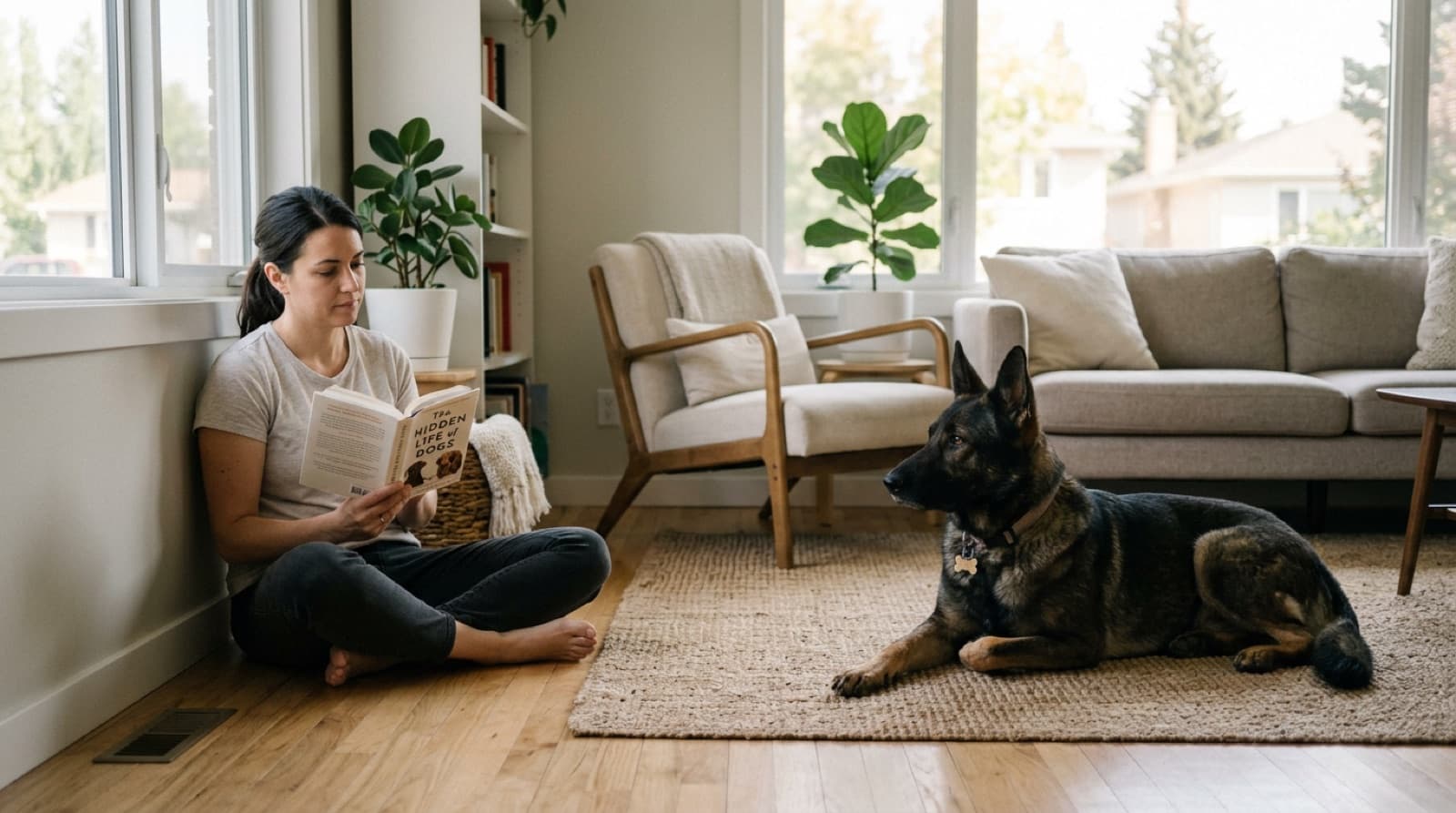
Why German Shepherds need more than a pet breed
The German Shepherd was developed as a working dog, not a pet. Herr von Stephanitz spent decades selecting for biddability, intelligence, drive, and the willingness to work all day. The AKC working group classification is accurate; the breed expects a job. A modern GSD in a typical pet home is being asked to run on a fraction of what they were designed for. The under-exercised, under-stimulated Shepherd is the destructive Shepherd, the reactive Shepherd, the surrendered-at-eighteen-months Shepherd.
Drive does not switch off. A GSD who is bored will create a job. Pulling laundry off the line, patrolling the fence at every neighbour's footstep, herding the kids, escalating door behaviour, fixating on the cat. None of this is bad-dog behaviour. It is a working dog without work. The fix is real exercise plus real mental enrichment, not punishment for the symptoms.
Intelligence cuts both ways. The breed's ranking near the top of working intelligence (commonly cited as third behind Border Collie and Poodle) means they learn fast. They also learn the wrong things fast. A Shepherd who learns that scratching the door produces a walk has learned a behaviour you do not want. A Shepherd who learns that barking moves the delivery driver along has learned reactivity. Mental work redirects that learning machinery onto things you want.
Family lines vs working lines. Working-line GSDs (often imported from German or Czech lines, common in Edmonton police and sport circles) carry more drive than family-line American show GSDs. Both still need real exercise; working lines need more. Rescue dogs are usually somewhere on the spectrum and the foster home is the best read on individual drive. Ask the rescue what the foster sees during a typical day.
The 60 to 90 minute daily floor: what counts
The number adopters hear is 60 to 90 minutes a day. The number is right, but it deserves unpacking because not every minute is the same.
What counts as full exercise
| Activity | Counts as exercise? | Notes |
|---|---|---|
| Off-leash run on a trail | Yes, fully | The gold standard. 40 minutes off-leash beats 90 minutes leashed. |
| Long-line work on a trail | Yes, mostly | Slightly less aerobic than full off-leash but counts as real exercise. |
| Brisk leashed neighbourhood walk | Partial | A 45 minute leashed walk is closer to 25 minutes of GSD exercise. |
| Sniffari (slow scent walk) | Yes, as decompression | Excellent mental work; pair with a faster session if it is the day's only outing. |
| Fetch (moderate) | Partial | 5 to 10 minute fetch sessions, not 45 minutes of ball-launcher. |
| Tug or flirt pole | Partial | Short bursts; high arousal so use sparingly. |
| Backyard alone time | No | Patrolling and barking is not exercise. |
| Mental enrichment (puzzle, scent work) | Counts as the mental layer | 20 minutes of nose work can tire a GSD as much as a 45 minute walk. |
The realistic Edmonton structure. Most owners who succeed with a GSD build the day around two outings. A morning session (30 to 45 minutes) and an evening session (30 to 45 minutes), with one of the two being off-leash or long-line in the river valley several days a week. The other is a brisk leashed neighbourhood walk or a structured training-walk hybrid. Add 20 minutes of mental work spread through the day (a puzzle feeder at breakfast, a short training session before dinner). That is the floor.
Adolescence costs more. A GSD between 8 months and 2 years is at peak energy and peak need for outlets. Plan on the upper end of the range (closer to 90 minutes plus mental) through that window. Skipping it produces the behavioural problems that fill rescue surrender forms. After age 2 the dog typically settles; after age 6 you can taper.
Puppy caveat. If you have a GSD puppy under 12 months, do NOT hit the 60 to 90 minute adult floor. The five-minute-per-month-of-age rule is widely cited as a soft guide: a 4 month old puppy gets roughly 20 minutes of structured exercise. Growth plates close between 12 and 18 months; over-exercising puppies during this window predicts hip and elbow problems for life. Free play and short sessions, not long forced runs.
Mental enrichment that actually works
Mental work is the most under-used tool in pet-home GSD programming. Owners think of exercise as the leash going on and the door opening. The dog's brain needs as much programming as the body. A 20 minute nose-work session can leave a Shepherd more settled than a 45 minute walk because problem-solving fatigues differently than aerobic work.
Puzzle feeders. Kong Wobbler, snuffle mats, lick mats, slow-feed bowls, food-dispensing puzzles (Outward Hound, Trixie). Replace the regular food bowl with one of these at least once a day. The dog works for breakfast instead of inhaling it in 60 seconds. Edmonton owners who add this single change report less destructive behaviour within two weeks.
Scent work and nose games. Start at home. Hide 5 to 10 high-value treats around a room, cue the dog to find them. Build up: hide treats in the yard, in long grass, on the deck. Graduate to scent discrimination using birch oil (the introductory scent in sport nose work). Scent work suits the breed's analytical drive better than almost any other enrichment. A 20 minute session leaves the dog calmly satisfied in a way fetch does not.
Short training sessions throughout the day. Five-minute reps build skills faster than one 30 minute block. A morning sit-stay practice, a midday recall game in the hallway, an evening loose-leash walking drill. The cumulative effect is huge and the dog learns to take the training-mode cue (treat pouch on, marker word ready) seriously. Skill retention improves; reactivity decreases as the dog has a job to focus on.
Structured walks vs decompression walks. Both have a place. Structured walks (heel position, frequent check-ins, training built in) build manners and the working partnership. Decompression walks (long-line, lots of sniffing, dog leads the pace) lower arousal and give the dog autonomy. A healthy week mixes both. Pure structured-only walking builds a dog who cannot relax; pure decompression-only walking misses the manners layer.
Dog sports. Once the basics are in place, structured sports redirect breed drive into something constructive. Tracking, obedience, rally, agility, scent work, herding (rare in Edmonton but available), and Schutzhund or IPO (controversial and not necessary for pet homes). None of these are mandatory; all of them give a working brain a constructive outlet. The Edmonton dog sport community is active; trainers and clubs are easy to find through breed-specific Facebook groups.
Edmonton off-leash strategy for a GSD
The river-valley off-leash network is the single best exercise asset Edmonton GSD owners have. Hawrelak south slope, Mill Creek Ravine, Whitemud Ravine, Terwillegar, and Capilano all offer the kind of varied terrain, scent, and movement opportunity that a Shepherd thrives in. The full Edmonton off-leash parks guide covers each in detail.
The bylaw. The City of Edmonton Animal Care and Control Bylaw 21244 restricts off-leash dog activity to designated zones. Off-leash outside a designated zone carries a fine that can reach the $250 range. A long-line clipped to a harness keeps you compliant on regular trails and gives a GSD real range to move.
Coyote presence is the real recall test. All five river-valley off-leash zones border corridors with established coyote populations. Dawn and dusk are the highest-traffic times. A GSD off-leash who picks up a coyote signal can run a long way before recall lands. Spring (April through July, pup-rearing season) raises the risk; deep winter (food-stressed coyotes) raises it again. The Alberta SPCA tracks wildlife incidents in Edmonton; coyote interactions with off-leash dogs happen.
The long-line is the realistic compromise. A 30 to 50 foot biothane line clipped to a back-clip harness gives the dog real freedom to sniff and range while keeping the option to stop them at any moment. Biothane is waterproof, washable, does not stiffen in Edmonton cold, and stays grippy when wet. Pair with a sturdy back-clip harness (not a flat collar; the line can transmit a sudden jerk that hurts the neck on a collar).
The 95 percent rule. Off-leash status is earned when the dog recalls reliably (95 percent or better) under moderate distraction. Most GSDs reach this with months of structured long-line work. Many do not get there under full prey arousal, and that is OK. A dog who needs to stay on a long-line for life still gets an excellent life. The owner who removes the line at 60 percent reliable recall is the owner who calls Edmonton 311 after the dog chases a deer into the ravine.
Never near roads. Off-leash next to any road, even a quiet residential street, is not negotiable. A loose Shepherd who sees a squirrel cross the road can be in front of a car before recall fires. Off-leash zones are inside the designated areas only. Transit to and from is on a 6 foot leash.
Recall training for a working-drive breed
Recall is the single most important behaviour you will train. It is built on a long-line over months, not weeks. The goal is not to graduate off the line in three weeks; the goal is to make the recall reliable enough that one squirrel does not undo six months of work.
Pick the recall word and never poison it. Choose a word the dog has not heard a thousand times. Avoid the dog's name as the recall cue (the name is overused). Use something distinct: “come,” “here,” “to me.” Whatever you pick, use it only when you can reward heavily and never call when you cannot enforce. A recall word called repeatedly without reward becomes a word that means nothing.
The reward hierarchy. Build a treat hierarchy: regular kibble at the bottom, mid-value training treats in the middle, very high-value rewards (real meat, cheese, freeze-dried liver) at the top. The high-value reward is reserved for recall. The dog learns that the recall word predicts the best thing in the dog's day. Recall pays better than anything else, every time.
The criterion ladder. Start in zero-distraction environments (your own living room, then yard). Cue, reward, repeat. Build to low distraction (quiet residential street at off-peak), then moderate (a quiet park), then higher (a busier park), then the off-leash zone with the long-line still on. Each step requires the previous step to be solid. Do not rush distraction levels; a single failed recall under high distraction undoes weeks of work.
What does not work. Punishing the dog for not coming. Calling repeatedly when the dog is not coming. Calling when you cannot enforce (off the long-line, distance too great). Calling the dog only to leash up and end the fun (this teaches recall equals end of fun; instead recall, reward heavily, then release back to play). The mechanics matter as much as the gear.
Prey arousal is the unicorn. Even well-trained GSDs can lose recall under full prey arousal. A rabbit breaking from cover, a deer crossing the trail, a squirrel running across the path. The dog's body fires the chase response before the brain processes the recall word. Build the recall ladder anyway, build it solid, and keep the long-line on in any environment with active wildlife. Off-leash in a fenced facility is the safest place to test prey-arousal recall.
Browse adoptable German Shepherds in Edmonton
Edmonton rescues note daily exercise needs and recall progress on every Shepherd's foster profile. Read the foster notes carefully; some dogs come with reliable recall in low-distraction environments and a clear long-line program for distraction work. Working-line versus family-line distinction matters; the foster home can tell you which one this dog is.
See Edmonton Adoptable Dogs →
Winter exercise programming: -25 C and below
Edmonton winters test exercise discipline. The owner who skips three days because of cold ends up with a destructive Shepherd by day four. The GSD double coat handles cold well; the limiting factor is owner willingness, not dog tolerance.
Cold-weather thresholds for an adult healthy GSD
| Temperature | Outdoor programming |
|---|---|
| -10 to -20 C | Normal sessions. 45 to 60 minutes off-leash or long-line is fine. |
| -20 to -25 C | Paw protection on (boots or wax). Sessions 30 to 45 minutes. Watch for ice between pads. |
| -25 to -30 C | Shorter pulses (20 to 30 minutes), boots non-negotiable, front-load mental work indoors. |
| Below -30 C | Brief potty breaks only. Indoor enrichment is the whole day. |
Paw protection. Edmonton sidewalks are salted heavily through winter. Salt irritates pads and is toxic if the dog licks it off. Options: dog boots (Muttluks, Ruffwear Polar Trex), paw wax (Musher's Secret, Pawtector), or both. Rinse the paws with warm water after every winter walk regardless. Check between the toes for ice balls after long sessions; pluck them carefully or thaw with body heat.
The indoor substitute on extreme days. When the day is below -30 C and outdoor work has to be 5 minute potty breaks, the daily exercise floor moves indoors. Twenty minutes of scent work in the basement. Treadmill walks if you own one (some GSDs take to dog treadmills well; introduce gradually). Stair laps if your house has them. Hallway recall games. Tug sessions. A 60 minute indoor enrichment day can be done as four 15 minute blocks spread through the day.
The river valley is open all winter. Most river-valley off-leash zones stay snow-packed and walkable through winter. Hawrelak south slope, Mill Creek Ravine, Terwillegar, and Capilano are usable on most winter days. Trails are quieter, parking is easier, and the dog has the whole zone. The cold is a feature, not a bug, for a working-coat breed.
Sustained exercise vs short pulses. Below -25 C, switch from one long session to multiple shorter ones. Two 25 minute sessions plus indoor enrichment beats one 50 minute session that the dog is reluctant to start. Mental enrichment fills the gap.
Training methodology: force-free is the canonical answer
Every major dog-training credentialing body in North America has aligned around force-free, science-based, positive reinforcement training. The position statements are direct and consistent. This is not a stylistic preference; it is the consensus of behaviour science.
The Certification Council for Professional Dog Trainers (CCPDT) requires force-free methodology from certified trainers. The International Association of Animal Behaviour Consultants (IAABC) requires the same from certified behaviour consultants. The American Veterinary Society of Animal Behavior (AVSAB) position statement on the use of dominance theory in behaviour modification explicitly rejects pack-leader framing and aversive correction.
What this rules out. Prong collars, e-collars (also called shock collars), choke chains, alpha rolls, scruff shakes, leash pops as correction, and any technique that relies on causing pain, fear, or intimidation. These tools increase reactivity and fallout in intelligent biddable breeds. GSDs are particularly vulnerable; the aversive layer often produces a dog who is harder to handle, not easier. Many GSD surrenders trace back to aversive training that backfired.
What it rules in. Marker-based training (a clicker or a verbal “yes”), high-value food rewards, play as reward, structured shaping of behaviour, criterion building, positive interrupters, environmental management. The science is settled; the work is in the application.
How to find a trainer. Look for credentials: CPDT-KA, CPDT-KSA, KPA-CTP, IAABC-CDBC, or veterinary behaviourist (DACVB). Ask about methodology. If the trainer uses language like “balanced,” “dominance,” “pack leader,” or “corrections,” keep looking. If the trainer offers e-collar work, prong collars, or board-and-train programs without transparent methodology, keep looking. Edmonton has a growing force-free trainer scene; the rescues you adopt from will usually have a trainer referral list.
Group classes vs private. Start with a group puppy class or basic obedience class for socialization plus baseline skills. Move to private sessions for specific issues (reactivity, recall, separation anxiety). Both are useful; private is more efficient once a specific gap is identified.
Common exercise and training mistakes
Patterns we see across Edmonton GSD rescue placements and the surrender notes that come back to the foster network.
Under-exercising the adolescent. The 8 month to 2 year window is peak destruction. Owners who cruise through puppyhood at 30 minutes a day hit a wall when the dog needs 90. Skipped exercise in adolescence is the leading cause of surrender at the 1 to 2 year mark. Adopters: confirm the daily floor matches the dog's life stage before bringing the dog home.
Over-exercising the puppy. Long forced runs, repetitive jumping, marathon hikes, off-leash mountain biking with a puppy under 12 months. Growth plates close between 12 and 18 months; impact during this window predicts hip and elbow problems for life. Free play and short structured sessions are correct. The five-minute-per-month-of-age guide is a useful upper limit.
Off-leash without proven recall. A 70 percent recall is not off-leash recall. A single failure under prey arousal in the Whitemud Ravine can produce a dog 2 kilometres away within minutes. The math on coyote risk and traffic risk does not justify the freedom until the recall is 95 percent reliable under moderate distraction.
Repetitive ball fetch. A 45 minute ball-launcher session every day reinforces obsessive chase patterns. The dog stops being able to settle without a ball, shows shadow or light chasing in the house, and develops OCD-pattern behaviour. Short fetch sessions mixed with other activities are fine; daily marathon fetch is not.
No mental work at all. The owner who walks the dog twice a day and offers no enrichment ends up with a dog who creates jobs. Patrol barking, fence reactivity, door explosions, herding the kids. Add 20 minutes of mental work per day and watch the symptoms decrease.
Aversive tools for reactivity. Prong collars and e-collars for reactivity in a Shepherd usually make the reactivity worse. The dog associates the trigger (a passing dog, a stranger, a bicycle) with the pain or shock of the correction. Reactivity escalates. The fix is force-free desensitization and counter-conditioning, run with a credentialed behaviour consultant. It takes longer; it works.
Believing the dominance frame. The pack-leader and alpha framing is outdated and counter-productive. The AVSAB position statement is direct. A trainer who tells you the dog “needs to know who is alpha” is offering 1970s pop ethology, not behaviour science. Walk away.
Frequently asked questions
How much exercise does a German Shepherd need in Edmonton?
Plan for 60 to 90 minutes of real daily exercise plus 20 to 30 minutes of mental work for an adult GSD. The mental piece matters as much as the physical with this breed. A 45 minute leashed neighbourhood walk does not count as 45 minutes of exercise for a working-line Shepherd; it is closer to a warm-up. The exercise floor goes up during adolescence (roughly 8 months to 2 years) and stays high through age 6 or 7 before tapering for seniors. Edmonton owners who skip the floor for a week of bad weather see the dog tell them about it through destruction, reactivity, or fence testing. Build a routine that survives -25 C, not just a routine that works in July.
Where can I exercise a German Shepherd off-leash in Edmonton?
The Edmonton river-valley off-leash zones are excellent GSD terrain: Hawrelak south slope, Mill Creek Ravine, Whitemud Ravine, Terwillegar, and Capilano. All are unfenced. All border river-valley corridors with active coyote presence. A GSD off-leash in those zones who picks up a prey scent or a coyote signal can be a long way away before recall lands. The realistic position: keep your GSD on a 30 to 50 foot biothane long-line until recall is reliable at roughly 95 percent under moderate distraction. Most working-line Shepherds get there with months of structured training. Many family-line Shepherds get there faster. Reliable recall under full prey arousal is the unicorn; do not bet the dog on it.
Does a German Shepherd need exercise in -25 C Edmonton winter?
Yes. The GSD double coat handles Edmonton cold well, and an adult healthy Shepherd is fine for sustained outdoor work down to roughly -25 C with paw protection. Below that, shorten the outdoor session to 20 to 30 minute pulses and front-load mental enrichment indoors. The bigger winter risk is undershooting exercise because the weather is bad. A GSD who does not get worked for three winter days becomes a different dog by day four. Cold is not the limiting factor; owner discipline is. Build a winter routine of two shorter outdoor sessions plus puzzle feeders, scent work, and structured training so the daily floor still gets met.
What is the best training method for a German Shepherd?
Force-free positive reinforcement. The CCPDT, IAABC, and AVSAB position statements on training methods are aligned on this. Aversive tools (prong collars, e-collars, alpha rolls, scruff shakes) are rejected by all major credentialing bodies because they increase fallout in intelligent reactive breeds. GSDs are biddable, highly motivated by food and play, and excel under reward-based training. The dominance and pack-leader framing is outdated and counter-productive. If a trainer uses language like alpha, dominance, or "balanced," that is the signal to keep looking. Look for credentials like CCPDT (CPDT-KA, CPDT-KSA), KPA-CTP, or IAABC certification.
How do I teach a German Shepherd reliable recall?
Recall is built on a long-line over months, not weeks. Start in a low-distraction environment (your own yard, a quiet residential street at off-peak hours). Use a 30 to 50 foot biothane line, a back-clip harness, and very high-value treats (real meat, cheese, freeze-dried liver). Call your dog's name and the recall word once. Reward when the dog turns toward you and again when the dog reaches you. Practice many short reps, not long sessions. Graduate distraction levels carefully: quiet yard, quiet park, busier park, off-leash zone with the line still attached. Many GSDs reach reliable recall under moderate distraction in 4 to 6 months. Under full prey arousal, plan on keeping the line on indefinitely.
What counts as mental enrichment for a GSD?
Anything that makes the dog think and problem-solve. Puzzle feeders (Kong Wobbler, Outward Hound puzzles), snuffle mats, scatter feeding in long grass, nose-work games (find the treat), short training sessions throughout the day (5 minute reps build skills faster than one 30 minute block), and structured walks where the dog is asked to heel and check in. A 20 minute scent-work session can tire a Shepherd as much as an hour of fetch. Mental work also serves as the bad-weather substitute when the outdoor session has to be cut short. Build a rotation so the dog is not solving the same puzzle every day.
Can my GSD do scent work or nose work in Edmonton?
Yes, and they tend to thrive at it. Scent work suits the breed's analytical drive better than repetitive fetch. The basic version is at-home: hide high-value treats around the house or yard and cue the dog to find them. Build up to scent-discrimination games where the dog learns to find a specific scent (birch oil is the standard introductory scent in sport nose work). Edmonton has an active dog sport scene including nose work, tracking, obedience, rally, and agility through various community-based clubs. We do not name specific clubs without verified current information, but the Edmonton-area working-dog community is easy to find through Facebook groups and trainer recommendations.
Is fetch good exercise for a German Shepherd?
In moderation, yes. As a daily 45 minute repetitive ball-launcher routine, no. Repetitive high-arousal fetch reinforces obsessive ball-chasing patterns that show up as OCD-style behaviour in some Shepherds. The dog stops being able to settle without a ball and shows shadow or light chasing in the house. Better fetch programming: short 5 to 10 minute fetch sessions mixed with other activities (tug, training, free sniffing). Mix in toy variety so the dog is not fixated on one object. Stop the session while the dog still wants more, not when the dog is exhausted. The same goes for flirt poles and other high-arousal tools.
My GSD is destructive when I leave the house. Is it an exercise problem?
Often yes, sometimes no. Adolescent destruction (8 months to 2 years) is usually under-exercise plus under-stimulation. Add 20 minutes of mental work before you leave, a frozen Kong as a departure routine, and reassess after two weeks. If the destruction continues alongside vocalization, drooling, pacing, or refusing to eat when alone, that is closer to separation anxiety, which is a behaviour modification project, not an exercise project. A force-free behaviour consultant (IAABC-CDBC, CCPDT-KA with separation anxiety specialty) can sort the difference. Edmonton Animal Care and Control fields complaints about barking destructive dogs; do not let it reach that stage.
How young can I start training a GSD puppy?
Day one. Puppies can learn name recognition, basic recall, sit, and crate skills from 8 to 10 weeks. Enrol in a force-free puppy class as soon as the first vaccine series is complete (your vet will advise on timing in Edmonton). The critical socialization window closes around 14 to 16 weeks; missing it makes adolescent reactivity much more likely. Keep formal training sessions short (3 to 5 minutes) and frequent. What you do NOT do with a young GSD puppy: long forced exercise, jumping on hard surfaces, repetitive running on pavement. Growth plates close around 12 to 18 months; over-exercise during that window predicts hip and elbow problems.
More Edmonton German Shepherd guides
Edmonton Adoptable Dogs →
Current German Shepherd and GSD-mix listings from Edmonton rescues, with foster-tested temperament and recall notes.
German Shepherd Adoption Edmonton →
Edmonton rescue routes for GSDs, adoption costs, surrender patterns, and the breed-vs-buy reframe.
German Shepherd Health Issues: Hips, DM, Bloat →
German Shepherd health issues to plan for: hip and elbow dysplasia, degenerative myelopathy, bloat, EPI, hemangiosarcoma and drug sensitivity, plus what to ask your vet.
GSD Adolescence Edmonton →
The 8 month to 2 year stage that breaks most pet-home Shepherds, what to expect, and how to manage through it.
New dog? Start with these care guides
Everything a new adopter needs to set up a safe, happy home.