The short answer
GSDs are heavy shedders that blow their undercoat twice yearly (March-April and September-October, 2 to 3 weeks each). Edmonton timing is actually more predictable than chinook-affected southern Alberta because the cycle is photoperiod-driven, not temperature-driven. Never shave a GSD. The double coat insulates against both cold and heat; shaving causes permanent damage. The Furminator can damage guard hairs if used carelessly. Safer alternatives: undercoat rake + slicker brush + metal comb + HV dryer. Bathe every 6 to 8 weeks (less often in dry Edmonton winter). Long-coat (stockhaar) GSDs need 3 to 4x weekly brushing vs 1 to 2x for stock coats. Summer heat management: brushing + early or late walks + cooling mats, never shaving. Black nails: Dremel grinder, look for the triangle pattern. Edmonton professional grooming: $80 to $300 per service depending on coat type and HV dryer use.
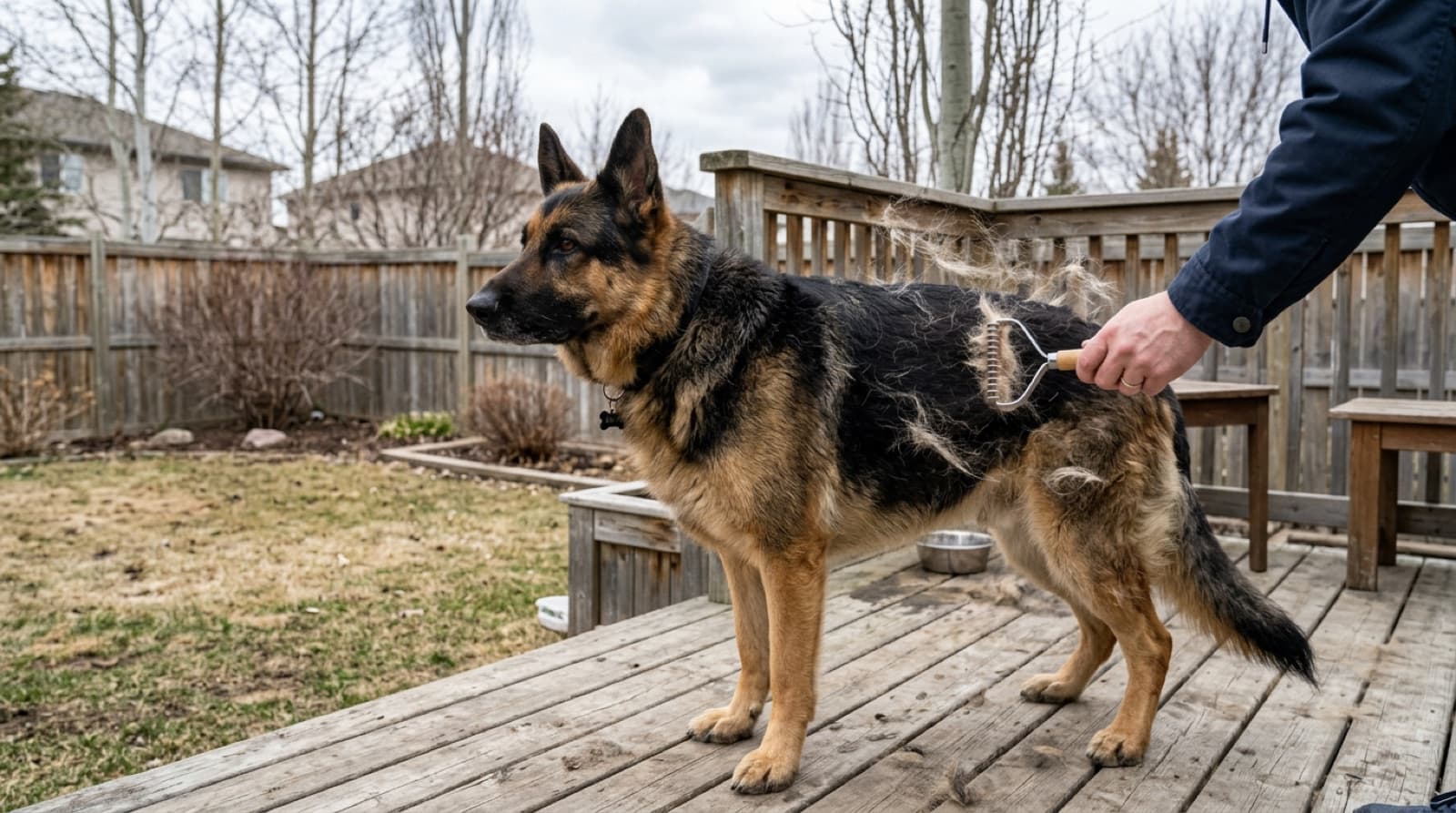
Never shave a German Shepherd, even in Edmonton summer
Shaving causes lasting damage. The double coat insulates against BOTH cold and heat. Shaving removes heat protection, increases sunburn risk, and changes coat texture permanently. If an Edmonton groomer recommends shaving your GSD, find a different groomer.
Five reasons never to shave:
- The double coat insulates against BOTH cold and heat. Shaving removes heat protection and increases sunburn and overheating risk.
- The coat may grow back unevenly with permanently changed texture (the “post-shave coat” syndrome).
- The undercoat may not regrow properly, leaving permanent bald patches or fluffy texture loss.
- Shaving does not reduce shedding. It just makes shed hairs shorter and harder to remove from carpet and clothing.
- An intact double coat keeps the dog cooler than bare skin would, by trapping a layer of air against the body and shielding from sun.
Acceptable trims: feathering on legs and tail, sanitary trim around genitals, paw fur trim.
NEVER acceptable: full body shave, “summer cut,” #5 or shorter blade work.
The breed-club consensus is consistent on this. The Canadian Kennel Club breed standard and the AKC German Shepherd Dog breed profile both describe the double coat as a defining structural feature that requires preservation, not removal.
Edmonton coat blow timing
GSDs blow their undercoat twice a year, on roughly the same schedule across most northern climates:
- Spring blow: March to April. Driven by photoperiod (day-length crossing roughly 12 hours in mid-March). Lasts 2 to 3 weeks. The dog loses the thick winter undercoat.
- Fall blow: September to October. Photoperiod cycle reverses. The summer coat sheds out so the new winter undercoat can grow in. Lasts 2 to 3 weeks.
Edmonton is actually more predictable than chinook-affected southern Alberta because the shedding cycle is photoperiod-driven, not temperature-driven. Calgary GSDs sometimes experience off-cycle coat blows when a chinook drops a -25C night into a +10C day mid-winter; Edmonton GSDs follow the standard March-April and September-October schedule cleanly.
Outside of blowing season, GSDs shed daily at a maintenance rate. There is no “not shedding” season for the breed.
Setting expectations: GSDs are heavy shedders. If shedding is a deal-breaker for your household, this is the wrong breed. The popular nickname “German Shedder” is not affectionate exaggeration; it is descriptive. Edmonton GSDs typically lose 4 to 7 lbs (yes, pounds) of undercoat per coat-blow event.
The tool kit: what to use and what to avoid
Recommended tool rotation for GSD owners:
- Undercoat rake (Mars Coat King, Safari Undercoat Rake, $20 to $50). Lifts dead undercoat without cutting guard hairs. This is the workhorse tool.
- Slicker brush (Chris Christensen Big G, Hertzko, $25 to $80). Finishing and topcoat smoothing.
- Metal comb (wide-tooth plus fine-tooth combo, $15 to $25). Final pass to verify the coat is clear.
- High-velocity (HV) dryer for coat-blow events ($150 to $500 depending on brand). K-9 brand is the gold standard at $300 to $500. Transformative for shedding management; blasts loose hair out before brushing.
- Dremel rotary grinder for black-nail trimming ($25 to $60). Safer than clippers for nails where the quick is not visible.
Some of the product links in this section are Amazon affiliate links — we may earn a small commission at no extra cost to you. It never changes which products we recommend.
The Furminator controversy. The Furminator removes loose undercoat efficiently but the cutting blade can damage GSD guard hairs if pressed too hard or used too often. Many GSD owners report Furminator-related coat damage: thinning guard hairs, harsh texture, frizzy regrowth, undercoat that will not fully clear. If you use one, use it sparingly (once a week max during coat blow), light pressure only, never on guard hairs. The safer rotation above works better for most GSDs.
Working order during coat blow:
- HV dryer first to blast loose hair (outdoors if possible; the hair plume is significant).
- Undercoat rake to lift remaining dead coat.
- Slicker for finish.
- Metal comb to verify clear coat.
One 60-minute session with this rotation during peak coat blow can remove more hair than a week of daily brushing alone.
Edmonton winter changes daily maintenance, not the blow cycle
The 5 to 6 months of furnace-heated dry indoor air plus the dog's thicker winter undercoat means more visible hair accumulation indoors. Vacuum more often, humidify the home, brush in a contained space.
Edmonton winter pet-hair management:
- Humidifier in the home (whole-home or single-room, target 35 to 45% relative humidity). Reduces static cling and dander spread; eases dry-skin shedding spikes.
- Upgrade vacuum frequency to every 2 days in deep winter. Quality HEPA vacuum is the difference between manageable and overwhelming pet hair.
- Replace HVAC filters more often through heating season (every 60 days vs the standard 90 days). Heating systems pull pet hair through the ducts; clogged filters reduce furnace efficiency.
- Strategic brushing in a garage or mudroom captures undercoat before it migrates to living areas. A short brushing session before bringing the dog in from a walk is the highest-yield routine.
- Washable furniture covers ($30 to $80) on the spots the dog actually uses.
- Robot vacuum (Roomba s9, Roborock S7) running daily on a schedule keeps maintenance manageable.
One important caveat: do NOT over-brush in October. The fall coat blow lays down the thick winter undercoat the dog actually needs at -30C. Heavy brushing through October can leave a GSD under-insulated for January. Tool the brush rotation back to weekly maintenance once the coat blow finishes.
Long-coat (stockhaar) vs stock-coat GSDs
| Variant | Brushing | Professional groom | Edmonton winter notes |
|---|---|---|---|
| Stock coat (standard) | 1 to 2x weekly off-season; daily during coat blow | Every 8 to 12 weeks; $80 to $140 bath + brush; $150 to $300 full coat blow with HV dryer | Standard winter care; intact coat handles -30C well |
| Long coat (stockhaar) | 3 to 4x weekly minimum; daily during coat blow | Every 6 to 10 weeks; $120 to $180 bath + brush; $200 to $350 full coat blow | Additional paw + feathering trims for snow/ice/salt; mat-prone friction zones need extra attention |
Long coats mat severely if neglected. Armpits, behind ears, between back legs, and around the collar are mat-prone friction zones. Long-coat GSDs are also more prone to picking up Edmonton winter snow, ice balls, and salt, so additional paw fur and feathering trims for cold weather. Both variants follow the never-shave rule. Edmonton rescues see both variants; ask the rescue to specify coat type if not noted on the listing.
Browse adoptable German Shepherds in Edmonton
Adult GSDs often have documented coat type in foster notes. Edmonton rescues will tell you whether a dog is stock coat or long coat before adoption so you can plan the grooming budget.
See Available German Shepherds →Edmonton GSD groomer selection
What to look for:
- Experience with double-coat breeds (Siberian Husky, Bernese Mountain Dog, Newfoundland, Samoyed background is a good sign).
- HV dryer on premises. This is the gold-standard tool for double coats; ask before booking.
- NEVER recommends shaving. This is a knowledge red flag if they do.
- Uses brush-out rather than over-relying on the Furminator.
- Comfortable handling a 70 to 90 lb adult GSD without aversive tools.
Edmonton pricing tiers:
- Stock coat bath + brush: $80 to $140 per service.
- Stock coat full coat-blow service with HV dryer: $150 to $300 per service.
- Long coat bath + brush: $120 to $180 per service.
- Long coat full coat-blow service: $200 to $350 per service.
Frequency recommendations: stock-coat GSDs benefit from 2 to 4 professional grooms per year (anchored on coat-blow events). Long-coat GSDs benefit from 4 to 6 professional grooms per year. Many Edmonton groomers offer “deshedding packages” for coat-blow season (typically a 2-hour appointment with HV dryer + multiple brushing passes). Worth the cost during peak coat-blow weeks. Off-season home brushing is sufficient for most stock-coat GSDs.
Frequently Asked Questions
How often do German Shepherds blow their coat in Edmonton?
GSDs blow their undercoat twice a year: typically March to April (spring blow) and September to October (fall blow). Each event lasts 2 to 3 weeks of intense daily shedding. During blowing, you can pull handfuls of undercoat out by hand; brushed coat fills entire grocery bags. Outside of blowing season, GSDs shed daily but at a maintenance rate. Edmonton timing is actually more predictable than Calgary because Edmonton lacks the rapid-temperature-swing chinook events that sometimes trigger off-cycle coat blows. Edmonton GSD coat blows follow the photoperiod cycle (day-length change) more reliably than they follow temperature. Spring blow starts when daylight stretches past about 12 hours in mid-March; fall blow starts when daylight drops below 12 hours in mid-September. Setting expectations: GSDs are heavy shedders year-round. If shedding is a deal-breaker, this is the wrong breed.
Should I ever shave my German Shepherd?
No. Never. Shaving causes lasting damage. Five reasons: (1) the double coat insulates against BOTH cold and heat, so shaving removes heat protection and increases sunburn and overheating risk; (2) the coat may grow back unevenly with permanently changed texture (the "post-shave coat" syndrome); (3) the undercoat may not regrow properly, leaving permanent bald patches or fluffy texture loss; (4) shaving does not reduce shedding, it just makes shed hairs shorter and harder to remove from carpet and clothing; (5) an intact double coat keeps the dog cooler in summer than bare skin by trapping a layer of air against the body and shielding from sun. Acceptable trims: feathering on legs and tail, sanitary trim around genitals, paw fur trim. NEVER acceptable: full body shave, "summer cut," #5 or shorter blade work. If an Edmonton groomer recommends shaving your GSD, find a different groomer. This is a knowledge red flag for that business.
Is the Furminator safe for German Shepherds?
Controversial. The Furminator removes loose undercoat efficiently but the cutting blade can damage GSD guard hairs if pressed too hard or used too often. Many GSD owners report Furminator-related coat damage: thinning guard hairs, harsh texture, frizzy regrowth, undercoat that will not fully clear. Safer alternatives: an undercoat rake (Mars Coat King or Safari Undercoat Rake, $20 to $50, lifts dead undercoat without cutting), a slicker brush (Chris Christensen Big G or Hertzko, $25 to $80, finishing and topcoat smoothing), and a metal comb (wide-tooth plus fine-tooth combo, $15 to $25). For coat-blow events, a high-velocity (HV) dryer is transformative. K-9 brand HV dryers run $300 to $500; cheaper imports $150 to $250. Working order during coat blow: HV dryer first to blast loose hair, then undercoat rake to lift remaining, then slicker for finish, then comb to verify. If you do use a Furminator, use it sparingly (once a week max during coat blow), light pressure only, never on guard hairs.
How often should I bathe my German Shepherd in Edmonton?
Every 6 to 8 weeks for a healthy GSD, far less often than most pet owners assume. GSD double coats produce natural oils that protect skin and water-repel; over-bathing strips these and causes dry skin, dandruff, and worse shedding. Edmonton-specific consideration: the long dry-air winter (5 to 6 months of furnace-heated indoor air at low humidity) already stresses dog skin, so over-bathing in winter is even more counterproductive. Many Edmonton GSD owners bathe every 8 to 10 weeks through winter and pull bath frequency tighter (6 to 8 weeks) through summer when outdoor mud and pollen need addressing. Timing tip: a warm bath at the start of spring coat-blow season helps loosen undercoat (the "warm bath plus HV dryer" technique professional groomers use). Use GSD-appropriate shampoo: oatmeal-based, hypoallergenic, fragrance-free. Brands: Earthbath Oatmeal & Aloe, Burt's Bees, Pro Pet Works. Avoid human shampoo (wrong pH), heavily fragranced shampoos, and tearless puppy shampoo (often too gentle to clean a GSD coat). Critical drying technique: thoroughly dry the undercoat or you risk hot spots and yeast under the dense coat.
How is grooming different for long-coat (stockhaar) vs stock-coat GSDs?
Significantly different maintenance. Stock-coat GSD (the standard breed coat, short to medium length): brushing 1 to 2x weekly off-season, daily during coat blow. Easy maintenance, average grooming difficulty. Long-coat or stockhaar GSD (the rarer long-haired variant, recessive trait, not officially recognised in some kennel club standards): brushing 3 to 4x weekly minimum to prevent matting, daily during coat blow, paying special attention to feathering on ears, legs, tail, and britches. Long coats mat severely if neglected. Armpits, behind ears, between back legs, and around the collar are mat-prone friction zones. Long-coat GSDs typically need professional grooming every 6 to 10 weeks (vs every 8 to 12 for stock coats). Long coats are also more prone to picking up Edmonton winter snow, ice balls, and salt, so additional paw fur and feathering trims for cold weather. Both coat types follow the never-shave rule. Edmonton rescues see both variants; ask the rescue to specify if not noted on the listing. The Canadian Kennel Club breed standard recognises both variants in some contexts, though long-coat status varies by jurisdiction.
How do I keep my GSD cool in Edmonton summer without shaving?
Heat management without shaving. Daily brushing in summer removes dead undercoat and improves air circulation through the coat. Walks before 10 AM or after 7 PM during heat wave days (above 25C). Skip walks above 28C, replace with indoor activity, kiddie pool play, frozen Kong toys, AC time. Cooling mat ($30 to $80) or kiddie pool with shallow water in shaded yard area. Cool wet bandanas or cooling vests (Ruffwear Swamp Cooler) for short walks during marginal weather. Constant fresh water access. Watch for heat stroke signs: heavy panting, drooling, glazed eyes, weakness, vomiting, collapse. Emergency response: cool with wet towels (NOT ice, too cold causes vasoconstriction that worsens heat dissipation), AC, ER vet within minutes. Never leave a GSD in a parked car (interior hits 40C+ within 10 minutes on a 24C day). Edmonton summer heat is generally milder than Calgary because Edmonton hits 30C+ less frequently than southern Alberta, but heat wave events still happen and the breed handles heat better than brachycephalic breeds but worse than short-coated breeds. Edmonton heat-stroke ER cost: $800 to $3,000+.
How do I trim a German Shepherd's nails (especially black nails)?
Every 3 to 4 weeks for adult GSDs. Long nails cause splaying toes, joint stress, altered gait, and increase joint disease risk in a breed already prone to hip and elbow dysplasia. Black nails are harder than light nails because you cannot see the quick (the blood vessel inside the nail). Recommended approach for black GSD nails: use a Dremel (rotary grinder) instead of clippers because it grinds gradually so you can stop progressively when you see the nail surface change. Dremel brands: Dremel 7300-PT ($40 to $60), Hertzko Pet Nail Grinder ($25 to $40). Several short cuts or grinds rather than one big one. Look for a triangle pattern on the underside of the nail (lighter colour). That is your stop signal; the quick is just beyond. Edmonton professional nail trim: $15 to $25 if not bundled with grooming. Many vet clinics offer drop-in nail trims for $20 to $35. If your GSD hates nail trims (most do; sensitive about feet), counter-condition with high-value treats over weeks of practice. Many adult rescue GSDs need extensive desensitisation before tolerating home nail trims.
How do I manage GSD shedding in my Edmonton home?
GSD shedding is a daily lifestyle adjustment, not something you eliminate. Realistic management for Edmonton households: (1) daily brushing during coat-blow weeks (5 to 10 minutes outside on a mild spring day is ideal); (2) off-season weekly brushing minimum; (3) HEPA-filter vacuum cleaner because GSDs destroy regular vacuums fast (brands: Dyson Animal series, Shark Vertex Pro; plan to vacuum every 2 to 3 days); (4) robot vacuum running daily on a schedule (Roomba s9, Roborock S7) keeps maintenance manageable; (5) lint rollers everywhere (by the door, in your car, at work); (6) washable furniture covers ($30 to $80); (7) avoid black, navy, or charcoal clothing if your GSD is black-and-tan (light-coloured clothing hides hair better); (8) outdoor brushing days are gold (collect loose undercoat outside before it spreads through the house; Edmonton spring brushing on a calm warm day in April is the highest-yield window); (9) diet matters (high-quality protein and omega-3 fatty acids reduce excessive shedding from poor coat health). Edmonton GSDs typically lose 4 to 7 lbs of undercoat per coat-blow event. Yes, pounds. Plan storage and disposal accordingly.
Does Edmonton winter change shedding patterns?
Less than you would expect, with one nuance. The shedding cycle is driven primarily by photoperiod (day-length change) rather than temperature, so Edmonton GSDs blow their coats on roughly the same schedule as GSDs in milder climates: spring blow March to April, fall blow September to October. What Edmonton winter changes is daily maintenance shedding INDOORS. The combination of furnace-heated dry indoor air plus 5 to 6 months of indoor confinement plus the dog's thicker winter undercoat means more visible hair accumulation on furniture, clothing, and floors than in summer when the dog can shed outside. Practical implications: humidifier in the home (whole-home or single-room, 35 to 45% relative humidity reduces static cling and dander spread); upgrade vacuum frequency to every 2 days in deep winter; replace HVAC filters more often (every 60 days during heating season vs the standard 90 days); strategic brushing in a garage or mudroom captures undercoat before it migrates to living areas. The fall coat blow lays down the thick winter undercoat the dog actually needs at -30C, so embrace it: a thinned winter coat in Edmonton equals a cold dog. Do not over-brush in October.
Edmonton professional grooming for a GSD: cost and frequency?
Professional grooming for a GSD is optional but recommended during coat-blow weeks. Edmonton pricing: $80 to $140 for full bath + brush-out service, $150 to $300 for full coat-blow service with HV dryer at a quality groomer. Long-coat GSD pricing runs higher ($120 to $180 for bath + brush, $200 to $350 for coat blow). Frequency: stock-coat GSDs benefit from 2 to 4 professional grooms per year (anchored on coat-blow events). Long-coat GSDs benefit from 4 to 6 professional grooms per year. What to look for in an Edmonton GSD groomer: experience with double-coat breeds (Siberian Husky, Bernese, Newfoundland, Samoyed background is a good sign), HV dryer on premises (this is the gold standard tool for double coats), NEVER recommends shaving (knowledge red flag if they do), uses brush-out rather than over-relying on the Furminator. Many Edmonton groomers offer "deshedding packages" for coat-blow season, typically a 2-hour appointment with HV dryer + multiple brushing passes. Worth the cost during peak coat-blow weeks. Off-season home brushing is sufficient for most stock-coat GSDs.
Does diet affect GSD shedding?
Yes, meaningfully. Coat quality and shedding intensity reflect overall nutrition. A GSD on a poor-quality diet (cheap kibble with low-quality protein sources, excessive fillers, no omega-3 supplementation) sheds more, has duller coat texture, develops dandruff, and shows more skin irritation. Improvements that consistently reduce shedding intensity: high-quality protein as the first ingredient (named meat sources like "deboned chicken" or "lamb meal" rather than "meat by-products"), adequate fat content (12 to 18% for adult GSDs), omega-3 fatty acid supplementation (fish oil or salmon oil, 1 to 2 capsules daily for a 70 to 90 lb GSD, EPA + DHA combined 500 to 1,500 mg/day depending on dog size, consult vet for dose), adequate biotin and zinc (look for skin-and-coat formulations), fresh water available constantly. Diet-related shedding improvements typically show up at 4 to 8 weeks after dietary change, with full coat-quality improvement at 3 to 6 months. Edmonton GSDs with persistent shedding problems despite quality diet should see a vet to rule out thyroid issues (hypothyroidism is breed-elevated in GSDs and causes excessive shedding plus weight gain plus lethargy) or food allergies. Diet does not eliminate twice-yearly coat blow; it modulates daily maintenance shedding.
Bottom line for Edmonton GSD owners: what should I expect?
Expect to commit. GSDs are heavy shedders year-round with two intense coat-blow events of 2 to 3 weeks each. Expect pounds of undercoat per blow, daily vacuuming during peak weeks, weekly brushing year-round, and a permanent lifestyle adjustment to pet hair on every surface. Expect to never shave the dog and to find a groomer who agrees. Expect $80 to $300 per professional groom, 2 to 6 grooms per year depending on coat type. Expect to invest in tools ($100 to $300 in brushes, comb, possibly HV dryer over the dog's lifetime) and upgraded vacuum ($400 to $800 for a quality pet-specific model). Expect the dry winter air to challenge skin and require humidifier support. Expect to embrace the fall coat blow because the thick winter undercoat is what keeps the dog comfortable at -30C. The reward: GSDs that get appropriate coat care have decade-long lives with excellent skin health, comfortable thermoregulation in Edmonton extremes, and the iconic dramatic coat that defines the breed. Edmonton rescues (SCARS, Edmonton Humane Society, Zoe's Animal Rescue, AHHRB, AARCS Edmonton fosters) will share each dog's coat type and any historical skin issues during the foster phone screen.
Adoptable German Shepherds in Edmonton
Live listings from SCARS, Edmonton Humane Society, Zoe's, AHHRB, and AARCS Edmonton fosters.
German Shepherd Adoption Edmonton
Rescue pipelines, costs, working-line vs show-line, family-fit reality, breed-mix patterns.
GSD Adolescence Edmonton
The 8 to 24 month phase, force-free training playbook, working-breed energy management.
GSD Health Issues Edmonton
Hip and elbow dysplasia, degenerative myelopathy, EPI, bloat (GDV), hypothyroidism, specialty vet access.
New dog? Start with these care guides
Everything a new adopter needs to set up a safe, happy home.