The short answer
Brush daily, never shave. Doodle coats hold dead hair instead of releasing it, so F1B and F2B coats can pelt within two weeks of skipped brushing. Professional grooming in Edmonton runs $150 to $220 every six to eight weeks for a standard Doodle. Body shaving triggers Post-Clipping Alopecia and texture change, so scissor work or a number four or longer guard only. Edmonton dry indoor winter air accelerates matting; humidity and daily line brushing matter most from November through March. Drop ears plus curly coat mean weekly ear checks and monthly ear-canal hair plucking.
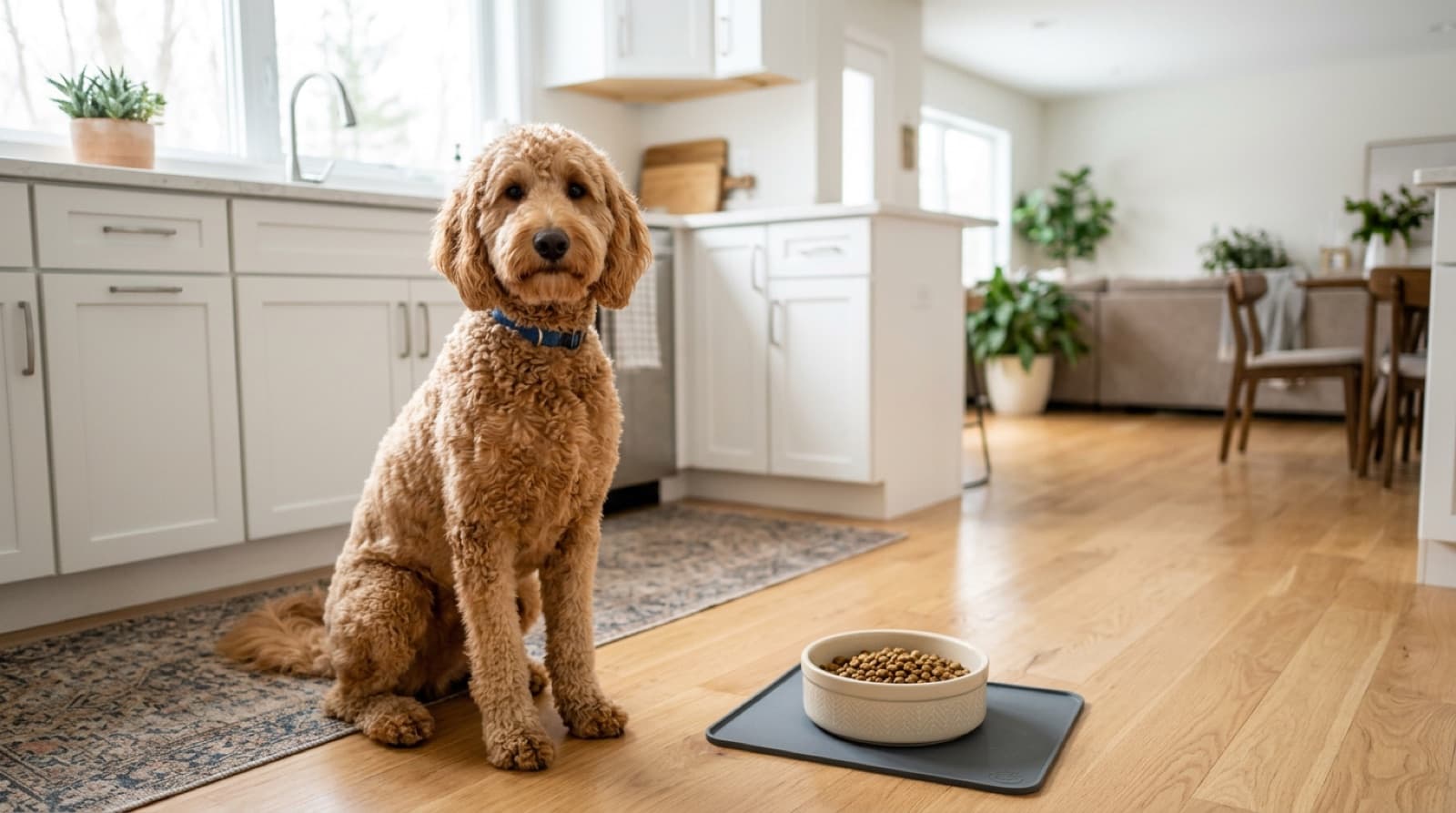
Generation to coat: what F1, F1B, F2B, and multigen actually mean
Doodle marketing leans hard on coat-type promises, and most of the promises overstate what genetics can guarantee. A few honest baselines first. The Poodle side of the cross brings a curly coat that holds dead hair and resists releasing it, which is what produces low-shedding behaviour and matting risk in equal measure. The Golden Retriever (or Labrador, in a Labradoodle) side brings a double coat that releases dead hair onto the floor. What you get in any individual Doodle depends on which traits express, and that varies puppy to puppy even within a single litter.
F1 is the first-cross generation, one Poodle parent and one Golden parent. Coat outcomes spread across a wide range. A typical F1 litter has some puppies with a flat shedding coat (Golden-dominant), some with a wavy moderate-maintenance coat (the most common F1 outcome), and some with a curly low-shedding coat (Poodle-dominant). Matting risk is moderate. Shedding is unpredictable. An F1 is the most common rescue Doodle in Edmonton because backyard breeders ran heavily F1 in the 2018 to 2021 window before chasing the F1B trend.
F1B is an F1 Doodle bred back to a Poodle, so the genetics are seventy-five percent Poodle and twenty-five percent Golden. Coats are typically curly to very curly, very low-shedding, and most mat-prone. F1B is what most allergy-sensitive families ask for, and it is also where most owner-surrender from grooming overwhelm originates. F2B is even further Poodle-weighted and the curliest of the common combinations.
Multigenerational Doodles (F2, F3, and beyond) vary widely depending on what the breeder selected for. A reputable multigen breeder who tracks coat traits across generations can produce more consistent coats. A backyard breeder running multigen without selection produces an unpredictable mix. Most multigen Doodles in Edmonton rescue come from the second category.
For an adult rescue Doodle, generation labels are usually unknown or guessed. The only honest assessment is touching the coat. Tight curls with a springy, soft texture mean Poodle-dominant grooming demands and aggressive matting risk. A looser wave with some shed hair on a brush means the dog falls closer to the F1 range. A flatter coat that sheds visibly is essentially a low-maintenance Golden in a Doodle body. Build your grooming routine around what the dog actually has, not what the label said.
The matting reality: why curly coats pelt
A Doodle coat sheds the way every other coat sheds, biologically. Hair follicles cycle through growth, rest, and release phases on a predictable schedule. The difference is what happens to the dead hair after the follicle releases it. In a shedding double-coated breed, the dead hair works its way out through the topcoat and onto the floor. In a curly Poodle-cross coat, the dead hair tangles with the surrounding live hair on its way out and gets stuck. The longer it stays, the more it tangles with new growth, and the result is a mat against the skin.
The friction zones go first. Behind the ears, in the armpits, between the back legs, around the collar, in the beard and moustache, and along the tail base. Anywhere the coat is rubbed by movement, fabric, or another body part is where the felting starts. From a small tangle to a true pelt (a solid mat that lies flat against the skin and cannot be brushed out) takes about seven to fourteen days in an F1B or F2B coat and three to four weeks in an F1.
Pelts are not just a cosmetic problem. They pull on the skin, restrict movement, hold moisture against the skin and cause hot spots, and conceal sores, ticks, and infections. The American Animal Hospital Association grooming guidance for double-coated and curly-coated breeds treats matting prevention as a welfare issue, not a cosmetic one, and that framing is correct.
The daily line brushing routine
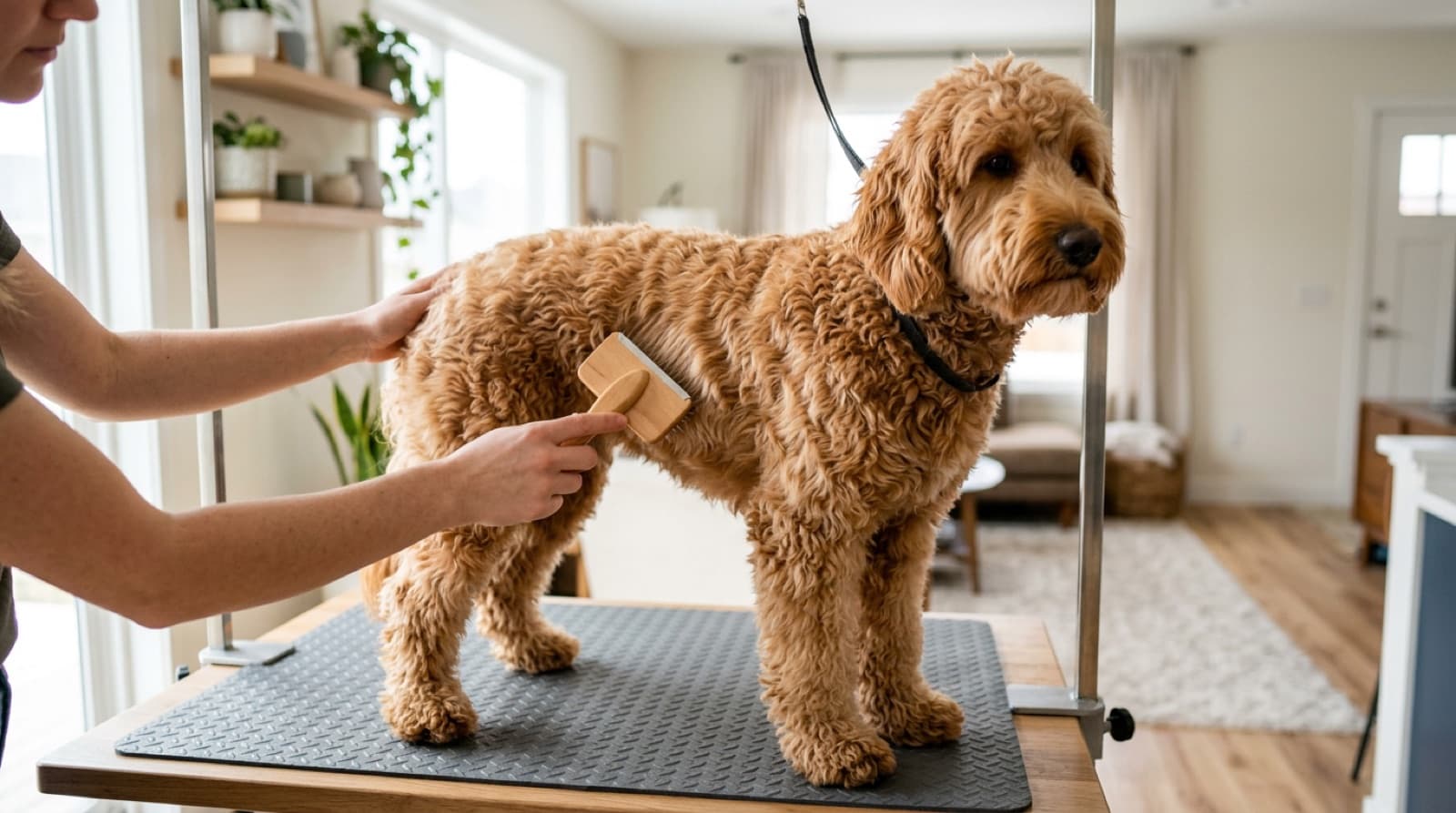
Ten to fifteen minutes a day is enough for most Doodles. The goal is to reach the skin and pull dead hair before it can felt with live hair. Stroking the top of the coat with a brush feels productive but accomplishes almost nothing for a curly coat. Line brushing is the technique that actually works.
Sit the dog on a non-slip surface elevated to your waist so your back is comfortable. Start at one shoulder. Part the coat in a horizontal line near the skin with one hand. With the other hand, brush from the skin outward through the parted section using a slicker brush. Lay down a new horizontal line a half-inch higher and repeat. Work your way up the body in sections, then repeat on the other side, the legs, the chest, the belly, the tail, and the beard. A metal comb passed through the same sections at the end finds anything the brush missed.
Three tools handle most of the work. A slicker brush is the daily primary tool, with fine bent wires that reach through curls without cutting guard hairs. A metal greyhound-style comb is the verification tool, used after the brush to confirm you reached skin level. A de-matting tool with rounded blades helps with small developing tangles in friction zones. Skip the Furminator-style deshedding tools, which cut and damage curly textures.
Most Doodles tolerate brushing well if it starts in puppyhood as a quiet routine paired with treats. An adult rescue Doodle who has never had positive brushing experience may resist. Build tolerance with short sessions, high-value treats, and progress measured in weeks not days. A Doodle who actively fights brushing usually has uncomfortable mats already; address those at the groomer first, then start the home routine on a clean coat.
Friction zones get extra attention. Lift each ear and brush behind it. Lift each front leg and brush the armpit. Check the beard, where food and water create mats faster than anywhere else. Check the rear and the base of the tail, where sanitary issues compound matting.
Edmonton groomer pricing and waitlists
A full professional Doodle groom in Edmonton typically runs $150 to $220 every six to eight weeks for a standard-size Doodle. The price covers a bath, blow-dry on a high-velocity dryer, brush-out at the table, sanitary trim, paw and face tidy, ear clean, and a full body cut with scissors or a long guard. Mini Doodles (15 to 35 lbs) run closer to $120 to $170. Bernedoodles, Sheepadoodles, and other large Doodles stretch to $200 to $280. Mobile groomers, who come to your home, charge a $30 to $50 premium and are worth it for an anxious or senior Doodle.
Annual professional grooming cost for a standard Doodle on a six-week schedule lands in the $1,200 to $1,800 range. On an eight-week schedule with more home brushing, the floor drops to $900 to $1,400. This is the single largest ongoing cost of Doodle ownership outside of food and vet care, and it is the cost most surrendering owners underestimated when they bought the puppy.
Waitlists are a real planning factor in Edmonton. Established Doodle-experienced groomers run four to eight weeks for new clients in normal months, and six to ten weeks during the spring shed and the back-to-school intake wave in September. The practical strategy is to book your next appointment on your way out of the current one rather than waiting until you need a groom. Cancellations happen, and many groomers maintain a short-notice list you can sign up for.
Add-on costs to expect. De-matting at the table runs $30 to $80 depending on severity. A full shave-down for a pelted coat runs $150 to $220 and is sometimes folded into the regular price for a returning client. Ear-canal hair plucking is typically included; if it is not, ask. Anal gland expression, if you want it done, is $15 to $25.
Browse adoptable Edmonton Doodles
Rescue Doodles arrive in Edmonton in steady numbers, often surrendered when the daily brushing and the every-six-week grooming bill caught the previous owner off guard. Foster notes usually include the current coat condition, so you know whether your first appointment will be a maintenance groom or a reset.
See Available Edmonton Dogs →How to choose an Edmonton Doodle groomer
Doodle coats expose groomer skill quickly. A Poodle-experienced groomer who understands curly coat behaviour produces a much better result than a generalist who sees Doodles occasionally. The questions to ask on the phone before you book tell you most of what you need to know.
Ask whether they refuse to body-shave a Doodle except for medical reasons, and what guard length they consider the shortest acceptable body cut. The right answers are no body shaving and a number four guard or longer for any clipper work. A groomer who is willing to clip a Doodle short for a summer cool-down does not understand Post-Clipping Alopecia.
Ask whether they use a high-velocity dryer on the bath. The answer should be yes. A high-velocity dryer is essential for getting a curly undercoat fully dry and for blowing out the dead coat that the brush could not reach. A groomer who relies on cage dryers or air drying is a generation behind on curly-coat work.
Ask how they handle a dog that arrives with serious matting. The right answer is that they call the owner before clipping out a significant mat or moving to a shave-down. A groomer who proceeds without checking is making decisions you should be part of. Pricing should be transparent before the dog goes on the table, with any add-on fees explained at drop-off.
The International Professional Groomers certification body lists certified groomers across Canada, including in Edmonton. Certification is not a guarantee of skill, but it signals continuing-education commitment and exposure to coat-care best practices.
Once you find a groomer who passes the phone questions, build a relationship. Stay with one shop for a year before considering a change. The groomer learns your dog's tendencies, the matting patterns specific to that coat, and the temperament quirks that affect handling. Bouncing between groomers in search of small price differences produces worse results than committing to one good shop.
Bath frequency and drying technique
Monthly at most for a healthy adult Doodle. Over-bathing strips the natural skin oils that keep the coat manageable and dries the skin underneath, both of which increase matting and produce the damp-coat smell that follows under-dried Doodles. The exception is an active skin problem or a working day that left the dog genuinely dirty.
Use a gentle dog shampoo without heavy fragrance. Follow with a conditioner formulated for curly coats; a leave-in spray conditioner during line brushing through the week extends the bath benefits. Avoid human shampoo (wrong pH for dog skin), heavily fragranced products (skin irritant), and shampoos with sulphates (overdry curly coats).
The drying step is where most home baths go wrong. A wet Doodle coat that air dries traps moisture against the skin and felts together as it dries, producing more matting than you started with. Towel dry first, then use a low-heat blow dryer while line brushing the coat outward in sections. A high-velocity dryer made for home use ($200 to $400) produces the best result; a regular hair dryer on low heat works as a budget alternative if you keep moving and never park the heat in one spot.
Pay extra attention to drying the ears, between paw pads, in the beard, and in any skin folds. Damp warm hidden spots breed yeast and bacteria within hours.
Ear care: the weekly check and the monthly plucking
Doodles inherit drop ears from both sides of the cross and a tendency to grow hair inside the ear canal from the Poodle side. The combination traps moisture and warmth, blocks airflow, and builds wax against debris. Chronic ear infections are one of the most expensive and frustrating problems in adult Doodles, and the prevention routine is largely mechanical.
The weekly check. Lift each ear and look inside. A clean ear is pale pink, smells faintly of skin or nothing at all, and shows no debris. Brown or black wax, a sweet yeasty smell, redness along the ear canal, head shaking, ear scratching, or visible discomfort all signal a developing infection. Wipe the visible part of the ear flap and the entry to the canal with a vet-approved cleaner on a cotton pad once a week. Do not push anything down into the canal.
The monthly plucking. Hair grows inside the Poodle-cross ear canal and traps debris there. Plucking the canal hair monthly with hemostats removes the trap and lets the canal ventilate. Most groomers include this in a normal appointment; if yours does not, ask, or learn the technique yourself with a vet's coaching the first time. A few dogs have ear canals where plucking is not appropriate (chronic inflammation, allergic ears), and your vet will tell you which category your dog falls into.
When an infection has started, treat it promptly. Drop-ear dogs cannot resolve an infection without veterinary cleaning and topical or oral medication. A delayed infection becomes a chronic one, and a chronic ear is a lifetime maintenance problem that costs more in management than treating the original episode would have.
Edmonton winter coat care: dry indoor air is the real enemy
Edmonton winters are harder on Doodle coats than summers, and the damage comes from indoors, not outdoors. Forced-air heating drops indoor humidity into the teens or twenties in January, creating static that mats fine curls, drying the skin underneath, and accelerating coat breakage at the tips. Repeated transitions between -25 C outdoor air and bone-dry heated indoor air compress the coat further.
The winter routine. Brush daily, not three times a week. A humidifier in the rooms your dog spends most time in helps both the coat and the skin (aim for forty to fifty percent indoor humidity, measured with a $15 hygrometer from any hardware store). A leave-in conditioning spray applied lightly during the daily brush-out reduces static.
Outdoor sessions need a different routine than summer. A short sanitary trim around the paws prevents snowball formation between the toes, which is one of the fastest ways a winter walk ends early. Rinse paws with lukewarm water after walks on salted sidewalks and towel dry; de-icing salt is hard on the pads themselves and on the fur around them. Some owners use dog booties for prolonged cold; the fit matters more than the brand, and most dogs need a week or two to tolerate them.
Winter coats and sweaters are fine for short walks at -20 C and below, and they are unnecessary for a healthy adult standard Doodle above -15 C. They do create static and friction matting when worn for hours, so take them off when the dog is home.
Never shave a Doodle in winter to make a sweater fit better or to reduce the trail of snow that comes in on the coat. The sweater goes over the coat, not in place of it. A shaved Doodle in Edmonton winter is colder, more prone to skin damage from cold-air friction, and at risk of Post-Clipping Alopecia for the next twelve to twenty-four months.
The sanitary trim: where clippers belong
Clippers absolutely do have a role in Doodle grooming. They just do not go on the body. The appropriate uses cover the small areas where short hair is genuinely useful and where the long coat is impractical.
- Rear sanitary area. The coat under the tail and around the rear gets soiled during bathroom breaks and benefits from being clipped short. Most groomers use a number ten clipper here. This does not affect the protective body coat.
- Paw pads and between toes. Long hair between the pads picks up Edmonton snow, de-icing salt, and grit. A short trim keeps paws clean and grippy and prevents snowball formation in winter.
- Around the eyes. Hair growing over the eyes catches debris, blocks vision, and can scratch the cornea. A careful scissor trim keeps the area clear; most groomers handle this without a clipper.
- Around the ears. Short hair on the underside of the ear flap and along the ear edge reduces moisture trapping. The canal-hair plucking is separate; this is just the visible outside.
- Beard and moustache. A short scissor tidy after each meal reduces the food and water that mats the beard.
None of this is body shaving. A skilled groomer does all of these in a way that looks tidy without changing the overall coat silhouette. If a groomer suggests extending clipper work onto the body proper, ask directly whether they understand the Post-Clipping Alopecia risk in Poodle-cross coats. The answer tells you whether you are in the right shop.
Post-Clipping Alopecia and the never-shave rule
The single most important rule for a Doodle coat: do not body-shave it. Not in summer to cool the dog down. Not because it is matted and a shave-down feels easier than the work of preventing the next mat. Not for a teddy bear cut that goes too short. Body shaving a Doodle is for genuine medical reasons only.
Doodles inherit Poodle coat traits and are at real risk of Post-Clipping Alopecia, a hair-cycle disruption recognised by the American College of Veterinary Dermatology. After a body shave, the coat can grow back patchy, woolly in texture, sparse in coverage, or in some cases not return at all in the shaved area. The mechanism is not fully understood (theories include hair-cycle interruption, follicle damage, and underlying endocrine triggers), but the clinical picture is consistent.
Recovery, when it happens, is slow. Most regrowth takes twelve to twenty-four months and may not return to original density or texture. Some dogs never fully regrow the coat in the affected area. There is no reliable treatment beyond patience, regular gentle brushing, ruling out endocrine causes (hypothyroidism, hyperadrenocorticism) with a vet workup, and supportive care.
Texture change is the second risk. A clipped Doodle coat often grows back with a different texture than the original. The new coat is frequently softer, denser, and more matting-prone than what was there before. Owners who shaved once and were unhappy with the regrowth often end up shaving again in frustration, which compounds the problem.
The teddy bear cut conversation is more nuanced. A skilled groomer using scissors only can shape the body coat to a slightly shorter, rounded look without clippers, leaving the guard hairs intact at one and a half to two inches in length. That is not shaving and does not carry the same alopecia risk. Where it goes wrong is when a teddy bear cut crosses into clipper territory and the guard hairs come off short. Confirm with your groomer that any shorter cut will be done with scissors only, or with a number four guard or longer.
The summer cool-down argument for shaving is also wrong on the physiology. A properly brushed-out coat insulates against heat as well as cold by trapping cooler air against the skin. A shaved coat exposes pink Doodle skin directly to sun, causing sunburn and increased heat absorption. The dog is hotter, not cooler.
The backyard breeder coat lottery
Most rescue Doodles in Edmonton came from the 2018 to 2022 backyard breeder boom, when Doodle prices spiked and untrained breeders produced litters without regard to coat-trait selection. The result is a coat lottery that affects the grooming routine your rescue Doodle needs.
An F1B from a careful multigen breeder who tracked coat genetics across generations might have a predictable curly low-shedding coat. An F1B from a backyard breeder who bred whatever Doodle they had to whatever Poodle they could find produces a coat that ranges across the full spectrum, often within a single litter. Two F1B siblings from a backyard breeder can have completely different coats, one closer to a Standard Poodle and one closer to a Golden Retriever, with grooming demands to match.
For an adult rescue Doodle, the breeder background is usually unknown and irrelevant to today's care decisions. Touch the coat, observe how it behaves under a brush, see whether it sheds onto your clothes, and build the routine around the dog you have. The label on the kennel papers (if there even are kennel papers) is not the grooming plan.
Senior Doodle coat changes
From around eight to nine years of age, the Doodle coat changes. The texture often softens further, the density decreases, and grey hairs come in around the muzzle and the eyes. The coat releases dead hair slightly faster than it did in adulthood, which paradoxically makes matting slightly easier to manage in the smaller adult-mat sense, but the new texture mats more readily into pelts if neglected.
What changes about the routine. Brushing stays daily but becomes gentler because thinning skin is more sensitive. The slicker brush stays the primary tool but with lighter pressure. Bath frequency drops to every six to eight weeks because senior skin dries out faster, and a senior-appropriate oatmeal-based shampoo helps. Professional grooming intervals can stretch from six weeks to eight or nine weeks paired with more home grooming, which also makes the table session easier for an arthritic senior.
Watch for sudden changes. Patchy thinning, bilateral symmetrical hair loss (the same pattern on both sides of the body), or sudden coat colour change can signal hypothyroidism, Cushing's disease, or other endocrine conditions. All of these need a vet workup including bloodwork, not a grooming change.
Some Edmonton groomers offer senior-friendly appointments with shorter sessions and seated work. Ask about it once your dog crosses ten years; many groomers will accommodate without being asked but only if they know the dog is struggling on the table.
Frequently asked questions
How much does Goldendoodle grooming cost in Edmonton?
A full professional Goldendoodle groom in Edmonton typically runs $150 to $220 every six to eight weeks for a medium Doodle. That covers a bath, blow-dry on a high-velocity dryer, brush-out and de-matting at the table, sanitary trim, paw and face tidy, ear clean, and a full scissor or short-clip body cut. Mini Doodles (15 to 35 lbs) run closer to $120 to $170. Standard Doodles (50 to 90 lbs) sit at $160 to $220. Bernedoodles, Sheepadoodles, and other large Doodles can stretch to $200 to $280. Annual professional grooming cost lands in the $1,200 to $1,800 range for a standard Doodle on a six-week schedule. Add $30 to $80 for de-matting if the coat has tangled badly between visits, or $150 to $220 for a full shave-down when matting has gone past the brush-out stage.
Why does my Doodle mat so fast?
Doodle coats trap dead hair instead of shedding it. A Golden Retriever or Labrador releases dead hair onto the floor and the furniture. A Poodle-cross holds that dead hair inside the living coat, where it twists with new growth and forms a mat against the skin. The curlier the coat, the faster it happens. F1B and F2B Doodles, which are seventy-five percent or more Poodle, can pelt within ten to fourteen days of skipped brushing. F1 Doodles with wavier coats give you more like three to four weeks before serious matting appears. Friction zones go first: behind the ears, in the armpits, between the back legs, around the collar, in the beard and moustache area, and along the tail. Daily line brushing reaches the skin and pulls dead hair out before it can felt with live hair, which is the only reliable prevention.
F1, F1B, F2B, multigen: what coat will my Doodle actually have?
Generation gives you a rough probability, not a guarantee. F1 (one Poodle parent, one Golden parent) typically produces a wavy coat with moderate matting and some shedding. About one in four F1 puppies in a litter has a flatter, more Golden-like coat that sheds normally and mats less. F1B (an F1 Doodle bred back to a Poodle) is seventy-five percent Poodle, with a curly low-shedding coat that mats fast. F2B (F1B bred to F1B or to a Poodle) is the curliest and most allergen-friendly of the common combinations and the most maintenance-heavy. Multigenerational Doodles vary widely depending on what the breeder selected for. For a rescue Doodle of unknown background, the only honest assessment is touching and feeling the adult coat. Tight curls and a soft springy texture mean Poodle-dominant grooming demands. A looser wave with some shed in your hand on a brush means more in the F1 range.
Why should I never shave my Doodle?
Two separate problems. The first is Post-Clipping Alopecia, a hair-cycle disruption that the American College of Veterinary Dermatology recognises in plush-coated breeds. After a body shave, the coat can grow back patchy, woolly, or sparse, and recovery (when it happens) takes twelve to twenty-four months. Doodles inherit Poodle coat traits and are at real risk. The second problem is texture change. A clipped Doodle coat often comes back with a different texture than the original (softer, denser, woollier) and mats worse than it did before. Body shaving a Doodle should be reserved for genuine medical reasons, like a surgical site or a coat so severely pelted that humane de-matting is impossible. Even the popular teddy bear cut should be done with scissors or with a long guard (a number four or longer), not a short body clip.
What brushes do I need for a Doodle?
Three tools handle most of the work. A slicker brush with fine bent wires lifts the coat off the skin and pulls dead hair without cutting guard hairs. A metal greyhound-style comb with combination wide and fine teeth checks your brushing work and catches the spots a slicker glossed over. A de-matting tool with rounded blades helps with small tangles in the friction zones. A starter kit of three good single tools runs $80 to $130 at any Edmonton pet supply store. Skip Furminator-style deshedding tools, which cut the topcoat and damage curly textures. If you decide to bath at home, a high-velocity dryer is the fourth tool that makes a meaningful difference; the $200 to $400 versions designed for home use are enough for a standard Doodle.
How often should I bath my Doodle?
Monthly at most for a healthy adult Doodle, more often only for active skin problems or for working dogs that get genuinely dirty. Over-bathing strips the natural oils that keep the coat manageable, leading to dry skin, increased matting, and that distinctive damp-coat smell that follows under-dried Doodles around the house. Use a gentle dog shampoo without heavy fragrance, follow with a conditioner formulated for curly coats, and dry thoroughly. The drying step is where most home baths go wrong. A wet Doodle coat that air-dries traps moisture against the skin and felts together as it dries. Towel dry first, then use a low-heat blow dryer while line brushing the coat outward in sections. Pay extra attention to the ears, between paw pads, in the beard, and in any skin folds.
How do I care for my Doodle in Edmonton winter?
Edmonton dry indoor heat is harder on a Doodle coat than the outdoor cold. Forced-air furnaces drop indoor humidity into the teens or twenties in January, creating static that mats fine curls and dries the skin underneath. Daily brushing matters more from November through March than at any other time of year. A humidifier in the rooms your dog spends most time in helps both the coat and the skin (aim for forty to fifty percent indoor humidity, measured with a fifteen-dollar hygrometer). Rinse paws with lukewarm water after walks on salted sidewalks and towel dry. A short sanitary trim around the paws prevents snowball formation between the toes. Winter sweaters and coats are fine for short walks but create static when worn for hours indoors, so take them off when the dog is home.
How do I find a Doodle-experienced groomer in Edmonton?
Ask three questions on the phone before you book. First, do they refuse to body-shave a Doodle except for medical reasons, and what guard length do they consider the shortest acceptable body cut. The right answer is no body shaving and a number four guard or longer for any clipper work. Second, do they use a high-velocity dryer for the bath, which is essential for getting the undercoat fully dry. Third, how do they handle a dog that arrives with serious matting (do they call the owner before clipping out a mat or shave-down). A groomer who waves off all three questions and tells you to drop the dog and trust them is not the right shop. Established Edmonton Doodle groomers run four to eight week waitlists for new clients in normal months and longer during spring shed season; book your next appointment when you check out of the current one.
Why do Doodles get so many ear infections?
Drop ears plus curly coat plus an ear canal that grows its own hair. Air does not move through the ear canal the way it does in a prick-eared breed, which traps warmth and moisture; the hair inside the canal traps wax and debris; the curly outer coat keeps water in after a bath or a swim. The combination is a yeast and bacterial growth environment. The maintenance routine is weekly. Lift the ear, look inside, smell it. A clean ear is pale pink and smells faintly of skin or nothing at all. Brown wax, a strong sweet or yeasty smell, redness, or head shaking and scratching all signal a developing infection. Wipe the visible parts of the ear flap with a vet-approved cleaner on a cotton pad. Have a vet or experienced groomer pluck the hair from inside the ear canal monthly, or learn the technique yourself. Treat any infection promptly; chronic ear disease is one of the most expensive and frustrating problems in adult Doodles.
My rescue Doodle came in matted. What do I do?
Have an honest conversation with a Doodle-experienced groomer in the first week. Most rescue Doodles arrive with some matting from neglect or stress shedding in the previous home. Light matting in the friction zones can be brushed out at the table with extra time and a de-matting fee. Heavy matting against the skin (a pelt) cannot be brushed out humanely; the right answer is a shave-down to start fresh, then commit to a daily brushing routine as the coat grows back. The coat will look short and strange for three to six months, which is the cost of the reset. While the new coat grows in, brush daily, keep baths to once a month at most, and book a touch-up groom every six weeks even though there is less to cut. By month nine to twelve the coat is back to a normal length and you have a clean baseline to maintain.
Related Edmonton Goldendoodle guides
Edmonton Adoptable Dogs
Current Edmonton-area listings from SCARS, Zoe's, EHS, GEARS, Hope Lives Here, AHHRB, and AARCS Edmonton fosters, including Goldendoodles and Doodle mixes when available.
Goldendoodle Adoption Edmonton
Where Edmonton rescue Doodles come from, real adoption fees vs breeder pricing, the 2020-2022 surrender wave, and the foster notes that tell you what coat you are inheriting.
Goldendoodle Health Issues Edmonton
Hip and elbow dysplasia, atopic dermatitis and ear disease, the hybrid-vigour myth, Golden cancer inheritance, and the Edmonton specialty vet ecosystem.
Goldendoodle Behaviour and Training Edmonton
The high-energy reality, retrieve drive, separation anxiety risk, force-free training tiers, and Edmonton off-leash options for an active Doodle.
Find your Edmonton rescue Goldendoodle
Browse current Edmonton-area Goldendoodle and Doodle-mix listings. Foster temperament and coat-condition notes help you find a dog whose grooming demands match what you can commit to before you apply.
Browse Edmonton Dogs →New dog? Start with these care guides
Everything a new adopter needs to set up a safe, happy home.