The short answer
A Goldendoodle in Edmonton needs 60 to 90 minutes of real daily exercise plus 20 to 30 minutes of mental enrichment. Separation anxiety is the breed's number one behaviour issue, made worse by the pandemic-puppy plus return-to-office cycle. Adolescence runs 6 to 18 months and is when most surrenders happen. Force-free positive reinforcement is the only training method endorsed by CCPDT, IAABC, and AVSAB; aversive correction tends to backfire badly on this breed. River-valley off-leash zones (Hawrelak, Mill Creek, Whitemud, Terwillegar, Capilano) work for Doodles with reliable recall on a long-line first.
The Doodle personality blend
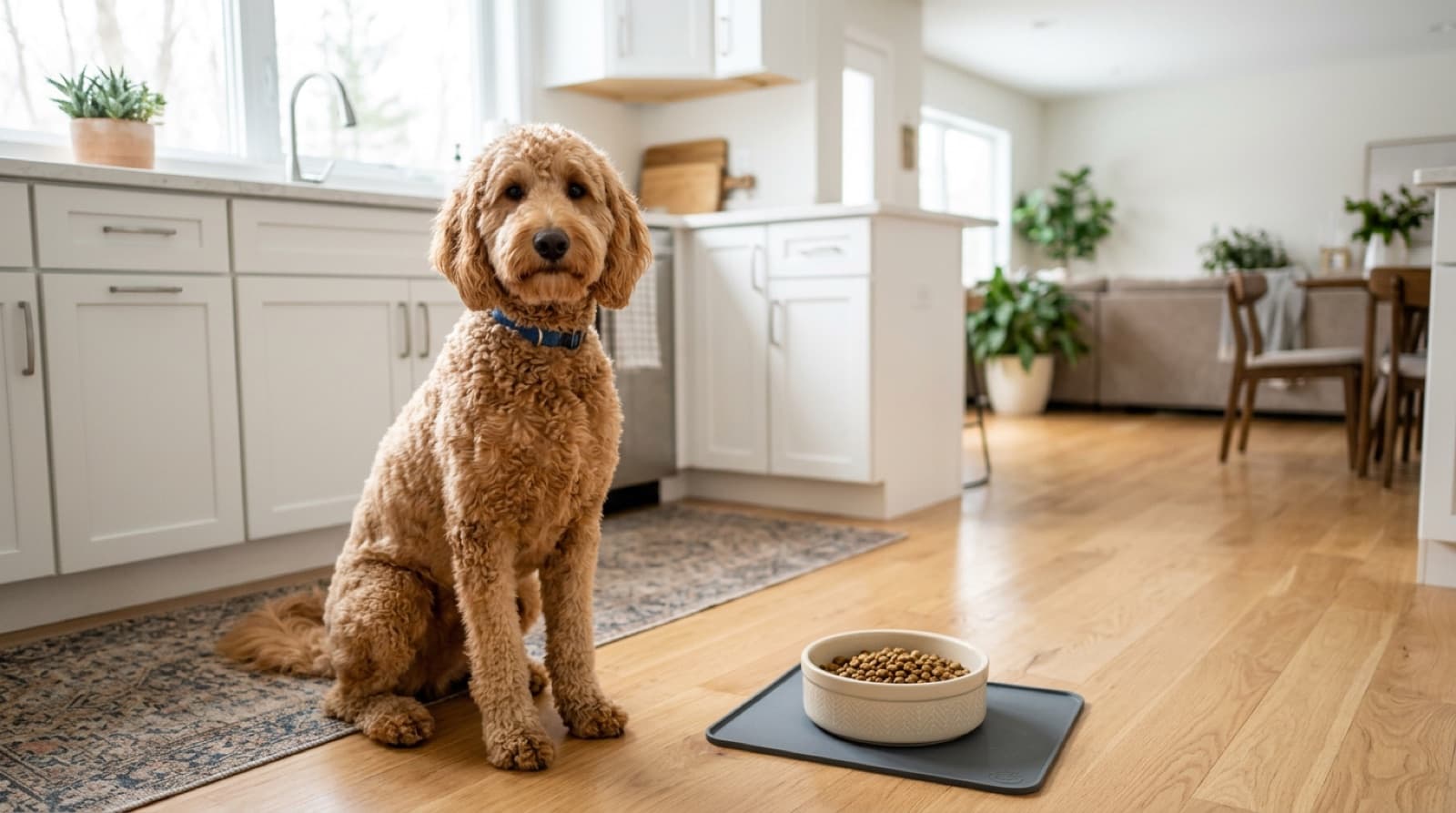
A Goldendoodle is a deliberate cross of two of the most-loved working breeds in North America. The Golden Retriever contributes friendliness, food motivation, and a willingness to please that is unusual even among working breeds. The Poodle parent contributes intelligence (commonly ranked second highest of any breed in working trials) and a low-shed wavy coat. The combination produces a dog that learns fast, bonds hard, and tends to be excellent with children and other animals.
The combination also produces a dog that needs work. Both parent breeds were selected to be partners to a working human all day. Neither was selected to be alone, neither was selected to be sedentary, and neither was selected to entertain themselves. A Goldendoodle in a typical pet home where the humans leave at 8 AM and return at 6 PM is being asked to do something neither parent breed was bred for. The result is the breed-specific behaviour issues: separation anxiety, destruction, and adolescent crisis.
F1, F1b, F2, multi-gen. Doodles vary widely depending on the cross. F1 (Golden x Poodle) is the original 50-50 cross. F1b (F1 x Poodle) is a backcross to Poodle and tends to be higher-drive, more Poodle-coated, and more allergy-friendly. F2 (F1 x F1) and multi-gen Doodles vary more widely. Rescue Doodles in Edmonton are usually unverified crosses; the foster home is the best read on individual temperament and energy level.
Size matters for behaviour. Standard Doodles (50 to 80 lbs) tend to need more exercise and mature later. Mini Doodles (15 to 35 lbs, Goldendoodle x Mini or Toy Poodle) tend to need less physical exercise but the same mental enrichment, and can spike adolescent behaviours earlier. Medium Doodles fall in between. Match the dog's size to your routine; a Standard Doodle in a downtown Edmonton condo with no off-leash access is a setup for behavioural problems.
The pandemic-puppy separation anxiety crisis
Between March 2020 and late 2022, a wave of households across Canada acquired puppies during lockdown. Goldendoodles were one of the most-sought breeds because the social media reputation as low-shedding family dogs collided with families suddenly home full-time. Many of those puppies were raised in homes where someone was always present. The puppy never spent a meaningful stretch alone in the first 12 to 18 months of life. Separation tolerance was never programmed.
From 2023 onward, return-to-office policies began pulling those same humans out of the home for 8 to 10 hour stretches. The dog that was never alone is now alone all day. The result, across the Goldendoodle, Labradoodle, and Cavoodle populations specifically, is a separation anxiety wave. Edmonton rescue intake from 2023 forward reflects this directly: the 2 to 4 year old Doodle surrendered for “cannot be left alone” is now the modal Doodle adoption candidate.
What separation anxiety looks like. The ASPCA defines separation anxiety as panic-state behaviour that begins shortly after the human leaves and continues until the human returns. Signs: destructive chewing focused on exit points (doors, window frames, blinds), excessive vocalization (barking, howling that the neighbours hear), house-soiling in a house-trained dog, refusing to eat treats or meals left out, pacing, drooling pools, self-injury from escape attempts. These are not naughty-dog behaviours. They are panic.
What it is not. Adolescent destruction (chewing the couch corner once over six weeks) is not separation anxiety. Boredom barking that stops within 15 minutes of the human leaving is not separation anxiety. A puppy that has not been crate-trained yet is not separation anxiety. The distinction matters because the treatments are different: management and exercise for adolescent destruction, gradual desensitization protocols for true separation anxiety.
The treatment protocol. Gradual departure desensitization. Start by walking to the door and returning immediately. Then putting on shoes and returning. Then opening the door and returning. Then stepping outside for one second. Each step at the dog's pace, reading panic signals before they escalate. Most protocols take 8 to 16 weeks of daily work. A force-free behaviour consultant with separation anxiety specialty training (IAABC-CDBC or CCPDT-KA with the separation anxiety endorsement) runs this work professionally. Severe cases benefit from veterinary behavioural medication during the desensitization period, prescribed by a vet or a DACVB veterinary behaviourist.
What does not work. Crate-training a panicking dog harder. Punishing the destruction. Leaving the dog “to cry it out.” A bigger backyard. More daycare without addressing the underlying panic. These either fail to help or make the panic worse. Separation anxiety is a treatable condition, but it requires a structured protocol, not willpower.
Goldendoodle adolescence: the 6 to 18 month window
Adolescence is when most pet-home Goldendoodles hit the wall, and it is when most rescue Doodles in Edmonton get surrendered. The window runs roughly 6 to 18 months for Standards and 5 to 14 months for Minis. Inside that window, expect the dog to act like the training of the last six months evaporated. It did not; the brain rewired and the previous skills will return with continued reinforcement. Owners who hold the line through adolescence end up with the dog they were promised. Owners who decide the dog is “just like this now” surrender the dog at 14 months.
The typical adolescent symptom set
| Behaviour | What it is | Management |
|---|---|---|
| Counter-surfing | Doodle height plus food motivation | Clear counters, manage the environment, reward four-on-the-floor. |
| Jumping on guests | Greeting drive plus reinforcement history | Tether at the door, reward sit-greetings, guests ignore the jumping dog. |
| Mouthing and nipping | Play behaviour that intensifies in adolescence | Redirect to toys, end play when teeth touch skin, do not punish. |
| Alert-barking | Self-rewarding behaviour, very common in Doodles | Manage window views, reward quiet, teach a positive interrupter. |
| Selective recall | Adolescent independence testing | Back on the long-line, retrain criteria, do not call when you cannot enforce. |
| Door dashing | Lack of impulse control plus excitement | Use a house-leash, teach a wait at thresholds, manage the environment. |
| Destructive chewing | Boredom plus teething aftermath | Crate or pen when unsupervised, high-value chew toys, environmental management. |
The four pillars of surviving Doodle adolescence. First, hit the daily exercise floor. Second, run short training reps every day so the dog has a job and you have continued reinforcement. Third, manage the environment so the dog cannot rehearse unwanted behaviours (counter clear, crate when unsupervised, tether for greetings). Fourth, do not take adolescent behaviour personally; the dog is not broken, the dog is 10 months old.
When adolescence is something more. Compulsive behaviours that persist after a settled daily routine (tail-spinning, light-fixation, fly-snapping, obsessive licking), reactivity that escalates over weeks, anxiety symptoms that worsen rather than improve, or aggression at thresholds you have not crossed before all warrant a force-free behaviour consultant. Most adolescent Doodle issues resolve with consistent management. The minority that does not is worth professional input.
The 60 to 90 minute daily floor
The number adopters hear is 60 to 90 minutes a day plus 20 to 30 minutes of mental enrichment. The number is correct, but not every minute is the same.
What counts as full exercise
| Activity | Counts as exercise? | Notes |
|---|---|---|
| Off-leash run on a trail | Yes, fully | The gold standard for adult Doodles with reliable recall. |
| Long-line work on a trail | Yes, mostly | Slightly less aerobic than off-leash but counts as real exercise. |
| Brisk leashed neighbourhood walk | Partial | A 45 minute leashed walk is closer to 25 minutes of real Doodle exercise. |
| Sniffari (slow scent walk) | Yes, as decompression | Excellent mental work; pair with a faster session if it is the day's only outing. |
| Fetch (moderate) | Partial | 5 to 10 minute fetch sessions, not 45 minutes of ball-launcher. |
| Tug or flirt pole | Partial | Short bursts; high arousal so use sparingly. |
| Backyard alone time | No | Patrolling and barking is not exercise. |
| Mental enrichment (puzzle, scent work) | Counts as the mental layer | 20 minutes of nose work can settle a Doodle as much as a 45 minute walk. |
The realistic Edmonton structure. Most owners who succeed with a Doodle build the day around two outings. A morning session (30 to 45 minutes) and an evening session (30 to 45 minutes), with one of the two being off-leash or long-line in the river valley several days a week. Add 20 minutes of mental enrichment spread through the day (puzzle feeder at breakfast, short training session before dinner). That is the floor.
Puppy caveat. If you have a Doodle puppy under 12 months, do not hit the 60 to 90 minute adult floor. The five-minute-per-month-of-age rule is widely cited as a soft guide: a 4 month old puppy gets roughly 20 minutes of structured exercise. Growth plates close between 12 and 18 months (later for Standards); over-exercising puppies during this window predicts joint problems for life. Free play and short sessions, not long forced runs.
Browse adoptable Goldendoodles in Edmonton
Edmonton rescues note separation anxiety status, adolescence stage, and recall progress on every Doodle's foster profile. Read the foster notes carefully; the difference between an easy placement and a hard one usually comes down to whether the dog has been programmed for separation tolerance.
See Edmonton Adoptable Dogs →
Edmonton off-leash strategy for a Goldendoodle
The river-valley off-leash network is the single best exercise asset Edmonton Doodle owners have. Hawrelak south slope, Mill Creek Ravine, Whitemud Ravine, Terwillegar, and Capilano all offer varied terrain, scent, and movement opportunity. The full Edmonton off-leash parks guide covers each in detail.
The bylaw. The City of Edmonton dog services and Animal Care Bylaw 21244 restrict off-leash activity to designated zones. A long-line clipped to a back-clip harness keeps you compliant on regular trails and gives a Doodle real range to move.
Coyote presence is real, especially for Mini Doodles. All five river-valley off-leash zones border corridors with established coyote populations. A 25 lb Mini Doodle off-leash at dawn during the spring pup-rearing season (April through July) is at predation risk. A Standard Doodle off-leash who picks up a prey scent (Poodle parent contributes some prey drive) can be a long way away before recall lands. The realistic position for both sizes is a 30 to 50 foot biothane long-line until recall holds.
The Doodle off-leash personality. Most Doodles are extroverts on the trail and want to greet every dog and human they encounter. This is a feature for social Doodles in busy off-leash zones; it becomes a problem when the Doodle bounces a reactive on-leash dog or an unfamiliar child. Practice impulse control around triggers: heel-walk past, leave-it, recall away. The friendliness is a Golden parent contribution; the manners need teaching.
The 95 percent rule. Off-leash status is earned when the dog recalls reliably (95 percent or better) under moderate distraction. Most Doodles reach this with 3 to 6 months of structured long-line work, faster than working breeds because of the Golden food motivation and Poodle biddability. A Doodle who needs a long-line for life still gets a full life. The owner who removes the line at 70 percent reliable recall is the owner who calls 311 after the dog chases a deer or another dog.
Recall training for Goldendoodles
Doodles tend to learn recall faster than working breeds because the Golden contributes deep food motivation and the Poodle contributes precision learning. That speed is a trap if owners cut corners. The 70 percent recall is not off-leash recall. Build to 95 percent under distraction.
Pick the recall word and never poison it. Choose a word the dog has not heard a thousand times. Avoid the dog's name as the recall cue. Use something distinct: “come,” “here,” “to me.” Whatever you pick, use it only when you can reward heavily and never call when you cannot enforce. A recall word called repeatedly without reward becomes a word that means nothing.
The reward hierarchy. Build a treat hierarchy: regular kibble at the bottom, mid-value training treats in the middle, very high-value rewards (real meat, cheese, freeze-dried liver) at the top. The high-value reward is reserved for recall. The dog learns that the recall word predicts the best thing in their day. Recall pays better than anything else, every time.
The criterion ladder. Start in zero-distraction environments (your own living room, then yard). Cue, reward, repeat. Build to low distraction (quiet residential street at off-peak), then moderate (a quiet park), then higher (a busier park), then the off-leash zone with the long-line still on. Each step requires the previous step to be solid. Do not rush distraction levels.
The Doodle-specific trap. The recall to greet, not the recall to come back. Doodles love to bound up to other dogs and humans on the trail. Practice deliberately calling away from greetings, rewarding heavily, then releasing back to the greeting if appropriate. The dog learns that recall does not mean the end of fun; it means a brief reward and a release. This is the hardest piece for friendly extroverted Doodles and the most important.
Mental enrichment for Goldendoodles
Mental enrichment is the most under-used tool in Doodle ownership. The Poodle parent in particular needs problem-solving work; without it, the dog invents jobs. A 20 minute nose-work session can settle a Doodle more than a 45 minute walk because problem-solving fatigues differently than aerobic work.
Puzzle feeders. Kong Wobbler, snuffle mats, lick mats, slow-feed bowls, food-dispensing puzzles. Replace the regular food bowl with one of these at least once a day. The dog works for breakfast instead of inhaling it in 60 seconds. Edmonton owners who add this single change report less destructive behaviour within two weeks.
Scent work and nose games. Start at home. Hide 5 to 10 high-value treats around a room, cue the dog to find them. Build up to scent discrimination using birch oil (the introductory scent in sport nose work). Scent work suits the Doodle analytical side and produces a calmly satisfied dog after 20 minutes.
Short training sessions throughout the day. Five-minute reps build skills faster than one 30 minute block. A morning sit-stay practice, a midday recall game in the hallway, an evening loose-leash walking drill. The cumulative effect is large, the dog learns to take the training-mode cue seriously, and reactivity decreases as the dog has a job.
Dog sports. Once the basics are in place, structured sports redirect breed drive into something constructive. Agility, rally, obedience, scent work, dock diving, treibball. The Karen Pryor Academy clicker-trained approach suits Doodles well because the Poodle parent loves precise markers. None of these are mandatory; all of them give a working brain a constructive outlet.
Winter exercise programming for Doodles
Edmonton winters test Doodle exercise discipline. The owner who skips three days because of cold ends up with a destructive Doodle by day four. Doodles have wavy or curly coats that insulate reasonably but mat with snow and ice, so winter brings a grooming layer to the exercise problem.
Cold-weather thresholds for an adult Doodle
| Temperature | Outdoor programming |
|---|---|
| -10 to -20 C | Normal sessions. 45 to 60 minutes off-leash or long-line is fine for adults. |
| -20 to -25 C | Paw protection on (boots or wax). Sessions 30 to 45 minutes. Watch for ice between pads and snowballing in the coat. |
| -25 to -30 C | Shorter pulses (20 to 30 minutes), boots non-negotiable, jacket for Mini Doodles, front-load mental work indoors. |
| Below -30 C | Brief potty breaks only. Indoor enrichment is the whole day. |
Paw protection. Edmonton sidewalks are salted heavily through winter. Salt irritates pads and is toxic if the dog licks it off. Options: dog boots, paw wax, or both. Rinse the paws with warm water after every winter walk regardless. Check between the toes for ice balls after long sessions; pluck them or thaw with body heat.
The coat problem. Doodle coats catch snow and ice balls that build up between the legs, around the belly, and in the leg furnishings. Trim the leg furnishings shorter for winter, towel-dry after every outing, and check the coat for mats weekly. Skipping winter grooming creates painful mats that need to be shaved out.
The indoor substitute on extreme days. When the day is below -30 C and outdoor work has to be 5 minute potty breaks, the daily exercise floor moves indoors. Twenty minutes of scent work in the basement. Hallway recall games. Tug sessions. Indoor agility. A 60 minute indoor enrichment day can be done as four 15 minute blocks spread through the day. Doodles take to indoor mental work well because both parent breeds were selected to engage with humans.
Training methodology: force-free is the answer
Every major dog-training credentialing body in North America has aligned around force-free, science-based, positive reinforcement training. The position statements are direct and consistent. This is not a stylistic preference; it is the consensus of behaviour science.
The Certification Council for Professional Dog Trainers (CCPDT) requires force-free methodology from certified trainers. The International Association of Animal Behaviour Consultants (IAABC) requires the same from certified behaviour consultants. The American Veterinary Society of Animal Behavior (AVSAB) position statements on humane dog training and on dominance theory explicitly reject pack-leader framing and aversive correction.
What this rules out. Prong collars, e-collars (also called shock collars), choke chains, alpha rolls, scruff shakes, leash pops as correction, and any technique that relies on causing pain, fear, or intimidation. These tools tend to produce shutdown or anxiety in Goldendoodles because both parent breeds are soft to correction. Many Doodle surrenders trace back to aversive training that backfired into an anxious or shut-down dog the owner could not read.
What it rules in. Marker-based training (a clicker or a verbal “yes”), high-value food rewards, play as reward, structured shaping of behaviour, criterion building, positive interrupters, environmental management. The science is settled; the work is in the application.
How to find a trainer in Edmonton. Look for credentials: CPDT-KA, CPDT-KSA, KPA-CTP, IAABC-CDBC, or veterinary behaviourist (DACVB). Ask about methodology. If the trainer uses language like “balanced,” “dominance,” “pack leader,” or “corrections,” keep looking. If the trainer offers e-collar work, prong collars, or board-and-train programs without transparent methodology, keep looking. The Edmonton force-free trainer scene is growing; the rescues you adopt from usually maintain referral lists of credentialed trainers in the metro.
Group classes vs private. Start with a force-free group puppy class or basic obedience class for socialization plus baseline skills. Move to private sessions for specific issues (separation anxiety, reactivity, recall). Both are useful; private is more efficient once a specific gap is identified.
Common Doodle behaviour mistakes
Patterns we see across Edmonton Goldendoodle rescue placements and the surrender notes that come back to the foster network.
Under-exercising the adolescent. The 6 to 18 month window is peak destruction. Owners who cruise through puppyhood at 30 minutes a day hit a wall when the dog needs 90. Skipped exercise in adolescence is the leading cause of Doodle surrender at the 10 to 18 month mark. Adopters: confirm the daily floor matches the dog's life stage before bringing the dog home.
No separation desensitization from day one. The single biggest predictor of separation anxiety is a puppy that never spends meaningful time alone in the first 12 months. Build separation tolerance from week one. Short crate sessions while you are home. A frozen Kong in a pen while you shower. A 10 minute trip to the mailbox. Build the tolerance before you need it; trying to install it during a return-to-office transition at 14 months is much harder.
Free-feeding. Leaving a bowl of food down all day robs the dog of the daily reinforcement engine. Meal times are training opportunities. Puzzle feeders, scatter feeding, and food-dispensing toys turn breakfast into 20 minutes of mental work. Free-feeding also tends to produce resource guarding and obesity in the breed.
Over-reliance on dog daycare. Daycare every weekday can mask separation anxiety without treating it. The dog tolerates the daycare-commute routine but never learns to be alone, so weekends and holidays become a crisis. Use daycare as one tool among many, not as the entire solution. A force-free behaviour consultant can sort whether your Doodle is a daycare candidate or a separation anxiety case that needs treatment first.
Off-leash without proven recall. A 70 percent recall is not off-leash recall. A single failure in the Whitemud Ravine can produce a dog 2 kilometres away within minutes, or a Mini Doodle pursued by a coyote. The math does not justify the freedom until the recall is 95 percent reliable under moderate distraction.
Aversive tools for soft Doodles. Prong collars and e-collars on a Goldendoodle tend to produce a shut-down anxious dog rather than a better-behaved one. The Golden parent contributes softness; both parent breeds respond best to reward-based methods. The fix is force-free management plus positive reinforcement, run with a credentialed trainer.
Believing the dominance frame. The pack-leader and alpha framing is outdated and counter-productive. The AVSAB position statement is direct. A trainer who tells you the dog “needs to know who is alpha” is offering 1970s pop ethology, not behaviour science. Walk away.
Frequently asked questions
How do I train a Goldendoodle in Edmonton?
Start with a force-free puppy class as soon as the first vaccine series is complete and build a daily routine that hits 60 to 90 minutes of real exercise plus 20 to 30 minutes of mental enrichment. Goldendoodles inherit Poodle biddability and Golden food-motivation, which makes them unusually trainable, but they also inherit Golden softness, which means aversive correction backfires fast. Pick a credentialed trainer (CPDT-KA, CPDT-KSA, KPA-CTP, or IAABC-CDBC), build a treat hierarchy, and run short five-minute training reps spread through the day. The single biggest difference between a settled adult Doodle and a destructive one is whether the owner programmed separation tolerance from day one.
Why does my Goldendoodle have separation anxiety?
Goldendoodles inherit two breeds that bond hard to humans and were never selected to work alone. Layer on the 2020 to 2022 pandemic-puppy generation that was raised in always-home households, plus the 2023 to 2025 return-to-office wave, and the breed is in the middle of a separation anxiety crisis across North America. The ASPCA describes separation anxiety as panic-state behaviour when the dog is left alone: destructive chewing, excessive vocalization, escape attempts, house-soiling, and refusal to eat. The fix is gradual desensitization to absences, not exercise alone. A force-free behaviour consultant with separation anxiety specialty training (IAABC-CDBC or CCPDT-KA with the specialty endorsement) is the right call if symptoms are severe.
What does Goldendoodle adolescence look like?
Goldendoodle adolescence runs roughly 6 to 18 months and combines two breeds that mature slowly. Expect counter-surfing, jumping, mouthing, alert-barking, selective recall, and a sudden return of puppy behaviours you thought were resolved. Larger Standard Doodles often hit the worst of it later (closer to 9 to 18 months); smaller Mini Doodles can spike earlier (6 to 14 months). The window is also when most Doodle surrenders happen, which is why so many adoptable Doodles in Edmonton rescue are 10 to 18 months old. Maintain the exercise floor, run short training reps daily, manage the environment so the dog cannot rehearse unwanted behaviours, and the dog comes out the other side.
How much exercise does a Goldendoodle need?
Plan for 60 to 90 minutes of real daily exercise plus 20 to 30 minutes of mental enrichment for a healthy adult. F1b Doodles (Doodle crossed back to a Poodle) and Standard Doodles often need the upper end; Mini Doodles and senior Doodles often need less. A 45 minute leashed neighbourhood walk does not count as 45 minutes of Doodle exercise; it is closer to a warm-up. Mix off-leash or long-line work in a river-valley zone with structured neighbourhood walks and mental enrichment. Edmonton owners who skip the floor for a week of bad weather see the dog tell them about it through destruction, anxiety, or fence patrolling.
Are Goldendoodles easy to train?
Yes, by working-breed standards. The Poodle parent contributes one of the highest working-intelligence scores of any breed, and the Golden Retriever parent contributes deep food motivation and willingness to please. The combination produces dogs that learn fast, retain skills, and excel at structured training. The catch is that the same intelligence means they learn the wrong things fast too. A Doodle who learns that jumping produces attention has learned a behaviour you do not want. Force-free positive reinforcement is the canonical method; aversive correction tends to produce a shut-down or anxious Doodle rather than a better-behaved one.
Can I let my Goldendoodle off-leash in the Edmonton river valley?
Only inside designated off-leash zones, and only once recall is reliable at roughly 95 percent under moderate distraction. The river-valley off-leash zones (Hawrelak, Mill Creek, Whitemud, Terwillegar, Capilano) are excellent Doodle terrain, but all are unfenced and border coyote corridors. A smaller Mini Doodle off-leash in a coyote zone at dawn is at real predation risk. A Standard Doodle off-leash who picks up a Poodle-inherited prey drive can be a long way away before recall lands. The realistic position: 30 to 50 foot biothane long-line until recall holds under distraction. Most Doodles get there with 3 to 6 months of structured work.
Why is my Goldendoodle destructive when I leave the house?
Three possibilities, in order of likelihood. First, under-exercise plus boredom: add the daily floor of 60 to 90 minutes plus mental enrichment for two weeks and reassess. Second, normal adolescent exploration: a 10 month old Doodle alone with shoes, remotes, and couch cushions will treat all three as legitimate prey. Third, true separation anxiety: panic-state behaviour with vocalization, drooling, pacing, refusing to eat, escape attempts. The first two are exercise and environmental management problems. The third is a behaviour modification project that needs a force-free behaviour consultant. Exercise alone will not fix true separation anxiety.
What is the best training method for a Goldendoodle?
Force-free positive reinforcement. The CCPDT, IAABC, and AVSAB position statements are aligned on this. Goldendoodles are especially soft to aversive correction; prong collars, e-collars, alpha rolls, and scruff shakes tend to produce shutdown, anxiety, or escalated reactivity in this breed rather than better behaviour. The Karen Pryor Academy clicker-training approach suits Doodles well because their analytical Poodle parent loves precise markers. If a trainer uses language like alpha, dominance, balanced, or corrections, keep looking. Look for credentials: CPDT-KA, CPDT-KSA, KPA-CTP, or IAABC-CDBC.
Should I send my Goldendoodle to daycare?
Sometimes yes, sometimes no, and never as the only fix for separation anxiety. Daycare suits socially confident Doodles who genuinely enjoy other dogs and need physical outlet on workdays. It does not suit Doodles with anxiety, resource guarding, or noise sensitivity. The bigger trap: using daycare every weekday to mask separation anxiety. The dog learns to tolerate the daycare commute but never learns to be alone, so weekends and holidays become a crisis. A force-free behaviour consultant can sort whether your Doodle is a daycare candidate or a separation anxiety case that needs treatment first.
Can a Goldendoodle do dog sports?
Yes, and they tend to excel. The breed combines Poodle intelligence and Golden willingness, which produces a near-ideal sport prospect for agility, obedience, rally, scent work, and dock diving. Standard Doodles do well in agility once growth plates close (typically 12 to 18 months); Mini Doodles often thrive in agility, rally, and scent work earlier. The Edmonton dog-sport community is active, and the rescues you adopt from usually have trainer and club referrals. Sport practice doubles as the structured mental work the breed needs and tends to settle adolescent Doodles faster than any other intervention.
More Edmonton Goldendoodle guides
Edmonton Adoptable Dogs →
Current Goldendoodle and Doodle-mix listings from Edmonton rescues, with foster-tested temperament and separation tolerance notes.
Goldendoodle Adoption Edmonton →
Edmonton rescue routes for Doodles, surrender patterns, adoption costs, and the breed-vs-buy reframe.
Poodle and Doodle Health Issues →
Poodle and doodle health issues to plan for: Addison’s disease, bloat in Standard Poodles, skin and ear problems, knees and heart valves in small Poodles, and epilepsy.
How to Groom a Goldendoodle →
A Goldendoodle grooming guide: why low-shed is not low-maintenance, the coat change matting crisis, the F1 vs F1b coat lottery, line brushing, and cost.
New dog? Start with these care guides
Everything a new adopter needs to set up a safe, happy home.