The short answer
F1 = 50% Poodle on average, F1B = 75% Poodle, F2 = two F1 Doodles bred together, F2B = ~62.5% Poodle, multigen = several generations bred for consistency. F1B is the most reliably low-shed and curly. F1 is the coat lottery (wavy moderate-shed to fully curly low-shed in the same litter). Hypoallergenic is overstated for every generation. Most Edmonton rescue Doodles arrive without paperwork, so the foster's description of the adult coat is more informative than any generation label. If you are buying from a breeder, the breeder's health testing and ethics matter more than the generation.
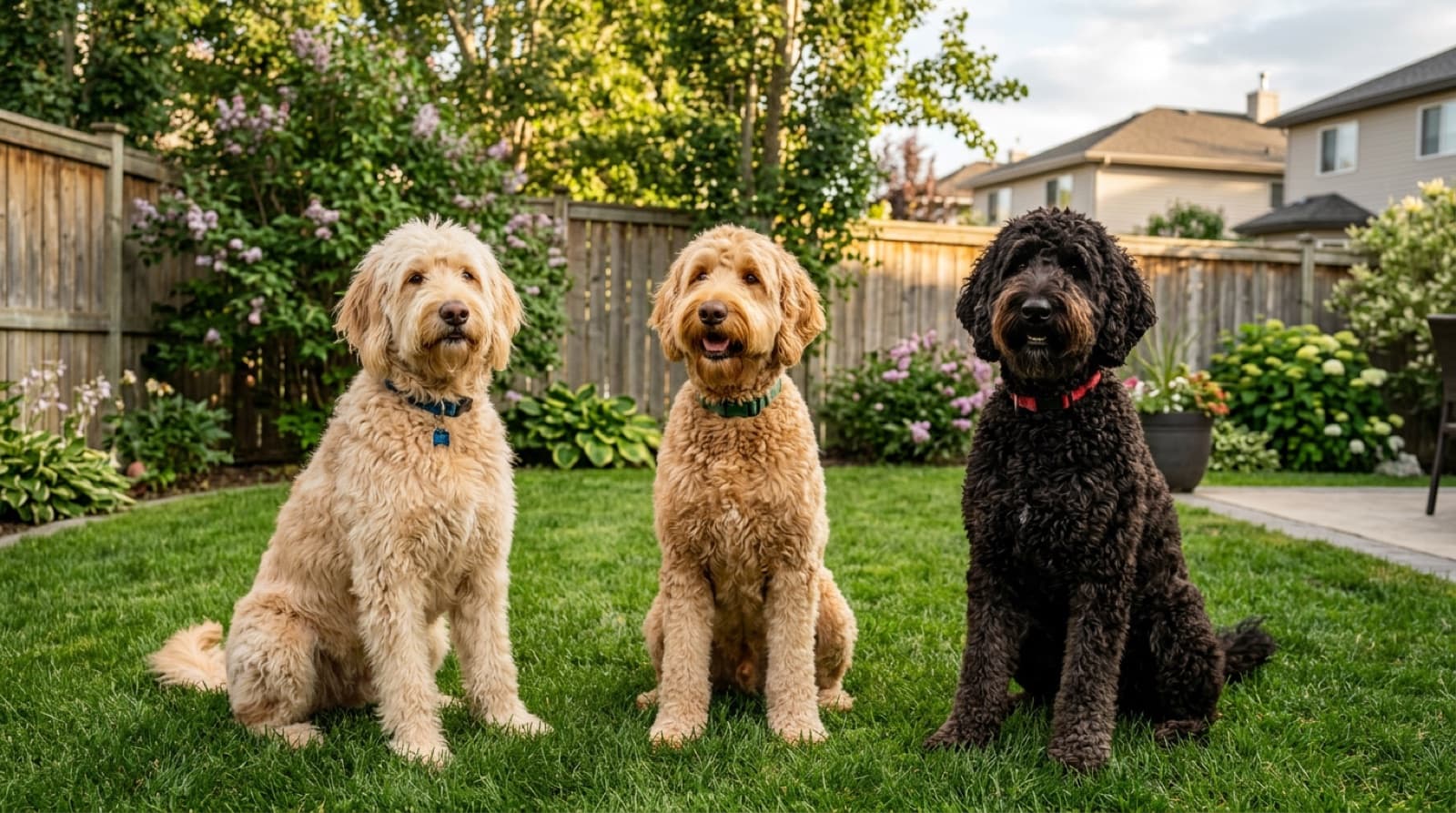
Why Edmonton adopters need to understand generations
Doodles are one of the most-surrendered designer mixes at Edmonton Humane Society, Zoe's Animal Rescue, AARCS Edmonton fosters, and AHHRB. The pandemic puppy wave of 2020 to 2022 produced thousands of Edmonton Doodles, and the adolescent surrender pipeline has been steady ever since. Grooming overwhelm, allergy disappointment, and coat-care realisation are the top three reasons given.
The breeder marketing that sold those puppies leaned heavily on generation labels. “F1B is hypoallergenic.” “Multigen is the most predictable.” “F2 has hybrid vigour.” Some of these claims are partly true and some are marketing. Adopters who understand what generations actually predict (and what they don't) make better decisions both in evaluating rescue Doodles and in screening breeders if they decide to buy.
The Canadian Kennel Club does not register Doodles as a breed, which means there is no formal registry of generation lineage in Canada. Generation claims rest on the breeder's record-keeping and honesty. In rescue, generation is usually unknown.
The generation table
| Generation | Cross | Poodle % | Coat tendency |
|---|---|---|---|
| F1 | Poodle × Golden Retriever | ~50% | Variable: wavy moderate-shed to curly low-shed |
| F1B | F1 Doodle × Poodle | ~75% | More reliably curly low-shed; more grooming |
| F1BB | F1B Doodle × Poodle | ~87.5% | Very Poodle-like; rare in rescue, marketing-heavy |
| F2 | F1 Doodle × F1 Doodle | ~50% | Most variable; ranges across whole spectrum |
| F2B | F2 Doodle × F1B Doodle | ~62.5% | More predictable than F2, less than F1B |
| F3+ / Multigen | Multigen Doodle × Multigen Doodle | Variable | Depends on breeder selection; can be highly consistent |
The label predicts the litter average, not the individual puppy. F1 littermates can range from nearly-Golden flat coats to nearly-Poodle tight curls. F1B is more uniform but still varies. Multigen consistency depends entirely on what the breeder selected for over multiple generations.
The genetics in plain English: KRT71 curl and RSPO2 furnishings
Two genes do most of the visible work on a Doodle coat. A variant in the KRT71 gene controls coat curl. A variant in the RSPO2 gene controls furnishings (the moustache, beard, and eyebrow facial hair characteristic of Poodles, Schnauzers, Wirehaired breeds, and Doodles). Both gene-trait associations are documented in peer-reviewed canine coat-variation genetics research.
Poodles carry two copies of the curl-promoting KRT71 variant and two copies of the furnishings RSPO2 variant. Golden Retrievers carry neither. The inheritance shakes out roughly as follows:
- F1 puppies inherit exactly one curl-promoting copy and one furnishings copy from each parent, so curl ends up partial (wavy moderate-shed) and furnishings end up present but lighter than a Poodle's.
- F1B puppies (F1 × Poodle) have a 50% chance of inheriting two curl copies and two furnishings copies, which produces the curly low-shed coat F1B is marketed for. The remaining 50% inherit one of each, producing a coat closer to F1.
- F2 puppies (F1 × F1) are the most variable because each parent already carries one curl and one no-curl copy. Punnett-square math predicts 25% no-curl (Golden-like), 50% one copy (wavy), 25% two copies (curly) in the average litter.
Real breed genetics are more complex than two genes because coat texture, density, length, and shedding involve additional gene variants and gene-gene interactions. The KRT71-plus-RSPO2 model captures most of the visible variation but does not predict every puppy.
The hypoallergenic question
No dog breed is truly hypoallergenic. The term is itself misleading, and the F1B Doodle marketing built around it overstates what genetics can deliver.
Dog allergens come from proteins in dander, saliva, and urine, not from hair itself. The Asthma and Allergy Foundation of America describes pet allergies as triggered by these proteins, and notes that no dog breed has been clinically established as hypoallergenic. The American College of Allergy, Asthma & Immunology takes the same position.
What the higher Poodle percentage in F1B Doodles actually delivers is reduced shedding, which reduces the environmental load of allergen-carrying hair around the house. That can help, but it does not eliminate allergens. A non-shedding dog still produces dander, saliva, and urine proteins. Allergic adopters can react to a low-shed dog under the right exposure conditions.
The honest read for Edmonton adopters with allergies: spend extended time with the specific Doodle before committing. An hour minimum, ideally an overnight trial at the foster home. Allergic reactions can develop or worsen after days of close contact, and returning a Doodle for allergies after a month is harder on the dog than verifying the fit before adoption. Some allergic adopters do well with F1B Doodles; some react regardless of generation. Individual variation matters more than the label.
For severely allergic households, the responsible path is consulting a board-certified allergist before committing to any dog, including Poodles and Doodles, and exploring options like immunotherapy. The breed marketing does not replace medical guidance.
Reading a rescue Doodle when there is no paperwork
Most Edmonton rescue Doodles come from owner surrender or backyard-breeder relinquishment, and the original generation paperwork was either never produced or did not travel with the dog. The Edmonton rescues will describe the adult coat, the foster's observed shedding pattern, and the grooming needs the dog actually has. That information is more useful than a paper label.
Visual cues for coat tendency in an adult Doodle:
- Flat or wavy coat with light furnishings: high Golden Retriever expression. Seasonally sheds. Brushing 2 to 3 times per week may be sufficient.
- Wavy moderate coat with clear furnishings: classic F1 expression. Light to moderate shedding. Brushing 3 to 5 times per week.
- Loose curls with full furnishings: mid-range expression, often F1 with two curl copies or F1B with one curl copy. Low shedding but mats faster.
- Tight Poodle-style curls with full beard and moustache: high Poodle expression, often F1B or F1BB. Lowest shed. Daily brushing required to prevent matting.
Questions to ask the foster: How often did you brush this dog to keep mats away? How much hair ended up on furniture in the first month? How did the dog react to the most recent professional groom? Has the foster home noticed allergic reactions in visitors? The answers are more predictive than any generation guess.
The adult coat is also a clue to the dog's probable grooming budget. Edmonton professional grooming runs $150 to $220 every 6 to 8 weeks for a typical Doodle, with severely matted dogs charging more or requiring a shave-down. A curly low-shed coat means the lower end of grooming frequency is non-negotiable; a wavy moderate-shed coat is more forgiving.
Browse adoptable Goldendoodles in Edmonton
Generations matter less when you can meet the adult coat in person. Live Edmonton listings from EHS, Zoe's, AARCS Edmonton fosters, AHHRB, and the rest of the Edmonton rescue network update regularly.
See Available Goldendoodles →If you are buying from a breeder: generation vs ethics
If you have decided against rescue and are evaluating breeders in Alberta or Saskatchewan, the generation matters less than the breeder. A multigen breeder selecting carefully for coat consistency, temperament, and health will produce more predictable puppies than an F1B breeder running high-volume Kijiji sales.
Non-negotiables for any responsible Doodle breeder:
- OFA hip and elbow testing on both parents (Excellent, Good, or Fair grades; not “passed” with no rating).
- Eye certification by a board-certified veterinary ophthalmologist (ACVO) within the last 12 months.
- Cardiac auscultation on both parents.
- Written health guarantee covering inherited conditions for at least 2 years.
- Return-at-any-age policy (the breeder takes the dog back regardless of age if the placement fails).
- Farm visit allowed before deposit. Meet both parents on site.
- No large advance sales through e-transfer without contracts.
- Willing to discuss specific health testing results, not just “fully health tested.”
Most “Goldendoodle breeders” in rural Alberta and Saskatchewan advertised on Kijiji and Facebook cannot meet these criteria. The doodle-mill pipeline that produced the current surrender wave runs on volume, minimal testing, stock photos, and waitlists collected through e-transfer deposits. Treat any breeder pitch that resists the non-negotiables above as a backyard or commercial operation, not a responsible breeder.
Scam-pattern warnings: the Canadian Anti-Fraud Centre tracks the most common puppy-purchase patterns (stock photos, e-transfer deposits with no contract, sudden shipping fees, fake breeder websites). Doodle puppies are among the most-scammed dog types in Canada because the $1,500 to $3,500 puppy price is a tempting target.
Frequently Asked Questions
What do F1, F1B, F2, and F2B mean for a Goldendoodle?
Generation labels describe how a puppy was bred. F1 is a first-generation Doodle: a Poodle bred to a Golden Retriever, with each puppy roughly 50% of each parent breed on average. F1B is an F1 Goldendoodle bred back to a Poodle, with each puppy roughly 75% Poodle and 25% Golden Retriever. F2 is two F1 Doodles bred together, which keeps the average at 50/50 but increases the variation between individual puppies in the same litter. F2B is an F2 bred to an F1B, which lands around 62.5% Poodle. Multigen or F3+ describes generations where breeders select for consistency in coat and temperament over multiple breedings. Important caveat for Edmonton adopters: percentages describe the average for a litter, not a guarantee for any individual puppy.
Which generation has the most predictable coat?
F1B is the most coat-predictable for a low-shed curly coat, because the higher Poodle percentage stacks the deck toward two copies of the curl-promoting gene variant. F1 is the least predictable, because puppies inherit either one or two copies of the curl variant and end up with anything from a wavy moderate-shed coat to a fully curly low-shed coat depending on the genetic dice roll. F2 is even less predictable than F1 because the parental Doodle parents are themselves coat-variable. Well-established multigen breeders selecting for coat over multiple generations can be highly predictable but the consistency depends on the breeder, not the label. The honest version: a label predicts a litter average, not your puppy.
Is the F1B Goldendoodle really hypoallergenic?
No dog breed or cross is truly hypoallergenic, and the term is itself misleading. Dog allergens come from proteins in dander, saliva, and urine rather than from hair, so a low-shed coat reduces but does not eliminate environmental allergen exposure. F1B Doodles, at roughly 75% Poodle, tend to shed less and trap less dander than F1 Doodles, which is why they are marketed as more allergy-friendly. The Asthma and Allergy Foundation of America and most veterinary allergists position the hypoallergenic-dog claim as overstated. Allergy-prone Edmonton adopters should spend extended time with the specific dog before committing, ideally an overnight trial at the foster home, because individual reactivity varies more than generation labels predict.
Why do F1 Goldendoodle puppies in the same litter look so different?
Two genetic variants do most of the visible work. A variant in the KRT71 gene controls coat curl, and a variant in the RSPO2 gene controls furnishings (the moustache and eyebrow facial hair characteristic of Doodles). Poodles carry two copies of the curl-promoting KRT71 variant and two copies of the furnishings RSPO2 variant. Golden Retrievers carry neither. An F1 puppy inherits one variant from each parent, which means coat curl ends up partial (wavy moderate-shed) and furnishings end up present but lighter. The flip of which exact variant copies any puppy inherits is random, which is why F1 littermates range from nearly-Golden flat coats to nearly-Poodle curls. F1B breeds the F1 back to a Poodle, which raises the odds that puppies receive two curl-promoting copies and produces a more uniform curly coat.
Do Edmonton rescue Goldendoodles come with generation paperwork?
Rarely. Most Goldendoodles that arrive at Edmonton Humane Society, Zoe's Animal Rescue, AARCS Edmonton fosters, or AHHRB come from owner surrender or backyard-breeder relinquishment, and the original generation paperwork was either never produced or did not travel with the dog. The rescue intake notes will describe the adult coat, the foster's observed shedding, and the grooming needs the dog actually has. That information is more useful than a paper label. The adult Doodle in front of you tells you more about coat behaviour, shedding, and allergen load than a generation tag ever could. If a rescue dog has documented papers, treat them as nice-to-have rather than load-bearing.
F1, F1B, or multigen if I am buying from a breeder?
If you have decided against rescue and are buying from a breeder in Alberta or Saskatchewan, the generation matters less than the breeder. A multigen breeder selecting carefully for coat consistency, temperament, and health will produce more predictable puppies than an F1B breeder doing high-volume Kijiji sales. The non-negotiables for any responsible Doodle breeder: hip and elbow OFA testing on both parents, eye certification through the American College of Veterinary Ophthalmologists or equivalent, cardiac auscultation, written health guarantee, return-at-any-age policy, farm visit allowed, no large litter advance sales through e-transfer. Most "Goldendoodle breeders" in rural Alberta cannot meet these criteria. The Canadian Kennel Club does not register Doodles as a breed, which means there is no kennel club registry of responsible Doodle breeders in Canada. Treat the buying decision with that gap in mind.
Are F2 or F2B Doodles more health-resilient (hybrid vigour)?
Probably not at the level often claimed. The hybrid-vigour argument predicts that crossing two purebreds reduces the expression of breed-specific inherited conditions, and at the F1 generation there is modest population-level support for this. By F2 and beyond, breeders are increasingly mating Doodles to Doodles, which reduces the genetic diversity that hybrid vigour depends on. F1B specifically (Doodle backcrossed to Poodle) is more Poodle than F1 and thus more exposed to Poodle-specific inherited conditions like sebaceous adenitis, progressive retinal atrophy, and von Willebrand disease. Health-testing the parents remains the only reliable filter regardless of generation. Edmonton specialty veterinary access for inherited-condition workups is generally good with referral pathway to the Western College of Veterinary Medicine in Saskatoon for complex cases.
Mini Goldendoodle and Toy Goldendoodle generations: same rules?
Same generation labels apply, but the size variable adds another layer. A Mini Goldendoodle is bred from a Mini Poodle (typically 10 to 15 inches at the shoulder) crossed with a Golden Retriever, almost always through artificial insemination because of the size mismatch. A Toy Goldendoodle uses a Toy Poodle parent. Both are produced more frequently by breeders than they appear in Edmonton rescue, partly because smaller Doodles are more in demand and partly because backyard breeders chase the smaller-size premium. The smaller the Poodle parent, the more pronounced the inherited Poodle-side conditions tend to be (patellar luxation, dental crowding, Legg-Calve-Perthes in small breeds, more severe progressive retinal atrophy expression). Generation label still describes Poodle percentage; size label describes Poodle parent size. Both matter for predictable outcomes.
How do I evaluate a rescue Doodle's coat if there is no paperwork?
Look at the adult coat in person. Wavy moderate-shed coats look closer to a wavy-furred Golden Retriever and shed seasonally. Curly low-shed coats look closer to a Standard Poodle and require frequent professional grooming to prevent matting. Run your hand against the grain of the coat: tight curls that spring back are high Poodle expression, loose waves are mid-range, straight fur is high Golden expression. Ask the foster: how often the dog needs brushing to stay mat-free, how much hair ends up on furniture, and how the dog responded to the most recent groom. The Edmonton rescues will share this information openly because they want the placement to stick. The adult-coat observation is more reliable than any generation guess.
Does Doodle generation predict temperament?
Less than coat. Both parent breeds (Standard Poodle and Golden Retriever) score consistently as biddable, family-oriented, and people-focused on breed temperament surveys. F1, F1B, F2, and multigen Doodles tend to fall within the same temperament band, which is the entire selling point of the cross. Where generation does matter for temperament: F1B Doodles, being more Poodle, sometimes inherit slightly more intensity and slightly less retriever-style mellowness than F1 Doodles. F2 and multigen Doodles vary more individually because Doodle-to-Doodle breeding amplifies whichever traits the parents happened to express. Foster notes describing the specific dog's behaviour in a home environment are more predictive than any generation label. Adolescent Doodles (8 to 18 months) can be exuberant regardless of generation.
What does a Doodle generation NOT tell me?
Several important things. Generation does not predict adult size within meaningful tolerance, because Golden Retrievers themselves vary from 55 to 80 lbs and Poodles range from 5 to 70+ lbs across varieties. Generation does not predict colour. Generation does not predict shedding outcome precisely. Generation does not predict allergy compatibility for a specific allergic adopter. Generation does not predict temperament beyond breed averages. Generation does not predict health outcomes beyond Poodle vs Golden inherited-condition risk weighting. The single most useful piece of information about any individual Doodle is the adult dog in front of you (in the case of rescue) or the documented health testing on both parents (in the case of breeders). Generation labels are marketing shorthand. The dog is the data.
Should I avoid F1B Doodles because of higher Poodle percentage?
No. F1B Doodles are often the best match for households that want predictable low-shed coats and accept the higher grooming commitment. The reason F1B is the most-marketed generation is that the coat outcome is more reliable for allergy-prone adopters. The trade-offs to know: F1B Doodles tend to need more grooming than F1 Doodles because curlier coats mat faster, F1B Doodles carry more Poodle-side health risk than F1 Doodles, and F1B Doodles sometimes inherit more Poodle-style intensity than F1 Doodles. None of these make F1B a bad choice; they make it a specific choice. An Edmonton adopter prioritising low shed and committed to $150 to $220 grooming every 6 to 8 weeks is well-matched. An adopter prioritising the easiest possible coat care is better-matched to an F1 with a wavy coat or to a non-Doodle breed entirely.
Adoptable Goldendoodles in Edmonton
Live listings from Edmonton Humane Society, Zoe's, AARCS Edmonton fosters, AHHRB, and the rest of the network.
Goldendoodle Adoption Edmonton
Rescue pipelines, costs, doodle-mill warnings, pandemic-puppy surrender pattern.
How to Groom a Goldendoodle
A Goldendoodle grooming guide: why low-shed is not low-maintenance, the coat change matting crisis, the F1 vs F1b coat lottery, line brushing, and cost.
Poodle and Doodle Health Issues
Poodle and doodle health issues to plan for: Addison’s disease, bloat in Standard Poodles, skin and ear problems, knees and heart valves in small Poodles, and epilepsy.
New dog? Start with these care guides
Everything a new adopter needs to set up a safe, happy home.