The short answer
A Husky handles Edmonton winter better than most breeds handle Edmonton summer. The double coat is built for sustained sub-zero work. But the coat does not cover the nose, ear tips, tail tip, scrotum, or paw pads, and those parts can frostbite from -25C down. The river-valley off-leash zones (Hawrelak south slope, Mill Creek Ravine, Whitemud Ravine) sit 35 to 50 metres below the city plateau and run 3 to 5C warmer than the rim parks, which makes them the default Edmonton winter Husky destination. Below -35C, sessions shorten and paw protection is mandatory. Below -40C, brief outdoor breaks only.
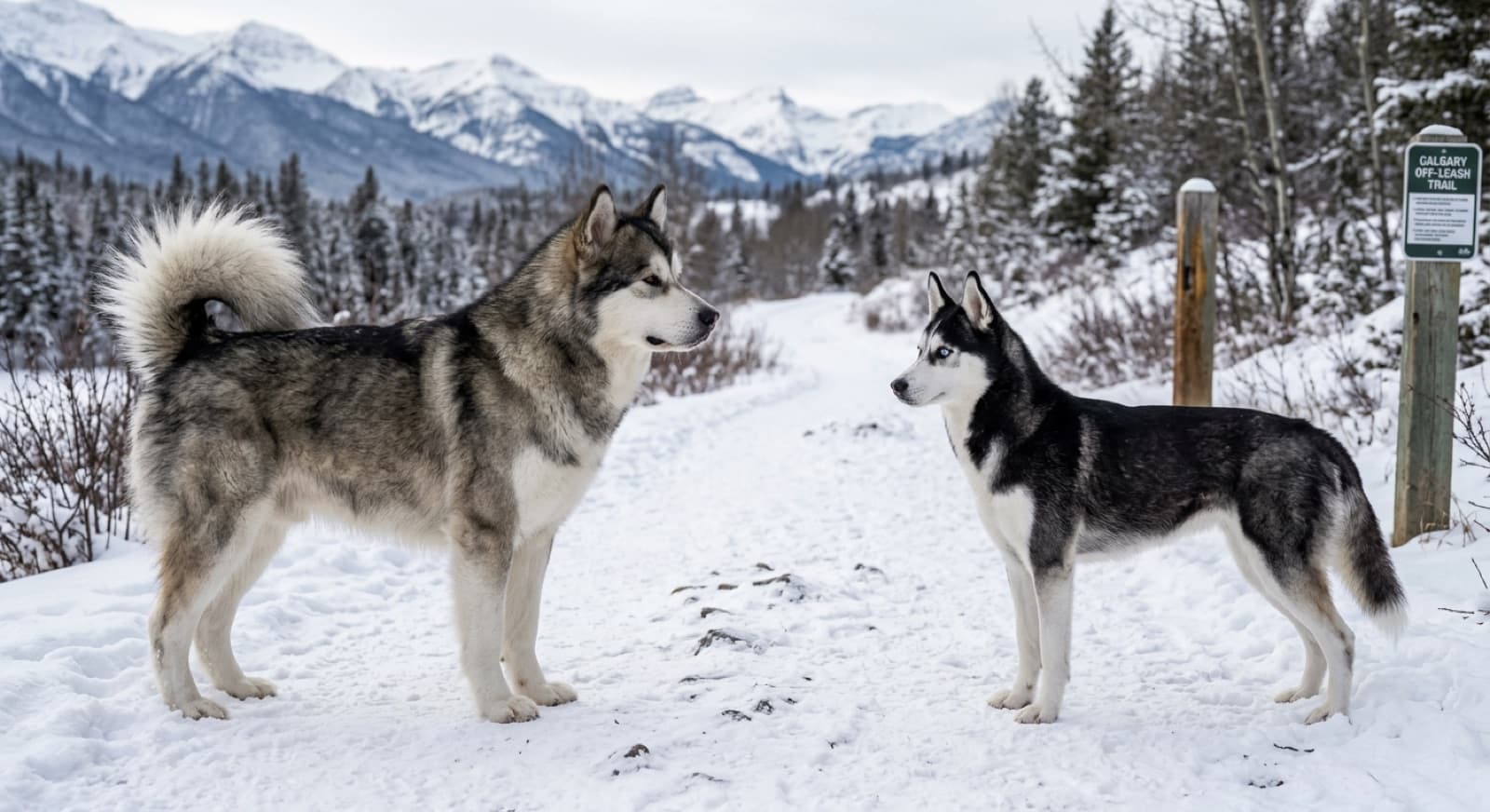
The Edmonton winter Husky reality vs the social media myth
Spend ten minutes on Husky social media and you will see videos of Huskies refusing to come inside in a blizzard, sleeping on snowbanks at -30C, and digging dens in fresh powder. The breed is genuinely built for this. The Siberian Husky double coat traps a layer of warm air close to the skin, the guard hairs shed snow, and the working-line endurance physiology is tuned for sustained cold-weather effort. The BC SPCA cold weather safety guidance notes that thick-coated Northern breeds tolerate cold better than most, while still naming the body parts that remain vulnerable regardless of coat.
The half-true version is the dangerous one. “Huskies love the cold” gets stretched into “Huskies are fine in any cold,” which is not what the breed-club material or the veterinary cold-weather literature actually says. The coat covers the body. It does not cover the nose. It does not cover the ear tips. It does not cover the paw pads, the tail tip, or the scrotum on an intact male. Those areas frostbite the same way any dog’s would, and in Edmonton’s -35C cold snaps the timeline shortens fast.
The other half-true thing: the coat works when dry. A wet Husky in deep cold is the worst-case scenario the breed is set up for. The double coat insulates by trapping air; soak that air layer with melted snow on a January thaw day, and the insulation collapses. Hypothermia in a wet Husky in -25C is faster than most owners expect.
The Edmonton owner pattern that actually works is this: trust the coat, protect the exposed parts, watch the dog more than the thermometer, and keep them dry on the way home. The rest of this guide is what that looks like by temperature.
Temperature thresholds Edmonton owners need to know
Wind chill matters more than ambient. Environment and Climate Change Canada wind chill guidance classifies a wind chill of -28 to -39 as “frostbite possible in 10 to 30 minutes,” and -40 to -47 as “frostbite possible in 5 to 10 minutes.” Those numbers apply to exposed human skin and they are a useful proxy for a Husky’s exposed pads, nose, and ear tips.
The following ranges are for a healthy adult Husky in good condition with no underlying health issues. Puppies, seniors, thin-coated mixes, and any dog with cardiac or respiratory conditions need stricter limits.
+5 to -10C: routine
All-day exposure is fine. Off-leash time at the river-valley parks, long sniff walks, full exercise programming. Paws are at no real risk on cleared sidewalks. Salt on the main streets is the only ongoing concern, and a paw rinse after the walk handles it.
-10 to -25C: monitor
The breed's sweet spot. Most Edmonton Huskies are at their most energetic in this range. Off-leash sessions of 30 to 90 minutes are comfortable. Watch puppies and seniors more carefully. Paw pads can dry out and crack from the cold-dry cycle; musher’s wax before walks helps. Salt on heavily treated stretches matters more as ambient drops.
-25 to -35C: shorten
Outdoor sessions drop to 15 to 30 minutes of sustained movement. Paw protection (boots or musher’s wax) becomes mandatory. Watch the ear tips and nose for early frostbite signs. Keep the dog moving the whole time; static cold exposure is not what the breed is built for. River-valley parks pull ahead of rim parks for wind shelter. Dry the coat fully before any second outing.
-35 to -40C: brief breaks only
5 to 15 minute outdoor sessions only. No sustained off-leash, no extended exercise. Bathroom breaks plus a short structured walk. Paw protection mandatory. Move the day’s exercise indoors: puzzle feeders, scent games, structured training sessions, controlled tug, indoor flirt-pole work. The Husky energy budget is real; if you skip it entirely you pay the price in destructive behaviour the next day.
Below -40C: indoor day
Skip the walk. Bathroom breaks only, and even those should be 2 to 5 minutes with the dog returning indoors immediately. Edmonton hits this range a handful of days each winter; the right move is an indoor exercise programme heavy on mental work. The AVMA cold weather pet safety guidance is explicit that “Northern breed” does not mean “immune to cold” below this threshold.
Two practical add-ons. First, the dog tells you. Lifted paws, repeated paw-licking, shivering, slowed pace, or a sudden U-turn toward the car are all signs the session is over. Trust the signal. Second, the wind chill calculation matters every time. A -28C ambient with a 25 km/h wind from the open river is functionally -40C, and the thresholds above shift down by one band.
Frostbite signs and emergency response
Husky frostbite happens on the exposed parts. The body coat protects the body. The frostbite zones are the nose, ear tips, tail tip, scrotum on intact males, and paw pads. Check those areas after any walk colder than -25C.
Stage 1: monitor
Skin looks pale, waxy, or grayish. The area is cold to touch. The dog often does not react to a gentle pinch (lost sensation). Get the dog indoors and rewarm the area gradually with warm (not hot) water or warm cloths. Do not rub; the friction damages frozen tissue. Most stage-one frostbite recovers fully, but the skin will be tender for several days and the area is more vulnerable to refreezing.
Stage 2: emergency vet
As the area rewarms it blisters, swells, or turns dark red, blue, or purple. The dog may show pain on touch. This is a vet visit, same day. Edmonton has 24-hour emergency veterinary services; call ahead and head in. Stage-two frostbite often requires pain management, antibiotics for secondary infection, and follow-up wound care.
Stage 3: full emergency
The tissue blackens and dies. The line between healthy and dead tissue (the demarcation line) appears over days. This is a full emergency, immediately. Dead tissue can require surgical removal, and the ear tip or tail tip may need partial amputation. The good news is that stage-three frostbite is rare in pet Huskies; it generally requires either prolonged extreme exposure (a dog lost in a -40C storm) or a wet-coat hypothermia event.
What not to do
Do not use hot water. Do not use a hair dryer on hot. Do not rub the area to warm it. Do not give the dog a hot bath. All of those approaches damage the partially frozen tissue further. Gradual rewarming, lukewarm cloths or water, and indoor stillness while the area thaws are the right pattern. If you are unsure of the stage, the Edmonton Humane Society publishes winter pet-care guidance and the city’s emergency vet clinics are open through the worst weather.
Paw protection: wax, boots, and the salt problem
Husky paws are built for cold. The breed has high pad fat content and good circulation in the feet, which is why most Huskies do fine barefoot in dry powder at -20C. The problem in Edmonton is not the cold itself; it is the combination of cold, salt, and salt-brine residue, which strips the protective lipid layer off the pad and causes the cracked-pad pattern most Edmonton winter Husky owners learn the hard way.
Musher's wax
The default for most Edmonton Huskies. A thick beeswax-based barrier applied to the pads before walks. It blocks salt absorption, reduces ice-ball buildup between the toes, and keeps the pads from drying out as fast. Apply 5 to 10 minutes before the walk so the wax sets. Reapply for any second outing. The wax wears off through the walk, which is what you want; it is doing its job.
Boots
Some Edmonton Huskies tolerate boots; many refuse the first dozen attempts. The build-up pattern that works is short indoor sessions with food rewards, working up to outdoor wear in mild cold before deploying them at -30C. Boots help most on heavily salted streets, on ice surfaces where slipping cracks the pads, and below -35C where exposed pad time is the limiting factor. Quality matters; cheap boots fall off in deep snow within minutes. Plan for replacement; pulled boots in deep snow are a routine Edmonton winter dog-walker frustration.
Post-walk rinse
Mandatory after any walk on salted sidewalks, with or without wax or boots. Rinse all four paws in lukewarm water in the laundry sink or a bowl by the door. Salt left on the pads continues to dry and irritate the skin after the walk. Dogs lick the salt off and ingest it, which causes vomiting in volume. The post-walk paw rinse is the single highest-impact winter routine an Edmonton Husky owner can build, and it adds two minutes to the trip.
Ice balls between the toes
The other Husky-specific winter paw issue. Snow packs between the toes and refreezes into hard ice balls that the dog cannot dislodge. Trimming the long hair between the pads in late October prevents most of it. Check the paws every 15 minutes on deep-snow walks. If you see the dog lift a paw repeatedly mid-walk, that is the signal; warm the paw between your hands until the ice melts, then continue or head home.
River-valley winter off-leash: Hawrelak, Mill Creek, Whitemud
The Edmonton river-valley off-leash zones are the single best winter Husky setup the city offers. Sitting 35 to 50 metres below the city plateau, sheltered from prairie wind by the valley walls, and shaded by dense tree cover that traps a thin layer of warmer air, the river-valley parks run 3 to 5C warmer than the surrounding rim. A -25C walk at Hawrelak’s south-slope trail feels closer to -18C in terms of how cold the hands get and how the dog’s ear tips respond.
The three default Edmonton winter Husky destinations:
- Hawrelak Park: the south-slope off-leash trail. Wooded corridor, packs down hard through winter, river-valley shelter is excellent. Central location. The lake itself is off-limits year-round; do not let your dog on the lake ice (warm-water outflows make the ice unreliable and there have been dog rescues from broken Hawrelak ice in past winters).
- Mill Creek Ravine: the long ribbon corridor through south Edmonton. Multiple access points, trail packs down through daily traffic, creek-bottom sections are the most sheltered. The standard Strathcona and Bonnie Doon winter pick.
- Whitemud Ravine: the wilder west-side corridor. More active wildlife corridor (coyote sightings spike in spring and at dawn/dusk year-round). Best for owners who want a hike-feeling visit. Watch the creek-ice condition in mid-winter.
Recall and the long-line reality. Most Edmonton Husky owners use a 10 to 15 metre biothane long-line in the off-leash zone year-round. Deep snow muffles sound, the prey drive amplifies when a rabbit or deer flushes, and the city’s recall reputation for Huskies is honest: many never have a recall reliable enough for true off-leash near wildlife. The long-line gives the dog freedom to move and sniff while the handler keeps a step-on safety net. It is also the right answer in the winter dusk window (sunrise around 8:50 AM and sunset around 4:15 PM in late December), when visibility drops fast and the prey drive interacts with poor light.
Coyote concentration is real and seasonal. Edmonton river-valley coyotes are most active at dawn and dusk year-round, with the highest concentration April through July during pup-rearing. In winter the food landscape thins and coyotes follow rabbit populations through the same trail corridors Husky owners use. Keep the dog within sight. Recall and re-leash at the first sight of a coyote. Never let the dog chase. Dogs under 25 lbs should stay leashed at dawn and dusk regardless of off-leash designation; a Husky is rarely in that weight class but Husky crosses can be, and the size differential is what makes coyote encounters dangerous.
Bylaw 21244. The Edmonton Animal Care and Control Bylaw covers off-leash. The dog must be leashed to and from the off-leash zone, must be under voice or visual control within it, and the handler must carry a leash and pick up waste. The fine for failing to leash or control a dog is $250. The City of Edmonton dogs services page (edmonton.ca dogs services) is the canonical reference. Bylaw officers patrol the river-valley parks in winter, less heavily than in summer but enough that the fine is a real consideration.
Browse adoptable Huskies in Edmonton
Edmonton is one of the densest Husky-rescue markets in the country, and the climate is genuinely the breed’s element. Browse Huskies and Husky crosses listed with Edmonton-area rescues. Foster-tested temperament notes tell you which dogs are calm enough for river-valley winter walks and which need a serious snow runner.
See Edmonton Adoptable Dogs →
Cold-weather exercise programming
The Husky 60 to 90 minute daily exercise need does not pause for winter. If anything, an Edmonton Husky is hungrier for movement in November through March than in summer. The programming changes; the volume does not.
The default winter routine
A 30 to 60 minute river-valley off-leash session at one of the three parks above, on a long-line. A 15 to 20 minute neighbourhood walk for sniff variety and bathroom breaks. A 15 to 30 minute indoor mental enrichment block: puzzle feeders, scent work, frozen Kong, structured training session. Split the volume across the day rather than doing it all in one block; a tired-then-restless Husky is the destructive pattern.
Skijoring and bikejoring
The breed’s working-dog roots show in skijoring (Husky pulls owner on cross-country skis) and bikejoring (same with a fat bike). Both are practiced in Edmonton with active local communities. The equipment is real (pulling harness, gangline, waist belt with quick release; budget $150 to $300 starter kit). Verify the off-leash designation of the route before deploying; not every Edmonton trail allows it. The river-valley off-leash zones generally do, with the same recall-and-control bylaw rules applying.
Indoor exercise for the extreme days
On a -42C day the right move is keeping the dog indoors and burning the exercise budget mentally. The combinations that work for most Edmonton Huskies: puzzle feeders for every meal (Outward Hound, Nina Ottosson; $20 to $60), snuffle mats with kibble hidden in fabric tags, frozen Kongs prepared the night before, structured trick-training sessions (a Husky brain on a new trick is the equivalent of 20 minutes of outdoor work), indoor flirt-pole or controlled tug, scent games hiding treats around the house, and a treadmill if you have space (some Huskies take to it quickly; some never will). On the worst weeks of January, a few days of indoor-only with strong mental work is sustainable; weeks of it without an outlet are not.
Daycare as the safety valve
Most Edmonton Husky owners we work with end up running one or two daycare days a week through the deep-winter months. The dog gets sustained movement and social play in a heated indoor space, the owner avoids the destructive pattern, and the off-leash and walk programme can absorb the rest of the week. The Edmonton daycare market has options at most price points; ask your rescue or breed-knowledgeable friends for honest recommendations. Outside daycare, dog-walker services that handle the midday gap on the worst-weather days are the second standard answer.
The wet Husky problem and coat care
The double coat insulates only when dry. Snow accumulation in the coat during long walks or play sessions, especially on warmer winter days when wet snow sticks rather than brushing off, can soak the undercoat and collapse the insulation. The dog comes in feeling cold to the touch even though it walked through -20C ambient without issue.
The drying routine that prevents the hypothermia path:
- Towel down the belly, legs, paws, and tail before the dog spreads the cold meltwater across the house.
- Check the undercoat at the chest, belly, and inner thighs. If it feels wet (not just cold), block any second outdoor trip until the coat is dry.
- Air dry indoors with the dog in a warm space. A blow-dryer on low heat speeds it up if the dog tolerates one.
- Do not towel-rub the coat aggressively. The double coat tangles when rubbed wet, especially during coat-blow season.
Edmonton winter can also trigger the spring coat-blow earlier than other climates because of the indoor-outdoor temperature swing. A Husky pulled between -25C trail walks and +21C heated indoor air will start shedding undercoat by late February in some years. Daily brush-outs through coat-blow season are the only way to manage it; an undercoat rake (the kind that pulls dead undercoat without cutting topcoat) does the work that combs and slicker brushes cannot. Resist the temptation to shave; the double coat insulates against summer heat as well as winter cold, and shaving permanently damages the regrowth in many Huskies.
Bathing through winter is mostly unnecessary and often counterproductive. Strip the natural oils and the coat insulates worse on the next walk. If the dog is genuinely dirty, dry shampoo and spot cleaning are better than a full bath in January. A full bath is fine in summer or in a heated indoor space with full drying time before the next outdoor trip.
Adopting a Husky in late autumn vs spring
The season you adopt in matters more for a Husky than for most breeds, especially if the dog is transferred from a southern Alberta foster home, from BC, or from a national rescue network with foster placements in milder climates. A Husky that has lived its life in coastal Vancouver does not have the same winter-acclimated coat density as a Husky that has lived through three Edmonton winters; the genetics are the same but the coat responds to the climate the dog actually lives in.
Late autumn adoption (October to early December). The dog acclimates to cold gradually as Edmonton temperatures drop. The coat thickens through the season. The first deep cold snap arrives after the dog has spent four to six weeks outdoors in progressively colder weather. Most foster-network transfer Huskies do well on this timeline. The downside is decompression stress overlapping with the year’s lowest light levels; the 3-3-3 rule still applies, and the first 30 days should be conservative.
Deep winter adoption (January to February). A dog arriving from a milder climate hits -30C in the first week. The coat has not had time to thicken to local conditions. The temperature thresholds in the section above shift down by one band for the first six to eight weeks. Be more conservative with session length. Watch the body language harder. Some dogs love it immediately; some need real acclimation time before they will voluntarily go outside in the deep cold. Both are normal.
Spring adoption (March to May). The easiest decompression season for any Edmonton rescue dog. The dog adjusts to the climate as it warms, has the full summer to settle into the household, and meets the first Edmonton winter as an established family member rather than a brand-new adopter. Most Edmonton rescue staff we know recommend spring adoption for first-time Husky owners specifically because the first winter is then a known-dog situation rather than a brand-new-dog plus brand-new-climate situation.
Most of the Edmonton rescues placing Huskies (SCARS, Edmonton Humane Society, Zoe's Animal Rescue) will tell you the foster’s observed cold tolerance for any dog with a non-Edmonton background. Ask. The honest read from the foster is more useful than the breed-average answer.
Frequently asked questions
How cold is too cold for a Husky in Edmonton?
For a healthy adult Husky, sustained outdoor time becomes a real consideration around -25 to -30C, paw protection and shorter sessions become mandatory at -35C, and outdoor time should be limited to brief breaks of 5 to 15 minutes below -40C. Wind chill matters more than ambient temperature; Edmonton wind chill can drop effective temperature 10 to 15C below the thermometer reading. Puppies, seniors, thin-coated Husky crosses, and dogs with health conditions need stricter limits than the breed average. The coat handles cold; the nose, ear tips, tail tip, scrotum on intact males, and paw pads do not.
Where can I exercise a Husky in Edmonton in winter?
The Edmonton river-valley off-leash zones are the best winter Husky setup the city offers. Hawrelak Park (south-slope off-leash trail), Mill Creek Ravine (long ribbon corridor through south Edmonton), and Whitemud Ravine (wilder west-side corridor) all sit 35 to 50 metres below the city plateau, sheltered from prairie wind and noticeably warmer than the rim parks. Recall is unreliable in deep snow when something runs, so most Edmonton Husky owners use a long-line in the off-leash zone through winter. The rim parks (Terwillegar, Capilano) work in calm cold but become brutal in wind chill.
Do Huskies need boots in Edmonton winter?
Most Huskies do not strictly need boots in dry powder snow at -20C, but boots and musher’s wax both have a real role in Edmonton. Boots help on heavily salted sidewalks (the salt-cracked-pad problem is the biggest winter paw injury we see), on ice surfaces where the paw pads slip and crack, and in the deepest cold below -30C where exposed pad time should be limited. Many Huskies refuse boots at first; build tolerance with short indoor sessions and food rewards. Musher’s wax (a thick beeswax-based barrier applied to the pads before walks) is the lower-friction alternative most Edmonton owners settle on.
What does Husky frostbite look like?
Early frostbite shows as pale, waxy, or grayish skin on the ear tips, nose, tail tip, scrotum, or paw pads. The area is cold to touch and the dog often does not react to a gentle pinch (lost sensation). At stage two, the skin can blister or turn dark and swollen as it rewarms. At stage three, the tissue blackens and dies. If you suspect frostbite, get the dog indoors, rewarm gradually with warm (not hot) water or warm cloths, do not rub the area, and call an emergency vet for any visible discoloration, blistering, or unresponsive tissue. Stage two and beyond is an emergency room visit.
Can I let my Husky off-leash in Edmonton winter?
Only in the designated off-leash zones, only when wind chill is manageable, and only with a recall you have actually tested in winter. Many Huskies have reliable summer recall and unreliable winter recall because deep snow muffles sound and the prey drive amplifies when something flushes. The honest pattern most Edmonton Husky owners settle on is a long-line (10 to 15 metres of biothane) in the off-leash zone year-round, with true off-leash only in low-distraction windows. The Edmonton bylaw fine for failing to control a dog is $250.
How long should a Husky walk be at -30C?
A healthy adult Husky in good condition can handle 20 to 45 minutes of active movement at -30C in calm conditions, provided the paws are protected and the dog is staying dry. The cap drops fast in wind chill; a -30C ambient with a 20 km/h wind effectively reaches -40C and the safe window collapses to under 20 minutes. Watch the dog, not the clock. Lifted paws, shivering, slowed pace, or repeated paw-licking are signs to head in. The Husky is built for endurance work, not for static cold exposure; keep them moving the whole time.
Why does my Husky eat snow?
Snow eating is common Husky behaviour and usually harmless in small amounts. The breed evolved to take in moisture from snow during sled-pulling work. The two real risks are large volumes during running play (packed snow in the stomach can cause vomiting or, rarely, blockage) and contaminated snow near salt-treated paths and parking lots. Discourage snow eating in heavily salted or sand-treated areas, carry water on longer walks so the dog has an alternative, and watch for any post-walk vomiting that does not resolve in an hour.
Do I need to dry my Husky after winter walks?
Yes, especially on warmer winter days when snow accumulates and melts in the coat. A wet Husky in a -25C re-entry to outdoors is a hypothermia path the breed is not actually built for; the double coat insulates when dry and conducts heat away when wet. After walks, towel down the belly, legs, paws, and undercoat. If the coat is heavily snow-loaded, blow-dry on low heat or let the dog air dry indoors before any second outdoor trip. The paw-pad rinse to remove salt and brine is a separate routine and should happen after every salted-sidewalk walk.
Is the river valley microclimate really warmer?
Yes, measurably. The Edmonton river valley sits 35 to 50 metres below the city plateau, sheltered from open prairie wind, with dense tree cover that traps a thin layer of warmer air. A -25C walk on Hawrelak’s south-slope trail or in Mill Creek Ravine genuinely feels closer to -18 to -20C in terms of how cold your hands and the dog’s ears get. It is the single best Edmonton winter dog setup the city offers, and the reason most central-Edmonton Husky owners default to the river-valley parks from December through February rather than the rim parks like Terwillegar or Capilano.
How is Edmonton winter different from Calgary for a Husky?
Edmonton lacks the chinook wind reprieve that gives Calgary a week of plus-5C in mid-January. Edmonton winter is longer, more consistently cold, and arrives earlier (October cold snaps are normal). The practical impact for a Husky: deep cold lasts longer and there are no warm windows to defer hard exercise into. Edmonton Husky owners need a year-round indoor exercise plan for the truly extreme days, and the river-valley parks become the default off-leash destination from late November through March rather than an occasional pick.
Related Edmonton Husky guides
Adoptable Huskies in Edmonton
Browse current Huskies and Husky crosses listed with Edmonton-area rescues. Updated regularly.
Husky Adoption Edmonton
Edmonton Husky rescue sources, adoption costs, surrender patterns, and breed-vs-buy honesty.
Husky Health Issues: Eyes, Skin, Thyroid
Siberian Husky health issues to plan for: juvenile cataracts, corneal dystrophy and PRA, zinc-responsive skin disease, hypothyroidism, epilepsy and degenerative myelopathy.
Edmonton Off-Leash Parks Guide
Every major Edmonton off-leash park reviewed, including the river-valley winter picks Huskies thrive in.
Find your Edmonton Husky
Browse adoptable Huskies from Edmonton-area rescues. Filter by energy and size to find one whose pace fits your winter routine.
Browse All Edmonton Dogs →New dog? Start with these care guides
Everything a new adopter needs to set up a safe, happy home.