The short answer
Pit Bull adolescence runs 8 to 30 months, longer than most breeds, with peak chaos at 12 to 18 months. 9 to 18 months is the peak surrender age at Edmonton rescues (SCARS, EHS, Zoe's, AHHRB all confirm). The cycle: cute puppy then adolescence hits then owner attributes problems to “bad dog” then February peak surrender during Edmonton winter compounding. This is neurological, not training failure. Sudden dog-selectivity emergence at 18 to 30 months catches many owners off-guard. Testosterone peaks at 10 to 12 months; modern vet consensus has shifted to delayed neuter (12 to 18 months) for working pits. Second fear period 6 to 14 months means Canada Day + NYE fireworks at 9 months equals high lifelong-phobia risk. Training protocol: 80% management plus 20% maintenance, NOT aggressive new-cue teaching. Long-line for 6 to 12 months. Edmonton force-free trainer ($800 to $1,500 over 9 to 15 months). Most pits become exceptional adults at 24 to 36 months IF owners survive adolescence.
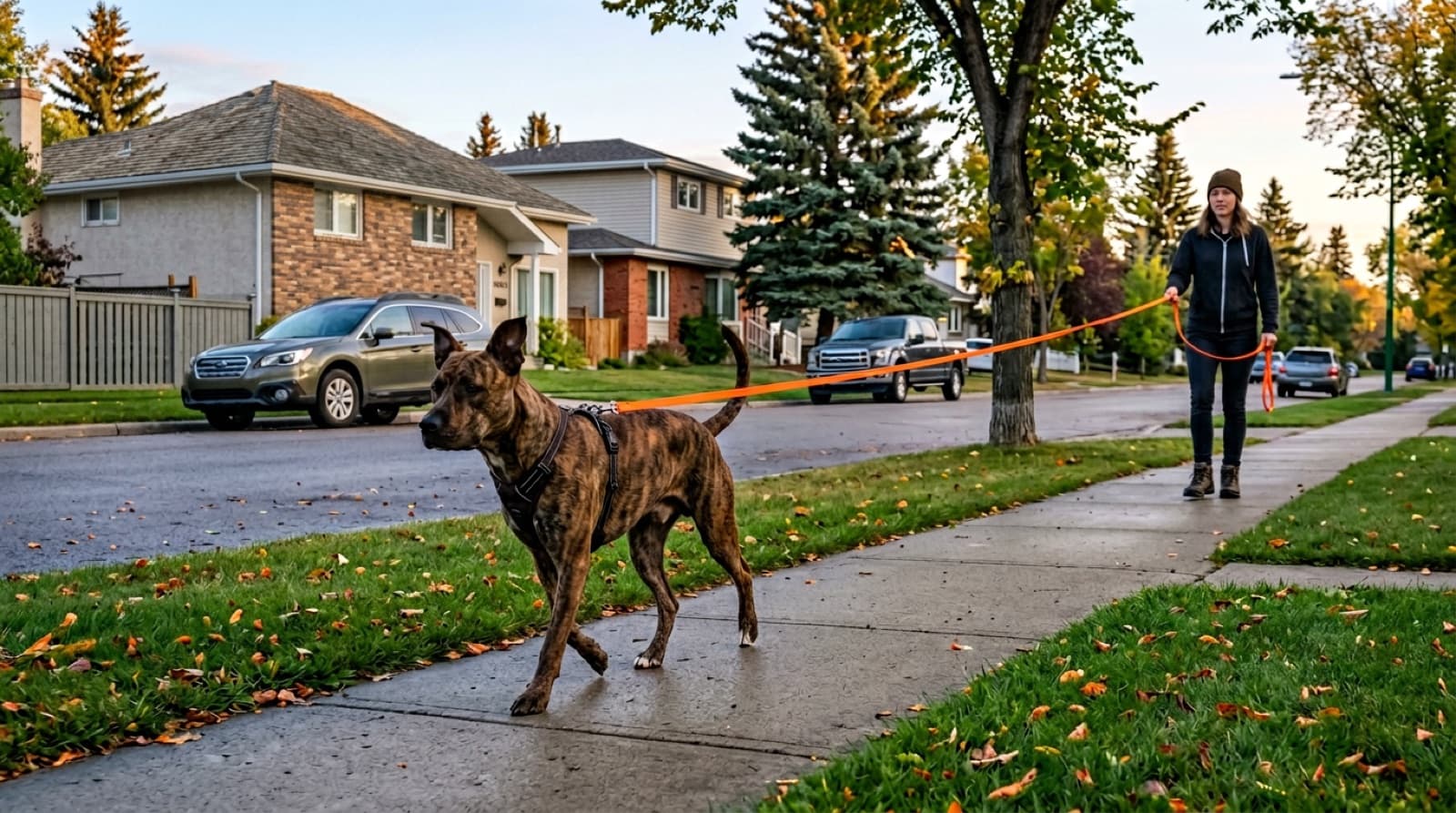
The 9 to 18 month surrender pattern at Edmonton rescues
SCARS, the Edmonton Humane Society, Zoe's Animal Rescue, and AHHRB all see the same pattern. The most common Pit Bull surrender age in Edmonton is 9 to 18 months. The cycle:
- Owner adopts a cute 8-week pit puppy or a young rescue. Puppy is initially manageable through the 4 to 8 month phase. Owner thinks “this is fine, I can do this.”
- Adolescence hits at 8 to 12 months. Recall regresses, training collapses, energy seems infinite, dog-selectivity may emerge, jumping and mouthing intensify.
- Owner attributes problems to “bad training” or “this is a bad dog” rather than recognising the developmental stage.
- Behavioural problems compound. Under-stimulated pit develops destructive chewing, fence-running, reactivity, dog-selectivity.
- Around 9 to 15 months, owner realises “this is too much” and surrenders to an Edmonton rescue.
The exact bottleneck is usually predictable: pit nips a child during play; pit injures another dog at an off-leash zone; pit destroys expensive household items; pit becomes uncontrollable on leash; pit develops resource guarding around food, toys, or owner; pit-on-pit fight in a multi-dog household; landlord receives a complaint.
Edmonton-specific compounding factors: Edmonton winter (5 to 6 months of -25 to -40C weather) traps under-stimulated pits indoors. February of the pit's adolescent winter is the peak surrender month at Edmonton rescues. Housing and insurance restrictions may compound the decision: a landlord finds out about the breed during a behavioural incident, or insurance coverage ends. The detailed Bylaw 21244 housing context lives in our sibling Edmonton Pit Bull housing and insurance guide.
Edmonton off-leash culture sets unrealistic expectations: owners adopt pits expecting to use the river-valley off-leash zones freely, then discover their dog is dog-selective and the zones are not suitable. The prevention: recognise adolescence is coming. Plan for 12 to 18 months of intensive training and management. Find a force-free trainer BEFORE problems start. Build winter enrichment routines in October. Accept that the dog you have at 6 months is not the dog you will have at 12 months, and that is normal.
The 8 to 30 month phase breakdown
| Age | Phase | What to expect |
|---|---|---|
| 4 to 8 mo | Late puppy | Mostly compliant, training is responsive. Owners feel “this is going great.” |
| 8 to 12 mo | Early adolescence | Longer recall response times, increased environmental interest, mouthing that does not resolve, possible dog-on-dog tension. |
| 12 to 18 mo | Peak chaos | Recall may collapse, leash manners regress, resource guarding may emerge, reactivity may develop. Sleep patterns disrupted. |
| 18 to 24 mo | Gradual return | Trained behaviours start returning. Sex hormones stabilise. Working drive may intensify. |
| 24 to 30 mo | Adolescence wraps | Adult patterns settle. The dog the owner adopted for emerges. |
| 30+ mo | Adult settling | Working drive channeled. Recall reliable. The breed's famous calm devotion shows up. |
American Bullies and XL Bullies, due to size, often have even longer adolescence (24 to 36 months for full maturity). The owner reframe: this phase is not “bad behaviour” or “training failure.” It is neurological. The adolescent pit brain is being rewired through synaptic pruning, prefrontal cortex development, and hormonal change.
The sudden dog-selectivity at 18 months
A pit who was dog-social as a puppy suddenly transitions to dog-selective or dog-tolerant at 18 to 30 months. This is the most universal and most surprising pattern of pit-type adolescence. Biology, not behaviour.
Owners often interpret this as “something happened” or “training failed.” Neither is true. Social maturity is when adult social patterns lock in. For pit-type dogs specifically, social maturity arrives at 18 to 30 months, later than most breeds.
As social maturity arrives:
- Tolerance for unfamiliar dogs may decrease. Puppy social rules differ from adult social rules.
- Same-sex tension may emerge, particularly with another adolescent or adult pit.
- Resource competition becomes more salient. Your pit may suddenly care about food bowls, sleeping spaces, owner attention in ways they did not as a puppy.
- Specific dog preferences may sharpen. Your pit may now actively dislike specific dogs they previously tolerated.
- Off-leash zone behaviour changes. What was fine at 8 months becomes risky at 18 months as social maturity arrives.
Practical implications: do not assume a dog-social puppy will be a dog-social adult. Do not blame yourself: excellent puppy socialisation does not guarantee adult dog-social behaviour in pit-type breeds. Adjust your lifestyle as social maturity arrives. If your 18-month pit starts showing tension at the river-valley off-leash, listen: switch to Sniffspot rentals or long-line walks. Get an Edmonton force-free trainer assessment if dog-selectivity emerges suddenly with intensity. They can help distinguish “normal social maturity adjustment” from “underlying medical issue or trauma response.”
The second fear period: do not lock in a phobia
The second fear period is a developmental window typically between 6 and 14 months when adolescent dogs become unusually sensitive to novel or threatening stimuli. Pit-type dogs are particularly affected because their natural arousal physiology can amplify fear responses.
Signs the second fear period has hit: previously confident pit suddenly afraid of new objects (a moved couch, a new lawn ornament, a parked truck on the next street), people in unusual clothing (winter coats, hats, sunglasses, hoods), sounds (industrial noise, doors slamming, garbage trucks), other dogs your pit was previously fine with, and Edmonton-specific triggers (LRT rolling sound, downtown construction, cyclists on the river-valley pathway).
A single bad experience during the second fear period can create a lifelong phobia. A pit who is bullied at the off-leash zone at 8 months may become reactive to other dogs for life. A pit who experiences a dog fight at 12 months may develop dog-aggression that is exceptionally hard to rehabilitate.
The handling protocol: avoid new traumatic events during this window. Pause busy off-leash zones, postpone introductions to high-energy dogs, skip Canada Day and NYE fireworks exposure for a 9-month-old pit if possible (the worst possible timing for adolescent noise exposure). Make positive associations with normal triggers: distance plus treats every time you see a garbage truck. Do not force exposure. Do not punish fear: yelling at a fearful pit confirms their suspicion that the world is dangerous. If fear escalates to reactivity, work with an Edmonton force-free trainer immediately. Early intervention during a fear period is dramatically more effective than after the dog has rehearsed the fear response for months. The window typically closes by 14 to 15 months.
Why aversive trainers are dangerous on adolescent pits
You will hear “balanced trainers” in Edmonton recommend prong collars and e-collars for Pit Bulls, often pitched as the only thing that works on a “stubborn” or “powerful” breed. The peer-reviewed research and breed-specific behavioural science say the opposite.
Why aversive is worse for adolescent pits specifically:
- The dog associates the painful correction with whatever they were looking at (another dog, a stranger, a kid on a bike) and learns that thing predicts pain. The dog gets MORE reactive to the trigger, not less.
- Aversive corrections often suppress growling, which sounds like progress but is dangerous. The growl is the warning before a bite. Suppress the growl and you get bites without warning. This mechanism turns a manageable reactive dog into a dangerous-dog-classified dog under Bylaw 21244.
- The adolescent brain is in active synaptic reorganisation. Trauma during this window produces lasting fear and reactivity patterns.
- Damages the owner-dog relationship at exactly the wrong developmental moment.
The science is not Pawfinder editorial. The American Veterinary Medical Association, the International Association of Animal Behaviour Consultants, the Certification Council for Professional Dog Trainers, and the American Veterinary Society of Animal Behavior all carry position statements against aversive correction tools.
Certifications to look for in an Edmonton trainer: CCPDT, KPA, IAABC, or Fear Free Certified. First sessions typically run $80 to $150. Total investment across adolescence: $800 to $1,500 over 9 to 15 months. Significantly less than the cost of a failed adoption.
Browse adoptable Pit Bulls in Edmonton
Adult Pit Bulls (3 years and up) often arrive in Edmonton rescue with documented foster behaviour notes covering adolescent patterns. Senior pits skip the chaos entirely and are frequently overlooked at the shelter.
See Available Pit Bulls →The training playbook: 80% management, 20% maintenance
Adolescent pits need management plus maintenance, not aggressive new-cue teaching. The shifts from puppy training:
- From teaching new cues to maintaining existing ones. Adolescence is not the right time to teach 10 new tricks. The brain is reorganising. Maintain “sit,” “down,” “place,” “leave it,” “drop it” reliably.
- From off-leash freedom to long-line management. A 15-foot biothane long-line ($30 to $50) prevents recall failure rehearsal. 6 to 12 months of long-line work is typical.
- From group puppy classes to structured adolescent classes. Edmonton CCPDT, KPA, or IAABC-credentialed trainers. $400 to $700 per 6-week course.
- From novel environment exposure to controlled environments. Adolescent pits in chaotic environments often regress or develop reactivity.
- From discipline-focused to enrichment-focused. Adolescent pits need MORE mental work than younger puppies, not less. Trick training, scent games, food puzzles, indoor enrichment.
- Bully-breed-specific impulse control. “Wait,” “leave it,” “settle,” “place” become non-negotiable. The brain physiology of adolescent pits favours impulsive responses; structured impulse-control practice builds neural pathways for adult self-regulation.
The rule of thumb: 80% management of the environment to prevent failure, 20% active training. Trying to train through chaos with adolescent pits almost always fails. Manage the environment, maintain core skills, build impulse control, wait for the brain to mature.
Edmonton winters are particularly challenging for adolescent pits because outdoor exercise is limited and indoor enrichment becomes critical. Plan for $400 to $700 in adolescent training class costs over 9 to 15 months, plus enrichment toys ($150 to $300), plus Sniffspot rentals during winter ($30 to $60/month). Worth every dollar to prevent the surrender outcome.
Frequently Asked Questions
When does Pit Bull adolescence start, and why is it longer than other breeds?
Pit Bull adolescence typically begins around 8 months and lasts until 24 to 30 months. Some pit-type dogs continue showing adolescent behaviour patterns until age 3 (full mental and social maturity), significantly longer than most breeds. The classic timeline: 4 to 8 months is late puppy phase, mostly compliant, training is responsive, owners feel "this is going great." 8 to 12 months is early adolescence: longer recall response times, increased environmental interest, sometimes dog-on-dog tension emerging, mouthing that does not resolve. 12 to 18 months is peak chaos: recall may collapse, leash manners regress, resource guarding may emerge or intensify, reactivity may develop. 18 to 24 months brings gradual return of trained behaviours with maturity. 24 to 30 months wraps adolescence for most pits. Why pit-type adolescence runs longer: larger dogs mature more slowly than small breeds; pit-type breeds were selectively bred for sustained drive and arousal (the brain wiring develops over an extended timeline); social maturity (when adult social patterns lock in) arrives 18 to 30 months in this breed group. American Bullies and XL Bullies, due to size, often have even longer adolescence (24 to 36 months for full maturity). The owner reframe: this phase is not "bad behaviour" or "training failure." It is neurological. The adolescent pit brain is being rewired.
Why is 9 to 18 months the peak surrender age for Pit Bulls in Edmonton rescues?
SCARS, Edmonton Humane Society, Zoe's Animal Rescue, AHHRB, and AARCS Edmonton fosters all see the same pattern: 9 to 18 months is the most common Pit Bull surrender age. The cycle is predictable. Owner adopts cute pit puppy or young rescue; puppy is initially manageable (4 to 8 month phase); adolescence hits at 8 to 12 months; owner attributes problems to "bad training" or "this is a bad dog" rather than recognising developmental stage; behavioural problems compound; around 9 to 15 months owner realises "this is too much" and surrenders. The exact bottleneck is usually predictable: pit nips a child during play, pit injures another dog at an off-leash zone, pit destroys expensive household items, pit becomes uncontrollable on leash, pit develops resource guarding, pit-on-pit fight in multi-dog household, landlord receives a complaint. Owner exhaustion plus lack of breed-specific support equals surrender decision. Edmonton-specific compounding factors: Edmonton winter (5 to 6 months of -25 to -40C weather) traps under-stimulated pits indoors, and February of the pit's adolescent winter is the peak surrender month at Edmonton rescues. Edmonton housing and insurance restrictions may compound the decision (landlord finds out about the breed during a behavioural incident, or insurance coverage ends).
My Pit was dog-social as a puppy. Why is he suddenly dog-selective at 18 months?
This is the most universal and most surprising pattern of pit-type adolescence. A pit who was dog-social as a puppy (loved every dog, did fine at the off-leash zone, played well with the resident dog) suddenly transitions to dog-selective or dog-tolerant at 18 to 30 months. Owners often interpret this as "something happened" or "training failed." Neither is true. Social maturity is when adult social patterns lock in. For pit-type dogs specifically, social maturity arrives at 18 to 30 months, later than most breeds. As social maturity arrives: tolerance for unfamiliar dogs may decrease (puppy social rules differ from adult social rules); same-sex tension may emerge (particularly with another adolescent or adult pit); resource competition becomes more salient; specific dog preferences may sharpen; off-leash zone behaviour changes. This is biology, not behaviour. The genetic predisposition for dog-selectivity (rooted in pit-type breed history) emerges with social maturity, sometimes regardless of socialisation quality. Practical implications: do not assume a dog-social puppy will be a dog-social adult; do not blame yourself; adjust your lifestyle as social maturity arrives (if your 18-month pit starts showing tension at the river-valley off-leash, listen and switch to Sniffspot rentals or long-line walks); get an Edmonton force-free trainer assessment if dog-selectivity emerges suddenly with intensity.
How does testosterone affect Pit Bull adolescence and reactivity?
Significantly. Testosterone in male pit-type dogs peaks around 10 to 12 months (sometimes earlier, slightly later in larger Bullies). The peak is dramatic: testosterone levels can run several times adult baseline. After roughly 12 months, testosterone gradually declines to adult baseline by 18 to 24 months. Behavioural implications: 10 to 14 months testosterone peak typically corresponds with peak adolescent reactivity emergence (marking, mounting, dog-on-dog tension especially with intact males, increased confidence). Same-sex aggression with intact males particularly likely during this window. Roaming behaviour: intact males may become escape artists during testosterone peak. The neuter timing decision (discussed with your vet): current Edmonton veterinary consensus has shifted from "6 months" to delayed neuter for working breeds. For pit-type males, most Edmonton vets suggest 14 to 18 months for typical pets, with some flexibility for athletic or working dogs. Trade-offs: pro-delayed includes bone/joint development benefits, possibly lower orthopedic disease rates, less behavioural suppression; con-delayed includes testosterone-driven behavioural peak during the most challenging adolescent window, increased same-sex aggression risk in multi-dog households, marking and roaming. Discuss with your vet at the 6-month wellness check. Adopted rescue pits are typically already altered before adoption (Edmonton rescue standard). For females, similar timing: most vets now suggest 1 heat cycle minimum (8 to 12 months) for medium and large working breeds.
What is the second fear period in pit bulls, and how do I handle it?
The second fear period is a developmental window typically between 6 and 14 months when adolescent dogs become unusually sensitive to novel or threatening stimuli. Pit-type dogs in second fear period are particularly affected because their natural arousal physiology can amplify fear responses. Signs the second fear period has hit: previously confident pit suddenly afraid of new objects (a moved couch, a new lawn ornament, parked truck), people in unusual clothing (winter coats, hats, sunglasses, hoods), sounds (industrial noise, doors slamming, garbage trucks), other dogs your pit was previously fine with, and Edmonton-specific triggers (LRT rolling sound, downtown construction, cyclists on the river-valley pathway). Importantly, a single bad experience during the second fear period can create a lifelong phobia. A pit who is bullied at an off-leash zone at 8 months may become reactive to other dogs for life. The handling protocol: avoid new traumatic events during this window. Pause busy off-leash zones, postpone introductions to high-energy dogs, skip Canada Day and NYE fireworks exposure for a 9-month-old pit if possible. Make positive associations with normal triggers (distance plus treats every time you see a garbage truck). Do not punish fear (yelling at a fearful pit confirms the world is dangerous). If fear escalates to reactivity, work with an Edmonton force-free trainer immediately. Early intervention during a fear period is dramatically more effective than after the dog has rehearsed the fear response for months. The window typically closes by 14 to 15 months.
What does training look like for an adolescent Pit Bull?
Different protocol from puppy training. Adolescent pits need management plus maintenance, not aggressive new-cue teaching. The shift: from teaching new cues to maintaining existing ones (adolescence is not the right time to teach 10 new tricks; the brain is reorganising; maintain "sit," "down," "place," "leave it," "drop it" reliably; add new behaviours only when current ones are solid). From off-leash freedom to long-line management (a 15-foot biothane long line, $30 to $50, prevents recall failure rehearsal; most adolescent pits benefit from 6 to 12 months of long-line work). From group puppy classes to structured adolescent classes (Edmonton force-free certified trainer options, $400 to $700 per course). From novel environment exposure to controlled environments (adolescent pits in chaotic environments often regress or develop reactivity). From discipline-focused to enrichment-focused (adolescent pits need MORE mental work than younger puppies, not less; trick training, scent games, food puzzles, indoor enrichment are all critical). Bully-breed-specific consideration: focus on impulse control during this window. "Wait," "leave it," "settle," "place" become non-negotiable. The brain physiology of adolescent pits favours impulsive responses; structured impulse-control practice builds the neural pathways for adult self-regulation. The training rule of thumb: 80% management of the environment to prevent failure, 20% active training. Trying to train through chaos with adolescent pits almost always fails.
My adolescent Pit Bull is mouthing, jumping, and testing me constantly. Is this normal?
Yes, and the management is different from puppy mouthing. Pit-type adolescent dogs are physically larger, stronger, and faster than they were as puppies, but impulse control is still developing. Mouthing, jumping, and testing behaviours that were "manageable puppy stuff" become genuinely problematic in a 60 lb adolescent. Normal adolescent behaviours: mouthing during play (bites are typically not aggressive but can break skin in adolescent pits; jaw strength is significant), jumping greetings (full-body tackles, can knock down adults and seriously injure children or seniors), stealing items (adolescent pits routinely pick up and run with anything), testing leash manners (pulling, lunging, ignoring cues that worked at 6 months), resource guarding emergence (food bowl tension, toy possessiveness, sleeping space defence), selective deafness on recall. Management protocol: mouthing requires yelping, redirecting to chew toys, ending play immediately when bites happen, no rough housing for 6 to 12 months while adolescence resolves. Jumping requires training an alternative greeting behaviour ("sit to greet"), rewarding four-on-floor, ignoring jump attempts, never knee-bumping or pushing down (encourages persistence). Stealing items requires managing environment (do not leave high-value items accessible), trade-and-return with a high-value treat, never chase (chasing is rewarding). Leash manners use a front-clip harness, structured walks at controlled pace, NOT correction-based (which damages pit trust). Resource guarding requires feeding in a separate room, dropping high-value treats while they eat to associate human approach with positive outcomes, NEVER taking items by force (creates worse guarding). Recall uses long-line management, high-value rewards.
How does Edmonton winter compound adolescent Pit Bull challenges?
Significantly. Edmonton has 5 to 6 months of sub-zero weather, with January and February averaging -10 to -15C ambient and frequent -25 to -40C wind chill events. For an adolescent pit, this means: exercise volume drops below the 90 to 120 minute daily target (cold limits outdoor time, paw protection becomes essential, salt-cracked pads are a real Edmonton injury), indoor confinement increases (more line-of-sight to chewable surfaces, more boredom, more destruction), daylight contracts (Edmonton December gives roughly 7.5 hours of daylight, and a chunk is dark commute), holiday treats and family stress disrupt routine (December through January brings family visits, table scraps, schedule disruption). The Edmonton-specific risk: February peak surrender at rescues. An adolescent pit in deep winter with insufficient outlet builds destructive behaviour and reactivity that owners interpret as "the dog being bad" rather than seasonal under-exercise. The management plan: maintain the 60 to 90 minute structured exercise target year-round (river-valley walks at -15 to -20C are still possible with paw protection), prioritise indoor mental enrichment on the deepest cold days (food puzzles, scent games, training sessions), consider daycare 2 to 3 days a week through the worst stretches ($30 to $55/day in Edmonton), build winter enrichment routines in October before deep cold hits.
When do I know my Pit Bull's adolescent issue is normal vs a real behavioural red flag?
The hardest call for Edmonton pit owners. Normal adolescent issues (resolve with management plus maturity): mouthing during play, jumping greetings, leash pulling, recall regression, mild resource possessiveness, selective deafness, occasional dog-on-dog tension at distance, fear or wariness of novel triggers (especially during second fear period), mild reactivity that stays at distance. Red flags requiring immediate professional intervention: bite to a human (any bite, even a nip; must be assessed by a veterinary behaviourist), bite to another dog with injury, severe resource guarding with growling or biting at family members, sudden personality change in a previously stable pit (medical workup FIRST), inability to recover from arousal (over-threshold for hours after a trigger), self-injurious behaviour, predatory aggression toward small animals or children, inter-dog aggression that injures the resident dog, severe noise phobia that escalates to self-injury, inability to be handled by vets or strangers safely. Triage: vet workup FIRST for any sudden behavioural change (rule out pain, neurological, thyroid; sudden change in pits aged 4+ is medical until proven otherwise). Edmonton force-free trainer assessment for any behaviour that does not respond to standard management ($150 to $250 initial, $90 to $150/hour follow-up). Veterinary behaviourist referral for severe cases (telemedicine DACVB consultation $300 to $600, or onward referral to Western College of Veterinary Medicine in Saskatoon). The hard truth: most adolescent pit issues resolve with maturity plus management. Rare cases involve concerning pathology. Do not panic at normal adolescence; do not ignore actual red flags.
Why are prong collars and e-collars dangerous on adolescent Pit Bulls?
You will hear "balanced trainers" in Edmonton recommend prong collars and e-collars for Pit Bulls, often pitched as the only thing that works on a "stubborn" or "powerful" breed. The peer-reviewed research and breed-specific behavioural science say the opposite. Aversive corrections increase aggression and bite risk in pit-type breeds in two ways. First, the dog associates the painful correction with whatever they were looking at (another dog, a stranger, a kid on a bike) and learns that thing predicts pain. The dog gets more reactive to the trigger, not less. Second, aversive corrections often suppress growling, which sounds like progress but is dangerous. The growl is the warning before a bite. Suppress the growl and you get bites without warning. This mechanism turns a manageable reactive dog into a dangerous-dog-classified dog under Edmonton Bylaw 21244. The science is not Pawfinder editorial: the American Veterinary Medical Association, the International Association of Animal Behaviour Consultants, the Certification Council for Professional Dog Trainers, and the American Veterinary Society of Animal Behavior all carry position statements against aversive correction tools. What to look for instead: trainers who describe themselves as force-free, positive reinforcement, or LIMA (Least Intrusive, Minimally Aversive). Verify CCPDT, KPA, IAABC, or Fear Free certification before booking. First sessions typically run $80 to $150 in Edmonton.
When should I escalate to a force-free trainer or vet behaviourist?
Earlier than most owners do. The most common Edmonton pit owner mistake is waiting until adolescence is severe before getting professional help. Triage: ALWAYS get a force-free trainer involved by 8 to 10 months, even if your pit seems fine. Adolescence is much easier to manage with established trainer relationships than to start fresh during a crisis. Initial assessment ($150 to $250) sets a baseline. Escalate immediately if any of these emerge during adolescence: dog-on-dog reactivity (lunging, growling at other dogs on leash), bite history with humans (any bite, even nipping), severe resource guarding (around food, toys, people, spaces), property destruction beyond normal chewing, escape attempts (digging under fences, jumping over, opening doors), severe separation anxiety, severe noise phobia (especially during Canada Day and NYE fireworks), inability to settle for hours despite structured rest, mouthing or jumping that does not respond to standard management. Veterinary behaviourist consultation if training is not improving within 8 to 12 weeks of consistent professional work, severe reactivity beyond what general trainers can manage, suspected pain or medical issues affecting behaviour, or conversation about behavioural medication. Edmonton specialty behavioural referral typically routes through DACVB telemedicine ($300 to $500 initial) or Western College of Veterinary Medicine in Saskatoon for complex cases. Investment math: a force-free trainer for adolescence ($800 to $1,500 over 9 to 15 months) is dramatically less than the cost of a failed adoption or surrender.
Is there hope? When do Pit Bulls become the dogs they are meant to be?
Yes. Most Pit Bulls become exceptional adult companions IF owners survive adolescence. The arc: 24 to 30 months adolescence wraps; working drive remains intense but channeled; reactivity may resolve or stabilise; sleep patterns settle; recall returns to reliable; the dog you trained at 6 months reappears with adult depth. Dog-selectivity, if it emerged during adolescence, has stabilised into a known pattern. 3 to 6 years are peak pit years: athletic, mentally engaged, deeply bonded with their person, capable of complex training, sport-ready. Most Edmonton pit owners report "I could not imagine life without this dog" in this window. 6 to 9 years bring mature working dog phase: slight energy reduction, settled into family routines, still mentally sharp. Many pits in this age range are the calmest companions an owner has ever had. 9+ years bring senior phase. Pit-type dogs typically live 12 to 15 years (some 16+). The "perfect adult Pit Bull" people describe is real, but they do not emerge until after the developmental phases complete. Edmonton pit owners reporting "best dog I have ever had" almost universally went through adolescence chaos and stuck with it. The dropout rate during 9 to 18 months is high; the satisfaction rate at 30 to 48 months is among the highest of any breed type. Three things that predict making it through: proactive professional support, realistic expectations, environmental management commitment.
Adoptable Pit Bulls in Edmonton
Live listings from SCARS, Edmonton Humane Society, Zoe's, AHHRB, and AARCS Edmonton fosters.
Pit Bull Adoption Edmonton
Rescue pipelines, costs, breed-mix reality, adopt vs buy framework, surrender pattern context.
Pit Bull Housing & Insurance Edmonton
Landlord conversations, condo board pet rules, home insurance restrictions, Bylaw 21244 dangerous-dog provisions.
Pit Bull Temperament: Myth vs Reality
Media-driven fear vs ATTS temperament-test data, breed-mix reality, the family-pit framework.
New dog? Start with these care guides
Everything a new adopter needs to set up a safe, happy home.