The short answer
Alberta has no breed-specific legislation. Pit Bulls are legal in Edmonton. The barriers are private: condo boards, landlords, and some home insurance carriers can restrict Pit Bull-type dogs by their own rules. Edmonton condo bylaws often catch shepherd-pit mixes through “appearance” language. Landlords can deny under the Residential Tenancies Act. Some insurance carriers exclude bullies from liability coverage. Sort all three in writing before you apply to adopt. Best starting rescues: Edmonton Humane Society, SCARS, Zoe's Animal Rescue.
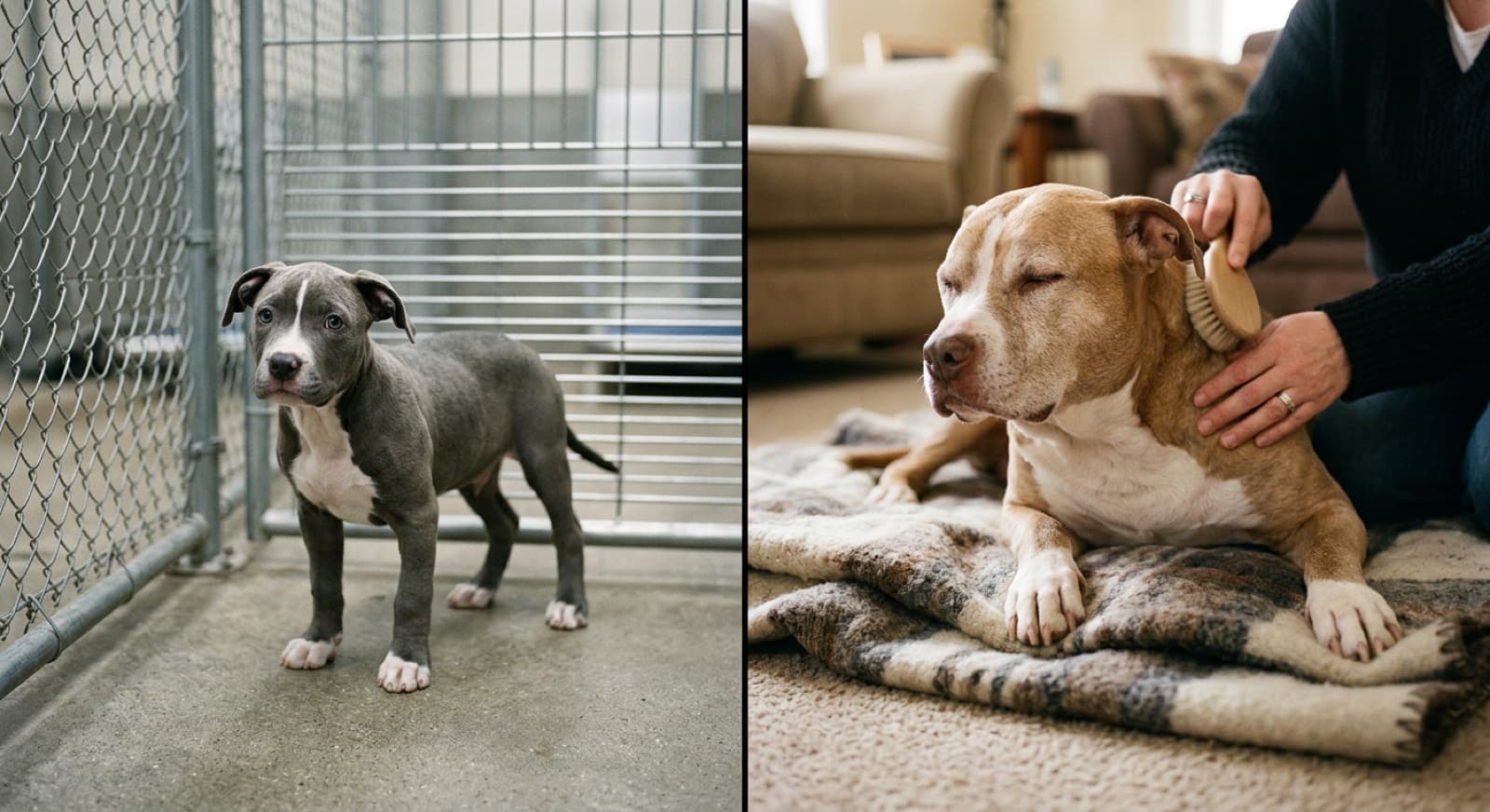
The legal reality: Alberta has no BSL
This is the most important fact to get straight before reading anything else. Alberta has no provincial breed-specific legislation. There is no ban, no required muzzle, no restricted-breed registry, and no licensing surcharge for Pit Bull-type dogs in Alberta provincial law. The City of Edmonton's Animal Care and Control Bylaw 21244 is breed-neutral. All dogs over three months old must be licensed annually with the City. The licensing fee is the same whether the dog is a Pit Bull, a Poodle, or a Labrador. The City does not require Pit Bull owners to submit additional paperwork, carry liability insurance, or muzzle their dogs in public.
Ontario is the comparison point that confuses Edmonton adopters. Ontario passed provincial restrictions on Pit Bull-type dogs in 2005. That law applies in Ontario only. It does not apply in Alberta, and Alberta has never passed similar legislation. The Alberta SPCA has historically opposed breed-specific legislation, citing evidence that breed-neutral dangerous-dog frameworks (which Edmonton uses) reduce bites more effectively than breed bans.
What Edmonton does have is a breed-neutral dangerous-dog framework. Any individual dog with documented aggressive behaviour can be designated dangerous through the bylaw process, regardless of breed. A designated dog faces real ongoing restrictions: required muzzle in public, secure containment, additional licensing fees, and possible euthanasia if the conditions are violated. Pit Bulls receive this designation no more often, in proportion, than other breeds with similar behaviour; the framework looks at the dog's behaviour, not its appearance.
All of this means the legal side is the easy side. The hard side is everything in private contract: condo bylaws, lease clauses, and insurance underwriting rules. The next sections cover each.
What Edmonton condo boards can restrict
Alberta's Condominium Property Act gives condo corporations authority to pass and enforce bylaws governing how units are used. Pet restrictions are among the most common and the most enforceable. A condo bylaw can ban pets entirely, restrict by number, restrict by weight, restrict by specific named breed, or restrict by general categories like “aggressive breeds” or “muscular short-coated dogs.” All of these are legal under Alberta law as long as the bylaw was properly passed.
A condo board cannot violate Alberta human rights legislation. A bylaw cannot, for example, ban service dogs or assistance animals from people with disabilities. But pet restrictions on companion animals are not a protected human rights matter. A board can write a Pit Bull ban into the bylaws and enforce it against every unit owner and tenant.
The enforcement timeline matters. A bylaw is binding from the moment it is registered. If you bought your condo five years ago when pets were allowed and the board passes a bully-breed ban this year, your existing dog is sometimes grandfathered, but no replacement is allowed once that dog passes. Read the new-bylaw notice carefully; the grandfather language is not automatic. Some boards explicitly grandfather; others require you to remove the dog within a stated period.
If you are buying a condo and you own a Pit Bull (or plan to adopt one), make the offer conditional on the condo board accepting the dog in writing. The standard pet form most boards use will require the breed, weight, age, vaccination records, and sometimes a photo. The board approval is the only document that protects you. A property manager's verbal “sure, that should be fine” is not enforceable when a different board member later objects. Get it in writing before closing.
The “appearance bullying” problem
This is the trap that catches Edmonton adopters of pit-mix rescue dogs more than any other. Condo bylaws and lease clauses often restrict dogs by appearance rather than by registered breed. The language varies but the effect is the same.
Common Edmonton bylaw language: “Pit Bull or any dog that resembles one in appearance.” “American Pit Bull Terrier, American Staffordshire Terrier, Staffordshire Bull Terrier, or any mix thereof.” “Muscular short-coated breeds.” “Any dog over 25 kg.” A weight cap alone catches most Pit Bulls and most shepherd mixes.
A DNA test showing your dog is mostly Boxer, mostly Labrador, or mostly shepherd does not always help. The bylaw enforcer looks at the dog standing in front of them. A blocky-headed dog with a short coat and a wide chest, regardless of actual ancestry, often gets called a Pit Bull. Many Edmonton rescue dogs labelled “shepherd mix” or “boxer mix” get caught in bully bans because they look pit-typical even though they are not.
The dogs most affected by appearance bullying in Edmonton rescues:
- Shepherd-pit mixes. A huge share of northern Alberta rescue intake. Many get labelled shepherd mix by the rescue, then get called Pit Bull by a condo board.
- Boxer mixes. Short coat, blocky head, muscular build. Boxers are not Pit Bulls, but they often get caught in “Pit Bull or similar” bylaws.
- American Bulldogs. Distinct breed. Frequently called Pit Bulls by board members who do not know the difference.
- Bullmastiffs and Cane Corsos. Some bylaws explicitly include these; others sweep them up under “muscular breeds.”
- Staffies and Amstaffs. Distinct breeds. Both fall under nearly every Pit Bull bylaw.
- Lab-bully crosses. Very common in Edmonton rescues. The Lab heritage does not protect them from appearance-based enforcement.
When you read a condo bylaw or a lease pet clause, do not look only at the breed names. Read the whole sentence. A clause that bans “Pit Bull or any dog that resembles one” gives the board total discretion. A clause with a weight cap catches dogs that no one would call a Pit Bull. Run the actual rescue dog you are considering past the bylaw language and ask, in writing, whether this specific dog would be approved.
How to read an Edmonton condo bylaw for pet restrictions
Whether you are buying a condo or moving into a rental unit in one, the condo bylaws apply to your dog. Get them and read them before you commit. The property manager has a copy. Alberta Land Titles also has copies on file. If you are buying, your real estate agent should pull the bylaws as part of due diligence.
The pet section is usually called “Pets and Animals” or “Permitted Use of Units.” Read it twice. The first read tells you whether pets are allowed at all. The second read tells you what counts as a permitted pet.
The questions to answer from the bylaw text:
- Are dogs allowed at all? Some Edmonton condo buildings are entirely pet-free.
- How many dogs per unit? Some bylaws cap at one.
- Is there a weight or height limit? Common Edmonton caps: 25 kg, 30 kg, sometimes 18 kg.
- Are specific breeds named as restricted? Look for Pit Bull, American Staffordshire Terrier, Staffordshire Bull Terrier, American Bulldog, Bullmastiff, Cane Corso, Doberman, Rottweiler.
- Is there general “aggressive breed” or “appearance” language that gives the board discretion?
- Is board approval required before bringing a new dog into the unit? Most condos require this.
- What records does the board need? Vaccinations, licence, photo, training records, neuter status.
- Is there a pet fee or pet deposit?
- What are the grounds for revoking pet approval? Most bylaws name noise complaints, leash violations, and aggressive behaviour as triggers.
If the bylaw is unclear, email the property manager and ask specifically: “I am planning to adopt a [breed mix] from Edmonton Humane Society. The dog is [weight]. Would this dog be approved under the current pet bylaw?” Get the answer in writing before signing or closing. A verbal yes from a property manager that the board later contradicts is worth nothing.
Landlord screening for Pit Bull-owning renters
The Alberta Residential Tenancies Act governs the landlord-tenant relationship. It allows landlords to set pet policies in the lease, including breed-specific exclusions and weight limits. A landlord can deny your rental application based on the breed of your dog. A landlord can also include a pet clause in the lease that lets them terminate the tenancy if you bring in an undisclosed pet. Pet ownership is not a protected ground under Alberta human rights legislation.
The practical reality of finding a pit-friendly Edmonton rental: plan for a search that takes two to four times as long as a no-pet search. Independent landlords are typically more flexible than large property-management companies. Houses, basement suites, and older walk-ups are typically more flexible than newer professionally-managed apartment buildings. Suburban Edmonton (Sherwood Park, St. Albert, Spruce Grove, Beaumont, Leduc) often has more pit-friendly options than downtown high-rise rentals.
What to prepare before you start applying:
- A pet resume. A two-page PDF with your dog's name, breed (or DNA-test breakdown if you have one), age, weight, vaccination records, microchip number, City of Edmonton licence number, training certificates, and the rescue's temperament evaluation. Add a recent photo of your dog being calm at home, not action shots.
- References from previous landlords. If you have rented with the dog before, a brief letter or email from the previous landlord confirming the dog caused no problems is worth more than anything else in the application.
- Liability insurance confirmation. Tenant insurance with confirmed pet liability coverage. Show the certificate.
- Force-free training certificate. Group obedience class completion or a trainer's reference letter signals responsibility.
- An offer to meet the dog. Many landlords agree to rent to a bully-breed owner after meeting the dog and finding her calm and well-mannered. Offer the meet-and-greet up front.
The conversation strategy: lead with your rental history, introduce the dog matter-of-factly, offer the pet resume, and address common concerns proactively. “I have a four-year-old Pit Bull mix from SCARS, fully vaccinated, tenant insurance with $1M liability, two references from previous landlords, force-free training certificate. Would you be open to meeting her?” This conversation goes better than “Do you allow Pit Bulls?”
Never move in with an undisclosed bully breed. The landlord can terminate the tenancy with proper notice for breaching the pet clause, and you lose both the home and the security deposit. The lease becomes void, and re-renting with the dog under a black mark is dramatically harder. If a landlord refuses your application, move on; do not move in and hope.
Browse adoptable Edmonton Pit Bulls
Pit Bull-type dogs are among the longest-waiting dogs in Edmonton rescue, not for temperament reasons but because of housing and insurance friction. If your housing is pit-friendly, you are looking at some of the most affectionate, people-focused dogs in the entire inventory.
See Edmonton Adoptable Dogs →
Insurance carrier landscape for Edmonton Pit Bull owners
Insurance is the second private barrier and the one most adopters discover after the fact. The Insurance Bureau of Canada confirms that insurers have wide discretion to set underwriting rules. Some Alberta home and tenant insurance carriers exclude Pit Bull-type breeds (sometimes grouped with Rottweilers and Dobermans) from liability coverage. Some charge an additional premium to include them. Some do not ask about breed at all. There is no provincial regulation requiring insurers to cover bully breeds, and there is no central registry of which carriers do.
The categories you will encounter when you call carriers:
- No questions asked. Some carriers do not ask about breed and provide standard liability coverage regardless. This is the easiest outcome. Get the answer in writing in case underwriting rules change at renewal.
- Covered with disclosure. Some carriers ask, accept the disclosure, and provide standard coverage. Confirm the liability limit (typically $1M to $2M for home insurance) and confirm there is no breed-specific exclusion buried in the policy schedule.
- Covered with premium. Some carriers will cover the dog for an additional annual premium. Reasonable if the dollar figure is modest. Read the policy carefully to confirm liability is genuinely included and not just property coverage.
- Covered with reduced liability. Some carriers will issue the policy but reduce the dog-bite liability cap (for example, from $1M to $100K). Verify what your actual exposure is in a worst-case scenario; reduced caps may be insufficient.
- Excluded. Some carriers will not include Pit Bull liability under any circumstances. The home or tenant policy may still be available, but the dog is uninsured for liability. This is the worst outcome and you should switch carriers if you find it.
- Refused or non-renewed. Some carriers will decline the home or tenant policy entirely if a Pit Bull-type dog is in the household. Or they will issue a non-renewal at the next renewal date if you add the dog mid-term.
The right order of operations: before you submit a rescue application, call your existing home or tenant insurance carrier and ask specifically. “I am planning to adopt a Pit Bull mix from a rescue. Does my policy include liability for this breed?” Get the answer in writing by email. If the answer is anything other than “yes, full standard coverage,” get a second quote from a different carrier before adopting.
Renters insurance is harder than home insurance. Tenant policies for Edmonton renters often have lower liability caps and tighter breed exclusions than homeowner policies. If you rent, the insurance step is even more important to do before adopting; an undisclosed bully breed discovered at claim time can void the policy entirely and leave you personally liable.
Separately, pet liability insurance and pet health insurance are different products. Pet liability covers third-party injuries; pet health covers the dog's own vet bills. Some pet health insurers exclude Pit Bull-type breeds; some do not. Verify both before enrolling. The principle is the same as everything else on this page: get the answer in writing, before you adopt, with the breed specified.
Pre-adoption housing and insurance checklist
The single highest-leverage thing you can do as a prospective Pit Bull adopter in Edmonton is sort the contracts before you fill out the rescue application. The rescue's application will ask about your housing. A clean, documented answer makes the placement go smoothly.
Confirm in writing, before applying to adopt:
- Housing approval. If you own a condo: condo board approval of the specific breed (or breed mix) in writing. If you rent: landlord approval in writing, ideally as a signed lease addendum. If you own a single-family home: confirm there are no neighbourhood covenants (rare in Edmonton but possible in some newer developments).
- Home or tenant insurance. Carrier confirmation by email that the breed is covered for liability, with the policy liability limit stated.
- Pet health insurance. Optional but recommended; confirm the carrier accepts the breed before enrolling. Enrol the dog within the first week of adoption to avoid pre-existing condition exclusions.
- City licensing. Plan to license the dog with the City of Edmonton within the first week. The licence is breed-neutral and required for all dogs over three months.
- A vet. Have a primary care vet identified. The first vet visit is usually within the first two weeks of adoption.
- A trainer. Identify a force-free trainer running group classes in your area. For an adolescent or adult rescue Pit Bull, a class started within the first month of adoption is the single highest-impact behavioural investment you can make.
- An exit plan. If your circumstances change radically (job loss, illness, family change), what is your plan for the dog? Most reputable Edmonton rescues will accept their own dogs back without judgment if the situation truly cannot continue. Knowing this is a real safety net.
Most rescue applications take a few weeks to process. Use that window to finish the checklist. If something on the list comes back negative (the condo board says no, the insurance carrier excludes the breed, the landlord refuses), better to learn that before the dog is in your home than after.
If your housing changes after you already own a Pit Bull
This is the scenario behind a large share of Edmonton bully-breed surrenders. The owner did everything right at adoption, then life changed: a job move, a divorce, selling a house, parents moving in, a new baby in a smaller space. The housing changes faster than the dog can be transitioned.
The most common patterns and how to think about them:
Selling a single-family house and moving to a condo. Start the condo search at least three months out. Read every bylaw before making an offer. Make the offer conditional on the condo board accepting the dog in writing. Do not rely on a property manager's verbal yes; the board is the deciding authority. If you cannot find a pit-friendly Edmonton condo within your budget, the alternatives are renting a single-family or expanding the search to St. Albert, Sherwood Park, or Beaumont.
Renting after owning. The same playbook as a new adopter: pet resume, references from previous neighbours, insurance documentation, force-free training certificate. Budget two to four months of search time. Avoid major property-management companies with blanket breed exclusions.
Divorce or separation. Decide which partner keeps the dog based on who has more housing stability, not on who emotionally attached more. The partner with the established single-family home or the pit-friendly condo keeps the dog; the partner taking the new lease starts from scratch. This is hard but it is the realistic version that does not end with the dog at a shelter.
Insurance non-renewal mid-policy. If your carrier issues a non-renewal notice because you added a Pit Bull mid-term, you have 60 to 90 days to find a new carrier. Switch immediately. Do not let coverage lapse; a gap on the policy makes it harder to bind a new policy.
If a surrender becomes unavoidable. Return the dog to the rescue you adopted from first. Reputable Edmonton rescues, including Edmonton Humane Society, SCARS, and Zoe's Animal Rescue, will accept their own dogs back and re-place them in their network. This is dramatically better for the dog than surrendering to general intake or rehoming through online ads. Document everything you know about the dog (vet records, training notes, behavioural patterns, food preferences) so the next adopter has full information.
Avoid Kijiji listings, free-to-good-home posts, and informal rehoming through social media. Bully breeds rehomed this way sometimes end up in dog fighting, abuse, or simple neglect. The rescue's vetting process is the protection.
The Edmonton geographic reality
Where in Edmonton you live matters as much as what breed you own. The pit-friendliness gradient runs roughly from urban high-density to suburban single-family.
Downtown high-rise condos and managed apartments. Generally the most restrictive. Larger buildings have professional management companies that often apply blanket breed policies across their entire portfolio. Bylaws are typically restrictive, weight caps common, board approval required for every pet. Possible to find pit-friendly options here but takes the longest search.
Older walk-up apartments and converted houses. More flexible. Smaller buildings, independent landlords, fewer formal policies. Bylaws (if a condo) are sometimes older and less restrictive. The trade-off is older buildings sometimes have noise issues that make a vocal Pit Bull difficult.
Basement suites in single-family neighbourhoods. Often the easiest rental for a Pit Bull adopter. The landlord lives upstairs, decisions are personal not corporate, and the dog gets a yard. The downside is the landlord lives upstairs; a barking Pit Bull becomes a daily problem.
Single-family rental houses in suburban Edmonton. The friendliest pattern. Independent landlord, fenced yard, neighbourhood with other dogs, fewer formal restrictions. Available in north, south, and west Edmonton suburbs and especially in surrounding municipalities (Sherwood Park, St. Albert, Spruce Grove).
Single-family ownership. The most stable long-term housing for a Pit Bull adopter. Your only constraint is the City of Edmonton Animal Care and Control Bylaw, which is breed-neutral. No condo board, no landlord, no breed bylaw. If you can structure your adoption timeline around buying a house first, the housing problem largely solves itself.
None of this means you cannot have a Pit Bull in downtown Edmonton. People do. It does mean the search is harder, the contracts are tighter, and the margin for error is smaller. Adopters who match their housing type to their preferred breed have noticeably fewer crises down the road.
Frequently asked questions
Are Pit Bulls legal in Alberta?
Yes. Alberta has no provincial breed-specific legislation and the City of Edmonton has no breed-specific ban under Animal Care and Control Bylaw 21244. Pit Bull-type dogs, including American Pit Bull Terriers, American Staffordshire Terriers, Staffordshire Bull Terriers, American Bullies, and pit-type mixes, are legal to own throughout the province. The only legal restrictions on individual dogs come through the standard dangerous-dog process, which is breed-neutral and applies to any dog with documented aggressive behaviour. The Alberta SPCA has historically opposed breed-specific legislation as ineffective.
Can I own a Pit Bull in Edmonton?
Yes, with the same licensing requirement as any other dog. All dogs over three months must be licensed annually with the City of Edmonton. The licence is breed-neutral; the fee is the same as for any other dog. The City does not maintain a restricted-breed registry. The practical barriers in Edmonton are private: your condo board, your landlord, and your home insurance carrier. None of those are municipal or provincial law; they are private contract restrictions that you can verify before you adopt.
Can an Edmonton condo board ban Pit Bulls?
Yes. Alberta's Condominium Property Act gives condo boards authority to pass and enforce bylaws, including pet restrictions. A condo bylaw banning bully breeds is legally binding on every unit owner and tenant in that building. The board does not need a special hearing to enforce an existing bylaw; if the bylaw is on the books when you buy or move in, it applies. The only path around a board bylaw is to amend it, which requires a board vote and typically a unit-owner vote. Read the full pet bylaw before you make an offer on a condo.
Can an Edmonton landlord refuse to rent to me because I own a Pit Bull?
Yes. Alberta's Residential Tenancies Act allows landlords to set pet policies in the lease, including breed-specific restrictions. A landlord can deny your application, write a breed exclusion into the lease, or terminate a lease for an undisclosed bully-breed dog. The Act does not classify pet ownership as a protected characteristic. Your only defences are finding a pit-friendly landlord, disclosing the dog before signing, and getting any approval in writing as a lease addendum.
Do home insurance carriers in Alberta cover Pit Bulls?
It varies by carrier. Some Alberta home and tenant insurance carriers exclude certain breeds from liability coverage, some charge a premium for them, some do not ask about breed at all. The honest answer is that you have to call your specific carrier and ask in writing. The Insurance Bureau of Canada notes that insurers have discretion to set underwriting rules. Get the answer in writing before you adopt. Disclosing the dog and learning a carrier will not cover you is a recoverable situation; not disclosing and learning at claim time is not.
What is “appearance bullying” in Edmonton condo bylaws?
Many condo bylaws restrict dogs based on appearance rather than registered breed. Common language includes “Pit Bull or any dog that resembles one,” “muscular short-coated breeds,” or a weight cap like 25 kg. This sweeps up dogs that are not Pit Bulls at all: Boxer mixes, American Bulldogs, Cane Corsos, Bullmastiffs, Staffies, Amstaffs, and a large share of shepherd-pit mixes from Edmonton rescues. A DNA test showing your dog is mostly shepherd does not always override the bylaw if a board member looks at the dog and calls it a bully. Read the language closely.
Are Edmonton rentals harder to find with a Pit Bull?
Yes, noticeably. Plan on the rental hunt taking two to four times as long as it would without a bully breed. Independent landlords renting houses, basement suites, and older walk-ups are typically more flexible than large property-management companies. Edmonton suburban single-family rentals (Sherwood Park, St. Albert, Spruce Grove) often have fewer restrictions than downtown high-rises and managed apartment buildings. Build a pet resume with vaccination records, training certificates, rescue temperament evaluation, and previous-landlord references before you start applying.
Should I disclose the breed to my landlord or insurance carrier?
Always. Non-disclosure is the single fastest path to eviction or denied claim. A landlord who discovers an undisclosed bully breed three months in can terminate the lease in Alberta with proper notice; you lose the home and your security deposit. An insurance carrier that discovers an undisclosed restricted breed at claim time can deny the claim and rescind the policy. Honest upfront disclosure costs you some applications. Hiding the dog costs you the home.
Where can I adopt a Pit Bull in Edmonton?
Pit Bull-type dogs turn up most weeks at the main Edmonton-area rescues. Edmonton Humane Society, SCARS, Zoe's Animal Rescue, and the Greater Edmonton Animal Rescue Society all see Pit Bulls and pit-type mixes regularly. AARCS, headquartered in Calgary, tags Edmonton-foster dogs separately. Rescue foster homes evaluate temperament over weeks, which is the best read available on the individual dog. Each rescue's application asks about housing; sort the housing and insurance side first so the conversation goes well.
What if my housing changes after I already own a Pit Bull?
This is the hardest scenario and the most common cause of Edmonton bully-breed surrenders. The path forward depends on the change. Selling a house and moving to a condo: read the condo bylaw before making an offer and only buy in a pit-friendly building. Renting after owning: start the hunt three months out and budget for a longer search. Divorce or separation: keep the dog with whichever partner can house them; the other partner takes the new lease. If the dog must be rehomed, surrender to the rescue you adopted from first; they keep adopters in their network and re-place rather than letting the dog cycle through general intake.
Related Edmonton Pit Bull guides
Edmonton Adoptable Dogs
Current Edmonton-area Pit Bull and pit-mix listings from Edmonton Humane Society, SCARS, Zoe's, GEARS, Hope Lives Here, AHHRB, and AARCS Edmonton fosters.
Pit Bull Adoption Edmonton
Edmonton rescue sources, real adoption costs vs breeder pricing, why Pit Bulls wait so long in Edmonton rescue, and the application process.
Pit Bull Health Issues: Skin, Knees, Lumps
Pit Bull-type dog health issues to plan for: itchy skin and allergies, torn knee ligaments, mast cell tumours, hips, weight and what to ask your vet.
Pit Bull Temperament: Myth vs Reality
What Edmonton rescue foster homes consistently report about Pit Bull temperament, where the myths come from, and what the dogs themselves are actually like.
Find your Edmonton rescue Pit Bull
Pit Bull-type dogs wait the longest in Edmonton rescue. If your housing is sorted, you are looking at some of the most affectionate, people-focused dogs in the entire inventory. Foster temperament notes describe each individual dog honestly.
Browse All Edmonton Dogs →New dog? Start with these care guides
Everything a new adopter needs to set up a safe, happy home.