The short answer
Pit Bulls are individuals. The breed has documented affectionate-with-people patterns AND documented dog-to-dog selectivity. Edmonton rescue foster assessment is the single best predictor of how a specific dog will live in your specific home. The nanny dog framing is marketing. The dangerous dog framing is misinformation. The truth is harder: most Pit Bulls are wonderful with people, many are great with kids, many are dog-selective rather than dog-friendly or dog-aggressive, and the foster notes will tell you which one you are looking at. Read them carefully. Best starting points: Edmonton Humane Society, SCARS, Zoe's Animal Rescue.
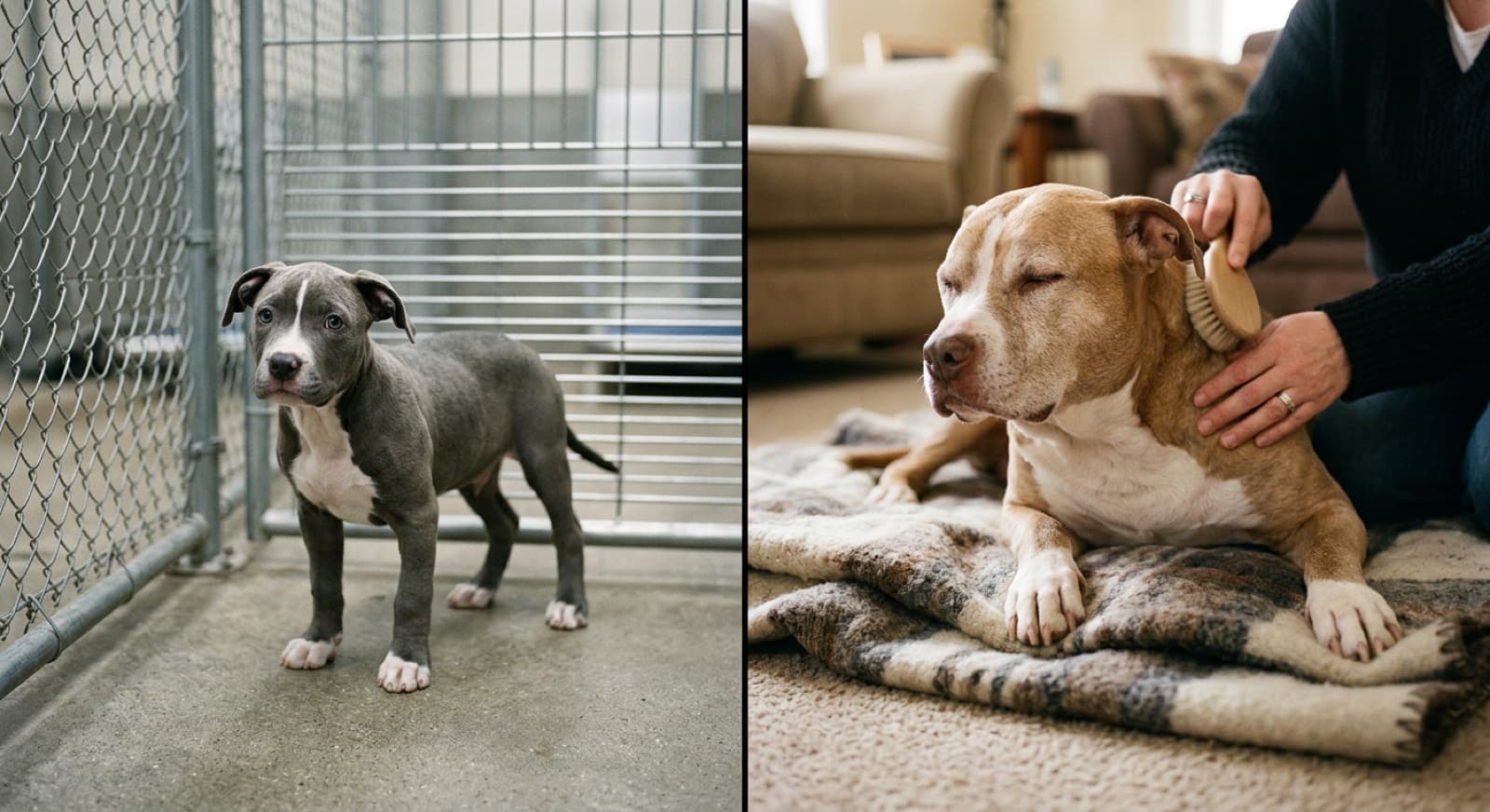
What “Pit Bull” actually means
The first honest framing: “Pit Bull” is not a single breed. It is a colloquial umbrella term that covers several distinct breeds plus mixes of those breeds plus dogs who simply look the part. Understanding the umbrella matters because the conversation about temperament keeps collapsing different dogs into one mental category.
- American Pit Bull Terrier (APBT). The breed at the core of the umbrella. Medium-sized, athletic, originally developed from a mix of terrier and bulldog stock. Not recognised by the Canadian Kennel Club but recognised by the United Kennel Club.
- American Staffordshire Terrier (AmStaff). A close cousin to the APBT, recognised by the CKC and AKC. Often slightly larger and stockier than the APBT.
- Staffordshire Bull Terrier (Staffy). Smaller, originally British, recognised by the CKC and AKC. Often described in the breed literature as exceptionally affectionate with people.
- American Bully. A newer breed developed from APBT lines, generally stockier and broader. Comes in standard, pocket, classic, and XL variants.
- Mixes of the above. The majority of dogs in Edmonton rescues that get called Pit Bulls are mixes (often APBT or AmStaff crossed with Lab, Boxer, Cattle Dog, or Shepherd).
- Appearance-based identification. A real fraction of dogs labelled Pit Bull-type in Edmonton rescues are identified by look alone (blocky head, muscular build, short coat). Genetic testing often surprises adopters: the dog they thought was a Pit Bull is actually a Boxer-Lab cross, or vice versa.
The implication: when someone says “Pit Bulls are X,” the statement is already imprecise because the umbrella covers genuinely different dogs. A Staffordshire Bull Terrier and an American Bully XL are not the same dog. A Pit-mix with significant Lab in the mix is not the same as a pure APBT. The honest assessment of any specific dog is done individually, in foster care, by people who have lived with that dog for weeks.
What the temperament-test data actually shows
The American Temperament Test Society (ATTS) publishes breed-by-breed results from a standardised evaluation that puts dogs through a series of social, environmental, and mild-stress scenarios. The test is not a guarantee that any individual dog will behave well in every situation; it is a directional signal about how a breed group performs under controlled conditions.
On the ATTS test, Pit Bull-type breeds have consistently posted pass rates in line with or higher than many family-favourite breeds. The American Pit Bull Terrier, American Staffordshire Terrier, and Staffordshire Bull Terrier have all historically scored at or near the top of the breed rankings. The score is comparable to or better than Golden Retrievers, Labrador Retrievers, Border Collies, and many other breeds widely considered family-safe.
This matters because it directly contradicts the public-perception gap. The dogs being publicly characterised as inherently dangerous are scoring on a temperament test as well as the dogs being publicly characterised as inherently family-safe. The honest reading: breed is a poor predictor of individual temperament, and the dogs most often vilified by media coverage are not the dogs that show up in the standardised assessment data.
The American Veterinary Society of Animal Behavior (AVSAB) position statement on breed-specific legislation reaches the same conclusion. AVSAB explicitly opposes BSL on the grounds that breed is a poor predictor of bite risk, that BSL has not been shown to improve public safety in jurisdictions that have implemented it, and that individual assessment is the appropriate basis for managing risk. The ASPCA takes the same position. Alberta has no breed-specific legislation. Edmonton does not ban Pit Bull-type dogs.
The “nanny dog” history: contested origin, useful caution
For decades, Pit Bull advocates promoted the “nanny dog” framing: the idea that Staffordshire Bull Terriers were historically chosen to watch over children, that the breed has a unique gentleness with kids. The framing was repeated widely in Pit Bull advocacy circles through the 1990s and 2000s.
The origin is contested. Researchers tracing the nanny dog phrase have found it surfacing in 1980s and 1990s media coverage rather than in older breed history. The phrase appears to be a 1980s marketing-style coinage that got grafted onto the breed's history rather than something documented in actual historical sources. Modern Pit Bull advocates including Bad Rap and Best Friends Animal Society publicly retired the nanny dog framing around 2013 because it set up unsafe expectations on both sides.
The honest reframe is more useful than the myth. Many Pit Bulls genuinely are wonderful with kids. The Staffordshire Bull Terrier breed standard from the United Kingdom Kennel Club describes the breed as “reliable family pet” with affection for children, and foster homes regularly confirm this is real for many individual dogs. At the same time, no dog of any breed should be left unsupervised with a young child, ever. This rule applies as firmly to Pit Bulls as it does to Labradors, Golden Retrievers, and every other breed.
The practical takeaway for Edmonton families: a foster-assessed adult Pit Bull whose notes describe documented positive history with kids is often a safer family adoption than a puppy of any breed, because you know what you are getting. The nanny dog label is unhelpful. The actual foster observation, written down, is gold.
Dog-to-dog tolerance: the real pattern
The single most important thing for new Pit Bull adopters to understand is dog-to-dog selectivity. This pattern is real, it is documented across the bully-breed rescue community, and it is the most common reason a Pit Bull adoption hits friction. Understanding it before you adopt prevents most of that friction.
Experienced bully-breed rescues use a four-point spectrum to describe dog-to-dog social style. The terminology comes from Bad Rap and is now used across the rescue community.
- Dog-social. Enjoys most other dogs, comfortable in playgroups and dog parks. A minority of Pit Bull-type dogs.
- Dog-tolerant. Fine with familiar dogs, neutral with unfamiliar dogs at a distance, does not actively seek interaction. A common pattern.
- Dog-selective. Likes some specific dogs (often opposite-sex, often calm older dogs, often the resident dog at home) and not others. The most common pattern in adult Pit Bulls. Often emerges as the dog reaches social maturity (18 to 30 months).
- Dog-aggressive. Should not interact with other dogs in any unsupervised setting. A minority.
Two things to internalise. First, dog-selectivity is not a behaviour problem; it is a normal breed-typical preference. Many Pit Bulls who are dog-selective are also deeply bonded to their resident-dog housemate and happy in their human-focused life. Second, dog-selectivity often emerges around social maturity. A Pit Bull who was friendly with every dog at the park as a puppy can quietly shift to selective at 24 months. This catches many first-time bully owners off-guard. Edmonton foster homes flag this pattern when they see it, and they tell adopters honestly.
The practical implication: most Edmonton Pit Bull adopters should plan a lifestyle that does not depend on the dog being a dog-park dog. Long-line river-valley walks at off-hours, structured single-dog play with carefully chosen partners, and quiet on-leash neighbourhood walks are the realistic rhythm for a dog-selective Pit Bull. Many Pit Bulls live full, happy lives without ever being dog-park regulars, and that is a successful outcome rather than a compromise. See our Edmonton off-leash parks guide for which trails work for dog-selective dogs and which are a poor match.
With cats and other pets in the home
Cat compatibility in Pit Bulls varies dog by dog, and the foster home is the only reliable source of truth. Many Pit Bulls live peacefully with cats; some are genuinely uninterested; some have a level of prey drive that makes a cat home unsafe regardless of training. The breed does not produce a single answer here.
Edmonton foster homes that include cats test compatibility carefully. The foster observation captures real information: how the dog responds to a calm cat in a shared room, whether the dog ignores fast cat movement or fixates on it, how the dog handles a cat that swats and retreats. If a Pit Bull's foster notes describe calm and curious-but-respectful body language around cats, the dog is likely a safe cat-home candidate. If the notes describe high arousal, fixation, or any chase-and-grab behaviour, the dog needs a cat-free home.
Small pets including rabbits, ferrets, and pocket pets are a different conversation. Many Pit Bulls have meaningful prey drive toward small fast-moving animals, and even dogs who do well with cats may not do well with a guinea pig. If you have small pets, ask the rescue specifically whether any of their current dogs have been assessed around that animal. Most have not, and the honest rescue answer is “we do not know.”
Multi-dog households with a Pit Bull work for many Edmonton families. The pattern that works most consistently: opposite-sex pairs (a male Pit Bull and a female non-Pit, or vice versa), calm temperament match, and careful introduction managed over weeks. Same-sex pit-pit pairings are riskier, particularly female-female, and most experienced bully-breed rescues either decline same-sex pit-pit placements or require detailed screening. None of this is rigid breed prediction; it is a pattern observed often enough that careful rescues plan around it.
Why Edmonton rescues lean so heavily on foster assessment
More than any other breed, Pit Bull adoptions live or die on the quality of the foster assessment. The reason is simple: the public-perception gap is so wide that a Pit Bull placed into the wrong home does not just get returned. The return cascades. The dog comes back stressed, the adopter tells the story to friends, and the breed's reputation takes another hit. Edmonton rescues know this, and they invest in foster assessment accordingly.
What a thorough Pit Bull foster assessment looks like in practice: two to six weeks of in-home observation. Temperament around adults, children (if the foster has them), other dogs (if the foster has them), cats (if the foster has them). Energy level through different times of day. Reactivity triggers. Recovery time from arousal. Body-language patterns under mild stress. House manners, crate behaviour, alone-time tolerance. The foster writes detailed notes, and the rescue uses those notes to match the dog to the right home.
Edmonton Humane Society, SCARS, Zoe's Animal Rescue, GEARS, Hope Lives Here, and AHHRB all use foster-based assessment for the Pit Bull-type dogs in their care. Some run formal foster-to-adopt programs where adopters bring the dog home for two to four weeks before finalising, with the rescue covering vet care and accepting returns with no penalty. For a first-time Pit Bull adopter, foster-to-adopt is the highest-value path because it removes the all-or-nothing risk.
The corollary: trust the foster assessment. When a foster home flags a dog as “single-pet household,” that note reflects weeks of observation, not a guess. When a dog is flagged as “great with kids who respect dog space,” the foster has seen it. When a dog is flagged as “needs experienced handler,” the rescue is being honest with you, not arbitrary. Read the foster notes carefully and apply for the dog whose notes match your actual home.
Browse adoptable Edmonton Pit Bulls
Current Edmonton-area Pit Bull and Staffy-type listings from EHS, SCARS, Zoe's, GEARS, Hope Lives Here, and AHHRB. Foster notes describe dog-selectivity, cat compatibility, and the kind of home each dog actually fits. The honest match is the easy match.
See Edmonton Adoptable Dogs →
When a Pit Bull is NOT the right adopter match
The honest mismatches. None of these are character flaws on either side; they are real patterns that produce returns and unhappy dogs when missed.
- Lifestyle that depends on the dog being a dog-park dog. Most Pit Bulls are dog-selective. A daily off-leash dog-park social hour is not the realistic life for the median Pit Bull. If your routine cannot absorb that, the breed is the wrong fit.
- Multi-dog household without careful screening. Two random Pit Bulls in the same house is not a safe default. Same-sex pit-pit pairs in particular are high-friction. If you already have a dog, the new Pit Bull needs to be foster-tested with the resident dog before adoption.
- Households with very young children where supervision cannot be guaranteed. Not because Pit Bulls are uniquely risky around kids (the temperament data does not support that) but because no dog should ever be unsupervised with a young child, and households that cannot enforce supervision are the wrong fit for any large strong breed.
- Exercise capacity below 60 minutes daily. Pit Bulls are athletic dogs with real exercise needs. An under-exercised Pit Bull becomes a destructive Pit Bull, and the destruction gets blamed on the breed rather than the unmet need.
- Rental or condo without confirmation in writing. Some Edmonton landlords and condo boards restrict bully breeds. Confirm in writing before you adopt. See our companion piece on Pit Bull housing and insurance reality for the working framework.
- Expectation of a low-key couch dog from a 1- to 3-year-old. Peak adolescence is peak energy regardless of breed. A Pit Bull at 18 months is not the same dog she will be at 36 months. Plan for the adolescent stage honestly.
- No tolerance for the public-perception conversation. Pit Bull owners get questions, get assumptions, get the occasional nervous reaction on a sidewalk. The dog handles this fine; the owner has to. If the social load of being a Pit Bull owner is more than you want, that is real information.
None of these mismatches are about a defective breed or a defective adopter. They are about fit. The same Edmonton rescue that gently redirects one applicant toward a different breed will enthusiastically approve the next applicant for the exact same dog. The match is what matters.
The honest family-fit framework
Who Pit Bulls thrive with, in plain terms. This is the pattern Edmonton foster homes describe over and over.
Strong fits
- Single-dog households or thoughtfully-chosen opposite-sex multi-dog pairings.
- Families with older kids (roughly 8-plus) who understand dog body language and respect dog space.
- Adopters who walk daily for an hour or more and can shift exercise patterns through Edmonton winter without losing the routine.
- Households that include at least one person who is home or breaking up the day with the dog most days.
- Adopters who have or are willing to build a relationship with a force-free trainer.
- Owners who value the deep affection and people-orientation Pit Bulls deliver, over the on-paper hipster appeal of a different breed.
- Households where one adult can confidently handle a strong 50- to 80-pound dog on leash.
Where the friction shows up
- Routines that depend on daily dog-park socialisation.
- Households with multiple existing dogs that have not been screened with the candidate Pit Bull.
- Households with infants or toddlers where supervision cannot be constant.
- Apartment or condo settings without written breed approval.
- Adopters who travel often without a Pit-Bull-friendly boarding or sitter network in place.
- Insurance situations where the home insurer excludes bully breeds and the adopter cannot switch.
If your situation lands cleanly in the strong-fit column, the breed is often a wonderful match. If you have one or two friction points, foster-to-adopt removes most of the risk. If multiple friction points stack, the rescue may honestly redirect you toward a different breed or a different life stage, and that redirection is them doing right by both you and the dog.
Edmonton resources when behaviour issues emerge
Even the best-matched Pit Bull adoption can hit a behaviour question that needs professional input. The right professional tier matters. Force-free trainers, behaviour consultants, and veterinary behaviourists solve different problems.
Tier 1: force-free trainer
For basic obedience, leash skills, impulse control, and most normal adolescent or new-adoption issues. Look for trainers certified through CCPDT (Certification Council for Professional Dog Trainers) as CPDT-KA, or graduates of the Karen Pryor Academy. Force-free trainers do not use prong collars, e-collars, or aversive corrections. For Pit Bulls in particular, aversive methods often escalate reactivity rather than reduce it. Group classes typically run $200 to $400 for a six- to eight-week course in the Edmonton area; private sessions run $100 to $200 per hour.
Tier 2: credentialed behaviour consultant
For dog-to-dog reactivity that does not respond to regular training, resource guarding that escalates over weeks, severe stranger fear, or any behaviour question that needs a structured behaviour-modification plan. Look for consultants certified through IAABC (International Association of Animal Behaviour Consultants) as a Certified Dog Behaviour Consultant (CDBC). IAABC certification requires demonstrated assessment skills and a behaviour-modification case portfolio. Sessions run $150 to $300 per hour, and the work happens over weeks or months rather than in a single appointment.
Tier 3: veterinary behaviourist
For confirmed bite history, severe anxiety, severe fear, or any situation that may need behavioural medication alongside training. Veterinary behaviourists are board-certified through the American College of Veterinary Behaviorists (DACVB). They can diagnose behavioural disorders and prescribe medication. There are very few DACVBs in Canada, and Edmonton-area cases often work through referral or telehealth. Initial consultations typically run $400 to $800. For genuinely dangerous behaviour, this is the correct tier. Alberta SPCA also publishes welfare and behaviour resources worth reviewing at albertaspca.org.
Frequently asked questions
Are Pit Bulls dangerous?
No more than any other large, strong dog with the wrong management. The American Veterinary Society of Animal Behavior position is that breed is a poor predictor of bite risk and that breed-specific legislation does not improve public safety. Individual temperament, socialisation, supervision, and the owner's handling skill matter far more. Pit Bull-type dogs in Edmonton rescue care are temperament-tested in foster homes; the assessment notes are honest and detailed. The dogs flagged as suitable for kids, dogs, or multi-pet households are flagged for a reason. The dogs flagged as single-pet or experienced-home-only are flagged for a reason too. Read the foster notes carefully.
Are Pit Bulls good family dogs?
Many are excellent family dogs. The breed has well-documented affection-with-people patterns, and a Pit Bull who has been raised with kids or fostered with kids often does very well in family homes. That said, no dog of any breed should be left unsupervised with young children, and that rule applies as firmly to Pit Bulls as it does to Labradors, Golden Retrievers, or any other breed. The honest answer: a foster-assessed adult Pit Bull with documented kid history is often a safer family bet than a puppy of any breed, because you know what you are getting.
What is the nanny dog myth?
The nanny dog framing emerged in 1980s media. The idea was that Staffordshire Bull Terriers (and by extension all Pit Bull-types) were historically chosen to watch over children. Modern Pit Bull advocates including Bad Rap and Best Friends Animal Society retired the nanny dog framing around 2013 because it set up unsafe expectations. The honest reframe: Pit Bulls are not statistically better or worse with kids than other breeds, and no dog should ever be left unsupervised with a young child. Individual temperament, supervision, and training matter more than breed.
What does "dog-selective" mean for Pit Bulls?
Dog-selective means the dog likes some other dogs and not others. This is the most common Pit Bull pattern (more common than dog-social and more common than dog-aggressive), and it is a normal, healthy breed trait rather than a behaviour problem. A dog-selective Pit Bull may be best friends with the resident dog at home and have zero interest in dogs at the park. Edmonton rescues identify where a specific dog sits on the spectrum during foster care and tell adopters honestly. Many Pit Bulls live full happy lives without ever being dog-park dogs, and that is a successful outcome.
Can a Pit Bull live with cats?
Many can, some absolutely cannot, and the only honest predictor is foster assessment. A Pit Bull who has been fostered in a home with cats and shows calm, curious, or indifferent body language around them is likely a safe bet for a cat home. A Pit Bull whose foster notes describe high prey drive, fixation on small animals, or any history of inappropriate cat behaviour is not. Edmonton foster homes test cat compatibility carefully because they know how much it matters. If you have a cat, ask the rescue specifically which dogs have been cat-tested.
What is the American Temperament Test Society pass rate for Pit Bulls?
The American Temperament Test Society publishes breed-by-breed pass rates from their standardised temperament evaluation. Pit Bull-type breeds (American Pit Bull Terrier, American Staffordshire Terrier, Staffordshire Bull Terrier) have consistently posted pass rates comparable to or higher than many family-favourite breeds including Golden Retrievers and Border Collies. The data is publicly available at atts.org. The caveat: the ATTS test measures specific traits in a controlled setting and does not predict every real-world situation. It is a useful directional signal that the breed has been unfairly characterised, not a guarantee for any individual dog.
Are Pit Bulls banned in Edmonton or Alberta?
No. Alberta has no breed-specific legislation. Edmonton does not ban Pit Bull-type dogs. The City of Edmonton operates on owner-responsibility laws applied equally to every breed. The real constraints adopters face are housing and insurance: some landlords and condo boards restrict bully breeds, and some home insurance providers ask about breed. Confirm your rental, condo bylaws, and home insurance before you apply to adopt. See our companion article on Pit Bull housing and insurance reality for Edmonton-specific options.
When is a Pit Bull NOT the right adopter match?
Several patterns are honest mismatches. Households that need a daily dog-park dog without exception (most Pit Bulls do not enjoy unmoderated dog-park settings). Multi-dog households that have not done careful pairing screening. Homes with very young children where supervision cannot be guaranteed. Households without time or capacity for 60-plus minutes of daily exercise. Adopters who expect a low-key couch dog from a 1- to 3-year-old (this is peak adolescence regardless of breed). Edmonton rescues will tell you honestly if a specific dog suits your specific situation. Trust them.
Do I need a special trainer for a Pit Bull?
You need a force-free trainer, which is true for any rescue dog. Look for trainers certified through CCPDT (Certification Council for Professional Dog Trainers) as CPDT-KA, or graduates of the Karen Pryor Academy. Force-free means no prong collars, no e-collars, no aversive corrections. For Pit Bulls specifically, aversive methods often increase reactivity and can damage the human-dog bond, so the force-free approach is both safer and more effective. For dog-dog reactivity that does not resolve with regular training, an IAABC-credentialed behaviour consultant is the next step. For any bite history, a veterinary behaviourist (DACVB) is the right tier.
Why do Edmonton rescues do such thorough Pit Bull assessment?
Because the public-perception gap is so wide that careful matching is the only way to set adoptions up to succeed. A Pit Bull placed into the wrong home gets returned, and returns hurt the dog and erode public trust in the breed. Edmonton rescues use weeks of foster care to identify dog-selectivity patterns, cat compatibility, kid tolerance, energy level, and household-fit indicators before a single adoption application is approved. The thoroughness is not gatekeeping; it is the practice that produces the affectionate, settled Pit Bulls you see in long-term Edmonton homes.
Related Edmonton Pit Bull guides
Edmonton Adoptable Dogs
Current Edmonton-area Pit Bull and Staffy-type listings from EHS, SCARS, Zoe's, GEARS, Hope Lives Here, and AHHRB with detailed foster notes.
Pit Bull Adoption Edmonton
Edmonton rescue sources for Pit Bulls and Staffy-types, real adoption costs vs breeder pricing, surrender patterns, and the foster-to-adopt path.
Pit Bull Health Issues: Skin, Knees, Lumps
Pit Bull-type dog health issues to plan for: itchy skin and allergies, torn knee ligaments, mast cell tumours, hips, weight and what to ask your vet.
Pit Bull Housing & Insurance Edmonton
Edmonton condo and rental restrictions on bully breeds, home insurance providers that cover Pit Bulls, and the documented-conversation script that works.
Find your Edmonton rescue Pit Bull
Browse current Edmonton-area Pit Bull and Staffy-type listings. Foster temperament notes help you find the dog whose actual personality matches your actual home.
Browse All Edmonton Dogs →New dog? Start with these care guides
Everything a new adopter needs to set up a safe, happy home.