The short answer
Pug eye care is the breed-defining ongoing medical commitment. Brachycephalic anatomy (shallow eye sockets, prominent eye position, short tear ducts) creates lifetime vulnerability. Proptosis is an emergency (eyeball pops out of socket; do NOT push it back; transport to ER vet within 30 to 60 minutes). Corneal ulcers are common; vet within 24 hours. Dry eye (KCS) needs lifelong daily cyclosporine. Pigmentary keratitis is the slow chronic condition affecting most Pugs to some degree. Daily 30-second eye-wipe routine plus pet insurance from day one are non-negotiable. Edmonton specialty ophthalmology runs $300 to $700 per consult; WCVM Saskatoon handles complex cases. Lifetime eye-care budget: $500 to $1,500/year if chronic conditions develop, $1,500 to $4,000 per acute emergency event.
Why Pug eyes are vulnerable
Three brachycephalic anatomy factors stacked together:
- Shallow eye sockets (orbits). Hold the eye loosely in place. Easier for trauma to displace the eyeball than in a deep-set-eye breed.
- Prominent eye position. Exposes more corneal surface to dust, debris, lash contact, and accidental trauma.
- Shortened tear-duct anatomy. Increases dry eye risk and tear-film instability.
The Royal Veterinary College epidemiological studies on brachycephalic breed health consistently identify eye conditions as among the most common breed-specific medical burdens. Most Pugs experience at least one significant eye event in their lifetime. Many experience several.
The AKC Pug breed profile describes the breed as “adaptable, charming, mischievous” but does not foreground the eye-care commitment. The breed-club guidance is more practical: every Pug owner needs a daily eye routine and pet insurance from day one.
The proptosis emergency protocol
EMERGENCY. Proptosis is when the eyeball partially or fully pops out of the socket. The eye remains attached to the optic nerve and can sometimes be saved if treated within 30 to 60 minutes.
Typically triggered by trauma: a fall, a leash jerk on a collar, a bite from another dog, sometimes even rough play. Pugs are at far higher risk than other breeds because of the shallow orbital anatomy.
Emergency steps in order:
- Do NOT push the eye back in. You will damage the cornea and optic nerve.
- Keep the eye moist with sterile saline if available, or clean lukewarm water on a clean cloth held gently over the eye. Never let the eye dry out.
- Prevent rubbing or pawing. A protective collar (Elizabethan or inflatable) helps if you have one ready.
- Transport to a 24-hour emergency vet immediately. Edmonton 24-hour emergency clinics handle proptosis cases routinely.
- Vet treatment: sedation, eye cleaning, then either replace the eye in the socket (tarsorrhaphy: lid sutured partially closed for healing) or enucleate (remove the eye) if the damage is too severe to save.
Cost: $1,500 to $4,000 for proptosis surgery. Outcome: roughly 50% of repositioned eyes retain vision long-term; many develop dry eye, scarring, or pigmentary changes afterward. Some Pugs lose the eye and live well as one-eyed dogs.
Prevention: harness instead of collar (no leash jerks on the neck), supervise rough play, secure your home against falls, keep your Pug away from larger dogs at unfamiliar off-leash settings.
Corneal ulcers: the most common Pug eye event
Erosions on the surface of the cornea. Pugs develop them at much higher rates than non-brachycephalic breeds because the prominent eye position exposes the cornea to dust, debris, lash contact, and accidental trauma.
Signs:
- Excessive blinking or holding one eye partially closed
- Eye discharge (clear at first, often becoming yellow or green if infected)
- Redness
- The dog pawing at the eye
- Light sensitivity (squinting in bright rooms or outdoors)
- Visible cloudiness on the corneal surface
- Sometimes a visible white or grey spot on the eye
Diagnostic: Schirmer tear test and fluorescein dye test (the dye stains the ulcer green under blue light). Edmonton vet cost: $200 to $500 for diagnosis plus medication.
Treatment by severity:
- Superficial ulcers: topical antibiotic drops, anti-inflammatory drops, Elizabethan collar to prevent self-injury. 1 to 2 week healing.
- Deep or non-healing ulcers: surgical intervention (debridement, grid keratotomy, or corneal grafting) by a board-certified veterinary ophthalmologist (referral from your GP vet; Edmonton specialty ophthalmology clinics handle most cases; WCVM Saskatoon for complex cases).
Untreated corneal ulcers can perforate the eye and cause permanent vision loss or loss of the eye entirely. If you suspect an ulcer, see your vet within 24 hours.
Dry eye (KCS) and pigmentary keratitis
| Condition | Key signs | Treatment | Lifetime cost |
|---|---|---|---|
| Dry eye (KCS) | Thick mucous discharge, recurring redness, dull corneal surface, recurrent ulcers | Lifelong daily cyclosporine ointment (Optimmune, vet-prescribed) + preservative-free artificial tears | $500 to $1,200/year |
| Pigmentary keratitis | Brown or black pigment on corneal surface (starts inside corner), gradual progression, vision impairment in advanced cases | Address underlying causes + topical cyclosporine or tacrolimus + surgical options for severe cases | $400 to $1,000/year + surgical considerations |
KCS diagnostic: Schirmer tear test. Healthy dogs produce 15+ mm of tear in 60 seconds; KCS dogs produce less than 10 mm. Pigmentary keratitis diagnostic: visual examination by your vet or a board-certified veterinary ophthalmologist.
Pet insurance covers most of these costs IF KCS or pigmentary keratitis is diagnosed AFTER policy start. Pre-existing conditions are excluded by most carriers. The window to get insurance in place is the first 14 days of adoption, before the first wellness visit if possible.
Browse adoptable Pugs in Edmonton
Edmonton rescue Pugs often arrive with documented eye-care history. Senior Pug adoption gives you a known eye baseline.
See Available Pugs →The daily 30-second routine
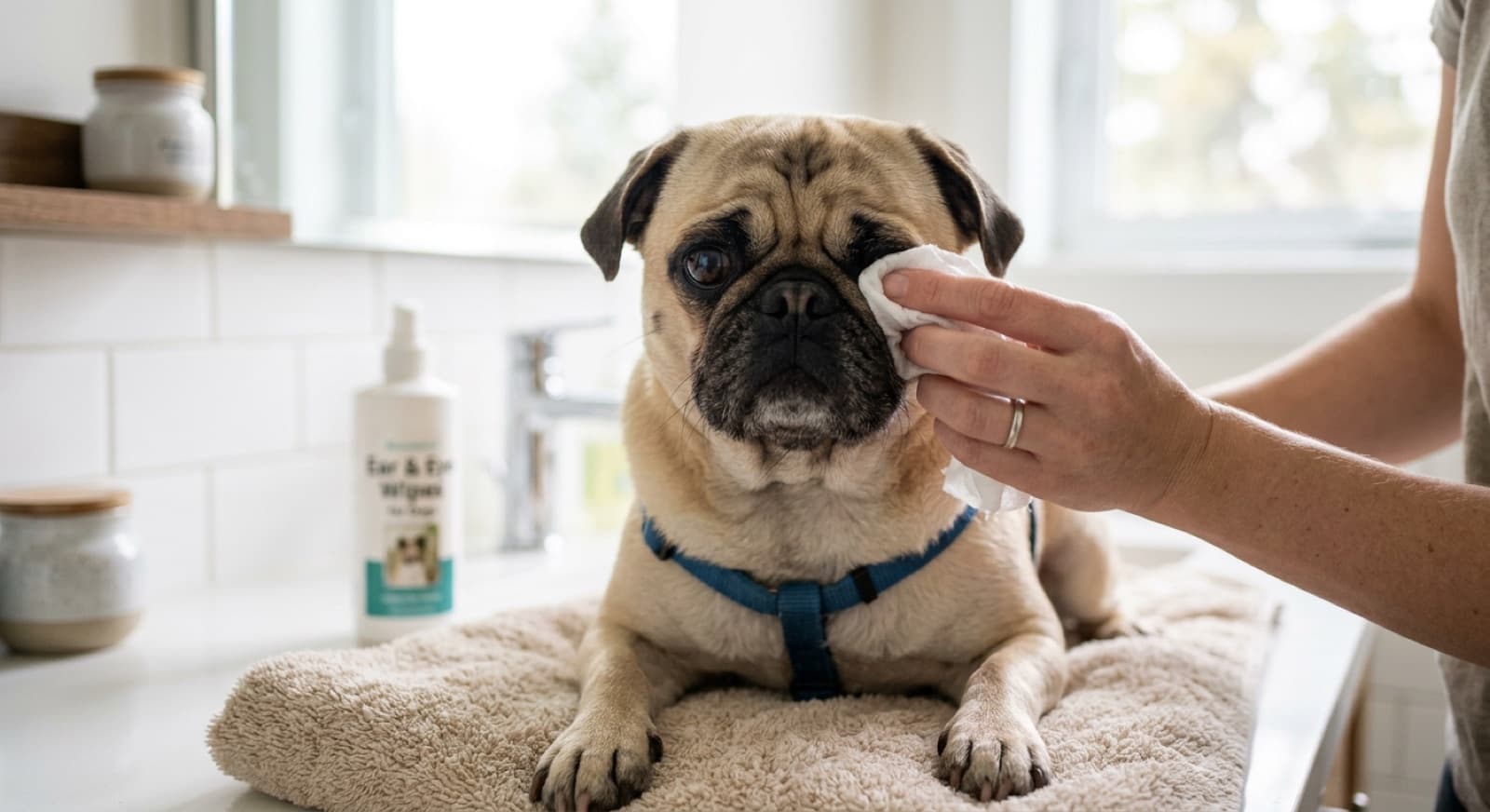
Daily: gently wipe each eye with a damp soft cloth or unscented baby wipe to remove discharge and dust. Wipe from the inside corner outward. Use a separate clean section of the cloth for each eye to avoid cross-contamination. Check for redness, discharge colour change, squinting, or asymmetry between eyes. Any new abnormality is a same-day vet call.
Weekly: gently pull down the lower lid to inspect the underside. Check for foreign objects, lash issues, or mucous accumulation.
After walks: wipe eyes and the nasal fold area to remove dust and pollen, especially during Edmonton spring (pollen) and fall (harvest dust) seasons. After windy days, wipe more thoroughly.
Edmonton dry winter adjustments: humidifier (35 to 45% relative humidity reduces eye and skin dryness simultaneously). More frequent eye-wipe routine through deep winter (twice-daily wipes if your dog tends toward yellowish discharge). Preservative-free artificial tears (Refresh Tears, GenTeal, Systane) 1 to 2 drops in each eye 1 to 2 times daily if your vet recommends them.
Avoid: chamomile tea folk-remedies (irritant), tap water (chlorine and pH irritation), human eye drops with redness-reducing ingredients (toxic to dogs).
Frequently Asked Questions
Why are Pug eyes so vulnerable?
Brachycephalic anatomy. The Pug skull is selectively bred for a flat face, which produces three eye-vulnerability factors stacked together: very shallow eye sockets (orbits) that hold the eye loosely in place, prominent eye position that exposes more corneal surface to dust, debris, and trauma, and shortened tear-duct anatomy that increases dry eye and tear-film instability risk. The Pug Dog Encephalitis registry and the Royal Veterinary College epidemiological studies on brachycephalic breed health consistently identify eye conditions as among the most common breed-specific medical burdens. The result is a breed where lifetime eye-care vigilance is non-negotiable. Most Pugs will experience at least one significant eye event in their lifetime. Many will experience several. Edmonton specialty veterinary access for ophthalmology is available locally for routine cases and referrable to the Western College of Veterinary Medicine in Saskatoon for complex cases. Pet insurance with no breed exclusions for eye conditions is the foundation of responsible Pug ownership in Edmonton.
What is Pug proptosis and what do I do if it happens?
EMERGENCY. Proptosis is when the eyeball partially or fully pops out of the socket, typically triggered by trauma (a fall, a leash jerk, a bite from another dog, sometimes even rough play). Pugs are at far higher risk than other breeds because of the shallow orbital anatomy. The eye remains attached to the optic nerve and can sometimes be saved if treated within 30 to 60 minutes. EMERGENCY PROTOCOL: (1) Do NOT push the eye back in. You will damage the cornea and optic nerve. (2) Keep the eye moist with sterile saline if available, or clean lukewarm water on a clean cloth held gently over the eye. Never let the eye dry out. (3) Do NOT let your dog rub or paw at the eye. A protective collar (Elizabethan or inflatable) helps if you have one ready. (4) Transport to a 24-hour emergency vet immediately. Edmonton 24-hour emergency clinics handle proptosis cases routinely. (5) The vet will sedate the dog, clean the eye, and either replace the eye in the socket (tarsorrhaphy procedure, lid sutured partially closed for healing) or enucleate (remove the eye) if the damage is too severe to save. Cost: $1,500 to $4,000 for proptosis surgery. Outcome: roughly 50% of repositioned eyes retain vision long-term; many develop dry eye, scarring, or pigmentary changes afterward. Some Pugs lose the eye and live well as one-eyed dogs. Prevention: harness instead of collar (no leash jerks on the neck), supervise rough play, secure your home against falls, keep your Pug away from larger dogs at unfamiliar off-leash settings.
What is a corneal ulcer in a Pug and how do I recognise it?
Corneal ulcers are erosions on the surface of the cornea. Pugs develop them at much higher rates than non-brachycephalic breeds because the prominent eye position exposes the cornea to dust, debris, lash contact, and accidental trauma. Signs: excessive blinking or holding one eye partially closed, eye discharge (clear at first, often becoming yellow or green if infected), redness, the dog pawing at the eye, light sensitivity (squinting in bright rooms or outdoors), visible cloudiness on the corneal surface, sometimes a visible white or grey spot on the eye. The Schirmer tear test and fluorescein dye test are the diagnostic tools your vet uses (the dye stains the ulcer green under blue light). Edmonton vet cost: $200 to $500 for diagnosis plus medication. Treatment depends on severity: superficial ulcers respond to topical antibiotic drops, anti-inflammatory drops, and an Elizabethan collar to prevent self-injury (1 to 2 week healing). Deep or non-healing ulcers may need surgical intervention (debridement, grid keratotomy, or corneal grafting) by a board-certified veterinary ophthalmologist (referral from your GP vet; Edmonton has specialty ophthalmology clinics, with WCVM Saskatoon for complex cases). Untreated corneal ulcers can perforate the eye and cause permanent vision loss or loss of the eye entirely. If you suspect an ulcer, see your vet within 24 hours.
What is dry eye (KCS) in Pugs?
Keratoconjunctivitis sicca (KCS), commonly called "dry eye," is a chronic condition where the tear glands produce insufficient tears to keep the cornea moist and healthy. Pugs are predisposed because of the shortened anatomy that affects tear-duct function. Signs: thick mucous discharge (often green or yellow), recurring eye redness, the dog squinting or rubbing eyes, dull-looking corneal surface (less shiny than a healthy eye), recurrent corneal ulcers (dry eye predisposes to ulcers), chronic conjunctivitis that does not respond to standard antibiotic treatment. Diagnosis: Schirmer tear test (a small paper strip held under the lower lid for 60 seconds measures tear production; healthy dogs produce 15+ mm of tear in 60 seconds; KCS dogs produce less than 10 mm). Treatment: lifelong daily eye medication. Cyclosporine ophthalmic ointment (Optimmune, prescribed by your vet) is the standard first-line treatment, applied twice daily. Tacrolimus ophthalmic drops are a backup for non-responsive cases. Artificial tear lubrication (preservative-free) for between-dose comfort. Edmonton vet cost: $200 to $400 initial diagnosis, $40 to $100/month ongoing medication. Pet insurance covers most of these costs if KCS is diagnosed AFTER policy start. Pre-existing KCS is excluded by most carriers. Get insurance before the first KCS event if possible.
What is pigmentary keratitis in Pugs?
Pigmentary keratitis is the breed-defining chronic eye condition in Pugs. Brown pigment cells migrate onto the cornea over time, eventually blocking vision in severe cases. It is more common in Pugs than in any other breed and affects a majority of Pugs to some degree over their lifetime. Causes are multifactorial: chronic dry eye, repeated mild trauma from prominent eye position, lash contact (entropion, where lashes turn inward and rub the cornea), nasal fold contact (the prominent skin fold can rub the cornea), and breed-genetic predisposition. Signs: brown or black pigment visible on the corneal surface, usually starting at the inside corner and spreading; gradual rather than sudden onset; vision impairment in advanced cases (the dog may bump into furniture, hesitate at stairs, or behave more cautiously in new environments). Diagnosis: visual examination by your vet or a board-certified veterinary ophthalmologist. Treatment: address underlying causes (dry eye, entropion, nasal fold contact) plus topical cyclosporine or tacrolimus to slow pigment migration. Surgical options exist for severe cases (medial canthoplasty to shorten the eye opening, nasal fold reduction surgery to reduce corneal contact) but are usually reserved for advanced cases threatening vision. Edmonton specialty veterinary ophthalmology referral runs $300 to $700 per consultation. Pigmentary keratitis does not typically reverse; the goal is to slow progression and preserve vision.
Daily eye-care routine for an Edmonton Pug?
Daily 30-second routine: gently wipe each eye with a damp soft cloth or unscented baby wipe to remove discharge and dust. Wipe from the inside corner outward. Use a separate clean section of the cloth for each eye to avoid cross-contamination. Check for redness, discharge colour change, squinting, or asymmetry between eyes. Any new abnormality is a same-day vet call. Weekly: gently pull down the lower lid to inspect the underside (check for foreign objects, lash issues, or mucous accumulation). After walks: wipe eyes and the nasal fold area to remove dust and pollen, especially during Edmonton spring (pollen) and fall (harvest dust) seasons. After windy days, wipe more thoroughly. Edmonton dry winter air increases eye-irritation risk; consider a humidifier (35 to 45% relative humidity) to reduce dryness-related eye issues. Products: damp soft cloths, unscented baby wipes (Earthbath, Burt's Bees, plain water-based), preservative-free artificial tear drops if your vet recommends them (Refresh Tears, GenTeal, Systane, $15 to $25). Avoid: chamomile tea folk-remedies (irritant), tap water (chlorine and pH irritation), human eye drops with redness-reducing ingredients (toxic to dogs). If your Pug has a known eye condition, follow your vet's specific protocol.
When does my Pug need a veterinary ophthalmologist?
Escalate to a board-certified veterinary ophthalmologist (specialty referral from your GP vet) when: a corneal ulcer is not healing after 7 to 14 days of treatment, KCS is not responding to first-line cyclosporine, pigmentary keratitis is progressing and threatening vision, proptosis aftercare is needed for tarsorrhaphy or enucleation follow-up, entropion (in-turning lashes) surgical correction is needed, recurrent corneal ulcers (more than 2 per year) suggest underlying KCS or entropion not yet diagnosed, suspected glaucoma (sudden cloudy eye, severe pain, sudden vision loss), or any eye condition that the GP vet flags as requiring specialty assessment. Edmonton specialty veterinary ophthalmology is available locally for routine cases. Complex cases (corneal transplants, lens-related surgery, advanced glaucoma management) refer to the <a href="https://wcvm.usask.ca" target="_blank" rel="noopener noreferrer nofollow" className="font-semibold hover:underline" style={{ color: '#F07D00' }}>Western College of Veterinary Medicine</a> in Saskatoon. Cost: $300 to $700 per specialty consultation, $1,500 to $5,000 per surgical procedure depending on complexity. The American College of Veterinary Ophthalmologists maintains a directory of board-certified veterinary ophthalmologists. Insurance reimbursement makes these costs manageable if coverage is in place before the condition becomes pre-existing.
Does Edmonton winter affect Pug eye health?
Yes. Edmonton dry winter air (5 to 6 months of furnace-heated low humidity) stresses Pug eyes more than humid climates. The reduced ambient humidity accelerates tear-film evaporation, which worsens existing dry eye and increases corneal ulcer risk in healthy dogs. Three adjustments for winter: (1) humidifier in the home (whole-home or single-room, target 35 to 45% relative humidity, reduces eye and skin dryness simultaneously); (2) more frequent eye-wipe routine through deep winter (consider twice-daily wipes if your dog tends toward yellowish discharge); (3) preservative-free artificial tears (Refresh Tears, GenTeal, Systane) 1 to 2 drops in each eye 1 to 2 times daily if your vet recommends them. Edmonton cold-wind exposure also matters during outdoor walks: wind-chill conditions below -20C can dry the cornea quickly. Limit outdoor exposure for Pugs with existing dry eye or pigmentary keratitis during deep cold. Heated indoor air conditions can also worsen ear and skin issues simultaneously with eye issues; many Edmonton Pug owners notice flares of multiple conditions during January and February.
How much does Pug eye care cost annually?
Wide range depending on the dog. Healthy Pug (no chronic eye conditions): $50 to $150/year for routine eye-care products plus annual vet eye exam. Pug with dry eye (KCS): $500 to $1,200/year for daily medication, periodic vet checks, sometimes artificial tear products. Pug with pigmentary keratitis: $400 to $1,000/year for ongoing cyclosporine/tacrolimus therapy and ophthalmology follow-ups, plus surgical considerations if vision becomes threatened. Pug with corneal ulcer event: $200 to $1,500 per ulcer event depending on severity (most superficial ulcers $200 to $500; complex ulcers requiring referral $1,000 to $1,500). Pug with proptosis emergency: $1,500 to $4,000 per event for surgical repair plus aftercare. Pug with severe combined eye issues (KCS + pigmentary keratitis + recurrent ulcers): $1,500 to $3,500/year. Pet insurance is the buffer. Trupanion, Pets Plus Us, OVMA Pet Health Insurance, and Fetch all cover Pug eye conditions IF coverage starts before the condition is diagnosed. Premiums for an adult Pug run $50 to $110/month in Edmonton. Buy insurance within 14 days of adoption, before the first wellness visit if possible.
Can a Pug live well with reduced vision or one eye?
Yes. Pugs adapt to vision loss reasonably well, far better than many sighted owners expect. The breed relies heavily on scent and hearing, both of which compensate effectively. Many Edmonton Pug owners report no meaningful quality-of-life change after their dog lost vision in one eye following proptosis or enucleation. Adjustments to make life easier for a partially or fully blind Pug: keep furniture arrangement consistent (the dog memorises the layout); use scent markers near stairs or hazards (a few drops of essential oil safe for dogs at the top and bottom of stairs); place rugs or texture changes at room transitions (the dog feels the transition with paws); voice cues for direction (left, right, step up, step down); avoid sudden routine changes; harness instead of collar for walks (better navigation cues); supervise outdoor time to prevent accidental hazards. Edmonton vet behaviourist or rehabilitation vet referral is appropriate if the dog struggles with vision loss adaptation. Most Pugs that lose one eye continue to live full happy lives with the remaining eye for the rest of the breed-typical lifespan (12 to 15 years for the breed).
Adopting a rescue Pug with existing eye issues?
Common in Edmonton rescue Pugs. The brachycephalic surrender pattern includes many Pugs that arrive with chronic eye conditions the previous owner could not manage. Edmonton rescues (SCARS, Edmonton Humane Society, Zoe's Animal Rescue, AHHRB) and breed-specific networks disclose known eye conditions during the foster phone screen. Adoption protocol: (1) Schedule a vet visit within 14 days of adoption for full eye assessment (Schirmer tear test, fluorescein dye test, intraocular pressure measurement); (2) Establish baseline eye health documentation before purchasing pet insurance (some carriers will cover conditions noted in adoption paperwork but not conditions diagnosed at first wellness visit); (3) Get pet insurance within 14 days regardless. Pre-existing exclusion still applies but coverage for FUTURE conditions begins immediately; (4) Commit to daily eye-wipe routine from day one; (5) Discuss any chronic medications (cyclosporine, tacrolimus) with your vet for continuity. Edmonton vet costs for first-year rescue Pug eye baseline: $300 to $800. The investment is worth it because Pug eye issues compound. Catching them early is dramatically cheaper than late-stage intervention. Senior Pug adoption (8+ years) typically arrives with established eye conditions disclosed by the rescue. The trade-off is shorter remaining lifespan but more medical predictability.
Bottom line for Edmonton Pug owners?
Pug eye care is the breed-defining ongoing medical commitment. Expect to invest in daily 30-second eye-wipe routine, pet insurance from day one with coverage that includes brachycephalic conditions, willingness to recognise eye emergencies (proptosis, sudden vision loss, severe pain) and act within minutes, lifetime budget of $500 to $1,500/year for chronic eye conditions if they develop, and willingness to escalate to specialty ophthalmology when GP vet treatment plateaus. RIGHT FOR YOU IF: realistic about the breed's medical burden, Edmonton suburb or condo with structured routine, $50 to $110/month pet insurance budget, comfortable with daily eye-wipe routine, willing to commit to specialty ophthalmology referrals when needed. CHALLENGING IF: limited budget for chronic medication, first-time owner unfamiliar with brachycephalic eye-care, no pet insurance budget. WRONG IF: expectation that the breed is "easy" because of small size, unwilling to commit to daily routine, unable to absorb a $1,500 to $4,000 proptosis emergency. Edmonton rescue Pugs are often adopted into the right hands and live full happy lives with proper care. Senior Pug adoption from SCARS, EHS, Zoe's, or AHHRB skips the variable-puppy-prediction phase and provides documented eye baselines. The breed is medical-cost defined. Plan accordingly.
Adoptable Pugs in Edmonton
Live listings from SCARS, Edmonton Humane Society, Zoe's, AHHRB, and AARCS Edmonton fosters.
Pug Adoption Edmonton
Rescue pipelines, costs, brachycephalic reality, breed-mix patterns, family-fit framework.
Pug Health Issues: Breathing, Eyes, Spine
Pug health issues to plan for: short-nose breathing and heat, eye injuries, skin folds, weight, spinal disease in older Pugs, mast cell tumours and Pug dog encephalitis.
Pug Winter Care Edmonton
Cold tolerance limits, brachycephalic cold-air considerations, gear standards, indoor exercise.
New dog? Start with these care guides
Everything a new adopter needs to set up a safe, happy home.