The short answer
Pugs are TWICE vulnerable to Edmonton winter. The brachycephalic airway means cold dry air hits the soft palate and larynx without warming, which triggers or worsens BOAS. The thin coat and small body lose heat fast in the same outing. Plan for short bundled potty walks, no sustained exercise outdoors, and a full indoor enrichment routine through the deep-cold months. A coat is mandatory below -5C. Booties or paw wax are valuable below -15C. Sessions drop to 10 to 20 minutes between -15 and -25C, to 5 to 10 minutes between -25 and -35C, and below -35C is an indoor day with 2 to 3 minute bathroom breaks only.
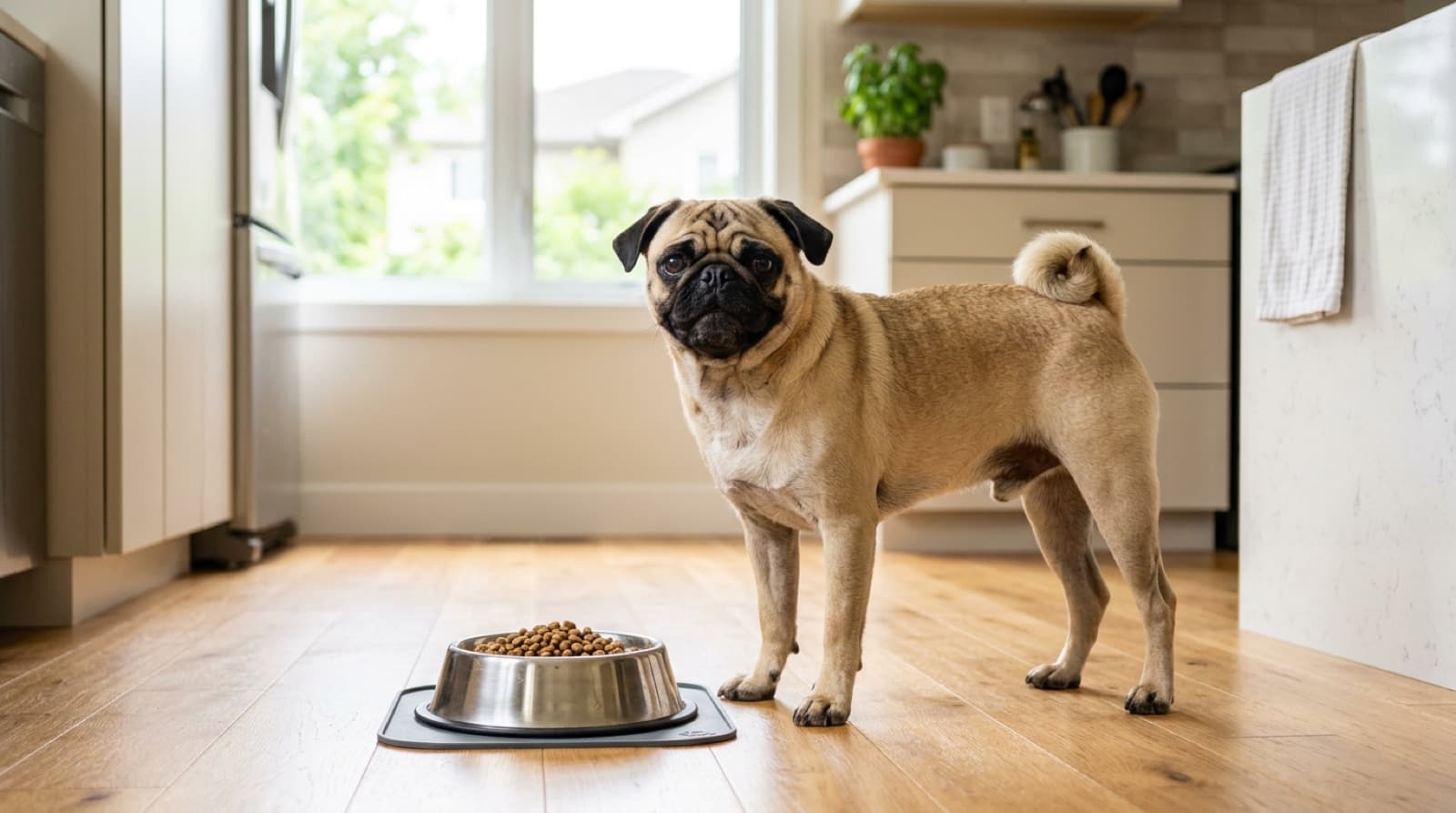
The Edmonton winter Pug reality
Pugs occupy an awkward spot on the cold-weather spectrum. They are bigger than a Pomeranian or a Yorkie, so the pure heat-loss math is slightly more forgiving. They have slightly more body fat than a Frenchie, and some Pug lines carry a thin undercoat that Frenchies lack entirely. Owners who have come from Pomeranian or Frenchie experience often assume the Pug will be the easier winter dog. In Edmonton, that assumption falls apart fast.
The Pug is one of the most popular Edmonton apartment breeds, and the breed lands in Edmonton rescue most often for two reasons: vet bills associated with breathing, eye, or spinal issues, and lifestyle mismatch when an owner expected a low-need lap dog and got a dog with serious medical care requirements. Winter exposes the medical reality. A Pug that coped fine through a Vancouver winter or a Toronto winter can struggle visibly through a January in Edmonton because the cold-air physiology has not been tested at -25C or -30C before.
Three systems are stressed at once in Edmonton cold. The first is heat conservation. The Pug coat is short and provides minimal insulation. The body mass (typically 14 to 18 lbs for a healthy adult Pug) sits between a true toy breed and a Frenchie, so thermal loss is moderate rather than catastrophic, but it is still far faster than on a thick-coated Husky or a heavier Lab. The second is the airway. The brachycephalic build means cold air bypasses the normal nasal warming pathway and hits the soft palate and larynx directly. The American College of Veterinary Surgeons brachycephalic syndrome resources describe the airway anatomy that drives this; the same anatomy that causes summer heat intolerance also causes winter cold-air intolerance.
The third system is unique to the Pug among brachycephalic breeds: the eyes. Pug eyes sit further forward in the skull than most breeds, with shallow orbits and prominent corneas. Cold wind, dry air, and ambient debris all reach the cornea more easily than they would on a deeper-set eye. The Edmonton Pug owner pattern that actually works is the inverse of the Husky pattern: keep the outdoor exposures brief and slow-paced, protect the eyes from wind, keep the indoor day full of gentle mental enrichment, layer the dog in a coat below -5C, and stop trying to meet the exercise budget outdoors.
Cold air aspiration and BOAS in Edmonton winter
A normal-snouted dog has 15 to 20 cm of nasal passage lined with warm vascular tissue that pre-warms inhaled air before it reaches the soft palate and the airways below. A Pug has almost none of that nasal length because of the foreshortened skull. Cold dry Edmonton air, at -25C with low humidity, hits the soft palate and larynx at very close to ambient temperature. That cold air is a direct mucosal irritant, and on an airway already compromised by elongated soft palate, stenotic nares, and (in many Pugs) a hypoplastic trachea or partially everted laryngeal saccules, the irritation produces immediate audible symptoms.
The clinical picture of cold-air BOAS flare is recognisable once you know what to look for. The dog sounds raspier than usual. Snorting and snoring become more pronounced. Breathing becomes audible at rest, not just during exertion. The gums may darken or turn slightly bluish during exercise (a sign of reduced oxygen exchange). Exercise tolerance drops; a Pug that managed a 30 minute walk in October may need to stop and sit after 10 minutes in January. In severe cases, laryngeal spasm can produce gagging, retching, or brief collapse. Cambridge BOAS research and the broader veterinary literature describe these signs as part of the normal BOAS clinical picture, exacerbated by cold dry air.
A Pug that sounds raspier in winter is not adapting; it is in a low-grade BOAS flare for the duration of the cold months. The fix is environmental, not pharmacological in most cases. Shorten the outings. Slow the pace so the dog breathes through the nose rather than the mouth (panting cold air directly into the lower airway is worse than nose breathing). Some Pug owners use a snood to add a warm air buffer in front of the nose; the dog inhales air that has been partly warmed by its own exhaled breath. Most importantly, run a humidifier indoors. Edmonton winter indoor air is brutally dry (often 15 to 25 percent relative humidity in a heated apartment), and that dryness compounds airway irritation when the dog is indoors as well as outdoors.
Do not minimise cold-air aspiration risk. A Pug with diagnosed BOAS, especially one that has had or needs airway surgery, deserves stricter winter limits than the breed average. If the dog has had soft palate resection, nare widening, or saccule removal, the surgery does not undo the underlying cold-air sensitivity; it just gives the dog more margin. Talk to the surgical or primary vet about specific cold-weather limits for your dog.
Temperature thresholds Edmonton Pug owners need to know
Wind chill matters more than ambient. Environment and Climate Change Canada wind chill guidance classifies a wind chill of -28 to -39 as frostbite possible in 10 to 30 minutes on exposed human skin, and -40 to -47 as frostbite possible in 5 to 10 minutes. Those numbers apply roughly to a Pug's exposed nose, ear tips, paw pads, and tail underside, and they cap the safe outdoor session length faster than the ambient thermometer suggests.
The following ranges are for a healthy adult Pug in good condition with no diagnosed severe BOAS, cardiac disease, or spinal disease. Puppies, seniors, post-surgical dogs, and any Pug with respiratory, ocular, or cardiac conditions need stricter limits than the breed average.
+5 to -5C: routine
Walks of 20 to 30 minutes are comfortable for most healthy adult Pugs. Coat is optional for the breed average; thin-coat individuals and Pugs recently transferred from warmer climates benefit from a light fleece. No paw protection needed unless sidewalks are heavily salted. Watch for early BOAS signs even at this mild range; a dog that starts snorting harder than usual in light cold is signalling that the airway is sensitive and the outing should stay short.
-5 to -15C: coat required, watch BOAS
Insulated coat required. Sessions of 15 to 25 minutes. Paw protection (booties or paw wax) becomes valuable but is not yet strictly mandatory unless the dog is walking on heavily salted streets. Slow the pace so the dog breathes through the nose. Watch for raspy breathing, gum colour change, eye squinting from wind, and the dog wanting to stop. Most Edmonton Pugs find this range workable on a sheltered route but become reluctant on exposed sidewalks with prairie wind.
-15 to -25C: coat plus paws mandatory, no sustained exercise
Outdoor sessions drop to 10 to 20 minutes of structured walking. Coat mandatory. Paw protection mandatory. No sustained or aerobic exercise outdoors in this range; the cold-air load on the airway combined with exertion is exactly the combination that produces BOAS flare. Check the ear tips, nose, paws, and tail underside every five minutes; if you see any pale or waxy patches, head home. Sheltered river-valley routes pull ahead of exposed sidewalk routes by a wide margin. Dry the dog fully before any second outing.
-25 to -35C: brief breaks only
5 to 10 minute outdoor sessions only. Bathroom break plus a one-block sniff loop, then back inside. Coat and booties (or wax) mandatory. The walk is not exercise; it is a brief outdoor break to keep the dog mentally connected to the outside world. Move all the day's exercise indoors. This is the highest-risk window for BOAS flare from cold-air aspiration; watch for any sustained raspy breathing, gagging, or the dog wanting to lie down mid-walk.
Below -35C: indoor day
Bathroom breaks only, 2 to 3 minutes each, with the dog returning indoors immediately. Pee pads are a sensible backup for Edmonton Pugs on these days; a -40C day is not the time to insist on a long outdoor potty walk. The AVMA cold weather pet safety guidance is explicit that brachycephalic and short-coated small breeds need shorter cold exposure than thick-coated medium and large dogs regardless of body mass.
Two practical add-ons. First, the dog tells you. Lifted paws, shivering, refusing to walk, sitting down mid-walk, sudden audible breathing, squinting eyes against the wind, or turning toward home are all signs the session is over. A Pug that asks to be carried after two blocks is not being stubborn; it is communicating. Second, the wind chill calculation matters every time. A -22C ambient with a 25 km/h wind from an open boulevard is functionally -33C for the exposed parts, and the thresholds above shift down by one band. Edmonton lacks the Calgary chinook reprieve, so a cold snap that hits -30C can sit there for a week or two rather than breaking back to -5C overnight.
Frostbite signs and emergency response on a Pug
Pug frostbite happens on predictable exposure points, but the timeline is shorter than on a coat-insulated medium dog because the thin coat does not protect the body skin the way a double coat would. The frostbite zones to check after any walk colder than -20C are the ear tips, nose, paw pads, tail underside, and on intact males the scrotum. The curled Pug tail tucks over the back, which protects most of its length, but the underside skin remains exposed.
Stage 1: monitor
Skin looks pale, waxy, or grayish. The area is cold to touch and the dog often does not react to gentle pressure (lost sensation). Get the dog indoors and rewarm the area gradually with lukewarm (not hot) water or warm cloths. Do not rub; friction damages partially frozen tissue. Most stage-one frostbite recovers fully, but the skin will be tender for several days and the area is more vulnerable to refreezing on the next outing.
Stage 2: emergency vet
As the area rewarms it blisters, swells, or turns dark red, blue, or purple. The dog may show pain on touch and may refuse to put weight on a frostbitten paw. This is a vet visit, same day. Edmonton has 24-hour emergency veterinary services; call ahead and head in. Stage-two frostbite on a Pug usually requires pain management, antibiotics for secondary infection, and follow-up wound care.
Stage 3: full emergency
Tissue blackens and dies. The line between healthy and dead tissue (the demarcation line) appears over days. This is a full emergency, immediately. Dead tissue can require surgical removal, and ear tip or tail tip amputation is a real possibility. Stage three is rare in pet Pugs and almost always involves either prolonged extreme exposure or a wet-coat hypothermia event where the dog could not get back indoors.
What not to do
Do not use hot water. Do not use a hair dryer on hot. Do not rub the area to warm it. Do not put the dog in a hot bath. All of those approaches damage partially frozen tissue further. Gradual rewarming, lukewarm cloths or water, and indoor stillness while the area thaws are the right pattern. The Edmonton Humane Society publishes winter pet-care guidance, and the BC SPCA cold weather pet safety guidance covers frostbite first-response in detail. Edmonton 24-hour emergency vet clinics stay open through the worst weather.
Pug eye care in Edmonton cold
The Pug winter feature that catches most new owners off guard is the eyes. Pug eyes sit further forward in the skull than most breeds, with shallow orbits and prominent corneas. Wind, dry air, blowing snow, and even small debris reach the cornea directly. The breed is also predisposed to dry eye (keratoconjunctivitis sicca), corneal ulcers, pigmentary keratitis, and entropion (inward-rolling eyelid). Edmonton winter conditions stress every one of those.
Cold wind and dry eye
Dry indoor heating air sits at 15 to 25 percent relative humidity for most of an Edmonton winter, and outdoor cold air is even drier in absolute moisture content. Both deplete the tear film that protects the Pug cornea. A dog that already has marginal tear production (a common Pug finding) will show worsening squinting, mucus-like discharge, and rubbing at the eyes through the cold months. Vet-prescribed eye lubricant drops applied before outdoor walks help measurably for diagnosed dry-eye Pugs, and a routine Schirmer tear test from your vet is worth scheduling if you have a Pug entering its first Edmonton winter and have never had baseline tear measurements done.
Corneal ulcers
Pug corneas are more vulnerable to injury than deeper-set eyes. A blowing snow particle, a low branch, an over-enthusiastic face rub against a frozen carpet, or chronic eye rubbing from dry eye can all start a corneal ulcer. Signs are squinting, holding the eye closed or partially closed, visible cloudiness or a white spot on the cornea, redness, and tearing. A suspected corneal ulcer is a same-day vet visit. Untreated ulcers can progress to deep ulcers, descemetoceles, or perforation within 24 to 48 hours in a Pug. Treatment is straightforward when caught early (topical antibiotics, pain control, e-collar) and complicated when caught late.
Wind protection
Short-brimmed dog visors and snoods that partially shield the face from direct wind help some Pugs, especially those with diagnosed eye conditions. Most Pugs tolerate them after a few short positive-reward sessions. The simpler intervention is route choice: sheltered river-valley paths beat exposed boulevards on windy days. A windy -10C day on an open prairie sidewalk is harder on Pug eyes than a still -20C day in the Mill Creek Ravine.
Browse adoptable Pugs in Edmonton
Pugs in Edmonton rescue come with foster notes that flag observed cold tolerance, BOAS severity, eye-condition history, and indoor exercise preference. Foster temperament reads tell you which dogs have settled into Edmonton winter outings already and which need acclimation time.
See Edmonton Adoptable Dogs →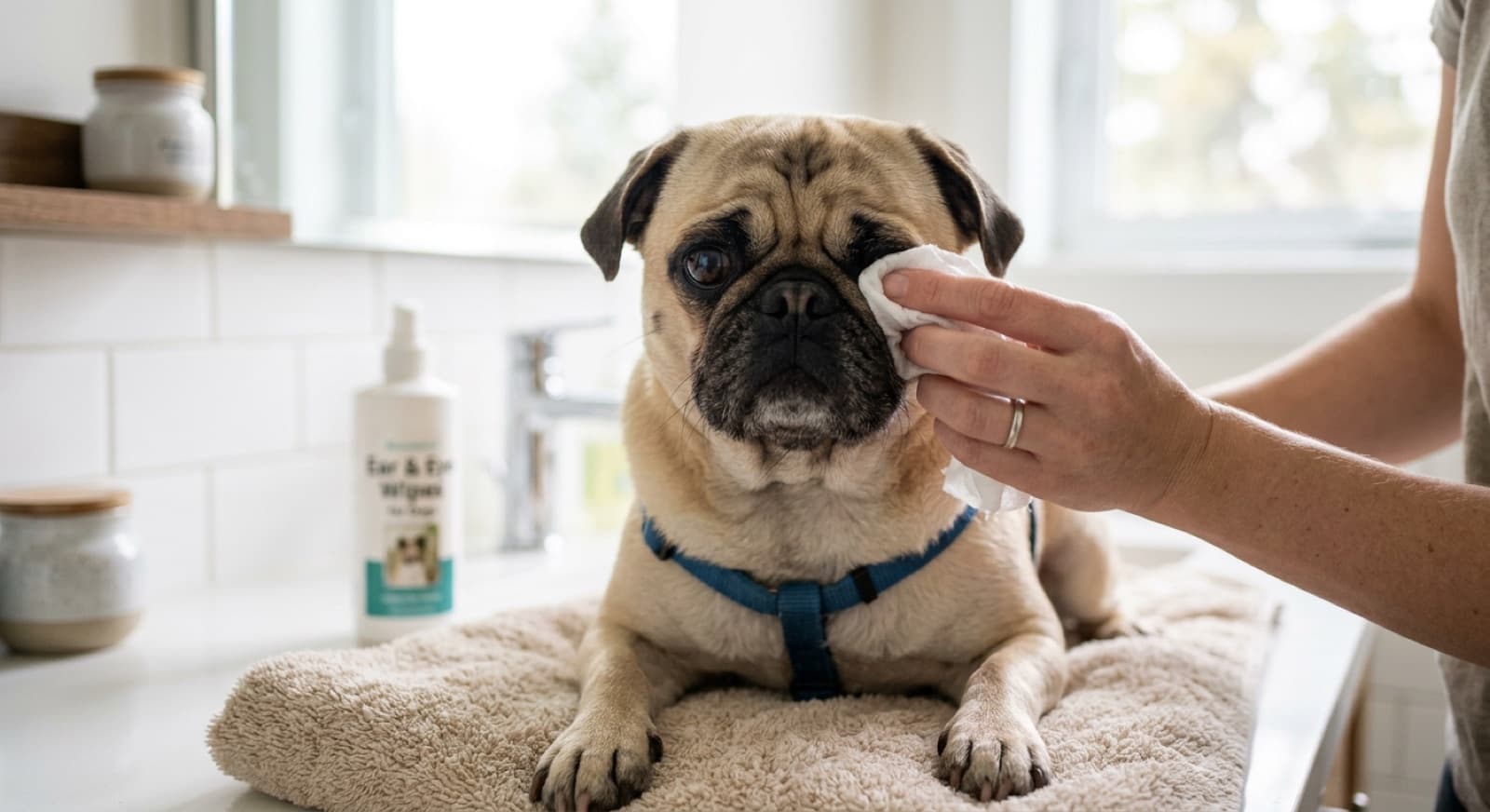
The Pug winter coat and bootie fit reality
Pug body proportions complicate winter gear. The chest is broad and barrel-shaped, the back is short, the neck is thick, and the body is compact. Most off-the-shelf small-dog coats are cut for a longer torso (think Dachshund or Yorkie proportions), so a small coat fits a Pug's length but rides up at the chest, while a medium coat fits the chest but hangs past the tail. Expect to try two or three coats before finding the right fit.
Coat coverage and fit
The Pug coat that works best is cut for bulldog-shaped bodies (broad chest, short back, wide neck opening) and covers the chest, belly, and shoulders without restricting the legs. An adjustable Velcro chest closure handles the proportional difference between dogs. Insulation matters more than waterproofing for most Edmonton conditions because Edmonton winter snow is dry powder rather than wet sleet; a quilted or fleece-lined coat with a windproof shell outperforms a heavy waxed-canvas coat for most Pugs.
The bootie fit problem
Pug paws are small and round with prominent toes, and most booties on the Canadian market need a size-up to fit comfortably. The build-up pattern that works is short indoor sessions with food rewards, working up to outdoor wear in mild cold before deploying in deep cold. Many Pugs refuse boots at first; the high-step gait on the first wear is normal and resolves within a week of consistent practice.
Paw wax as the default
For Pugs that genuinely refuse booties (a meaningful minority), paw wax is the everyday solution. A thick beeswax-based barrier applied to the pads before walks blocks salt absorption and reduces drying. Apply 5 minutes before the walk so the wax sets. Reapply for any second outing. The wax wears off through the walk, which is what you want; it is doing its job. Most Edmonton Pug owners settle on paw wax as the everyday solution and reserve booties for the deepest cold or longest outings.
The post-walk salt rinse
Mandatory after any walk on salted sidewalks, with or without wax or booties. Rinse all four paws in lukewarm water in the kitchen sink or a bowl by the door. Salt left on the pads continues to dry and irritate the skin after the walk, and a Pug licking salt off its paws can ingest enough to cause vomiting. The post-walk paw rinse is the single highest-impact winter routine an Edmonton Pug owner can build. It takes two minutes and prevents most winter paw injuries.
Indoor exercise on extreme-cold days
The Pug exercise budget is small and weighted heavily toward mental rather than aerobic work. Most healthy adult Pugs need 30 to 40 minutes of distributed activity per day, and indoor mental work counts double for a Pug brain. On a -40C Edmonton day, the indoor routine fully replaces the walk and the dog goes to bed satisfied. The critical rule is that Pugs cannot substitute high-impact play for missed walks; the BOAS airway cannot sustain it, and overheated indoor exertion in a heated apartment triggers the same airway distress that summer heat does.
Puzzle feeders
The single highest-value indoor enrichment for a Pug. Feed every meal from a puzzle toy rather than a bowl. A 10 minute work session for a meal that would have taken 90 seconds from a bowl is genuine mental exercise. Rotate two or three different puzzle types so the dog does not memorise the solution. Starter puzzles in the $15 to $30 range are widely available at Edmonton pet stores; the more advanced multi-step puzzles run $40 to $70. Pugs are highly food-motivated, which makes them especially responsive to puzzle work.
Scent games and snuffle mats
Hide a few small treats around the apartment and let the dog find them. A Pug that has not done scent work before may need to be shown the pattern the first few times; once they catch on, this becomes 15 to 20 minutes of focused work for a 5 minute setup. Snuffle mats (fabric mats with hidden treats tucked into folds) are a structured version of the same exercise for small spaces. Scent work is the safest indoor substitute for outdoor exercise on a brachycephalic breed because it does not require sustained respiratory effort.
Trick training
Pugs learn tricks well in short reward-based sessions. Five to ten minute blocks several times a day add up to real mental exercise. Force-free, reward-based training methodology is the standard recommended by the American Veterinary Society of Animal Behavior for all breeds; for a brachycephalic breed, force-free is also the only training approach that does not aggravate the airway through stress-induced panting.
Gentle indoor play
Brief gentle fetch in a long hallway, controlled short tug with a soft toy, slow find-it games. Avoid sustained running, jumping off furniture, and wrestling. Pugs have short spines vulnerable to intervertebral disc disease, so any high-impact indoor play risks both an airway flare and a spinal injury. Most Edmonton Pug owners settle into a pattern of three or four short play sessions per day rather than one long block.
What does NOT work
High-impact substitute exercise. Sustained indoor fetch. Wrestling with other dogs in a heated apartment. Stair sprints. A Pug that has not been able to walk outside for a week needs MORE mental enrichment, not more physical exertion. Trying to compensate for missed walks with aerobic indoor play is the single most common winter mistake Edmonton Pug owners make, and it produces a tired, panting, airway-distressed dog rather than a satisfied one.
Indoor humidity and the dry-air airway problem
Edmonton winter indoor air is brutally dry. A heated apartment in January often runs at 15 to 25 percent relative humidity, and that dryness is hard on a Pug airway even before the dog steps outside. The dry indoor air pulls moisture from the soft palate and laryngeal mucosa, leaving the airway more reactive to the cold outdoor air that follows. Dry indoor air also worsens dry eye and tear-film stability for the prominent Pug cornea.
A humidifier near where the Pug sleeps helps measurably for many dogs. The target is a relative humidity of 35 to 45 percent in the room where the dog spends most of its time. Cool-mist humidifiers are safer than warm-mist (no burn risk) and are widely available in Edmonton. Run it through the heating season, clean the reservoir weekly to prevent mineral buildup, and monitor the room with a cheap hygrometer ($10 to $20). Some Pug owners report that the indoor humidifier alone reduces overnight snoring noticeably, which is a useful proxy for whether the airway is in a more comfortable state.
The humidifier does not fix the outdoor cold-air problem; that is environmental and unavoidable. But reducing the indoor airway baseline irritation means the dog enters every winter walk with less inflammation already in the airway, and the walk is better tolerated. The same intervention helps the eye surface, particularly for Pugs with diagnosed dry eye who already use prescription lubricant drops. This is one of the small high-leverage interventions that distinguishes Edmonton Pug owners who manage the breed well from owners who fight winter the whole season.
Travel and boarding in deep winter
Travel in deep winter is harder on a Pug than on almost any other breed. The combination of stress (which raises respiration rate), cold-air exposure during transit, and unfamiliar environments stacks airway pressure on a dog that already has limited respiratory reserve. The honest rule is to minimise travel during Edmonton deep winter when possible, and plan carefully when it is not.
Car transit. Pre-warm the car before loading the dog. Keep transit short. Carry a coat for the dog from house to car and car to destination. Never leave a Pug in a parked cold vehicle; the small body mass loses heat fast in a cold cabin even with the engine off only briefly. The same brachycephalic anatomy that causes summer heat distress causes winter cold distress in a parked car.
Boarding in deep cold. If you must travel, board the dog with someone who genuinely understands BOAS, not a generic kennel that treats Pugs like any other small dog. Boarding stress raises respiration rate, and a stressed Pug in a cold facility with frequent outdoor potty breaks is at higher risk of an airway crisis than a settled home dog. Better options are a Pug-experienced in-home sitter who keeps the dog at your home or theirs, or a small-roster boarding setup that limits outdoor time on deep-cold days and brings the dog inside quickly if breathing becomes laboured. Discuss BOAS specifically with any boarder before drop-off.
Air travel. Most airlines now restrict or refuse brachycephalic breeds in cargo because of the documented mortality risk. In-cabin small-breed travel is generally safer for a Pug that fits the carrier requirements, but the cold ground transit from terminal to airplane can still be hard on the dog. If air travel with a Pug is unavoidable, choose flights with the shortest ground time and ask the airline about their brachycephalic policy in writing before booking.
Senior Pugs in Edmonton winter
Older Pugs (roughly 9 years and up) need a tighter winter routine than the breed average. Several things stack at once. Joint stiffness is more pronounced in cold; a senior Pug that managed summer walks may resist leaving the apartment in deep cold because the cold makes the joints hurt. BOAS often worsens with age as soft palate tissue becomes more redundant and laryngeal cartilage weakens. Eye conditions (dry eye, pigmentary keratitis, cataracts) progress with age. Cardiac disease becomes more common and reduces cold tolerance further.
Practical add-ons. An insulated coat is mandatory below freezing for most seniors, not below -5C. Warm-up movement (five minutes of indoor walking before going outside in cold) helps loosen stiff joints. Joint supplements (glucosamine, chondroitin, omega-3) prescribed by a vet help some senior Pugs tolerate cold better. Pee pads as a backup for the worst-weather days take pressure off both the dog and the routine; a senior Pug does not need to prove anything by walking outside in -35C.
Cardiac signs to watch for in winter: increased cough that does not resolve, exercise intolerance, and any episode of fainting or collapse. Senior Pug hearts can decompensate in cold weather, and the right move is a vet check before assuming the dog is just slowing down. Distinguishing a BOAS flare from a cardiac event is not something an owner can reliably do at home; that is what the vet visit is for.
Pug Dog Encephalitis and cold stress
Pug Dog Encephalitis (PDE), also called Necrotizing Meningoencephalitis, is a breed-specific autoimmune inflammation of the brain. It is most often diagnosed in young adult Pugs (1 to 7 years old), and the cause is incompletely understood. Stress is described in the veterinary literature as one of several recognised triggers for clinical onset or relapse, alongside genetic predisposition and (in some lines) a specific dog leukocyte antigen haplotype. Cold stress, drastic temperature shifts, and the broader stress load of an Edmonton winter routine could reasonably be considered part of that stress picture, though no published study isolates cold as a single trigger.
The honest framing for Pug owners is this. PDE is rare overall but devastating when it occurs, and most affected dogs progress over weeks to months. Cold stress in itself does not cause PDE in a healthy Pug. But for a Pug already diagnosed with PDE, or a Pug from a known-affected line, managing total stress load through winter is reasonable defensive husbandry: shorter outings, indoor enrichment instead of frantic activity, consistent routine, and prompt vet consultation for any new neurological signs (seizures, circling, head tilt, vision changes, sudden behaviour change).
The relevant ask for adopters: ask the rescue whether the Pug came from a line with known PDE history, whether any littermates were affected, and whether the dog has had any neurological screening. Most Edmonton rescue Pugs do not have this history available, which is normal. The reasonable approach is to know what PDE signs look like and have a low threshold for vet evaluation rather than to manage hypothetically.
Adopting a Pug from a warmer climate
The Pug does not develop a winter coat the way a double-coated breed does, so acclimation is mostly behavioural and respiratory rather than thermal. The dog learns to tolerate brief cold-air exposure without panicking, and the airway gradually adjusts to the dry indoor and outdoor air. A Pug that has lived its life in coastal Vancouver, a southern province, or any milder climate will need genuine acclimation time before it tolerates Edmonton winter the way a locally raised Pug does.
Late autumn adoption (October to early December). The dog acclimates gradually as Edmonton temperatures drop through the season. The first deep cold snap arrives after the dog has had four to six weeks of progressively colder outdoor time. Most foster-network transfer Pugs do well on this timeline. Pair with the 3-3-3 decompression rule for the first 30 days and keep winter outings conservative regardless of the dog's background.
Deep winter adoption (January to February). A Pug arriving from a milder climate hits -30C in the first week. The airway has not been tested against deep cold dry air, and the eyes have not been exposed to prairie winter wind. Shift the temperature thresholds above down by one band for the first eight to ten weeks. Be more conservative with session length. Some Pugs tolerate the shock fine; others refuse to leave the apartment for several days and need careful acclimation through repeated brief outdoor trips. Both responses are normal.
Spring adoption (March to May). The easiest decompression season for any Edmonton rescue dog. The Pug adjusts to Edmonton as it warms, has the full summer and autumn to settle into the household, and meets the first Edmonton winter as an established family member rather than a brand-new adopter. Most Edmonton rescue staff recommend spring adoption for first-time Pug owners specifically because the first winter is then a known-dog situation.
Edmonton rescues placing Pugs (SCARS, Edmonton Humane Society, Zoe's Animal Rescue) generally know the foster home's climate and the dog's observed cold tolerance, BOAS severity, eye-condition history, and airway baseline. Ask. The honest foster read on a specific dog is more useful than the breed-average answer.
Frequently asked questions
How cold is too cold for a Pug in Edmonton?
For a healthy adult Pug, +5 to -5C is routine, -5 to -15C requires a coat and 15 to 25 minute sessions, -15 to -25C requires coat plus paw protection and drops sessions to 10 to 20 minutes with no sustained exercise, -25 to -35C limits outdoor time to brief 5 to 10 minute potty breaks, and below -35C is an indoor day with 2 to 3 minute bathroom breaks only. The thresholds are tighter than for a similarly sized non-brachycephalic dog because cold dry Edmonton air triggers BOAS (Brachycephalic Obstructive Airway Syndrome) flare-ups on top of the normal heat-loss problem. Puppies, seniors, and any Pug with diagnosed BOAS, cardiac, or spinal disease need stricter limits than the breed average.
Can a Pug live in Edmonton winter at all?
Yes, with a structured indoor-heavy routine and conservative outdoor exposure. Pugs are one of the most popular Edmonton apartment dogs because their exercise budget is small, indoor mental enrichment satisfies most of it, and short bundled potty walks meet the outdoor need. A Pug in a heated Edmonton condo with a thoughtful winter plan does better than a high-drive working breed left under-exercised in the same conditions. The catch is that Pugs cannot substitute high-impact play for missed walks; the BOAS airway cannot sustain it, and overheated indoor exertion triggers the same airway distress that summer heat does.
What is cold air aspiration in a Pug and why does it matter?
A normal-snouted dog warms inhaled air through a long nasal passage before it reaches the airways. A Pug has almost no nasal length because of the brachycephalic build, so cold dry air hits the elongated soft palate and narrowed nares without pre-warming. That cold air is a direct airway irritant, and it triggers or worsens BOAS symptoms: snorting, raspy breathing, gagging, exercise intolerance, and in severe cases laryngeal spasm. A Pug that sounds raspier on a January walk than it did in October is not adapting; it is in a BOAS flare. The fix is shorter outings, slower pace, and a warm air buffer (a snood or coat that covers the muzzle area in deep cold) for some dogs.
What does Pug frostbite look like?
Early frostbite on a Pug shows on the ear tips, nose, paw pads, tail (curled tightly over the back, but exposed underneath), and on intact males the scrotum. The skin looks pale, waxy, or grayish and feels cold to touch. The dog often stops reacting to gentle pressure on the area. Because Pugs have minimal coat insulation and small body mass, frostbite progresses faster than on thick-coated medium dogs. At stage two the area blisters or turns dark and swollen as it rewarms; any visible blistering or persistent discolouration is an emergency vet visit, same day. Rewarm gradually with lukewarm cloths, never with hot water or rubbing.
Does a Pug need a winter coat in Edmonton?
Yes, below about -5C for most Pugs and below freezing for seniors, thin-coat individuals, or any dog recently transferred from a warmer climate. The Pug coat is a short single layer with minimal undercoat (some Pug lines carry slightly more undercoat than Frenchies, but most provide little insulation). A well-fitting insulated coat that covers the chest, belly, and shoulders without restricting the legs is the standard Edmonton Pug setup from late October through March. Fit is challenging because Pugs are barrel-chested with short backs and a thick neck. The coat supplements the body coat; it does not replace shortening the walk in deep cold.
Why do Pug eyes need extra winter protection?
Pugs have prominent, shallow-set eyes that sit further forward in the skull than most breeds. Cold wind and dry air irritate the cornea directly, and Pugs are already prone to dry eye (keratoconjunctivitis sicca), corneal ulcers, and pigmentary keratitis. A walk on a windy -20C Edmonton day can leave a Pug squinting, tearing, or rubbing at its eyes when you get home. Many Edmonton Pug owners use vet-prescribed eye lubricant before deep-cold walks, especially for dogs already diagnosed with dry eye. Any persistent squinting, holding an eye closed, or visible cloudiness needs same-day vet attention; corneal ulcers in Pugs can progress quickly.
Do Pugs need boots in Edmonton winter?
Most Pugs benefit from boots on heavily salted streets and in any sustained outdoor session below -15C, but fit is real work. Pug paws are small and round with prominent toes, and most boots on the Canadian market need a size-up to fit comfortably. The build-up pattern that works is short indoor sessions with food rewards, working through tolerance over several weeks. Many Edmonton Pug owners settle on paw wax (a thick beeswax-based barrier applied to the pads before walks) as the everyday solution and reserve boots for the deepest cold or longest outings. A post-walk paw rinse in lukewarm water removes residual salt either way and prevents the pad-cracking that drives most winter paw injuries.
How do I exercise a Pug indoors on a -40C Edmonton day?
Pug indoor exercise is mostly mental and gentle, not aerobic. The combinations that work: puzzle feeders for every meal, short scent games hiding treats around the apartment, structured trick training in 5 to 10 minute blocks several times a day, gentle indoor fetch in a long hallway, and brief controlled tug with a soft toy. What does NOT work for a Pug is high-impact substitute exercise. Pugs cannot sprint, jump, or wrestle hard to make up for a missed walk because the BOAS airway cannot sustain it. A 30 to 40 minute distributed mental routine is enough for most adult Pugs on a deep-cold day.
Why does my Pug sound raspier in winter?
Cold dry Edmonton air aggravates the BOAS airway. Most Pugs have some combination of stenotic nares (narrowed nostrils), an elongated soft palate, and a hypoplastic trachea. Cold dry air irritates each of those structures, and the dog responds by snorting, breathing harder through the mouth, and showing the raspy sound owners notice in winter. A Pug that sounds normal in summer and raspy in January is not adapting; it is in a low-grade BOAS flare for the duration of the cold months. Shorten the outings, slow the pace so the dog breathes through the nose, run a humidifier indoors to add moisture to dry indoor air, and book a vet check if the raspy breathing persists indoors or worsens with mild exertion.
I am adopting a Pug from a warmer climate. How long does Edmonton winter acclimation take?
Plan for eight to twelve weeks of conservative routine for the first Edmonton winter, and longer if the dog comes from coastal BC, a southern province, or any climate that did not introduce the dog to sub-zero air. The Pug does not develop a winter coat the way a double-coated breed does, so acclimation is mostly behavioural and respiratory rather than thermal. Shorten the temperature thresholds in this guide by one band for the first six weeks. Most Edmonton rescues placing Pugs will share the foster home location so you know what climate the dog has been acclimated to.
Related Edmonton Pug guides
Adoptable Dogs in Edmonton
Browse current dogs listed with Edmonton-area rescues, including Pugs and Pug mixes. Updated regularly.
Pug Adoption Edmonton
Edmonton Pug rescue sources, adoption costs, foster acclimation, and breed-vs-buy honesty.
Pug Health Issues: Breathing, Eyes, Spine
Pug health issues to plan for: short-nose breathing and heat, eye injuries, skin folds, weight, spinal disease in older Pugs, mast cell tumours and Pug dog encephalitis.
Pug Weight Management Edmonton
The Pug obesity epidemic in Edmonton winter, calorie math, indoor exercise programming, and the BOAS-obesity feedback loop.
New dog? Start with these care guides
Everything a new adopter needs to set up a safe, happy home.