The short answer
Edmonton Pug obesity is a stacked problem: a food-motivated breed, a small body where 2 extra lbs is significant, a brachycephalic airway where every kilogram loads breathing, and a 4 to 5 month winter window when outdoor exercise drops sharply. Healthy Pugs run 14 to 18 lb; obese Pugs commonly hit 22 to 28 lb at vet weigh-ins. The target is Body Condition Score 4 to 5 of 9. The plan: roughly 30 kcal per kg per day at maintenance, a 10 to 15 percent winter food cut, treats capped at 10 percent of daily calories, and structured indoor enrichment to replace lost outdoor minutes. Partner with the vet to rule out hypothyroidism before treating weight gain as a discipline problem.
Why Pugs gain weight so fast
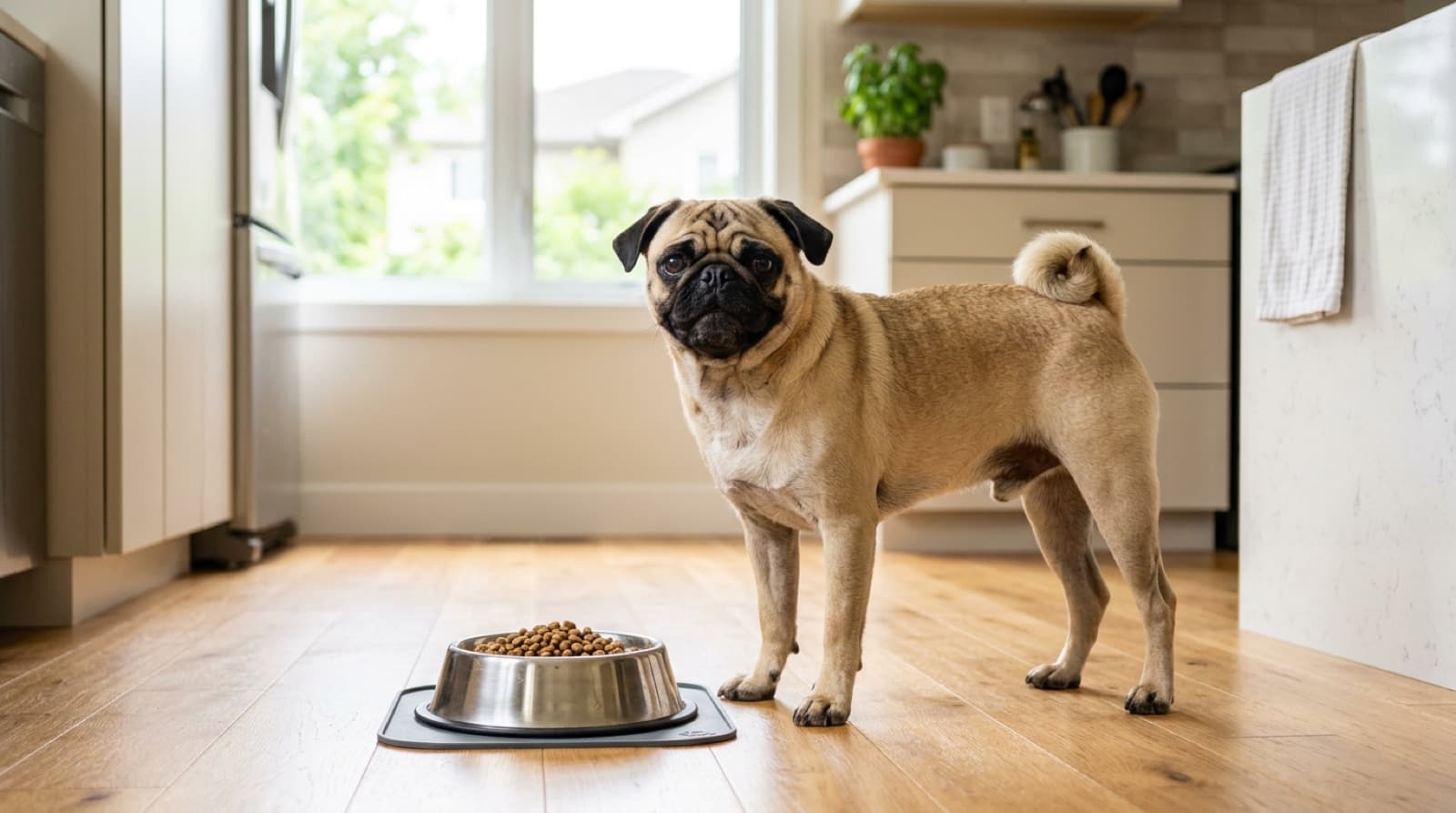
Pugs are one of the most food-motivated breeds in the toy and small-breed group. The breed was developed in China as a companion dog for emperors, and the temperament selection across centuries emphasized food drive as a training and bonding tool. Modern Pugs will work for food the way some sporting breeds work for prey, and they will eat the food regardless of whether they are hungry, regardless of whether the meal is theirs, and regardless of whether the bowl is on the floor or the kitchen counter.
On top of the drive, the body math works against them. A Pug stomach is small. A Pug daily calorie budget is small. A few extra training treats or table scraps add up to a meaningful percentage of daily calories quickly. A 50 kcal treat for a Lab is 4 percent of daily intake; the same treat for a Pug is 20 percent. The mathematical sensitivity to overfeeding is much higher than for a larger breed.
The ASPCA pet weight management guidance notes that more than half of North American pet dogs are overweight or obese. For Pugs specifically, the rate is among the highest of any small breed. Most pet Pugs in Edmonton homes are running BCS 6 to 7, which owners see as normal because that is what most Pugs look like.
Then Edmonton winter arrives. From late October through April, outdoor exercise volume drops 30 to 50 percent for a typical Pug household because the brachycephalic airway cannot sustain cold-air exertion and deep cold limits session length even with a coat on. Most owners do not adjust food. The weight creeps on. By March, the dog is 2 to 4 lbs heavier than they were in September. Half is lost over the summer. The next winter starts a pound or two above the previous baseline. Across four winters, the pattern produces a 6 to 10 lb gain on a dog whose total healthy weight is 14 to 18 lb.
Why Pug obesity is uniquely dangerous
Pug obesity compounds five separate breed-specific risks at once. Each one amplifies the others, which is why a moderately overweight Pug presents clinically like a lean Pug with severe disease.
BOAS amplification
Brachycephalic Obstructive Airway Syndrome (BOAS) is the breathing problem nearly every Pug carries to some degree. Stenotic nares (narrowed nostrils), an elongated soft palate, and a hypoplastic trachea combine to make breathing harder than for a long-snouted breed. Every extra pound on a Pug loads that airway, increases respiratory effort, worsens snoring and snorting, reduces exercise tolerance, and raises the risk of acute respiratory crisis during heat or stress. See the Pug health issues guide for the BOAS surgical timing and cost.
Orthopaedic compounding
Pugs carry above-breed risk for patellar luxation, hip dysplasia, hemivertebrae (a spinal malformation common in screw-tailed breeds), and intervertebral disc disease. Obesity multiplies the clinical severity of all of them. An overweight Pug with mild hip dysplasia presents like a lean Pug with severe dysplasia. The dog stops moving voluntarily because moving hurts, which compounds the weight problem in a feedback loop.
Heat intolerance
Pugs cool primarily through panting, and the brachycephalic airway makes panting less efficient than for a long-snouted breed. Obesity worsens heat dissipation further by adding insulating fat and raising metabolic load. An overweight Pug overheats at a lower ambient temperature than a lean Pug, which matters during Edmonton summers and on warm indoor heating days in winter.
Cardiac strain
Chronic obesity adds workload to the cardiovascular system. Combined with the existing respiratory effort from BOAS, an obese Pug works harder at rest than a lean Pug, accelerating cardiac wear over the dog lifespan.
Reduced lifespan
Lean dogs live meaningfully longer than overweight dogs across multiple peer-reviewed studies. The AAHA weight management guidelines cite a lifespan reduction of around 2 years in dogs maintained at BCS 6 to 7 compared to BCS 4 to 5 across their adult years. For a breed whose median lifespan is already 12 to 15 years, that is a 15 percent loss. Weight management is the single highest-leverage thing an Edmonton Pug owner can do for their dog.
Body Condition Score: how to check at home
Body Condition Score is the veterinary tool that matters more than scale weight. The WSAVA global body condition standards use a 9-point scale where 1 is emaciated, 5 is ideal, and 9 is severely obese. For Pugs, target BCS 4 to 5. The monthly home check has three parts; do it the same day each month and write down the result.
Rib check
Place flat hands on the Pug ribcage at chest level and apply light pressure. You should feel each rib through a thin layer of fat, similar to feeling knuckles through skin. If you have to press firmly to feel ribs, the Pug is overweight (BCS 6 or higher). If ribs are clearly visible from across the room without touching, the Pug is underweight (BCS 3 or lower).
Waist check from above
Stand directly over the Pug and look straight down. There should be a visible narrowing behind the ribcage (the waist). A straight side-to-side line from chest to hips means overweight. A pronounced narrowing that looks underfed means underweight. Pugs naturally have a barrel chest, so the waist is subtle even at lean weight; you are looking for any narrowing rather than a dramatic hourglass.
Abdominal tuck from the side
From the side view, the abdomen should slope upward from the bottom of the chest to the hindquarters. A belly that hangs straight or sags down is overweight. The tuck should be visible but subtle; Pugs do not have the dramatic tuck of a sighthound.
Realistic Edmonton picture: most rescue Pugs arrive at BCS 6 or 7. Many shelter intake notes will say the dog “needs to lose weight” in the medical chart. Take the note seriously. Plan the first 4 to 6 months as a managed weight-loss period and then settle into maintenance at BCS 4 to 5.
Photos help. Take three each month: one from above, one from the side standing, one from the side sitting. The visual change is slow and easier to track in photo comparisons than in the moment.
The Pug calorie math
Kibble bag recommendations are typically 25 to 40 percent too high for Pugs. Manufacturer feeding guidelines are calibrated for high-activity dogs rather than the typical pet Pug, and the bag math over-feeds at every life stage. Directional adult Pug calorie ranges using a quality kibble at roughly 350 to 450 kcal per cup:
- 14 lb (6.4 kg) lean Pug, normal activity: roughly 190 kcal a day, split into two meals. About 1/2 cup of quality kibble.
- 16 lb (7.3 kg) lean Pug, normal activity: roughly 220 kcal a day. About 1/2 to 2/3 cup.
- 18 lb (8.2 kg) lean Pug, normal activity: roughly 245 kcal a day. About 2/3 to 3/4 cup.
- Winter adjustment for any size: reduce 10 to 15 percent from October through March. A 16 lb Pug on 220 kcal summer goes to 190 kcal winter.
- Active weight loss for an overweight Pug: reduce 20 to 25 percent from maintenance until target BCS reached, typically 4 to 6 months. Recheck with the vet at 6 to 8 weeks.
Two rules change the outcome more than the specific number. Weigh kibble in grams on a kitchen scale, not in cups. Cup measurements drift 20 to 30 percent between bags, owners, and tired evening feeders. At Pug portion sizes (50 to 70 grams per meal), that drift IS the weight problem. A digital kitchen scale costs $15 and pays for itself in vet bills.
Feed two meals on schedule, never free-feed. A Pug will eat all available food immediately and ask for more. Free-feeding is the single fastest path to obesity in the breed. Twice-daily measured meals (morning and evening) plus a small lunch portion if the dog handles the gap poorly works for most Edmonton Pug schedules.
Food selection: kibble, slow feeders, weight formulas
For most healthy adult Pugs at BCS 4 to 5, a quality adult maintenance kibble at measured portions is sufficient. The brand matters less than the portion discipline. Look for a kibble with a named meat as the first ingredient, moderate calorie density (350 to 450 kcal per cup), and a complete nutritional profile that meets AAFCO standards for adult dogs. Higher protein and moderate fat work well for the breed; avoid kibbles with excessive added fat as the first few ingredients.
Slow-feeder bowls and puzzle feeders are the single highest-leverage non-food intervention for a Pug. The breed inhales food. A bowl-fed Pug finishes a meal in 60 seconds and signals hunger again 30 minutes later. A slow-feeder bowl stretches the same meal to 5 to 10 minutes, which engages the satiety pathway and reduces between-meal begging. Puzzle feeders stretch it to 15 to 20 minutes and double as mental enrichment. Both run $10 to $30 at most Edmonton pet stores. For a brachycephalic breed, choose a slow feeder with shallow ridges rather than deep maze patterns, because the short muzzle struggles to reach into deep grooves.
Prescription weight-management formulas come into play for BCS 7 to 9 Pugs where DIY calorie reduction is not moving the dog after 8 to 12 weeks. Talk to your vet about which prescription diet suits your specific Pug. These formulas have a stronger satiety effect (higher fiber and protein), which matters because the Pug will feel less hungry between meals. Plan on 6 to 12 months on the diet for moderate weight-loss programmes, paired with monthly weigh-ins.
When transitioning a Pug to a new food, do it over 7 to 10 days rather than overnight. Sudden food changes cause GI upset, and a Pug with a queasy stomach will refuse the new food. Mix in 25 percent new with 75 percent old for 3 days, then 50/50 for 3 days, then 75/25 for 3 days, then full new food.
The treat problem: 10 percent rule
Treats should be 10 percent of daily calories or less. For a Pug eating around 200 kcal a day, that is 20 kcal of treats. Most commercial training treats run 5 to 15 kcal each, which means 2 to 3 treats a day is the entire budget. Most owners are well past that by mid-morning.
The single most effective Pug treat strategy is using kibble as training treats. Pull 1 to 2 tablespoons out of the daily kibble allowance, use it for training and rewards, and feed the remaining kibble at meals. Zero extra calories. Most Pugs are food-motivated enough that kibble works as a reward with no quality drop.
Low-calorie alternatives that add volume without calories:
- Green beans (canned no-salt or fresh, around 30 kcal per quarter cup). The classic small-dog weight-loss treat; many vets recommend replacing 20 to 25 percent of kibble volume with green beans during active weight loss.
- Baby carrots (around 5 kcal each). Crunchy and welcome; cut into Pug-sized pieces to prevent choking.
- Cucumber slices, minimal calories, hydrating.
- Plain canned pumpkin (not pie filling, around 20 kcal per tablespoon). Helps satiety and digestion.
- Ice cubes, zero calories. Most Pugs love them but watch for tooth wear in seniors.
- Blueberries (around 1 kcal each). Antioxidants and high-value reward.
Avoid: grapes and raisins (toxic), anything seasoned or fried, anything with onion or garlic (toxic), large hard bones (Pug teeth and jaws are not built for them), and high-fat dental chews that often exceed 50 kcal each.
The hardest part of treat management is household coordination. Every family member needs to count treats together. A Pug works each person separately, and the dog will collect three different sets of treats every day if nobody is tracking. Designate one person as the treat counter and keep a daily count visible (a sticky note on the fridge, a shared notes app, anything).
Browse adoptable Pugs in Edmonton
Most Pug surrenders in Edmonton arrive at BCS 6 or 7. A foster-tested weight assessment plus the rescue medical notes tell you what the first 4 to 6 months of weight-loss work will look like before you commit.
See Edmonton Adoptable Dogs →
Edmonton winter exercise: indoor heavy, outdoor light
The Pug winter exercise challenge is that you cannot substitute high-intensity indoor play for missed outdoor walks. A working breed losing a walk can do 20 minutes of indoor fetch or tug to make up the calories. A Pug cannot. The BOAS airway will not sustain that level of effort, and pushing past it triggers respiratory distress. The replacement strategy is mental work plus short distributed movement.
The Edmonton winter Pug routine that works for most households:
- Two or three short outdoor walks of 10 to 20 minutes each at a slow sniff-friendly pace. Better than one long walk for both calorie burn and BOAS tolerance. Coat plus paw protection at sub-zero temperatures; see the Pug winter care Edmonton guide for temperature thresholds.
- Puzzle feeders for every meal, 15 to 20 minutes of mental work per meal that doubles as portion control.
- One scent-game block of 10 to 15 minutes: hide small portions of the daily kibble allowance around the apartment and let the Pug hunt.
- Two short trick-training sessions of 5 to 10 minutes each. Mental work burns calories and tires the dog harder than passive movement.
- Frozen Kong prepared the night before, stuffed with the day's kibble allowance mixed with a small amount of plain canned pumpkin or wet food. Stretches a meal to 20 to 40 minutes.
On deep-cold days (below -25C), skip the long walk entirely and run the indoor routine twice. Distributed gentle movement plus mental enrichment will keep a Pug settled. The AVMA cold weather pet safety guidance is explicit that brachycephalic breeds are at elevated risk in cold air, which adds another reason to keep winter sessions short.
Summer, spring, and fall: frequency over duration
Even in warm Edmonton months, Pug exercise stays short and frequent rather than long and hard. The brachycephalic airway and heat intolerance cap the dog at moderate-intensity work. Three or four 15 to 20 minute walks across the day burn more calories and tire the dog better than one 60 minute walk that triggers heavy panting and forces an early stop.
Edmonton off-leash parks suitable for short Pug sessions include several beginner-friendly options with shaded trails and water access. Plan summer Pug walks for early morning or late evening to avoid heat. Mid-day temperatures above 22C are risky for the breed; above 26C is dangerous. Carry water, watch for early heat-stress signs (heavy panting, dark gums, slowing pace, reluctance to move), and end the session before the dog asks to stop.
Swimming with a Pug-fit life vest is excellent low-impact exercise where available. Water buoyancy unloads the joints while the dog moves, and the cool water removes the heat-stress risk. Many Edmonton Pug owners take dogs to lake cabins or off-leash water-access parks seasonally. Build up tolerance gradually because most Pugs are not natural swimmers and the front-heavy build affects balance.
Building a weight-loss plan
For an overweight Pug at BCS 6 or higher, the structured weight-loss plan has four components. Start with a vet visit to rule out medical causes (covered below) and confirm the target weight. Then run the plan for 4 to 6 months, paired with monthly weigh-ins and a recheck at 6 to 8 weeks.
- Calorie deficit: reduce daily intake 20 to 25 percent from maintenance. For a 22 lb Pug whose maintenance is roughly 300 kcal a day, drop to 225 to 240 kcal a day. Reweigh kibble daily on a kitchen scale.
- Target weight loss rate: 1 to 2 percent of body weight per week. A 22 lb Pug should lose 0.2 to 0.4 lb a week, reaching 16 to 18 lb target in 16 to 30 weeks. Faster than 2 percent per week is unsafe; slower than 0.5 percent means the deficit needs adjustment.
- Weekly weigh-ins: on a kitchen or baby scale at home, same time of day, ideally before breakfast. Track in a notes app or pet health app. Photos every 4 weeks (above, side standing, side sitting) help visualise change.
- Vet recheck at 6 to 8 weeks: confirms the plan is working and lets the vet adjust if weight is not moving. If the dog has lost less than 4 to 6 percent of starting weight by 8 weeks, the deficit needs to be deeper or a medical condition is masking progress.
Build the plan around what the household can sustain. A perfect plan abandoned at week 6 is worse than a moderate plan held for 6 months. The goal is permanent change in the feeding routine, not a temporary diet.
When weight gain is a medical condition
Most Pug weight gain is overfeeding plus under-exercise. But a meaningful minority of cases have a medical driver, and treating those as a discipline problem misses the underlying condition. Rule out the medical causes before starting a calorie cut on any adult Pug whose weight has crept up despite consistent feeding.
Hypothyroidism
Pugs sit at slightly above-average breed risk for hypothyroidism. Affected dogs gain weight despite normal or reduced food intake and often show lethargy, hair thinning at the flanks and tail, dry skin, cold intolerance, and reduced exercise tolerance. Diagnosis is a T4 blood panel, which most Edmonton vets price at $150 to $300, sometimes paired with free T4 and TSH for fuller picture. Treatment is daily levothyroxine, which is inexpensive ($20 to $50 a month) and effective; most dogs respond within 4 to 8 weeks. Rule out hypothyroidism before treating apparent obesity in any adult Pug.
Cushing disease
Senior Pugs face moderate Cushing risk. Symptoms include increased thirst and urination, pot-bellied appearance, muscle wasting along the spine and shoulders, hair thinning, and panting. Diagnosis runs $300 to $500 in Edmonton with the low-dose dexamethasone suppression test or ACTH stimulation. Lifelong management with daily medication.
Diabetes
Obesity itself drives Pug diabetes risk, so the relationship is bidirectional. Diabetic Pugs may gain weight (Type 2) or lose weight while eating more (Type 1). Symptoms include increased thirst and urination and visible energy changes. Treatment is daily insulin plus a diabetes-management diet, around $60 to $120 a month for insulin and supplies plus regular blood-glucose monitoring.
Vet partnership
For stubborn weight cases that do not respond to a structured calorie cut at 8 to 12 weeks, the American College of Veterinary Nutrition maintains a directory of board-certified veterinary nutritionists who handle complex cases. Edmonton has access to consult referral through several specialty practices. The Edmonton Humane Society also publishes general weight management resources for adopters.
Senior Pug weight management: different rules
After age 9 to 10, the senior Pug weight playbook changes. Preventing muscle wasting matters more than aggressive weight loss, and an over-aggressive calorie cut speeds the natural age-related muscle loss, weakens the dog, and worsens joint pain. The senior approach is more conservative on calorie reduction and more attentive to protein quality.
The senior Pug feeding adjustment is a smaller 10 percent reduction from adult maintenance, plus a switch to senior-formula kibble with adequate protein (do not over-restrict protein in seniors; the old guidance to cut protein for ageing dogs is outdated) and joint-support ingredients (glucosamine, chondroitin, omega-3s). Most quality senior formulas are designed exactly for this trade-off.
Vet weigh-ins move from quarterly to every 6 months, paired with senior blood panels (CBC, chemistry, T4) to screen for hypothyroidism, kidney disease, cardiac changes, and Cushing. Annual senior wellness panels cost $300 to $500 at most Edmonton clinics and catch the conditions that change the weight-management approach entirely.
Exercise shifts from quantity to quality. Short slow sniff-friendly walks that let the senior Pug move at their own pace are more valuable than forced longer walks that aggravate arthritis. Hydrotherapy and warm-water swimming are excellent senior Pug options when available; the water buoyancy unloads the joints while the dog still burns calories.
Multi-Pug households and competitive eating
Two or three Pugs in one household introduces competitive eating, resource guarding, and the food-theft problem that derails weight-loss plans. Most multi-Pug homes need to feed dogs in separate rooms or separate crates, supervise meals to the end, and remove bowls immediately when finished. Free-feeding is impossible because the slower eater will lose calories to the faster eater every day.
If one Pug is on a prescription weight-loss formula, the others cannot share that food (it is calibrated for the patient's specific calorie deficit). Feed each Pug their own measured meal in a separate space, and pick up bowls before letting dogs interact again. The 10 percent treat budget rule applies per dog, not per household: counting one treat for each dog separately keeps the calculation honest.
Frequently asked questions
How can I tell if my Pug is overweight?
The scale alone misleads with Pugs because the healthy range (14 to 18 lb) is narrow. Body Condition Score is the reliable check. Stand over the Pug and look down: there should be a visible narrowing behind the ribs (the waist). From the side, the belly should slope up from the chest toward the hindquarters, not hang flat or sag. Run flat hands along the ribs with light pressure: you should feel each rib through a thin layer of fat, similar to feeling knuckles through skin. If you have to press firmly to find ribs, the Pug is BCS 6 or higher. Most Edmonton pet Pugs sit at BCS 6 to 7, which looks normal because most Pugs look that way, but the dog is 2 to 5 lbs heavier than they should be. On a small body, 2 lbs over target is significant.
How much should a healthy adult Pug weigh?
Adult Pug lean weight runs roughly 14 to 18 lb depending on frame and sex. Males trend slightly heavier than females. The Canadian Kennel Club breed standard targets 14 to 18 lb, and most Edmonton vets use the same range. Obese Pugs commonly hit 22 to 28 lb at vet weigh-ins, which is 30 to 70 percent over target. On a body this small, those extra pounds load the BOAS airway, the spine, the hips, and the heart at a rate disproportionate to a larger overweight breed. The target is Body Condition Score 4 to 5 of 9, which is leaner than what most Pug owners think looks normal.
How many calories does my Pug need per day?
Directionally, a healthy adult Pug at maintenance needs roughly 30 kcal per kg of body weight per day. A 14 lb (6.4 kg) lean Pug works out to about 190 kcal a day; an 18 lb (8.2 kg) lean Pug to about 245 kcal. Quality kibble runs 350 to 450 kcal per cup, so most adult Pugs eat 1/2 to 3/4 cup a day total, split into two meals. Winter Edmonton activity cuts that further by 10 to 15 percent because exercise volume drops. For active weight loss in an overweight Pug, reduce 20 to 25 percent from maintenance until target BCS is reached, typically 4 to 6 months. Weigh kibble in grams on a kitchen scale, not in cups: cup measurements drift 20 to 30 percent and at Pug portion sizes, that drift IS the weight problem.
Why is Pug obesity more dangerous than obesity in other small breeds?
Three reasons stack. First, BOAS amplification: every extra pound loads the brachycephalic airway, increases respiratory effort, and worsens snoring, snorting, exercise intolerance, and heat stress. Second, orthopaedic compounding: Pugs already carry above-breed risk for patellar luxation, hip dysplasia, hemivertebrae, and intervertebral disc disease. Extra weight multiplies the clinical severity of all of them. Third, heat intolerance: an overweight Pug overheats faster than a lean Pug at the same temperature, which matters in summer and on warm indoor heating days. Combined, an obese Pug faces a meaningfully shorter lifespan than a lean Pug. Weight is the single most modifiable health risk for the breed.
My Pug gains weight every Edmonton winter. What is the fix?
Match winter food to winter activity. Edmonton winter runs roughly October through April, and outdoor exercise volume drops 30 to 50 percent for a typical Pug owner because the brachycephalic airway cannot handle sustained cold-air exertion and deep cold limits session length. Most owners do not reduce food to match. The fix is a 10 to 15 percent kibble cut from October through March, combined with structured indoor enrichment (puzzle feeders for every meal, snuffle mats, scent games, short trick-training blocks) to replace lost outdoor minutes. A Pug brain responds well to nose work, and 20 minutes of indoor mental work tires the dog roughly as much as a 20 minute walk while burning calories. Plan the winter routine in October, not in March when the weight is already on.
What treats are safe for an overweight Pug?
Stay under 10 percent of daily calories for treats. For a Pug eating around 200 kcal a day, that is 20 kcal of treats. Most commercial training treats run 5 to 15 kcal each, so 2 to 3 small treats a day is the realistic budget. Best low-calorie options: green beans (around 30 kcal per quarter cup, the classic small-dog weight-loss treat), baby carrots (5 kcal each), cucumber slices, plain canned pumpkin (around 20 kcal per tablespoon, helps satiety), ice cubes, and blueberries (1 kcal each). The single highest-leverage trick is using kibble as training treats: pull 1 to 2 tablespoons out of the daily kibble allowance and use it for training rewards. Zero extra calories. Avoid grapes, raisins, onion, garlic, anything fried or seasoned. Every member of the household needs to count treats together; a Pug works each family member separately.
How do I exercise a Pug for weight loss without triggering BOAS?
Pug exercise is short, frequent, and slow rather than long and hard. The breathing structure cannot sustain aerobic effort the way other breeds can, so the goal is consistent low-intensity movement rather than calorie-burning sprints. Three short walks of 15 to 20 minutes each at a slow sniff-friendly pace works better than one 45 minute walk that triggers heavy panting. Mental enrichment burns calories without straining the airway: puzzle feeders, snuffle mats, scent games, and short trick-training blocks of 5 to 10 minutes. Avoid forced fetch, sprinting, sustained tug, and any play that ends with the Pug breathing hard with mouth open. If the Pug starts snorting hard or moves to mouth-breathing, the session is over. Swimming with a Pug-fit life vest is excellent low-impact exercise where available because water buoyancy unloads the joints while the dog moves; many Edmonton owners do this seasonally.
What is the safe rate of weight loss for an overweight Pug?
1 to 2 percent of body weight per week is the safe veterinary target. A 22 lb Pug at BCS 7 trying to reach 16 lb (a 6 lb loss) should plan on 16 to 25 weeks, roughly 4 to 6 months. Faster than 2 percent per week is unsafe and unsustainable: rapid weight loss in small dogs can trigger hepatic lipidosis, muscle wasting, and metabolic stress. Weekly home weigh-ins on a baby scale or kitchen scale track progress better than monthly checks because the change is small. Take photos from above and from the side every 4 weeks for visual comparison; the change is slow and easier to see in side-by-side photos than in the moment. Partner with the vet on the plan: a recheck at 6 to 8 weeks confirms the dog is responding correctly and lets the vet rule out medical conditions if weight is not moving.
When should I see a vet about my Pug weight?
See the vet before starting a weight-loss programme on any Pug that has gained weight despite consistent feeding or that is sitting at BCS 7 or higher. Two medical conditions present as Pug weight gain and need to be ruled out first. Hypothyroidism affects Pugs at slightly above-average breed rates and causes weight gain despite normal or reduced food intake; diagnosis is a T4 blood panel, which most Edmonton clinics price at $150 to $300, and treatment is daily levothyroxine. Cushing disease is less common in Pugs but possible in seniors, presenting with pot-belly, thin skin, increased thirst, and panting. Diagnosis runs $300 to $500. A vet wellness visit with weigh-in, BCS check, and blood work establishes the baseline and rules out the medical drivers. The American College of Veterinary Nutrition can refer to a board-certified nutritionist for stubborn cases.
How is weight management different for a senior Pug?
After age 9 to 10, preventing muscle wasting matters more than aggressive weight loss. Senior Pugs lose lean muscle mass naturally, and an over-aggressive calorie cut speeds the loss, weakens the dog, and worsens joint pain. The senior Pug feeding adjustment is a smaller 10 percent reduction from adult maintenance, plus a switch to senior-formula kibble with adequate protein (do not over-restrict protein in seniors) and joint-support ingredients (glucosamine, chondroitin, omega-3s). Vet weigh-ins move from quarterly to every 6 months, paired with senior blood panels to screen for hypothyroidism, kidney disease, cardiac changes, and Cushing. Exercise shifts from quantity to quality: short slow sniff-friendly walks that let the dog move at their own pace, distributed across the day. The goal is healthy ageing, not a lean number on the scale.
Related Edmonton Pug guides
Adoptable Pugs in Edmonton
Browse current Pugs and Pug crosses listed with Edmonton-area rescues. Updated regularly.
Pug Adoption Edmonton
Edmonton Pug rescue sources, adoption costs, surrender patterns, and the brachycephalic care reality.
Pug Health Issues: Breathing, Eyes, Spine
Pug health issues to plan for: short-nose breathing and heat, eye injuries, skin folds, weight, spinal disease in older Pugs, mast cell tumours and Pug dog encephalitis.
Pug Winter Care Edmonton
Temperature thresholds, BOAS in cold air, frostbite zones, eye care, and the Edmonton winter routine.
Find your Edmonton Pug
Browse adoptable Pugs and Pug crosses from Edmonton-area rescues. Filter by age and energy to find one whose lifestyle fits yours.
Browse All Edmonton Dogs →New dog? Start with these care guides
Everything a new adopter needs to set up a safe, happy home.