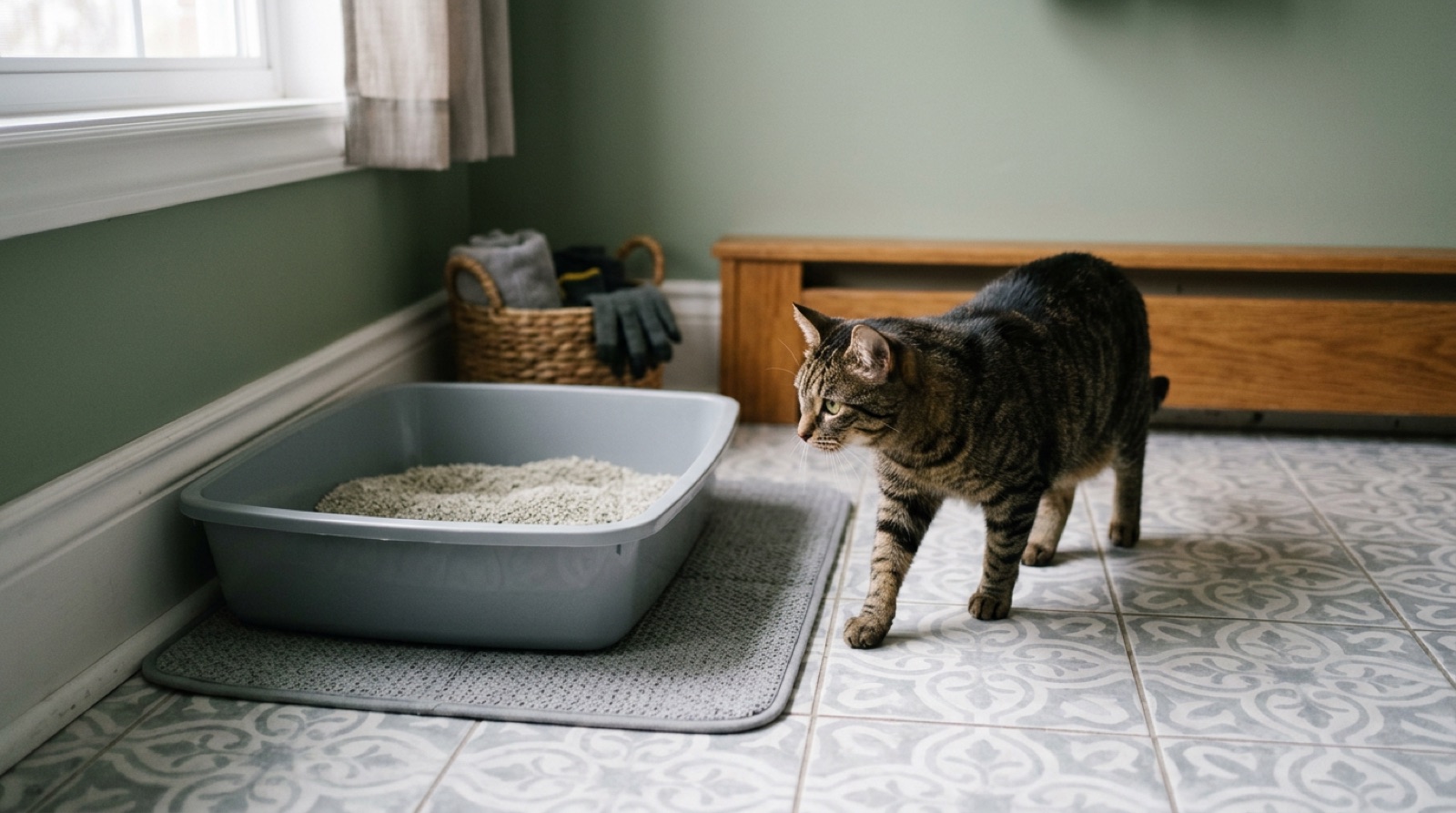
The short answer
Go to the vet first. House soiling is the most commonly reported cat behaviour problem, and a large share of cases turn out to be medical. A male cat straining in the box and producing little or no urine is an emergency; a full blockage can be fatal within a day or two. Once a vet clears the cat, work through the environment in order: one box per cat plus one, unscented clumping litter, uncovered boxes, daily scooping, and a quiet spot away from food and the furnace.
Emergency: stop reading and call a vet if you see this
- A male cat going in and out of the box repeatedly with little or no urine coming out
- Crying, howling, or obvious pain in or near the box
- Constant licking at the genital area
- Vomiting, refusing food, hiding, or lethargy alongside straining
- Blood in the urine
Cornell's Feline Health Center is blunt about this: urethral obstruction is a true medical emergency, and an obstructed cat can deteriorate fatally in less than 24 to 48 hours. Winnipeg Animal Emergency Hospital, 400 Pembina Hwy, is at 204-452-9427. Bridgwater Veterinary Hospital and Wellness Centre, 100-350 North Town Rd, is at 204-452-0911. This article is informational and is not veterinary advice.
Litter box failure is the number one reason cats get surrendered, and Winnipeg shelters see the fallout every week. That is the frustrating part, because most of these cats are fixable. The owner tried three litters, bought a covered box, yelled a few times, and gave up before anyone checked whether the cat had a bladder full of crystals.
The order matters more than any single tactic. Medical first, environment second, stress third. Work it backwards and you spend a month adjusting furniture while a treatable condition gets worse. Cornell's house soiling guidance starts in the same place: a thorough physical exam and diagnostics before anything else.
If your cat is newly adopted and this started in week one, read our first week with a rescue cat guide alongside this one. Some early accidents are decompression, not disease, though the vet check still comes first.
Step 1: Rule Out the Medical Causes
Anything that makes urinating or defecating painful, urgent, or difficult can push a cat out of the box. Cornell's point is that a cat who feels pain in the box may start associating the box itself with pain and avoid it entirely. Here is what a vet is typically looking for:
| Condition | What you might notice | Urgency |
|---|---|---|
| Urethral obstruction (male cats) | Straining with no urine, crying, vomiting, collapse | Emergency, same night |
| Urinary tract inflammation or infection | Frequent small urinations, blood, box avoidance | Vet within 24 hours |
| Bladder stones or crystals | Straining, blood, repeat episodes | Vet promptly |
| Kidney disease | Drinking and urinating far more, weight loss | Vet within days |
| Diabetes | Large volumes of urine, big appetite, weight loss | Vet within days |
| Arthritis (older cats) | Accidents beside a high-sided box, hesitating at the step | Vet at next visit |
| Constipation or diarrhoea | Faeces outside the box, straining, hard or loose stool | Vet within days |
This table is orientation for the phone call, not a diagnosis. Only a veterinarian can tell these apart, and several of them look identical from the couch.
Step 2: The Multi-Cat Maths
The rule is one box per cat plus one spare, on every floor the cat uses. One cat means two boxes. Three cats in a Transcona bungalow means four. People hear this and assume it is shelter overkill. It is not; it is the single change that resolves the most cases, and it costs less than a bag of premium litter.
| Cats in the home | Minimum boxes | Placement |
|---|---|---|
| 1 | 2 | Different rooms, one per floor in a two-storey |
| 2 | 3 | Spread out so no cat can guard them all |
| 3 | 4 | At least two floors, never all in one room |
| 4 | 5 | Multiple rooms with two exits each |
Two boxes side by side count as one box to the cat. The point of the spare is not capacity, it is access: a nervous cat needs an option that is not being watched, guarded, or blocked by the household bully. In a multi-cat home the bullying is often invisible to humans, since it happens as a stare across a hallway rather than a fight.
Step 3: Box, Litter, Location
What most cats want
- ✓Large, uncovered box, roughly 1.5 times the cat's length
- ✓Unscented, fine-grained clumping litter
- ✓About two inches of litter, not a token layer
- ✓Scooped daily, washed every few weeks
- ✓Quiet corner with two escape routes
- ✓Low entry for seniors and arthritic cats
What pushes cats out
- •Covered boxes that trap odour and have one exit
- •Plastic liners, which most cats dislike
- •Scented litter, crystals, or pellets
- •The box beside the furnace or washing machine
- •The box next to the food and water bowls
- •Bleach or strongly perfumed cleaners on the box
Winnipeg housing shapes this more than people expect. Basement furnace rooms are the default box location in half the older homes in Wolseley and St. Boniface, and a furnace kicking on in January is genuinely startling to a cat mid-squat. Apartment dwellers in Osborne Village have the opposite problem: not enough room to separate box from food. If space is tight, separate them by height rather than distance. A bowl on the counter and a box on the floor across the room beats both on the same tile.
Step 4: Cleaning the Accidents Properly
Use an enzymatic cleaner. Enzymes break down the odour compounds in urine. Ordinary household cleaners mask the smell for you while leaving the marker the cat is responding to. If the spot still smells like a toilet to the cat, the cat keeps using it as one.
Never use ammonia-based products. Ammonia is a component of cat urine. Cleaning with it effectively signs the spot for the cat and invites a repeat.
Soak, do not wipe. Urine passes through carpet into the underlay and sometimes into the subfloor. Surface-cleaning a carpet accident treats about a third of the problem.
Change what the spot is for. Once it is clean, put a food bowl, a plant, or a scratching post on it. Cats do not toilet where they eat. A cheap plastic carpet runner, spike side up, works on stubborn corners.
Do not punish. Rubbing a cat's nose in it or yelling adds stress to a problem that stress often caused. All it teaches is to hide the behaviour better, which usually means behind the couch.
Step 5: Stress, Territory, and the Winnipeg Cat Outside Your Window
When medical is clear and the boxes are right, look at what changed in the cat's world. Common Winnipeg triggers we hear about: a move across the city, a renovation, a new baby, a roommate, a schedule change, or an unfamiliar cat appearing at the patio door. Winnipeg has a large free-roaming cat population, so the window trigger is more common here than in most cities.
Marking near doors and windows is usually territorial rather than a box problem. Block the sightline with frosted film, close the blinds at cat height, and stop leaving food outside, which is what recruits the visitors in the first place. If you have been feeding a stray or there is a colony behind a nearby business, Craig Street Cats runs colony management and trap-neuter-return work for Winnipeg community cats and trains volunteer colony managers. Their clinics and training resumed in 2026; they can be reached at 204-421-1919. Note that they no longer operate an adoption or intake program, so they are the call for colony help rather than for surrendering a cat.
Inside the house, the fix for anxiety is resources and vertical space. More boxes, more water stations, more hiding spots, and shelves or cat trees so a nervous cat can get above the traffic. If the cat is new to a household that already has cats, slow the introduction down; our Winnipeg cat introduction guide covers the scent-swapping sequence that prevents most of these cases from starting.
Browse adoptable Winnipeg cats
Most Winnipeg rescue cats come from foster homes with a documented litter box history, so you know what you are getting before you commit. Listings refreshed regularly.
See Available Winnipeg Cats →Frequently Asked Questions
Why is my cat suddenly peeing outside the litter box?
Assume it is medical until a vet says otherwise. A sudden change in litter box habits is one of the most common early signs of urinary tract inflammation, a bladder stone, a urinary infection, kidney disease, diabetes, or arthritis that makes climbing into a high-sided box painful. Cornell's feline behaviour team makes the same point: house soiling is the most reported behaviour problem, and a physical exam with diagnostic tests comes before any behaviour plan. Book the appointment first. Rearranging boxes while a cat has a bladder stone wastes weeks and lets the problem get worse.
When is a cat straining in the litter box an emergency?
Immediately, if the cat is male and producing little or no urine. A blocked male cat is a true medical emergency and can die within roughly 24 to 48 hours without treatment, because his urethra is longer and narrower than a female's and obstructs more easily. Warning signs are repeated trips to the box with nothing coming out, crying or howling in or near the box, licking at the genitals constantly, vomiting, hiding, or collapse. Do not wait for morning and do not wait to see if it improves. Get to a Winnipeg emergency hospital that night.
Where do I take a blocked cat in Winnipeg after hours?
Winnipeg Animal Emergency Hospital at 400 Pembina Highway (204-452-9427) has provided after-hours emergency care since 1974 and covers evenings, overnights, weekends and holidays. Bridgwater Veterinary Hospital and Wellness Centre at 100-350 North Town Road (204-452-0911) states it runs 24-hour emergency care with phones answered around the clock. Call on your way rather than after you arrive so the team can prepare. If you have any doubt about whether it is urgent, phone and describe what you are seeing; triage over the phone is free and takes two minutes.
How many litter boxes should a Winnipeg cat household have?
One box per cat plus one spare, on every floor the cat uses. Two cats means three boxes. A single cat in a Wolseley two-storey house should still have a box upstairs and a box down, because a cat who gets caught short at the top of the stairs will use the closest soft surface instead. This rule solves more house-soiling cases than any product on the shelf, and it is free if you already own one box and buy a second. Boxes placed side by side count as one box to the cat.
What kind of litter do most cats prefer?
Unscented, fine-grained, clumping clay, filled about two inches deep. Cornell notes that most cats prefer simple uncovered boxes and dislike plastic liners, and the same preference logic applies to litter: cats want something that feels like soft sand under their paws and does not smell like a perfume counter. Scented litter is made for humans. Crystals, pellets, and heavily perfumed products are the ones we see cats reject most often. If you are switching litter, offer the new type in an extra box beside the old one instead of swapping outright.
Should I use a covered litter box?
Most cats would rather you did not. Covers trap odour inside the box, which is pleasant for you and unpleasant for the animal standing in it. They also create a single exit, which matters enormously in a multi-cat home where one cat ambushes another at the door. Cornell reports most cats prefer boxes without hoods. If you keep a covered box for tidiness, at least run one uncovered box alongside it and see which one the cat votes for. The cat's vote is the only one that counts here.
Where should the litter box go in a Winnipeg apartment?
Somewhere quiet, easy to reach, and away from the food bowl. Osborne Village and downtown apartments make this hard, and the two spots people default to are the two worst: beside the furnace and next to the washing machine. Both fire up without warning and can startle a cat mid-squat, and one bad scare is enough to make a cat abandon the box for good. Pick a low-traffic corner with two ways out, keep it off the same wall as the food, and do not move it once the cat has settled in.
Does a dirty litter box actually cause house soiling?
Constantly, and it is the easiest fix on the list. Scoop at least once daily, twice in a multi-cat home. Wash the box with unscented soap and warm water every few weeks and skip bleach or strong disinfectants, since the residual smell can put a cat off. Replace plastic boxes every year or so; old plastic absorbs odour that you cannot wash out but the cat can still smell. A cat with a clean box in a good location has very little reason to go elsewhere.
How do I clean cat urine so the cat stops returning to the spot?
Use an enzymatic pet cleaner, not a household cleaner. Enzymes break down the compounds in urine that hold the odour; ordinary cleaners just mask it, and the cat still smells the marker and treats the spot as a toilet. Avoid anything ammonia-based, because ammonia is a component of urine and effectively re-labels the spot. Soak the area rather than wiping it, since urine goes through carpet into the underlay. Then make the spot unattractive: a food bowl, a plant stand, or a scratching post over the target works better than scolding ever will.
Is my cat peeing outside the box out of spite?
No. Cats do not do revenge, and treating it that way delays the actual fix. What looks like spite is nearly always pain, anxiety, or a box the cat has decided is unusable. Stress triggers are real though: a new baby, a move to St. Boniface, renovation noise, a cat visible through the window, or a new roommate can all set it off. That is anxiety, not malice, and it responds to more boxes, more hiding spots, more vertical space, and time. Never punish a cat for house soiling; it adds stress to the exact problem stress caused.
Can outdoor cats visible through the window cause indoor spraying?
Yes, and in Winnipeg it is a common trigger given how many free-roaming cats the city has. A resident cat that sees an unfamiliar cat through a patio door may start marking near doors and windows, because from the cat's point of view the territory is under threat. Block the sightline with frosted film or by closing blinds at the level the cat looks through. Stop leaving food outside, which recruits visitors. If the marking continues after the sightline is gone, that is a vet and behaviour conversation, not a hardware one.
How long does it take to fix a litter box problem?
Days if it is medical and treated, two to four weeks if it is environmental, longer if it is anxiety-driven. The sequence that works is: vet exam first, then boxes (count, litter, cleanliness, location), then stress. Change one variable at a time and give it at least a week, or you will never know which change worked. Keep a short log of where and when the accidents happen; a pattern like “always the bathmat, always overnight” tells a vet or behaviour consultant more than a general complaint does.
When should I bring in a behaviour professional?
When the medical workup is clean, you have fixed box count, litter, cleanliness and location, and it has still been going on for a month. At that point you are dealing with an anxiety or territorial pattern that benefits from a structured plan. Look for a credentialled consultant through the International Association of Animal Behaviour Consultants, and loop your vet in either way, since some anxiety cases are managed medically alongside the behaviour work. Ask your vet before adding any product or supplement; we do not recommend medications here.
Further reading from veterinary sources: Cornell Feline Health Center on feline lower urinary tract disease and house soiling, plus client brochures from the Feline Veterinary Medical Association. For behaviour consultants, see the International Association of Animal Behaviour Consultants.
Related Winnipeg Cat Guides
Vet First. Boxes Second. Patience Third.
Most litter box problems are solvable, and most surrendered cats never got the chance. Hundreds of Winnipeg cats are waiting for someone who knows that.
Browse Available Winnipeg Cats →New cat? Start with these care guides
Everything a new adopter needs to set up a safe, happy home.