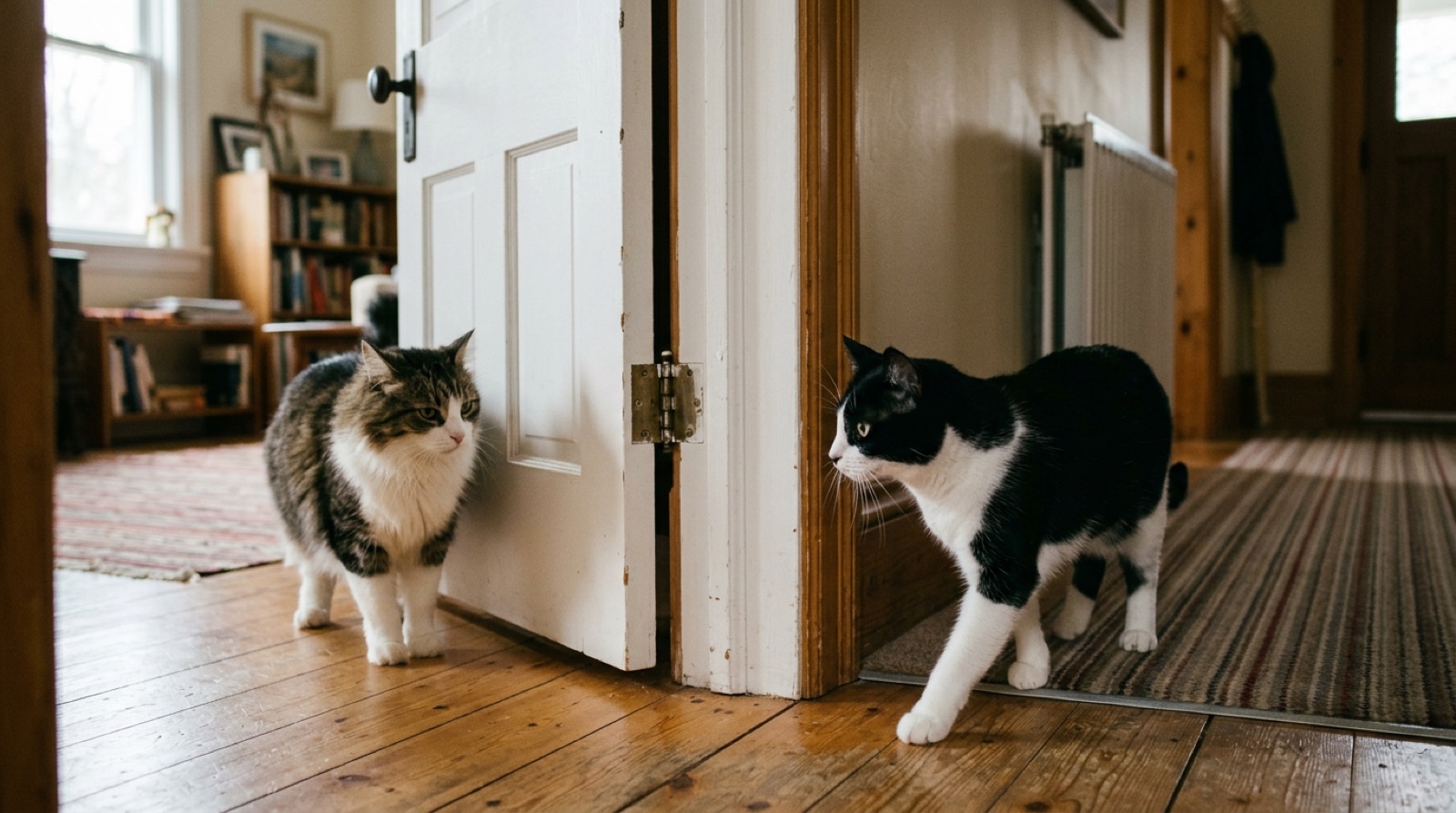
The short answer
Give the new cat its own closed room for the first few days with food, water, two litter boxes and a hiding spot. Swap bedding daily so each cat learns the other's scent before seeing it. Then feed both cats on either side of the closed door, then allow brief visual contact through a gate or a cracked door, then supervised open-room sessions. Expect two to four weeks, longer for an older resident cat. Keep one litter box per cat plus one, permanently.
The most common mistake new cat owners make is the one that feels most natural: opening the carrier in the living room so everyone can meet. From the resident cat's point of view, an unfamiliar animal has just materialised inside its territory with no warning. That first impression can take months to overwrite.
Cats read the world through scent. A cat that already smells familiar registers as part of the household long before it is visible, which is why the whole staged process is built around smell first and eye contact last. Two weeks of structure buys you a decade of peace, and the structure costs nothing but patience and a spare door.
This guide covers cat-to-cat and cat-to-dog introductions, realistic timelines, and what to do when it stalls. If you have just brought the cat home and have not started yet, read it alongside our first week with a rescue cat guide, which covers the room setup and the 3-3-3 decompression pattern.
The Introduction Timeline
Separate rooms, no contact
The new cat owns one closed room with food, water, two litter boxes, a bed and a hiding spot. The resident cat keeps the rest of the house. They hear and smell each other through the door and nothing else.
Scent swapping
Swap bedding, blankets, or a rubbed sock between the two cats daily. Rotate which cat has the run of the house for an hour so each explores the other's space without meeting.
Feeding on either side of the door
Put both food bowls near the closed door, far enough back that neither cat is stressed. Move them closer over several days. You are teaching each cat that the other's smell predicts good things.
Controlled visual contact
Crack the door a few centimetres, or use a baby gate or screen. Keep sessions to a few minutes and end them while both cats are still calm. Repeat several times a day.
Supervised face to face
Short open-room sessions with an escape route for both animals. Interrupt staring by tossing a toy, not by grabbing a cat. Build from minutes to hours across days.
Unsupervised together
Only once you have had multiple relaxed shared sessions with no hissing, chasing or blocking. Keep the extra litter boxes permanently; resource competition is what restarts conflicts.
These windows overlap and are guidance, not a schedule. Move to the next phase when both animals are relaxed at the current one, not when the calendar says so.
Scent Swapping Does the Heavy Lifting
If you only do one thing from this article, do this. Cats identify each other chemically. A cat whose smell is already woven into the household reads as a resident rather than an intruder, and that single fact changes how the first face-to-face meeting goes.
The practical version takes about two minutes a day. Swap the cats' blankets or beds. Rub a soft cloth gently on one cat's cheeks, where the scent glands are, and leave it near the other cat's sleeping spot. Once a day, close the new cat in a bathroom and let the resident cat explore the newcomer's room, then reverse it. Each cat maps the other's territory without a confrontation.
Watch the reaction rather than the calendar. A cat that sniffs the swapped blanket and walks away calmly is ready to move on. A cat that hisses at a blanket is telling you it needs several more days of exactly this, and it is far cheaper to learn that from a blanket than from a fight.
Introducing a Cat to a Resident Dog
Work on the dog, not the cat. The cat's job is to feel safe. The dog's job is to learn that ignoring the cat pays. Reward calm and reward looking away, starting well before the animals share a room.
Leash the dog for every early session. A leash gives you control without grabbing, and grabbing is how people get bitten by their own pets during a bad moment.
Give the cat vertical escape the dog cannot follow. Shelves, a tall cat tree, or a baby gate the cat can clear. A cat with an exit rarely needs to fight; a cornered cat always does.
Never allow a chase, not even once. Chasing is self-rewarding for a dog and gets harder to interrupt every time it succeeds. One chase down a hallway can undo three weeks of work.
Feed separately, permanently. Cat food is high value to dogs, and food guarding is where most cat-dog conflicts actually start. Feed the cat somewhere elevated the dog cannot reach.
A high prey drive needs a professional plan. If your dog fixates, stiffens, or cannot be redirected from the cat, that is not a patience problem. Get a credentialled behaviour consultant involved through the International Association of Animal Behaviour Consultants and keep a hard barrier up in the meantime. If you are still choosing a dog for a cat household, our Winnipeg dog listings flag cat-tested dogs.
Resources: The Part People Skip
Most multi-cat conflict is competition over resources, not personality. The competition is usually invisible to humans because it happens as a stare across a room rather than a fight, and the first sign an owner notices is a puddle on the bathmat. Multiply everything:
Multiply these
- ✓Litter boxes: one per cat plus one, spread across floors
- ✓Water stations in separate rooms
- ✓Feeding spots far enough apart to avoid staring
- ✓Scratching posts near each cat's favourite area
- ✓Beds and hiding spots at different heights
- ✓Vertical space: shelves, trees, window perches
Warning signs to act on
- •One cat blocking a hallway, doorway, or the stairs
- •Sustained staring or stalking rather than a quick hiss
- •Either cat stopping eating or hiding all day
- •New spraying or house soiling after the arrival
- •Fur pulled out, scratches, or an abscess
- •The resident cat abandoning a favourite spot entirely
Winnipeg housing shapes this too. Two-storey homes in Wolseley and Transcona create chokepoints at the top of the stairs, and small Osborne Village apartments make floor separation nearly impossible, which is why vertical space matters so much there. If house soiling starts after an introduction, work through our litter box troubleshooting guide, which begins with a vet visit rather than a behaviour theory.
Choosing a Second Cat That Will Actually Fit
The easiest introductions start before the adoption. Match energy rather than looks: a calm ten-year-old resident does badly with a kitten and much better with another settled adult. A playful three-year-old often does well with a young cat who wants a wrestling partner.
Ask the shelter or foster directly whether the cat has lived with other cats, and what happened. Winnipeg foster-based rescues can usually answer this precisely, because the cat has been living in a home rather than a kennel. That single question predicts the outcome better than breed, colour or age.
Consider a bonded pair instead of adding one cat to an existing one. Two cats who already like each other arrive as their own social unit, which is often less disruptive than expecting a solitary resident to accept a stranger. Winnipeg shelters usually price bonded pairs to move together, and our adoption costs guide covers what that means for the budget.
Finally, be willing to conclude that your cat is an only cat. Some are, and there is no failure in it. Forcing a second cat into a household that cannot absorb one is worse for both animals than leaving a good arrangement alone.
Browse adoptable Winnipeg cats
Foster-raised cats come with real notes on how they behave around other cats and dogs, so you can match temperament before you introduce anyone. Listings refreshed regularly.
See Available Winnipeg Cats →Frequently Asked Questions
How long does it take to introduce two cats?
Two to four weeks for most pairings, and up to a few months for a nervous or territorial cat. The variables are age, temperament and history: two young adults often settle in ten days, while an older resident cat who has been an only cat for a decade may need six weeks or more. Speed is not the goal. Rushing produces a fight, and a single bad fight can set the relationship back further than the two weeks of patience would have cost you. Go at the pace of the more anxious cat, always.
What is scent swapping and why does it matter?
Scent swapping means trading smells between cats before they ever see each other. Cats identify friend from intruder chemically, not visually, so a cat that already smells familiar is far less threatening when it finally appears. Swap bedding daily, rub a soft cloth on one cat's cheeks and leave it near the other's bed, and rotate which cat explores which part of the house. This step takes almost no effort and prevents more conflict than anything else in the sequence. Skip it and you are asking a stranger to walk into the living room.
Why does my new cat need its own room at first?
Because a scared cat given a whole house will pick a hiding place you cannot reach and stay there. A single room gives the newcomer a manageable territory to own, keeps food, water and litter boxes findable, and lets the resident cat keep the rest of the home without feeling invaded. It also makes it possible to monitor eating, drinking and litter box use, which is how you catch a health problem in week one. Our first week with a rescue cat guide covers the room setup in detail.
What if the cats hiss and swat at each other?
Hissing and swatting are communication, not failure. A hiss means back off, and a cat that hisses and then walks away has just settled a dispute without a fight. Interrupt only if you see sustained staring, stalking, or a cat being cornered with no escape. When you interrupt, toss a toy or make a noise; never reach between two aroused cats, because redirected aggression sends those teeth into your hand. If hissing has not eased at all after two weeks of shared space, go back a step and slow down.
When should I go back a step in the introduction?
Whenever either cat stops eating, hides constantly, blocks the other from a litter box, starts marking, or shows sustained aggression rather than a quick hiss. Those are all signals that the current level of contact is beyond what the cat can handle. Going back to the closed door for a few days is not a defeat; it is the whole reason a staged introduction exists. Then rebuild more slowly, with shorter sessions and more scent work between them.
How do I introduce a new cat to a resident dog?
Start with the dog on leash and the cat behind a barrier, and work on the dog rather than the cat. The cat needs an escape route and vertical space it can reach and the dog cannot, so shelves, a cat tree, or a baby gate the cat can jump. Reward the dog for calm and for looking away from the cat. Never let a dog chase a cat even once, because chasing is self-rewarding and gets harder to undo every time it happens. A dog with a strong prey drive needs a professional plan and a hard barrier, not optimism.
Where should the litter boxes go during an introduction?
One box per cat plus one spare, spread out so neither cat can guard them all. During the closed-door phase the new cat needs two boxes inside its own room. Once the cats share space, keep boxes in different rooms and on different floors, because a two-storey home in Wolseley or St. Boniface gives a bully cat an easy chokepoint at the top of the stairs. Blocked box access is one of the most common causes of house soiling after a new cat arrives, and it is entirely preventable.
Can I introduce cats faster if they are both kittens?
Usually yes. Two kittens under about six months often integrate in days rather than weeks, because neither has established territory to defend and both want to play. That is one reason shelters push bonded pairs so hard. The pairing that goes slowest is a kitten with an older resident cat: the kitten wants to wrestle and the senior wants to be left alone, so the senior retreats and stops using shared resources. Even with kittens, do the closed-door phase and the scent swap. It costs three days.
What does a successful introduction actually look like?
Not necessarily friendship. Plenty of cats settle into polite coexistence, sleeping in different rooms, sharing the house without conflict, and never grooming each other. That is a complete success. What you are looking for is relaxed body language in shared space, eating normally, using litter boxes freely, and no blocking or stalking. Cats who curl up together are a bonus, not the benchmark. Expecting best friends is how people conclude a perfectly functional introduction has failed.
Do I need more than one of everything?
Yes, and this is the part people cut to save money. Multiple litter boxes, multiple water stations, multiple beds, multiple scratching posts, and separate feeding spots. Resource competition is what turns two cats who tolerate each other into two cats who fight, and the competition is often invisible to humans because it happens as a stare across a room rather than a scuffle. Vertical space matters as much as floor space, especially in an Osborne Village apartment where the floor plan is small.
What if the introduction is still not working after two months?
Get help rather than waiting it out. Two months of tension usually means something structural is wrong: not enough resources, not enough vertical space, a medical problem in one cat, or a genuine temperament mismatch. Have both cats checked by a vet first, since pain makes cats short-tempered. Then look for a credentialled consultant through the International Association of Animal Behaviour Consultants. Some cats genuinely do better as only cats, and recognising that early is kinder than forcing it for years.
Should I use a pheromone diffuser or supplement?
Ask your veterinarian before adding anything, including products sold over the counter. We do not recommend specific products, doses, or supplements here, and a vet who knows the cat is the right person to weigh whether something is worth trying. What we would say is that no product substitutes for the structure: the closed-door phase, the scent swapping, and enough litter boxes. People often buy a diffuser instead of adding a second box, and the second box is what the cat actually needed.
Related Winnipeg Cat Guides
Two Weeks of Patience Beats Two Years of Tension
Winnipeg has one of the largest adoptable cat populations in Canada, including plenty of cats already proven to live well with others.
Browse Available Winnipeg Cats →New cat? Start with these care guides
Everything a new adopter needs to set up a safe, happy home.