The short answer
Winnipeg indoor cats live 12 to 18 years. Outdoor cats live 3 to 5, per the Cornell Feline Health Center and the American Association of Feline Practitioners (AAFP). The Winnipeg-specific risks are urban coyotes along the Assiniboine and Red River corridors, prairie wind chill that hits -40 every winter, Portage Avenue and Pembina Highway traffic, FIV and FeLV from feral cat fights, West Nile mosquitoes through summer, and great-horned owls in treed neighbourhoods. Every Winnipeg cat rescue requires indoor-only adoption. They are right.
The lifespan gap is dramatic
The feline veterinary literature converges on roughly the same numbers, summarized by the ASPCA and the AAFP:
- Indoor cats: typically 12 to 18 years, many live to 20 plus
- Indoor-outdoor cats: typically 6 to 10 years
- Strictly outdoor cats in urban Winnipeg: typically 3 to 5 years
That is not subtle. An outdoor cat in Winnipeg loses roughly two-thirds of its potential lifespan compared to an indoor sibling. The prairie city environment is harder than most Canadian cities on outdoor cats because the killers stack: coyote predation, extreme cold, traffic, feral-spread disease, and West Nile mosquitoes all hit the same animal across the same year.
The “cats lived outside on the prairies for 100 years” argument
This is the most common justification we hear in southern Manitoba, and it deserves a direct answer. Yes, prairie farm cats have lived outside for generations. They also died young. The historical average life expectancy of a prairie farm cat sat in the same 3 to 5 year range that current AAFP and Cornell data show for outdoor cats today. The lifespan gap was always there; we just did not measure it.
Two things have actually changed. Veterinary medicine, vaccinations, dental care, and parasite control now routinely add years to indoor cat lives, widening the gap between “sheltered cat with vet access” and “outdoor cat without.” And Winnipeg-area coyote density has risen dramatically since the 1990s. The grandfather generation of prairie cats did not have to deal with urban coyotes along the Assiniboine Forest or the Red River because urban coyotes were not yet a Canadian thing. A 1970 Winnipeg outdoor cat had a hard life; a 2026 Winnipeg outdoor cat has a harder one.
What kills outdoor cats in Winnipeg
Urban coyotes
Winnipeg has an established urban coyote population, with sightings concentrated along the Assiniboine River corridor (Assiniboine Park, Assiniboine Forest, Charleswood, Tuxedo), along the Red River through St. Vital, St. Boniface, Norwood, and the North End, and on the city fringe where development meets agricultural land (Sage Creek, Bridgwater, Waverley West, Transcona East). The City of Winnipeg publishes urban-wildlife advisories on coyote activity. Coyotes hunt at dawn, dusk, and overnight, which is exactly when most free-roam cats are out. A cat sits squarely in coyote prey size, and a coyote can clear a residential fence and take a cat from a backyard in seconds. The Assiniboine Forest in particular is a near-continuous coyote travel corridor through the western half of the city, and the river ice in winter gives coyotes uninterrupted access along the full length of both rivers.
Prairie winter cold
Winnipeg winter is the single most under-counted outdoor cat risk in southern Manitoba. Wind chill regularly hits -30 to -40 degrees Celsius for stretches of weeks at a time, and -45 to -50 wind chill is not unusual in January and February. Even on milder winter days the overnight low drops well below freezing. Frostbite hits ear tips, tail tips, and paw pads first; severe cases need amputation. Hypothermia and freeze-deaths most often happen when a cat takes shelter under a deck, in a shed, or in a garage and gets trapped or simply cannot warm up. Winnipeg emergency vet clinics see frostbite, hypothermia, and antifreeze toxicity cases all winter. At -40 with wind, exposed skin frostbites in under 5 minutes. A cat outside through a January cold snap is in immediate danger, and the danger does not require the cat to be lost. A free-roam cat with a normal routine is exposed every night.
Vehicle traffic
Traffic kills more outdoor cats than predators do in most North American cities, and Winnipeg is no exception. Portage Avenue, Pembina Highway, St. Mary's Road, Bishop Grandin Boulevard, Henderson Highway, Main Street, and the Perimeter Highway all carry heavy traffic at hours when cats roam. Residential alleys are also bad: the combination of detached garages with rear access, uncovered driveways, and cats sheltering under or in vehicles for warmth produces a steady stream of fan-belt fatalities every winter. Winnipeg vets see “cat started in a wheel well” and “cat under the engine block” cases every cold season. Check your wheel wells and hood in winter. The cat does not understand vehicles.
FIV, FeLV, and disease from feral cats
Winnipeg has a long-standing feral and community cat population that the Winnipeg Humane Society and Manitoba Animal Alliance both work to manage through TNR (trap-neuter-return). Free-roam pet cats interact with that population through fights, mating, and shared territory. FIV (feline immunodeficiency virus, transmitted by bite wounds in fights) and FeLV (feline leukemia, transmitted by saliva and blood) both have meaningful prevalence in Manitoba feral populations. Feline panleukopenia, ringworm, fleas, ticks, and intestinal parasites round out the list. Indoor cats are essentially immune to most of these. An outdoor intact male cat in Winnipeg will be in fights within weeks.
West Nile mosquitoes
Winnipeg is the mosquito capital of Canada, a function of low-lying flood plains around the Red and Assiniboine Rivers and the standing water that produces every spring. The City of Winnipeg runs an active mosquito control program, but exposure remains real through summer evenings. West Nile virus is documented in Manitoba mosquito pools most years, and the province publishes weekly surveillance numbers through the warm months. Cats can contract West Nile two ways: directly from infected mosquito bites, and from eating infected birds. Clinical disease in cats is less dramatic than in horses, and many infected cats clear the virus without obvious symptoms, but seroconversion is real and severe cases do occur. Indoor cats are functionally not exposed. This is a Winnipeg-specific outdoor cat risk driven by the city's dense summer mosquito populations.
Great-horned owls and hawks
Great-horned owls are common across Winnipeg, especially in treed neighbourhoods like River Heights, Wolseley, Crescentwood, Norwood, Old St. Vital, and along the Assiniboine Forest and Red River tree corridors. They hunt at dawn and dusk and take small cats, particularly kittens and cats under about 7 to 8 lbs. Red-tailed hawks and Swainson hawks pass through the warm months and occasionally take small pets. Aerial predation is one of the most under-counted causes of outdoor cat disappearance because there is rarely any evidence. The cat simply does not come home, and the owner concludes the cat ran away.
Off-leash dogs
Winnipeg has off-leash dog parks (the Kilcona Park off-leash area, the Little Mountain Park off-leash area, the Maple Grove Park off-leash area, the Juba Park off-leash area, and several smaller designated zones) and a strong dog culture overall. A loose dog with prey drive kills a cat in seconds, even an owner-supervised dog. Outdoor cats wander into dog territory constantly.
Theft and well-meaning “rescue”
Friendly outdoor cats get scooped up by strangers who assume they are lost. Purebred or distinctive-looking cats (Maine Coons, Bengals, Ragdolls, anything fluffy) are sometimes taken for resale. Even microchipped cats sometimes never come home because the finder does not check.
Why Winnipeg rescues require indoor-only
Every Winnipeg cat rescue makes indoor-only living a condition of adoption:
- Winnipeg Humane Society: indoor-only commitment standard for all cat adoptions
- D'Arcy's Animal Rescue Centre (D'Arcy's ARC): indoor-only required as a condition of adoption
- Manitoba-wide rescues with Winnipeg foster networks: indoor-only standard
The rescues are not being overly cautious. They have seen too many rescued cats die after going outside, especially through Manitoba winter. If you sign an indoor-only adoption agreement and let the cat outside anyway, the rescue can reclaim the cat under the contract. The Winnipeg Humane Society also handles rural transfers from across southern Manitoba, which means many of their cats arrive with outdoor history. The indoor-only commitment is specifically how they keep those cats alive long enough to repay the rescue investment with a long life.
The “but my cat loves outside” reframe
The cat does not love outside. The cat loves stimulation. Outside provides movement, scents, sounds, prey to watch, territory to patrol. All of those can be reproduced indoors with thought. The underlying needs are sensory enrichment, hunting outlet, vertical territory, and varied environment. Outdoor access is one way to meet those needs. It is also the way most likely to get the cat killed by a coyote, a vehicle, the winter, or another cat's bite.
The honest framing for new adopters: your cat's outdoor wanting is real and worth respecting, but the answer is to meet the underlying need indoors, not to send them into a Winnipeg winter to be hunted.
Safe outdoor alternatives
Catio (cat patio) and three-season prairie build
An enclosed outdoor structure attached to a window, door, or wall. The cat gets fresh air, sunlight, bird-watching, and outdoor scents without coyote, owl, or traffic risk. Most Winnipeg catios are three-season builds, used comfortably from May through September, with a screened porch or insulated extension as the cold-weather option. Use hardware cloth (not chicken wire, which raccoons rip through), cedar or treated lumber, a roof because hawks and owls will fly down into open enclosures, and a windbreak on the prevailing-wind side because prairie wind is a constant. DIY builds start around $200; custom builders run $1,500 to $5,000 plus. Add a heated mat or insulated shelter box to push the usable season into late fall. Winnipeg catio owners often add fine-mesh mosquito screening for summer comfort, since Winnipeg mosquito pressure is in a different league from most Canadian cities.
Insulated screened porch as a winter catio
For owners who want a winter option, a fully enclosed and insulated three-season-room conversion gives a cat year-round access to outdoor sights and sounds while keeping the actual cat indoors at safe temperatures. This is the most prairie-appropriate version of the catio idea. South-facing porches collect winter sun and stay surprisingly warm even on -30 days.
Leash-walking with a harness
Some cats tolerate harness training. Use a properly-fitted cat harness, not a dog harness. Train indoors for at least three to four weeks before going outside. Start in a quiet, predator-safe location like a fenced private yard or a townhouse courtyard. Avoid the Assiniboine Forest, the Red and Assiniboine River pathways, and treed park interiors at dawn and dusk because of coyote and great-horned owl activity. Avoid all leash walks in deep winter; cat paws frostbite in under 10 minutes at -30 with wind, and the cat will not tell you they are in trouble until it is severe. Avoid riverside walks at summer dusk because of mosquito density. A residential cul-de-sac in spring or autumn daytime works for most cats. The cat sets the pace. Most cats explore for 15 to 30 minutes then want to go in.
Supervised yard time
Sit outside with the cat in a fenced yard, within arm's reach the whole time. This works for cats that genuinely want sensory experience. Winnipeg fenced yards are not coyote-proof; a coyote can clear a six-foot privacy fence without effort and great-horned owls do not need a fence at all. Supervision is the entire safety mechanism. Once you stop watching, the safety is gone.
The indoor enrichment toolkit that actually works
Boredom is the fair concern with indoor cats. The fix is enrichment, not outdoor access.
- Vertical space. Cat trees, wall shelves, perches. Indoor cats use vertical territory more than horizontal, so height matters more than floor area. Winnipeg condo and townhouse living rewards this approach because vertical territory takes almost no floor space.
- South-facing window perches with a bird-feeder view. Winnipeg has excellent year-round bird life (chickadees, blue jays, magpies, nuthatches, woodpeckers, evening grosbeaks in winter, robins and warblers in summer). A window-mounted suet feeder gives the cat months of entertainment, and the south-facing winter sun warms the perch.
- Daily interactive play. 10 to 15 minutes with a wand toy. Make them chase, pounce, and finish the toy. Bookend morning and evening if you can.
- Puzzle feeders and food puzzles. Make them work for kibble. Slows eating and exercises the hunting circuit.
- Rotating toy supply. Hide half the toys, swap weekly. Old toys feel new again.
- A feline companion. Two cats keep each other entertained when you are at work. Bonded pairs are ideal for this, and the Winnipeg Humane Society and D'Arcy's ARC regularly have bonded pairs available.
- Scent enrichment. Cardboard boxes, paper bags, catnip, silvervine, dried valerian. Cheap and endlessly novel.
- Cat TV or nature videos. Multi-hour bird and squirrel videos work well for indoor cats and pair nicely with a window perch.
A brand-new rescue cat needs more than enrichment for the first few weeks. They need decompression time. See our first week with a rescue cat guide for the settling-in protocol.
Browse adoptable Winnipeg cats
Every cat from a Winnipeg rescue comes with an indoor-only adoption commitment. It protects the cat from Assiniboine and Red River coyotes, prairie winter, and Portage Avenue traffic, and it reflects current best practice in feline veterinary care.
See Available Cats →The indoor-outdoor middle ground
Some owners want a compromise: a few hours of supervised outdoor time, a screened porch, a catio, harness walks. Those are reasonable. What is not reasonable is unsupervised free-roam time, which is what most people mean by “indoor-outdoor.” The AAFP position is indoor-only or supervised-only. Most Winnipeg vets and rescues agree.
A screened porch counts as supervised. A catio counts as supervised. A condo balcony with proper screening counts as supervised. A backyard with the door propped open does not, because coyotes scale six-foot fences and great-horned owls take cats from open yards. The honest middle ground is enclosed outdoor access, not free-roam outdoor access.
What about barn cats and working cats?
Some Manitoba rescues run barn cat placement programs for semi-feral cats that would be miserable confined to a house. They get proper winter shelter (a heated barn corner or insulated outbuilding), food, vet care, and outdoor working life with an understanding rural owner. Barn cats are matched specifically to outdoor situations. Manitoba barn cat placements happen around Headingley, Oak Bluff, Stonewall, Selkirk, Beausejour, and across the RM of Springfield and the southern grain belt. This is a different track from urban pet cat adoption. Do not confuse “barn cat placement” with “outdoor pet cat.” A barn cat that would be miserable indoors is not the same animal as a friendly bonded rescue cat being asked to survive a Winnipeg winter alone.
Transitioning a previously outdoor cat
If you adopt an adult cat that was previously indoor-outdoor (common with surrendered cats and former strays, and very common with rural transfers into the Winnipeg Humane Society), the transition to indoor-only is hard for the first month or two. The cat will:
- Cry at doors and windows, sometimes for hours
- Sit by exits and try to dart out
- Scratch at door frames
- Act frustrated and undirected during the day
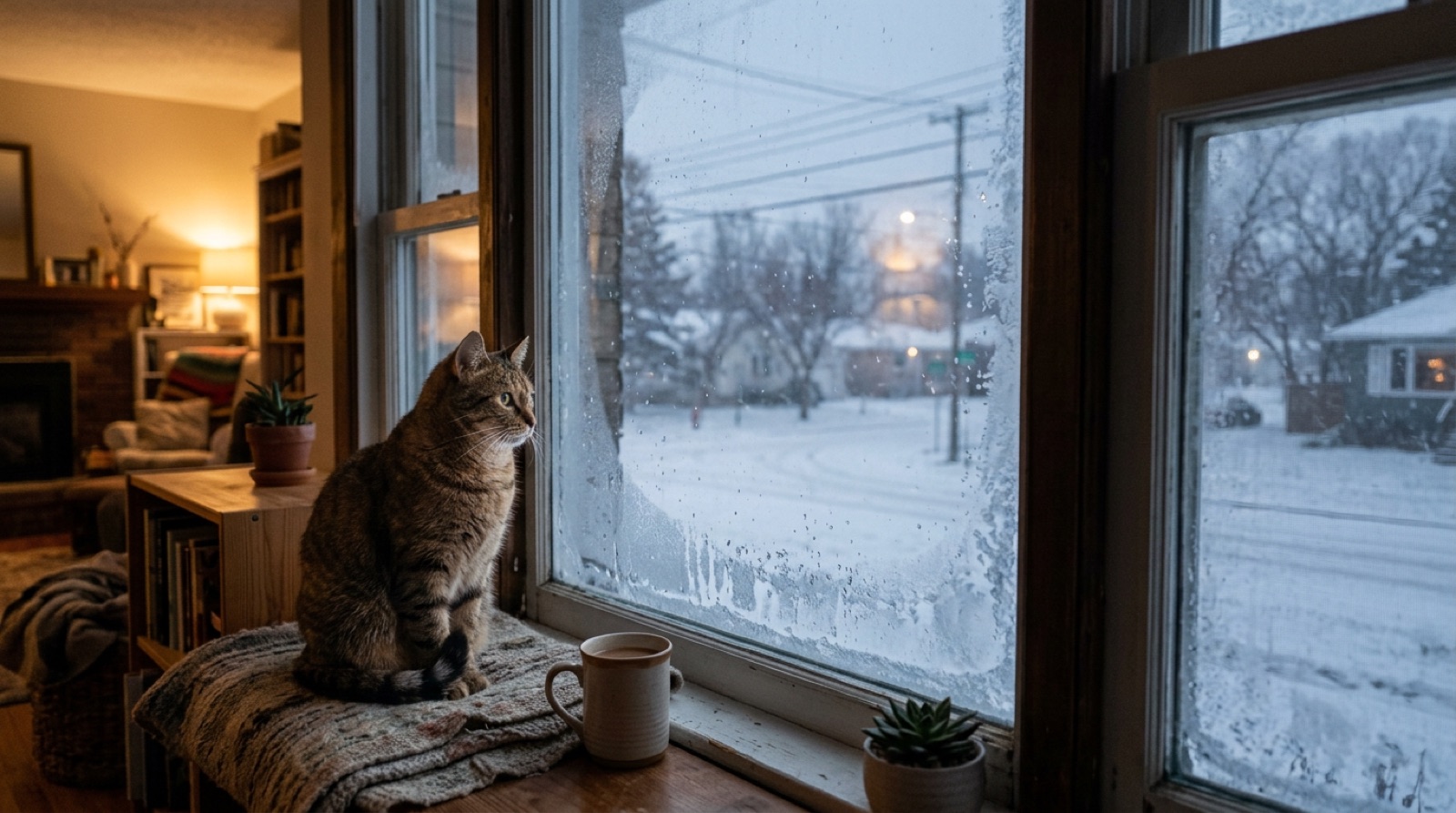
Stick with it. The protest phase typically runs 4 to 8 weeks. Increase enrichment heavily during this period: two play sessions a day, food puzzles, a tall cat tree by a south-facing window, catnip mice, a feline companion if possible. Winnipeg winter actually helps the transition because the prairie cold makes the outdoor option visibly miserable from the windowsill. A cat watching snow blow horizontally past the glass at -35 reconsiders. Most cats adjust within two months. Once they decide indoors is “home,” the door-darting and crying usually stop. The single most common mistake is giving in at week three and letting them out “just once,” which resets the entire timeline.
Frequently asked questions
Should I let my cat outside in Winnipeg?
No. Urban coyotes along the Assiniboine and Red River corridors, prairie winter wind chill at -30 to -40 (and colder), Portage Avenue and Pembina Highway traffic, FIV and FeLV from feral cat fights, and West Nile mosquitoes through summer all stack up. Winnipeg rescues universally require indoor-only adoption. Indoor cats live 12 to 18 years; outdoor cats live 3 to 5.
Are there urban coyotes in Winnipeg?
Yes. Winnipeg has an established urban coyote population, with sightings concentrated along the Assiniboine and Red River corridors, through Charleswood, Tuxedo, and St. Vital, and on the city fringe where development meets agricultural land. The City of Winnipeg publishes urban-wildlife advisories. Coyotes are most active at dawn, dusk, and overnight.
Does -40 degree weather actually kill outdoor cats?
Yes. Cats are not equipped for Winnipeg winter exposure. Frostbite hits ears, tails, and paws first; severe cases need amputation. At -40 with wind, exposed skin frostbites in under 5 minutes. Winnipeg emergency vets see hypothermia, frostbite, and antifreeze cases every winter.
How long do outdoor cats live in Winnipeg?
3 to 5 years on average, versus 12 to 18 years for indoor cats. The AAFP and Cornell Feline Health Center both publish this number. Winnipeg stacks coyote, cold, traffic, disease, and West Nile risks together, which is harder than most Canadian cities on outdoor cats.
Can cats get West Nile in Winnipeg?
Yes. Cats can contract West Nile from mosquito bites and from eating infected birds. Winnipeg sits on dense Red and Assiniboine River flood plains and has notoriously heavy summer mosquito populations. Manitoba mosquito pools test positive for West Nile most summers. Clinical disease in cats is less common than in horses, but seroconversion is real and indoor cats are functionally not exposed.
What is a catio and do they work in Winnipeg winters?
A catio is an enclosed outdoor cat patio attached to a window, door, or wall. Winnipeg catios are typically three-season builds (May to September) with a screened porch or insulated extension as the winter option. DIY builds start around $200; custom builds run $1,500 to $5,000 plus. Add fine-mesh mosquito screening for summer comfort.
Do Winnipeg rescues require indoor-only adoption?
Yes. The Winnipeg Humane Society, D'Arcy's ARC, and most Manitoba cat rescues require indoor-only living as a condition of adoption.
How do I transition a previously outdoor cat to indoor?
Plan for 4 to 8 weeks of protest. Stick with it. Increase enrichment significantly: daily play sessions, window perches, food puzzles, vertical territory. Winnipeg winter actually helps because the cold makes outside visibly miserable from the windowsill. Most cats adjust within two months.
Are barn cats different from indoor pet cats?
Yes. Working barn cats are semi-feral cats placed at Manitoba acreages and farms with proper winter shelter, food, and vet care. They are matched to outdoor working life and would be miserable confined indoors.
Do owls take cats in Winnipeg?
Yes. Great-horned owls are common across Winnipeg and along the Assiniboine Forest and river corridors, and they take small cats and kittens under about 7 to 8 lbs at dawn and dusk. Red-tailed hawks and Swainson hawks also take small pets through the warm months.
Can I leash-walk my cat in Winnipeg?
Some cats tolerate harness training. Use a cat harness, not a dog harness. Train indoors for several weeks first. Avoid the Assiniboine Forest and any treed park interiors at dawn and dusk because of coyote and owl activity. Avoid all leash walks in deep winter; paws frostbite in under 10 minutes at -30 with wind. Avoid riverside walks at summer dusk because of mosquito density.
But cats lived outside on the prairies for 100 years. Why is indoor the new standard?
Those cats died young. The historical average life expectancy of a prairie farm cat sat in the same 3 to 5 year range that current AAFP and Cornell data still show for outdoor cats. The lifespan gap was always there. What changed is veterinary medicine and the rise of urban coyote populations in Canadian cities since the 1990s. A 1970 prairie outdoor cat had a hard life; a 2026 Winnipeg outdoor cat has a harder one.
New cat? Start with these care guides
Everything a new adopter needs to set up a safe, happy home.