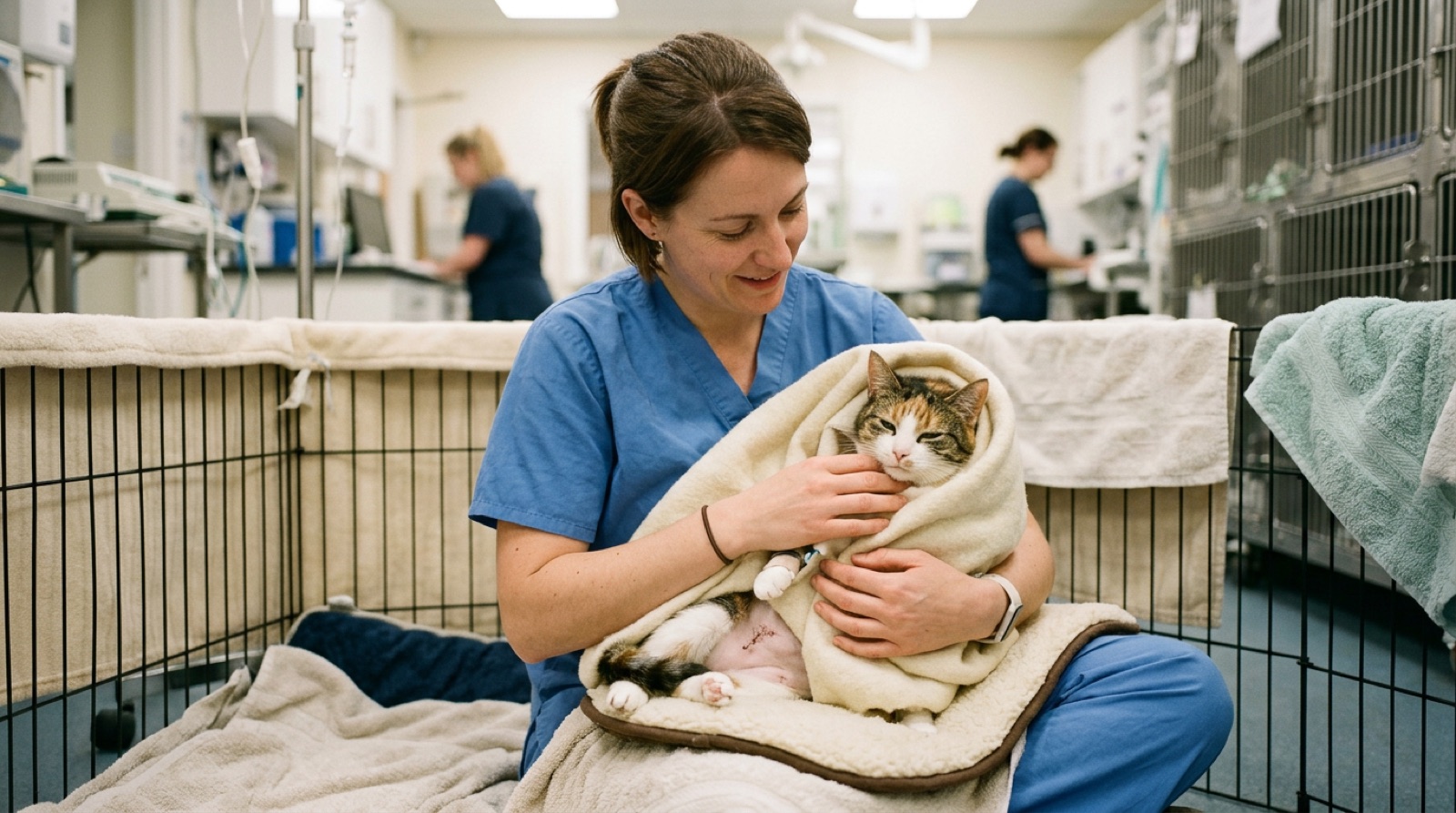
The short answer
Winnipeg cat spay typically costs $200 to $500 and neuter $150 to $350 at a full-service prairie vet. The WHS Shelter Clinic at the Winnipeg Humane Society drops that to $20 for Winnipeg residents, subsidised by the City. SNAP (Subsidised Spay/Neuter Assistance Program) helps low-income owners further, and the CARE Community Outreach Program offers $5 surgery with transport for under-resourced neighbourhoods. Craig Street Cats handles Trap-Neuter-Return for the city's community cat colonies. Every cat adopted from the Winnipeg Humane Society or D'Arcy's ARC arrives already spayed or neutered, vaccinated, and microchipped. Winnipeg also requires a cat licence under the Responsible Pet Ownership By-law for any cat over six months.
Heads up: This article is informational and is not veterinary advice. Always consult your Winnipeg veterinarian about timing, individual health factors, and the specific procedure recommendation for your cat. Pricing is current as of May 2026 and changes; confirm fees with the clinic before booking.
Spaying or neutering a cat in Winnipeg is one of those decisions every new owner runs into in the first month. The surgery prevents unwanted litters, ends heat cycles and spraying, and eliminates several reproductive cancers and infections. It also makes an indoor-only setup work the way it is supposed to, which matters more on the prairies than people sometimes realise. A door-darting cat in heat that gets out during a -40°C wind chill cold snap, or runs into one of the urban coyote corridors near the Red and Assiniboine river paths, is in real trouble within hours. The good news is Winnipeg has the strongest low-cost cat spay/neuter setup of any prairie city: the WHS Shelter Clinic does the surgery for $20 if you live in the city.
Already adopted from a rescue? Every Winnipeg cat rescue fixes every cat before placement. The surgery is already done by the time the cat comes home. Skip ahead to recovery if you need it, or to Winnipeg cat licensing to check what the city requires.
Haven't adopted yet? The cheapest total-cost route to a fixed cat is to adopt one that is already fixed. The typical $75 to $229 adoption fee at any Winnipeg cat rescue is generally less than the surgery alone, and it includes vaccines, microchip, deworming, and a vet check.
Cat Spay & Neuter Costs by Clinic Type
| Procedure | Standard Vet | WHS Shelter Clinic | Rescue Adoption |
|---|---|---|---|
| Spay (female, kitten 4-12 months) | $200-$400 | $20 (Winnipeg residents) | Included |
| Spay (female, adult) | $300-$500 | $20 (Winnipeg residents) | Included |
| Neuter (male, kitten 4-12 months) | $150-$250 | $20 (Winnipeg residents) | Included |
| Neuter (male, adult) | $200-$350 | $20 (Winnipeg residents) | Included |
Costs vary by age, weight, and health status. Pre-anaesthetic bloodwork ($60-$120) is often recommended for older cats and is usually quoted separately. Ask for a full written estimate before booking. The WHS Shelter Clinic $20 fee is for Winnipeg residents and is subsidised by the City; residents outside Winnipeg pay a higher rate and must provide proof of household income at booking. SNAP and the CARE Community Outreach Program drop the cost further for income-qualified residents. Demand is high; book several weeks ahead.
Why Spay or Neuter Your Cat
Cats are extremely efficient breeders. An unspayed female can have two to three litters a year of four to six kittens each. American Association of Feline Practitioners guidance recommends spay/neuter by 5 months to prevent the first heat cycle. The Winnipeg Humane Society, D'Arcy's ARC, and Craig Street Cats take in unwanted kittens every year, and most trace back to one accidental litter from an unfixed indoor cat or one unsterilised community-cat colony.
Spaying (female cats)
- ✓Eliminates the risk of pyometra, a life-threatening uterine infection
- ✓Greatly reduces mammary cancer risk, especially when done before the first heat
- ✓Ends heat cycles: no yowling, no restlessness, no scent attracting tomcats
- ✓Prevents unwanted pregnancy and accidental kittens
Neutering (male cats)
- ✓Eliminates testicular cancer risk
- ✓Greatly reduces urine spraying and marking behaviour
- ✓Reduces roaming, escape attempts, and door-darting
- ✓Decreases fighting and abscess injuries (intact toms fight more)
Where to Spay or Neuter Your Cat in Winnipeg
WHS Shelter Clinic (Winnipeg Humane Society)
The WHS Shelter Clinic at 45 Hurst Way runs Winnipeg's primary low-cost cat spay/neuter program. For Winnipeg residents, cat spay and cat neuter are $20 each, with the cost subsidised by the City of Winnipeg. Surgery includes anaesthesia and pre-anaesthetic check, with same-day discharge for healthy adult cats. Bookings are made directly through the clinic by email. Residents who live outside Winnipeg city limits are eligible at a higher rate and must provide proof of household income at the time of booking. The clinic also handles routine vaccines and microchipping at low subsidised rates. Demand is consistently high; book several weeks ahead.
Address: 45 Hurst Way, Winnipeg, MB R3T 0R3
Phone: +1-204-982-2021
SNAP (Subsidised Spay/Neuter Assistance Program)
SNAP is the Winnipeg Humane Society's income-qualified spay/neuter assistance program, partially supported by the City of Winnipeg. The program is designed for Winnipeg residents who cannot afford to see a veterinarian, with eligibility reviewed individually. To apply, email the SNAP program at the Winnipeg Humane Society and provide the household details and proof of income requested. Funding is finite and the program operates on annual intake cycles, so apply early in the program year. SNAP pairs with the regular WHS Shelter Clinic for the actual surgery; the program subsidises the cost rather than running a separate clinic.
Address: 45 Hurst Way, Winnipeg, MB R3T 0R3
Phone: +1-204-982-2021
Community Outreach Program (CARE Winnipeg)
The Winnipeg Humane Society's Community Outreach Program serves under-resourced neighbourhoods across Winnipeg, offering cat and dog spay/neuter surgery at a nominal $5 fee that includes transportation to and from the clinic. The program targets owners who face transportation, language, or financial barriers to standard veterinary care, and is run in partnership with community organisations. Vaccines and basic preventive care are usually folded into the visit. Capacity is limited; the program runs by neighbourhood rotation. Contact WHS to ask whether your area is currently being served.
Address: 45 Hurst Way, Winnipeg, MB R3T 0R3
Phone: +1-204-982-2021
Craig Street Cats TNR & Community Trapper Program
Craig Street Cats is the Winnipeg charity that has handled trap-neuter-return for the city's free-roaming and feral cat colonies since 2008. Founded by Lynne Scott, CSC runs TNR surgery cycles twice a month and trains volunteer Community Trappers who help residents and businesses humanely trap colony cats. Trapped cats are sterilised, vaccinated, ear-tipped (a clipped left ear identifies a TNR cat), and returned to their colony for ongoing care. CSC has reduced its founding Craig Street colony by roughly 90% over nine years and now supports colonies across Winnipeg. If you have been feeding a stray, notice a colony behind a business or apartment block, or live on an acreage with farm cats, contact Craig Street Cats before trying to trap on your own. Owner-cat low-cost spay/neuter is referred to WHS; CSC's direct sterilisation work is focused on community and feral cats.
Address: 487 Craig Street, Winnipeg, MB R3G 3C2
Phone: +1-204-421-1919
D'Arcy's ARC (Animal Rescue Centre)
D'Arcy's ARC is a foster-based no-kill rescue at 730B Century Street, founded in memory of D'Arcy Johnston. Every cat adopted from D'Arcy's ARC arrives already spayed or neutered, vaccinated, dewormed, and microchipped as part of the adoption package. The organisation receives no government funding and operates entirely on public donations and its thrift store. D'Arcy's ARC does not run its own low-cost spay/neuter program for the public; for owned-cat surgery, the path is WHS Shelter Clinic or SNAP. But for prospective Winnipeg cat owners, adopting from D'Arcy's ARC is the cheapest total-cost route to a fixed cat: the surgery is already done before the cat comes home.
Address: 730B Century Street, Winnipeg, MB
Phone: +1-204-888-2266
Standard Winnipeg veterinary clinics
Full-service vet clinics across Winnipeg and the surrounding RMs offer cat spay/neuter alongside their other surgical work. Pricing runs well above the WHS Shelter Clinic $20 fee, but you can bundle pre-anaesthetic bloodwork, vaccines, dental cleaning, or any other workup into one anaesthetic event. This is the right path for older cats, cats with prior health issues, or anyone whose vet already knows the cat's file. Same-day discharge is the standard for healthy adult cats. Get a written estimate before booking, and ask whether the quote includes the pre-anaesthetic exam, pain medication for the recovery week, and an e-collar.
Address: Across Winnipeg
Adopt a cat from a Winnipeg rescue
Every cat adopted from a Winnipeg rescue arrives already spayed or neutered, vaccinated, dewormed, and microchipped. The adoption fee is almost always less than the surgery alone at a standard prairie vet, and the fee funds the rescue's next intake. Winnipeg Humane Society and D'Arcy's ARC both follow this model alongside basic health screening before placement. For most prospective Winnipeg cat owners, adoption is the cheapest total-cost route to a fixed cat.
When to Spay or Neuter Your Cat
The current American Association of Feline Practitioners guidance recommends spay/neuter by 5 months of age. The AVMA endorses paediatric spay/neuter from 8 weeks of age in healthy kittens. The right timing depends on your individual cat's health and weight. Always confirm with your Winnipeg vet.
Kittens (8 weeks to 5 months)
Shelter and rescue protocols often use paediatric spay/neuter from 8 weeks once kittens reach 2 lbs (about 1 kg). Recovery is fast at this age and the surgery prevents the first heat cycle entirely. Private vets vary on minimum age; ask your Winnipeg clinic.
Young cats (5 to 6 months)
The veterinary-consensus sweet spot. Cats are large enough for low-risk surgery, the procedure prevents the first heat cycle, and recovery is quick. This is the timing most prairie vets default to for owned house cats, and the typical timing the WHS Shelter Clinic books at.
Adult cats
It is never too late for a healthy adult cat. Spay/neuter still removes the risk of reproductive cancers, eliminates heat cycles, and reduces spraying. Pre-anaesthetic bloodwork becomes more important with age. Most Winnipeg clinics will schedule healthy adults without complication.
Rescue cats
Winnipeg rescues spay or neuter before adoption regardless of age. If you adopt a young kitten, the rescue performs the surgery before handoff or builds it into the adoption contract with a follow-up appointment.
Pre-Surgery Preparation
Fasting: Standard cat guidance is no food after midnight the night before surgery, with water access until the morning of. Some vets shorten the fast for young kittens; confirm the specific window with your clinic.
Drop-off: Most Winnipeg clinics ask for morning drop-off (around 7:30 to 8:30 a.m.) and same-day pickup in the afternoon. Cat surgery is short and same-day discharge is standard.
Carrier: Bring your cat in a secure hard-sided carrier. Soft-sided carriers work for confident cats; nervous cats sometimes claw or chew through fabric. Line with a familiar blanket. Pre-warm the car in winter; the walk from house to vehicle at -30°C is hard on a fasted cat.
What to bring: Vaccination records (including proof of current rabies, which Winnipeg requires for licensing too), any medications, and the carrier with a soft towel inside for the ride home. If you are using SNAP or the CARE Community Outreach Program, bring the program paperwork the WHS sends you.
Bloodwork: Pre-anaesthetic bloodwork (around $60 to $120) is optional at most clinics for healthy young cats but recommended for any cat over 7 years old or with prior health issues. It screens kidney and liver function before anaesthesia.
Recovery Timeline (Cats)
| Timeline | What to Expect |
|---|---|
| Day 1 | Grogginess from anaesthesia, reduced appetite, wanting to hide. Keep in a small quiet room. E-collar on if used. |
| Day 2-3 | Most cats back to eating and normal activity. Still confine to prevent jumping. Watch for incision licking. |
| Day 4-7 | Incision healing visibly. Cat usually feels normal but is NOT cleared for jumping or rough play yet. Keep confined. |
| Day 7-10 | Vet clearance typical for cats. Stitches removed if not dissolvable. Return to normal life. |
Red flags: call your vet
- Incision opening, gaping, or bleeding
- Discharge, strong odour, or significant swelling at the site
- Fever, vomiting, or lethargy that lasts beyond day 2
- Refusal to eat or drink past 24 to 48 hours (cats fast more than dogs, but should be eating by day 2)
- Hiding behaviour beyond day 2 (some hiding is normal day 1; ongoing withdrawal is a warning sign)
- Repeated incision licking that gets past the cone
Post-Surgery Care at Home (Cats)
Confinement is the hardest part: Cats want to leap onto counters, cat trees, and beds. Jumping can pull stitches and open the incision. Confine to one small quiet room without high furniture for 7 to 10 days. A bathroom or spare bedroom works; remove anything to jump onto.
E-collar enforcement: The cone stays on for the full recovery window if your vet provides one. Cats are skilled lickers, and even a few minutes can introduce bacteria. Inflatable donut alternatives sometimes work but check that your cat cannot reach past it.
Litter substitution: Switch to plain paper-based litter or shredded newsprint for 7 to 10 days. Clay-clumping litter can stick to the incision and cause irritation or infection. Resume normal litter once the vet clears the incision.
No baths for 14 days: Cats usually do not need them anyway. The incision must stay dry. Spot clean with a damp cloth if needed.
Pain medication: Use only what your vet prescribed, on the schedule given. Never give human pain medication to cats. Many common human pain relievers are highly toxic to cats and can cause organ failure.
Multi-cat households: Separate from other cats during recovery if they play rough. A cat that gets pounced on can lose stitches in a second.
Trap-Neuter-Return (TNR) for Winnipeg Community Cats
Winnipeg has free-roaming and community cat populations like every prairie city, including colonies in industrial pockets, behind older commercial strips along Main Street and Selkirk Avenue, and on acreages just outside the city limits. Trap-Neuter-Return (TNR) is the most effective humane method to stabilise these colonies: trap, sterilise, vaccinate, ear-tip (a clipped left ear marks a TNR cat), and return to the colony. Sterilised cats stop reproducing and the population stops growing.
Craig Street Cats, founded in 2008 by Lynne Scott, is the Winnipeg charity that has handled TNR for the city's feral and community cat colonies for nearly two decades. CSC runs surgery cycles twice a month and trains volunteer Community Trappers who help residents and businesses humanely trap colony cats. The original Craig Street colony was reduced by roughly 90% over nine years; the model is proven. The Winnipeg Humane Society also runs a TNR program that pairs with CSC trapping for the actual surgery work.
Important: A tipped-eared cat is already sterilised. Do not trap it again. If you see a community cat with an ear tip, leave it; it is part of a managed colony. Manitoba winters are hard on outdoor cats; if you suspect a cat is suffering rather than thriving, contact Craig Street Cats at 204-421-1919 or the Winnipeg Humane Society rather than trying to trap on your own.
Winnipeg Cat Licensing & Bylaw Rules
Winnipeg requires cat licensing under the City of Winnipeg Responsible Pet Ownership By-law. All cats over six months of age must be licensed, and the licence is renewed annually (or bi-annually for 2-year licences). The licence fee structure rewards spaying and neutering: spayed/neutered cats qualify for a lower fee than intact cats. An intact (unspayed/unneutered) cat licence is only available to owners who can demonstrate active veterinary care, current rabies vaccination, and a history of responsible pet ownership.
- Who needs a licence: All cat owners in Winnipeg, for any cat over six months of age.
- Rabies vaccination required: Proof of current rabies vaccination is required to license your cat.
- Spayed/neutered cats: Qualify for a lower licence fee than intact cats.
- Intact cats: Higher licence fee, plus owners must show active veterinary care and responsible-ownership history. Breeding requires a separate breeding permit.
- Renewal: Annual renewal (or bi-annual for 2-year licences). An invoice is emailed or mailed one month before expiry, but the responsibility to renew sits with the owner.
- How to licence: Online through the City of Winnipeg pet licensing portal, by mail, in person, or by calling 311 to make an appointment with Animal Services.
- Where fees go: Licence revenue funds the Animal Services Agency, lost-pet reunification, and animal welfare services across Winnipeg.
Why fix anyway: licensing aside, the spay/neuter math still works on the prairies. A pyometra emergency surgery runs $2,000 to $4,000 at a Winnipeg emergency clinic. Mammary tumour treatment runs higher. Heat-cycle escape attempts in a Manitoba winter (-40°C wind chill cold snaps, urban coyotes along the Red and Assiniboine river paths, vehicle traffic on Portage and Pembina) end badly. A $20 surgery at the WHS Shelter Clinic, or even the $200 to $500 standard-vet range, prevents all of it.
Why Winnipeg Rescue Cats Are Already Fixed
Every Winnipeg cat rescue spays or neuters before adoption. It is part of the standard adoption package, alongside vaccines, deworming, microchip, and a vet check. Winnipeg Humane Society, D'Arcy's ARC, and Craig Street Cats all follow this model.
The math: a Winnipeg rescue cat adoption fee usually runs about $75 to $229. A private-vet spay alone runs $200 to $500. Adoption is almost always cheaper than the surgery in isolation, and it gets you a cat that has been vetted, vaccinated, and health-screened. The fee also funds the rescue's next intake.
Rescues fix every cat for population-control reasons too. Manitoba rescues take in unwanted kittens every year, and most trace back to one unspayed indoor cat that slipped out during a heat cycle, or one community-cat colony that was never sterilised. Fixing before placement breaks that cycle.
Browse adoptable Winnipeg cats
Most Winnipeg rescue cats arrive already spayed/neutered, vaccinated, dewormed, and microchipped. Skip the surgery booking and the recovery week.
See Available Winnipeg Cats →Frequently Asked Questions
How much does it cost to spay a cat in Winnipeg?
Spaying a female cat in Winnipeg costs $200 to $500 at standard prairie veterinary clinics. The WHS Shelter Clinic at the Winnipeg Humane Society offers cat spay at $20 for Winnipeg residents, subsidised by the City of Winnipeg. Low-income residents may also qualify for SNAP (Subsidised Spay/Neuter Assistance Program) for further help. Adopting an already-fixed cat from the Winnipeg Humane Society or D'Arcy's ARC is the lowest total-cost option for most people, since the typical $75 to $229 adoption fee runs less than the surgery alone at a private clinic.
How much does it cost to neuter a cat in Winnipeg?
Neutering a male cat in Winnipeg runs $150 to $350 at full-service prairie clinics. Cat neuter is one of the simplest sterilisation surgeries and is usually quick and outpatient. The WHS Shelter Clinic charges $20 for Winnipeg residents, subsidised by the City. SNAP can bring the cost lower for income-qualified owners. Most Winnipeg rescue cats arrive already neutered, so adoption replaces this cost entirely.
At what age should I spay or neuter my cat?
The American Association of Feline Practitioners recommends spay/neuter by 5 months of age. This is the “Fix by Five” standard, endorsed by the AVMA and the AAHA. Sterilising before 5 months prevents the first heat cycle, eliminates the mammary cancer risk associated with that first cycle, and gets ahead of spraying and roaming in males. Kittens can also be safely fixed earlier under paediatric protocols (often starting at 8 weeks once kittens reach about 2 lbs). Older cats can also be fixed if otherwise healthy. Always confirm timing with your Winnipeg veterinarian.
Is there low-cost cat spay/neuter in Winnipeg?
Yes. The WHS Shelter Clinic at 45 Hurst Way offers cat spay or neuter for $20 to Winnipeg residents, subsidised by the City of Winnipeg. Low-income residents may also qualify for SNAP (Subsidised Spay/Neuter Assistance Program) by emailing the Winnipeg Humane Society. The CARE Winnipeg Community Outreach Program runs $5 surgery with transportation included for residents who face additional barriers. Outside Winnipeg city limits, low-cost eligibility requires proof of household income at booking. Beyond all of that, adopting an already-fixed cat from a Winnipeg rescue is the cheapest total-cost route.
Does an indoor cat still need to be spayed or neutered?
Yes. Indoor cats benefit even though they never meet a mate. Unspayed females cycle into heat every two to three weeks during breeding season, with loud yowling, restlessness, and door-darting. Unneutered males spray urine to mark territory and push hard to get outside. Spay/neuter eliminates those behaviours and removes the risk of pyometra and the elevated risk of mammary cancer in females. Winnipeg adds a particular concern: -30°C and -40°C wind chill cold snaps and urban coyote presence in river-corridor neighbourhoods turn an escaped door-darter in heat into a serious problem fast. An accidentally outdoor cat in winter, even for a night, is at real risk of frostbite, vehicle strike, or predation.
How long is cat spay recovery?
Most cats need 7 to 10 days for full recovery, which is faster than dogs. Day 1 is grogginess and reduced appetite. By day 2 or 3 most cats are eating and moving normally. The incision should heal by day 10. The hard part is keeping a cat from jumping; cats want to leap onto counters and cat trees immediately, and that can pull stitches. Confine to one quiet room with no high furniture for the full 7 to 10 days.
Will spaying or neutering change my cat's personality?
The core personality stays the same. What changes is hormone-driven behaviour: heat yowling, urine spraying, roaming, and intact-tom fighting. Cats fixed young usually never develop those behaviours at all. Cats fixed as adults may take a few weeks for hormones to clear before behaviour fully settles. Spay/neuter does not make cats lazy. Weight gain after surgery is caused by over-feeding, not the surgery; portion-adjust slightly if needed.
Is there a Trap-Neuter-Return program in Winnipeg?
Yes. Craig Street Cats, founded in 2008 by Lynne Scott, is Winnipeg's primary trap-neuter-return charity for feral and community cats. CSC operates surgery cycles twice monthly and trains volunteer Community Trappers who help residents and businesses humanely trap colony cats. Trapped cats are sterilised, vaccinated, ear-tipped (a clipped left ear marks a TNR cat), and returned to their colony where volunteers continue feeding and care. CSC reduced its founding Craig Street colony by roughly 90% over nine years and now supports colonies across the city. The Winnipeg Humane Society also runs a TNR program that pairs with CSC trapping. If you have been feeding a stray, notice a colony, or live on an acreage with farm cats, contact Craig Street Cats at 204-421-1919 before trying to trap on your own.
Do Winnipeg rescue cats come already spayed or neutered?
Yes. Every Winnipeg cat rescue spays or neuters before adoption. The Winnipeg Humane Society, D'Arcy's ARC, and other local cat rescues all follow this model alongside vaccines, deworming, microchip, and a vet check. Adoption fees in Winnipeg typically run about $75 to $229, which is almost always less than the surgery alone at a standard vet. The fee also funds the rescue's next intake. Adoption is the cheapest total-cost path to a fixed cat for most people.
Does Winnipeg require a cat licence?
Yes. Under the City of Winnipeg Responsible Pet Ownership By-law, all cats over six months of age must be licensed. Cat licences are renewed annually (or bi-annually for 2-year licences). Spayed and neutered cats qualify for a lower fee than intact cats; an intact cat licence is only available to owners who can demonstrate active veterinary care, current rabies vaccination, and a history of responsible pet ownership. Proof of rabies vaccination is required to license. License revenue funds the Animal Services Agency, lost-pet reunification, and animal welfare services. Apply online through the City of Winnipeg pet licensing portal, by mail, or in person, or call 311 to make an appointment.
What if my cat is in heat right now: can she still be spayed?
Yes, but talk to your vet first. Many Winnipeg clinics will spay a cat in heat, though the surgery is slightly more complex because uterine blood vessels are engorged. Some vets prefer to wait until the cycle ends (about a week) for a simpler procedure. Pregnant cats can also be spayed; that is called a pregnancy spay and ends the pregnancy. Your Winnipeg vet will weigh the options based on your cat's health and which stage of the cycle she is in.
Is cat spay or neuter covered by pet insurance?
Routine spay/neuter is generally not covered by standard pet insurance because it is an elective procedure. Some Canadian pet insurance providers offer optional wellness add-ons that reimburse part of the cost; read the policy carefully and ask the insurer directly. Complications from surgery (rare but possible) may be covered under accident or illness coverage. For most Winnipeg cat owners, the cheapest path is the WHS Shelter Clinic $20 surgery, SNAP if you qualify on income, or adopting an already-fixed rescue cat.
Related Winnipeg Cat Guides
Skip the Surgery Bill: Adopt
Every Winnipeg rescue cat comes already spayed/neutered, vaccinated, and microchipped. Adoption fees are less than the surgery alone.
Browse Available Winnipeg Cats →New cat? Start with these care guides
Everything a new adopter needs to set up a safe, happy home.
Cat & Dog Spay/Neuter Cost in Canada
Standard and subsidised pricing by province, and how to find a low-cost clinic wherever you are.