The short answer
A stable Rottweiler is confident, calm, loyal, and protective, not aggressive. The temperament is shaped heavily by breeding, socialisation, and training, so the owner’s job is real. The two priorities: early, ongoing socialisation (the single most important thing, and non-negotiable for a guardian breed) and consistent, positive, reward-based training started early. Rottweilers are intelligent and thrive on having a job, so mental work matters as much as exercise. They can be excellent with their own family’s children, with supervision for size. In a Brandon winter, lean on indoor training and enrichment, since this smart breed needs its mind worked when the cold limits outdoor time.
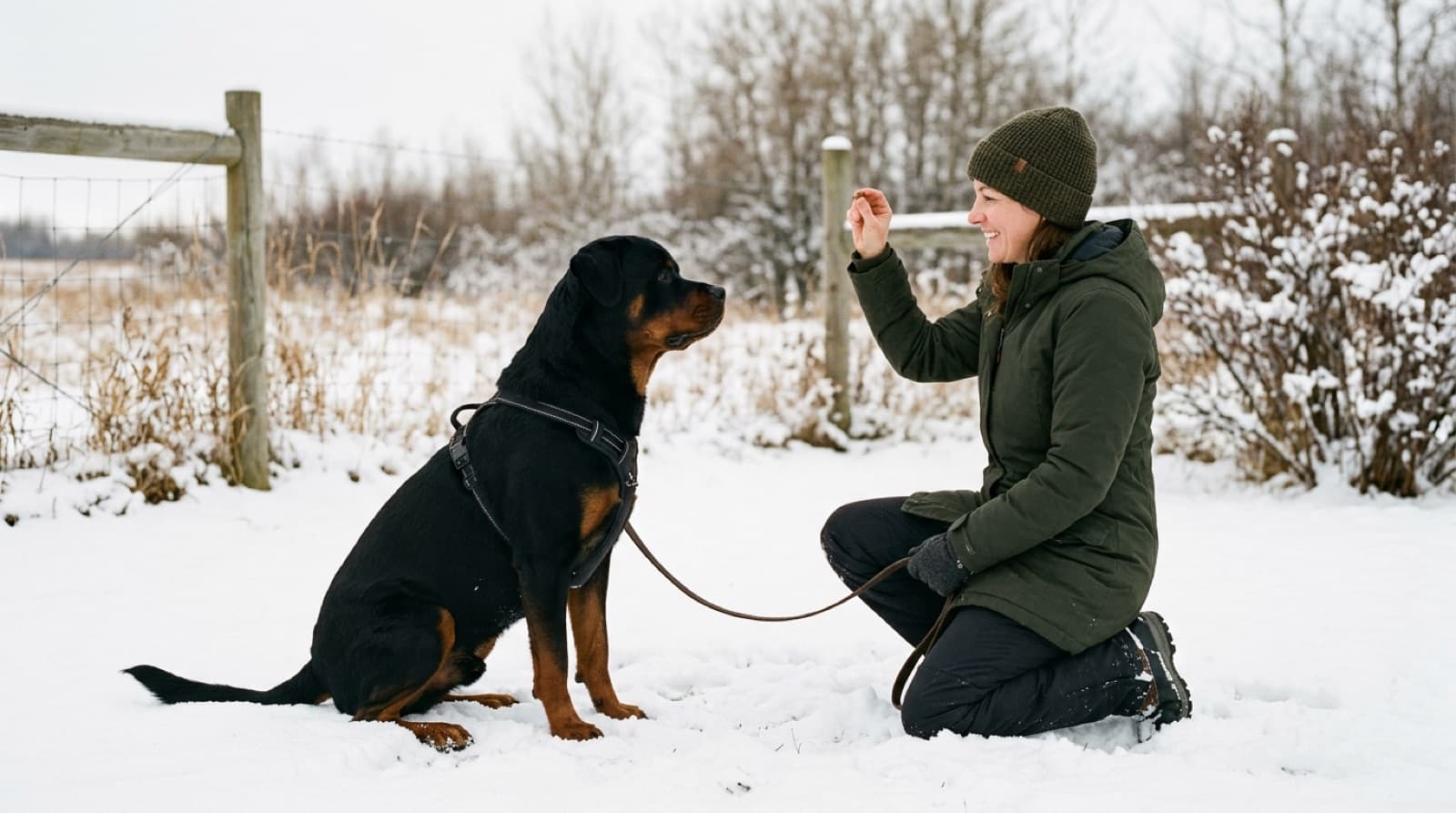
The guardian temperament, understood
A well-bred, well-raised Rottweiler is confident, calm, and steady, aloof with strangers and affectionate with its own people. The reputation for aggression outruns the reality for stable, properly raised dogs. This is a protective working breed, so the temperament is shaped by breeding, socialisation, and training rather than fixed at birth. A Rottweiler given structure and positive guidance becomes a trustworthy companion; one raised without it can become over-guarded or difficult, which is the dog that ends up in rescue. Understanding that the breed is powerful and responsive, not vicious, is the foundation of raising one well.
Socialisation and training, the two priorities
Socialisation comes first. Early, positive exposure to many people, dogs, places, and situations, continuing through life, is what produces a stable, confident adult instead of a suspicious one. For a guardian breed this powerful, it is non-negotiable. Adopting an adult with an unknown history? Work with a trainer on careful, positive socialisation.
Train with positive methods and clear structure. Rottweilers are intelligent and will test boundaries, so consistency matters. Reward-based training started early builds a responsive dog; harsh, force-based methods backfire with a powerful, sensitive breed. Group obedience classes double as socialisation.
Give the mind a job. This breed thrives on work, obedience, tracking, trick training, structured play, and a bored Rottweiler invents its own projects. Mental stimulation matters as much as physical exercise.
Ask your Brandon vet or the rescue you adopt from for a current positive-methods trainer. The American Kennel Club breed profile has a good overview of the Rottweiler’s working temperament.
Keeping a Rottweiler’s mind busy through winter
Rottweilers tolerate cold better than short-coated breeds thanks to their dense double coat, so they can still get outdoor exercise on many Brandon winter days, with attention to salted paws and shorter outings in extreme cold. But this intelligent breed needs its mind worked, and winter is the time to lean in: training sessions, puzzle feeders, scent games, and indoor obedience keep a Rottweiler busy when the deep cold limits outdoor time. Winter training projects, new skills and polished obedience, suit a breed that thrives on a job. Plan the routine before the cold, and see our Brandon winter dog care guide for the safety details.
Ready for a Rottweiler of your own?
Browse adoptable Rottweilers from Brandon and Manitoba rescues. An adult with a known temperament and a rescue’s honest assessment is often the wisest first Rottweiler.
See Available Rottweilers →Frequently Asked Questions
What is a Rottweiler’s temperament like?
A well-bred, well-raised Rottweiler is confident, calm, and deeply loyal, with a natural guardian instinct and a strong bond to its family. They are often described as aloof with strangers and affectionate, even goofy, with their own people, and many are calm, steady dogs rather than nervous or reactive ones. That said, this is a powerful working breed with protective instincts, so temperament is shaped heavily by breeding, socialisation, and training. A Rottweiler raised with early socialisation and consistent, positive guidance becomes a stable, trustworthy companion. One raised without that structure can become over-guarded or difficult, which is exactly the dog that ends up in rescue. The breed rewards a committed owner.
Are Rottweilers hard to train?
Not hard, in the sense that Rottweilers are intelligent, capable, and eager to work with a person they respect, but they need an owner who is calm, consistent, and confident. They are a thinking breed that will test boundaries, so wishy-washy, inconsistent rules produce a pushy dog. The key is positive, reward-based training with clear structure, started early. Harsh, force-based methods are both unnecessary and counterproductive with a powerful, sensitive breed, and can create the very problems people fear. Rottweilers excel at obedience and dog sports when trained well. For a first-time large-breed owner, working with a positive-methods trainer and committing to daily practice makes all the difference.
How important is early socialisation for a Rottweiler?
It is the single most important thing you do, and it is not optional for a guardian breed. Early, positive exposure to many people, dogs, places, sounds, and situations, ideally in puppyhood but continuing through life, teaches a Rottweiler that the world is normal and safe, which is what produces a stable, confident adult rather than a suspicious or reactive one. A Rottweiler that missed socialisation can become over-protective or fearful, and with a dog this powerful that is a serious problem. If you adopt an adult with an unknown history, work with a trainer on careful, positive socialisation and management. Good socialisation is what lets the breed’s natural steadiness shine instead of its wariness.
How much exercise does a Rottweiler need?
A Rottweiler needs a solid hour or more of exercise a day, along with mental work, though it is a different energy from a Boxer or Border Collie, more powerful and purposeful than frantic. Brisk walks, hikes, structured play, and training all count, and the breed genuinely enjoys having a job, whether that is obedience, tracking, carting, or trick training. Mental stimulation matters as much as physical exercise for this smart breed, and a bored Rottweiler can become destructive or invent its own guarding projects. Because Rottweilers are prone to joint issues and grow fast, avoid forced running and repetitive jumping in a young dog. In a Brandon winter, shift much of the workload to indoor training and enrichment.
Are Rottweilers good with children?
A well-socialised, well-trained Rottweiler from a stable line can be excellent with the children in its own family, often patient, gentle, and protective of them. Many Rottweilers are wonderful family dogs. The honest caveats are about size and supervision, not temperament: a Rottweiler is a large, powerful dog that can knock over a small child by accident, and any large guardian breed should be supervised with young children as a matter of course. Teach the dog gentle manners and teach children to respect the dog, and never leave young kids unsupervised with any big dog. Choose your source carefully, since temperament varies with breeding, and a rescue’s honest assessment of a specific dog with kids is invaluable.
Are Rottweilers aggressive?
Not inherently, and the reputation outruns the reality for well-bred, well-raised dogs. A stable Rottweiler is confident and protective but not aggressive; it should be calm and under control, not reactive or unpredictable. Problems arise from poor breeding, missed socialisation, lack of training, or deliberate mismanagement, not from the breed itself. That said, this is a powerful dog with guardian instincts, so responsible ownership matters more than with a small companion breed: socialise early, train consistently with positive methods, supervise appropriately, and never encourage guarding or aggression. Handled that way, Rottweilers are steady, trustworthy dogs. The breed’s strength is exactly why the preparation is non-negotiable.
How do I train and exercise a Rottweiler through a Brandon winter?
Rottweilers tolerate cold better than short-coated breeds, thanks to their dense double coat, so they can still get outdoor exercise on many Brandon winter days, with attention to salted paws and shorter outings in extreme cold. But a large, intelligent breed needs mental work too, and winter is the time to lean into it: training sessions, puzzle feeders, scent games, and indoor obedience keep a Rottweiler’s mind busy when the coldest days limit outdoor time. This breed thrives on having a job, so winter training projects, teaching new skills, polishing obedience, are ideal. Plan the routine before the deep cold, and see our Brandon winter dog care guide for the cold-weather safety details.
Where can I train a Rottweiler in Brandon?
Look for a trainer or class using positive, reward-based methods and, ideally, with experience in large working or guardian breeds, since the approach that suits a Rottweiler differs from what a small companion dog needs. Group obedience classes are valuable for a young Rottweiler because they combine training with the socialisation the breed needs so much. Ask your Brandon vet or the rescue you adopt from for a current recommendation on a force-free trainer, as specific programs change over time. Beyond formal classes, the most important work is daily and at home: consistent rules, rewarded calm, ongoing socialisation, and clear structure. A Rottweiler trained this way becomes the steady, loyal dog the breed is known for at its best.
Related Guides
New dog? Start with these care guides
Everything a new adopter needs to set up a safe, happy home.