The short answer
Boxers appear in Winnipeg rescue periodically, not daily, so set up alerts. Best rescues: the Winnipeg Humane Society, Manitoba Mutts Dog Rescue, and D'Arcy's ARC. Adoption fee: about $300 to $600 versus $1,500 to $3,000 from a breeder. White Boxers are not rare (about a quarter of all litters) and should not cost extra, though they carry higher congenital-deafness odds. Boxer crosses are more common than purebreds: Boxador, Bullboxer, Boxer Shepherd, Boxweiler. Most surrenders are adults given up over energy, slow maturity, lack of training, and cost. The breed-defining concerns are heart disease and a high cancer rate, so insure early. For most first-time owners, an adult Boxer (3 to 5 years) is the right pick.
Where can I adopt a Boxer in Winnipeg?
Purebred Boxers show up periodically, and Boxer crosses more often. Best places to check: the Winnipeg Humane Society on Hurst Way, Manitoba Mutts Dog Rescue, and D'Arcy's Animal Rescue Centre. Browse all currently available Boxers and Boxer crosses on LocalPetFinder's Boxer breed page. Listings update regularly. Because Boxers are a periodic arrival here, set up email alerts so you hear the moment one is listed.
For the full Winnipeg rescue landscape and how each organisation works, see our best dog rescues in Winnipeg guide. Browsing every adoptable dog at once is easy on the main Winnipeg dog adoption listings.
Is there a Boxer-specific rescue in Manitoba?
There is no large registered Boxer-only rescue based in Manitoba. Boxer rescue in Western Canada tends to run through breed-focused volunteer networks and transport, and reach into Manitoba is thin. We mention this honestly because adopters search for a breed-specific Boxer rescue and then send money to whatever name comes up first. Before applying or paying any breed-specific rescue, run this checklist:
(1) Canada Revenue Agency charitable registry
(2) A physical address or named foster network
(3) Public-facing vet references
(4) Recent adoptable dog listings
You rarely need a breed-specific group anyway. The Winnipeg Humane Society, Manitoba Mutts, and D'Arcy's ARC take in Boxers and Boxer crosses through the year, usually with a full vet workup and a foster temperament assessment.
How much does it cost to adopt a Boxer in Winnipeg?
Winnipeg Boxer rescue adoption fees range roughly $300 to $600. Fees include spay or neuter, vaccinations, microchip, deworming, and a basic vet workup. Senior Boxers are often reduced. Buying from a breeder: $1,500 to $3,000 or more. Annual care: roughly $1,800 to $3,200 per year, and Manitoba adds about 12 percent in combined tax to vet services and pet food. The breed-specific budget concern is medical: Boxers have real heart disease and high cancer rates, so pet insurance is worth enrolling early, commonly $40 to $90 per month for a young healthy Boxer.
| Source | Boxer Fee Range | What's Included |
|---|---|---|
| Winnipeg Humane Society | $300 to $575 | Spay or neuter, vaccines, microchip, vet check |
| Foster-based rescue (Manitoba Mutts, D'Arcy's ARC) | $300 to $600 | Spay or neuter, vaccines, microchip, foster temperament plus medical history |
| Senior Boxer (7+ years) | Often reduced | Same as above, at a lower fee |
| Standard breeder puppy | $1,500 to $3,000 or more | Initial vaccines only |
| Health-tested line | $2,500 or more | CKC papers, cardiac-tested parents (verify) |
For licensing and the local cost picture, see our Winnipeg pet licensing guide and the best dog rescues in Winnipeg guide.
Are there free Boxers for adoption in Winnipeg?
Almost never legitimately. Free Boxer listings on Kijiji, Facebook Marketplace, or local buy-and-sell groups are typically:
(1) Backyard breeders using free framing as bait-and-switch (the real price reveals after you express interest)
(2) Owners trying to offload an aging or sick Boxer without rescue screening, sometimes hiding a heart murmur or a lump
(3) Outright scams demanding shipping or vet-release fees for a dog that does not exist
Real Boxer adoption is never free. Even the lowest Winnipeg Humane Society fee covers spay or neuter, vaccines, microchip, and a vet exam at well below cost. The Boxer-specific risk is medical: this breed carries heart disease and high cancer rates, and an undisclosed problem can become thousands in vet bills within weeks. Owner-rehoming with a small fee and full medical disclosure can be legitimate, but verify vet records, ask for a recent vet visit, and meet the dog at its current home before you commit.
Should I look at “Boxer puppies for sale Winnipeg” instead of adoption?
Adoption is the better path for most Winnipeg households. Adopting an adult means the long Boxer adolescence has already played out and the rescue can tell you what you are getting. A rescue Boxer also costs $300 to $600 with full vet work, versus $1,500 to $3,000 from a breeder. With this breed, parent heart clearances matter more than almost anything, because Boxer cardiomyopathy can cause sudden death.
If you do buy from a breeder, only choose breeders who:
- Are CKC-registered (Canadian Kennel Club)
- Screen both parents for heart disease with a veterinary cardiologist (Boxer cardiomyopathy and aortic stenosis)
- Do hip testing and test for degenerative myelopathy
- Allow home visits and meeting both parents
- Take dogs back at any age and never sell through classifieds
Most Boxer puppy listings in Manitoba are well-meaning families breeding untested pets, which raises the odds of the breed-specific health issues. For the medical patterns to plan around, read our Boxer health issues guide.
The white Boxer myth
White Boxers are common, not rare, and should never cost extra. About a quarter of all Boxer puppies are born white, so a white coat is ordinary genetics, not a premium feature. The real issue is health: white Boxers have a higher rate of congenital deafness in one or both ears, tied to the same genetics as the white coat, and their pink skin sunburns more easily.
A white Boxer with normal hearing makes a wonderful, healthy pet, and a deaf Boxer can still thrive with hand-signal training and a careful, fenced life. What you should not do is pay a premium for the colour. Reputable breeders do not charge more for white, and if a listing markets a white Boxer as rare or worth extra, treat that as a red flag. If you adopt a white Boxer, ask whether its hearing has been checked, and if not, your vet can assess it.
Boxer crosses you will see in Winnipeg rescue
Boxer crosses are more common in Winnipeg rescue than purebred Boxers, and many arrive through northern Manitoba transport. The non-Boxer half changes the commitment substantially, so read each rescue's temperament notes carefully.
- Boxador (Boxer plus Labrador): typically 50 to 80 lbs, high-energy, friendly, and very trainable. A great fit for an active family that can meet the exercise needs.
- Bullboxer (Boxer plus a bulldog or Pit-type breed): muscular and people-oriented. Check against any rental or condo breed restrictions.
- Boxer Shepherd (Boxer plus German Shepherd): 60 to 90 lbs, intelligent and more protective, needing structured training and early socialization.
- Boxweiler (Boxer plus Rottweiler): large, strong, and best suited to an experienced, committed handler.
Browse adoptable Boxers in Winnipeg
Live inventory from Winnipeg rescues, including fawn, brindle, and white Boxers, Boxador and Bullboxer crosses, and senior dogs at reduced fees. Refreshed regularly, so set up alerts.
See Available Boxers →Why Boxers end up in Manitoba rescue
Boxer surrenders trace to a consistent set of causes, almost all tied to underestimating the breed:
Energy and slow maturity. A Boxer stays a bouncy, mouthy, jumping perpetual puppy until around age three, and people who pictured a calm dog surrender the reality.
Lack of training. An untrained 65-pound Boxer that jumps and pulls becomes unmanageable fast.
Health-cost surrender. Boxer heart disease and cancer can bring a bill an owner cannot carry.
Separation struggles. Boxers are intensely people-bonded and do poorly left alone all day.
Winnipeg winters make the exercise problem worse, since a short-coated Boxer needs shorter outings in deep cold and the pent-up energy turns destructive. Most Manitoba Boxer surrenders are good dogs whose owners were not ready for a high-energy, slow-to-mature breed. The fix is covered in our Boxer temperament and training guide.
Frequently Asked Questions
Where can I adopt a Boxer near me in Winnipeg?
Purebred Boxers show up in Winnipeg rescue periodically, not constantly, and Boxer crosses appear more often, many arriving through northern Manitoba transport. Best places to check: the Winnipeg Humane Society on Hurst Way, Manitoba Mutts Dog Rescue, and D'Arcy's Animal Rescue Centre. Browse currently available Winnipeg Boxers and Boxer crosses on LocalPetFinder's Boxer breed page, which updates regularly. Because Boxers are not an everyday rescue arrival here, set up email alerts on the rescue sites so you hear the moment one is listed. Most surrendered Winnipeg Boxers are 1 to 5 year old adults given up once the breed's long, high-energy adolescence outran the owner's expectations.
Is there a Boxer-specific rescue in Manitoba?
There is no large registered Boxer-only rescue based in Manitoba. Boxer rescue in Western Canada tends to run through breed-focused volunteer networks and transport, and reach into Manitoba is thin. You rarely need one. The general Winnipeg rescues, the Winnipeg Humane Society, Manitoba Mutts Dog Rescue, and D'Arcy's Animal Rescue Centre, take in Boxers and Boxer crosses through the year, usually with a full vet workup and a foster temperament assessment. If you do find a breed-specific Boxer rescue claiming Manitoba placements, verify it before applying or paying: check the Canada Revenue Agency charitable registry, a physical address or named foster network, public vet references, and recent adoptable dog listings. The same checklist applies to any out-of-province group.
How much does it cost to adopt a Boxer in Winnipeg?
Winnipeg Boxer rescue adoption fees run roughly $300 to $600, well under the $1,500 to $3,000 a breeder charges for a puppy. The Winnipeg Humane Society and foster-based rescues cover spay or neuter, vaccinations, microchip, deworming, and a basic vet workup in that fee. Senior Boxers are often reduced. Annual care for a Boxer in Winnipeg runs roughly $1,800 to $3,200 per year, and Manitoba adds about 12 percent in combined tax to vet services and pet food. The breed-specific budget concern is medical: Boxers have real rates of heart disease and are one of the more cancer-prone breeds, so pet insurance is worth enrolling early, commonly $40 to $90 per month for a young healthy Boxer. Budget as if a significant vet event is likely at some point, because for this breed it often is.
Are there free Boxers for adoption in Winnipeg?
Almost never legitimately. Free Boxer listings on Kijiji, Facebook Marketplace, or local buy-and-sell groups are usually backyard breeders using free framing as bait-and-switch, owners trying to offload an aging or sick Boxer without rescue screening, or outright scams demanding shipping or vet-release fees for a dog that does not exist. Real Boxer adoption is never free. Even the lowest Winnipeg Humane Society fee covers spay or neuter, vaccines, microchip, and a vet exam at well below cost. The Boxer-specific risk is medical: this breed carries heart disease and high cancer rates, and an undisclosed heart murmur or a lump on a free dog can become thousands in vet bills within weeks. Owner-rehoming with a small fee and full medical disclosure can be legitimate. Verify vet records, ask for a recent vet visit, and meet the dog at its current home first.
Should I look at Boxer puppies for sale in Winnipeg instead of adoption?
Adoption is the better path for most Winnipeg households. Buying through a breeder makes sense only if you specifically need a puppy with verifiable parent health testing. For a family companion, adoption gives you a known adult temperament, a full medical workup, a $300 to $600 fee instead of $1,500 to $3,000, and you take a Boxer out of rescue. If you do buy, only choose CKC-registered breeders who screen both parents for heart disease with a cardiologist (Boxer cardiomyopathy and aortic stenosis are serious breed concerns), do hip testing, test for degenerative myelopathy, allow home visits and meeting both parents, take dogs back at any age, and never sell through classifieds. Boxer heart clearances matter enormously, more than with most breeds, because Boxer cardiomyopathy can cause sudden death. Most Boxer puppy listings in Manitoba are well-meaning families breeding untested pets. Verify carefully.
Are white Boxers rare or unhealthy?
White Boxers are not rare, and they are not the flashy prize some listings imply. Roughly a quarter of Boxer puppies are born white, so they are common, not special, and they should never carry a premium price. The real issue is health, not rarity: white Boxers have a higher rate of congenital deafness, in one or both ears, linked to the same genetics that produce the white coat, and their pink skin is more prone to sunburn and skin cancer. A white Boxer with normal hearing makes a wonderful pet and is no less healthy than a fawn or brindle in other respects. Reputable breeders do not charge more for white, and many will not breed specifically for it. If a listing markets a white Boxer as rare or worth extra, treat that as a red flag, and if you adopt one, ask whether its hearing has been checked.
What are Boxer crosses like: Boxador, Bullboxer, Boxer Shepherd?
Boxer crosses are more common in Winnipeg rescue than purebred Boxers, and many arrive through northern Manitoba transport. A Boxador (Boxer plus Labrador) is typically 50 to 80 lbs, high-energy, friendly, and very trainable, a great fit for an active family that can meet the exercise needs. A Bullboxer (Boxer plus a bulldog or Pit-type breed) is muscular and people-oriented, and worth checking against any rental or condo breed restrictions. A Boxer Shepherd (Boxer plus German Shepherd) is 60 to 90 lbs, intelligent and more protective, needing structured training and socialization. A Boxweiler (Boxer plus Rottweiler) is large, strong, and needs an experienced, committed handler. All Boxer crosses tend to inherit the breed's energy and slow maturity, so read each rescue's temperament notes carefully, because the non-Boxer half changes the commitment substantially.
Why do Boxers end up in Winnipeg and Manitoba rescues?
Boxers are surrendered for a consistent set of reasons, almost all tied to underestimating the breed. Energy and slow maturity lead the list: a Boxer stays a bouncy, mouthy, jumping perpetual puppy until around age three, and people who pictured a calm family dog surrender the reality. Lack of training compounds it, because an untrained 65-pound Boxer that jumps and pulls becomes unmanageable fast. Health-cost surrender is real too, since Boxer heart disease and cancer can bring an unplanned bill an owner cannot carry. Add lifestyle changes, moves to no-pet rentals, and separation struggles, since Boxers are intensely people-bonded and do poorly left alone all day. Winnipeg winters make the exercise problem worse, because a short-coated Boxer needs a coat and shorter outings in deep cold, and the pent-up energy comes out as destruction. Most Manitoba Boxer surrenders are good dogs whose owners were not ready for a high-energy, slow-to-mature breed.
Are there Boxer puppies in Winnipeg rescues?
Purebred Boxer puppies are uncommon in rescue because they sell quickly through breeders. Most Winnipeg rescue Boxers are 1 to 5 year old adults, surrendered once the long adolescence revealed the full breed reality. Boxer cross puppies are more common and usually arrive as accidental litters, surrenders, or northern transport litters, most often in spring and summer. If you want a puppy, set up email alerts on the rescue sites and check LocalPetFinder often, because Boxer and Boxer-cross puppies are adopted quickly once listed. For most households an adult Boxer is the better choice anyway, because the perpetual-puppy adolescence, roughly to age three, is exactly the phase that overwhelms owners and drives the surrenders in the first place.
Are Boxers good for first-time dog owners in Winnipeg?
They can be, with realistic expectations and a training commitment. Boxers are affectionate, loyal, playful, and genuinely good with children, which makes them wonderful family dogs, but the flip side is a lot of dog for a first-timer: high energy, a long adolescence to about age three, strong jumping and mouthing habits, and a need for real daily exercise. For a first-time Winnipeg owner, the strong recommendation is to adopt an adult Boxer (3 to 5 years) past the wildest phase, and to commit to a force-free training class early. Four things to be honest about first: 60 to 90 minutes of daily exercise including winter, consistent training to manage the jumping and pulling, a real medical budget for the breed's heart and cancer risk, and a plan for the dog's alone-time, because Boxers struggle when isolated. If those fit, a Boxer is one of the most rewarding family dogs there is.
Should I adopt a senior Boxer?
Consider it, with the medical realities in mind. Senior Boxers (7+ years) appear in Winnipeg rescues because owners passed away, downsized, or could no longer manage a strong dog, and these dogs are usually calm, affectionate, house-trained, and quick to bond, with exercise needs that have settled to something a Winnipeg winter suits. The honest part is health: Boxers have elevated heart disease and cancer rates, and a senior Boxer may need more frequent vet visits and is harder to insure once conditions appear, so plan to absorb some vet costs directly. Boxers commonly live 10 to 12 years, so a 7 or 8 year old can still have good years ahead. Adoption fees are usually reduced. For a household that wants a devoted companion past the wild adolescence and can accept the medical odds, a senior Boxer is a deeply rewarding adoption.
Do Boxers handle Winnipeg winters?
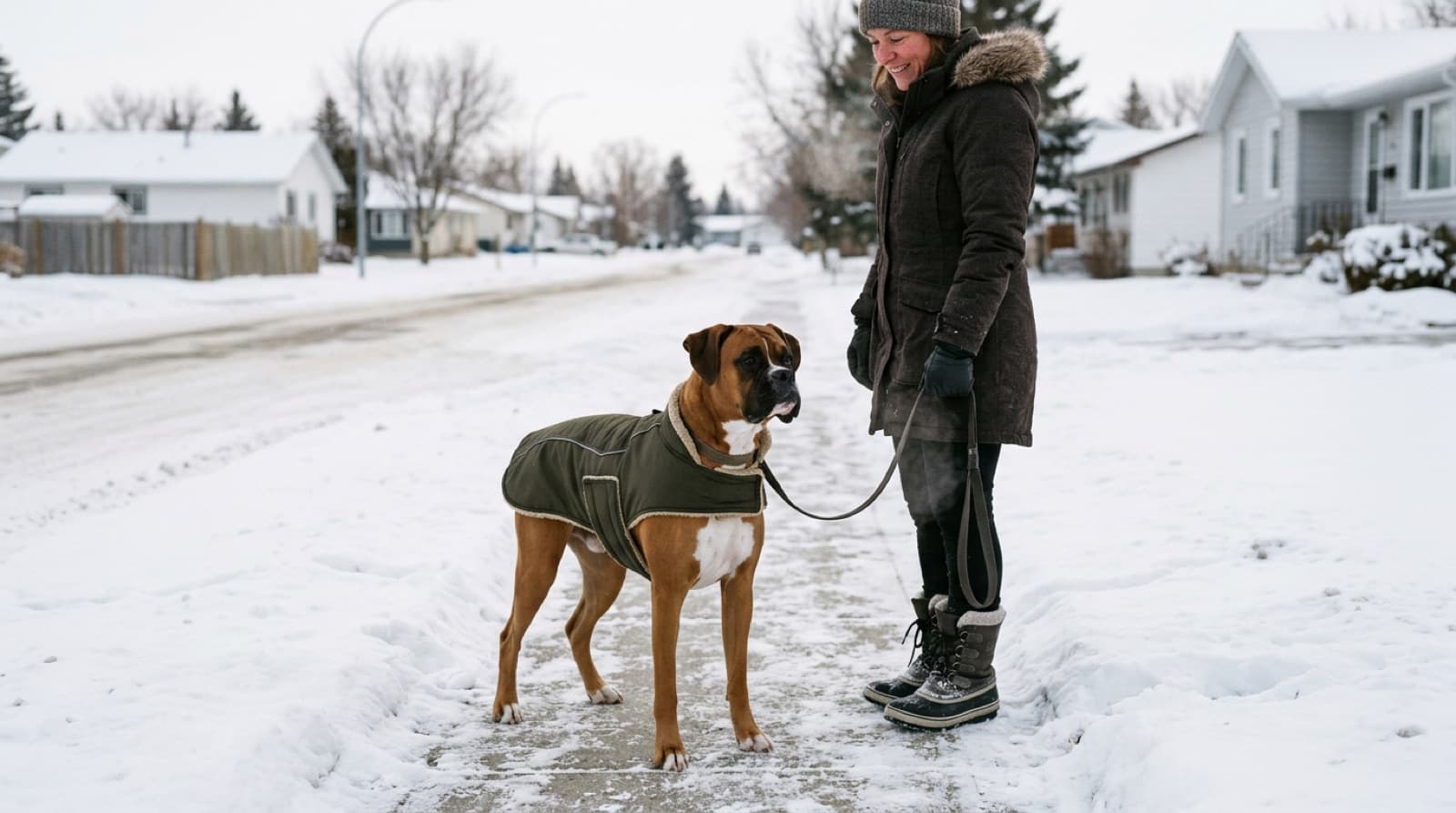
They need help, and Winnipeg tests it hard. A Boxer has a short single coat and a brachycephalic (short) muzzle, so it is genuinely cold-sensitive, unlike a Husky or a Golden, and a Manitoba winter demands management. Your Boxer will need a warm, well-fitted coat for walks below roughly -10, booties help on salted sidewalks and in deep cold, and outings should be shorter and more frequent when it is -35 with windchill. Watch for shivering, lifted paws, and reluctance, which mean it is time to go in. The upside is that Boxers are lower-maintenance on grooming than double-coated breeds. The winter challenge is really about exercise: a high-energy dog that cannot spend an hour outside in deep cold needs indoor enrichment, hallway fetch, and training games to burn energy, or the pent-up drive turns destructive. With a coat and a plan, a Boxer does fine through a Winnipeg winter.
Related Guides
New dog? Start with these care guides
Everything a new adopter needs to set up a safe, happy home.