The short answer
Winnipeg winter is a cold-and-frostbite problem, not a wet one. The real risks are frostbite on ears, tails, and paws in the deep freeze, hypothermia on walks that run too long, cracked pads from road salt and ice, and antifreeze poisoning. Use windchill as your guide: short walks down to about -15, shortened walks to -25, bathroom breaks only below -25, and indoor exercise during extreme cold warnings. This guide covers the gear, the warning signs, the indoor exercise that actually tires a dog out, and how to settle a newly adopted rescue through a brutal prairie winter.
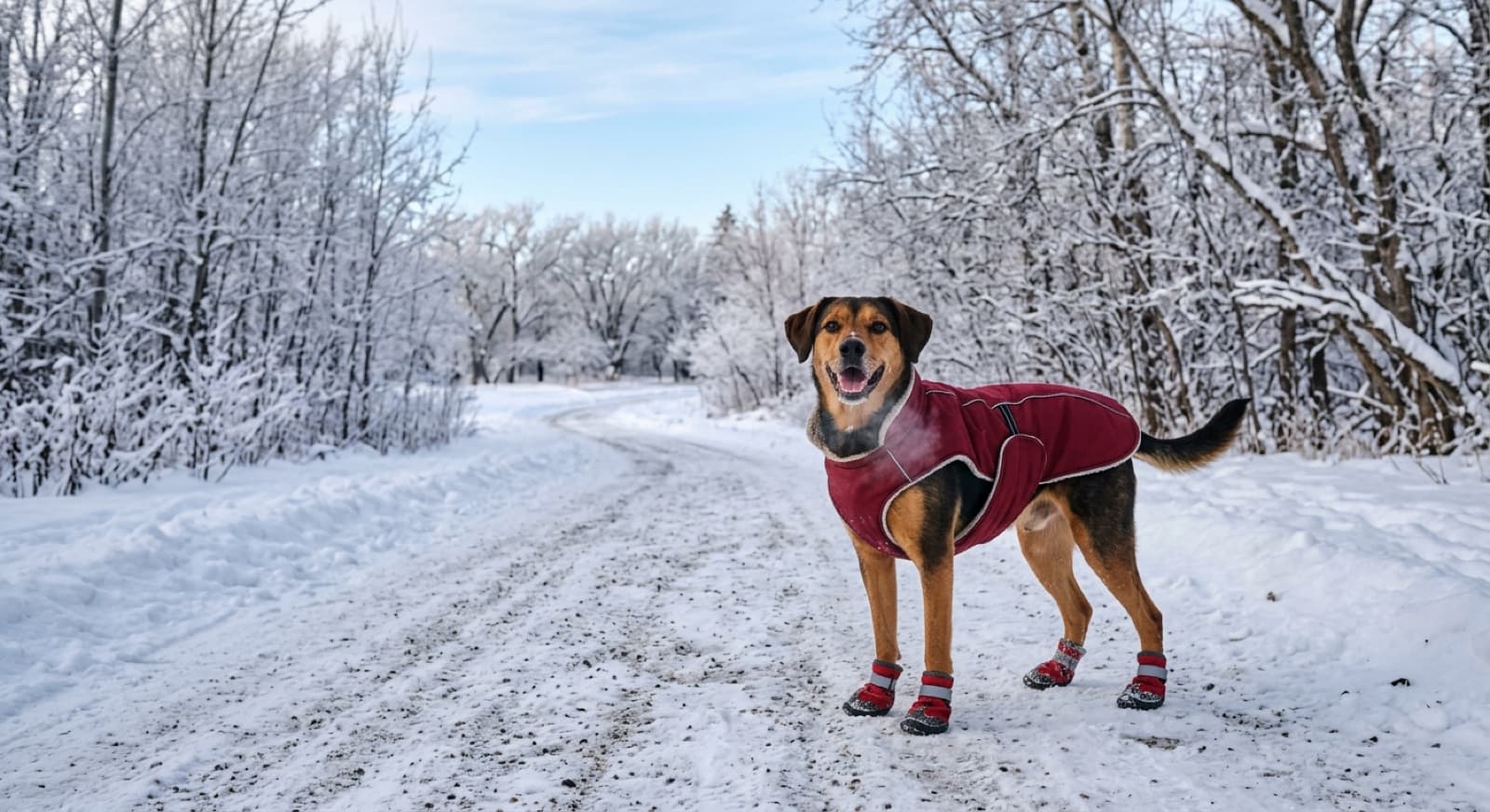
Winnipeg cold is the real deal
Winnipeg is one of the coldest major cities in Canada. January and February regularly bring air temperatures in the -25 to -35 Celsius range, and once you add wind off the open prairie, windchill values of -40 and colder are a normal part of a Winnipeg winter. Extreme cold warnings from Environment Canada are common, and at those temperatures exposed skin (yours and your dog’s) starts to freeze in minutes.
That changes the whole job. In a milder coastal climate, winter dog care is about managing rain and damp. On the prairies it is about managing exposure. The dominant risks are frostbite, hypothermia, cracked paw pads, and antifreeze. The gear is insulated coats and paw protection, not raincoats. And the daily decision is not “will my dog get wet” but “is it safe to be outside at all right now.”
The single most useful habit is checking the windchill before every walk. Air temperature alone undersells the danger. A -20 Celsius day with a stiff wind can carry a -32 windchill, and that is the number that matters for how fast skin and paws freeze. Environment Canada publishes both the temperature and the windchill in the daily forecast, and posts extreme cold warnings ahead of the worst stretches.
The good news: this is manageable. Winnipeg dog owners have done it for generations. The rest of this guide is the practical version of what works.
When it is too cold to walk
There is no single cutoff that fits every dog, because a Malamute and a Chihuahua live in different winters. Use windchill bands and adjust for your dog.
| Windchill | Most dogs | Small / short-coat / senior / puppy |
|---|---|---|
| 0 to -15 | Normal walks, coat for short coats | Coat, watch for shivering |
| -15 to -25 | Shorten walks, monitor paws | Short walks only, coat mandatory |
| -25 to -30 | Bathroom break, keep it brief | Quick bathroom break, then inside |
| Below -30 | Out only to relieve themselves | Indoor potty options worth considering |
Adjust down for any dog that is small, short-coated, very young, very old, lean with little body fat, or new to a cold climate. Adjust up for thick double-coated northern breeds, who genuinely enjoy the cold. Even those breeds have a ceiling in an extreme cold warning, though, and frostbite does not care how thick the coat is on the ear tips.
When Environment Canada posts an extreme cold warning, treat it as a clear signal to keep outdoor time to bathroom breaks and move exercise indoors. There is no walk worth a frostbitten paw.
Frostbite and hypothermia: the warning signs
These are the two cold-weather emergencies every Winnipeg dog owner should be able to recognise. Knowing the signs buys you the time that matters. The American Veterinary Medical Association publishes detailed cold-weather pet safety guidance worth reading before the deep freeze sets in.
Frostbite
Frostbite hits the extremities first because the body pulls blood to the core in the cold. Watch the ear tips, tail tip, scrotum, and paw pads. Signs include skin that looks pale, grey, or bluish, feels cold and hard, and may later swell or look red as it warms. The dog may favour a paw, limp, or react when you touch the area. If you suspect frostbite, get your dog inside and warm the area slowly with body heat or lukewarm (not hot) water, and call your vet for treatment. Do not rub the area, do not use a heating pad, and do not apply direct heat, because all three can make the damage worse.
Hypothermia
Hypothermia is a drop in core body temperature, and it is dangerous fast in Winnipeg cold. The early sign is violent shivering. As it worsens, the shivering stops and the dog becomes weak, slow, stumbling, and eventually lethargic, stiff, or confused. A dog that stops shivering in deep cold is not warming up; that is a red flag. Get them inside immediately, wrap them in dry towels or a blanket, warm them gradually, and call your vet or an emergency vet for guidance. Severe hypothermia needs veterinary treatment, not just a warm room.
When in doubt, call. Frostbite and hypothermia in deep prairie cold are emergencies. This article describes the warning signs so you can act, but treatment is a job for your vet or an emergency vet. Know which Winnipeg emergency clinic is closest to you before you need it, and keep the number in your phone.
Paw protection in salt and ice
Winnipeg salts and sands its streets and sidewalks heavily through winter. That salt cracks paw pads, stings any existing cracks, and is irritating if the dog licks it off later. Add ice balls forming in the hair between the toes and you have the most common winter paw problems. Three lines of defence handle almost all of it.
1. Paw balm or musher's wax
Applied before the walk, a wax barrier protects the pad from salt and reduces ice buildup. Look for beeswax-based products without essential oils a dog might lick off. Reapply through the season as needed.
2. Booties (if your dog tolerates them)
Boots solve the salt-and-ice problem completely and add real warmth for short-coat dogs in deep cold. Many dogs hate them at first and walk like a startled pony for the first few wears, which is normal. Some dogs never adjust. If yours does, boots are the gold standard for Winnipeg winter. If yours does not, fall back on balm plus a rinse.
3. Rinse and check after every walk
Wipe or rinse the paws with lukewarm water when you get home to remove salt, then dry between the toes. Inspect for cracks, redness, or stuck ice. Trim the long hair between the pads before winter so ice balls cannot form and cut into the skin. Catching a small crack early beats treating an infected pad later.
Coats: which dogs actually need one
A coat is gear, not a fashion statement, for the dogs that need it. Here is the rough breakdown for Winnipeg cold.
- Definitely need a coat: short-coat and thin-skinned breeds (Greyhounds, Whippets, Boxers, Pit Bull mixes, Dobermans, Boston Terriers, Frenchies), toy and small breeds (Chihuahuas, Yorkies, Miniature Pinschers), puppies, seniors, and any lean dog with little body fat.
- Usually fine without one: thick double-coated breeds built for cold (Husky, Malamute, Samoyed, Bernese, Great Pyrenees, Newfoundland). They handle Winnipeg winter well and often prefer it, though an extreme cold warning still shortens their outings.
- Depends on the dog: medium single-coated breeds (Labs, single-coat Doodles, Vizslas). Watch for shivering and add a coat if they show it.
For a coat that actually works in -30, look for full belly coverage and a high neck or collar, not just a thin strap across the back. The belly and chest lose heat fast, and that is where a back-only coat fails. Reflective trim is a bonus for dark winter mornings and evenings.
Antifreeze and cold-engine dangers
Winter brings two specific hazards that are easy to forget until they cause harm.
Antifreeze poisoning
Antifreeze containing ethylene glycol tastes sweet, and dogs will drink it from a garage floor, driveway, or street puddle near a parked car. Even a small amount can be fatal, and the window to treat it is short. Clean up spills immediately, keep containers sealed and out of reach, and consider a pet-safer propylene-glycol product. If you think your dog ingested antifreeze, do not wait: call an emergency vet right away. This is one of the few situations where minutes genuinely change the outcome.
Cats under warm cars
Outdoor and community cats crawl into wheel wells and onto warm engines to escape the cold. Starting a cold car can injure or kill a hidden cat. Bang on the hood or honk the horn before you start the engine on a cold Winnipeg morning. It takes five seconds and it saves lives during a cold snap.
Browse adoptable dogs in Winnipeg
Winnipeg rescues list adoptable dogs year-round. Match by coat type and energy to find a dog suited to prairie winters, from a thick-coated northern mix to a couch-loving senior.
See Available Winnipeg Dogs →Indoor exercise for housebound days
On the coldest weeks of a Winnipeg winter, the walk gets cut to a bathroom break. A high-energy dog still needs an outlet, and a bored dog finds its own entertainment in your furniture. The fix is enrichment. Mental work tires a dog out as much as a physical walk, sometimes more.
- Snuffle mat. Hide kibble in a bristled mat and let the dog sniff it out. Twenty minutes of nose work settles most dogs.
- Frozen Kongs and puzzle feeders. Stuff a Kong, freeze it, and it becomes a half-hour project. Replace the food bowl entirely on indoor days.
- Training sessions. Five to ten minutes of focused training (sits, downs, spins, paw targets, place, recall games) is real mental exercise. Polish a new trick each week.
- Hide and seek. Have someone hold the dog, hide, and call them. Free, easy, and dogs love it.
- Scent games. Hide a high-value treat in one of three boxes and let the dog find it. Build up to hides across rooms.
- Stairs. A few controlled sets of up-and-down gives a working breed some physical output indoors.
- Indoor daycare. During a long cold snap, a day at an indoor dog daycare gives a working breed the run it cannot get outside.
A skipped walk during an extreme cold warning is not a welfare failure. A 45-minute walk at -38 windchill is the actual risk. Choose the indoor option without guilt.
Recall, ice, and footing
Winter changes the off-leash calculus in Winnipeg. Ice underfoot means a dog cannot stop or turn the way it can on grass, so a dog that bolts after a squirrel can slide into trouble before it hears your recall. Salted and sanded paths chew up paw pads on a long run. And frozen water is never a guaranteed safe surface.
- Stay off uncertain ice. The Assiniboine and Red Rivers, retention ponds, and lakes are not reliable ice. A dog that breaks through is in immediate danger and so is anyone who goes after it. Keep dogs off any frozen water you cannot confirm is solid.
- Use a long-line in deep cold. On icy footing, a long-line on a maintained path gives freedom without the bolt risk of full off-leash.
- Pick maintained areas. Stick to plowed and sanded paths and designated off-leash areas rather than untracked snow that hides ice and debris.
For more on which Winnipeg parks work for off-leash time and which suit a nervous new rescue, see the Winnipeg off-leash parks guide.
Settling a new rescue through a prairie winter
Adopting in winter adds a layer. A dog in the 3-3-3 decompression window is already processing a new home, new people, and new routines. A brutal Winnipeg cold snap on top of that asks a lot. Keep the first weeks low-key and predictable.
- Keep walks short and calm. Do not try to walk the nerves out of a frightened dog in -25. Short, quiet outings plus indoor enrichment do more for a decompressing dog than a long cold march.
- Coat a thin or short-coat rescue from day one. A dog that came from a milder climate, a foster home down south, or northern intake may feel the cold acutely and have no winter conditioning.
- Build a warm indoor routine. Enrichment, a warm bed, and a steady schedule help a new dog feel safe faster than a packed activity calendar.
- Watch for cold sensitivity. Shivering, lifting paws off the ground, or refusing to move outside is the dog telling you it is too cold. Listen and head in.
For the full decompression playbook, read the first week with a rescue dog in Winnipeg. The winter version is the same approach, just with a coat and shorter outings.
Where to walk when the weather breaks
Winnipeg gets milder stretches between cold snaps, and the city has good winter walking when the windchill cooperates. Assiniboine Park has wide maintained paths and is a reliable choice on a calmer day. Kilcona Park is one of the larger off-leash areas in the city and works well for a hard run when footing is decent. The Assiniboine Forest gives a sheltered, treed walk that blocks some of the wind. Bonnycastle Park near the Forks is a smaller central option, and the river trails around the Forks draw plenty of winter walkers when conditions allow.
Whichever you pick, check the windchill first, layer up the dog if it needs it, protect the paws, and keep the outing length matched to the temperature. A 20-minute walk on a -8 day is a gift in a Winnipeg January. An hour at -35 windchill is not.
Frequently asked questions
What temperature is too cold to walk a dog in Winnipeg?
Watch the windchill, not the air temperature. Most dogs handle short walks down to about -15 Celsius windchill. Between -15 and -25, shorten walks and watch short-coat dogs closely. Below -25 windchill, keep it to a few minutes for a bathroom break, and below -30 (common in January and February in Winnipeg) most dogs should only go out long enough to relieve themselves. Small, short-coat, senior, and young puppies feel the cold faster than thick-coated breeds. When Environment Canada issues an extreme cold warning, treat that as your cue to switch to indoor exercise.
How do I know if my dog has frostbite or hypothermia?
Frostbite hits the extremities first: ear tips, tail tip, and paw pads. The skin may look pale, grey, or bluish, feel cold and hard, and the dog may favour a paw or yelp when you touch the area. Hypothermia shows as violent shivering that gives way to weakness, slowing down, stumbling, and eventually lethargy or confusion. Both are emergencies in deep Winnipeg cold. Get your dog inside, wrap them in dry towels or a blanket, and warm them slowly. Never use hot water, a hair dryer on high, or a heating pad directly on the skin. Call your vet or an emergency vet right away for treatment guidance.
Does my dog need a coat for Winnipeg winter?
Short-coat and small dogs do. Frenchies, Boxers, Pit Bull mixes, Whippets, Greyhounds, Chihuahuas, Dobermans, Boston Terriers, and most toy breeds need an insulated coat any time it is below about -5 Celsius, and a coat plus shortened walks in the deep freeze. Thick double-coated breeds (Husky, Malamute, Samoyed, Bernese, Great Pyrenees) handle Winnipeg cold well and usually do not need a coat at typical winter temperatures, though even they have limits in an extreme cold warning. Look for full belly coverage and a high neck, not just a thin back strap.
How do I protect my dog’s paws from salt and ice in winter?
Three layers of defence. First, apply paw balm or musher’s wax before the walk to create a barrier against salt and ice. Second, consider booties if your dog tolerates them, which solve the salt problem completely. Third, rinse the paws with lukewarm water when you get home and dry between the toes. Road salt and ice-melt cracks paw pads and is irritating if the dog licks it off. Trim the long hair between the pads before winter so ice balls do not form and cut into the pad. Check paws after every walk for cracks or redness.
What can I do for exercise when it is too cold to walk?
Mental work tires a dog out as much as a walk. Snuffle mats, puzzle feeders, frozen stuffed Kongs, and scattering kibble around a room all engage the nose and brain. Short indoor training sessions (sits, downs, spins, recall games, place commands) burn real energy. Hide-and-seek through the house and a few sets of stairs work for higher-energy dogs. On the worst cold-snap weeks, a day of indoor daycare gives a working breed the outlet it needs. A skipped walk during an extreme cold warning is not a welfare failure; an hour outside at -35 windchill is.
Is antifreeze really dangerous to dogs in winter?
Yes, and Winnipeg winter is peak season for it. Antifreeze tastes sweet, dogs and cats will lap it up, and even a small amount of ethylene glycol can be fatal. Garage floors, driveways, and street puddles near parked cars are the usual sources. Clean up any spills immediately, store containers sealed and out of reach, and consider pet-safer propylene-glycol antifreeze. If you suspect your dog drank antifreeze, this is a same-minute emergency: call an emergency vet immediately, because the window for treatment is short.
Should I check under my car before starting it in winter?
Yes, especially if outdoor or community cats live nearby. Cats crawl into wheel wells and up onto warm engines to escape the cold, and starting the engine can injure or kill them. Bang on the hood or honk the horn before you start a cold car. It costs five seconds and can save an animal’s life during a Winnipeg cold snap.
Is it safe to let my dog off-leash on ice or frozen ponds?
Be cautious. Frozen retention ponds, the Assiniboine and Red Rivers, and lakes are never guaranteed safe ice, and a dog that breaks through is in immediate danger. Stick to maintained off-leash areas and avoid letting a dog run onto any frozen water you cannot confirm is solid. Ice underfoot also makes recall riskier because dogs slip and cannot stop, and salted or sanded paths chew up paw pads. In deep cold, a long-line on a regular path beats off-leash on uncertain footing.
How do I help a newly adopted rescue dog through their first Winnipeg winter?
Go slow and keep it predictable. A dog still in the 3-3-3 decompression window is processing a new home, and a brutal prairie winter on top of that is a lot. Keep walks short and calm, build a warm indoor routine with enrichment, and do not push a nervous dog into long cold outings to "exercise the nerves out." Layer a coat on a thin or short-coat rescue from day one. Watch for cold sensitivity in dogs that came from milder climates or from northern intake. If your rescue refuses to go out in the cold, a few steps for a bathroom break plus indoor enrichment is enough until they settle.
Do puppies and senior dogs need extra winter care in Winnipeg?
Yes. Puppies lose body heat fast, have thin coats, and cannot regulate temperature well, so keep their outdoor time very short in the cold and use a coat. Senior dogs feel joint stiffness more acutely in cold and damp, so a warm-up indoors before walks, a coat to keep the back warm, shorter and more frequent outings, and a warm sleeping spot all help. Both age groups are more vulnerable to hypothermia than a healthy adult dog. If a senior is suddenly reluctant to walk, talk to your vet about pain management rather than forcing the issue.
Related Winnipeg dog guides
First Week With a Rescue Dog
The 3-3-3 rule, decompression, and how to start a Winnipeg rescue dog right, winter or not.
Winnipeg Off-Leash Parks
Every off-leash park in Winnipeg, with notes on footing and which work for new rescue dogs.
Best Dog Rescues Winnipeg
Winnipeg Humane Society, Manitoba Mutts, D'Arcy's ARC, and Hull's Haven compared.
All Winnipeg Dogs
Every adoptable dog from Winnipeg rescues, with size, breed, and energy filters.
Find your Winnipeg winter dog
Browse adoptable dogs from Winnipeg rescues. Match by coat type and energy to find a dog ready for prairie winters.
Browse All Winnipeg Dogs →New dog? Start with these care guides
Everything a new adopter needs to set up a safe, happy home.