The short answer
Set up one safe room with a litter box, food, water, a bed and a hiding spot. Carry the cat in, open the carrier, and leave. Expect hiding for a few days, keep the food and litter the same as the shelter used, and do not pull the cat out from under anything. Book a vet visit in the first fortnight. Call a vet immediately for a male cat straining in the litter box, or any cat not eating for two days.
The cat you meet in week one is not the cat you adopted. That is worth knowing before you drive home from Greenock Street, because the gap between the affectionate animal you met and the shape hiding behind the dryer can be alarming if nobody warned you.
Nothing has gone wrong. A cat that has just changed everything it knows does the sensible thing and finds cover. Your job in week one is smaller than you think: make the room predictable, keep the food familiar, and be boring and present.
Here is the week in order, what to buy first, and where the line sits between normal settling behaviour and something worth phoning a clinic about.
The Settling-In Timeline
| When | What it looks like | What to do |
|---|---|---|
| Day 1 | Straight under the bed. Little or no eating. No interest in you at all. | Leave the carrier open in the safe room and walk away. Do not pull the cat out from anywhere. |
| Days 2 to 3 | Eating overnight when the house is quiet. Using the box. Still hiding in daylight. | Sit in the room reading aloud without approaching. Let the cat decide the pace. |
| Days 4 to 7 | Comes out when you are still. Maybe a head bump. Starts investigating the room properly. | Introduce a wand toy. Play is often the first real contact a shy cat accepts. |
| Weeks 2 to 3 | Exploring beyond the safe room. Real personality showing up. Sleep schedule forming. | Open the house gradually, one room at a time, with the safe room still available. |
| Month 3 | Fully settled. This is the cat you actually adopted. | Book the wellness visit if you have not already, and get on a routine. |
A pattern, not a schedule. Confident cats from foster homes often move much faster than this. Shy shelter cats often take longer, and that is fine.
Setting up the safe room
Pick the quietest room you have. A spare bedroom is ideal, a bathroom works, a laundry room with the machines off is fine. What matters is low traffic and a door that closes.
Litter box away from the food. Cats will not happily eat next to a toilet. Opposite corners is enough in a small room.
Give it somewhere to hide that you approve of. A cardboard box on its side or a covered bed. If you do not provide a hiding spot, the cat picks one behind an appliance and getting it out is much harder.
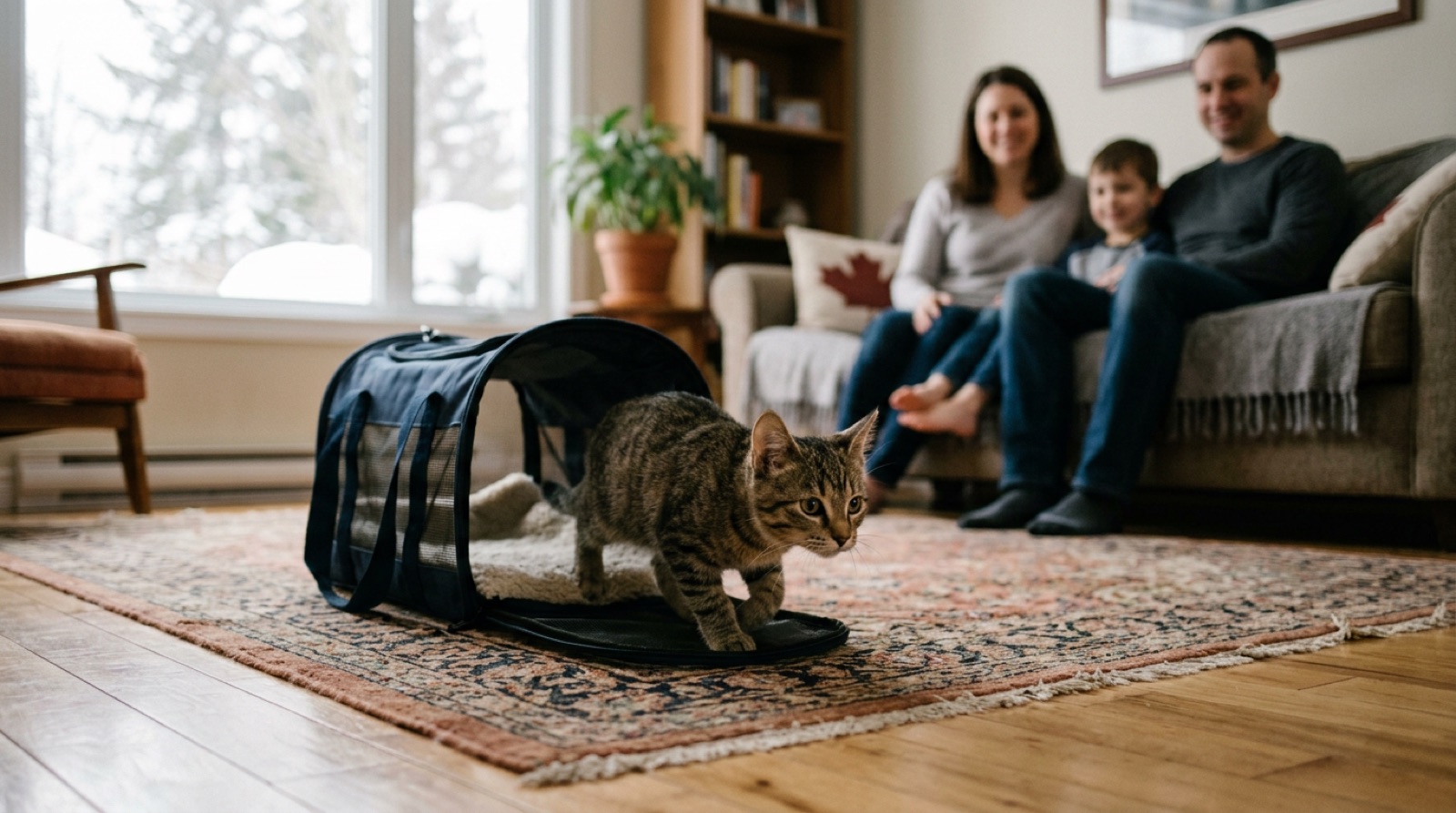
Leave the carrier open in the room. It is the only familiar object the cat owns. Plenty of cats sleep in it for the first few nights.
Keep it boring on purpose. No visitors, no children coming to look, no music. The room is dull by design for the first few days.
Food and litter: change nothing at first
Ask the shelter or foster what they were feeding and what litter they used, and buy those before pickup. It feels like a small thing. It is the difference between a cat that eats on night one and a cat with an upset stomach on top of everything else.
Switch food gradually over roughly a week, moving from mostly old to mostly new a little at a time. For litter, set out a second box with your preferred type beside the familiar one and let the cat vote. Cats have strong opinions about texture and most will tell you clearly.
Two boxes for one cat is the standard advice, and it earns its keep in week one when a nervous cat may not want to cross a room it has not mapped yet.
Registering with a Moncton vet
Book the first appointment within the first couple of weeks, once the cat is eating and using the box. Adopted cats leave P.A.W. with a first vaccination and deworming done, not a finished schedule, so the first visit is about follow-ups and a baseline while the cat is healthy.
Greater Moncton has several full-service options, including Elmwood Veterinary Hospital and Moncton Animal Hospital, plus Moncton Veterinary Walk-in and Urgent Care in Riverview for things that will not wait for an appointment.
Ask about the after-hours arrangement while you are registering. Knowing where you are driving at 2 a.m. is a question best answered on a calm Tuesday afternoon.
Call a vet tonight if you see this
A male cat crouching in the litter box repeatedly, crying, or producing nothing may have a urinary blockage. That is fatal within hours and it does not wait until morning. It is a vet call first, before any thought about litter preferences or new-home stress.
The same applies to laboured breathing, repeated vomiting, collapse, suspected poisoning, or a cat that has eaten nothing in two days. Riverview Animal Health Centre on Pine Glen Road runs 24/7 emergency care at 506-387-4015. Phone and describe what you are seeing rather than deciding on your own whether it counts.
Browse adoptable Moncton cats
Foster-based rescues can tell you in advance whether a cat is a two-day settler or a two-week hider, which makes week one far easier to plan. Listings refreshed regularly.
See Available Moncton Cats →Frequently Asked Questions
How long does it take a rescue cat to settle in?
Think in threes. Roughly three days to stop panicking, three weeks to start showing a personality, and three months to be genuinely at home. That is a pattern, not a schedule, and plenty of cats move faster or slower. A confident adult from a foster home might own the sofa by Wednesday. A shy cat from a shelter may spend two weeks behind the dryer. Neither says anything about whether you chose the right cat, and pushing the timeline is the one thing that reliably makes it longer.
What is a safe room and do I really need one?
Yes, and it is the single highest-value thing you can do in week one. Pick one quiet room, ideally a spare bedroom or a bathroom, and put the litter box, food, water, a bed and a hiding spot in it. A whole house is overwhelming to a cat that just left a shelter. One room is a territory it can learn in a day, and everything after that is expansion from a base rather than survival in a maze. Close the door and let the cat run that room before you open the rest.
My new cat is hiding and will not come out. Is that normal?
Completely normal, and the worst response is to go looking for it. A cat that has just moved is not sulking, it is doing exactly what cats do in unfamiliar territory: find cover, watch, and come out when the coast seems clear. Keep the food, water and litter box close to the hiding spot, and spend time in the room without approaching. Reading aloud or working quietly on your laptop does more than any coaxing. Most cats start moving around overnight in the first two or three days.
My cat is not eating. When should I worry?
A skipped meal or a quiet first day is expected. Two full days without eating is a vet call, and that is not an overcautious rule. Cats that stop eating can develop liver problems faster than most people realise, and a cat that has just moved house is exactly the profile at risk. Try warming wet food slightly to lift the smell, and offer whatever the shelter or foster was feeding rather than something new. If nothing is going in by day two, phone your clinic.
Should I change the cat’s food and litter right away?
No, change both slowly and not at the same time. Ask what the shelter or foster home was using and buy that first, even if you intend to switch. For food, mix in the new one over a week or so, moving from mostly old to mostly new. For litter, put out a second box with the new litter beside the familiar one and let the cat choose. Changing everything on day one is how you get diarrhoea and a cat going outside the box in the same week.
How do I introduce a rescue cat to my resident cat?
Slowly, through a closed door, over weeks rather than days. Keep the new cat in the safe room and let them smell each other under the door first. Swap bedding between them so each learns the other's scent as normal. Then feed them on either side of the closed door, moving the bowls closer over several days. Only then try short supervised visual contact. Rushing this is the most common reason a two-cat household stays tense for a year instead of settling in a month.
What do I need to buy before pickup day?
A carrier, two litter boxes, litter, food and water bowls, whatever food the cat has been eating, a scratching post and a bed or blanket. P.A.W. requires that cats leave in a proper carrier, so that one is not optional. The scratching post matters more than it sounds, because a new cat in a strange house will scratch something, and it is cheaper if that something is a post rather than the arm of your sofa. Everything else can wait until you know the cat.
When should I book the first vet visit?
Within the first couple of weeks, once the cat is eating and using the box. Adopted cats arrive with a first vaccine and deworming done, not a complete schedule, so the first visit is about the follow-ups and getting a baseline while the cat is well. Greater Moncton has several full-service clinics including Elmwood Veterinary Hospital and Moncton Animal Hospital. Register before you need them rather than during a crisis, and ask what their after-hours arrangement is while you are on the phone.
What symptoms mean call a vet tonight?
A male cat straining in the litter box without producing urine is the one to know, because a urinary blockage is fatal within hours and it is a genuine emergency at any time of night. Also call immediately for laboured breathing, repeated vomiting, collapse, a suspected poisoning, or a cat that has not eaten in two days. Riverview Animal Health Centre on Pine Glen Road is Greater Moncton's 24/7 emergency hospital at 506-387-4015. For anything after hours that is not clearly an emergency, phone them and ask rather than guessing.
How do I stop a new cat from bolting out the door?
Assume it will try, especially in the first fortnight. Keep the safe room door as a buffer, put a sign on the front door for guests, and get in the habit of checking where the cat is before you open anything. A cat that escapes in its first week has no map of the neighbourhood and no reason to come back to a house it barely knows. If it does get out, search close and low first: under decks, sheds and parked cars within a few houses.
Is it normal for a rescue cat to have diarrhoea in the first week?
Mild and short-lived, often yes. Moving house is stressful, and stress plus a food change is enough to loosen things up for a couple of days. Keep the diet consistent while it settles. What is not normal is diarrhoea lasting more than two or three days, blood in the stool, or diarrhoea alongside vomiting or refusal to eat. That combination needs a vet rather than a wait, particularly in a kitten, where dehydration moves quickly.
Should I let my new cat sleep in my bedroom?
Once the safe room phase is over and the cat is comfortable, that is entirely your call and most people end up saying yes. In week one, keep the cat in the safe room overnight instead. It sounds harsh and it is actually kinder, because a cat with one small territory to learn settles faster than one wandering a dark house it does not know. When you do open the bedroom, expect a period of 4 a.m. visits while the routine sorts itself out.
Related Moncton Guides
One search, every Moncton rescue
Shelter cats and foster cats from across Greater Moncton, in a single list.
Browse Available Moncton Cats →New cat? Start with these care guides
Everything a new adopter needs to set up a safe, happy home.