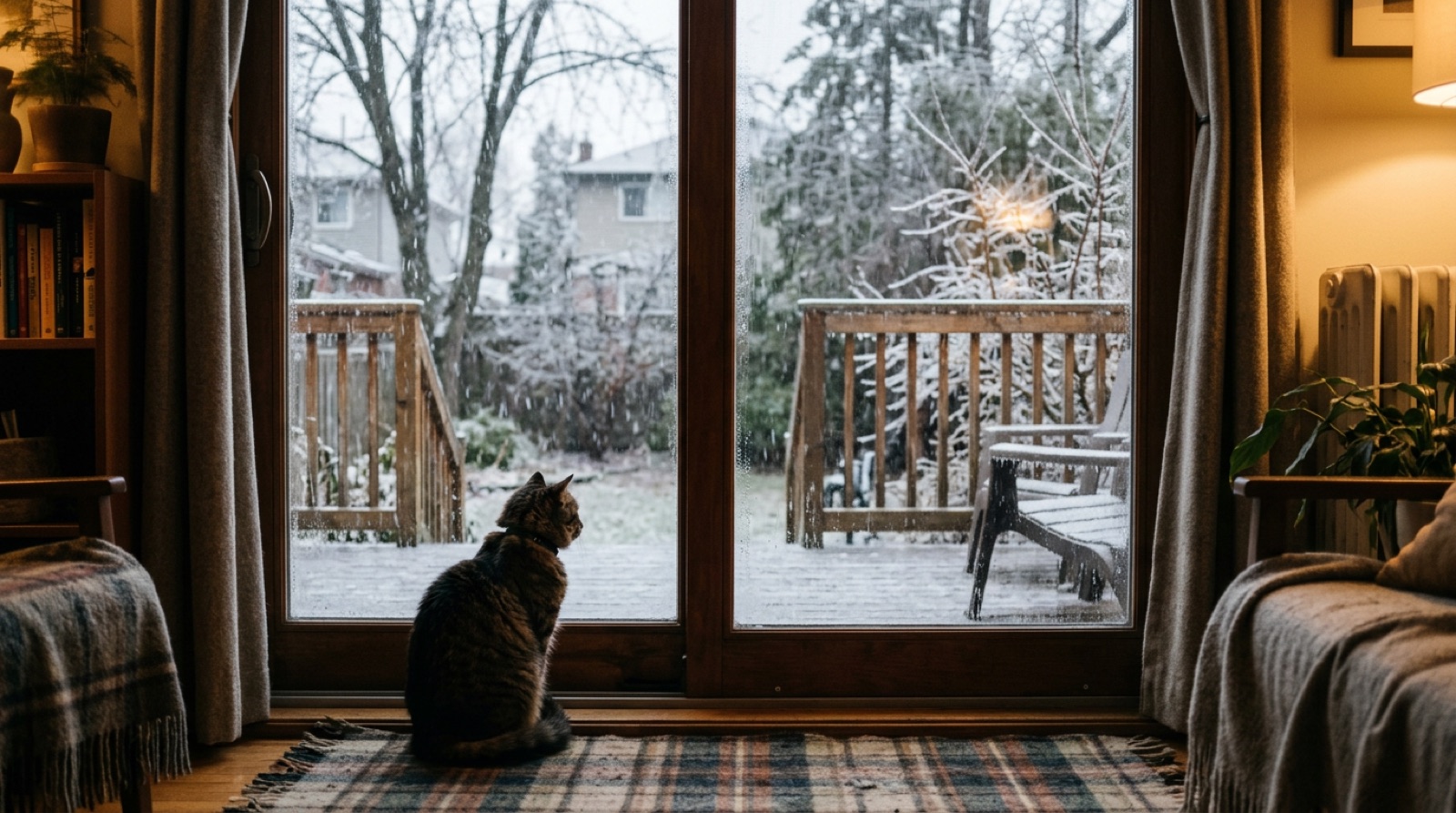
The short answer
Indoors, in Moncton, for almost every household. The freeze-thaw cycle and freezing rain are harder on a cat than dry prairie cold, because wet fur stops insulating. Traffic on the main routes through Moncton, Dieppe and Riverview is constant, cold snaps turn parked cars into a hazard, and fighting spreads feline leukemia and FIV. If your cat wants outside, build a roofed catio or try harness training rather than opening the door.
People move here from places where letting the cat out was normal and assume it transfers. It mostly does not. The Maritime climate creates a specific problem that dry-cold cities do not have, and it is worth understanding before you decide.
A cat's coat works by trapping air. Wet fur cannot trap air. In a Moncton January the temperature crosses zero repeatedly, so what falls is often rain or wet snow rather than the dry powder that shakes off. A cat caught out in freezing rain gets soaked, then the temperature drops again, and the margin disappears fast.
The rest is the ordinary urban list: cars, other cats, wildlife, and closed shed doors. Below is what each risk looks like here and what to do instead.
What a Roaming Cat Faces in Greater Moncton
| Risk | Why it matters here | When |
|---|---|---|
| Freeze-thaw and freezing rain | Wet fur loses insulation fast, and a soaked cat in a refreeze is in real trouble within hours | November to April |
| Warm engine blocks | Cats climb into wheel wells and engine bays for heat during cold snaps, with predictable results when the car starts | Coldest weeks |
| Traffic | Wheeler Boulevard, Mountain Road and the main arteries through Dieppe and Riverview carry fast, constant traffic | Year round |
| Road salt and de-icer | Licked off paws after a walk on treated pavement, and irritating to pads on contact | Winter |
| Wildlife and other cats | Fights spread feline leukemia and FIV; the river corridor and wooded edges bring coyotes and foxes through | Year round |
| Getting shut in | Sheds, garages and basements around older neighbourhoods, especially when a storm is coming and everything gets closed up | Year round |
Why Maritime winter is different
A prairie winter is cold and dry. Snow there is powder, and a cat shakes it off. A Moncton winter swings across the freezing point over and over, so the same week can deliver rain, slush, a hard refreeze and glare ice on every surface.
That matters for three reasons. Wet fur does not insulate, so a soaked cat is in trouble at temperatures that would be survivable dry. Ice makes escape from a dog or a car slower and clumsier. And a cat that gets under a porch to shelter from freezing rain can end up sealed in when everything refreezes.
Then there is the road salt. It gets on paws, it irritates pads, and cats groom it off and swallow it. None of these are dramatic on their own. Stacked across a winter, they are why outdoor cats in this climate turn up at the clinic more often.
Check under the hood on cold mornings
During a cold snap, the warmest thing on any Moncton street is a car that was running twenty minutes ago. Cats climb into wheel wells and up beside the engine block for that heat, and they are still there when somebody turns the key.
Bang on the hood or tap the horn before starting on a cold morning. It takes two seconds and it is the single easiest thing anyone in this city can do for the neighbourhood's cats, whether or not they own one.
Better options than opening the door
A roofed catio. Even a small balcony or back-step enclosure gives fresh air, sun and birdsong with none of the road. Roof it rather than leaving mesh overhead, because rain is the thing you are managing here.
Harness and lead. Fit it indoors, let the cat wear it around the house, then try a quiet garden. Some cats love it, some refuse. Never attach a lead to a collar.
Height indoors. A tall tree or a cleared shelf near a window changes an apartment more than any toy. Cats want vertical territory, and they want to watch things.
A window bird feeder. The cheapest enrichment available. Put it outside the main window and the cat has a channel to watch all winter.
Daily play. Two ten-minute wand sessions covers most of the hunting drive that pushes a cat toward the door in the first place.
If your cat already goes outside
Move the cat indoors gradually rather than overnight. Shorten the outdoor window week by week, add enrichment at the same time, and put a meal and a play session exactly where the going-out routine used to sit. Winter is the easiest season to do it, because the weather is arguing your case for you.
While the transition is happening, make sure the cat is spayed or neutered, vaccinated, and microchipped. Our spay and neuter guide covers the New Brunswick subsidy programs if cost is the obstacle. An unfixed roaming cat is how the next generation of kittens arrives at P.A.W. next August.
Expect complaining at the door for a couple of weeks. It stops. Cats are creatures of routine, and once the new routine has been running a month, the old one is gone.
Browse adoptable Moncton cats
Plenty of cats in Greater Moncton rescues are already settled indoor cats, so you can skip the transition entirely. Listings refreshed regularly.
See Available Moncton Cats →Frequently Asked Questions
Should cats be indoor only in Moncton?
For most households here, yes, and the climate is a big part of why. A Moncton winter is not a steady deep freeze, it is a repeating cycle of thaw, rain, and refreeze, and that pattern is harder on a cat than dry cold. A soaked cat cannot insulate itself, and freezing rain soaks a cat quickly. Add the traffic on Wheeler Boulevard and Mountain Road, the disease risk from fighting, and the wildlife moving along the Petitcodiac corridor, and the indoor cat simply lives longer.
Is it cruel to keep a cat indoors?
No, provided the indoor life has something in it. A bored indoor cat in an empty apartment is a genuine welfare problem. An indoor cat with vertical space, window perches, daily play and things to hunt is a contented animal, and the cats coming out of Greater Moncton rescues are frequently indoor-only already. The fair comparison is not indoors versus a wild adventure. It is indoors versus a shorter life with road, disease and winter risk attached to it.
What is the engine block risk in winter?
Cats seek heat, and a car that has just been parked is the warmest thing on a Moncton street in January. They climb into the wheel well or up beside the engine, then the car starts. It is a well-known winter hazard everywhere cars and outdoor cats coexist, and Maritime cold snaps make it more likely. If there are outdoor cats in your neighbourhood, bang on the hood or give the horn a quick tap before starting the engine on a cold morning. It costs you two seconds.
How cold is too cold for a cat outside?
Well before the temperature you would guess, and the wet is what does it. In dry cold a healthy adult cat with a full coat copes for short periods. In Moncton the problem is that cold usually arrives with freezing rain or wet snow, and a wet cat loses heat fast regardless of the thermometer. Kittens, thin cats, seniors and short-coated cats have far less margin. If you would not stand outside in it in a soaked jacket, the cat should not be out in it either.
What about a catio or an enclosed run?
This is the best of both worlds and it works well in Moncton if you build for the weather. A roofed catio keeps freezing rain off, and a solid floor keeps the cat out of slush and salt. Even a small balcony enclosure gives a cat fresh air, birdsong and sun without the road or the neighbourhood tomcat. Build it with a roof rather than open mesh overhead, because the thing you are managing here is not just escape, it is precipitation.
Can I harness train a cat in Moncton?
Yes, with patience and low expectations at the start. Fit the harness indoors and let the cat wear it around the house for short sessions until it stops walking like a crab. Then try a quiet back garden rather than a walk down Mountain Road. Plenty of cats take to it and a few refuse entirely, and either outcome is normal. Do not use a collar for this. A properly fitted harness is the only safe attachment point on a cat.
My cat has always gone outside. Can I bring it indoors now?
Usually, though it takes a few weeks of complaining. Transition gradually rather than slamming the door on a Tuesday. Shorten the outdoor window, add more indoor enrichment at the same time, and put food and play right where the going-out routine used to sit. Winter is the easiest season to make the switch, because the weather is doing half the persuading for you. Expect yowling at the door for a fortnight and then a cat who has forgotten it was ever an issue.
Does Moncton have a bylaw about cats roaming?
Moncton licences dogs, not cats, so there is no cat tag to buy and no annual renewal. Cats are dealt with by the animal control system in other ways, including how an unclaimed cat is handled after being picked up, and P.A.W. holds the animal control contract for Moncton, Dieppe and Riverview. If you want to know exactly what applies to your situation, phone the city or P.A.W. rather than relying on a summary. Either way, a microchip does more for a roaming cat than any paperwork would.
What wildlife is a risk to cats around Moncton?
Coyotes and foxes move along the wooded edges and the river corridor, and they are the risk people underestimate most because they are rarely seen in daylight. Birds of prey take small cats and kittens. The larger and more common danger is other cats, since fighting spreads feline leukemia and FIV, and both of those are expensive and sometimes untreatable. Parks like Centennial and Mapleton are lovely places for a person to walk. They are not a safe range for a housecat.
How do I keep an indoor cat from getting bored?
Build upward and play daily. Cats want height, so a tall tree, a cleared shelf, or a window perch changes an apartment more than another toy does. Ten minutes of wand play twice a day covers most of the hunting drive, and food puzzles handle the rest by making the cat work for part of a meal. Rotate toys instead of leaving all of them out, since a toy that vanishes for three weeks comes back interesting. A window with a bird feeder outside it is the cheapest entertainment there is.
Are barn cats a different situation?
They are, and it is a legitimate placement rather than a loophole. Some cats are genuinely unsuited to living indoors with people, usually because they were never socialised to humans, and forcing that is worse for them than a working placement. P.A.W. runs a Barn Buddies program that places those cats with property owners who can provide heated shelter, food and daily care. The key words are heated shelter and daily care. A barn cat is a managed animal, not a cat left to fend for itself.
What if my indoor cat escapes during a storm?
Search close first. An indoor cat that gets out rarely goes far, and it usually goes down and under rather than away, so check under decks, sheds, porches and parked cars within a few houses. Bring a torch and go out at dusk and dawn when it is quiet. Post in local community groups with a clear photo, and phone P.A.W. at 506-857-8698 in case the cat has been picked up. This is exactly the situation a microchip solves, which is why every cat adopted here comes with one.
Related Moncton Guides
One search, every Moncton rescue
Shelter cats and foster cats from across Greater Moncton, in a single list.
Browse Available Moncton Cats →New cat? Start with these care guides
Everything a new adopter needs to set up a safe, happy home.