The short answer
Follow the 3-3-3 rule: expect three days of stress, three weeks of settling, three months to full trust. Keep week one quiet and routine-driven, with short leashed walks and no visitors, pet stores, or dog parks. The Fredericton paperwork fits in one clinic visit and one form: rabies vaccine (the SPCA does not routinely give it), then the $10 City licence that requires proof of it. Save 506-447-8387, the 24/7 emergency vet, on day one.
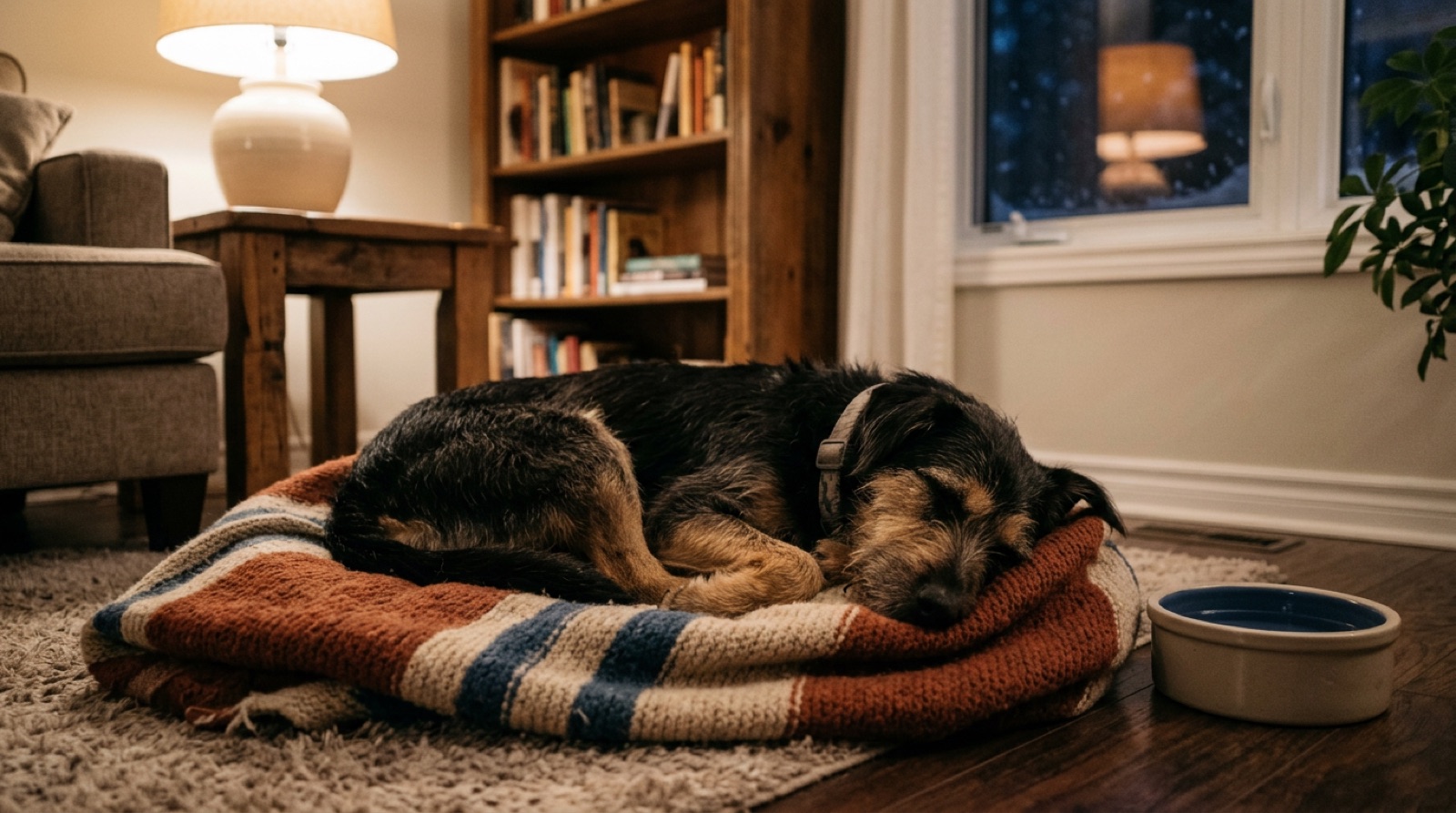
The dog in your back seat just lost everything it knew, again. Shelter dogs live in a state of low-grade alarm, and the drive home from Hilton Road does not switch it off; a new house is just the next unknown. The single most useful thing to understand about the first week is that you are not meeting your dog yet. You are meeting a stressed animal wearing your dog's body, and the real personality surfaces over weeks.
That reframing changes everything about how you run the week. The accidents, the hiding, the not eating, the shadowing you room to room: mostly stress, mostly temporary. Your job is not to fix behaviours in week one. It is to make the world small, predictable, and safe until the dog's nervous system catches up with its new luck. If you have not chosen a dog yet, our rescue roundup maps where to look; this guide starts the day you sign.
The 3-3-3 Rule
| Stage | What the Dog Is Doing | What You Do |
|---|---|---|
| First 3 days | Decompressing. May hide, sleep constantly, skip meals, or seem shut down. Not its real self. | Keep the world tiny. One calm room, set meal times, short toilet walks, no visitors. |
| First 3 weeks | Learning your routines. Personality emerges, and so do test behaviours as confidence grows. | Build routine and gentle training. Expand walks. Start calm introductions to people and dogs. |
| First 3 months | Bonding for real. Trust sets in; the dog knows it is home. | Widen the world: fenced dog parks, new routes, longer adventures, maybe the Killarney trails. |
Timelines vary by dog. Shut-down dogs and dogs with rough histories move slower; resilient dogs move faster. Progress that stalls or reverses for weeks is a reasonable trigger to involve your vet or a qualified trainer.
Day by Day, Roughly
Day 1: Straight home, leashed toilet walk, one calm room with water and a bed. Family present but not hovering. No tour of the house, no guests, no errands with the dog. Save the emergency numbers tonight.
Days 2-3: Routine begins: same wake time, meal times, toilet times. Short, quiet leash walks near home. Let the dog approach you for affection rather than the reverse. Ignore accidents; reward outdoor toileting like it invented fire.
Days 4-5: If the dog is eating and curious, expand to more of the house and slightly longer walks. Start two-minute name games and hand-feeding moments. Book the vet visit for the rabies shot if you have not already.
Days 6-7: A first calm outing further afield: a quiet stretch of the Green or an Odell Park loop at an off-peak hour, on the 2-metre leash. One new person meeting the dog on the dog's terms is plenty of social progress for week one.
What stays off the schedule all week: dog parks, pet-store meet-and-greets, downtown patios, kids' birthday parties, and any plan that depends on the dog coping. The dog gets veto power for a while yet.
The Fredericton To-Do List
| Task | When | Why It Matters Here |
|---|---|---|
| Book the rabies vaccine | Week 1 | The Fredericton SPCA does not routinely give it, and the City requires proof of rabies vaccination before selling a dog licence. One clinic visit covers the shot and your new vet relationship. |
| Register with a vet | Week 1-2 | The rabies appointment doubles as a wellness check and gets your dog a file at a clinic before you ever need same-day help. Full-service clinics like Fredericton Animal Hospital on Prospect Street take new patients. |
| Save the emergency numbers | Day 1 | Capital City Emergency Veterinary Hospital, 506-447-8387, open 24/7 on Bishop Drive. The walk-in clinic on Smythe Street, 506-777-1235, noon to midnight. Save both before you need either. |
| Buy the City licence | After the rabies shot | Every Fredericton dog must be licensed, with fees paid on or before December 31 each year: $10 for a fixed dog, $25 intact. SPCA dogs arrive fixed, so you land on the cheap rate. |
| Check the tag and microchip | Week 1 | Your SPCA dog is microchipped; confirm the registration points to your phone number, not the shelter. A collar tag with your number is the fastest way home for a bolter. |
| Walk the leash routes first | Weeks 1-3 | The Green, Odell Park, and Carleton Park on a 2-metre leash. Quiet, predictable, and legal. The off-leash parks come later, once trust and recall exist. |
The rabies-then-licence sequence is the one genuinely Fredericton-specific wrinkle: the City will not sell the tag without proof of rabies vaccination, and the shelter does not routinely give the shot. Full details in our licensing guide and adoption costs guide.
Decompression: The Principles Behind the Plan
Small world first. A dog that has one room mastered relaxes faster than a dog with a whole house of unknowns. Expand territory when the dog looks bored with the current one, not before.
Routine is the language. You cannot explain to a dog that this home is permanent. Repetition says it for you: meals at the same times, walks on the same routes, bed in the same corner. Predictability is what safety feels like from inside a dog.
Let the dog initiate. Sit low, side-on, no eye contact pressure, and let the dog close the distance. The fastest way to a cuddly dog is weeks of not demanding cuddles.
Guard the door. New dogs bolt, and a bolted dog in a new city has no idea where home is. Leash on before the door opens, two points of contact on walks, and the microchip registered to your number. If the worst happens, call the SPCA at 506-459-1555, because Animal Control impounds land at Hilton Road.
Watch, do not test. Week one is for observing what the dog offers, not testing what it tolerates. The hugging, the nail trims, the vacuum: introduce all of it gradually, later, paired with good things.
When Normal Stress Is Not the Story
Most week-one weirdness resolves itself. A few things should trigger a call rather than patience:
- No food at all past two to three days, or no water, especially in small or thin dogs
- Vomiting, diarrhea that persists past a day, coughing, or laboured breathing
- Guarding food or spaces with stiffening, hard stares, or snaps at any point
- Panic that escalates rather than fades: frantic crate escape attempts, self-injury, wall-scratching when alone
- Any bite that breaks skin, however small
Medical concerns go to your clinic, or the walk-in clinic on Smythe Street (noon to midnight) for same-day worries; true emergencies go to Capital City on Bishop Drive at any hour. Our emergency vet guide maps the tiers. Behaviour concerns are a vet conversation first too, since pain drives more “behaviour problems” than people expect.
Still looking for the dog?
Browse adoptable Fredericton rescue dogs. Every one arrives fixed, vaccinated, and microchipped, so week one starts on the right foot.
See Available Fredericton Dogs →Frequently Asked Questions
What is the 3-3-3 rule for rescue dogs?▾
A rough map of how rescue dogs settle: about three days to decompress from the shock of the move, about three weeks to learn your routines and start showing real personality, and about three months to feel genuinely at home and bonded. It is a guideline, not a schedule; shut-down dogs can take longer and confident dogs move faster. Its real value is expectation-setting, because most “problem behaviours” in week one are just stress, and most of them fade on their own as the dog settles.
What should I do the first day my rescue dog comes home?▾
Less than you think. Bring the dog straight home rather than touring town, walk it on leash around the yard or block to toilet, then let it explore one calm room with water, a bed, and no crowd. Skip the welcome party, the pet store trip, and the introductions to every neighbour. Save the two emergency vet numbers, note what food the shelter fed, and let the dog choose how much interaction it wants. Boring first days build confident dogs.
When should a new rescue dog see a vet in Fredericton?▾
Within the first week or two, sooner if anything seems off. Fredericton adopters have a built-in reason: the SPCA does not routinely give the rabies vaccine, and the City requires proof of rabies vaccination before it will sell a dog licence. Book the shot, and use the same appointment as a wellness check and file-opening visit with your chosen clinic. Bring the shelter's medical paperwork so the vet can see what has been done.
Do I need to license my new dog right away?▾
Reasonably soon, yes. By-law S-11 requires every Fredericton dog to be registered with the City, with fees paid on or before December 31 each year and the tag worn. The fee is $10 for a spayed or neutered dog, which every Fredericton SPCA dog is, and $25 intact. The sequencing detail: the City wants proof of rabies vaccination first, so the order is rabies shot, then licence. Our licensing guide walks the whole process.
When can I take my new rescue dog to the dog park?▾
Weeks in, not days. An off-leash park stacks strange dogs, strange people, and no escape route onto a dog that barely knows you. Wait at least the three-week settling mark, then confirm the basics: reliable recall in your yard, calm on-leash greetings with a few dogs, and a dog that checks in with you when unsure. Start at the fenced parks, Cityview or Knowledge Park Drive, in a quiet hour. The unfenced Killarney Lake trails are a graduation for later. Our off-leash guide covers all three.
Should I crate my rescue dog?▾
A crate used well is a bedroom, not a punishment, and many rescue dogs relax faster with a den they control. Set it up in a quiet corner, door open, treats appearing inside as if by accident, and let the dog discover it. Some dogs with unknown histories panic in crates; if you see frantic escape behaviour rather than reluctance, stop and use a gated room instead. The goal in week one is a safe retreat the dog chooses, whatever furniture that turns out to be.
My new rescue dog is not eating. Is that normal?▾
Common in the first 48 to 72 hours; stress suppresses appetite. Keep offering the same food the shelter used, at set times, in a calm spot, and remove it between meals rather than coaxing. Most dogs start eating once the cortisol drops. Call a vet if the dog refuses all food past two to three days, is also lethargic or vomiting, or is a small breed or underweight dog with less reserve. The walk-in clinic on Smythe Street handles same-day concerns noon to midnight.
How do I stop my rescue dog escaping in a new city?▾
Assume a flight risk for the first month, because a new dog that bolts has no map home. Two points of contact outdoors at first: a well-fitted collar with tag plus a harness the dog cannot back out of. Check fence lines before the first off-leash yard time. Doors are the danger zone: use a leash or gate ritual at the front door. And keep the microchip registration current, because a licensed, chipped, tagged dog picked up by Animal Control gets home from the SPCA on Hilton Road fast.
What should the first walks look like?▾
Short, quiet, and repetitive. Same route, same pace, low traffic, on the 2-metre leash the bylaw requires. Repetition turns a scary new world into a known one, which is exactly what a decompressing dog needs. The Green's flat riverfront stretch works well once the dog handles mild dog traffic; Odell Park's forest loops are calmer if the Green is too busy. Let the dog sniff generously. Sniffing is how dogs process a place, and a sniffy 20 minutes tires a dog more than a marched hour.
When does the two-dog limit matter for adopters?▾
Before you adopt dog number three. By-law S-11 caps Fredericton households at two dogs unless you comply with the kennel provisions, which involve a $100-per-year kennel licence. Most first-time adopters never touch the limit, but multi-dog households moving to Fredericton and families considering a third dog should call the City's bylaw line at 506-460-2020 first. It is a far better conversation to have before the dog is home than after a complaint.
What if my new dog arrives in winter?▾
The 3-3-3 timeline does not change, but the logistics do. Toilet trips get short and businesslike in the cold, so a porch light and a shovelled patch of yard help house-training enormously. Short-coated dogs may need a jacket sooner than you expect, salt on sidewalks stings paws and gets licked off, and the early darkness means reflective gear for after-work walks. Killarney's off-leash season is closed December through April anyway, which conveniently removes the temptation to rush the trails. Our winter care guide covers the full playbook.
When should I start training a new rescue dog?▾
Gentle name-and-recall games can start day one; formal expectations should wait until the dog has settled, usually a couple of weeks in. Early training is really relationship-building: reward the dog for checking in, for coming when called across the kitchen, for calm on the mat. Keep sessions to a few minutes and end early. If you hit real behaviour concerns, resource guarding, bite history surfacing, or panic that is not fading, ask your vet for a referral to a qualified trainer rather than waiting it out.
Related Fredericton Guides
Three Days. Three Weeks. Three Months.
The plan is patience with a checklist attached. Find the dog and start the clock.
Browse Available Fredericton Dogs →New dog? Start with these care guides
Everything a new adopter needs to set up a safe, happy home.