The short answer
Expect several hundred dollars plus 15% HST at a full-service Halifax clinic, with spays costing more than neuters. Bide Awhile runs a low-cost program for cats 6 months and up, open to anyone with a Notice of Assessment under $30,000 or a valid student ID. Spay Day HRM runs a low income program with months-long waits, so apply early. Adopted cats arrive already fixed. The Nova Scotia SPCA TNR program for feral colonies is on hiatus until 2027.
Medical note: This article is general information, not veterinary advice, and it does not recommend any medication or dose. Surgical timing, anaesthetic protocol, and pain management are decisions for the veterinarian examining your cat. If something looks wrong after surgery, call the clinic rather than searching for a home remedy.
Getting a cat fixed is the single highest-value veterinary decision a Halifax owner makes, and it is also the one most often delayed on cost. That delay is how the city ends up with the spring wave of kittens that fills every rescue from Bedford to Dartmouth.
The good news is that HRM has more assistance than most Canadian cities of its size, thanks to two independent organisations that both formed around the same problem in 2011. The catch is that the programs run on waits and paperwork rather than walk-ins, so timing matters.
This guide covers what the surgery costs, which program you might qualify for, what recovery actually looks like at home, and where community cat sterilisation stands right now. If you are still choosing a cat, note that every cat from the main Halifax rescues comes fixed already.
Halifax Spay and Neuter Programs
| Program | Who qualifies | How it works |
|---|---|---|
| Bide Awhile Low Cost Spay & Neuter | Notice of Assessment under $30,000, or valid student ID | Cats 6 months and up. Certificate bought from the shelter, surgery booked separately at a partner clinic. |
| Spay Day HRM Low Income Program | Students, low or fixed income, or recently took in a stray | One-time per household. First come, first served, priority to greatest need. Waits can run months. |
| Nova Scotia SPCA low-cost spay/neuter | Low-income families and individuals | Runs through the SPCA veterinary hospitals and the Yarmouth high-volume clinic. Apply through the SPCA. |
| Trap Neuter Return (feral colonies) | Community and feral cats, not owned pets | Nova Scotia SPCA program, free when running, currently on hiatus until 2027. |
Verified July 2026 from bideawhile.org, Spay Day HRM, and the Nova Scotia SPCA veterinary services page. Programs change and fill; confirm current eligibility and pricing directly. Pre-anaesthetic bloodwork is usually quoted separately, about $50 to $100, and is recommended for cats over 5. Ask for an itemized estimate before booking.
What the Surgery Costs in HRM
Halifax clinics do not publish flat rates, and there is a real reason for that beyond marketing. A quote depends on the cat's weight and age, whether pre-anaesthetic bloodwork is included, what pain medication goes home, and whether anything unexpected turns up during surgery. Plan on several hundred dollars, with a spay meaningfully above a neuter because it is abdominal surgery with a longer anaesthetic.
Add 15% HST, which applies to veterinary services in Nova Scotia. When you call around, ask each clinic the same three questions: is pre-anaesthetic bloodwork included, does the cat go home with pain medication, and is a recheck covered. A quote that is a hundred dollars cheaper because it excludes all three is not actually cheaper.
The Nova Scotia SPCA operates its own veterinary hospitals, branded Tartan Tails, in Dartmouth and Sydney, plus a high-volume spay and neuter clinic in Yarmouth serving low-income families. These are open to the public rather than shelter-only, which makes them worth including in your calls.
The Student Route Nobody Uses
Bide Awhile's low-cost program accepts a valid student ID as eligibility on its own, with no income documentation required, for cats at least 6 months old. In a city with the student population Halifax has, that is a remarkably wide door and very few people walk through it.
The mechanics are simple. You buy a certificate from the shelter at 67 Neptune Crescent in Dartmouth, then book the surgery yourself at one of their partner clinics: Fall River Animal Hospital, Elmsdale Animal Hospital, or Vetcetera Animal Hospital. The surgery is typically same-day outpatient, so the cat goes home that afternoon. Fees are not published online, so call 902-469-9578 during business hours.
If you do not have a student ID, the same program accepts proof of income showing a Notice of Assessment under $30,000. Spay Day HRM covers a slightly different set of circumstances, including people who have recently taken in a stray cat, which is a common Halifax situation nobody plans for.
Recovery at Home
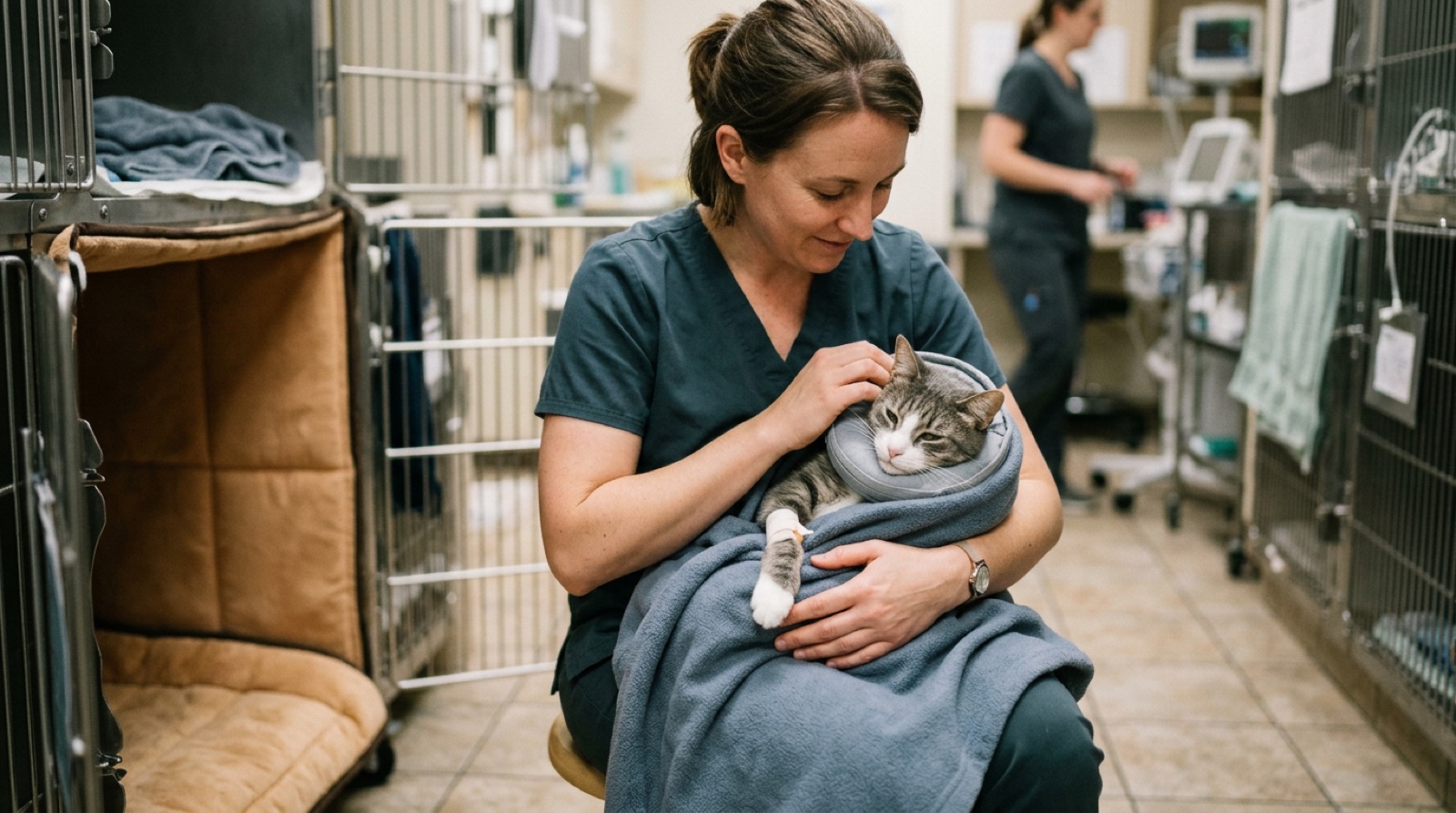
Day of surgery. Your cat comes home groggy and possibly unsteady. Set up a quiet room with a low-sided litter box, water, and a soft bed on the floor rather than anywhere it might fall from. Skip the high perch for tonight. Offer a small meal only if the clinic has said to.
Days one to three. Most cats are eating and moving normally by now. Neuters bounce back fastest. Keep the cone or recovery suit on, even though your cat will campaign hard against it, and look at the incision once a day.
Days four to fourteen. Spays need continued restriction. No jumping from height, no rough play with another cat, and absolutely no going outside. This is the stretch where owners relax too early and a cat opens an incision doing something enthusiastic off the back of a sofa.
What normal looks like. A clean, closed incision, a cat eating and using the box, and a gradual return to usual behaviour. Mild quietness on day one is expected.
Call the vet, do not wait it out
Contact the clinic that performed the surgery if you see a swollen, open, oozing or foul-smelling incision, no eating within 24 hours of coming home, repeated vomiting, laboured breathing, or lethargy that deepens rather than improves after the first day. Also call if your cat has managed to lick the site through the cone.
Separately, and unrelated to surgery: a male cat straining in the litter box, crying, and producing nothing may have a urinary blockage. That is a life-threatening emergency measured in hours, not days. Go to a veterinary hospital immediately rather than waiting for morning.
Community Cats and the TNR Hiatus
The Nova Scotia SPCA ran a free Trap Neuter Return program from 2016, using a mobile clinic and a dedicated surgery team, coordinating with local rescue groups on trapping. Every cat handled was ear-tipped, which is the removal of the tip of the left ear under anaesthetic so a sterilised colony cat can be identified from a distance.
The SPCA has placed TNR on hiatus until 2027, citing rising costs for staffing, medical supplies and vehicles alongside a decline in available trappers, volunteers, and dedicated funding. That gap matters. Colony populations do not pause because a program does.
If you have a colony near you, still report it to catcolony@spcans.ca so the need is documented, and contact a community-cat group such as Halifax Cat Rescue Society, which manages colonies with food, water, and shelter. Do not trap without somewhere for the cat to go. And feeding a colony without a sterilisation plan makes the problem grow faster, which is the hardest thing to tell a kind neighbour who has been putting food out all winter.
Browse adoptable Halifax cats
Every rescue cat listed here is already spayed or neutered, so the surgery, the wait, and the bill are all behind you. Listings refreshed regularly.
See Available Halifax Cats →Frequently Asked Questions
How much does it cost to spay or neuter a cat in Halifax?
Clinics in HRM do not publish standard rates, and quotes vary by clinic, by the cat, and by what bloodwork or pain medication is included. Plan on a few hundred dollars at a full-service Halifax clinic, with a spay costing more than a neuter because it is abdominal surgery. Add 15% HST. The most reliable move is to phone two or three clinics and ask what their quote includes, since a cheap number without pre-anaesthetic bloodwork or take-home pain relief is not the same service as a higher one that has both.
Are there low-cost spay and neuter programs in Halifax?
Yes, and two of them are open to more people than most Halifax residents realise. Bide Awhile Animal Shelter runs a Low Cost Spay and Neuter Program for cats at least 6 months old, open to anyone with a Notice of Assessment under $30,000 or a valid student ID. Spay Day HRM runs a low income program for students, low or fixed income households, and people who have recently taken in a stray. The Nova Scotia SPCA also offers low-cost spay and neuter through its veterinary services for low-income families.
Can students get a cat fixed cheaply in Halifax?
Yes, and this is the most underused resource in the city. Bide Awhile accepts a valid student ID as eligibility on its own, with no income documentation needed, for cats 6 months and older. Spay Day HRM also lists students as an eligible category and asks for a copy of the student ID. Given how many people at Dalhousie and the other Halifax universities end up with a cat during a degree, that pathway matters. Call Bide Awhile at 902-469-9578 to ask about current pricing and availability.
How does the Bide Awhile spay and neuter program work?
You buy a certificate from the shelter and then book the surgery separately at one of their partner clinics, currently Fall River Animal Hospital, Elmsdale Animal Hospital, and Vetcetera Animal Hospital. The program is feline only and the cat must be at least 6 months old. Procedures are usually same-day outpatient surgeries, so the cat goes home the same afternoon. Pricing is not published online, so call 902-469-9578 during business hours to confirm the current fee and whether certificates are available.
How long is the wait for a subsidised spay or neuter in Halifax?
Longer than you want, particularly with Spay Day HRM. Their applications are processed first come, first served with priority given to greatest need, and they state outright that waits can extend for months depending on veterinary clinic availability. Apply early rather than when a cat is already in heat or a litter is on the way. If the cat is unspayed, unsupervised, and female, the wait is the single strongest argument for keeping her strictly indoors until the appointment comes through.
At what age should a Halifax cat be spayed or neutered?
Most Canadian clinics do the surgery somewhere between four and six months, before a cat can reproduce. The programs in HRM set their own floors, and Bide Awhile requires the cat to be at least 6 months for its low-cost certificate. If you adopted from the Nova Scotia SPCA or Bide Awhile, this is already handled, because both sterilise before the cat leaves. Your vet should make the call for your specific cat based on weight, health, and development rather than a calendar date alone.
What does recovery from a cat spay or neuter look like?
Quieter than most owners expect. A neuter is a small external procedure and many cats are close to normal within a day or two. A spay is abdominal surgery and warrants about ten to fourteen days of restricted activity: no jumping from height, no rough play, and no letting the cat outside. Keep the cone or recovery suit on, keep the incision dry, and check it once a day. A cat that is eating, drinking, and using the litter box normally by the day after surgery is generally on track.
When should I call the vet after my cat is fixed?
Call if the incision is swollen, opening, oozing, or smells; if your cat has not eaten within 24 hours of coming home; if there is repeated vomiting, laboured breathing, or persistent lethargy beyond the first day; or if your cat is licking through a cone and reaching the site. None of that is something to wait out overnight to see how it looks. Post-surgical complications are uncommon but they escalate quickly, and a phone call to the clinic that did the surgery costs nothing.
Does the Nova Scotia SPCA still run trap neuter return?
Not right now. The SPCA ran a free TNR program for feral colonies from 2016, using a mobile clinic and a surgery team, and ear-tipped every cat so a fixed cat could be identified at a glance. The organisation has placed TNR on hiatus until 2027, citing rising costs for staffing, medical supplies and vehicles alongside declining trapper availability and funding. If you have a colony in your neighbourhood, still report it to catcolony@spcans.ca so the SPCA knows where the need sits.
What should I do if there is a feral cat colony near my house?
Report it rather than trying to trap alone. Email the Nova Scotia SPCA at catcolony@spcans.ca and contact a community-cat group like Halifax Cat Rescue Society, which manages colonies with food, water, and shelter. Trapping without a spay appointment already booked leaves you holding a stressed, unhandleable cat with nowhere for it to go. Feeding a colony without a sterilisation plan is worse than doing nothing, because a well-fed unfixed colony grows faster than a hungry one.
Does fixing a cat change its personality?
It changes specific behaviours rather than the cat. Neutered males spray far less, roam far less, and get into fewer fights, which in Halifax means fewer abscesses from territorial scraps and fewer cats hit crossing a road while chasing a female. Spayed females stop the loud, relentless heat cycles and avoid the pyometra and mammary cancer risks that come with staying intact. The cat that greeted you at the door before surgery still greets you afterwards. What changes is the hormone-driven behaviour, not the character.
Do rescue cats in Halifax already come fixed?
Yes. Both the Nova Scotia SPCA and Bide Awhile include the spay or neuter surgery in the adoption fee, so a rescue cat arrives already sterilised. That is a substantial part of why adoption beats a free kitten on cost. A $300 adult cat from a Dartmouth shelter has had the surgery, the FeLV test, the vaccines, and the microchip paid for already. A free kitten leaves you booking and funding every one of those yourself.
Related Halifax Guides
Skip the surgery bill entirely
Every cat from a Halifax rescue comes spayed or neutered, vaccinated, and microchipped.
Browse Available Halifax Cats →New cat? Start with these care guides
Everything a new adopter needs to set up a safe, happy home.
Cat & Dog Spay/Neuter Cost in Canada
Standard and subsidised pricing by province, and how to find a low-cost clinic wherever you are.