The short answer
Indoor. Almost every London rescue adopts on that condition, and the local reasons are concrete: fast arterial roads cutting through residential streets, coyotes established along the Thames River valley, engine block sheltering on cold mornings, humid summer heat, and lake-effect winters. Indoor cats live substantially longer. Give vertical space, window perches, daily play and a puzzle feeder, and consider a catio or harness walking if your cat wants fresh air.
This question sounds like a values debate and it mostly is not. It is a geography question, and London's geography answers it fairly clearly.
The city is laid out around fast arterial roads that run straight through residential neighbourhoods. The Thames River and its forks carry a green corridor through the middle of the city, which is lovely for people walking the Thames Valley Parkway and equally useful for coyotes moving around. Winters bring snow off Lake Huron and cold snaps sharp enough to cause frostbite. Summers are humid enough to cause heat stress.
None of that means a cat has to live a small life. It means the outdoor version of a big life is the one that gets cats killed here, and there are better versions. If you are still choosing a cat, the live London cat listings are refreshed regularly, and most are already indoor-adjusted.
What actually threatens a London cat outdoors
| Risk | Why it matters here | When |
|---|---|---|
| Arterial road traffic | Wonderland, Fanshawe Park, Oxford, Wharncliffe and Highbury carry fast, constant traffic through residential areas | Year-round |
| Coyotes | Established along the Thames River valley and the trail corridors that thread through the city | Year-round, worse at dawn and dusk |
| Deep cold and lake-effect snow | Snow off Lake Huron plus hard cold snaps; frostbite on ears, paws and tail comes fast | December to March |
| Engine block sheltering | Cats climb into warm engine bays overnight and are killed or maimed when the car starts | Late autumn to early spring |
| Humid summer heat | Southwestern Ontario humidity means heat stress, dehydration and hot asphalt | June to August |
| Disease and parasites | Feline leukemia, FIV, fleas, ticks and worms all transmit through outdoor contact | Year-round |
| Fights and abscesses | Territorial fighting produces bite abscesses that need veterinary treatment | Year-round |
| Getting lost or picked up | A roaming cat may be taken in as a stray by a neighbour or brought to a shelter | Year-round |
Traffic and coyotes: the two that kill
London's road network is the first problem. Wonderland, Fanshawe Park, Oxford, Wharncliffe and Highbury all carry fast, heavy traffic directly through areas where people live and cats roam. A cat crossing at dusk is nearly invisible to a driver doing the posted limit. There is no cat-safe version of that road.
Coyotes are the second. They are established along the Thames River valley and use the ravines and trail corridors that thread through the city as movement routes, which puts them well inside neighbourhoods that feel purely suburban. Dawn and dusk are the highest-risk hours, and those are precisely when outdoor cats are most active.
Both risks share a feature that makes them hard to manage: they are invisible until they are not. An outdoor cat can be fine for four years and then not come home on a Tuesday. That is the pattern rescues see, and it is why they adopt to indoor homes rather than trusting a quiet street.
Bang on the hood before you start the car
On a cold London morning the warmest sheltered spot on the street is the engine bay of a car that was driven the night before. Cats climb into the wheel well and settle against the block. When the engine turns over, the belts and fan cause catastrophic injuries.
The prevention takes two seconds. Bang on the hood or sound the horn before starting the car on any cold morning, from late autumn through early spring. Do it whether or not you own a cat, because the cat under your hood is usually somebody else's or a community cat. Tell everyone in the household. This is the cheapest life saved on this entire page.
Winter and summer, the London versions
London sits in a snowbelt that catches lake-effect snow off Lake Huron, so accumulation regularly outruns the forecast. Combine that with hard cold snaps and you get the conditions that cause frostbite on ears, paws and tail. Wind chill and wet fur both accelerate heat loss sharply. Kittens, seniors, thin cats and short-haired cats have the least tolerance.
Summer looks harmless and is not. Southwestern Ontario humidity means cats overheat faster than the thermometer reading suggests, because they cool themselves mostly through panting and grooming rather than sweating. Paved driveways and asphalt hold heat past sunset and burn paw pads. Cats that shelter in sheds, garages or under decks can be shut in and left without water.
Indoors, both problems mostly disappear. Keep water available in more than one spot year-round, and give the cat a cool low space, a basement or a tile floor, during humid stretches.
How to make indoor life genuinely good
Go vertical. Cats measure territory in three dimensions. A tall cat tree, a shelf run or a cleared bookcase top adds more usable space than any floor rearrangement.
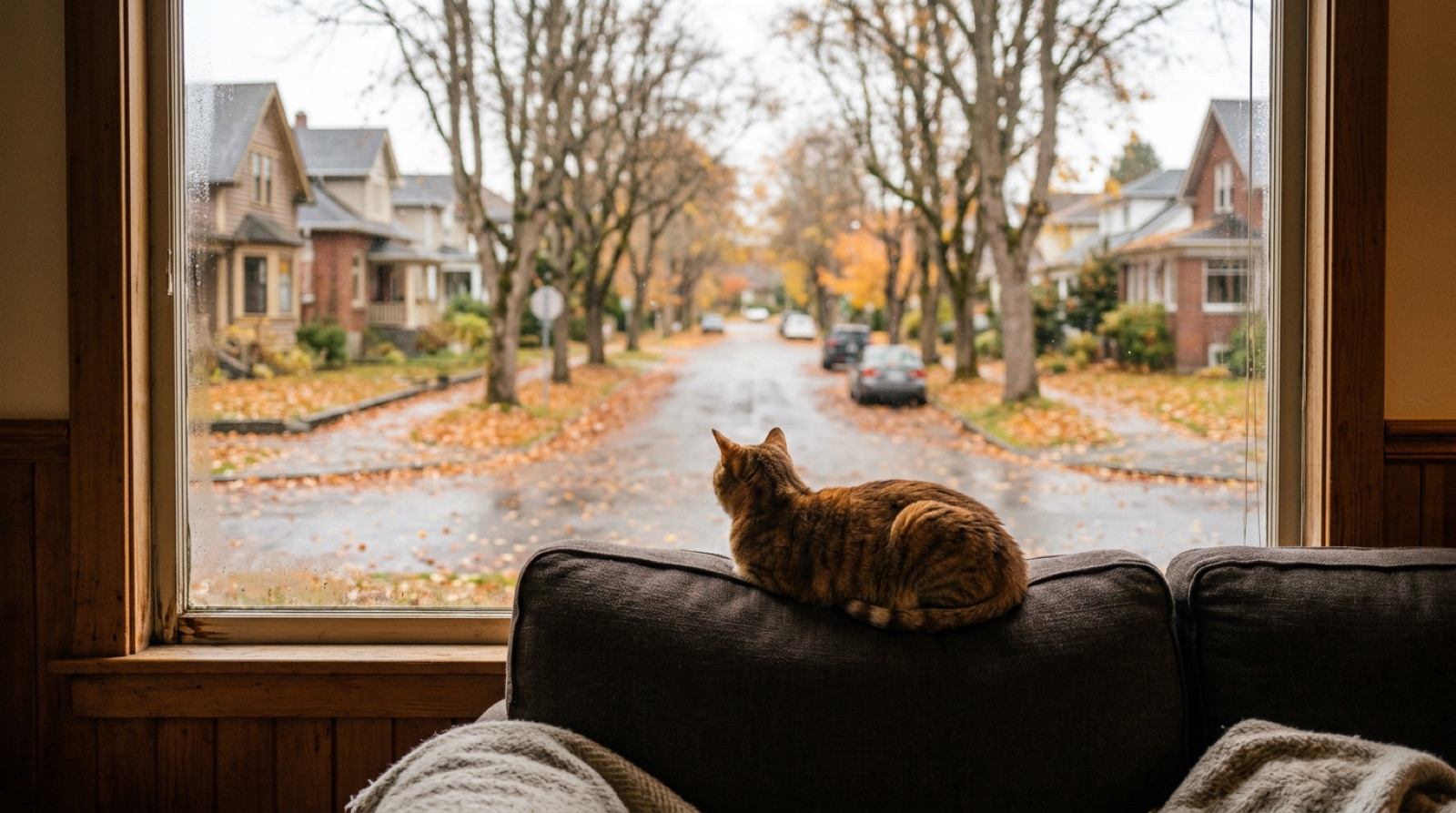
Put a perch at a window. A bird feeder outside that window turns it into a television. This is the cheapest enrichment available.
Play twice a day, ten minutes each. Wand toys that mimic prey movement. Let the cat catch the toy at the end, because a hunt with no kill is frustrating rather than satisfying.
Feed through puzzles. A puzzle feeder or a scattered-kibble hunt turns eating into work, which is what a cat is built for.
Give scratching surfaces in more than one place. Vertical and horizontal, sisal and cardboard. This protects your furniture as much as it serves the cat.
Consider two cats. A bonded pair entertains itself in a way no toy matches, and it costs far less than double. Rescues list pairs on purpose. Our cost guide runs the two-cat arithmetic.
Catios and harness walking
A catio is the middle path: an enclosed outdoor space that delivers fresh air, sunlight and things to watch without exposing the cat to traffic or predators. It can be as small as a window-mounted box or as large as a screened section of deck. Build it so the cat can always come back in on its own, and never as a space where the cat could be shut out.
Harness and lead work for a lot of cats, particularly those introduced to it young. Start with the harness indoors alone, then add the lead, then a quiet doorway. Choose calm spaces rather than busy ones, and stay clear of off-leash dog areas entirely. Never tether a cat outdoors unattended, which restrains it in front of the exact hazards you were trying to avoid.
A screened balcony works for London apartment dwellers near downtown or Masonville, provided the screen is secure. Cats push against screens, and a screen that pops out of its frame at height is worse than no access at all.
Browse adoptable London cats
Many listings note whether a cat is already settled as indoor-only, which makes the transition easier from day one. Listings refreshed regularly.
See Available London Cats →Frequently Asked Questions
Should cats go outside in London, Ontario?
Almost every London rescue adopts to indoor homes, and the reasons are specific to this city rather than generic advice. London is threaded by fast arterial roads that cut straight through residential neighbourhoods, coyotes are established along the Thames River valley and its trail corridors, winter brings lake-effect snow and hard cold snaps, and summers are humid enough to cause real heat stress. Indoor cats live substantially longer on average. If your cat currently goes out, the answer is not guilt, it is a transition plan and some enrichment indoors.
Are there really coyotes in London, Ontario?
Yes, and they are not a rural-edge issue only. Coyotes use the Thames River valley and the ravine and trail corridors that run through the city as movement routes, which puts them within reach of neighbourhoods that feel entirely suburban. Cats are small enough to be prey. Dawn and dusk carry the highest risk, which is exactly when many outdoor cats are most active. The practical takeaway is not to panic about coyotes specifically but to recognise that a London cat outdoors at night is exposed to a predator that is genuinely present.
What is the engine block risk and how do I prevent it?
Cats seek warmth on cold nights and a recently driven car has the warmest sheltered space on the street. They climb into the wheel well or engine bay and settle against the block. When the engine starts, the result is severe injury or death from the belts and fan. It happens across Southwestern Ontario every winter. The prevention is simple and takes two seconds: bang on the hood or honk the horn before starting the car on any cold morning, from late autumn through early spring. Tell everyone in your household to do it too.
How cold is too cold for a cat in London?
Far warmer than most people assume. Cats lose heat quickly through their ears, paws and tail, and frostbite on those extremities happens well before temperatures reach the dramatic lows London hits in January. Wind chill and wet fur both accelerate it sharply, and a snowbelt city that catches lake-effect snow off Lake Huron produces plenty of both. Kittens, seniors, thin cats and short-haired cats have the least margin. If you would not stand outside comfortably in what you are wearing, the cat should not be out in it either.
What about summer? London is not exactly tropical.
Southwestern Ontario humidity does more damage than the temperature number suggests. Cats cool themselves inefficiently, mostly through panting and grooming, so a humid London July afternoon causes real heat stress. Asphalt and paved driveways hold heat long past sunset and burn paw pads. Cats sheltering in garages, sheds or under decks can get shut in and go without water for hours. Indoors, keep fresh water in more than one spot, and if your home gets hot, provide a cool tile or basement space where the cat can settle low and out of the sun.
Will my cat be bored or unhappy indoors?
Only if the indoor environment is boring, and that is a solvable problem rather than an argument for letting the cat roam. Cats need vertical space, hunting outlets and something to watch. A tall cat tree at a window, a couple of shelves, a scratching post and ten minutes of wand-toy play twice a day covers most of it. Puzzle feeders turn a meal into a hunt. Two cats entertain each other in a way no toy can, which is part of why rescues push bonded pairs. Boredom is a set-up problem, not a species problem.
What is a catio and does it work in a London winter?
A catio is an enclosed outdoor space, anything from a window box the cat can sit in to a full screened deck enclosure, that gives fresh air and sights without exposure to traffic or predators. It works well in London for most of the year, and the honest answer about January is that the cat decides. Give access rather than forcing it and most cats take a few minutes of cold air and then come back in. Build it so the cat can always return indoors on its own, never as a space the cat can be shut out in.
Can I walk my cat on a leash in London?
Many cats take to a harness and lead, particularly if introduced young, and it is a genuinely good compromise for a cat that wants outside time. Start indoors with the harness alone for short sessions before attaching a lead or opening a door. Choose quiet spaces rather than busy ones, and keep away from off-leash dog areas entirely. A cat surprised by a loose dog can panic badly enough to slip a harness. Never tether a cat outside unattended, which leaves it restrained in the presence of exactly the hazards you were avoiding.
My cat has always gone outside. How do I transition to indoors?
Gradually, and with the indoor environment upgraded before you start rather than after. Add the cat tree, the window perch, the scratching post and the play routine first, so indoors becomes more interesting on the same day it becomes the only option. Shift feeding fully indoors and move mealtimes to the hours the cat used to go out. Expect protest for one to two weeks, including yowling at the door. It does pass. Cats adapt to indoor life at every age, and the transition is usually harder on the owner than the cat.
Do indoor cats still need vaccines and parasite prevention?
Yes, and skipping them is a common mistake. Fleas ride in on your clothing and on dogs, mosquitoes get indoors, and any trip to a clinic, a boarding facility or a groomer means contact with other animals. Rabies vaccination also matters for licensing purposes in London, since proof of rabies vaccination is part of registering a cat. Talk to your veterinarian about the right schedule for an indoor-only cat, because it may differ from what an outdoor cat needs, but the answer is never nothing at all.
What if my cat gets out anyway?
Start close and start immediately. Most escaped indoor cats hide within a very short radius rather than travelling, often under a deck, a shed or a parked car within a few properties. Search at dawn and dusk when it is quiet, call softly rather than loudly, and put the litter box and an unwashed item of your clothing outside the door so the scent can guide the cat back. Notify neighbours quickly. This is also the argument for the microchip and the London cat identification tag, which is how a found cat gets traced back to you.
Does London have rules about cats roaming?
London regulates animals through its animal control by-law and runs an annual Cat Identification program administered by the London Animal Care Centre, which requires cats to be registered and to wear the tag issued to them. A roaming cat picked up as a stray is far easier to reunite when it carries that tag and a microchip. Rather than trying to interpret by-law text yourself, check the City of London animal services pages directly or phone the London Animal Care Centre, since specific provisions change and they are the authority on what applies to your situation.
If your cat gets out
Search close first. Escaped indoor cats usually hide within a few properties rather than travelling, typically under a deck, a shed or a parked car. Look at dawn and dusk when the street is quiet, and call softly rather than shouting.
Put the litter box and an unwashed item of your clothing outside the door so the scent gives the cat a route home. Tell neighbours immediately and ask them to check sheds and garages, which is where cats get shut in.
This is also the case for identification. London runs an annual cat licensing program through the London Animal Care Centre, and a microchip plus the issued tag is how a found cat gets traced back to you rather than absorbed into the shelter system. Full details on fees and registration are in our London cat cost guide.
Related London Guides
A long indoor life starts here
Adoptable cats from London and Middlesex County rescues, in a single list.
Browse Available London Cats →New cat? Start with these care guides
Everything a new adopter needs to set up a safe, happy home.