The short answer
Adopt from a London rescue and the surgery is already done, included in the fee. If you own an unfixed cat and qualify on income, the City of London subsidy is $80 and covers rabies, flea treatment, a microchip, pain medication and a nail trim. For unowned feral cats inside city limits, the City TNR program is free, including surgery, vaccines, microchip and ear tip. Otherwise you pay full London clinic rates, with a spay costing more than a neuter.
Spaying and neutering is the single most expensive routine thing a cat needs, and the single most subsidised. That combination means the price you pay in London depends far more on which door you walk through than on the surgery itself.
Most people reading this fall into one of three groups. You are about to adopt, in which case the work is done and you can skip to the licence section. You own an unfixed cat and want to know the cheapest legitimate route. Or there is a cat living outside near you and you are trying to work out what to do about it.
All three have a London-specific answer. If you are still choosing a cat, the live London cat listings are refreshed regularly, and every one of those cats is already fixed.
Your options in London, compared
| Route | Who it is for | Cost | Notes |
|---|---|---|---|
| Adopt an already-fixed cat | Anyone adopting from a London rescue | Included in the adoption fee | Cheapest route by a wide margin |
| City of London subsidy program | Ontario Works, ODSP, ACSD, subsidised housing or low income | $80 per cat | Includes rabies, flea treatment, microchip, pain meds, nail trim |
| City of London TNR program | Unowned feral cats inside city limits | Free | Traps rented on an $80 refundable deposit |
| High-volume low-cost clinic | Low-income owners, rescues, shelters | Reduced, quoted per case | Appointment required, eligibility screened |
| Your regular London vet | Anyone | Full clinic rates | Most expensive, most continuity of care |
City program costs and inclusions verified July 2026 from the City of London's own pet resources page. Clinic pricing varies and is not published as a schedule, so phone for a quote. Pre-anaesthetic bloodwork is usually quoted separately, about $50 to $100, and is recommended for cats over 5. Ask for an itemized estimate before booking.
The City of London subsidy: $80 for a cat
The City of London subsidised spay and neuter program exists to remove cost as the reason a cat stays unfixed. A cat spay or neuter costs $80, and that fee also includes the rabies vaccine, flea treatment, a microchip, pain medication and a nail trim. For comparison, the microchip and rabies vaccine alone at full retail would eat a meaningful chunk of that.
Eligibility runs on household circumstances: residents receiving Ontario Works, ODSP, Assistance for Children with Severe Disabilities, or living in subsidised housing, plus families with income below a City threshold.
The pet has to qualify too. The cat must be healthy, at least three months old and under six years, between 2 and 80 pounds, and licensed with the City of London. That licensing condition trips people up, so register the cat first. Enquiries go to animalservices@london.ca.
The free TNR program for feral cats
If there is a genuinely feral cat living outdoors near you inside London city limits, the City will sterilise it for free. Eligible cats are unowned, living outdoors, and will be released back where they were trapped. That last condition is the whole point of trap-neuter-return: the cat goes home to its territory, but it stops producing litters.
Each eligible cat is assessed by a veterinarian and receives the spay or neuter surgery, rabies and FVRCP vaccines, parasite treatment, a microchip, a tattoo and a left-ear tip, all at no charge. Humane live traps are available on a refundable $80 deposit.
Logistics are fixed and worth planning around. Drop-off runs Monday to Friday from 9 to 10 a.m. at London Animal Shelter Services on Wonderland Road South, with a maximum of two cats per trap, and pickup is the same day in the mid-afternoon. Contact animalservices@london.ca or the City line at 519-661-2489 before you set a trap.
One important distinction: a friendly cat that walks up to you is probably somebody's pet, not a feral. Get it scanned for a microchip at a London clinic first. London licences cats, so a found cat is often traceable.
High-volume clinics and regular vets
East Village Animal Hospital in London is an ASPCA Humane Alliance trained and partnered high-volume spay and neuter clinic, serving low-income individuals, people on social assistance, rescue groups, humane societies and municipal shelters across a multi-county region around London, Kitchener and Hamilton. Phone 519-455-3824. Appointments are required and it does not operate as a drop-in or emergency service.
If you do not qualify for a subsidised route, your regular London veterinarian is the answer. You pay full rates, and a spay costs more than a neuter because it is abdominal surgery rather than a small external procedure. What you get in exchange is continuity: the same clinic knows your cat, holds the records, and is who you phone if something looks wrong at day three.
Phone for a quote rather than assuming. London clinics do not publish surgical price lists, and quotes vary with the cat's age, weight, health status and what bloodwork the clinic wants first.
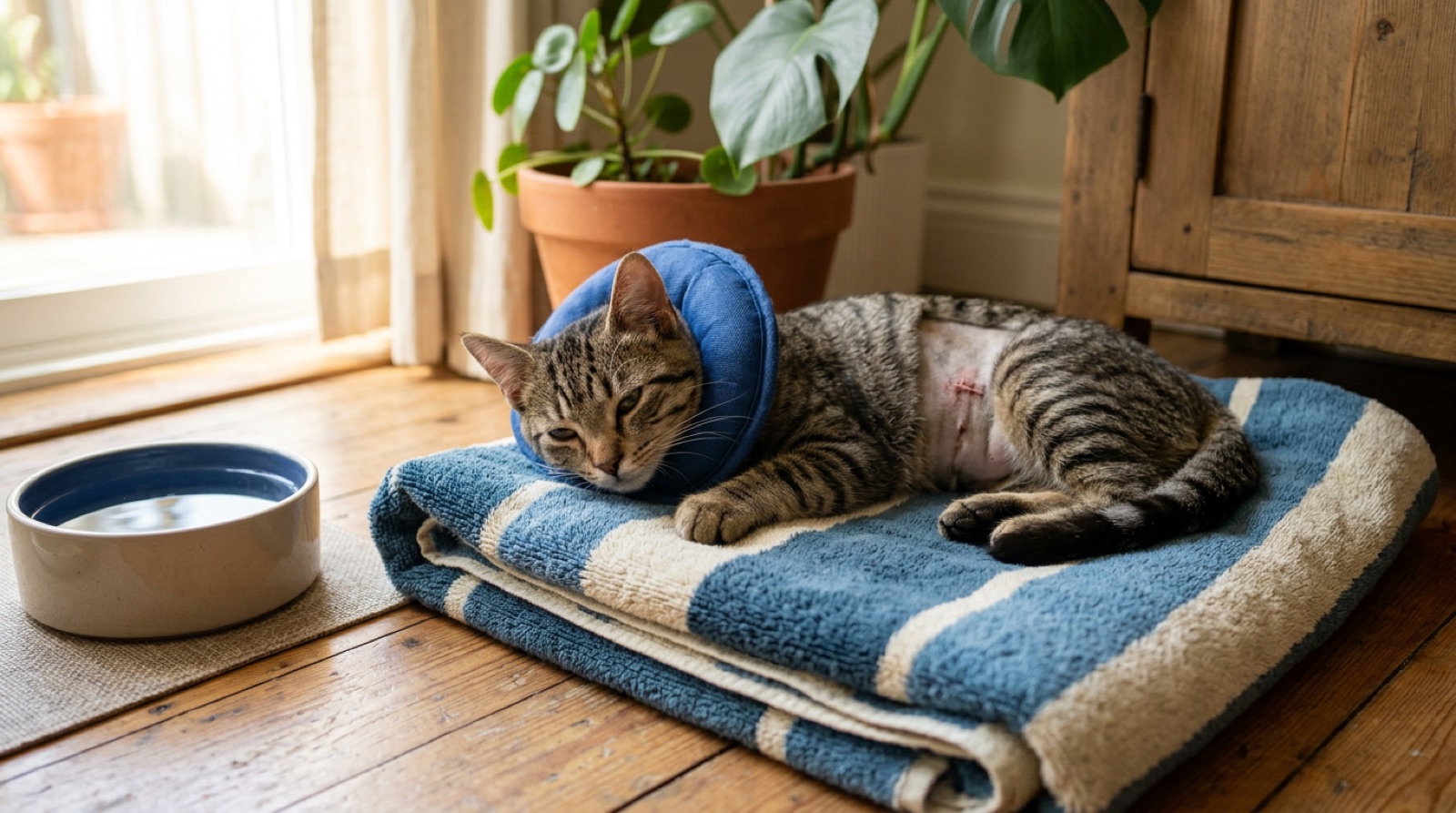
Recovery week, realistically
Most cats come home the same day and are eating normally within a day or two. The difficulty is not that they feel terrible. It is that they feel fine and immediately try to jump on top of the fridge with a fresh abdominal incision.
Keep the cat indoors for the whole recovery period your clinic specifies, no exceptions, even if the cat normally goes out.
Restrict jumping and climbing. Move the cat tree access, close off the stairs if you can, and give a quiet low room with everything at floor level.
Leave the cone or recovery suit on for as long as the clinic says. A cat that licks the incision open turns a routine surgery into a second one.
Check the incision daily for redness, swelling, discharge, bleeding or gapping. Take a photo on day one so you have a baseline to compare against.
Give pain medication exactly as prescribed and never substitute anything from your own cupboard. Human painkillers are toxic to cats and some are fatal at small doses.
Your clinic's discharge instructions override anything written here. If they conflict, follow the clinic.
When to phone a vet immediately
Straining in the litter box without producing urine is an emergency in a male cat, surgery or no surgery. A urinary blockage becomes life-threatening within hours rather than days. Go to a vet first and worry about the behavioural explanation afterwards. The same urgency applies to an incision that opens or bleeds, repeated vomiting, refusal to eat beyond about 24 hours, or lethargy that deepens rather than lifts after the first day.
London has 24-hour emergency coverage at London Regional Veterinary Emergency and Referral Hospital on Adelaide Street North at 519-432-3300, with weekend and overnight coverage also available at Southwest Veterinary Hospital on Wellington Road South at 519-672-1623. Regional hours shift, so phone ahead. Never medicate a cat yourself.
Browse adoptable London cats
Every cat listed by a London rescue is already spayed or neutered, vaccinated and microchipped. The most expensive surgery a cat needs is behind them. Listings refreshed regularly.
See Available London Cats →Frequently Asked Questions
How much does it cost to spay or neuter a cat in London, Ontario?
It depends entirely on which route you qualify for, and the spread is enormous. If you adopt from a London rescue, the surgery is already done and included in the adoption fee, which is why adopting is the cheapest path to a fixed cat. If you qualify on income, the City of London subsidised program charges $80 for a cat spay or neuter, and that fee also covers the rabies vaccine, flea treatment, a microchip, pain medication and a nail trim. At a regular London clinic paying full rates, expect several hundred dollars, with a spay costing more than a neuter because it is abdominal surgery.
Who qualifies for the City of London spay and neuter subsidy?
The program is aimed at London residents receiving Ontario Works, ODSP, Assistance for Children with Severe Disabilities, or living in subsidised housing, as well as families with income below a City threshold. The pet also has to qualify: healthy, at least three months old and under six years, between 2 and 80 pounds, and licensed with the City of London. That last condition catches people out, so register your cat first. The cat fee is $80 and includes the rabies vaccine, flea treatment, a microchip, pain medication and a nail trim. Enquiries go to animalservices@london.ca.
Does London have a TNR program for feral cats?
Yes, and it is free. The City of London runs a trap-neuter-return program for unowned feral cats living outdoors inside city boundaries, on the condition that the cat is released back where it was trapped. Eligible cats are assessed by a veterinarian and receive the spay or neuter surgery, rabies and FVRCP vaccines, parasite treatment, a microchip, a tattoo and a left-ear tip at no charge. Humane live traps are available on a refundable $80 deposit. Drop-off runs Monday to Friday between 9 and 10 a.m. at London Animal Shelter Services on Wonderland Road South, with same-day pickup in the afternoon.
Why does the ear tip matter on a TNR cat?
It is the universal signal that a community cat has already been sterilised and vaccinated. A small portion of the left ear is removed while the cat is under anaesthetic, so it heals painlessly and is visible from a distance. That saves the cat from being trapped, transported and anaesthetised a second time by somebody who did not know its history. If you spot an ear-tipped cat around your London neighbourhood, it belongs to a managed colony and it does not need rescuing. Leave it alone and it will carry on doing exactly what it was returned to do.
At what age should a cat be spayed or neutered?
Most veterinarians in Ontario recommend the surgery before the cat reaches sexual maturity, which for cats arrives earlier than people expect, often around five or six months. Rescues frequently do it earlier still under paediatric protocols so a kitten never leaves unfixed. The City of London subsidy program accepts cats from three months of age. Talk to your own veterinarian about timing for your specific cat, because weight, health and breed all factor in. What matters most is not leaving it until after the first litter, because in cats that window closes quickly.
What actually happens during the surgery?
A neuter on a male cat removes the testicles through a small incision and is a quick procedure with a fast recovery, often no sutures at all. A spay on a female cat is abdominal surgery, removing the ovaries and uterus, so it takes longer, needs internal and external closure, and carries a longer recovery. Both are done under general anaesthetic with pain control. Most cats go home the same day. Your clinic will give you specific discharge instructions, and those instructions matter more than anything you read online.
What does recovery week look like for a cat?
Quieter than people expect, and the main job is stopping the cat from undoing the work. Keep the cat indoors for the full recovery period, restrict jumping and climbing, and check the incision daily for redness, swelling, discharge or gaps. Most cats are eating and behaving normally within a day or two, which is exactly when they try to leap onto the fridge. Keep the cone or recovery suit on for as long as your clinic says, not until the cat looks annoyed. If anything about the incision looks wrong, phone the clinic rather than deciding it will settle.
When should I call the vet after the surgery?
Call if the incision opens, bleeds, swells, discharges or smells. Call if your cat will not eat for more than about 24 hours, seems lethargic beyond the first day, vomits repeatedly, or strains in the litter box without producing urine. That last one is an emergency in male cats regardless of surgery, because a urinary blockage is life-threatening within hours rather than days. London has 24-hour emergency coverage, and a phone call costs nothing. No clinic minds a false alarm. Every clinic minds a cat that was brought in a day too late.
Does spaying or neutering change a cat's personality?
The core personality stays. What generally changes is the hormone-driven behaviour: spraying and territorial marking, roaming to find mates, yowling through the night in a female in heat, and fighting with other cats over territory. Owners often describe the cat as calmer, but calmer here means less driven by hormones rather than sedated or dulled. Your cat will still be affectionate or aloof, chatty or silent, exactly as before. Talk to your veterinarian about weight after surgery, since metabolic needs shift and portions sometimes need adjusting.
Can I get a low-cost spay or neuter in London if I am not on assistance?
Your options narrow but they are not gone. High-volume low-cost clinics operating in the London region screen for eligibility and generally serve low-income individuals, people on social assistance, rescue groups, humane societies and municipal shelters, so being outside those categories usually means paying regular clinic rates. Appointments are always required at these clinics, and none of them operate as drop-in services. If you are just above a threshold, phone and ask rather than assuming. Some programs assess household circumstances rather than applying a hard cutoff.
Why does sterilisation matter so much in London specifically?
Because of what arrives at London rescues every summer. Unspayed cats cycle from spring through autumn, so litters land in waves, and a single unfixed outdoor female compounds the following year. London adds a second pressure: student turnover at Western University and Fanshawe College means cats get left behind when leases end in spring, and some of those cats are intact. The City funds both a subsidy program and a free feral TNR program because sterilisation upstream is far cheaper than sheltering kittens downstream. It is the same reason every London rescue fixes cats before adoption.
My cat is already fixed. What do I still need to do?
Register the cat with the City. London runs an annual Cat Identification program and a spayed or neutered cat that is also microchipped qualifies for the lowest fee tier at $23 instead of $53 for an intact cat. You bring proof of the spay or neuter, the microchip documentation and proof of rabies vaccination. Licences expire December 31 every year regardless of when you registered. Adopted cats already meet every condition, so this is usually a paperwork exercise rather than a hurdle, and it is how a lost cat gets traced home.
Related London Guides
Already fixed, already waiting
Adoptable cats from London and Middlesex County rescues, in a single list.
Browse Available London Cats →New cat? Start with these care guides
Everything a new adopter needs to set up a safe, happy home.
Cat & Dog Spay/Neuter Cost in Canada
Standard and subsidised pricing by province, and how to find a low-cost clinic wherever you are.