The short answer
Phone the Niagara SPCA Animal Clinic in Welland at 289-820-9651 for the low-cost route, or the Humane Society of Greater Niagara clinic at 905-682-0767 to stay in St. Catharines. Neither publishes a flat cat price, so ask for a current quote. If money is the barrier, call Niagara Action for Animals at 905-682-4970 about assistance. If you adopted from a Niagara shelter, this is already done.
If you adopted a cat from a Niagara rescue, the surgery is finished and you can skip most of this. Shelter cats go home fixed. That is a large part of what the adoption fee buys.
This guide is for the other situations. You took in a stray that turned up behind a Merritton garage. Somebody handed you a free kitten in a parking lot. You have owned an unfixed cat for a while and the vet has started asking about it. All of those end at the same place: booking a surgery date and getting through the recovery week.
Below is where Niagara owners actually go, what help exists, and an honest account of the ten days afterwards. If you are still choosing where to adopt, our Niagara cat rescue guide covers each organisation.
Where Niagara Owners Go
| Option | What it is | Where | Notes |
|---|---|---|---|
| Niagara SPCA Animal Clinic, Welland | Low-cost, high-volume spay and neuter | 700 East Main St, Welland | Prices by phone, 289-820-9651 |
| Humane Society of Greater Niagara clinic | Full-service clinic plus spay and neuter | 160 Fourth Ave, St. Catharines | Phone 905-682-0767 |
| Private St. Catharines veterinary clinics | Standard practice pricing | Across the city | Higher cost, more scheduling flexibility |
| Niagara Action for Animals | Financial assistance, not a clinic | Niagara region | Helps with cost via partner clinics |
Clinic details verified July 2026 from each organisation's own website. Cat spay and neuter pricing is quoted by phone rather than published, so confirm before booking. Pre-anaesthetic bloodwork is usually quoted separately, about $50 to $100, and is recommended for cats over 5. Ask for an itemized estimate before booking.
The Welland low-cost clinic
The Niagara SPCA Animal Clinic at 700 East Main Street in Welland grew out of the long-running Welland and District Regional Spay Neuter Clinic. It is a low-cost, high-volume operation run by the Niagara SPCA and Humane Society, and it does cats and dogs. Phone 289-820-9651.
Alongside surgery it offers rabies vaccination, the FVRCP feline core vaccine, microchipping, recovery collars and flea treatment, so you can bundle things into one trip rather than driving down the canal twice. Its published wellness pricing includes a $60 wellness exam, $30 to $40 vaccinations and $40 microchipping, and the organisation notes those listed prices are tax exempt.
Spay and neuter pricing itself is quoted by phone, and additional fees can apply if a cat is pregnant, in heat, or has a hernia. Book well ahead in kitten season. High-volume clinics are exactly the ones that fill first when every rescue in the region is trying to sterilise a summer's worth of litters.
Staying in St. Catharines
The Humane Society of Greater Niagara runs a full-service veterinary clinic at 160 Fourth Avenue, and spay and neuter surgeries are part of what it does. Phone 905-682-0767. For anyone without a car, that matters more than a slightly lower price half an hour away in Welland.
Private practices across St. Catharines do the same surgery at standard clinic pricing. They typically cost more than a high-volume clinic, and in exchange you get scheduling flexibility, a vet who already knows your cat, and a relationship that carries into everything afterwards. Neither choice is wrong. Cost and continuity are the two things you are trading.
Whichever you choose, ask three questions when you book: what the quote includes, whether pre-surgical bloodwork is recommended for this cat, and what pain medication goes home with you. Those answers are what actually differ between clinics.
If money is the barrier
Niagara Action for Animals is an all-volunteer registered charity that helps with spay and neuter costs through partnerships with local clinics, including the Welland clinic and the Humane Society of Greater Niagara. Phone 905-682-4970.
Its Carol's Ferals program supports trap-neuter-return work and may provide money toward the surgery if you are genuinely committed to trapping and after-care for a colony. The organisation is clear that assistance is provided as funds allow, so treat it as a real programme with real limits rather than a guaranteed subsidy.
Call before you book anything. Assistance programmes usually have to be arranged in advance with a partner clinic, and paying full price first then asking for help afterwards rarely works.
Recovery week, honestly
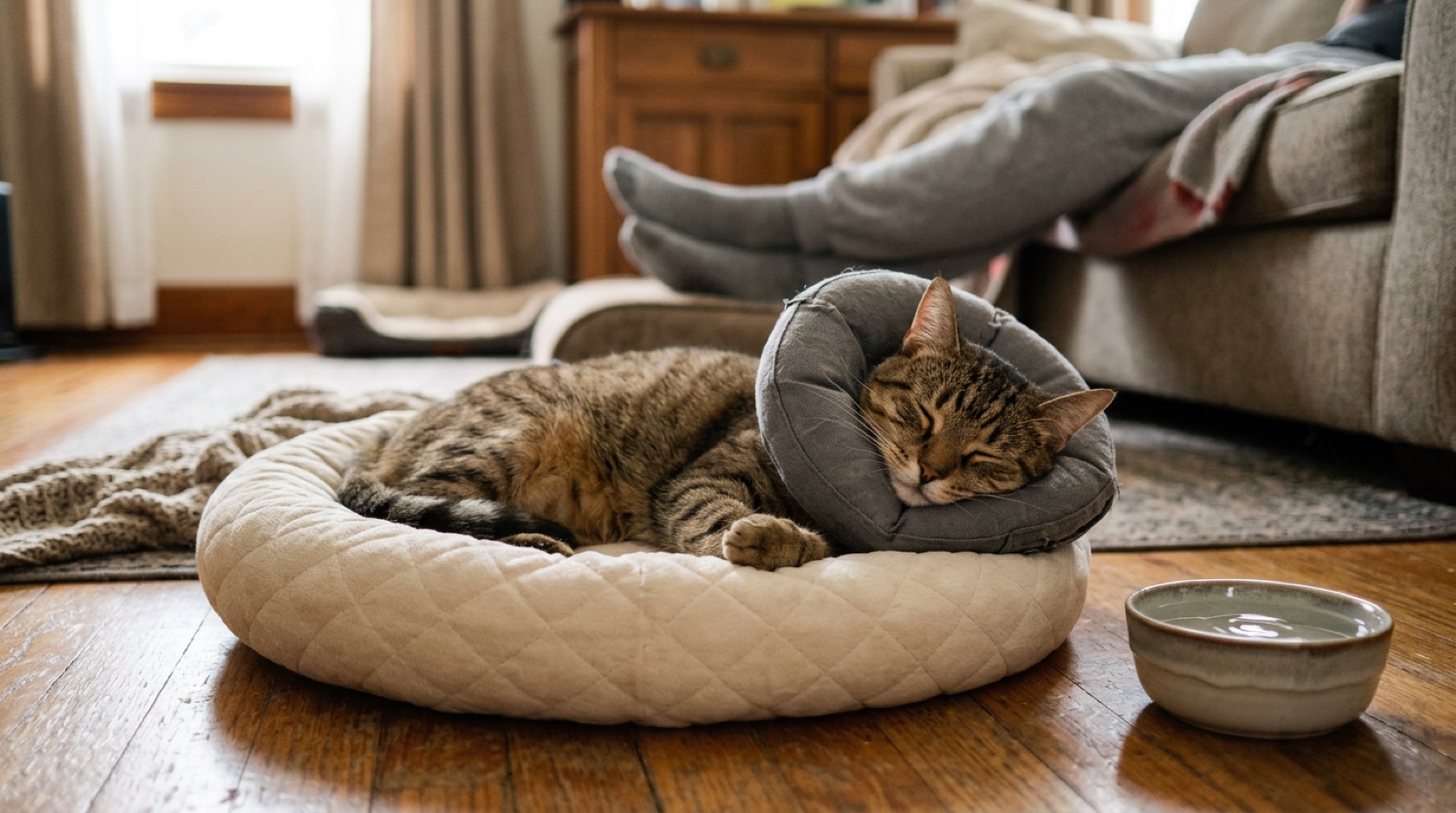
Day one. Groggy, wobbly, uninterested in food and slightly offended. Keep the cat somewhere warm, quiet and low to the ground. A small bathroom works better than a bedroom with a tall bed to leap off.
Days two and three. Appetite returns and so does the desire to jump on things. This is where owners get complacent. The incision is nowhere near healed even though the cat behaves as though it is.
Days four to ten. Keep the cone on, keep the cat indoors, and check the incision once a day in good light. Redness, swelling, discharge or a bad smell all mean phone the clinic. So does a cat that stops eating again after starting.
The follow-up. Go to it even if everything looks perfect. A vet spots a developing problem days before an owner does, and that check is usually included in what you already paid.
Straining in the litter box is an emergency
A male cat straining in the box, crying, going in and out repeatedly, or producing nothing may have a urinary blockage. That is life-threatening within hours, not days, and it is not a litter box behaviour problem. Get to a veterinarian or an emergency clinic immediately. Do not wait until morning, and do not try to manage it at home.
This is separate from spay and neuter recovery, but it is the single most time-critical thing a cat owner should recognise. Any change in urination after surgery also warrants a phone call to the clinic that did the procedure.
Browse adoptable St. Catharines cats
Every cat listed through a Niagara rescue is already spayed or neutered, so the surgery, the cone and the recovery week are somebody else's memory. Listings refreshed regularly.
See Available St. Catharines Cats →Frequently Asked Questions
Where can I get a cat spayed or neutered in St. Catharines?
You have three practical routes. The Niagara SPCA Animal Clinic in Welland is a low-cost, high-volume spay and neuter clinic about half an hour down the canal, and it is the cheapest option most Niagara owners find. The Humane Society of Greater Niagara runs a full-service veterinary clinic on Fourth Avenue in St. Catharines that also does spay and neuter surgeries. Private clinics across the city do the same procedure at standard practice pricing, usually with more flexible scheduling. Book early either way, because the low-cost clinics fill weeks ahead in kitten season.
How much does it cost to spay or neuter a cat in Niagara?
Neither the Welland clinic nor most Niagara practices publish a flat cat spay price, so you phone for a current quote. That is normal rather than evasive. Price depends on the cat's sex, weight, age, whether she is pregnant or in heat, and whether a hernia or a retained testicle turns up. A neuter is a simpler procedure than a spay and costs less. The low-cost clinic in Welland exists specifically to keep the number down, so it is the first call worth making if cost is the deciding factor.
Do I need to do this if I adopted from a shelter?
No, and this is one of the quiet advantages of adopting. Cats from the Humane Society of Greater Niagara and the Niagara SPCA go home already spayed or neutered, so the biggest routine surgery of the cat's life is finished and paid for inside the adoption fee. This guide is for people who took in a stray, accepted a free kitten from a classified ad, or already own an unfixed cat. If your cat came from a Niagara rescue, check the paperwork and then stop worrying about it.
What age should a cat be fixed?
Most veterinarians in Ontario do the surgery somewhere between four and six months, and many shelters do it earlier under paediatric protocols so the cat leaves already fixed. The reason for not waiting is that female cats can get pregnant younger than people expect, often before their first birthday and sometimes well before. In a region with a real community-cat population, one missed season becomes a litter and then several litters. Your vet will confirm the right timing for your particular cat based on weight and health.
Is there help if I cannot afford the surgery?
Yes, and it is worth a phone call before you assume otherwise. Niagara Action for Animals helps with spay and neuter costs through partnerships with local clinics including the Welland spay and neuter clinic and the Humane Society of Greater Niagara. Its Carol's Ferals program may also provide money toward trap-neuter-return work for colony cats if you are committed to caring for the colony afterwards. Funding is described as available according to finances, so ask what is open rather than assuming a fixed program.
What actually happens on surgery day?
Your cat fasts overnight, usually from around midnight, though water is generally fine unless the clinic says otherwise. You drop the cat off in the morning and go home. The surgery happens under general anaesthetic and takes far less time than the day implies, since most of the day is monitoring and recovery. Most cats go home the same afternoon, groggy and unimpressed with you. Follow the clinic's fasting instructions exactly, because an anaesthetic on a full stomach is genuinely dangerous.
How long does recovery take?
Plan for ten to fourteen days of restricted activity, even though your cat will feel fine long before that. Males bounce back faster than females because a neuter is a smaller procedure. The hard part is not pain management, it is keeping a cat that feels recovered from jumping off the fridge and tearing an incision that has not finished healing. Keep the cat indoors, skip the cat tree for a couple of weeks, and check the incision daily for redness, swelling or discharge.
Does my cat have to wear the cone?
Yes, and the ten days of complaints are worth it. Cats groom obsessively and a cat licking an incision will open it, which turns a routine surgery into an infection and a second vet visit. If the plastic cone is genuinely making your cat miserable, ask the clinic about a soft recovery collar or a surgical suit instead. Do not simply take it off because the cat looks sad. Take it off when the clinic says the incision has healed, which is usually at the follow-up check.
What warning signs mean I should call the vet?
Call if the incision is opening, oozing, bleeding, hot to the touch or increasingly swollen, or if there is a bad smell. Call if your cat has not eaten anything twenty four hours after surgery, or has not urinated. Call if there is repeated vomiting, laboured breathing, or a cat that stays hidden and unresponsive rather than sleepy. Grogginess on day one is normal. Deterioration on day two or three is not. Clinics far prefer an unnecessary phone call to a delayed one.
Will fixing my cat change its personality?
Not the personality, but some behaviours change and that is usually the point. Neutered males spray less, roam less and fight less, which matters enormously in a city with busy corridors like the QEW and Highway 406. Spayed females stop going into heat, which stops the yowling and the attempts to get out the door. Cats do become slightly more prone to weight gain after surgery, so watch portions rather than free feeding. That is the only real trade-off and it is manageable.
What is TNR and does it happen in Niagara?
Trap-neuter-return means humanely trapping unowned outdoor cats, sterilising and vaccinating them, then returning them to a monitored colony with a caregiver. It is how you shrink a feral population without killing cats, and Niagara has documented colony work supported by local groups. Niagara Action for Animals may fund TNR through its Carol's Ferals program where somebody commits to after-care. If you are feeding an unowned cat, contacting a group about TNR is more useful than feeding alone, which grows the colony.
Can I fix a cat that is already an adult?
Yes. There is no upper age limit in principle, only a health assessment. An older cat may need pre-surgical bloodwork to confirm the kidneys and liver can handle anaesthetic, which adds cost but exists for good reason. Vets do this surgery on adult and senior cats regularly. If you have taken in an unfixed adult stray, the answer is not that it is too late. The answer is a conversation with a clinic about what pre-surgical workup that particular cat needs first.
Related Niagara Guides
One search, every Niagara rescue
Shelter cats and foster cats from across the Niagara region, in a single list.
Browse Available St. Catharines Cats →New cat? Start with these care guides
Everything a new adopter needs to set up a safe, happy home.
Cat & Dog Spay/Neuter Cost in Canada
Standard and subsidised pricing by province, and how to find a low-cost clinic wherever you are.