The short answer
A rescue Rottweiler carrying trauma is usually frightened, not dangerous, and the fear-based first-night snap is largely preventable. Give the dog a quiet decompression space, follow the 3-3-3 rule (and expect a Rottweiler to need longer), and force nothing in the first few days. Read growling as communication, not defiance. Use force-free methods only, since aversive tools reliably make a fearful guardian breed worse. Bring in a Toronto force-free trainer or veterinary behaviourist early, ideally within the first one to two weeks. The bond, once it forms, is often the deepest a dog owner ever has. This is a committed handler's project, and it rewards that commitment enormously.

Why the first-night snap happens
The dog is not aggressive. The dog is overwhelmed. A Rottweiler is a naturally watchful, self-assured guardian breed, so a stressed one often reads as controlled and confident right up until it is not, which is exactly why a fear response can seem to come out of nowhere on the first night. The Canadian Kennel Club breed profile describes the calm, self-assured, protective temperament that makes this breed such a devoted companion and also means its stress signals can be quiet and easy to miss.
Common contributing factors:
- New-home overstimulation: sights, smells, sounds, household members, and sometimes other pets, all new at once
- Forced physical interaction: petting, hugging, face-touching, leashing, or crating before the dog has decompressed
- Undisclosed bite history: some rescues do not know a dog's full history, and some do not share it
- A fear-based temperament: some Rottweiler lines carry lower fear thresholds
- Pain you do not know about: undiagnosed orthopaedic, ear, or dental pain
- Resource guarding that was never triggered in the foster home
What to do right away if it happens:
- Do not punish or react with fear yourself
- Calmly remove yourself from the dog's space
- Crate or gate the dog in their safe area
- Do not force interaction for the next 24 to 48 hours
- Contact the rescue right away, tell them what happened, and ask whether the dog has a bite history they did not share
- Book a vet exam to rule out pain
- Arrange a consult with a Toronto force-free trainer or a veterinary behaviourist within a week
What NOT to do: alpha-roll, scold, physically correct, force the dog to “face their fear,” hug or pet for the next 48 hours unless the dog initiates, introduce more people or pets, skip the vet exam, or hide the incident from the rescue or your future trainer. Punishment and confrontation increase risk in a fearful dog, they do not reduce it.
The 3-3-3 rule for a rescue Rottweiler (extended)
The 3-3-3 rule is standard rescue-community guidance: three days to decompress, three weeks to learn the routine, three months to feel at home. For Rottweilers these timelines usually run longer because of size-specific safety and the breed's bonding intensity. Our first-week guide covers the general decompression setup; this page is about the Rottweiler-and-trauma version of it.
First 3 days, decompression: the dog is overwhelmed, sometimes shut down, sometimes hyper-vigilant. May not eat. May seem “too good.” The real personality is not showing. Bite risk is highest in this window, so no forced interaction.
First 3 weeks, learning the routine: the dog starts to settle and learn the household schedule, and sometimes shows apparent “regression” as real behaviours surface. Real Rottweiler personality often takes four to six weeks to appear.
First 3 months, feeling at home: the real personality emerges and the bond deepens.
The trauma extension: many rescue Rotties need 6 to 12 months for full adjustment, because of larger size (more to be overwhelmed by), the breed's intense bonding to specific people, and any pre-existing fear or reactivity from a rough past. Severe cases sometimes need 12 to 24 months with ongoing behaviour support. Treat 3-3-3 as a minimum, not a deadline.
Fear is not aggression
Most of what looks like aggression in a newly adopted Rottweiler is fear. The dog is frightened and using distance-increasing signals, freezing, a hard stare, a growl, an air-snap, to say please back off. Reading that correctly changes everything you do next.
A confident-looking guardian breed can be genuinely scared underneath, and the calm exterior hides how close to threshold the dog is. Growling is communication, not defiance. If you punish the growl, you do not remove the fear, you just teach the dog to skip the warning and go straight to the snap next time. That is how “he bit with no warning” stories are made, and the warning was usually there all along.
The practical response to fear and to what looks like aggression is the same: create distance, lower the pressure, remove whatever triggered the response, and rebuild positive associations at a pace the dog can handle. Watch for the early, quiet signals (a closed mouth, a whale eye showing the whites, a stiff body, a lip lick, turning away) and respond to those, long before the growl. If the fear responses are frequent, escalating, or unpredictable, that is a professional conversation, because undiagnosed pain and true behaviour pathology both need help to sort out.
Asking the rescue about bite history and past trauma
For a guardian breed, the bite-history conversation is central to the match, not paperwork. Adopters who skip it and later discover an undisclosed history involving a child or another dog end up managing a problem they were never prepared for. Treat this as the most important conversation you have with the rescue.
What to ask directly:
- Has this dog ever bitten anyone, however minor?
- Has there been any “air snap” or near-miss?
- Has anyone been frightened by the dog's response in any situation?
- What is the dog's reaction to strangers, other dogs, kids, food removal, toy removal, being startled while sleeping, being grabbed by the collar, and vet handling?
- Why was the dog surrendered? Get specifics, not just “could not keep.”
- How long has the dog been in foster? Has it rotated foster homes, and why?
- What is the foster household like? Other dogs, cats, kids, and how does this dog do with them?
- Are there any people the dog has shown fear or reactivity toward?
- Has the dog had a recent vet exam? Any medical concerns?
- Are there situations the foster reports avoiding because of the dog's response?
What good rescues do: foster-based Toronto rescues like Save Our Scruff, TEAM Dog Rescue, Fetch + Releash, Redemption Paws, and Hopeful Tails disclose all incidents including minor ones, provide a written temperament evaluation, are honest about what they do not know, match on the dog's known temperament and your experience, and sometimes decline a match when the fit is wrong.
Red flags: “no known history” with no explanation of how that was assessed, vague temperament notes, no foster placement (a kennel-only read is rarely enough for a Rottweiler), pressure to adopt quickly, refusal to disclose, or an adoption process that never asks about your experience. Walk away from a rescue that gets defensive or evasive.
Building trust, step by step
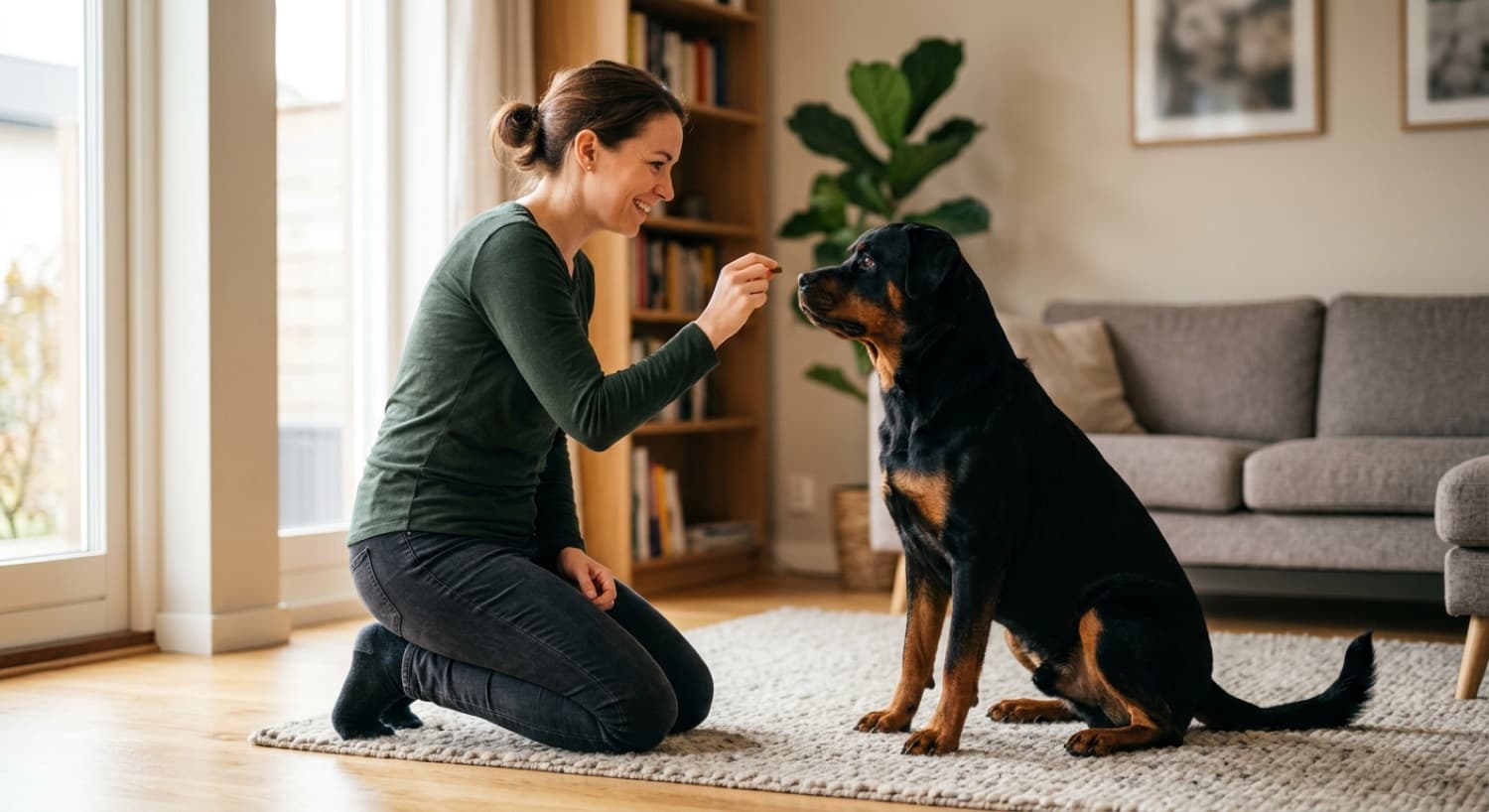
The same principles that work for any fearful dog carry extra weight with a large guardian breed.
Principles:
- Let the dog set the pace. Never force interaction.
- Predictability builds trust. Same routine, same person feeding, same times.
- Choice empowers a fearful dog. Offer options when you can.
- Distance matters. Respect the dog's threshold.
- Time is non-negotiable. Trust is not earned in days or weeks.
- Everyone in the household has to be consistent.
Early-weeks practice: sit on the floor at a distance, ignore the dog, and read a book. Drop treats periodically without acknowledging the dog. Speak quietly. Avoid direct eye contact and reaching. Avoid hugging and face-touching. Let the dog approach and sniff freely.
Handling: touch only when invited. Start with the chest or chin, not the head or back. Keep sessions short and end on a good note. Watch body language the whole time. Build cooperative-care patterns for grooming and vet visits with a force-free professional.
When the breakthrough comes: sometimes weeks, sometimes months, sometimes a single moment. For Rottweilers, the bond, once it forms, is often intense and lifelong, and many Toronto owners describe their rescue Rottie as the most loyal companion of their lives.
What NOT to do, Rottweiler-specific
Avoid flooding: do not introduce too much too fast. No visitors, no crowded places, no forced socialisation, no baths in the first week, and no vet visits in the first three to seven days unless it is an emergency.
Avoid aversive training: no alpha rolls or dominance methods, which can trigger a defensive bite in a fearful Rottweiler. No yelling, hitting, or throwing things. No shock collars, prong collars, or leash-correction methods. Modern behaviour science favours positive-reinforcement and low-stress handling for fearful dogs. Aversive methods reliably raise aggression in a fearful guardian breed.
Avoid forced handling: no hugging or kissing, no face-touching unless invited, no prolonged eye contact early, and no grabbing the collar without preparation.
Rottweiler-specific additions:
- Do not let kids approach the dog while it is eating or sleeping
- Do not take the dog's food or toys to “test” resource guarding
- Do not force introductions to other dogs
- Do not take a rescue Rottweiler to High Park, the Don Valley ravines, or a busy off-leash zone before trust and reliable behaviour are established (our off-leash parks guide covers when the dog is ready)
- Do not use an off-leash dog park in the first six or more months
When to bring in a Toronto behaviour professional
For a rescue Rottweiler carrying trauma, professional help is more urgent than for most rescue dogs.
When to consult:
- Right away, ideally a pre-adoption call, then a foundation consult within the first one to two weeks
- When any concerning behaviour appears (reactivity, fear, growling, snapping, resource guarding)
- After any bite incident, including a minor air snap
- Before introducing other pets, kids, or visitors
- For any first-time Rottweiler owner, regardless of the dog's history
What to look for in a Toronto professional: a force-free trainer who works with guardian breeds and reactive dogs, and who can explain a LIMA, positive-reinforcement approach in plain language. The Fear Free directory is one way to find low-stress-handling professionals. Ask whether they have rescue-trauma and Rottweiler experience, and whether they will coordinate with a veterinary behaviourist if medication becomes part of the plan. For severe cases, ask your primary Toronto vet for a referral to a board-certified veterinary behaviourist; any medication is prescribed and monitored by that veterinarian.
What to ask a prospective trainer: Are you certified in force-free, LIMA, positive-reinforcement-only methods? Do you have rescue-dog trauma experience? Do you have Rottweiler-specific experience? What is your approach with fearful or fear-reactive dogs? Will you coordinate with the rescue and a veterinary behaviourist if needed? Can you provide references?
Red flags: shock or prong-collar recommendations, alpha or dominance language, promises of fast results, refusal to explain methodology, or refusal to coordinate with veterinary care.
Where to find a rescue Rottweiler in Toronto
Rottweilers and Rottie mixes turn up through both shelter and foster channels in the Toronto area. A shelter path like the City of Toronto Animal Services or the Toronto Humane Society can mean a same-day adoption, but the personality you meet in a loud kennel may differ from the dog who emerges at home, so plan for a longer discovery period. A foster-based rescue like Save Our Scruff, TEAM Dog Rescue, Fetch + Releash, Redemption Paws, or Hopeful Tails places dogs from home environments and can usually tell you how a specific dog does around kids, cats, and other dogs, which matters enormously for a guardian breed with an unknown past.
For a trauma case, the foster route is often the safer starting point precisely because someone has already lived with the dog and can describe its triggers honestly. For a fuller comparison of local rescues and how they operate, see our best dog rescues in Toronto guide, and if you are still weighing the decision, the Toronto adoption guide walks through the whole process. The wider guardian-breed reality, including the Ontario legal and housing picture, lives in our Rottweiler temperament and training guide.
Bottom line for a Toronto rescue Rottweiler trauma case
Likely to succeed if: you have patience for an extended timeline, a commitment to force-free training through the first year, a predictable household, a Toronto force-free trainer experienced with reactive and guardian breeds, a verified foster temperament evaluation and honest bite-history disclosure, emotional preparation for slow trust-building, and a long-term mindset.
Likely the wrong fit if: you are not willing to use force-free methods, you lean toward aversive tools, you are impatient with slow progress, or you are a first-time Rottweiler owner without breed-experienced mentorship and a household with very young children and a severely fearful dog.
The reward: extraordinary loyalty once trust is built. Toronto Rottweiler owners often describe their rescue Rotties as the most devoted dogs of their lives. The first-night fear response is real and prevention matters, and the partnership, when it works, is exceptional.
Browse adoptable Rottweilers in Toronto
Foster-evaluated rescue Rotties and Rottie mixes from Toronto-area rescues. For a dog that may carry trauma, prioritise a rescue with a detailed temperament evaluation and honest bite-history disclosure, an experienced calm handler, and a force-free trainer engaged early. Refreshed regularly.
See Available Rottweilers →Frequently Asked Questions
My rescue Rottweiler snapped at me on the first night. What happened?
A stressed Rottweiler in an overwhelming new environment can fear-bite, especially when interaction is forced. The dog is not aggressive; the dog is overwhelmed. Common contributing factors are new-home overstimulation, forced physical interaction (petting, hugging, face-touching, leashing, crating) before the dog has decompressed, an undisclosed bite history the rescue did not know or did not share, a fear-based temperament, undiagnosed pain (orthopaedic, ear, dental), or resource guarding that was never triggered in foster. What to do right away: do not punish or react with fear, calmly remove yourself from the dog's space, crate or gate the dog in their safe area, do not force interaction for the next 24 to 48 hours, contact the rescue and tell them what happened, book a vet exam to rule out pain, and arrange a consult with a Toronto force-free trainer or a veterinary behaviourist within a week. Do not alpha-roll, scold, or physically correct. The first-night bite pattern is largely preventable with 3-3-3 decompression: let the dog set the pace, keep things quiet, no visitors, no baths, no grooming, no vet unless it is an emergency, in the first three days.
What is the 3-3-3 rule for a rescue Rottweiler?
The 3-3-3 rule is standard rescue-community guidance: three days to decompress, three weeks to learn the routine, three months to feel at home. For Rottweilers the timelines often run longer because of size-specific safety and the breed's bonding intensity. First three days: decompression. The dog is overwhelmed, sometimes shut down, sometimes hyper-vigilant. They may not eat. They may seem too good to be true. The real personality is not showing yet, and bite risk is highest in this window, so no forced interaction. First three weeks: learning the routine. The dog settles, learns the household rhythm, and sometimes shows what looks like regression as real behaviours surface. Real Rottweiler personality often takes four to six weeks to appear. First three months: feeling at home, with the bond deepening. For a dog carrying trauma, expect longer: many rescue Rotties need 6 to 12 months for full adjustment, and severe cases sometimes need 12 to 24 months with ongoing behaviour support. Treat 3-3-3 as a minimum, not a finish line.
How do I ask the rescue about bite history and past trauma?
For a guardian breed, this conversation is essential, not optional. Ask directly: has this dog ever bitten anyone, however minor? Any air snap or near-miss? Has anyone been frightened by the dog's response in any situation? What is the dog's reaction to strangers, other dogs, kids, food removal, toy removal, being startled while sleeping, being grabbed by the collar, and vet handling? Why was the dog surrendered, with specifics? How long has the dog been in foster, and has it rotated foster homes and why? What is the foster household like, and are there people the dog has shown fear toward? Has the dog had a recent vet exam? Are there situations the foster avoids because of the dog's response? Good foster-based rescues like Save Our Scruff, TEAM Dog Rescue, and Redemption Paws disclose every incident, provide a written temperament evaluation, are honest about what they do not know, and sometimes refuse a match when the fit is wrong. Red flags: vague temperament notes, no foster placement, pressure to adopt quickly, refusal to disclose, or no screening of you. If a rescue gets defensive or evasive, walk away.
How do I build trust with a traumatised rescue Rottweiler?
Same principles as any fearful dog, with extra weight because of the size and the guardian temperament. Let the dog set the pace. Predictability builds trust: same routine, same person feeding, same times. Choice empowers a fearful dog, so offer options rather than corners. Distance matters, so respect the dog's threshold. Time is non-negotiable, and trust is not earned in days or weeks. Everyone in the household has to be consistent. In the early weeks, sit on the floor at a distance, ignore the dog, and read a book. Drop treats periodically without acknowledging the dog. Speak quietly. Avoid direct eye contact and reaching. Avoid hugging and face-touching. Let the dog approach and sniff freely. When you do handle the dog, touch only when invited, start with the chest or chin rather than the head or back, keep sessions short, and watch body language the whole time. Build cooperative-care patterns for grooming and vet visits with a force-free professional. For Rottweilers, the bond, once it forms, is often intense and lifelong.
What should I NOT do with a fearful rescue Rottweiler?
Avoid flooding: no visitors in the first week, no crowded places, no forced socialisation, no baths, no grooming, and no vet visits in the first three to seven days unless it is an emergency. Avoid aversive training: no alpha rolls or dominance methods, which can trigger a defensive bite in a fearful Rottweiler, and no shock collars, prong collars, or leash-correction methods, which reliably raise aggression in fearful dogs. With a large, powerful breed the consequences of getting this wrong are serious. Avoid forced handling: no hugging or kissing, no face-touching unless invited, no prolonged eye contact early, and no grabbing the collar without preparation. Do not over-comfort fearful behaviour, since it can reinforce fear, and do not rush the timeline. Avoid inconsistency between family members. Avoid overwhelming environments: loud media, several new pets at once, unsupervised children, and High Park or any off-leash zone before the bond is solid.
When should I bring in a Toronto behaviour professional?
For a rescue Rottweiler carrying trauma, professional help is more urgent than for most rescue dogs. Ideally have a pre-adoption call, then a foundation consult within the first one to two weeks. Consult immediately if any concerning behaviour appears (reactivity, fear, growling, snapping, resource guarding), after any bite incident including a minor air snap, before introducing other pets or visitors, and for any first-time Rottweiler owner regardless of the dog's history. Look for a Toronto force-free trainer who works with guardian breeds and reactive dogs, and who can explain a LIMA, positive-reinforcement approach. Ask whether they have rescue-trauma and Rottweiler experience, and whether they will coordinate with a veterinary behaviourist if medication becomes part of the plan. For severe cases, your primary vet can refer you to a board-certified veterinary behaviourist; any medication is prescribed and monitored by that veterinarian. Red flags in a trainer: shock or prong-collar recommendations, alpha or dominance language, promises of fast results, or refusal to coordinate with veterinary care.
What is a realistic decompression timeline for a rescue Rottweiler?
Often longer than the standard 3-3-3 because of the breed's size and temperament. First 24 to 48 hours: the dog is overwhelmed, sometimes shut down, sometimes hyper-vigilant, may not eat much, and may seem too good to be true. Bite risk is highest here, so no forced interaction. Days three to seven: the dog begins to learn the home, eating and drinking normalise, and a little real behaviour starts to show. Still no baths, grooming, or non-emergency vet visits. Weeks two and three: the routine becomes familiar, personality emerges, and you may see apparent regression as the dog stops masking. Gentle force-free training can begin. Weeks four to eight: personality is clearer, the bond is developing, and behaviours become consistent. Weeks eight to twelve: real adjustment, deeper bonding, trust accelerating. Months three to twelve: profound bonding and full family integration, though some trauma may still surface. Severe cases sometimes need 12 to 24 months with ongoing behaviour support.
Is fear the same as aggression in a rescue Rottweiler?
No, and confusing the two is where a lot of adopters go wrong. Most of what looks like aggression in a newly adopted Rottweiler is fear-based: the dog is frightened and using distance-increasing signals (freezing, hard staring, growling, air-snapping) to say back off. Growling is communication, not defiance, and punishing it only teaches the dog to skip the warning next time, which makes a bite more likely, not less. A confident guardian breed can look intimidating while being genuinely scared underneath. The practical response is the same either way: create distance, lower the pressure, protect the dog from whatever triggered the response, and build positive associations at a pace the dog can handle. If the fear responses are frequent, escalating, or unpredictable, that is a veterinary behaviourist conversation, because undiagnosed pain and true behaviour pathology both need a professional to sort out.
Can a first-time owner adopt a traumatised rescue Rottweiler?
It is possible but it is not the easy path, and honesty here protects both you and the dog. A large guardian breed with a hard past asks a lot: patience for an extended timeline, a genuinely calm household, the physical ability to manage a strong dog safely, and a commitment to force-free methods even when progress is slow. If you are a first-time Rottweiler owner, the safest version is a foster-evaluated adult whose temperament is a known quantity, paired with a Toronto force-free trainer from day one and a rescue that stays available for support. Skip the unknown-history dog with an active bite record unless you have direct guardian-breed experience and a behaviour professional already lined up. A good rescue will tell you honestly whether a specific dog suits your experience level, and the right match is far more important than any single dog you fell for online.
Bottom line for a rescue Rottweiler with trauma in Toronto?
Likely to succeed if you have patience for an extended timeline, are committed to force-free training through the first year, keep a predictable household, work with a Toronto force-free trainer experienced with reactive and guardian breeds, verify the foster temperament evaluation and any bite-history disclosure, and take a long-term view. Challenging if your household has very young children who need constant supervision, very sensitive resident pets, an inflexible schedule, or an expectation of immediate bonding. Likely the wrong fit if you are not willing to use force-free methods, lean toward aversive tools, are impatient with slow progress, or are a first-time Rottweiler owner without breed-experienced mentorship. The reward, when it works, is extraordinary loyalty and a profound bond, often described by Toronto owners as the most devoted dog of their lives.
The full Rottweiler cluster
Rottweiler Adoption in Toronto
Where to adopt, real costs, and the guardian-breed reality of rescuing a Rottie.
Rottweiler Temperament and Training
The watchful guardian temperament, socialisation, the teenage months and why force-free training works best.
First Week With a Rescue Dog
The general decompression routine for any newly adopted Toronto rescue dog.
Rottweiler Health Issues: Bone Cancer, Heart, Hips
Rottweiler health issues to plan for: bone cancer, subaortic stenosis, hip and elbow dysplasia, bloat, JLPP and eye disease, and what to ask your vet in month one.
New dog? Start with these care guides
Everything a new adopter needs to set up a safe, happy home.