The short answer
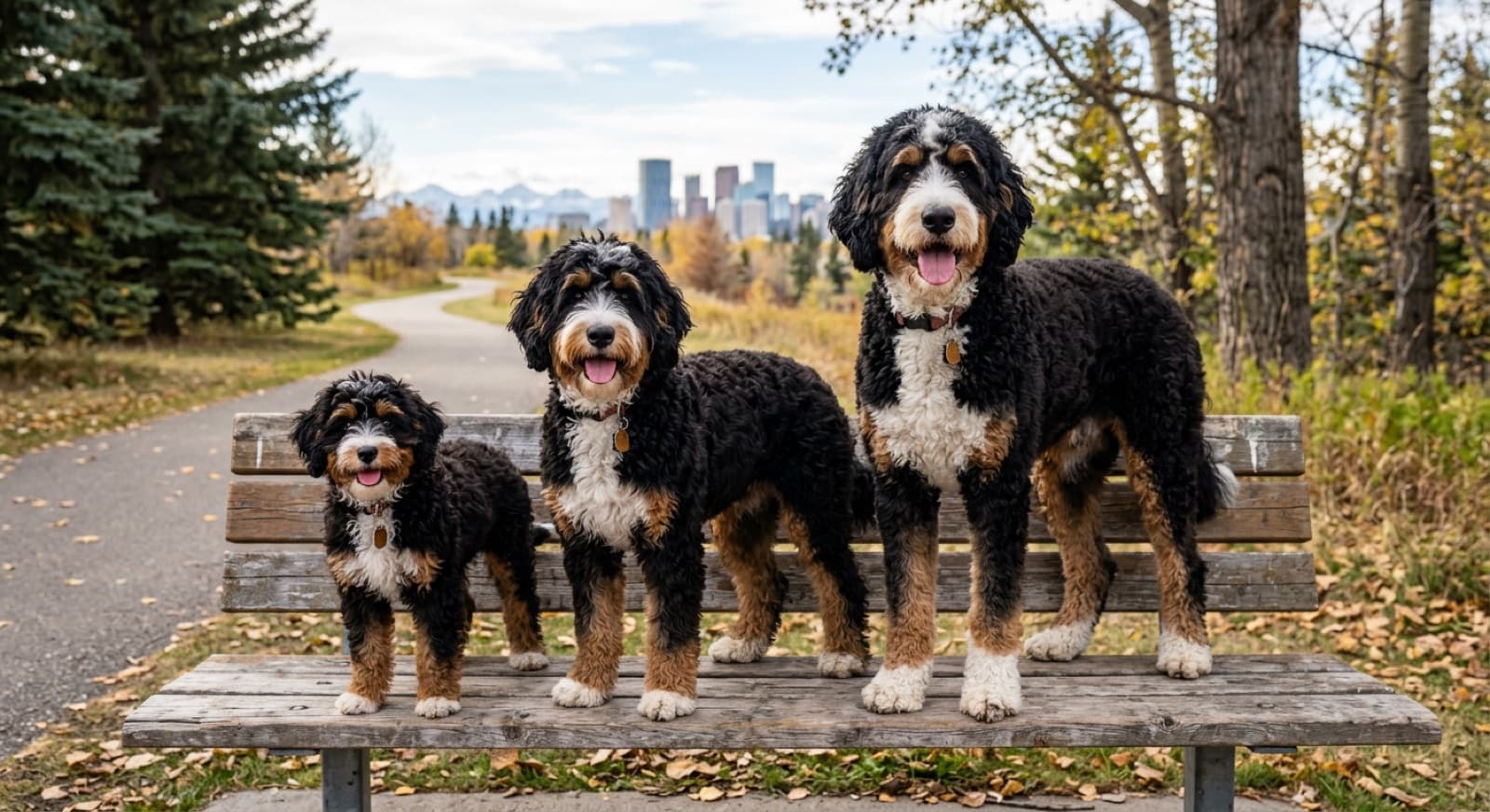
Bernedoodles come in three sizes, set by the Poodle parent: Standard (50 to 90-plus lbs, big), Miniature (25 to 50 lbs), and Tiny/Toy (10 to 25 lbs). Generation labels (F1, F1B, multigen) describe how much Poodle is in the mix, higher-Poodle generations tend toward curlier, lower-shedding coats, but never guarantee it. Coats come in straight (Bernese-like, sheds, easy), wavy (the ideal), and curly (lowest-shedding, highest-maintenance). No dog is truly hypoallergenic. All but the straight coat need frequent brushing plus grooming every four to eight weeks. Adopting an adult lets you see the actual size and coat. Browse adoptable Toronto dogs.
The sizes: Tiny, Mini, Standard
Bernedoodle size is set mainly by the Poodle parent. Standards (from a Standard Poodle) are the largest at 50 to 90-plus pounds, a genuinely big dog needing more space, exercise, food, and grooming, and carrying more joint and bloat risk, though many are gentle and mellow. Miniatures (from a Mini Poodle) sit at 25 to 50 pounds, a versatile, sturdy middle ground that suits families and even larger apartments. Tiny/Toy Bernedoodles (from a Toy Poodle) are 10 to 25 pounds, best for smaller homes and cheaper to feed and groom. Size drives cost, space, exercise, and health, so it is the first thing to match to your life. Because adult size is somewhat unpredictable in a crossbred puppy, especially in Mini and Tiny lines, adopting an adult from a rescue, where you see the grown size, is a real advantage. Our adoption guide covers the breed's needs.
Generations and coat types
Generation labels boil down to how much Poodle is in the dog. F1 is a straight Bernese-to-Poodle cross (50/50), most variable in coat. F1B is an F1 bred back to a Poodle (about 75% Poodle), tending toward curlier, lower-shedding coats. Multigen comes from several Doodle generations aimed at more consistent, reliably low-shedding coats. Coats fall into three types: straight (Bernese-like, sheds, easiest to groom), wavy (relatively low-shedding, often ideal), and curly (lowest-shedding, most matting-prone). Curlier coats and higher-Poodle generations suit allergies better, but no dog is truly hypoallergenic and coats vary dog to dog, so you cannot assume by label. The reliable move, a real advantage of adopting an adult, is to meet the specific dog and confirm the actual coat. The AKC Bernedoodle overview has more background.
Grooming, and choosing your fit
Whatever the coat, grooming is a real commitment: wavy and curly coats mat readily and need frequent brushing to the skin plus professional grooming every four to eight weeks ($70 to $130-plus per visit in Toronto, more for a big Standard), while straight coats are easier but shed more. To choose your fit: a Standard suits a house with room and an owner ready for a big dog's cost and grooming; a Mini is a versatile family middle ground; a Tiny suits smaller homes. All Bernedoodles need consistent grooming and dislike being left alone, and for allergies, curlier coats and higher-Poodle generations are safer bets, confirmed by meeting the dog. Because adult size, coat, and temperament are clearest in a grown dog, adopting an adult is the surest way to get the right match. Our health guide covers the size-related health considerations. See the breed page for adoptable Bernedoodles.
Browse adoptable Bernedoodles in Toronto
Adopting an adult lets you see the real size, coat, and temperament. Browse adoptable Bernedoodles and Doodle mixes near Toronto.
See Available Bernedoodles →Frequently Asked Questions
What sizes do Bernedoodles come in?
Bernedoodles come in three general size categories, determined mainly by the size of the Poodle parent used in the cross. Standard Bernedoodles (from a Standard Poodle) are the largest, typically 50 to 90-plus pounds and a genuinely big dog. Miniature Bernedoodles (from a Miniature Poodle) are medium, typically 25 to 50 pounds. Tiny or Toy Bernedoodles (from a Toy Poodle) are the smallest, typically 10 to 25 pounds. Size affects a great deal: exercise needs, living space, food and vet costs, grooming cost and time, and health risks (larger dogs are more prone to joint problems and bloat, while very small ones may have other considerations). Because Bernedoodles are a crossbreed, adult size can be somewhat unpredictable in a puppy, especially in Mini and Tiny lines, which is a real advantage of adopting an adult from rescue: you see the actual grown size rather than guessing. Match the size to your home, activity level, and budget.
What do F1, F1B, and multigen mean for a Bernedoodle?
These generation labels describe how much Poodle is in the mix, which affects the coat and shedding. F1 is a first cross: a purebred Bernese Mountain Dog bred to a purebred Poodle (50/50), producing the most variable coats, some shed, some do not. F1B is an F1 Bernedoodle bred back to a Poodle (roughly 75% Poodle), which tends to produce curlier, lower-shedding coats and is often chosen by allergy-conscious buyers. F2 is two Bernedoodles bred together, with variable results. Multigenerational (multigen) Bernedoodles come from several generations of Doodle breeding, aiming for more consistent, reliably low-shedding coats. The practical point for an adopter: generation influences the odds of a low-shedding coat but never guarantees it, and if you are adopting an adult from rescue, the dog’s actual coat in front of you matters far more than its generation label (which may be unknown anyway).
Do Bernedoodles shed, and which are best for allergies?
It varies, and this is the biggest misconception about the breed. Because the Bernedoodle crosses a heavy-shedding Bernese Mountain Dog with a low-shedding Poodle, coats range from curlier, lower-shedding Poodle types to straighter, more Bernese-like coats that shed more. Higher-Poodle generations (like F1B) and curlier coats are generally the lower-shedding, more allergy-friendly options. But two honest caveats matter: no dog is truly hypoallergenic (low-shedding reduces, but does not eliminate, the dander and hair that trigger reactions), and because coat type varies dog to dog, you cannot assume any given Bernedoodle is allergy-friendly based on the breed name or even the generation alone. The reliable approach, and a real advantage of adopting an adult from rescue, is to meet and spend time with the specific dog before committing, ideally enough to gauge your allergic response, and to confirm the actual coat type, rather than gambling on a puppy’s uncertain future coat.
What coat types do Bernedoodles have?
Bernedoodles generally have one of three coat types, and knowing them helps set expectations. The straight (or "flat") coat is the most Bernese-like: it sheds more and is the least allergy-friendly but the easiest to groom. The wavy coat is intermediate: relatively low-shedding and manageable, and often considered the ideal Bernedoodle coat. The curly coat is the most Poodle-like: the lowest-shedding, but the most prone to matting and the highest-maintenance to groom. Coat type varies even within a single litter and is influenced by the generation. For an adopter, the takeaway is to look at and feel the actual coat: a curlier coat means lower shedding but more grooming, while a straighter coat sheds more but is easier to maintain. Colour also varies beautifully in Bernedoodles (tri-colour, black-and-white, sable, and more), but colour does not affect shedding or grooming, coat type does. Our adoption guide covers why meeting the specific dog matters so much.
How much grooming does a Bernedoodle need?
More than most people expect, and it scales with size and coat type. Most Bernedoodle coats, especially the wavy and curly types, mat readily and need frequent at-home brushing (several times a week, often more for a curly coat) plus professional grooming every four to eight weeks to keep the coat healthy and prevent painful matting. A neglected Bernedoodle coat mats close to the skin and may have to be shaved down. And because Bernedoodles can be large, grooming a big Standard costs more and takes longer than a small dog, professional grooming for a medium-to-large Doodle in Toronto typically runs $70 to $130-plus per visit, a genuine recurring cost. The straighter, flat coats are easier but shed more. Whatever the coat, brushing right down to the skin (not just the surface, where mats hide underneath) is essential, and keeping the coat in a shorter "teddy bear" trim makes maintenance far more manageable. Budget the time and money before adopting.
Which Bernedoodle size is right for me?
It depends on your home, lifestyle, and budget. A Standard Bernedoodle is a big dog (50 to 90-plus pounds) needing more space, exercise, food, and grooming, and carrying more joint and bloat risk, but many are wonderfully gentle and mellow, suiting a house with room. A Miniature Bernedoodle (25 to 50 pounds) is a versatile middle ground, substantial enough to be sturdy but more manageable in size and cost, often a good fit for families and even larger apartments. A Tiny or Toy Bernedoodle (10 to 25 pounds) suits smaller homes and apartments and costs less to feed and groom, though very small Doodles can have their own considerations. Whatever the size, all Bernedoodles need consistent grooming and dislike being left alone. Because adult size can be unpredictable in a crossbred puppy, adopting an adult from rescue, where you see the actual grown size, temperament, and coat, is a genuine advantage in getting the right match for your home.
Bernedoodle Adoption in Toronto
Where to adopt, costs, and the honest Doodle reality.
Bernedoodle Health Issues: What Each Parent Adds
Bernedoodle health issues to plan for: cancer risk from the Bernese side, hip and elbow dysplasia, bloat, degenerative myelopathy, Addison’s and skin and ear problems.
New dog? Start with these care guides
Everything a new adopter needs to set up a safe, happy home.