
The short answer
Mitral valve disease (MVD) is a progressive heart condition Cavaliers develop earlier and more than any breed, and it is their leading cause of death. It usually starts as a heart murmur a vet hears before any symptoms appear, so routine heart checks from adulthood are essential. As it advances, watch for coughing, a rising resting breathing rate, tiring, or fainting. Early disease is monitored; an enlarging heart is when vets usually start treatment. Many Cavaliers live good years with it. This is general information, not veterinary advice; heart care is always directed by your vet.
What MVD actually is
The mitral valve sits between two chambers on the left side of the heart, and its job is to seal shut each time the heart pumps so blood flows the right way. In mitral valve disease, the valve gradually thickens and degenerates until it no longer closes cleanly, so a small amount of blood leaks backward with every beat. To compensate, the heart works harder and, over time, can enlarge, and in advanced disease that strain can tip into congestive heart failure, where fluid backs up into the lungs. It is a slow, progressive process, often unfolding over years, which is both the challenge (it is easy to miss early) and the opportunity (there is time to catch and manage it). Screening programs like the OFA cardiac database exist precisely to track and reduce this disease in predisposed breeds.
Why Cavaliers, and why so early
MVD is the most common heart disease in dogs of all breeds, but the Cavalier carries a genetic predisposition that makes it appear both far earlier and far more frequently than in other dogs. Where many breeds develop valve disease only in old age, Cavaliers can show the first murmur in middle age, and the proportion affected rises steeply as they get older. This early onset is the whole reason heart monitoring should be routine for the breed from adulthood rather than something reserved for senior dogs. The AKC Canine Health Foundation has funded significant research into MVD in Cavaliers, and it is also why responsible breeders follow strict cardiac-screening protocols, a point worth insisting on if you ever consider a breeder rather than adoption.
The warning signs to watch for
Early MVD is silent, which is why the vet exam matters, but as it progresses there are signs a vigilant owner can catch:
- A persistent cough, especially at night or after lying down.
- Faster or more laboured breathing, particularly at rest or during sleep.
- Reduced stamina: tiring more easily on walks, or slowing down.
- Fainting or collapse, which always warrants prompt veterinary attention.
- Restlessness at night, reduced appetite, or a general drop in energy.
One of the most useful home tools is the resting (or sleeping) breathing rate: with a little practice you can count how many breaths your dog takes per minute while genuinely asleep, and many vets ask owners of heart-disease dogs to track it, because a sustained climb is an early warning that fluid may be building. Ask your vet whether and how to monitor it for your dog. Obvious breathing distress is an emergency, go straight to a vet.
Monitoring, staging, and treatment
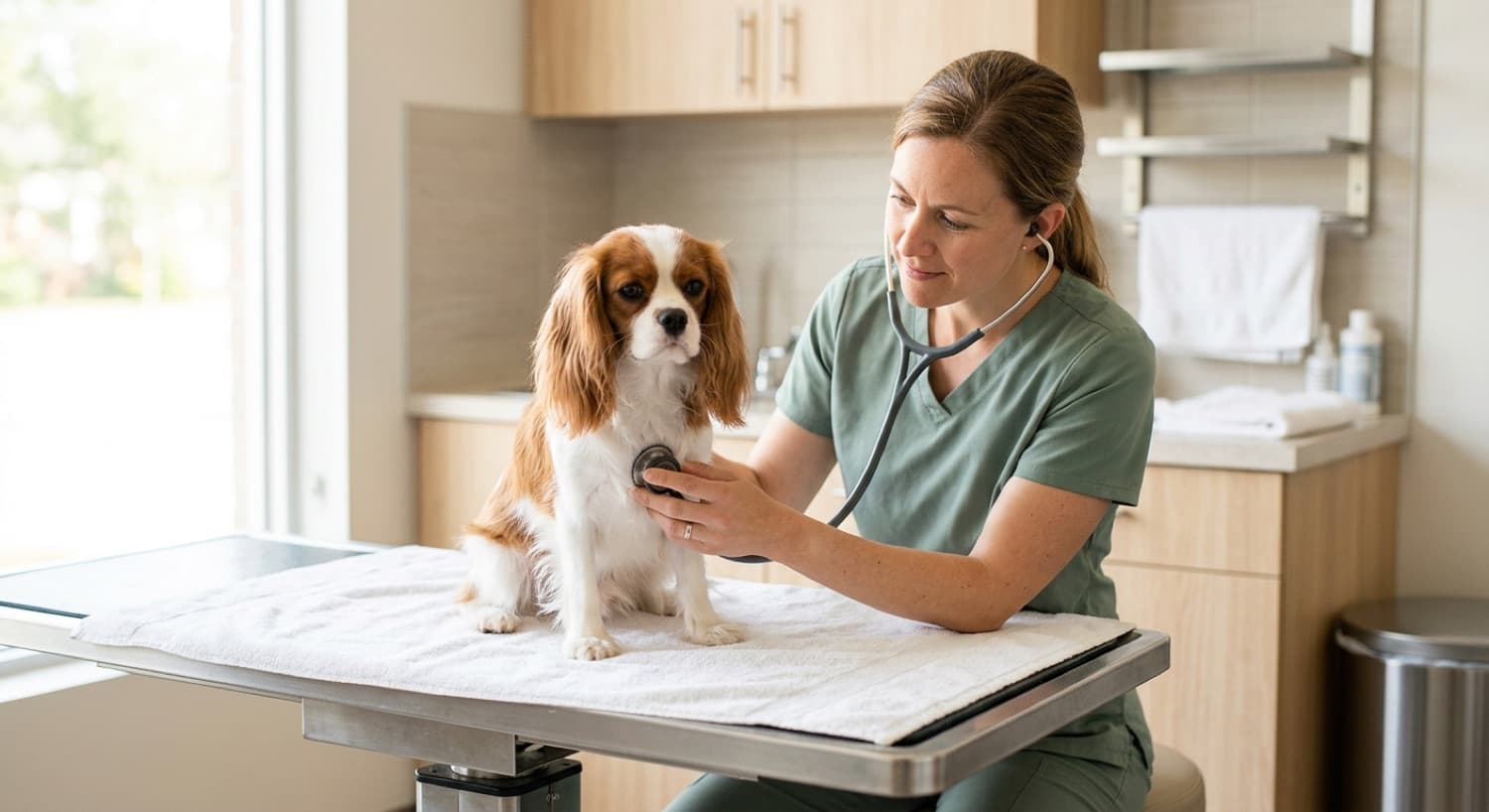
When a vet hears a murmur, the next steps are about understanding how far the disease has progressed. That usually means chest X-rays and an echocardiogram (a heart ultrasound) to see whether the heart is enlarging, often with input from a veterinary cardiologist. Vets stage the disease along a scale from at-risk-but-healthy through to symptomatic heart failure, and the stage guides what happens: in the earliest stage the approach is careful monitoring rather than medication, while a heart that has started to enlarge is typically the point at which treatment begins. In heart failure, treatment usually combines several heart medications to manage fluid and support the heart. The specifics, which medications, what doses, and when, are decisions for your veterinarian, and modern veterinary cardiology gives many Cavaliers good-quality years even after diagnosis. Your job as an owner is to keep the monitoring appointments, watch for the signs above, and follow the plan your vet sets.
Living well with a Cavalier's heart
The takeaway is hopeful, not frightening. A heart murmur is not a countdown, and a great many Cavaliers live full, happy lives with a monitored or treated heart. The levers you control are real: keep your dog lean (extra weight is a direct burden on a compromised heart), keep up routine heart checks so disease is caught early, track the resting breathing rate if your vet recommends it, and act quickly on any cough or breathing change. Do those things and you give your Cavalier the best possible odds. For the wider health picture, see our Cavalier health guide, and the Canadian Kennel Club breed profile for background on the breed.
Browse adoptable Cavaliers in Toronto
Understanding the heart reality is the best preparation for giving a rescue Cavalier a long, well-cared-for life. Meet the adoptable Cavaliers and Cavalier mixes near you.
See Available Cavaliers →Frequently Asked Questions
What is mitral valve disease in Cavaliers?
Mitral valve disease (MVD), also called degenerative or myxomatous mitral valve disease, is a condition where one of the heart's valves gradually thickens and stops sealing properly, so a little blood leaks backward each beat. Over time the heart works harder and can enlarge, and in advanced cases this can progress to congestive heart failure. It is the most common heart disease in dogs generally, but Cavaliers are affected far earlier and more often than any other breed, which is why it is considered the defining health issue of the breed and the leading cause of death in Cavaliers.
At what age do Cavaliers get heart murmurs?
Earlier than most breeds, which is the crux of the problem. In Cavaliers, the murmur of early mitral valve disease often appears years sooner than in other dogs, sometimes in middle age rather than old age, and the proportion of affected dogs climbs steadily with age. That early onset is exactly why heart monitoring should be routine for the breed from adulthood on, not something you wait for old age to start. A murmur is usually the first sign, and a vet detects it on a normal physical exam, often well before the dog shows any outward symptoms.
What are the warning signs of heart failure in a Cavalier?
Early MVD usually has no visible signs, which is why vet monitoring matters. As the disease advances, watch for a persistent cough, faster or more laboured breathing, especially at rest, reduced stamina or tiring on walks, fainting or collapse, reduced appetite, and restlessness at night. An increase in the resting or sleeping breathing rate is one of the more useful early warnings, and many vets ask owners to track it at home. Any of these signs, particularly a cough or a rise in resting breathing rate, warrants a prompt vet visit, and obvious breathing distress is an emergency.
How do vets monitor and stage MVD?
It starts with the routine physical exam, where a vet listens for a murmur and grades its intensity. Once a murmur is found, the vet may recommend further tests, typically chest X-rays and an echocardiogram (a heart ultrasound), to see whether the heart is enlarging and to stage the disease. Vets commonly use a staging system that runs from at-risk-but-healthy through to symptomatic heart failure, because the stage guides what happens next: early stages are monitored, while a heart that has begun to enlarge is the point at which treatment is usually considered. Your vet, or a veterinary cardiologist, decides the right monitoring interval for your dog.
How is mitral valve disease treated in Cavaliers?
It depends on the stage, and it is very much a decision for your veterinarian. In the earliest stage, before the heart enlarges, the usual approach is careful monitoring rather than medication. Once imaging shows the heart is starting to enlarge, vets often begin cardiac medication, and once a dog reaches heart failure, treatment typically involves a combination of heart medications to manage fluid and support the heart. The encouraging reality is that veterinary heart care has improved a great deal, and many Cavaliers live good-quality years after diagnosis with appropriate treatment. What the specific medications and timing should be is always a conversation with your vet, not something to self-manage.
Can you prevent MVD in a Cavalier?
You cannot prevent the genetic predisposition, but you can influence outcomes and support responsible breeding. For your own dog, keeping it lean, maintaining routine heart checks, and acting quickly on any warning sign all help you catch and manage disease at the best possible point. At the breed level, responsible breeders follow heart-screening protocols, breeding only older dogs with clear hearts whose own parents also had clear hearts at an older age, to reduce early-onset MVD in the next generation. This is a major reason to adopt or to buy only from breeders who document cardiac screening, and to avoid the backyard and mill breeding that ignores it.
How long can a Cavalier live with heart disease?
It varies widely, and a diagnosis is not a countdown. Many Cavaliers carry a heart murmur for years with no symptoms and a normal quality of life, and even after the heart begins to enlarge or reaches failure, modern veterinary treatment can give many dogs good-quality time. The biggest factors are how early the disease is caught, how closely it is monitored, and how well treatment is followed once it is needed, all of which are within an owner's influence. That is the whole point of taking heart health seriously in this breed: good management genuinely changes both how long and how well a Cavalier lives.
Cavalier Health Issues
Syringomyelia, eyes, ears, kneecaps, and the full picture.
Cavalier Adoption in Toronto
Where to adopt, the temperament, and the costs.
New dog? Start with these care guides
Everything a new adopter needs to set up a safe, happy home.