The short answer
German Shepherds are heavy year-round shedders that also blow their undercoat twice a year (April to May and October, 2 to 3 weeks each). Never shave a GSD, the double coat insulates against both cold and heat. Essential brush kit: undercoat rake, slicker brush, metal comb, and a high-velocity dryer. The Furminator can damage guard hairs, so use it sparingly if at all. The Toronto differences: seasonal blows hit sharp and fast, winter road salt has to come out of the paws and coat, and humid summers raise hot-spot risk, so dry the undercoat fully after any swim or bath. Bathe only every 6 to 8 weeks. Long-coat (plush) GSDs need 3 to 4 times weekly brushing versus 1 to 2 for stock coat.
Browse adoptable German Shepherds in Toronto. For where to adopt, see our full GSD adoption guide for Toronto. For temperament and training, read the GSD training and temperament guide, and for the medical side, the GSD health-issues guide covers the skin and thyroid pieces that interact with coat behaviour.
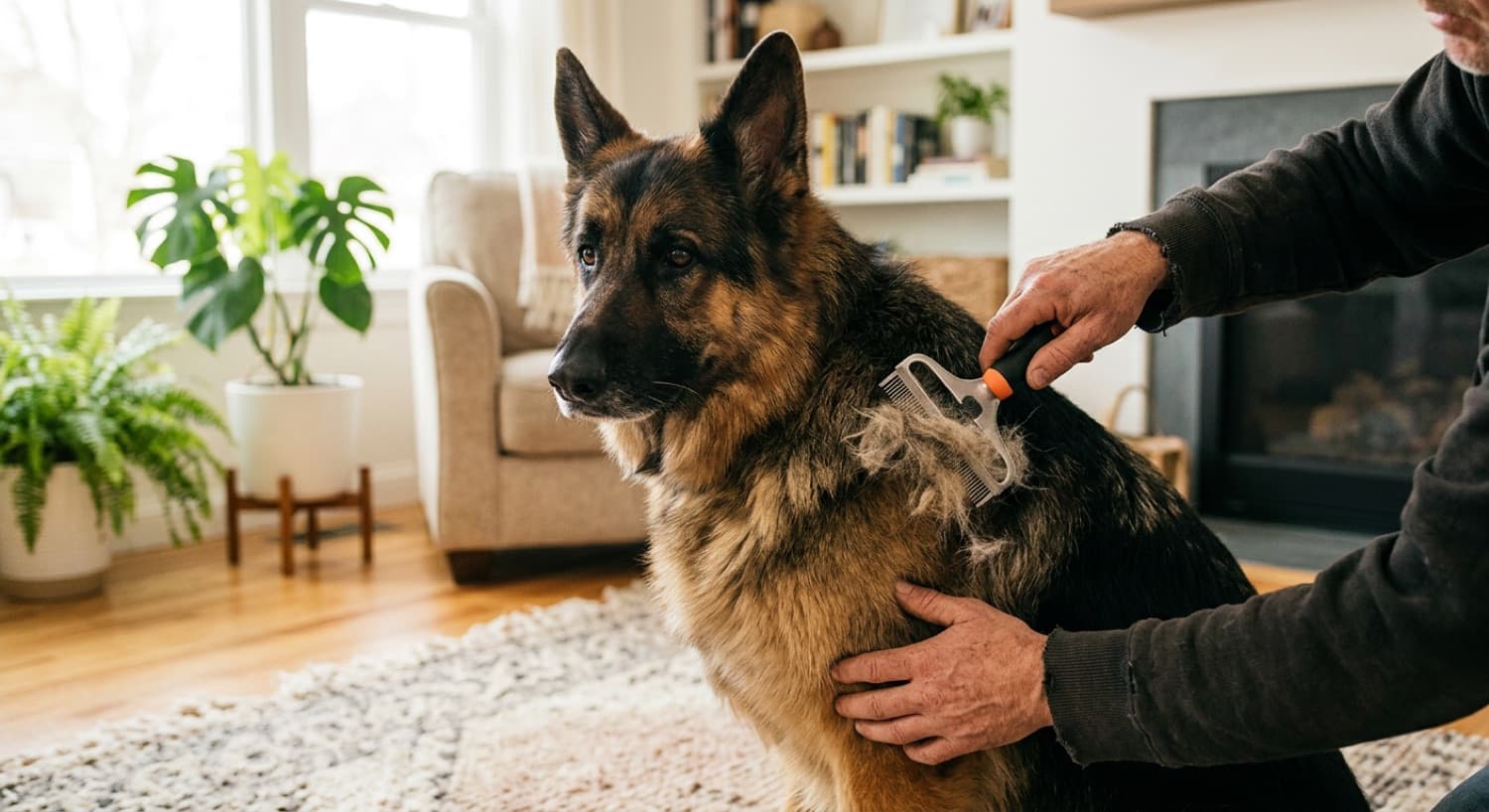
Never shave a German Shepherd, even in a humid Toronto summer
Shaving causes lasting damage. The double coat insulates against both cold and heat, so shaving removes heat protection and raises sunburn risk. Coat often grows back unevenly with permanent texture changes, and the undercoat may not regrow properly. Shaving does not reduce shedding, it just makes shed hairs shorter and harder to remove. If a Toronto groomer offers to shave your GSD, find a different groomer. Acceptable trims: feathering on legs and tail, sanitary trim, paw fur. Never acceptable: a full body shave or a “summer cut.”
How often do German Shepherds blow their coat?
Twice a year, usually April to May (spring blow) and October (fall blow). Each event runs 2 to 3 weeks of heavy daily shedding. During a blow you can pull handfuls of undercoat out by hand, and brushed-out coat fills grocery bags. Outside blow season, GSDs still shed daily at a steady maintenance rate, more than most short-coated breeds.
The Toronto wrinkle: our seasons flip sharply, so the blows land hard and fast. The spring blow hits when the warm weather finally arrives in April and May, and the fall blow lands in October as the dog grows in its winter coat for the cold ahead. That concentrated shedding is why a real brush routine and a dry indoor space matter most during those weeks. The Canadian Kennel Club German Shepherd breed profile describes the dense double coat with a soft undercoat, and the German Shepherd Dog Club of Canada documents the same thick double coat that needs thorough regular brushing. The message from both: plan for it, do not try to engineer around it.
Should I ever shave my German Shepherd?
No, never. Five reasons:
- The double coat insulates against both cold and heat. Shaving removes the heat-protection layer and raises sunburn and overheating risk.
- Coat often grows back unevenly or with a different texture (the post-shave coat problem), permanently changing the coat.
- The undercoat may not regrow properly, leaving bald patches or fluffy texture loss.
- Shaving does not reduce shedding. It just makes shed hairs shorter and harder to remove from carpet and clothing.
- An intact double coat keeps a GSD cooler than bare skin would, by trapping a layer of air against the body.
Acceptable trims: feathering on legs and tail, sanitary trim around the genitals, paw-fur trim (useful in a Toronto winter to keep salt and snow from packing in). Never acceptable: a full body shave, a summer cut, or a #5-or-shorter blade. If a groomer leads with a shave, that is a knowledge flag for the business.
What grooming tools actually work on German Shepherds?
Four tools matter, plus a fifth used with caution:
| Tool | Purpose | Cost (directional) | Use |
|---|---|---|---|
| Undercoat rake | Lift dead undercoat without cutting (most important tool) | $20 to $50 | Weekly off-season, daily during coat blow |
| Slicker brush | Finishing + topcoat smoothing | $25 to $80 | After undercoat rake |
| Metal comb | Tangles + verify undercoat removal | $15 to $25 | After slicker |
| HV dryer | Coat blow + drying a wet coat fast | $150 to $500 | Coat blow, post-bath, post-swim drying |
| De-shedding tool (Furminator type) | Maintenance (controversial, can damage guard hairs) | $25 to $50 | Sparingly, light pressure, never on guard hairs |
Avoid: clippers (no shaving) and pin brushes used alone, which do not reach the undercoat. Working order during a coat blow: HV dryer first to blast loose hair, then undercoat rake to lift the rest, then slicker to finish, then comb to verify. An HV dryer earns its cost fast during the sharp April and October blows, and it also dries a dog quickly after a summer swim so moisture never sits against the skin.
The Toronto winter challenge: road salt in the coat and paws
This is the Toronto-specific winter chore, and it is easy to overlook. Sidewalk and road salt collects in the paw fur, between the toes, and along the belly and leg feathering. Dried salt irritates the pads and the skin, and by February an unwashed GSD can be itchy and flaky underneath a thick coat that hides it.
From November to March, a German Shepherd walking Toronto sidewalks picks up salt, brine, and slush on every outing. The salt itself does not bother the double coat, which is built for snow and cold, but it becomes a problem when it packs into the paws and sits against the skin between walks.
The winter after-walk routine:
- Rinse or wipe the paws and belly with lukewarm water after every walk. A shallow paw dip in a bowl by the door works well.
- Check between the toes for packed salt and ice balls, and dry the fur so nothing sits wet against the skin.
- Trim the fur between the paw pads through winter so less salt and snow packs in.
- Booties help if your GSD tolerates them, keeping salt off the pads entirely.
- Do not let salted feathering dry against the skin on the legs and belly, which is the reliable way to end up with a dry, itchy dog by late winter.
Dry indoor heating makes the salt problem worse by pulling moisture out of the skin, so a humidifier and consistent brushing both help through the cold months. Our Toronto winter dog care guide covers salt, cold, and paw protection in more depth, and the AVMA dog-care guidance reinforces routine skin and coat checks as part of basic care.
Hot spots, pyoderma, and humid summers
A humid Toronto summer raises the skin-trouble risk for double-coated dogs. A hot spot (acute moist dermatitis) is a raw, inflamed, often oozing patch that can appear and spread within hours. A dense undercoat plus summer humidity plus a swim is the classic trigger.
Prevention is mostly drying and brushing:
- Dry the undercoat fully after every bath, swim, or humid-day play session.
- Brush regularly so the coat does not mat. Mats trap moisture against the skin.
- Check the skin during every brushing, especially over the hips, neck, and base of the tail.
- Keep the coat clean and dry after a summer trip to Cherry Beach or a swim in a cottage lake, because a thick wet coat on a hot day can set off a hot spot fast.
German Shepherds are also predisposed to German Shepherd pyoderma, a deep recurring skin infection the breed is genetically prone to. So treat any non-healing, spreading, or painful skin lesion as a vet visit, not a home-management problem.
If you find a hot spot: gently clip the surrounding fur so air reaches it, keep it clean and dry, and see a vet if it is large, spreading, or painful. Most need a short course of treatment. Recurring hot spots or pyoderma can point to an underlying allergy or thyroid issue worth investigating, so a Toronto veterinary dermatology referral is the next step if skin trouble keeps coming back despite good coat care. Keeping routine costs down helps free the budget for that, so see our guide to low-cost vet options in Toronto.
How often should I bathe my German Shepherd?
Every 6 to 8 weeks for a healthy GSD, far less often than most pet owners assume. Double coats produce natural oils that protect the skin and repel water, and over-bathing strips those oils, causing dry skin, dandruff, and worse shedding. In a Toronto winter, frequent baths plus dry indoor heating is a fast track to a flaky, itchy dog, so bathe less and brush more.
GSD-appropriate shampoo: oatmeal-based, hypoallergenic, fragrance-free. A warm bath at the start of a spring coat blow helps loosen the undercoat (the warm-bath-plus-HV-dryer technique groomers use).
Avoid: human shampoo (wrong pH), heavily fragranced shampoos (skin irritant), and tearless puppy shampoo (often too gentle for a working coat).
Critical drying step: dry the undercoat fully or you risk hot spots and yeast under the dense coat, which matters most in humid summer weather. A thorough HV dry or a towel-plus-warm-room dry both work, the key is reaching the skin layer.
Toronto professional grooming (directional): roughly $70 to $120 for a full GSD deshed groom (bath, blow-out, and brush-out), pricier than smaller breeds because of coat volume, and higher again during a peak coat-blow season. Prices vary by neighbourhood and service depth, so ask for a quote that names the tools and the dry-down method. If a groomer's default offer is a summer cut for a GSD, treat it as a knowledge flag and look for a Toronto groomer experienced with double coats instead.
How is grooming different for long-coat vs stock-coat GSDs?
Significantly different maintenance:
| Coat Type | Brushing | Professional Grooming | Notes |
|---|---|---|---|
| Stock coat (standard) | 1 to 2 times weekly off-season, daily during blow | Every 8 to 12 weeks | Average difficulty, the breed standard |
| Long coat (plush) | 3 to 4 times weekly minimum, daily during blow | Every 6 to 10 weeks | Mat-prone in friction zones (armpits, behind ears, between back legs, around collar) |
In a Toronto winter, long coats collect more snow, slush, and road salt in the leg and belly feathering, and any moisture held there sits against the skin longer. That means extra paw-fur and feathering trims through the cold season and a stricter after-walk cleanup habit. Both coat types follow the never-shave rule. Toronto-area rescues see both variants, so ask the rescue to specify the coat type if the listing does not.
How do I trim a GSD's nails, especially black nails?
Every 3 to 4 weeks for an adult GSD. Long nails cause splayed toes, joint stress, and an altered gait, and they raise joint-disease risk in a breed already prone to hip and elbow dysplasia. Black nails are harder than light nails because you cannot see the quick, the blood vessel inside.
Recommended approach for black GSD nails:
- Use a Dremel-style grinder instead of clippers so you grind gradually and can stop progressively as the nail surface changes.
- Take several short grinds rather than one big cut.
- Watch the underside of the nail for a lighter triangle pattern, your stop signal, because the quick is just beyond it.
A directional Toronto price is $15 to $30 for a professional trim, or $20 to $35 for a vet-clinic drop-in. If your GSD hates nail trims (most do, they are sensitive about their feet), counter-condition with high-value treats over weeks. Many adult rescue GSDs need patient desensitization before tolerating a home trim, which is worth building into the routine when you bring one home. Our first-week guide for a rescue dog covers settling a new dog before you start handling paws.
How do I manage German Shepherd hair everywhere in my Toronto home?
GSD shedding is a daily lifestyle adjustment, not something you eliminate.
Realistic management for Toronto households:
- Daily brushing during coat-blow weeks (5 to 10 minutes). Brush outside on the balcony or in the yard whenever the weather allows so loose undercoat never reaches your floors.
- Off-season weekly brushing minimum.
- A strong HEPA-filter vacuum. GSDs wear out cheap vacuums fast. Plan to vacuum every 2 to 3 days.
- A robot vacuum running daily on a schedule keeps a condo manageable.
- Lint rollers by the door, in the car, and at work.
- Washable furniture covers.
- Light-coloured clothing hides hair better than black, navy, or charcoal if your GSD is black-and-tan.
- Run a humidifier in winter. Dry indoor heating makes a GSD shed even more, so adding moisture back helps the coat and the skin.
- Diet matters: good-quality protein and omega-3 fats support coat health and reduce excess shedding.
- Skin checks during brushing, flagging dry patches and hot spots early, which is easy to miss under a dense coat.
Most Toronto GSD owners describe shedding as just part of the deal once they settle into the routine. A German Shepherd can shed several pounds of undercoat across a full coat blow, so plan storage and disposal.
Browse adoptable German Shepherds in Toronto
Ready for the brush kit, the coat blows, and the winter salt routine? Meet the German Shepherds and GSD mixes available right now from Toronto-area rescues.
See Available German Shepherds →Frequently Asked Questions
How often do they blow coat?
Twice a year (Apr to May + Oct), 2 to 3 weeks each, plus heavy daily year-round shedding. Toronto's sharp seasonal changes make the blows hit hard and fast when the weather flips.
Never shave?
Right. The double coat insulates against heat and cold. Shaving causes permanent damage and does not reduce shedding. If a groomer offers to shave your GSD, find a different groomer.
Furminator safe?
Controversial. It can damage guard hairs. Safer: undercoat rake + slicker + metal comb + HV dryer. If you use a Furminator, do it sparingly with light pressure only.
How do I get road salt out of the coat?
Rinse or wipe the paws and belly with lukewarm water after every winter walk, check between the toes for packed salt, and dry the fur. Trim the paw-pad fur in winter and use booties if your GSD tolerates them.
Bath frequency?
Every 6 to 8 weeks. Over-bathing strips natural oils, and winter indoor heating already dries the skin, so brush more and bathe less.
Long coat vs stock coat?
Stock: 1 to 2 times weekly brushing, groom every 8 to 12 weeks. Long (plush): 3 to 4 times weekly, groom every 6 to 10 weeks. Long coats mat severely and collect more winter salt if neglected.
Hot spots?
Humid Toronto summers raise the risk, and GSDs are also prone to pyoderma. Prevent by drying the undercoat fully after swims and baths and brushing so the coat does not mat. See a vet for any large, spreading, or non-healing patch.
Black nail trim?
Every 3 to 4 weeks. A grinder is easier on dark GSD nails, take small grinds and watch for the triangle pattern. Roughly $15 to $30 for a Toronto professional trim.
German Shepherd Adoption Toronto
Where to find them, costs, scam warnings, and Shepherd mixes in the GTA.
GSD Training & Temperament
Drive, handler focus, adolescence, and the right structure for a working breed.
German Shepherd Health Issues
Hips and elbows, skin and pyoderma, thyroid, and degenerative myelopathy.
Adoptable German Shepherds in Toronto
Live GSD and Shepherd-mix listings from Toronto-area rescues.
New dog? Start with these care guides
Everything a new adopter needs to set up a safe, happy home.