The short answer
Rottweilers are genuinely good with kids when they are well-bred, well-socialised, supervised, and trained. The risk to small children is rarely the thing the headlines warn about. Your dog is not trying to hurt your toddler. It is a devoted family member that cannot recognise it outweighs the child by five times. The injuries Toronto families see are knockdowns, accidental face contact during zoomies, a tail to the eye, not bites. So the plan is size management: baby gates, a house-leash on adolescents, a rock-solid place command, force-free training, and clear rules about which kid ages handle this breed best. Never leave young kids unsupervised with any large dog. Rottweilers are fully legal in Ontario; only pit-bull-type dogs are restricted under the Dog Owners' Liability Act.
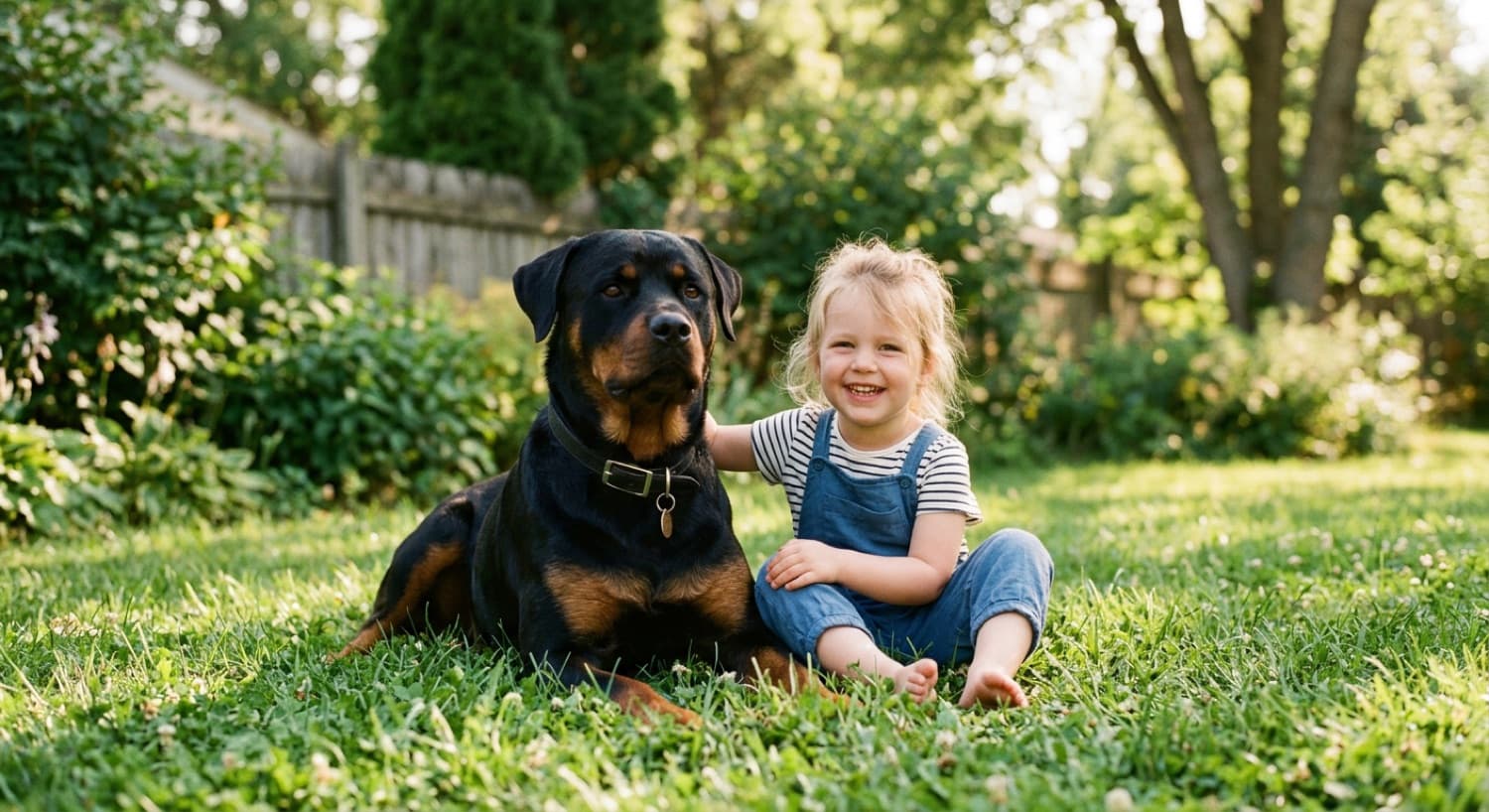
Why this breed is family-oriented in the first place
It is worth understanding where the family orientation comes from, because the reputation and the reality are so far apart for this breed.
Rottweilers descend from Roman droving dogs that travelled with families across the Alps moving cattle. Later, in the German town of Rottweil, they were the butcher's dog, working alongside families on farms and pulling small carts to market. The breed was selected over centuries to live in close proximity to children, livestock, and other working animals without being a nuisance about any of it. Tolerance, patience, and a steady temperament were the working traits that made the dog useful. The Canadian Kennel Club breed profile still describes that self-assured guardian devoted to home and family.
That history is still in the dogs we see today. Well-bred companion-line Rottweilers with proper socialisation tend to be remarkably patient with their own kids. They tolerate ear pulls, tail grabs, dress-up costumes, and the general indignity of being a child's favourite stuffed animal. They learn the kids' routines and seem to genuinely enjoy being part of family life.
The reputation that scares people came from a different source. In the 1990s the breed was popular as a perceived tough dog, sometimes acquired by people who should not have been responsible for any large breed, raised badly, and trained with aversive methods that raise bite risk. Bad ownership produced bad outcomes. The breed's temperament was never the problem. Modern Toronto Rottweiler families with companion-line dogs and force-free training look very little like that 1990s image.
The size-based risk that gets underestimated
Here is the part most Rottweiler-and-kids articles skip past, and it is the part that actually matters.
A Rottweiler is 80 to 135 lb of dog. Even a gentle one is physically larger than every member of your household under the age of 12. The breed has a characteristic full-body wiggle when greeting people it loves, which is adorable from a distance and dangerous in close quarters with a 25 lb toddler. Adolescent Rottweilers (8 to 24 months) get zoomies that send them careening through the living room, or a narrow condo hallway, without any awareness of where the small humans are.
Toronto families report knockdown incidents regularly. A toddler caught by a wagging tail and stitched up at a paediatric ER. A 4-year-old bowled over during a happy greeting and breaking a wrist on the way down. A visiting grandparent tangled in the leash and left with a torn rotator cuff. Nothing aggressive happened in any of these cases. The dogs were, in their own way, expressing love.
The reframe that helps: assume your Rottweiler will accidentally injure your small child at some point, and design your home to make that less likely. That is not pessimism. That is how experienced Rottweiler families actually live. The good news is that the management is mostly environmental, and it gets dramatically easier once the dog is past adolescence and the child is past 5.
The age-by-age framework
Different kid ages carry very different risk profiles with this breed. Here is what it looks like in practice.
Babies (0 to 12 months). Manageable with preparation. The baby is not mobile, supervision is constant by definition, and most Rottweilers adjust to a new family member faster than expected. The challenge is establishing the new household routines without making the dog feel displaced. The strongest predictor of problems is families who dramatically reduce attention to the dog when the baby arrives. The dog notices. Resentment toward babies is a real thing, and it is preventable.
Crawling babies and toddlers (6 months to 4 years). Highest-risk window. The child is mobile, unpredictable, does not understand boundaries, and may grab the dog's ear or tail while it is sleeping. A toddler approaching a sleeping or eating Rottweiler is a genuine bite-risk situation, and the dog often is not fully at fault for it. This is where baby gates, crates, and constant supervision matter most. Toronto rescues generally recommend against new Rottweiler adoption with kids under 5 unless the family has serious breed experience and the capacity for round-the-clock management.
Elementary-age kids (5 to 10). The sweet spot. Kids old enough to follow rules, stable on their feet, and mature enough to learn dog body language. The bonds Rottweilers form with children in this age range are some of the most rewarding family-dog relationships there are. Parents often find their elementary-age kids are more responsive to the dog than the adults are.
Pre-teens and teens (10 and up). Often becomes the kid's dog. Pre-teens and teens are old enough to take part in training, walking, and care. Rottweilers respond well to consistent handling from older kids and sometimes form their primary bond with the teenage household member.
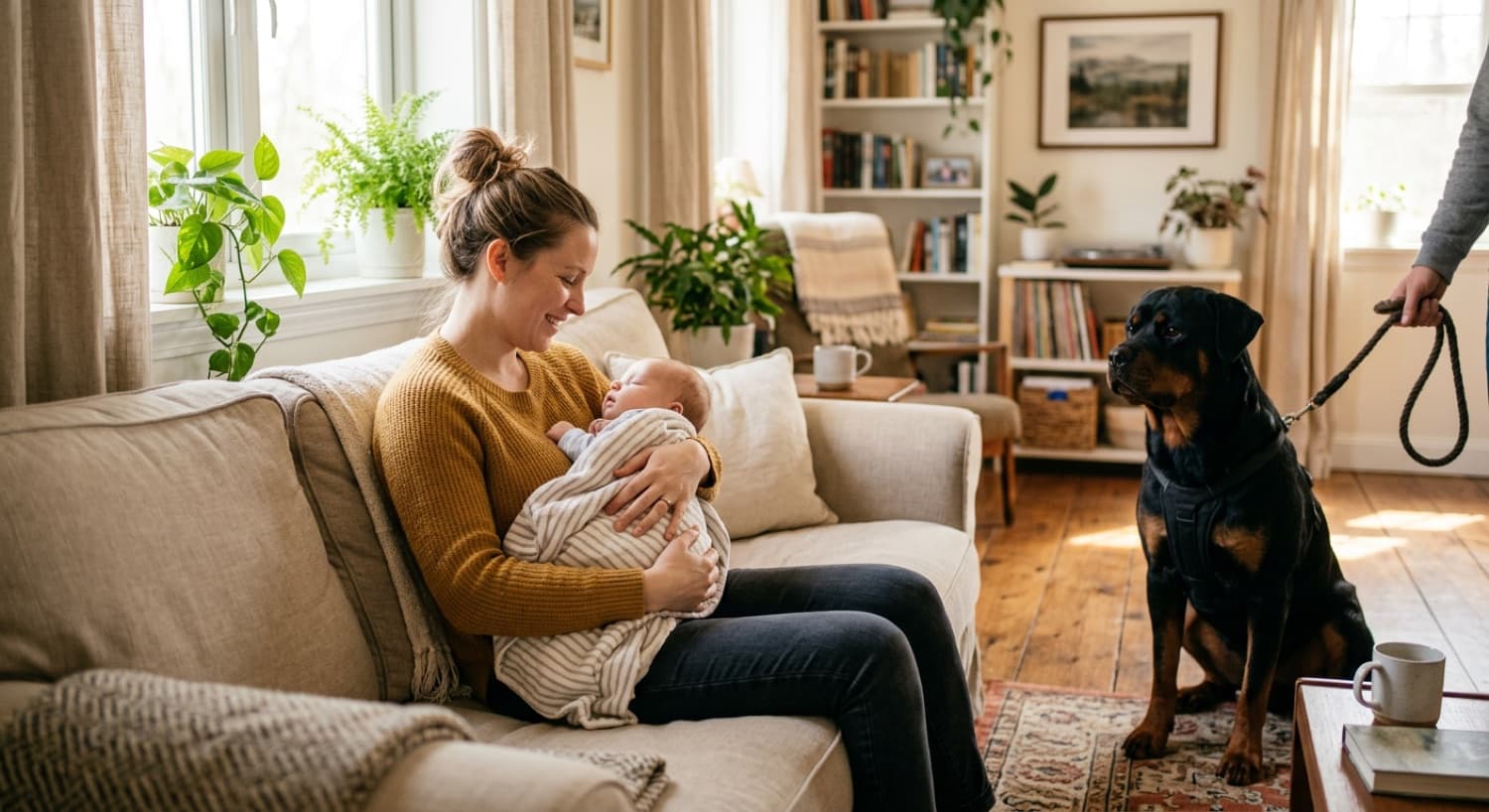
Pregnancy and an existing Rottweiler: the prep list
If you are pregnant and have a Rottweiler, you have months of runway and you should use them. Most of what makes the actual baby arrival smooth is preparation that happens before the baby is in the house.
The most useful first step is a Toronto force-free trainer who has worked with families through baby integration. They will assess your dog's current state, build a custom plan, and give you something more specific than generic advice. Confirm the trainer's methods are reward-based rather than aversive before you book.
Practical things to start months ahead: play recordings of baby sounds (crying, cooing, gurgling) at low volume during calm times, paired with treats. Bring out the baby gear (stroller, carrier, bassinet, swing) and let your dog get used to them as objects in the house. Practise your post-baby walking route with the empty stroller. Work on the place command on a designated bed until it is automatic. Set up baby gates so the boundaries exist before they are needed.
The day baby comes home, send a hospital blanket ahead so your dog can investigate the new smell on its own. When you arrive, have someone else carry the baby in while you greet the dog calmly, like any other day. The first introduction should be brief, leashed, and at a distance, with the dog rewarded for calm behaviour.
The single biggest mistake is dramatically reducing the dog's attention when the baby arrives. Walks get skipped, training drops, the dog gets relegated to a different room. The dog notices and starts associating the baby with its own loss of access to the family. Keep the routine going as much as you can, even if that means asking a neighbour or hiring a Toronto dog walker for the first month.
Knockdown prevention that actually works
Most of the answer to knockdown prevention is environmental setup, not training. Train as much as you can, but do not expect an adolescent Rottweiler to consistently override its excitement with self-control. It will fail sometimes. Plan for the failure.
Environmental tools that help: baby gates separating high-traffic kid play areas from dog access. A house-leash on adolescent Rottweilers (under 24 months) so you can intercept before excitement builds. A place command on a designated bed the dog defaults to when kids enter the room. A front-clip harness for walks, because it reduces leverage on a strong dog. A crate or designated room for high-stress times like meals and visitor arrivals.
On the training side, four on the floor means all four paws stay on the ground for attention, and jumping earns nothing. Every family member, including kids old enough to take part, has to enforce the same rule or it will not stick. Train wait at doorways so the dog does not blast through the door at returning kids. Build impulse control through small daily exercises like waiting before meals and leave it with high-value items.
Kids' behaviours matter too. Teach kids not to run from the dog (it triggers chase), not to scream around the dog, not to take the dog's food or toys, and not to disturb a sleeping or eating dog. Even with all of this, supervise. An adolescent Rottweiler and small kids should not be alone together for extended stretches, period. A tired dog is a less knockdown-prone dog, and most of these problems ease by 24 months and up as the dog matures into the calm adult the breed is famous for.
Adopting a rescue Rottweiler with kids in the home
Foster-to-adopt is the safest path for families with kids. You take the dog home for a few weeks before signing the final paperwork, and if it does not work out, the dog goes back without judgement.
Toronto-area rescues that place Rottweilers (Toronto Humane Society, Save Our Scruff, TEAM Dog Rescue, Fetch and Releash, Redemption Paws, Hopeful Tails, and City of Toronto Animal Services) increasingly do detailed foster temperament evaluations because the kid question matters so much for this breed. What you want is a foster family who has actually lived with the dog around children. Has been around kids and was fine is too vague. Lived with our 7-year-old and 10-year-old for 8 weeks, was patient when our daughter pulled his ear, and never guarded his bowl when the kids walked past is what you are looking for.
Questions to ask the rescue before committing: How long has the dog been in foster? What did the foster home look like (kids, other dogs, cats)? Has the dog ever bitten anyone, including air-snaps or near-misses? How does the dog react to strangers, kids running past, food being removed, toys being touched, being startled while sleeping, being grabbed by the collar, and vet handling? And why was the dog surrendered, the real reason rather than the polite version?
If the rescue is evasive, defensive, or pressuring you to decide quickly, walk away. The good Toronto Rottweiler rescues are more interested in the right placement than the fastest one, and they will be honest about what they do not know about the dog. For the full adoption process, application timeline, and costs, our Rottweiler adoption in Toronto guide covers the logistics so this page can stay on family fit.
For families with kids under 5 who have not owned a Rottweiler before, most experienced volunteers will steer you toward a different breed or toward waiting until your kids are older. That is not a personal judgement about you. It is the rescue trying to set both the family and the dog up to succeed. The Rottweiler community has seen too many adoption failures from this exact combination, and the cost, to the family, to the dog, and to the next family, is high enough that the recommendation is worth taking seriously.
When rehoming is the right call
This is one of the hardest conversations Rottweiler families face, and most of the rescue community will tell you the shame is in not rehoming when you should, not in rehoming when it is the right answer.
It is the right call when there has been a bite incident with a child (any incident, even a minor one), severe fear-reactivity around kids that has not improved with a force-free trainer, persistent resource guarding that endangers a curious toddler, multiple incidents despite genuine training effort, or a family situation that simply cannot provide the supervision a Rottweiler needs.
Families who wait too long out of guilt can end up with a serious incident that also hurts the dog's placement chances at the next home. Earlier is better. Direct disclosure is better.
If you are going to rehome, do it the right way. Contact the original breeder if you bought from one, since many CKC contracts require return. Otherwise contact the rescue you adopted from, or one of the Toronto breed-experienced rescues. Disclose the full history honestly to whoever takes the dog next, including any incidents and warning signs. Do not use Kijiji or Facebook to rehome a Rottweiler, because the risk to the dog is too high, and treat City of Toronto Animal Services as a last resort rather than a first call.
Most of the time, with proper preparation and force-free trainer support, integration works. Sometimes it does not, and acknowledging that is part of being a responsible owner. The dog deserves a placement that fits. Your family deserves to feel safe in their own home. Both can be true.
Trainers, professional help, and family support
For family integration work, look for a Toronto force-free trainer with real experience in family integration, reactivity and anxiety work, and baby preparation. Confirm the methods are reward-based before you book. This matters doubly for a guardian breed: never use aversive collars, which raise bite risk in exactly the dogs where you least want it.
For severe cases (chronic stress, aggression toward family members, or a history of incidents), a board-certified veterinary behaviourist, available in Ontario in person or via telehealth, can assess the dog and prescribe anti-anxiety medication when it is genuinely indicated. The assessment alone is often worth it for a family sitting on the edge of a rehoming decision. Behaviour and bite-risk situations are exactly the kind of thing the Fear Free movement has reshaped, moving professional training toward building trust rather than suppressing behaviour through fear.
The Toronto Rottweiler community is bigger and more active than people expect. Foster-based rescues (Save Our Scruff, TEAM Dog Rescue, Fetch and Releash, Redemption Paws, Hopeful Tails) often have volunteers who have raised Rottweilers with their own kids and will talk you through it. Family Paws Parent Education (familypaws.com) is an evidence-based international resource specifically for dog-and-baby integration. The point is you are not doing this alone. Reach out before things get hard.
What success looks like
The Toronto Rottweiler families who do this well share a few patterns. They started with a companion-line dog or a foster-evaluated rescue rather than a working-line dog. They engaged a force-free trainer early, before problems showed up. They invested in environmental management instead of fighting the dog's adolescent brain. They taught their kids how to behave around the dog. They never used aversive collars. And they kept supervising even after they thought they no longer needed to.
What they got back is a dog that becomes the central relationship of their kids' childhood. A Rottweiler who lies on the kitchen floor while the kids do homework. Who walks the kids to the school bus. Who sleeps at the foot of the bed and wakes up first when the child has a bad dream. Who turns out to be the family member their kids tell people about for the rest of their lives.
It is not the easy version of dog ownership. But it is often the most meaningful one.
Related Rottweiler reading
This guide focuses on family fit and child safety. The wider Rottweiler-and-Toronto picture lives across companion articles:
- For the full adoption playbook (Toronto rescues, application timeline, real costs), see our Rottweiler adoption in Toronto guide.
- For temperament, socialisation, and the Toronto housing and insurance reality, see Rottweiler temperament and training.
- For joints, bloat, cancer risk, and why insuring early matters, see Rottweiler health issues.
- For settling a newly adopted Rottweiler in the first days, see our first week with a rescue dog guide.
Sources and further reading
- Canadian Kennel Club. “Rottweiler.” ckc.ca. Breed temperament, guardian nature, and family suitability.
- Fear Free. fearfree.com. Reducing fear, anxiety, and stress in pets, and force-free, trust-based training that lowers bite risk in guardian breeds.
- Family Paws Parent Education. familypaws.com. Evidence-based dog-and-baby integration programmes and educator directory.
This article reflects directional guidance gathered from Toronto rescues and force-free trainer communities, with external breed and behaviour sources cited above. Veterinary behaviour and bite-risk situations require professional assessment. Rottweilers are legal to own in Ontario; only pit-bull-type dogs are restricted under the Dog Owners' Liability Act.
Browse adoptable Rottweilers in Toronto
For families with kids, prioritise adult adoption with a foster-evaluated, kid-friendly history. A foster-based rescue can give you something close to a real preview of how the dog will do with your children, which is exactly what makes a great match for this breed. Foster-to-adopt is available at most Toronto rescues. Refreshed regularly.
See Available Rottweilers →Frequently Asked Questions
Are Rottweilers actually good with kids?
Yes, when they are well-bred, well-socialised, and well-trained. The Rottweiler reputation as a dangerous breed does not match what a properly raised dog is like living with its own family. The breed was developed as a Roman droving dog and later a German farm dog working alongside kids on the property, so family orientation is in its history. Well-raised Rottweilers tend to be tolerant, patient, and physically affectionate with their own children. The part most articles skip is that good with kids does not mean no risk. A Rottweiler is 80 to 135 lb of dog, and even a gentle one creates real physical risk for a small child simply by existing in the same room. The risk is rarely aggression. It is knockdowns, accidental injuries during play, and a dog who does not understand it is bigger than the small human it is leaning on. That distinction matters, because the plan for size-based risk is different from the plan for aggression risk.
I am pregnant with a Rottweiler at home. What do I do now?
You have months to prepare, and that is a gift, so use them. The single most useful step is a Toronto force-free trainer experienced with family and baby integration. Practical things to start months ahead: play recordings of baby sounds (crying, cooing, gurgling) at low volume during calm times, paired with treats. Bring out the baby gear (stroller, carrier, bassinet, swing) so your dog gets used to the objects long before there is a baby in them. Practise your post-baby walking route with the empty stroller. Build a rock-solid place cue on a designated bed. Set up baby gates so the boundaries exist before the baby shows up. The day baby comes home, send a hospital blanket ahead so your dog can investigate the smell on its own. When you arrive, have someone else carry the baby in while you greet the dog calmly. Keep introductions brief, leashed, and at a distance, and reward calm behaviour. The biggest mistake we see is families dramatically cutting the dog's attention when the baby arrives. The dog notices, and resentment toward the baby is a real thing, so keep the walks, training, and one-on-one time going. Family Paws Parent Education (familypaws.com) is an evidence-based resource Toronto parents can use alongside a local trainer.
How dangerous is the knockdown risk really?
Real, and often underestimated until it happens. A 110 lb Rottweiler doing a happy full-body wiggle greeting can put a 25 lb toddler on the floor without meaning anything by it. Adolescent Rottweilers (8 to 24 months) doing zoomies through a living room or a narrow condo hallway do not map their body around small kids. Toronto parents end up in paediatric ERs after a Rottweiler tail catches a toddler in the face during a play burst. Nothing aggressive happened. The dog was thrilled. The child still needed stitches. The way to think about it: assume your Rottweiler will accidentally injure your small child at some point, and design your home to make that less likely. Baby gates separating the play area, a place command so the dog goes to a designated bed when kids enter the room, a house-leash on adolescent dogs so you can redirect before excitement builds, and structured exercise before the high-energy parts of the day. None of that is paranoid. It is the standard force-free approach for families with a Rottweiler and small kids. Once the dog is past adolescence (24 months and up) and the child is past 5, the risk drops sharply.
What ages of kids work best with Rottweilers?
Elementary-age kids (5 to 10) are the sweet spot. They are old enough to follow rules, stable enough on their feet to handle an enthusiastic greeting, and mature enough to learn dog body language. The bonds that form in this age range often last the rest of the dog's life. Pre-teens and teens frequently become primary trainers and walking partners, and the relationship can be excellent. Babies (0 to 12 months) are manageable with proper preparation, because the baby is not mobile, supervision is constant anyway, and most dogs adjust faster than people expect. Crawling babies (6 to 18 months) and toddlers (1 to 4) are the highest-risk window. The child is mobile, unpredictable, does not understand boundaries, and may grab the dog while it is sleeping or eating. Most Toronto rescues genuinely do not recommend new Rottweiler adoption with kids under 5 unless the family has serious breed experience and the capacity for round-the-clock supervision. An adolescent Rottweiler (under 24 months) plus a toddler is the highest-stakes combination there is, and the one most likely to end in a knockdown injury or a return to the rescue.
How do I introduce my Rottweiler to a baby?
Start months before the baby arrives, and get a force-free trainer involved. Play baby sound recordings at low volume during calm times, paired with treats. Bring baby gear into the house early so the dog gets used to the stroller, swing, and carrier as objects. Practise the new walking routine. Train place until it is automatic. Set up baby gates. The day baby comes home, send a hospital blanket ahead so your dog can investigate the new smell first. Have someone else carry the baby in while you greet your dog calmly, like any other day. Keep the first introductions brief, leashed, and at a distance, with the dog rewarded for calm behaviour. Do not force interaction and do not hold the baby toward the dog's face for a first-kiss photo. Multiple short positive exposures over days work far better than one long meeting. In the early weeks, never leave the dog and baby unsupervised, even for a minute. Keep the dog leashed, gated, or crated when you cannot actively watch both, and give the dog a quiet break during feeding, crying, and visitors. And keep the dog's normal life going. The strongest predictor of trouble is families who suddenly drop the dog's routine when the baby arrives.
How do I stop my Rottweiler from knocking my kids over?
Most of the answer is environmental setup, not training. Put a house-leash on the dog through the first stretch of adolescence so you can redirect before excitement escalates. Use baby gates to separate high-traffic kid play areas from dog access. Train a place command on a designated bed that the dog defaults to when kids enter the room. Use a front-clip harness for walks to reduce leverage on a strong dog. On the training side, teach four on the floor, where all four paws on the ground earns attention and jumping earns nothing, and make sure every family member enforces the same rule or it will not stick. Train wait at doorways so the dog does not blast through the door at returning kids. Teach the kids too: do not run from the dog (it triggers chase), do not scream around the dog, do not take the dog's food or toys, and do not disturb a sleeping or eating dog. The reality is that even with good training an adolescent Rottweiler will sometimes fail, which is why management matters more than training in this phase. A tired dog is a less knockdown-prone dog, so structured daily exercise helps. Most knockdown problems ease by 24 months and up as the dog matures into the calm adult the breed is known for.
Should I adopt a rescue Rottweiler if I have kids?
Sometimes. The answer depends on the specific dog and the specific kids. Toronto-area rescues that place Rottweilers (Toronto Humane Society, Save Our Scruff, TEAM Dog Rescue, Fetch and Releash, Redemption Paws, Hopeful Tails, and City of Toronto Animal Services) increasingly do detailed foster temperament evaluations, precisely because the kid question matters so much for this breed. What you want is a foster family who has actually lived with the dog around children and can tell you specifically how the dog responded. Has been around kids and was fine is too vague. Lived with our 7-year-old and 10-year-old for 8 weeks, was patient when our daughter pulled his ear, and never guarded his bowl when the kids walked past is what you are looking for. If the dog has not been tested with kids in foster, that is not an automatic no, but you have to assume risk. Foster-to-adopt is the safest path, and many Toronto rescues offer it: you take the dog home for a few weeks before signing final paperwork, and if it does not work out, the dog goes back without judgement. For families with kids under 5 who have not owned a Rottweiler before, most experienced volunteers will gently steer you toward a different breed or toward waiting until the kids are older. That is not a personal judgement. It is the rescue trying to set both the family and the dog up to succeed.
When is rehoming the right call?
It is the right call when the safety risk to your family is real and is not responding to professional help. A bite incident with a child (any incident, even a minor one), severe fear-reactivity around kids that has not improved with a force-free trainer, persistent resource guarding that endangers a curious toddler, or a family situation that genuinely cannot provide the supervision a Rottweiler needs. The shame is in not rehoming when you should. Families who wait too long out of guilt can end up with a serious incident that also hurts the dog's chances at the next home. If you are considering it, do it the right way. Contact the original breeder if you bought from one, since many CKC contracts require return. Otherwise contact the rescue you adopted from, or one of the Toronto breed-experienced rescues. Disclose the full history honestly to whoever takes the dog next, including any incidents and warning signs. Do not use Kijiji or Facebook to rehome a Rottweiler, because the risk to the dog is too high, and treat City of Toronto Animal Services as a last resort rather than a first call. Most of the time, with preparation and force-free support, integration works. Sometimes it does not, and acknowledging that is part of being a responsible owner.
Are Rottweilers safe with newborns?
An existing Rottweiler plus a new newborn is a manageable transition for most families given months of preparation, and the breed often adjusts to a baby as a new family member faster than people expect. A new rescue Rottweiler arriving at the same time as a new baby is a different story and not one we recommend, because it is too much novelty too fast for a dog still learning the home. With an existing Rottweiler and an incoming baby, the keys are months of desensitisation (sounds, smells, gear), force-free trainer involvement, a rock-solid place command, baby gates set up before the baby arrives, and not dropping the dog's routine. The crawling-baby phase (6 to 18 months) is when supervision needs to peak, because a baby grabbing the dog's ear while it sleeps is a genuine bite-risk situation and the dog is not at fault for it. Baby gates and crate management buy you the time to react. Some Rottweilers become remarkably gentle around babies, hovering protectively and alerting you when the baby cries from another room. That is the breed at its best. But not every dog gets there, so if yours shows chronic stress around the baby (panting, drooling in the baby's presence, avoiding rooms with the baby, or growling when the baby cries), call a force-free trainer or a veterinary behaviourist. Do not wait for an incident.
What Toronto trainers and resources help with Rottweilers and kids?
Look for a Toronto force-free trainer with real experience in family integration, reactivity and anxiety work, and baby preparation, and confirm their methods are reward-based rather than aversive before you book. Aversive collars elevate bite risk in guardian breeds, so that matters doubly here. For severe cases (chronic stress, aggression toward family members, or a history of incidents), a board-certified veterinary behaviourist, available in Ontario in person or via telehealth, can assess the dog and prescribe anti-anxiety medication when it is genuinely indicated, and the assessment alone is worth it for families on the edge of rehoming. Beyond professionals, the Toronto Rottweiler community is larger and more active than people expect, and foster-based rescues (Save Our Scruff, TEAM Dog Rescue, Fetch and Releash, Redemption Paws, Hopeful Tails) often have volunteers who have raised Rotties with their own kids and will talk you through it. Family Paws Parent Education (familypaws.com) is an evidence-based international resource specifically for dog-and-baby integration. The point is that you are not doing this alone, so reach out before things get hard.
The full Rottweiler cluster
Rottweiler Adoption in Toronto
Where to adopt, real costs, the guardian-breed reality, and where to find a rescue Rottie.
Rottweiler Temperament and Training
The watchful guardian temperament, socialisation, the teenage months and why force-free training works best.
Adoptable Rottweilers in Toronto
All currently available Rottweilers and Rottie mixes. Updates regularly.
First Week With a Rescue Dog
The decompression routine that helps a newly adopted Rottweiler settle and build trust.
New dog? Start with these care guides
Everything a new adopter needs to set up a safe, happy home.