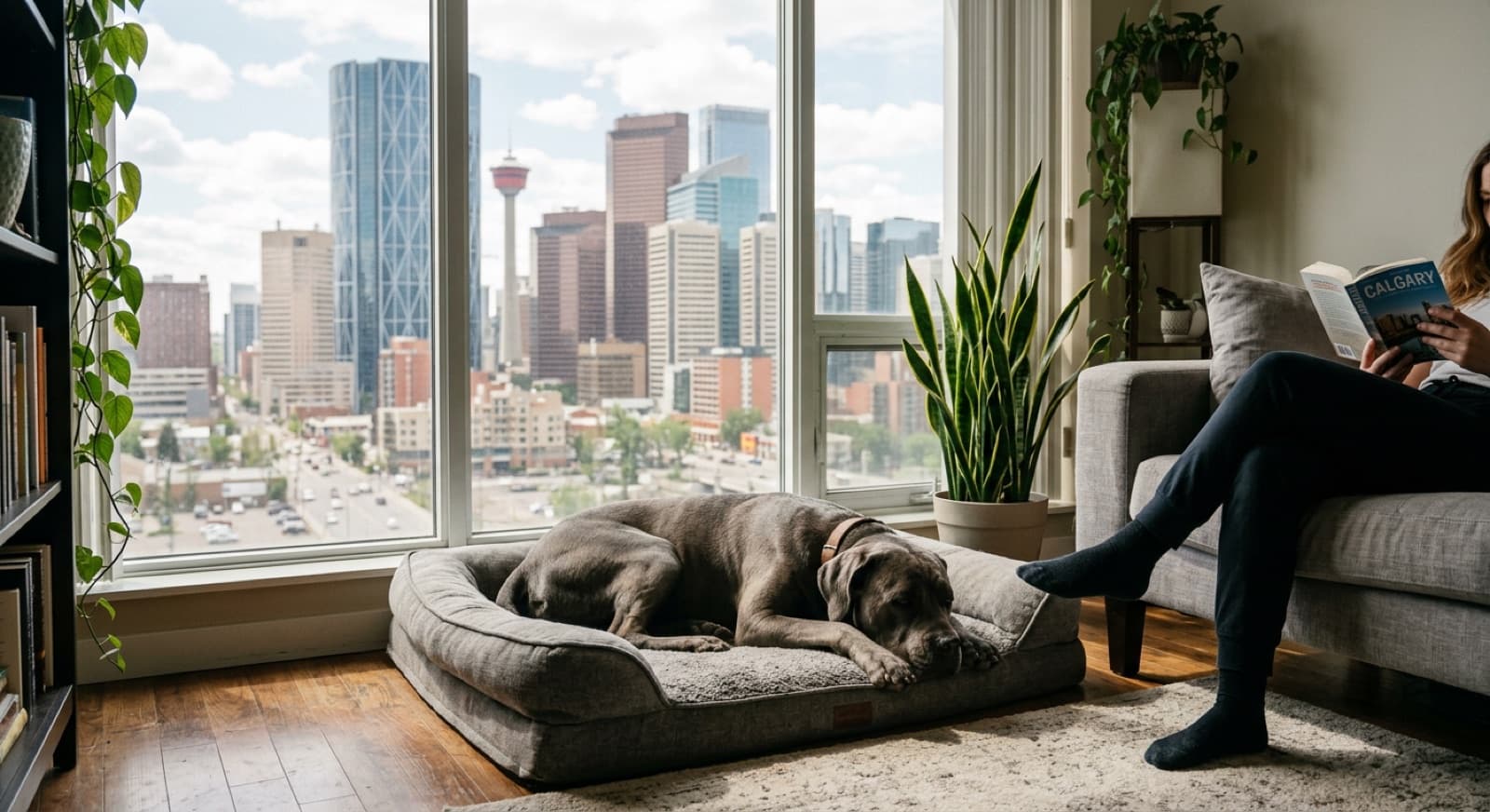
The short answer
Legally yes. Practically difficult. Calgary has no breed-specific legislation and no municipal Cane Corso ban. The barriers are private. Most Calgary condo bylaws have 50–75 lb weight caps OR restricted-breed lists that include Cane Corso, Doberman, Rottweiler, Mastiff, Pit Bull, German Shepherd. A male Corso is 99–110 lb. A female is 88–99 lb. Both blow past the cap AND land on the list. Verify YOUR bylaw IN WRITING before adopting. Insurance: many Canadian carriers refuse Corso liability coverage. AVOID Allianz, Intact, RBC, TD (often restrict). MORE OPEN: Square One, Aviva (with disclosure), independent brokers, Wawanesa. Independent dog liability $20–$40/mo for $1M is the backstop. Exercise: 60–90 min daily plus 20–30 min mental work. Doable in apartment IF committed to early-morning + evening walks. Sue Higgins (fenced, best), Bowmont Silver Springs Gate (fenced), Nose Hill (open, off-peak only), River Park, Edworthy. Stairs: multiple flights daily accelerate hip and elbow issues in young Corsos. Ground floor or elevator strongly preferred. Noise: not heavy barker but alert-bark is deep, travels through walls. Corner units, top floors, white noise machine, quiet-cue training week one. ESA bypass usually fails in Alberta condo and tenant law; do not plan on it. House with even a small yard is materially easier than central condo: no stair penalty, no bylaw reviews, easier insurance, recovered logistics time. Reddit consensus from apartment Corso owners: doable but harder than expected, every time.
VERIFY bylaws + insurance IN WRITING BEFORE adopting
The #1 surrender driver for Calgary Cane Corso adopters is condo bylaw or insurer policy discovered AFTER adoption. Get the full condo pet policy from your property management company, name the breed explicitly (Cane Corso, also called Italian Mastiff), get written acceptance. Then contact your tenant or home insurer, name the breed, and get written liability confirmation. Then adopt. Two weeks of paperwork prevents a heartbreak surrender.
The honest reality: why Corso apartment living is hard in Calgary
Four stacked constraints make Cane Corso apartment living difficult in Calgary. None are individual deal-breakers. Stacked together, they explain the surrender rate.
The four constraints:
- Condo bylaw weight and breed restrictions. Most Calgary buildings cap at 50–75 lb and/or list Corso as a restricted breed. A male Corso is 99–110 lb. A female is 88–99 lb. The breed clears 75 lb at 6–8 months as a puppy
- Insurance refusal. Tenant insurance liability and home insurance liability often exclude guardian breeds. Allianz, Intact, RBC, TD frequently restrict. Square One and Aviva are more open with disclosure
- Exercise constraints. 60–90 minutes daily plus mental work, every single day, in winter, on salted sidewalks, before and after work
- Noise from a large vocal guardian breed. Not a constant barker but the alert-bark is deep and travels through shared walls
The Reddit consensus from apartment Corso owners is consistent: it is doable but harder than they expected. Every owner who makes it work in a Calgary apartment talks about commitment to schedule, verified housing and insurance BEFORE adoption, and a force-free trainer engaged in week one. Owners who improvise their way through it are the ones who end up surrendering to BARCS, AARCS, or rescue at month 6–18.
Calgary condo bylaw reality
Calgary condo bylaws are set by individual boards under the Condominium Property Act of Alberta. There is no city-wide standard. Half the buildings restrict; half are flexible. You need YOUR bylaw, in writing.
The five common patterns:
- Weight cap. 50 lb, 65 lb, or 75 lb is most common. A few buildings allow up to 100 lb. Checked at adoption-application time and re-checked on complaint
- Restricted-breed list. Roughly half of Calgary condo bylaws maintain an explicit list. The repeat offenders:
- Pit Bull / American Staffordshire Terrier
- Rottweiler
- Doberman Pinscher
- Cane Corso
- Mastiff (any)
- German Shepherd
- Akita, Chow Chow
- Wolf hybrids
- Some bylaws use vague language: “aggressive breeds” or “guard breeds.” This gives the board discretion to reject on review even if the breed is not named
- Board approval clause. Even buildings without weight caps or breed lists often require explicit board approval for any new dog. Approval can be denied without specific reason
- Number of pets. Two-dog maximums are common. A Corso plus another large dog is a hard no in most buildings
- Grandfather clauses. If you already own a Corso when the bylaw changes, you can sometimes keep the dog through end of life. Replacement dogs follow the new rule
How to get the bylaw in writing:
- Request from your property management company directly
- Pull bylaws via Calgary Land Titles Office (Service Alberta)
- If you are buying, make the offer-to-purchase contingent on Cane Corso acceptance, in writing, from the condo board
- If you are renting in a condo-managed building, ask the leasing agent AND the property manager. A verbal yes from a leasing agent is not enforceable when a complaint hits the board six months later
Apartment vs condo distinction matters. A “condominium” building has a board and unit owners; pet rules come from the board bylaw. A “rental apartment” managed by a single property manager has rules set by the management company. The decision-maker is different and the rules can differ.
Insurance refusal reality
Two insurance products matter for Corso owners: tenant or home insurance liability, AND pet insurance for the dog. Liability is the harder one.
Tenant and home insurance liability — Calgary carrier landscape for Cane Corso:
| Carrier | Corso-friendly? | Notes |
|---|---|---|
| Square One Insurance | YES (often) | Online direct-to-consumer. Breed-neutral on most policies. Strongest starting option |
| Aviva | YES with disclosure | Name the breed explicitly at application. May require a rider at modest premium |
| Wawanesa | VARIABLE | Verify policy by policy; some flexibility |
| Co-operators | VARIABLE | Some policies cover, some restrict. Get it in writing |
| Independent brokers (Lloyds underwriters) | YES (often) | More flexible than bank-affiliated bundle insurers. Worth a quote |
| Allianz | NO (often restricts) | Historically excludes guardian breeds. Verify but expect a no |
| Intact | NO (often restricts) | Restricted-breed list typically includes Corso |
| RBC Insurance | NO (often restricts) | Bundle products tend to exclude guardian breeds |
| TD Insurance | VARIES BY POLICY | Some policies restrict. Always disclose at application |
| Belair Direct | NO (often) | Guard-breed restrictions common |
Pattern: direct-to-consumer online insurers and independent brokers tend to be more flexible than the big bank-affiliated bundle insurers.
Independent dog liability insurance is the backstop if your home or tenant insurer declines: typically $20–$40/month for $1M coverage. Providers like Wagsure write Canadian dog-liability standalone policies.
Pet insurance for the dog (vet costs) is a different product and does NOT typically exclude Cane Corso by breed. Trupanion, Pets Plus Us, Petsecure, and Spot all accept Corsos. The breed-specific concern in vet insurance is hip dysplasia, elbow dysplasia, and bloat coverage, not breed acceptance. Verify coverage caps and per-condition limits before enrolling.
The smart Calgary sequence:
- BEFORE adopting, contact your tenant or home insurer
- Name the breed explicitly (Cane Corso, also called Italian Mastiff)
- Get written confirmation of liability coverage
- If declined, quote Square One or an independent broker
- Add a pet insurance quote from Trupanion or Pets Plus Us
- THEN adopt
Most Calgary landlords require proof of liability insurance for large guardian breeds before lease signing. Showing up without it usually kills the application.
Exercise reality: the 60–90 minute daily math
A healthy adult Cane Corso needs 60–90 minutes of physical exercise daily plus 20–30 minutes of mental work. Doable from an apartment if the owner is committed. Not doable on a casual schedule.
The apartment-living exercise schedule that works:
- 6:00–6:30 AM – 30–45 minute walk before work. Calgary winter mornings are dark and cold. Cold-weather gear for the dog (a Corso handles -20°C comfortably with conditioning but paws need attention on salted sidewalks). Headlamp and reflective gear for you
- Midday – 15–20 minute potty break (dog walker, lunch break, or come home if remote). A Corso cannot hold for 10 hours without becoming destructive or anxious
- 5:30–7:00 PM – 60–90 minute outing. Off-leash park time, structured walk, or both
- Evening – 15 minutes of training or food-puzzle work to drain mental energy
Calgary off-leash parks that work for Corso owners:
- Sue Higgins Park (Southeast) – fully fenced. The best option for Corso recall practice with the safety margin of containment
- Bowmont Park Silver Springs Gate (Northwest) – fenced area within a larger park
- Nose Hill Park – open off-leash. A Corso with solid recall can do well here in off-peak hours. Avoid weekends
- River Park (Inner SW) – open off-leash. Good for variety
- Edworthy Park lower meadow – off-leash, river access for water-loving dogs
Avoid peak weekend hours at any off-leash park until your Corso is fully evaluated for off-leash readiness. Recall-failures with a 100-pound guardian breed off-leash create incidents that travel fast.
Calgary climate adjustments:
- Summer above 22°C – limit midday outdoor activity. The breed is heat-sensitive due to mass and shorter muzzle in many lines. Shift heavy exercise to early morning or late evening
- Winter to -20°C – fine for a conditioned adult Corso. Check paws for salt and ice balls between toes after every walk
- Winter below -25°C – shorten walks, prioritize indoor mental work. Booties help on salted sidewalks
The reality check: if you cannot commit to that schedule for 10–12 years, apartment Corso ownership will stress the dog and stress you. The dog will tell you with destruction, vocalization, or reactivity. The honest answer most apartment Corso owners give: it is doable but harder than they expected.
Noise considerations: the alert-bark in shared walls
Cane Corsos are NOT heavy barkers in the way small terriers or huskies are. The breed-specific concern is the alert bark: deep, low, and travels through shared walls.
Triggers in apartment context:
- Door knocks and deliveries
- Hallway footsteps
- Neighbour sounds (vacuum, TV, conversation)
- Building delivery activity (Amazon, food, packages)
- Elevator chime
Three levers to manage it:
- Neighbour proximity. Corner unit with one shared wall is dramatically easier than a centre unit with neighbours on every side. Top-floor units eliminate the upstairs-neighbour trigger. Ground-floor units have lobby and hallway traffic that triggers more frequent alerts
- Training to threshold. Teaching a quiet cue (reward silence after 2–3 alert barks rather than letting the bark continue) is fundamental for apartment Corso living. Calgary force-free trainers like Dogma Training, ImPAWSible Possible, and Centaur Dog Training all have Corso experience. Start week one. Do not let alert-barking become a rehearsed habit
- Environmental setup. White noise machine near the apartment door masks hallway footsteps. Window film or blinds on windows facing high-traffic areas reduce visual triggers. Crate or bed placed away from the door reduces door-trigger barking
The honest assessment: most apartment Corso owners receive at least one noise complaint in the first year. The complaint pattern is alert-bark at door deliveries or new neighbour noises. With deliberate training and environmental setup, complaints typically stop after month 2–3. Without training, complaints escalate and you risk lease termination.
The Corso temperament is more silent watcher than reactive vocalizer. You can shape the alert bark, but only if you start early and stay consistent.
Stairs: the joint constraint apartment adopters underestimate
Multiple flights of stairs, daily, for years, accelerate hip and elbow degeneration in a breed already genetically predisposed. Ground floor or elevator is strongly preferred for Corsos.
Daily stair descent in particular concentrates impact on developing joints in puppies and on weight-bearing joints in adults.
Practical rules:
- Carry puppies up and down stairs until 12 months minimum, 14–18 months ideally. A 6-month Corso puppy is 60–70 lb, at the edge of liftable for most owners. Plan for this
- Adult Corsos in stair-access buildings should use stairs at controlled pace, not a charging rush. Train a slow stair cue
- Multiple flights daily (more than 2 floors twice a day) creates measurable joint wear over 8–10 years. Ground floor or elevator access is strongly preferred
- If you live in a walk-up and you are committed to Corso adoption anyway, your vet checks should include hip and elbow scoring at 18–24 months as a baseline, then annually. Catching early degenerative changes lets you adjust before symptoms appear
The hard answer for prospective Corso adopters in 3rd-floor-walk-up buildings: pick a different building or pick a different breed. The joint cost over a 10-year lifespan is real, and joint surgery in a 110-pound dog costs $4,000–$8,000 per joint plus rehab. The math does not favour the breed in a high-stair building.
The ESA bypass: why it usually fails in Alberta
Online ESA certifications do not override Calgary condo bylaws or Alberta tenant law. The bypass usually fails when challenged.
Canadian ESA law is not the US ADA, and Alberta condo and tenant law treats Emotional Support Animals differently than service animals.
The legal picture:
- Service animals trained to perform specific tasks for a person with a disability are protected under the Alberta Human Rights Act and the Service Dogs Act of Alberta. Service dogs cannot be excluded from housing on breed or weight grounds. The dog must be certified through an approved program; an online registration is NOT certification. A Cane Corso CAN be a service dog if trained through a recognized program (mobility support is the most common Corso fit), but this is rare and takes 1–2 years of training
- Emotional Support Animals are NOT service animals under Alberta law. An online ESA letter from a US-based site does not create legal protection in Alberta. Condo boards and landlords can lawfully decline ESA accommodations on breed or weight grounds
- Some boards accommodate ESAs as a courtesy when the letter comes from an actual treating physician or psychologist in Alberta, but this is discretionary, not mandatory
- The Residential Tenancies Act allows landlords to set pet policies; emotional support claims do not automatically override those policies
- The Human Rights Tribunal has heard ESA cases. The bar for forcing accommodation is high (documented disability, treating practitioner letter, reasonable accommodation that does not impose undue hardship on the landlord). A 110-pound Corso in a 65-lb-weight-cap building is generally treated as undue hardship
The practical guidance: do not adopt a Cane Corso planning to use ESA status to bypass building rules. The bypass usually fails when challenged, and you will face eviction or a forced rehoming. If you have a documented disability and need a service dog for tasks, work with a service-dog organization that trains large guardian breeds (rare but exists); the legal protection is real but it has to be earned through proper certification.
The house-with-yard alternative: why it changes the math
A house with even a small yard is materially more Corso-compatible than a central condo. The yard does not replace exercise. The surrounding factors change the math.
A 100-pound working guardian breed will not exercise itself by sitting in a backyard. The structured exercise commitment stays the same. What changes:
- No stairs penalty on joints. Most Calgary houses have a few interior stairs but not multiple daily flights, which preserves joint health over a 10-year lifespan
- Potty access without going outside. A quick yard break for elimination is a 30-second operation. Apartment potty breaks require leashing, hallway transit, elevator, and parking-lot or boulevard time, which is 10–15 minutes per cycle. With 4–5 potty cycles per day, you save 45–75 minutes daily by having a yard. That recovered time goes into actual exercise rather than logistics
- No noise complaints from alert barking. A Corso in a house can alert-bark at the mailman without lease consequences
- No condo bylaw or property manager reviews of your dog. The municipal Calgary bylaw is your only constraint, and Calgary municipal bylaw is breed-neutral
- Insurance is easier. Home insurance for a single-family detached house in Calgary has more carrier options for guardian-breed liability than tenant insurance in a condo
- Long-term flexibility. Your dog ages, develops joint issues, becomes harder to walk; a yard accommodates the dog when the dog cannot manage long apartment-block walks anymore
The houses-with-yards alternative is not a luxury for Corso owners. For working guardian breeds, it is a structural fit that pays dividends across 10–12 years.
If you can afford a house with even a postage-stamp yard within commuting distance of Calgary, the trade-off versus a central condo is usually worth it for this breed. Suburban options to consider:
- Cochrane – west of Calgary, more space, often more flexible pet policies
- Okotoks – south, small-town feel, larger lots
- Airdrie – north, growing community with diverse rental and ownership options
- Chestermere – east, lake community, often pet-friendly
The exception is dedicated Corso owners in well-chosen apartments (ground floor or elevator, corner unit, Corso-friendly insurer, force-free trainer engaged early). It can work for the committed owner. It is harder than they expected, every time.
The Reddit consensus from apartment Corso owners
The honest pattern from r/CaneCorso and r/dogs threads on apartment Corso ownership.
What apartment Corso owners say consistently:
- “It is doable but harder than I expected.”
- “The exercise is fine. The bylaws and insurance were the surprise.”
- “Get the condo board approval in writing BEFORE you adopt.”
- “Make friends with your neighbours immediately. Get out ahead of complaints.”
- “Start the quiet cue in week one or you will regret it.”
- “Ground floor or elevator. Do not do walk-up with this breed.”
- “If you can move to a house with even a small yard, do it. Everything gets easier.”
- “The dog handled apartment life better than I did.”
The common failure pattern:
- Adopter does not verify condo bylaw weight cap or restricted-breed list
- Dog hits 75 lb at month 5–6 and a neighbour files a complaint
- Board issues a cease-and-desist or forced rehoming
- Insurer non-renews tenant liability mid-policy
- Alert-bark complaints escalate from one to three in three months
- Adopter surrenders to AARCS, BARCS, or rescue at month 6–18
The success pattern is the opposite of every step above. Verified bylaws in writing. Verified insurance liability in writing. Ground floor or elevator. Quiet cue in week one. Force-free trainer in week one. Commit to the 60–90 minute daily exercise schedule. Plan a move to a yard within 2–3 years if possible.
Apartment Corso ownership in Calgary is a committed-owner project. It is not the casual default housing fit for the breed. The honest math says: you can make it work, but stack the deck in your favour before adopting.
Frequently Asked Questions
Can you keep a Cane Corso in a Calgary apartment or condo?
Legally yes (no Calgary breed ban). Practically difficult. Most condo bylaws cap at 50–75 lb OR list Corso as restricted. Insurers often refuse liability. Exercise is 60–90 min daily plus mental work. Alert-bark travels through walls. Stairs hurt joints. Doable for committed owners; the #1 surrender driver is bylaws + insurance discovered AFTER adoption.
What Calgary condo bylaws restrict Cane Corso?
Half of Calgary buildings have 50–75 lb weight caps; half have explicit restricted-breed lists naming Cane Corso, Doberman, Rottweiler, Mastiff, Pit Bull, German Shepherd. Some use vague “aggressive breeds” language giving boards discretion. GET YOUR BYLAW IN WRITING from property management or Calgary Land Titles BEFORE adopting.
Which Calgary insurers cover Cane Corso?
MORE OPEN: Square One, Aviva (with disclosure), Wawanesa, Co-operators (variable), independent brokers via Lloyds. OFTEN RESTRICT: Allianz, Intact, RBC, TD (varies), Belair Direct. Independent dog liability $20–$40/mo for $1M is the backstop. Pet insurance (vet costs) does NOT typically exclude Corso: Trupanion, Pets Plus Us, Petsecure, Spot.
How much exercise does a Cane Corso need in apartment living?
60–90 minutes daily physical plus 20–30 minutes mental work. Schedule: 30–45 min AM walk, midday potty break, 60–90 min PM outing, evening training/puzzle. Calgary off-leash parks: Sue Higgins (fenced – best), Bowmont Silver Springs Gate (fenced), Nose Hill (off-peak only), River Park, Edworthy. Summer above 22°C limit midday; winter -20°C is fine with paw care.
Will my Cane Corso bark too much for apartment living?
NOT a constant barker but the alert-bark is deep and travels. Triggers: door knocks, hallway footsteps, neighbour sounds, deliveries. Manage with corner/top-floor unit, quiet-cue training week one (Dogma, ImPAWSible Possible, Centaur), white noise machine, window film. Most apartment Corso owners get at least one complaint year one. With training, complaints typically stop by month 2–3.
Do stairs hurt a Cane Corso?
Yes. Daily stair descent accelerates hip and elbow degeneration in a breed already genetically predisposed. Carry puppies up/down until 12 months minimum (14–18 ideal). Adults: controlled pace, slow stair cue. Multiple flights daily over 8–10 years creates measurable joint wear. GROUND FLOOR OR ELEVATOR STRONGLY PREFERRED. Joint surgery is $4,000–$8,000 per joint plus rehab.
Does ESA registration bypass condo breed restrictions?
Mostly NO in Alberta. Online ESA letters from US sites do NOT override condo bylaws or tenant law. Service dogs (trained for tasks, certified through approved Alberta programs) ARE protected. ESAs are NOT. A 110-lb Corso in a 65-lb cap building is treated as undue hardship by Human Rights Tribunal. Do not adopt planning the ESA bypass; it usually fails when challenged.
Is a house with a small yard better than apartment for Cane Corso?
Materially yes. Yard does not replace exercise (still 60–90 min daily). What changes: no stairs penalty, 45–75 min daily logistics saved on potty breaks, no noise-complaint risk, no condo board reviews, easier home insurance, long-term flexibility for aging dog. Cochrane, Okotoks, Airdrie, Chestermere all offer suburban options. For working guardian breeds, a yard is structural fit, not luxury.
Cane Corso Adoption Calgary
Where to find them, costs, breed naming truth, what to look for in a Calgary Corso adoption.
Is a Cane Corso Right for You?
The honest checklist before adopting a 110-lb guardian breed in Calgary.
Cane Corso Training Calgary
Force-free trainers in Calgary with guardian-breed experience, the quiet cue, leash discipline.
Cane Corso Temperament + Aggression
Guardian vs aggressive, what triggers reactivity, socialization windows, when to call a behaviourist.
Cane Corso First Week Home
The 3-3-3 rule applied to a guardian breed, week-one quiet cue, building trust safely.
Cane Corso With Kids + Cats
Compatibility realities, supervision rules, household management for a guardian breed.
Cane Corso Diet + Nutrition
Large-breed kibble, bloat prevention, joint supplements, Calgary cost math.
Cane Corso Health Issues
Hip and elbow dysplasia, bloat, cardiac, demodex, what to screen at Calgary vets.
Cane Corso Cost of Ownership
First-year and lifetime cost breakdown in Calgary dollars.
Male vs Female Cane Corso
Size, temperament, training, household-fit differences for Calgary adopters.
Pet Insurance for Cane Corso
Hip, elbow, bloat, cardiac coverage caveats; provider ranking for the breed.
Buy or Adopt a Cane Corso in Calgary?
The breeder vs rescue math, red flags, what the price difference actually buys you.
New dog? Start with these care guides
Everything a new adopter needs to set up a safe, happy home.