The short answer
Great Pyrenees typically weigh 85 to 160 lbs and live 10 to 12 years, which is shorter than many breeds and reflects the general giant-breed pattern. The breed has several elevated risks. Bloat (gastric dilatation-volvulus) is the dominant life-threatening emergency in this deep-chested giant breed; prophylactic gastropexy at spay or neuter is a worthwhile vet conversation. Osteosarcoma is an aggressive bone cancer with breed-elevated risk; unexplained lameness in a senior is never a wait-and-see. Hip and elbow dysplasia are documented; OFA or PennHIP screening matters. Patellar luxation appears in some lines. Neuronal degeneration is DNA testable in some lines; ethical breeders screen. Entropion (eyelid rolling inward) is common in some lines and surgically correctable. Cataracts appear in age-related and hereditary forms. Deafness has been documented in some mostly-white-coated lines; BAER testing matters for puppies. Inherited heart disease (patent ductus arteriosus, mitral valve disease) appears in some lines; cardiac screening matters. Skin conditions under the dense double coat (atopic dermatitis, hot spots) become a Calgary summer reality.
This article is informational only and is not veterinary advice. Always consult your Calgary veterinarian for individualised health guidance for your specific dog.
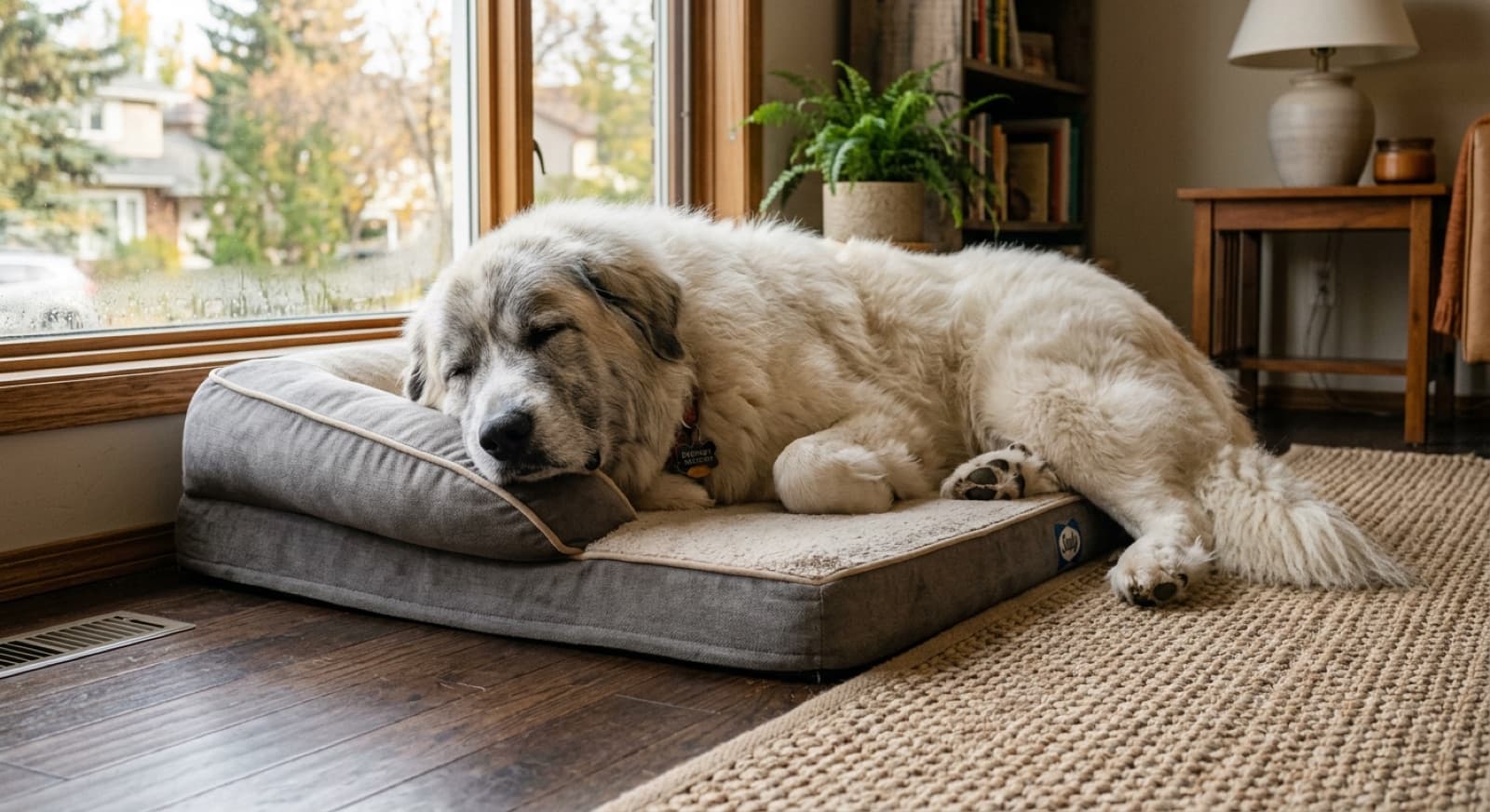
The Great Pyrenees (also called the Pyrenean Mountain Dog) is one of the oldest livestock guardian breeds, developed in the Pyrenees mountains between France and Spain to guard sheep and goats from wolves and bears. The modern Pyrenees is a calm, dignified, independent giant, but the breed's size, conformation, and working-line history concentrate several conditions worth knowing about. This article walks Calgary owners through the conditions to discuss with your vet at adoption and at every annual exam after that, what to watch for at home, and what belongs in the hands of a veterinarian rather than the internet. Sources include the American Kennel Club, the Orthopedic Foundation for Animals (OFA), the AKC Canine Health Foundation, the Cornell University College of Veterinary Medicine, the American Animal Hospital Association, the Canadian Kennel Club, and the Great Pyrenees Club of America health resources.
Why Great Pyrenees have a distinct health profile
Three facts shape almost everything on this page. First, the Great Pyrenees is a giant breed (85 to 160 lbs for adult males) and the giant-breed pattern is real: shorter lifespan than smaller dogs, higher lifetime cancer incidence (particularly osteosarcoma), and elevated joint stress from sheer body weight on hips, elbows, and knees. Second, the breed is deep-chested, which places it squarely in the high-risk band for bloat (gastric dilatation-volvulus). Bloat awareness and prophylactic gastropexy at spay or neuter are conversations worth having with your vet before the dog gets sick. Third, the modern Pyrenees draws from working livestock guardian lines with a relatively narrow founding base in some regions, which has concentrated several inherited conditions including some forms of neuronal degeneration, entropion, and patellar luxation in certain lines.
Ethical Pyrenees breeders use OFA hip and elbow screening, annual eye certifications, cardiac evaluations, and DNA tests where available before breeding. For a rescue Pyrenees without breeder records (which is most rescue Pyrenees), the practical implication is simple: manage proactively. Build a Calgary vet schedule, plan a week-1 baseline workup, discuss gastropexy if the dog is not yet altered, and establish a monthly lump-and-lameness check habit from day one. The rest of this article walks through what to ask the vet about and when.
Bloat (gastric dilatation-volvulus, GDV) the dominant emergency
Bloat is a life-threatening emergency in deep-chested giant breeds, and the Great Pyrenees sits squarely in the high-risk band. Survival depends on minutes, not hours. If you see the red flags below, drive to a Calgary 24-hour emergency clinic immediately and call ahead. Do not wait. Do not Google. Do not ask a Facebook group.
Gastric dilatation-volvulus is a condition in which the stomach distends with gas (dilatation) and then twists on itself (volvulus), cutting off blood supply and causing rapid tissue death and shock. The condition is most common in large and giant deep-chested breeds, and the Great Pyrenees, Great Dane, Saint Bernard, German Shepherd, and Standard Poodle all sit in the high-risk group. Even with prompt surgical correction, GDV carries a real mortality rate. Recognition speed is the lever.
Red flags that warrant an immediate Calgary emergency vet visit:
- Visibly distended or swollen abdomen, often appearing suddenly
- Repeated unproductive retching: the dog tries to vomit but nothing comes up, or only foamy saliva comes up
- Heavy drooling or thick stringy saliva
- Restlessness, pacing, inability to settle, or an anxious look
- Arched-back or hunched posture
- Rapid heart rate, weakness, pale gums, or collapse
- Sudden shift from normal to clearly unwell within minutes to hours, often after a meal
Action. Drive immediately to your nearest Calgary 24-hour emergency clinic and call ahead so they can prepare for surgery. Do not try to home-treat. Do not give over-the-counter remedies. Time from onset to surgical decompression is the single biggest predictor of survival.
Risk-reduction habits worth discussing with your Calgary vet:
- Feed two or three smaller meals per day rather than one large meal
- Avoid vigorous exercise for one hour before and one hour after eating
- Slow-feeder bowls for dogs that gulp food rapidly
- Avoid raising food bowls unless your vet specifically recommends it (the evidence on elevated feeders is mixed)
- Manage stress around feeding (multi-dog households can drive rapid eating)
- Discuss prophylactic gastropexy with your vet at the time of spay or neuter
Prophylactic gastropexy is a preventive surgical procedure that tacks the stomach to the body wall to prevent the volvulus (twisting) component of bloat. It does not prevent gas-bloat itself, but it dramatically reduces the risk of the life-threatening twist. The procedure is often combined with spay or neuter to avoid a separate anaesthesia event. The decision, the timing, and the cost belong entirely with your Calgary veterinarian, who can discuss it in the context of your specific dog. Bloat surgery on an emergency basis in Calgary commonly runs $4,000 to $8,000 with no guarantee of survival. Prophylactic gastropexy as a planned procedure is a fraction of that cost and is the reason the conversation is worth having early.
Osteosarcoma (bone cancer, breed-elevated risk)
Great Pyrenees sit in an elevated-risk group for osteosarcoma, an aggressive bone cancer. The single most important owner habit is treating any new lameness in a middle-aged or senior Pyrenees as a vet conversation, not a wait-and-see. Early diagnosis matters because the disease is aggressive and spreads quickly to the lungs.
Osteosarcoma is a malignant tumour of bone cells that occurs at a substantially higher rate in giant breeds than in smaller dogs. The tumour most often arises in the long bones of the limbs (the distal radius near the wrist, the proximal humerus near the shoulder, the distal femur near the knee, the proximal tibia near the knee, and sometimes the hock). Onset is usually middle-aged to senior. The disease is locally destructive (causing severe bone pain and a visible firm swelling near a joint as it progresses) and metastasises to the lungs, often before the primary tumour is even diagnosed.
Signs to discuss with your Calgary vet immediately:
- New lameness in a middle-aged or senior Pyrenees, particularly if persistent or progressive rather than acutely traumatic
- A firm swelling near a long-bone joint (wrist, shoulder, knee, or hock)
- Reluctance to bear weight on a limb
- Pain on palpation of a specific area of bone
- Lameness that does not resolve with rest and conservative management
- Visible muscle wasting in the affected limb
Diagnosis is by X-ray imaging, often with referral to a Calgary specialty centre for further workup. A bone biopsy or fine-needle aspirate confirms the diagnosis. Staging includes chest X-rays or CT to look for pulmonary metastases. Treatment decisions belong entirely with your Calgary veterinary team and a veterinary oncologist at Western Veterinary Specialist Centre or VCA Canada West. Treatment plans may include amputation plus chemotherapy, limb-spare surgery plus chemotherapy, or palliative care focused on pain management and quality of life. Cost commonly runs $5,000 to $15,000 or more depending on the plan, which is the reason early pet insurance matters for this breed.
Home routine. A monthly lameness and skin check is the single most useful habit for a senior Pyrenees. Run your hands slowly along each limb, feeling for any new firm swelling, asymmetry between limbs, or response to pressure. Document anything new and bring it to every Calgary vet visit. Lameness in a giant breed senior is never a wait-and-see.
Hip and elbow dysplasia
Hip and elbow dysplasia are documented in Great Pyrenees and are included in OFA hip dysplasia breed statistics. Ethical breeders evaluate both parents with OFA or PennHIP scoring before breeding, and elbows are also formally evaluated.
Hip dysplasia is a developmental malformation of the hip joint where the ball and socket do not fit together correctly, and elbow dysplasia is a similar developmental problem in the elbow. Both lead to painful arthritis over time. The conditions are influenced by genetics, growth rate, body weight, and exercise pattern during growth. The Great Pyrenees is a heavy giant breed in which both conditions are documented at a meaningful rate, and a 120 lb dog puts substantially more load through each joint than a smaller dog with the same dysplasia grade.
Symptoms to discuss with your Calgary vet:
- Bunny-hopping gait when running, where both rear legs push off together rather than alternating
- Reluctance to climb stairs, jump into the car, or get up onto the couch
- Hindlimb or forelimb stiffness after rest that improves with movement
- Visible muscle wasting in the hindquarters or shoulders
- Reduced willingness to walk distances on Calgary off-leash trails such as Nose Hill Park, Fish Creek Provincial Park, or Bowmont Park
- Shortened stride, particularly on a cold morning
Diagnosis is by X-ray imaging scored against OFA or PennHIP standards, read by your Calgary vet or a referral radiologist. Management ranges from conservative care (weight control, joint support recommended by your vet, physiotherapy, and pain control your vet selects) through to surgical options for severe cases. Surgical decisions and rehabilitation plans belong with a Calgary specialty centre such as Western Veterinary Specialist Centre or VCA Canada West. Total hip replacement and other advanced orthopaedic procedures are five-figure conversations.
Body weight is the most important owner-controllable factor. A Pyrenees at 130 lbs puts substantially more load through hips and elbows than the same dog at 110 lbs. Body condition scoring on the 1 to 9 scale at every Calgary vet visit is more useful than the bathroom scale alone. Lean body condition through the lifespan pays dividends in every joint.
Patellar luxation
Patellar luxation is a condition in which the kneecap slips out of its normal groove on the femur. Although the condition is best known in small breeds, it is documented in some Great Pyrenees lines and warrants screening as part of a comprehensive pre-breeding workup. Grades range from a kneecap that can be displaced manually but spontaneously returns (Grade I) to a permanently luxated kneecap (Grade IV).
Signs to discuss with your Calgary vet:
- A skipping or hopping gait, where the dog briefly carries one rear leg before returning to normal
- Sudden temporary lameness that resolves on its own
- Audible clicking from the knee
- Reluctance to fully extend or weight-bear on a rear leg
- Crouched stance
Diagnosis is by physical examination by your Calgary vet, often confirmed with X-ray imaging. Treatment for low grades is conservative (weight management, controlled exercise, joint support discussed with your vet). Higher grades may require surgical correction at a Calgary orthopaedic specialty centre. The plan belongs entirely with your vet team.
Neuronal degeneration (DNA testable in some lines)
A juvenile-onset form of neuronal degeneration has been characterised in some Great Pyrenees lines. The condition is autosomal recessive and DNA testable through commercial veterinary genetics labs. Ethical breeders screen both parents.
Neuronal degeneration in the Pyrenees produces progressive neurological signs in young dogs, typically appearing within the first year of life and progressing over months. The genetic basis has been identified for at least one form, and the DNA test allows ethical breeders to identify carriers and affected dogs and avoid producing clinically affected puppies by pairing Clear-to-Clear or Clear-to-Carrier.
Signs to discuss with your Calgary vet:
- Progressive weakness, particularly in the hindlimbs
- Ataxia: an unsteady, wobbly, or uncoordinated gait
- Exercise intolerance: tiring quickly, reluctance to continue an activity the dog used to enjoy
- Loss of muscle mass over weeks to months
- Tremors or knuckling over on the feet
- Sudden behavioural change in a juvenile or young adult
Diagnosis is by DNA testing through a commercial veterinary genetics lab combined with neurological evaluation by your vet or a referral neurologist at Western Veterinary Specialist Centre or VCA Canada West. Management is supportive only; there is no cure, and the condition is progressive. Quality-of-life conversations belong with your Calgary veterinary team. Carriers (one copy) are clinically normal and should be bred only to Clear partners.
Entropion (eyelid rolling inward)
Entropion is a condition in which the eyelid (most often the lower lid) rolls inward, causing the lashes and skin to rub on the surface of the eye. It is documented in some Great Pyrenees lines and produces chronic discomfort, corneal damage if untreated, and increased risk of secondary infection. The condition is surgically correctable and the procedure is routine at a Calgary veterinary ophthalmology referral.
Signs to discuss with your Calgary vet:
- Squinting, especially in bright light or wind
- Excessive tearing or wet streaks down the face
- Red, irritated, or swollen eyelid margins
- Visible rubbing of lashes against the cornea
- Recurrent eye infections
- Reluctance to open the eye fully
Diagnosis is by veterinary examination, often with referral to a veterinary ophthalmologist for confirmation and surgical planning. Treatment for clinical cases is surgical correction (blepharoplasty) at a Calgary ophthalmology specialty centre. The plan, the timing, and the cost belong entirely with your vet team and the ophthalmologist.
Cataracts (age-related and hereditary forms)
Both hereditary cataracts and age-related (senile) cataracts are documented in Great Pyrenees. Hereditary cataracts typically appear in young to middle-aged dogs and can cause significant vision impairment or blindness. Age-related cataracts develop in many senior dogs of any breed. Ethical breeders include annual eye examinations (CERF or OFA Eye Certification) in their screening.
Signs to discuss with your Calgary vet:
- Visible cloudiness in the lens, often appearing as a bluish-grey or white opacity behind the pupil
- Reluctance to navigate in dim light or in unfamiliar environments
- Hesitation on stairs or curbs
- Bumping into furniture in familiar rooms
- Cloudiness that appears in both eyes within months of each other
Diagnosis is by veterinary ophthalmology examination. Treatment for advanced cataracts causing vision loss may include surgical lens replacement (phacoemulsification) at a veterinary ophthalmology specialty centre; this is a major procedure and the decision belongs entirely with your vet team and the ophthalmologist. Many Pyrenees with cataracts adapt well to gradual vision loss in a stable home environment when furniture stays put and routines stay consistent.
Deafness and BAER testing
Congenital deafness has been documented in some mostly-white-coated lines across multiple breeds, and the Great Pyrenees is mostly or entirely white. The link between coat colour genetics and inner-ear development is well documented in the veterinary literature. The standard objective test for hearing loss in puppies is the Brainstem Auditory Evoked Response (BAER) test, which measures the electrical activity of the auditory pathway in response to sound. Ethical breeders of mostly-white-coated breeds often BAER-test puppies before placement to identify unilateral (one ear) or bilateral (both ears) deafness.
Signs to discuss with your Calgary vet:
- Failure to respond to sounds the dog should reliably hear (name, food bag, doorbell)
- Sleeping through household noise that should wake a hearing dog
- Easily startled when approached from behind
- Difficulty locating the source of a sound
- Inconsistent recall, particularly off-lead in an open environment
Diagnosis is by BAER testing, often at a referral specialty centre. For a rescue Pyrenees, your Calgary vet can discuss whether referral is warranted based on the dog's behaviour and any signs of hearing loss. Management of a deaf Pyrenees relies on visual cues, vibration cues, secure fencing (a deaf dog cannot hear approaching vehicles, off-lead dogs, or recall commands), and a thoughtful daily routine. Deaf Pyrenees can live full lives with attentive owners.
Inherited heart disease
Some Pyrenees lines carry an elevated risk of inherited heart disease. Patent ductus arteriosus (PDA) is a congenital defect in which a foetal blood vessel fails to close after birth, and it has been documented in the breed. PDA is usually identified in puppies and is surgically correctable when caught early. Mitral valve disease appears in some lines and is a senior-onset condition. Cardiac auscultation at every annual wellness visit is the baseline; an echocardiogram by a veterinary cardiologist is the next step if your Calgary vet hears a murmur or has other reasons for concern. Ethical breeders include cardiac evaluation in their pre-breeding screening.
Signs to discuss with your Calgary vet:
- Exercise intolerance disproportionate to age or condition
- Coughing, especially at rest or at night
- Rapid or laboured breathing at rest
- Episodes of weakness, fainting, or collapse
- Abdominal distention (a late sign of right-sided heart failure)
- Pale or bluish gums
- Puppy failure-to-thrive or stunted growth (a possible sign of PDA)
Diagnosis and management belong with your Calgary vet and a veterinary cardiologist when referral is needed. Cardiac medication selection, monitoring, and adjustment are specialist-level decisions.
Skin conditions under the double coat (a Calgary summer reality)
The Great Pyrenees carries a thick weatherproof double coat designed for mountain weather. In Calgary summers, that coat traps heat and humidity against the skin and creates conditions for atopic dermatitis (allergic skin inflammation) and hot spots (acute moist dermatitis, often appearing as a fast-developing raw patch). The breed is also prone to skin-fold issues in heavier individuals.
Signs to discuss with your Calgary vet:
- Persistent licking, chewing, or scratching at a specific area
- A rapidly enlarging raw, red, moist patch (a hot spot)
- Recurrent ear infections
- Hair loss, scaling, or thickened skin
- Strong odour from the coat or specific areas
- Seasonal worsening, particularly in Calgary summer humidity
Diagnosis and management belong with your Calgary vet, often with referral to a veterinary dermatologist for chronic cases. Treatment depends entirely on the underlying cause and may involve topical care, dietary changes, allergy workup, or systemic therapy your vet selects. Routine grooming is part of prevention. Brush the coat regularly to remove dead undercoat and to inspect the skin underneath. Never shave a Pyrenees double coat for summer comfort: the coat insulates against heat as well as cold, and shaving disrupts thermoregulation and can cause permanent coat damage. Professional de-shedding 2 to 3 times a year reduces the workload between brushings.
Calgary Great Pyrenees health checklist by life stage
The breed-specific conditions above each have a typical onset window, which gives a reasonable framework for what to ask your Calgary vet about and when. The specific tests, the timing, and any modifications based on your individual dog's history are decisions for your veterinarian.
Puppy (under 12 months):
- Standard vaccination series, parasite prevention, spay or neuter conversation (giant-breed timing is often later than for smaller dogs; discuss with your vet)
- Conversation about prophylactic gastropexy at the time of spay or neuter
- BAER hearing test conversation, particularly for mostly-white-coated puppies
- Baseline eye exam
- Cardiac auscultation (PDA is a puppy-onset condition)
- Body condition scoring established as a baseline; large-and-giant-breed puppy food and growth-rate planning
- Bloat education for the household before the puppy reaches adult size
Young adult (1 to 4 years):
- Annual wellness exam with full physical and dental check
- Annual skin and lump exam under the double coat (monthly home checks established as a habit)
- Annual cardiac auscultation
- Baseline bloodwork
- Annual eye exam (CERF or OFA Eye Certification where available)
- Hip and elbow radiograph conversation if any gait irregularity appears
- Neuronal degeneration DNA discussion if any juvenile-onset neurological signs appear
- Patellar evaluation as part of every orthopaedic exam
- Entropion check at every eye exam
Middle-aged (5 to 6 years):
- Annual wellness exam, escalating toward twice-yearly by age 6 or 7
- Annual full bloodwork
- Annual cardiac auscultation
- Annual eye exam (age-related cataracts may begin to appear)
- Annual skin exam under the coat (atopic dermatitis and hot-spot vigilance)
- Lump and lymph-node documentation begins in earnest
- Careful long-bone palpation begins (osteosarcoma vigilance)
- Joint support conversation with your vet
Senior (7+ years):
- Twice-yearly wellness exams
- Full senior bloodwork twice yearly
- Rigorous lameness, lump-and-bump, and long-bone palpation documentation; new lameness gets imaging, not a wait-and-see
- Annual eye exam
- Cancer screening conversations; osteosarcoma is the dominant senior cancer risk in this breed
- Joint support and mobility aids: orthopaedic bed, traction rugs on hardwood, ramps for stairs and the car
- Body condition scoring at every visit (lean is gentler on hips, elbows, and the heart)
- Quality-of-life conversations started long before they feel needed
Calgary veterinary access for a Great Pyrenees
The single most useful thing a new Pyrenees owner can do in the first week is build a Calgary veterinary plan before the dog has a problem. That means a regular vet you trust, a 24-hour emergency clinic identified and saved in your phone (bloat will not wait), and a short list of specialty referral options for the breed-specific conditions that may come up. The Pyrenees combination of bloat risk, senior osteosarcoma risk, and orthopaedic load makes early relationships with a specialty centre worth doing on purpose.
Calgary planning checklist:
- Regular vet: Choose a Calgary clinic with experience in giant-breed care. Ask whether the practice routinely manages large-breed orthopaedic cases, bloat triage, and senior cancer surveillance, because these are the bread-and-butter of giant-breed ownership. Use the Canadian Veterinary Medical Association directory if you need a starting point.
- 24-hour emergency clinic: Calgary has several distributed across NW, NE, SW, and SE. Identify the closest one to your home, save the address in your phone, and drive the route once in daylight so the path is in your head. Bloat survival is measured in minutes.
- Specialty referral options: Western Veterinary Specialist Centre and VCA Canada West Veterinary Specialists handle oncology, cardiology, ophthalmology, dermatology, neurology, and orthopaedic surgery. Your regular vet refers when needed.
- Low-cost spay and neuter access: Calgary Pet Wellness and Spay/Neuter Clinic offers lower-cost spay and neuter for adopters on a budget. Confirm services and pricing, and ask whether prophylactic gastropexy can be combined.
- Pet insurance: Enrol while the Pyrenees is young and symptom-free, particularly before any orthopaedic diagnosis or lameness appears in the chart. Compare Canadian providers on deductible, reimbursement, per-condition limits, and whether hereditary conditions and cancer treatment are covered.
- Microchip and licence: Calgary requires dog licensing under the Responsible Pet Ownership Bylaw, and microchipping is a standard recommendation. Pyrenees are documented escapers and roamers; a current licence and microchip are essential.
- Calgary-specific seasonal preparation: Winter is the Pyrenees natural element. Summer is the bigger management problem: heat tolerance plans, indoor cooling, dawn and dusk walking schedules, and double-coat care to prevent hot spots.
Pet insurance ROI for a Great Pyrenees
Pet insurance is a strong consideration for Great Pyrenees because the breed combines a high-cost emergency risk (bloat surgery commonly runs $4,000 to $8,000 in Calgary), an elevated senior cancer risk (osteosarcoma treatment commonly runs $5,000 to $15,000 or more), and orthopaedic correction for severe hip or elbow dysplasia that runs $4,000 to $7,000 or more. Across a 10 to 12 year lifespan, the Pyrenees owner who avoids all three is the exception rather than the rule.
The lever that matters most is enrolling early. Every Canadian provider excludes pre-existing conditions. A Pyrenees enrolled at 8 weeks old with no symptoms qualifies for the broadest coverage; one enrolled at age 4 after a diagnosis of hip dysplasia or after a documented lameness episode will have those issues excluded indefinitely. Calgary premiums vary by provider, age, and breed, so request real quotes from several Canadian insurers and compare deductible, reimbursement (typically 70 to 90 percent), and per-condition versus annual limits side by side.
Questions to ask any insurer before enrolling a Pyrenees:
- Are hereditary and congenital conditions covered, or excluded?
- Is bloat surgery covered, and is gastropexy covered separately as a preventive procedure?
- Are bilateral conditions (both hips for dysplasia, both elbows, both eyes for cataracts) treated as one claim or two?
- Is there a per-condition lifetime cap or only an annual cap?
- How are pre-existing conditions defined, and what counts as evidence of pre-existence?
- Are diagnostics (bloodwork, urinalysis, imaging, fine-needle aspirate, DNA testing, BAER) covered, or only treatments?
- Is specialty referral (oncology, cardiology, ophthalmology, dermatology, orthopaedic surgery) covered?
- Is cancer treatment (surgery, amputation, chemotherapy, radiation) covered without sub-limit caps?
Considering a Great Pyrenees in Calgary?
Health-aware adoption is the single biggest thing you can do for a Pyrenees. Bloat awareness, a Calgary vet plan, prophylactic gastropexy at spay or neuter, OFA-screened parents, lean body condition, and rigorous senior lameness vigilance turn a 10 to 12 year giant-breed companion into the dog the breed is supposed to be. Browse adoptable Great Pyrenees in Calgary and read the matching breed-fit guides before you bring the dog home.
See Calgary Great Pyrenees available now →Adopting a rescue Great Pyrenees with unknown history
Most rescue Pyrenees in Calgary come with limited paperwork. That is normal. The practical implication is that the week-1 vet visit is more important than it would be for a dog with breeder documentation, and the questions you ask the rescue before adopting matter.
What to ask the rescue:
- What is the dog's known history? Any prior owners, any returns, any reason for surrender?
- Any prior episodes that could have been bloat (sudden abdominal distention, unproductive retching, collapse)?
- Any persistent lameness, swelling near a joint, or reluctance to bear weight that could suggest early osteosarcoma?
- Any limping, stiffness, or reluctance to climb stairs that could suggest hip or elbow dysplasia?
- Any knee-clicking or skipping gait that could suggest patellar luxation?
- Any tremors, weakness, or wobbly gait that could suggest neuronal degeneration?
- Any visible eye changes, squinting, or eyelid irritation that could suggest entropion or cataracts?
- Any signs of hearing loss (especially in a mostly-white dog)?
- Any heart murmurs noted in foster or in prior vet records?
- Any current or historical lumps on the skin, or skin patches and hot spots under the coat?
- Any prior vet records, transferred X-rays, or eye exam results?
- Has the dog been spayed or neutered, and was gastropexy done at the same time?
- What food has the dog been eating, and at what schedule (smaller frequent meals reduce bloat risk)?
Plan a week-1 Calgary vet workup that covers:
- Thorough physical exam including skin check under the double coat, lymph-node palpation, long-bone palpation, and orthopaedic exam
- Baseline bloodwork: complete blood count, chemistry panel, electrolytes
- Cardiac auscultation
- Conversation about hip, elbow, and eye screening at the appropriate age
- Conversation about gastropexy if the dog is not yet altered, or if it was not done at the time of prior altering
- Conversation about DNA panel where breed-relevant tests are clinically indicated
- Lump and lameness baseline documentation
- Pet insurance enrolment before any new diagnoses appear in the chart
- Calgary summer heat-management plan and double-coat care plan
Budget framing. Plan for a week-1 vet workup of several hundred dollars. Plan to enrol pet insurance immediately, before any new diagnosis. Plan for a steady ongoing budget for joint support, premium large-and-giant-breed food, professional de-shedding for the double coat, and senior bloodwork after age 5. The conditions that matter most in a Pyrenees lifespan are largely manageable when caught early; the budget for catching them early is the actual lever.
Senior Great Pyrenees care (7 years and up)
Pyrenees are a working livestock guardian at heart, and seniors do best when their owners adjust the routine rather than dropping it. The dog who patrolled the fence at age 4 still wants a sense of purpose at age 10; the question is how to keep that going safely while watching for the senior conditions the breed is prone to. Giant breeds age faster than smaller dogs, so the senior label arrives sooner.
Mobility and orthopaedics:
- Orthopaedic bed with good support, sized for a giant dog
- Traction rugs on hardwood and tile to prevent slipping (a fall in a 120 lb dog is consequential)
- Ramps for getting into the car and up onto the couch
- Body condition scoring at every visit; lean is gentler on every joint
- Daily moderate exercise rather than weekend-warrior intensity
- Pain management decisions belong with your vet
Cancer monitoring (the dominant senior priority for a Pyrenees):
- Twice-yearly wellness exams with thorough skin and long-bone palpation
- Full senior bloodwork twice yearly
- Document every new lump, lameness episode, or long-bone change (size, location, date noted)
- Any new lameness in a senior Pyrenees gets imaging, not a wait-and-see
- Sudden weakness, pale gums, or visible distress is a same-day Calgary 24-hour emergency event
Cardiac, dental, and skin:
- Annual cardiac auscultation continues through the senior years
- Monthly home skin and coat check continues
- Annual or semi-annual dental check; professional cleaning when your vet recommends
- Watch for hot spots, atopic dermatitis flares, and ear infections, particularly in Calgary summer humidity
Dietary refinement and cognitive support:
- Senior diet conversation with your vet; caloric needs typically drop in seniors
- Cognitive dysfunction signs (disorientation, altered sleep, house-soiling, reduced engagement) are vet conversations
End-of-life framing:
Quality-of-life conversations should start years before they feel needed. Your Calgary vet team has the experience to help you read the trajectory and to discuss palliative options, in-home euthanasia, and aftercare when the time comes. Planning ahead is a kindness to the dog and to yourself.
Anaesthesia considerations
Great Pyrenees generally tolerate standard anaesthesia protocols well, but the breed's giant size, deep-chested build, double coat, and senior cancer risk profile mean a few specific pre-operative conversations are worth having with your Calgary veterinary team.
- Giant-breed positioning. A 130 lb dog needs careful positioning during surgery to avoid pressure injury and nerve compression. Calgary specialty centres handle this routinely.
- Weight-based dosing. Drug doses are calculated against lean body weight, not gross body weight, and a heavier giant breed requires careful drug selection and monitoring. Conversations about pre-anaesthetic bloodwork and drug protocols belong with your vet team.
- Pre-operative bleeding screen. A pre-operative coagulation profile is a worthwhile conversation, particularly in older dogs or those with any history of bruising or bleeding.
- Temperature regulation. A double coat helps maintain body temperature during surgery, but recovery monitoring still matters. Hypothermia and hyperthermia are both monitored.
- Combined gastropexy with spay or neuter. Discuss combining prophylactic gastropexy with spay or neuter to avoid a separate anaesthesia event.
- Recovery monitoring intensity. Giant breeds benefit from closer post-anaesthetic monitoring, particularly when the procedure was prolonged. A long recovery in a 130 lb dog needs structured turning and pressure-point management.
- Analgesia for orthopaedic procedures. Pain control planning around hip, elbow, or knee surgery in seniors is a specialty conversation; orthopaedic surgical centres in Calgary handle this routinely.
Anaesthesia planning, drug selection, monitoring intensity, and any modifications to standard protocols belong entirely with your Calgary veterinary team and any specialty consultants they involve.
The ethical Great Pyrenees breeder screening checklist
If you are considering a Great Pyrenees from a breeder, the documentation below should be available in writing for both parents. The Great Pyrenees Club of America and the Canadian Kennel Club publish parent-club versions of this guidance. Without these documents, walk away.
Required documentation for both parents:
- OFA or PennHIP hip evaluation. OFA scores of Fair, Good, or Excellent are acceptable starting points.
- OFA elbow evaluation. Normal is the target.
- CERF or OFA annual eye certification (entropion, cataracts, other inherited eye conditions).
- Cardiac evaluation. Auscultation at minimum; echocardiogram for older breeding dogs.
- Patellar evaluation. OFA patellar grade.
- BAER hearing test results for breeding dogs from lines with any history of deafness.
- DNA test results for breed-relevant conditions where tests are available (including some forms of neuronal degeneration).
- Discussion of cancer history (especially osteosarcoma) in the breeding lines.
- Discussion of bloat history in the breeding lines.
Beyond paperwork. An ethical Pyrenees breeder will want to meet you, ask about your home (acreage is the strong preference for this breed), ask about your previous dogs, and answer your questions in detail. They will offer a written contract that requires the dog to come back to them if it ever cannot stay with you. They will offer ongoing support. Puppies will have been socialised to many sights, sounds, surfaces, and handling experiences before they leave.
The walk-away test. If a Pyrenees breeder cannot or will not produce written OFA hip and elbow scores plus current eye certifications for both parents, walk away. These are the bare minimum. A Pyrenees from a backyard breeder with untested parents carries the full untested breed-risk profile, on a 120 lb dog who will live with the consequences for 10 to 12 years.
Emergency signs that warrant immediate vet attention
These signs are same-day Calgary emergency vet visits. Do not wait, do not Google, do not ask a Facebook group. Drive to your nearest 24-hour clinic and call ahead so they are ready. Bloat is the breed's defining emergency and survival is measured in minutes.
Suspected bloat (the most time-critical emergency in the breed):
- Visibly distended or swollen abdomen
- Repeated unproductive retching
- Heavy drooling, restlessness, pacing, hunched posture
- Rapid heart rate, pale gums, weakness, collapse
Suspected osteosarcoma fracture (pathological fracture through a tumour):
- Sudden severe lameness in a senior dog without obvious trauma
- Inability to bear weight on a limb
- Visible deformity of a long bone
Suspected heat stress (Calgary summer):
- Heavy panting that does not resolve with rest in shade
- Bright red or pale gums
- Thick stringy saliva, stumbling, weakness, or collapse on a warm day
- Vomiting or diarrhoea after exertion in heat
Sudden neurological signs:
- Sudden ataxia (severely unsteady gait)
- Seizure-like episodes
- Sudden dramatic behaviour change
- Sudden vision loss
Eye emergencies:
- Sudden cloudiness, blue-grey corneal change, or a film over the eye
- Persistent squinting, especially with redness or swelling
- A visibly enlarged or painful eye
Frequently Asked Questions
What is the typical lifespan of a Great Pyrenees?↓
What are the red flags of bloat in a Great Pyrenees?↓
What are the warning signs of osteosarcoma in a Great Pyrenees?↓
Is prophylactic gastropexy worth it for a Great Pyrenees?↓
What should I ask a Great Pyrenees rescue about a dog's health history?↓
When should I enrol a Great Pyrenees in pet insurance?↓
What are the biggest cost worries for a Calgary Great Pyrenees owner?↓
Some of the product links in this section are Amazon affiliate links — we may earn a small commission at no extra cost to you. It never changes which products we recommend. Always consult your veterinarian before starting any supplement.
How often should an adult Great Pyrenees see the vet?↓
Should a Great Pyrenees puppy have a BAER hearing test?↓
What should ethical breeders screen for in Great Pyrenees?↓
When should I escalate to a Calgary specialty vet?↓
Are there special dietary considerations for a large-breed Great Pyrenees?↓
Continue reading
Great Pyrenees in Calgary
Browse adoptable Great Pyrenees in Calgary right now, with live rescue listings and breed-fit context for each dog.
Great Pyrenees adoption Calgary
The full Calgary Pyrenees adoption guide: rescue sources, real costs, surrender patterns, and the breed-vs-buy conversation.
Great Pyrenees as livestock guardian
Why the Pyrenees barks at night, roams, and thinks independently. Alberta acreage fit, urban incompatibility, LGD work vs companion role.
Alaskan Malamute health issues Calgary
A neighbouring giant-breed health profile: bloat, AMPN, chondrodysplasia, Day Blindness, hips, thyroid, cancer, and zinc-responsive skin disease.
New dog? Start with these care guides
Everything a new adopter needs to set up a safe, happy home.