The short answer
Pyrenees appear regularly in Calgary rescue, mostly as 1 to 4 year young adults surrendered when guardian behaviour fully emerges. Best places to check: CHS, AARCS, BARCS, Pawsitive Match, ARF Alberta, Cochrane Humane, Heaven Can Wait, plus the Great Pyrenees Club of Alberta. Adoption fee: $500 to $900 vs $1,500 to $3,500 from a breeder with a 6 to 18 month waitlist. A centuries-old French and Spanish livestock guardian breed. AKC-recognised 1933. 85 to 160 lbs, 25 to 32 inches, 10 to 12 year lifespan. Acreage breed, not an urban companion breed. Excellent in Calgary winter, hard above 22°C. Sheds heavily year-round plus two dramatic blow cycles. Nighttime barking is breed instinct, not a training failure.
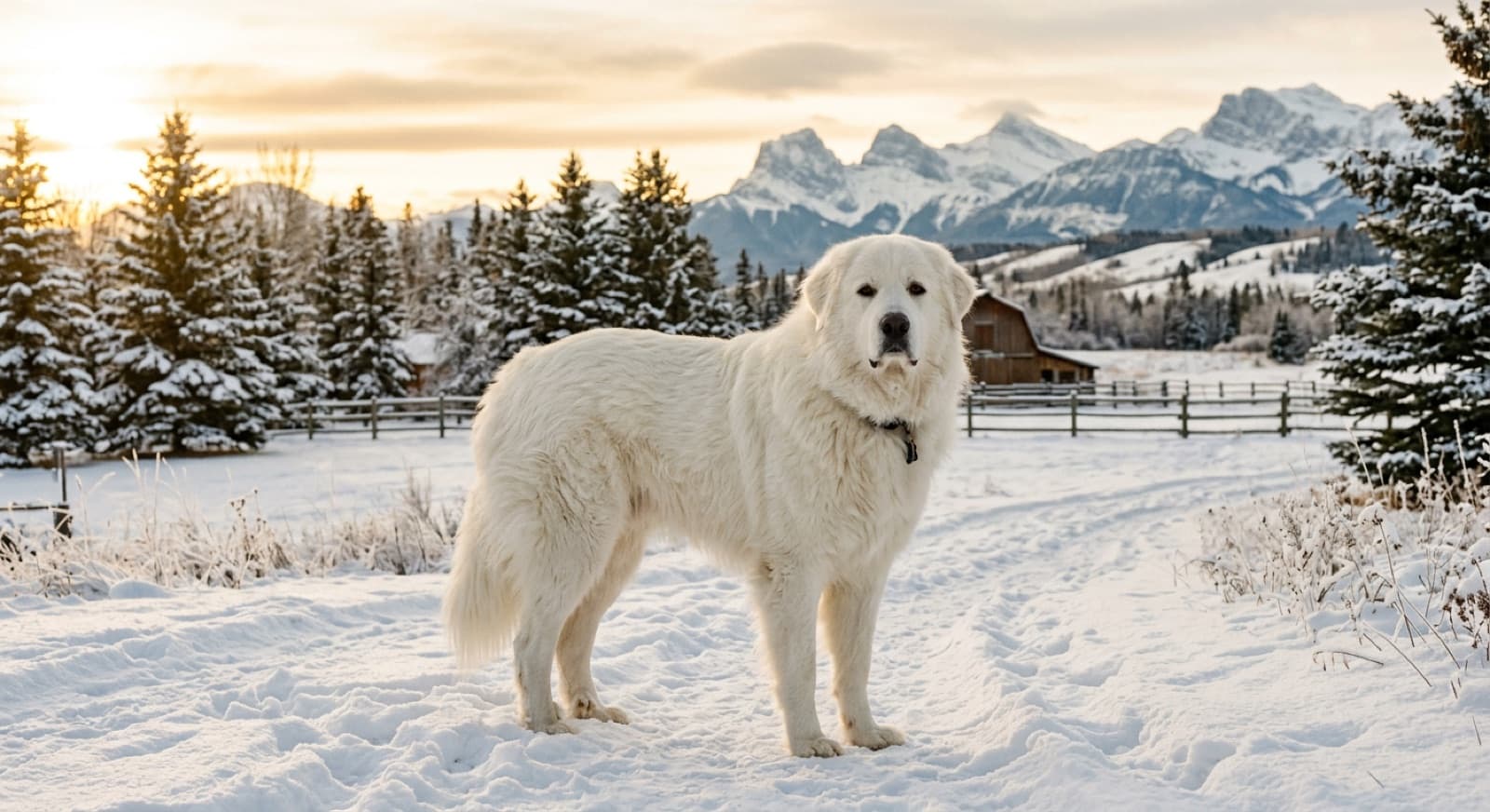
Where can I adopt a Great Pyrenees in Calgary?
Pyrenees show up regularly in Calgary rescue because Alberta’s large acreage and hobby-farm community produces ongoing surrenders. Best places to check: Calgary Humane Society, AARCS, BARCS, Pawsitive Match, ARF Alberta, Cochrane Humane, and Heaven Can Wait. Breed-specific networks include the Great Pyrenees Club of Alberta rescue committee and the Great Pyrenees Club of Canada referral network. Browse all currently available Calgary Pyrenees and Pyrenees mixes across 15+ Calgary rescues at LocalPetFinder's Great Pyrenees breed page. Listings update regularly.
Pyrenees turn up across Calgary metro and surrounding rural areas, but most surrenders originate from acreages in Rocky View County, Foothills County, Mountain View County, and outlying communities like Bragg Creek, Springbank, Bearspaw, and Bearspaw-Cochrane corridor where the dog was working as a livestock guardian and then needed rehoming. Suburban and urban Calgary intakes are usually mismatched homes that adopted a Pyrenees puppy off Kijiji or Facebook Marketplace and discovered the breed reality at the 12 to 18 month adolescence mark. The most common Calgary Pyrenees surrender reasons: nighttime barking driving neighbour complaints, escape and roaming, size-reality wall, shedding workload, age-related medical surrender (osteosarcoma is a real concern in the breed), and lifestyle mismatch.
How much does it cost to adopt a Great Pyrenees in Calgary?
Calgary Pyrenees rescue adoption commonly runs $500 to $900. Calgary Humane Society: $200 to $500. AARCS, BARCS, Pawsitive Match, ARF Alberta: $500 to $900. Calgary Animal Services: $225 plus GST. Senior Pyrenees (8 plus years): $300 to $500. Adoption fees include spay/neuter, vaccinations, microchip, deworming, and basic medical workup. Buying from a breeder: $1,500 to $3,500 for standard pet-quality with 6 to 18 month waitlists, higher for working-stock livestock guardian lines. Annual care: $2,200 to $3,800 per year. Food is a major line item (giant breed eats a lot), followed by professional de-shedding sessions, secure fencing investments for acreage perimeters, standard large-breed vet costs, and insurance ($60 to $100 per month).
| Source | Pyrenees Fee Range | What's Included |
|---|---|---|
| Calgary Humane Society | $200 to $500 | Spay/neuter, vaccines, microchip, vet check |
| AARCS / BARCS / Pawsitive Match / ARF | $500 to $900 | Spay/neuter, vaccines, microchip, foster temperament plus medical history |
| Calgary Animal Services | $225 plus GST | Spay/neuter, vaccines, microchip, City licence |
| Senior Pyrenees (8 plus years) | $300 to $500 | Same as above. Reduced fee. |
| Reputable breeder puppy | $1,500 to $3,500 | CKC papers, parent health testing, 6 to 18 mo waitlist |
| Working livestock guardian line | $2,500 plus | From established farm, often parent-raised on stock |
On top of the adoption fee, plan for these Calgary-specific ongoing costs. Giant-breed food: $110 to $170 per month for a quality kibble brand sized for an 85 to 160 lb dog. Twice-yearly professional de-shedding sessions: $100 to $180 each at a Calgary grooming salon. Acreage perimeter fencing if your property is not already secured for a determined patroller: $4,000 to $12,000 depending on perimeter length and terrain. Wind-blocked outdoor shelter for winter lounging: $300 to $800 if you build one. Pet insurance is genuinely worth it for the breed because hip and elbow surgery costs $5,000 to $9,000 per joint and osteosarcoma treatment can run $8,000 to $15,000 if pursued.
Why do Great Pyrenees get surrendered to Calgary rescues?
Most Calgary Pyrenees surrenders are 1 to 4 year young adults, surrendered after adolescent guardian behaviour fully emerges and the household realises the lifestyle requirement. Common reasons:
(1) Nighttime barking. Neighbour complaints in urban or suburban Calgary
(2) Escape and roaming. Patrol instinct expands past the property line
(3) Size-reality wall. The cute puppy became a 110 lb adult
(4) Shedding workload. Year-round plus dramatic twice-yearly blow
(5) Lifestyle mismatch. Apartment, townhouse, or small-lot bungalow homes
(6) Age-related medical surrender. Older Pyrenees with hip, joint, or cancer diagnoses
(7) Working dog rehomes. Farms downsizing or losing livestock
(8) Aging owners. 85 to 160 lbs becomes hard to manage
Most surrendered Pyrenees are well-socialised but have specific needs (acreage or rural property, tolerance for guardian behaviour, secure fencing, no shared walls) that screen out most urban adopters. Calgary rescues typically place Pyrenees after structured home checks because the breed's failure modes are predictable and an urban placement produces another surrender within 12 months. Rescues often prioritise applications from acreage owners, hobby farmers, and rural acreage households over inner-city or suburban applicants for exactly this reason.
Where do Great Pyrenees come from?
Great Pyrenees were developed over centuries in the Pyrenees mountain range between France and Spain, where shepherds bred them to guard sheep and goat flocks from wolves and bears across alpine pastures. The breed is one of the oldest livestock guardian dog (LGD) types in Europe, with fossil evidence and historical records suggesting Pyrenees-type dogs have been working in the region for at least a thousand years and possibly several thousand. In France the breed is known as the Chien de Montagne des Pyrénées (Pyrenean Mountain Dog), and in much of Europe that name is still standard.
Pyrenees were bred to make autonomous decisions through the night while shepherds slept. The working dog patrols territory, watches for threats, and vocalises at predators or intruders. By morning the shepherd checks on the flock and trusts the dog to have handled what happened overnight. This selection pressure produced a breed with strong independent decision-making, a deep territorial patrol instinct, nocturnal alertness, calm composure with the family flock, and wariness with strangers. The breed served French royalty as a court guardian during the seventeenth century, was nearly lost during World War I and II when European working-dog populations collapsed, and was rebuilt by dedicated breeders in the mid-twentieth century. The American Kennel Club recognised the breed in 1933, and the Canadian Kennel Club places Pyrenees in the Working Group. The Great Pyrenees Club of America maintains the breed standard and the recommended health-testing panel.
The breed is distinct from the Pyrenean Mastiff, a separate Spanish livestock guardian developed on the southern side of the same mountain range. Both share LGD heritage but they are not interchangeable. Modern Great Pyrenees in North America serve as working livestock guardians on hobby farms and ranches, as estate or property guardians, and as family companions in households equipped to support the breed. Calgary rescue intakes split between former working dogs whose farms downsized and pet-home Pyrenees that did not work out in suburban or urban placements.
What is the livestock-guardian temperament really like?
Great Pyrenees are calm with family, suspicious of strangers, independent, nocturnally vocal, and territorial patrollers. Despite the gentle-giant appearance, the temperament is genuinely different from a typical companion breed. The shepherd breeding selected for autonomy and decision-making, not for handler obedience.
Key Pyrenees temperament traits:
- Independent decision-makers. Bred to assess threats and act without waiting for handler direction. They will refuse commands they consider unnecessary.
- Nocturnal vocalisers. Barking at perceived threats through the night is the working behaviour, not a training problem.
- Territorial patrollers. The dog walks the perimeter of its territory and expects to control who enters.
- Calm with the family flock. Despite the working drive, most Pyrenees are gentle and patient with household members, including children they grew up with.
- Suspicious of strangers. Friendly-with-everyone is not the breed default. Pyrenees evaluate guests and may remain reserved with people outside the household.
- Pet-oriented family bond. Despite the working temperament, most Pyrenees form deep household attachments. The breed is not aloof with its own family.
- Moderate energy, high stamina. Pyrenees are not athletes. They patrol and rest, patrol and rest, rather than running endurance.
- Slow maturers. Pyrenees do not fully mature until 2 to 3 years, and guardian behaviour intensifies through adolescence (12 to 24 months).
The best-fit Pyrenees home is an acreage or rural property with at least some securely fenced area, a household that includes someone home much of the day, tolerance for guardian behaviour (the barking, the suspicion of strangers, the perimeter checking), and ideally a working role for the dog even if that role is just guarding chickens, watching the garden, or supervising the property. Bad-fit homes include apartments, townhouses with shared walls, suburban small-lot homes with close neighbours, households expecting a dog that will be friendly with every visitor, and homes whose only outdoor space is an unfenced front yard or a 4 ft chain-link backyard.
The full breakdown of livestock-guardian temperament including how it differs from other large working breeds, what daily life with a working LGD actually looks like, and which Calgary households can support the breed is in our Great Pyrenees livestock-guardian guide.
How do Great Pyrenees handle Calgary climate?
Winter: excellent. Summer: hard. The Pyrenees mountain range produces winters functionally similar to Calgary winters, and the breed's weatherproof double coat handles -30°C comfortably. Summer heat above 22°C ambient is the breed's real Calgary failure mode.
Calgary winter (October through April). Pyrenees are genuinely happy below freezing. Many prefer outdoor time over heated indoor time in winter and will choose to bed down in snow against a wind-blocked structure rather than sleep on a couch. -40°C with wind chill is the practical lower limit for sustained outdoor time. Calgary acreage Pyrenees owners often build wind-blocked outdoor lounging features (covered runs, three-sided shelter, deep straw bedding) for the dog to use voluntarily, while still maintaining indoor access. Watch for paw irritation from de-icer salt if you walk Calgary suburban sidewalks, and rinse paws after walks. Ice-ball formation in long foot feathering is common; trim feathering between pad pads and brush feet out after long winter walks.
Calgary summer (May through September). The dense double coat that makes the breed superb in winter becomes a serious overheating risk above 22°C ambient. Calgary summer highs routinely hit 25 to 30°C and heat waves push 32 to 35°C. Pyrenees summer protocol: walks before 7 AM and after 8 PM only when ambient is below 18°C, AC indoors strongly recommended (cool basement rooms work as alternative), zero midday outdoor activity from May through September, shade access at all times, water in multiple stations, cooling mats and cool floor surfaces accessible, never shave the coat (the double coat insulates against heat as well as cold; shaving exposes skin to high-altitude UV sunburn and disrupts the cooling air pocket). Watch for heat stroke signs (excessive panting, drooling, deep red gums, lethargy, vomiting, collapse). Heat stroke is a veterinary emergency.
Chinook winds can trigger off-cycle partial coat blows mid-winter, messier than the standard spring and fall cycles. Acreage Pyrenees handle Calgary summer better than urban or suburban Pyrenees because shaded outdoor space is usually abundant on rural properties, and the dog can move between sun and shade on its own schedule.
Where do Great Pyrenees actually thrive in Calgary metro?
Acreage. Rural property. Hobby farms. The breed was designed for one specific living environment, and Calgary metro has plenty of it just outside the city.
Strong-fit Calgary-area locations:
- Foothills acreages. Bragg Creek, Priddis, Millarville, Black Diamond, and the rural corridor west and southwest of Calgary. Lots typically 2 to 20 acres. Distant neighbours. Often already-fenced for horses or livestock.
- Rocky View County acreages. Springbank, Bearspaw, Cochrane area outskirts. 1 to 10 acre lots are common. The breed's patrol territory fits the property.
- Hobby farms with livestock. Chickens, goats, sheep, alpacas, sometimes cattle. This is the breed's actual job. A Pyrenees working a hobby farm is the most settled, lowest-anxiety version of the breed you will encounter.
- Established rural properties at 5+ acres with perimeter fencing, distant neighbours, and household members home much of the day.
Wrong-fit Calgary locations:
- Apartments and condos. Shared walls plus nighttime barking equals neighbour complaints and eviction risk.
- Townhouses. Same problem in detached townhouse-row configurations.
- Inner-city Calgary detached homes on standard 33 ft or 40 ft lots. Close neighbours, light pollution, urban sound stimulation, no patrol space.
- Suburban small-lot bungalows in Tuscany, McKenzie Towne, Cranston, Auburn Bay, and similar neighbourhoods. The yard is too small and the neighbours are too close.
The reason this matters is not snobbery about urban dog ownership. It is that the breed's nighttime barking, perimeter patrol, and stranger-suspicion behaviours are bred-in working traits that take generations to breed out, and individual training cannot override them. An urban Pyrenees with a working temperament is a setup for surrender within 18 months. An acreage Pyrenees with the same temperament is a working dog doing its job.
Why do so many Pyrenees end up in Alberta rescue?
Alberta has one of the largest hobby-farm and acreage communities in Canada relative to its urban centres, and Great Pyrenees are the most popular livestock guardian breed used on those properties. Chickens, sheep, goats, and small-scale cattle operations across rural Alberta use Pyrenees (and Maremma, Anatolian Shepherd, and other LGD breeds) to deter coyotes, foxes, cougars, and bears. The breed is genuinely doing work on hundreds of Alberta properties.
The downstream consequence: regular surrender flow into Calgary rescues. The common pathways:
- Rural acreage downsizes. The family sells the farm and moves to town. The Pyrenees cannot move with them.
- Backyard breeders producing pet-line puppies. Alberta has a steady supply of backyard Pyrenees breeding (often crossbred with other LGDs or with Labs and Shepherds) selling puppies via Kijiji and Facebook for $700 to $1,200. Many puppies end up in suburban Calgary homes that did not understand the breed, and the dogs cycle into rescue at 12 to 24 months.
- Working dogs whose role ended. A hobby farm loses its sheep or goats, and the LGD has no job. Some adapt to pet life on the same property. Others stop fitting and need rehoming.
- Aging owners. Rural seniors who can no longer manage an 85 to 160 lb dog. The Pyrenees gets surrendered while still healthy and well-socialised.
- Lifestyle changes. Divorce, job relocation, new baby, all of which can be incompatible with a working LGD's needs.
The result is that Calgary rescues see Pyrenees consistently, in contrast to breeds like Malamutes or Akitas that come through only occasionally. Adopters willing to provide an acreage or rural placement are usually able to find a Pyrenees match within a few months of starting their application process.
Browse adoptable Great Pyrenees in Calgary
Live listings from 15+ Calgary rescues. Filter Pyrenees and Pyrenees mixes, see senior dogs at reduced fees, and check current inventory before applying. The Alberta acreage breed that needs an acreage home. Listings update regularly.
See Available Pyrenees →What Pyrenees mixes show up in Calgary rescues?
Calgary rescues see Pyrenees mixes nearly as often as purebred Pyrenees, especially from Alberta backyard breeding. The common crosses:
- Pyrenees x Anatolian Shepherd. 90 to 150 lbs. Both parents are livestock guardians. The mix typically intensifies LGD traits: more vigilance, more patrol behaviour, often higher stranger-suspicion than purebred Pyrenees. Strong working dog. Demanding pet placement.
- Pyrenees x Maremma. 85 to 130 lbs. Two LGD breeds with similar working roles in different European mountain regions. Behaviourally similar to purebred Pyrenees, often slightly more vocal.
- Pyrenees x Labrador. 70 to 110 lbs. Sociable LGD blend, more trainable than purebred Pyrenees and friendlier with strangers (Lab influence). One of the easier Pyrenees mixes for households with some dog experience.
- Pyrenees x German Shepherd. 80 to 130 lbs. Working-line intensity. Often the most demanding Pyrenees mix in terms of exercise and mental work, particularly if the Shepherd parent was working-line.
- Pyrenees x Border Collie or Aussie. 60 to 100 lbs. Herding plus guarding instincts in one dog. Unusual but seen in rural Alberta working-dog crosses. Requires experienced handling.
- Pyrenees x mixed working farm dog. The grab-bag mixes. Calgary rescues often label these “Pyrenees mix” based on visual assessment without DNA testing. Actual genetic background often reveals additional breeds.
Foster temperament assessment matters more than the breed label for mixes. A Pyrenees mix raised on a hobby farm with experienced LGD handlers is a very different dog from one bred backyard-style and raised in a basement until the rescue intake. Read each rescue's temperament notes carefully and ask the foster home detailed behaviour questions before applying, particularly about barking patterns, stranger introductions, and how the dog has behaved overnight.
The nighttime barking question
Pyrenees bark at night. This is the working role of the breed, not a training failure. Most Calgary Pyrenees surrenders trace back to this single issue. If your household and property cannot tolerate nighttime barking, do not adopt a Pyrenees.
For a thousand years or more, Pyrenees were bred to vocalise at threats through the night while shepherds slept. The barking warned wolves and bears away before they reached the flock. In a modern Calgary household, the same instinct triggers on raccoons in the alley, sirens, headlights, footsteps on the sidewalk, deer at the field edge, and other dogs barking in the distance. The dog is doing its job. The job just has no useful target in most modern suburban or urban contexts.
Mitigation that helps but does not eliminate the behaviour:
- Bring the dog indoors at night. Reduces audible barking to neighbours but does not eliminate it (the dog still barks, just from inside).
- Soundproof or insulate the sleeping area. White-noise machines, heavy curtains, basement sleeping rooms. Reduces neighbour impact in detached homes.
- Increase daytime mental and physical activity. A more tired dog barks somewhat less. The barking does not stop, but the intensity reduces.
- Structured quiet-cue training. Can teach short windows of silence on cue. Will not override the underlying instinct for night-long patrolling.
- Channel into a working role. If the dog has chickens or other livestock to guard, the barking has a target and the dog is settled rather than reactive.
Mitigation that does not work and should not be attempted:
- Debarking surgery. The instinct continues. The dog suffers in silence. Ethically and behaviourally wrong for the breed.
- Shock collars or e-collars used punitively on barking. Cruel, ineffective on bred-in behaviour, and risks creating a stressed or fear-aggressive dog.
- Citronella and ultrasonic deterrent collars. Mostly ignored by Pyrenees. They are working dogs with a strong drive; the deterrent is not strong enough.
The real solution is lifestyle fit. An acreage Pyrenees barking at deer at 3 AM is doing its job and disturbing no one. A suburban Pyrenees barking at the neighbour's motion-light at 3 AM is the source of an escalating complaint. The breed has not changed. The setting has. If you cannot provide the setting, choose a different breed. Bernese Mountain Dog, Newfoundland, and Saint Bernard are gentle-giant breeds without the LGD vocalisation pattern.
Buying a Pyrenees puppy: breeder verification and free-pet scams
Pyrenees puppies are expensive ($1,500 to $3,500) with 6 to 18 month waitlists at reputable breeders. “Free Pyrenees puppy” or “Pyrenees puppy for sale cheap” on Kijiji, Facebook Marketplace, or Craigslist is almost always a scam, a backyard breeder bait-and-switch, or a mixed-breed dog being marketed as a purebred.
Free or cheap Pyrenees listings break down as:
- Backyard breeders using free framing as bait. “Free to good home” reveals to $500 plus when you arrive, plus no health testing, plus parents not on the premises.
- Mixed-breed dogs sold as purebred. A Lab or Shepherd mix sold as “rare Pyrenees” for $800 to $1,200. Without parentage verification and DNA testing, you have no way to confirm.
- Outright scams. Pay shipping or vet release fees for a dog that does not exist. The seller disappears after the deposit clears.
- Distressed informal rehoming. Sometimes legitimate but requires verification (vet records, original adoption paperwork, in-person meeting at the dog's current home, behavioural transparency).
Reputable Pyrenees breeder checklist:
- CKC registered and listed on the Great Pyrenees Club of Alberta or Great Pyrenees Club of Canada breeder referral pages.
- Health testing on both parents. Hip dysplasia (OFA), elbow dysplasia, patella, eye exam (CAER annually), neuronal degeneration (DNA), thyroid panel.
- Home or farm visits welcome and meeting both parents (at minimum the dam; the sire may be off-site).
- Take dogs back at any age. Lifetime breeder commitment to the dog.
- Contracts with spay/neuter clauses for pet-quality puppies.
- No selling through pet stores, Kijiji, or Facebook Marketplace.
- 6 to 18 month waitlist. Reputable Pyrenees breeders do not have puppies available immediately.
- Working-stock breeders may have shorter waitlists if they breed for livestock guardian work rather than pet placement. Often parent-raised on stock, which is a temperament asset.
For most Calgary households on acreage, adoption is the financially and ethically sound path. The rescue fee is one-third to one-quarter of breeder pricing, the dog is already past the worst chewing and house-training phase, the temperament is known (foster home or working farm has lived with the dog), and you are giving a home to a breed that ends up in Alberta rescue at much higher rates than its breeder-purchase volume should produce.
Frequently Asked Questions
Where can I adopt a Great Pyrenees in Calgary?
CHS, AARCS, BARCS, Pawsitive Match, ARF Alberta, Cochrane Humane, Heaven Can Wait, plus the Great Pyrenees Club of Alberta. Regular intake from Alberta acreages and hobby farms. Browse current listings at LocalPetFinder's Pyrenees breed page (updates regularly).
Pyrenees adoption cost in Calgary?
$500 to $900 from rescues vs $1,500 to $3,500 from reputable breeders with 6 to 18 month waitlists. Annual care $2,200 to $3,800 per year. Insurance $60 to $100 per month for a young healthy Pyrenees.
Can a Pyrenees live in urban Calgary?
Generally no. Nighttime barking is the breed's working role. Neighbour complaints and eviction risk follow in apartments, townhouses, and small-lot urban or suburban homes. Acreage breed, not an urban companion breed.
Pyrenees for first-time owners?
Generally no. Giant size, independent decision-making, nighttime barking, escape behaviour, and shedding workload create failure modes first-timers struggle to manage. Better first-time large breeds: Lab, Golden Retriever, Bernese Mountain Dog.
Daily exercise requirement?
Moderate. 30 to 45 minutes of leashed walking daily plus securely fenced property access for patrol. Pyrenees are not jogging dogs. Patrol-and-rest rhythm is the natural pattern.
Pyrenees in Calgary winter?
Excellent. Built for -30°C work. Many prefer outdoor winter time. Watch for de-icer salt on paws, ice balls in foot feathering, -40°C wind chill as practical limit.
Pyrenees in Calgary summer?
Hard. Overheating risk above 22°C. AC strongly recommended, zero midday outdoor activity May-Sep, never shave the coat, cool surfaces and water always available. Heat stroke is a real risk.
Nighttime barking truth?
Bred-in working behaviour, not a training failure. Mitigation (indoor sleeping, soundproofing, daytime activity, channelling into working role) reduces but does not eliminate. Real solution is lifestyle fit on acreage or rural property.
Recall reality off-leash?
Generally poor. Patrol drive and independent decision-making override ordinary stimulation. Most Calgary Pyrenees owners use long-lines, fenced acreage, or leashed walking rather than relying on recall in Nose Hill or Fish Creek.
Shedding reality?
Heavy year-round plus dramatic twice-yearly undercoat blow in 2 to 4 week cycles. Undercoat rake, slicker, high-velocity dryer, heavy-duty vacuum required. Many owners book 2 to 3 professional de-sheds per year ($100 to $180 each).
Why are breeder Pyrenees expensive?
$1,500 to $3,500 with 6 to 18 month waitlists. Drivers: health testing on parents ($1,200 to $2,500 per litter), C-section frequency in giant breeds, early socialisation work, waitlist screening. “Pyrenees puppy cheap” on Kijiji is usually Alberta backyard breeding or a mixed-breed dog.
Pyrenees and livestock?
Natural fit. The breed's actual job. Pyrenees on a hobby farm guarding chickens, sheep, or goats is the most settled version of the breed. Many Calgary rescue Pyrenees place into Alberta working-farm homes successfully.
The full Great Pyrenees cluster
Adoptable Pyrenees in Calgary
All currently available Pyrenees and Pyrenees mixes (Anatolian, Maremma, Lab, Shepherd crosses). Listings update regularly.
Livestock Guardian Temperament
What daily life with a working LGD looks like. Patrol behaviour, stranger-suspicion, autonomous decision-making, and which Calgary households can support it.
Great Pyrenees Health Issues: Joints, Bloat
Great Pyrenees health issues to plan for: hip dysplasia and slipping kneecaps, bloat, bone cancer and giant-breed growth, plus what to ask your vet after adoption.
Alaskan Malamute Adoption Calgary
Another large double-coated breed built for Calgary winter, with a different working temperament. Honest fees, rescue verification, and the Husky distinction.
New dog? Start with these care guides
Everything a new adopter needs to set up a safe, happy home.